Archive for PhD students

prequential posteriors

Posted in Books, Statistics, University life with tags , , , , , , , , , , , , , on December 15, 2025 by xi'an

Data assimilation is a fundamental task in updating forecasting models upon observing new data, with applications ranging from weather prediction to online reinforcement learning. Deep generative forecasting models (DGFMs) have shown excellent performance in these areas, but assimilating data into such models is challenging due to their intractable likelihood functions. This limitation restricts the use of standard Bayesian data assimilation methodologies for DGFMs. To overcome this, we introduce prequential posteriors, based upon a predictive-sequential (prequential) loss function; an approach naturally suited for temporally dependent data which is the focus of forecasting tasks. Since the true data-generating process often lies outside the assumed model class, we adopt an alternative notion of consistency and prove that, under mild conditions, both the prequential loss minimizer and the prequential posterior concentrate around parameters with optimal predictive performance. For scalable inference, we employ easily parallelizable wastefree sequential Monte Carlo (SMC) samplers with preconditioned gradient-based kernels, enabling efficient exploration of high-dimensional parameter spaces such as those in DGFMs. We validate our method on both a synthetic multi-dimensional time series and a real-world meteorological dataset; highlighting its practical utility for data assimilation for complex dynamical systems.

Nature tidbits [23 October 2025]

Posted in Books, Kids, pictures, Running, Travel, University life with tags , , , , , , , , , , , , , , , , , , , , , , , , , , , , , , , , , , , , , , , , , , , , , , on November 27, 2025 by xi'an

In this October issue of nature, plenty of the “usual” topics, namely AI and Trump.2.0 wrecking balls, along with two cosmology entries that related to my trip to the early universe last week, and a pros-and-cons opposition about animal testing,

a discussion on the nature of the “little red dots” that have been recently observed and whose nature remains open, the most popular explanation (I was given during lunch) being black holes surrounded by gas (even though I cannot understand why the gas is not attracted by the black hole!) [and would have produced a more exciting cover!]

a review of the recent book Discordance: The Troubled History of the Hubble Constant by Jim Baggott, entitled Why we still don’t understand the Universe — even after a century of dispute! A review that regrets that more time is spent on the Hubble “constant” (which varies with time!) rather than more controversial issues like dark matter and dark energy (And strangely bemoans that the book is focussed on scientific developments, missing sociological ones. Duh?! (Bonus for a picture of suit-and-tie Edwin Hubble sitting at the centre of a telescope),

two entries on the well-being [or lack thereof] of PhD students, with nothing particularly surprising (eg, inclusivity and respect help!), and Brazil, Australia and Italy ranking top locations but in a comparative study that does not mention France (as often in international comparisons found in Nature) despite the place being in the top 10 countries delivering PhD degrees, not that I believe PhD students are particularly well-treated in French academia!, the (unexplained) surprise being Italy ranking so high given the close resemblance between the two countries (low stipends, shortage of postdoc and permanent positions, high teaching loads for the advisor, limited travel budgets),

a conference (purposedly) made of AI-written papers reviewed by AI referees, Agents4Science 2025, how universities are rushed into adapting to AI-fluent students, whose skills are changing, and the rise in fake authors produced by paper mills, with a limited range of acceptable solutions,

why Trump 2.0‘s blackmail on pharmaceutical companies is counter-productive and likely to slow down progress, and why his massive increase of highly qualified scientists is shooting (or nuking) USelf in the foot, given the huge proportion) of im/emigrated Nobel prize winners (for physics, chemistry, and medicine), along the (post-) Nobel prize in economics is a direct or indirect reply to this regression by awarding the Prize to economists who worked on the importance of creativity and science on growth (not very surprising at first look!)

permutations accelerate ABC!

Posted in Books, Kids, pictures, Statistics, University life with tags , , , , , , , , , , , , , , , , , , , , , , on July 9, 2025 by xi'an

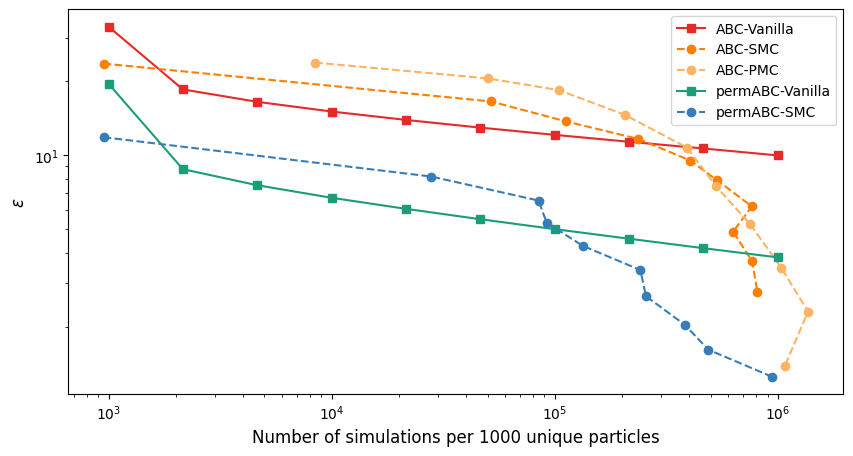
Yesterday a arXival by Antoine Luciano, Charly Andral (both PhD students, now or then, at Paris Dauphine), Robin Ryder (formerly at Paris Dauphine, now at Imperial College London) and myself got posted. It proposes to improve the scalability of ABC methods by exploiting the (full or partial) exchangeability in the data by implementing permutation-based matching between observed and simulated samples. This significantly improves computational efficiency, which is further enhanced by sequential strategies such as over-sampling, which facilitates early-stage acceptance by temporarily increasing the number of simulated compartments, and under-matching, which relaxes the acceptance condition by matching only subsets of the data. The map of France appears in connection with an application of the method to estimating SIR parameters, department by department. (It is also reminding me of the cover of Markov Chain Monte Carlo methods in practice, the 1996 contributed book edited by Wally Gilks, Sylvia Richardson and David Spiegelhalter.)

the new PhD timeline

Posted in Books, Kids, University life with tags , , , , , , , , , , , , , , , , on May 4, 2025 by xi'an

why don’t you wear a suit?!

Posted in Books, Kids, pictures, Travel, University life with tags , , , , , , , , , , , , , , , , , , , , , , on March 4, 2025 by xi'an