Access Modifiers in Python
Access Modifiers are used by various programming languages like C++, Java, Python, etc., that follow the object-oriented paradigm. Access Modifiers are used to modify the access of the class member variables and methods from outside the class. Encapsulation is a principle of OOPs that protects the internal data of the class with the help of access modifiers such as Public, Protected, and Private.
In the following tutorial, we will learn about the Access Modifiers and their types. We will also discuss how to use them in the Python programming language.
Types of Access Modifiers
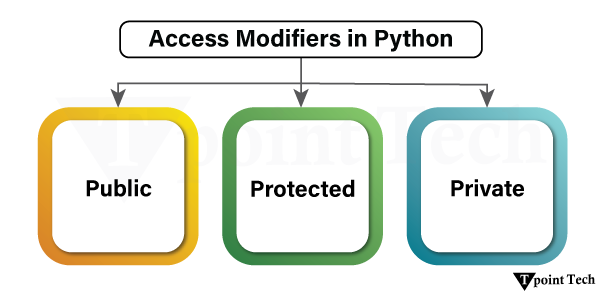
Python offers three levels of access modifiers:
- Public (name): The members of the public access modifier can be accessed anywhere.
- Protected (_name): The members of the protected access modifier should be accessed only within the class and its subclasses. It is not intended for public use.
- Private (__name): The members of the private access modifier can be accessed only within the class (using name mangling).
Let us discuss these modifiers with the help of examples.
1. Public Access Modifier
The member variables and methods of the public access modifier are accessible from anywhere in the program. By default, all the attributes and methods in Python classes are public unless explicitly modified.
Public Access Modifier Example
Let us consider the following example of the public access modifier:
Example
Output:
Lion
Den
Lion lives in Den
Explanation:
In the above snippet of code, we have defined a class called Animal. The Animal class has two member variables, name and home and a method display_data() which prints the member variable values. Both of these variables are public as no specific keyword (or convention) is assigned to them. We then instantiated the class as wild_animal. We then printed the values of the public attributes and called the method to print the details of the created object.
Key Features of Public Access Modifier
Several key features of Public Access Modifier in Python are as follows:
- Members of the public can access the public access modifier from anywhere.
- Both attributes and methods can be modified from outside the class.
2. Protected Access Modifier
The member variables and methods of the protected access modifier are only accessible within the class where it is declared and their subclasses. In order to implement the protected field or method, the developer follows a particular naming convention, mostly by adding a prefix to the variable or function name.
Protected members are indicated by a single underscore (_variable). Note that the Python interpreter does not enforce this restriction like other languages; it is only designated for programmers as they would try to access it using a plain name instead of calling it with the help of the respective prefix.
Protected Access Modifier Example
Let us consider the following example of a protected access modifier.
Example
Output:
Lion
Den
Lion lives in Den
Explanation:
In the above snippet of code, we have defined a class called Animal. The Animal class has two member variables, _name and _home and a protected method _display_data() which prints the member variable values. Both of these variables are protected, denoted by a single underscore (_) as a prefix. We then instantiated the class as wild_animal. We then printed the values of the protected attributes and called the method to print the details of the created object.
Note: It is possible to access the protected members; however, it is discouraged.
Key Features of Protected Access Modifier
Several key features of Protected Access Modifier in Python are as follows:- Single underscore (_) is just a convention. It does not prevent access from outside.
- The variable can still be accessed and modified from outside the class.
- Protected members are often used when designing parent-child class relationships (inheritance), where they can be accessed in a subclass.
3. Private Access Modifier
The member variables and methods of the private access modifier are only accessible within the class. Private access modifier is the most secure access modifier. Private members are indicated by double underscores (__) before the variable or method name. Python performs name mangling, meaning that it changes the name of the variable internally to prevent accidental access.
Private Access Modifier Example
Let us consider the following example of the private access modifier.
Example
Explanation:
In the above snippet of code, we have defined a class called Animal. The Animal class has two member variables, __name and __home and a private method __display_data() which prints the member variable values. Both of these variables are protected, denoted by a double underscore (__) as a prefix. We then instantiated the class as wild_animal. We then tried to print the values of the private attributes and called the method to print the details of the created object. However, doing this will raise an error.
Accessing Private Members using Name Mangling
We cannot directly access or modify the private attributes from outside the class in Python. The Name Mangling done by Python makes it difficult, but not impossible. It is strongly discouraged to do so, as it breaks encapsulation.
In name mangling, we can rename the private members of the class from __name to _ClassName__name. Let us consider the following example illustrating the use of name mangling in accessing the private members of the class.
Example
Output:
Lion
Den
Lion lives in Den
Explanation:
In the above snippet of code, we have defined a class called Animal. The Animal class has two member variables, __name and __home and a private method __display_data() which prints the member variable values. Both of these variables are protected, denoted by a double underscore (__) as a prefix. We then instantiated the class as wild_animal.
We then used the name mangling where we have renamed the private attributes from __name and __home to _Animal__name and _Animal__home, respectively and printed their values for the users. We then called the method again using the name mangling to print the details of the created object. In this case, the values are printed successfully.
Key Features of Private Access Modifier
Several key features of Private Access Modifier in Python are as follows- The members of the Private access modifier cannot be accessed directly from outside the class.
- Name mangling grants users access to private members; however, it should be avoided unless necessary.
- This ensures better encapsulation and prevents accidental modification of variables.
Comparison between the Different Access Modifiers in Python
We will now look at the tabular comparison between public, protected and private access modifiers in Python.
| Access Modifier | Syntax | Accessibility | Example | Key Features |
|---|---|---|---|---|
| Public | varName | Public members are accessible from anywhere (inside and outside the class) | self.varName |
|
| Protected | _varName | Protected members are accessible within the class and subclass (It does not enforce this restriction; it simply provides a convention) | self._varName |
|
| Private | __varName | Private members are accessible only within the class (We can also apply name mangling to access the members) | self.__varName |
|
Conclusion
In the above tutorial, we have learned the basics of Object-Oriented Programming. We have also discussed the different principles of OOP. We then understood the concept of encapsulation in detail. We have learned that encapsulation, being a fundamental principle of OOP, helps protect the data and ensure controlled access to attributes and methods of the class. Python offers three access modifiers to implement encapsulation in programs. These access modifiers (public, protected, and private) allow programmers to manage data visibility and security.
Subscribe to Tpoint Tech
We request you to subscribe our newsletter for upcoming updates.

We deliver comprehensive tutorials, interview question-answers, MCQs, study materials on leading programming languages and web technologies like Data Science, MEAN/MERN full stack development, Python, Java, C++, C, HTML, React, Angular, PHP and much more to support your learning and career growth.
Contact info
G-13, 2nd Floor, Sec-3, Noida, UP, 201301, India
Follow us


