Eastern Air Lines’ Lockheed L-749A-79 Constellation NX101A (Ed Coates Collection)
5 February 1949: An Eastern Air Lines Lockheed L-749A Constellation, serial number 2610, N115A, flew from Los Angeles to LaGuardia Airport, New York, in 6 hours, 17 minutes, 39-2/5 seconds, setting a new West-to-East transcontinental speed record for transport aircraft.
Captain Fred E. Davis was in command, with First Officer M.L. Jordan and Flight Engineer E. L. Graham, Eastern’s Chief Flight Engineer. The flight was timed by officials of the National Aeronautic Association.
The Constellation took off from Lockheed Air Terminal at Burbank, California, at 7:51:21 a.m., Pacific Standard Time (15:51:21 UTC), and passed over La Guardia at 5:08:02 p.m., Eastern Standard Time (22:08:02 UTC). The Constellation averaged 392 miles per hour over the 2,455 mile flight.
The following day, 6 February, Eddie Rickenbacker, Eastern Air Lines’ president and general manager, announced that that the company had ordered an additional seven Lockheed Constellations at a cost of more that $1,000,000 each, with the first one to be delivered to Miami, Florida, the following week.
The Lockheed L-749A Constellation was a longer-range development of the L-649, with fuel capacity increased by 1,130 gallons (4,278 liters). It was operated by a flight crew of four, with two to four flight attendants. It could carry up to 81 passengers.
The airplane was 97 feet, 4 inches (29.667 meters) long with a wingspan of 123 feet (37.49 meters) and an overall height of 22 feet, 5 inches (6.833 meters). It had an empty weight of 56,590 pounds (25,668 kilograms) and maximum takeoff weight of 107,000 pounds (48,534.4 kilograms).
Three view illustration of the Lockheed L-749 Constellation.
The L-749A was powered by four 3,347.662-cubic-inch-displacement (54.858 liter) air-cooled, supercharged, fuel-injected, Wright Aeronautical Division Cyclone 18 745C18BD1 (R-3350-75), two-row 18-cylinder radial engines with a compression ratio of 6.5:1. This engine, also known as the Duplex-Cyclone, featured “jet stacks” which converted the piston engines’ exhaust to usable jet thrust, adding about 15 miles per hour (24 kilometers per hour) to the airplane’s speed. They had a normal power rating of 2,100 horsepower at 2,400 r.p.m., and 2,500 horsepower at 2,800 r.p.m. for takeoff, (five minute limit). The engines drove 15 foot, 2 inch (4.623 meter) diameter, three-bladed Hamilton Standard Hydromatic 43E60 constant-speed propellers through a 0.4375:1 gear reduction. The 745C18BD1 was 6 feet, 6.52 inches (1.994 meters) long, 4 feet, 7.62 inches (1.413 meters) in diameter and weighed 2,915 pounds (1,322 kilograms).
The L-749 had a cruise speed of 345 miles per hour (555.22 kilometers per hour) and a range of 4,995 miles (8,038.7 kilometers). Its service ceiling was 24,100 feet (7,346 meters).
N115A was leased to California Hawaiian Airlines, 1961–1962. It was purchased by Rutas Internacionales Peruanas SA (RIPSA) in 1966 and re-registered OB-R-833. In 1968 it was withdrawn from service and was scrapped in 1981. Photographs of the derelict record-setting airplane parked at Lima, Peru, in 1980, are just to sad to publish here.
An Eastern Air Lines Lockheed L-749 Constellation, N108A. (LIFE Magazine)
Colonel William H. Councill, U.S. Army Air Forces, in the cockpit of his record-setting Lockheed P-80A-1-LO Shooting Star. (San Diego Air & Space Museum Archive)
26 January 1946: Colonel William Haldane Councill, U.S. Army Air Forces, a test pilot at the Flight Test Division, Wright Field, Ohio, made a record-breaking flight from Daugherty Field (Long Beach Airport), California, to overhead LaGuardia Airport, New York, in 4 hours, 13 minutes, 26 seconds. He was piloting a Lockheed P-80A-1-LO Shooting Star, serial number 44-85123. Colonel Councill flew as high as 41,000 feet (12,497 meters), but stayed at 35,000 feet (10,668 meters) for most of the flight. This flight set a new transcontinental speed record for the 2,457 miles (3,954 kilometers), averaging 584.82 miles per hour (941.18 kilometers per hour).
Colonel William Haldane Councill with Lockheed P-80A-1-LO Shooting Star 44-84999.John Paul Virgil Heinmuller (Smithsonian Institution)
The National Aeronautic Association representative, John P. V. Heinmuller, was the official timer. (Mr. Heinmuller was the Chief Timer of both the N.A.A. and the Fédération Aéronautique Internationale. He was president of the Longines-Wittnauer Watch Co., inc. He had also timed Lindbergh’s transatlantic flight in 1927. Mr. Heinmuller was the author of Man’s Fight to Fly: Famous World-Record Flights and a Chronology of Aviation, 1944).
Colonel Councill was accompanied by two other P-80s flown by Captain John S. Babel and Captain Martin I. Smith. This was the longest non-stop flight by a jet aircraft up to that time.
Colonel Councill’s P-80A had been modified with the installation of a 100-gallon (379 liters) fuel tank in the nose in place of the standard armament of six machine guns. Along with 300-gallon (1,135 liters) wing tip tanks, the Shooting Star’s maximum fuel load had been increased to 1,165 gallons (4,410 liters).¹
The P-80s flown by Captains Babel and Smith also had the nose fuel tank installed, but carried 150-gallon (569 liters) wing tip tanks. They had to stop at Topeka, Kansas, to refuel. Ground crews met them with four fuel trucks, and they were airborne in 4 minutes and 6 minutes, respectively.
Colonel William H. Councill, U.S. Air Force, waves from the cockpit of his record-setting Lockheed P-80A-1-LO Shooting Star, 44-85123. (AP Wirephoto, Photograph 2012.201.B0243.0237, Oklahoma Historical Society)
William Haldane Councill was born 5 October 1911 at Bellevue, Pennsylvania. He was the second of four children of William Mansfield Councill, a manager for a fireproofing company, and Bertha Etta Wing Councill. He attended Perry High School, where he was a member of the Aero Club.
William H. Councill. (The Thistle of 1933)
Bill Councill studied at the Carnegie Institute of Technology, Pittsburgh, Pennsylvania. He was a member of the Reserve Officers Training Corps (R.O.T.C.), and the Delta Upsilon (ΔΥ) fraternity. He was also a member of the Scabbard and Blade, and co-chairman of the Military Ball. Councill graduated in 1933 with the degree of Bachelor of Science in Mechanical Engineering (B.S.M.E.).
William H. Councill was commissioned as a second lieutenant, Engineer Reserve, 1 June 1933. He was appointed a flying cadet and trained as a pilot, 1 October 1933 to 14 October 1935. He then received a commission as a second lieutenant, Air Reserve.
Lieutenant Councill married Miss Lillie Louise Slay at Wahiawa Heights, Honolulu, Territory of Hawaii, 18 April 1936. They would have one daughter, Frances, born in 1943.
On 1 October 1938, Councill’s reserve commission was converted to second lieutenant, Air Corps, United States Army. Councill was promoted to first lieutenant, 1 October 1941.
During this time William Councill held a parallel commission in the Army of the United States. He was promoted to first lieutenant, A.U.S., 9 September 1940, and captain, A.U.S., 1 February 1942. On 1 March 1942, he was promoted to the rank of major, A.U.S. (A.C.), and to lieutenant colonel, 19 December 1942. On 3 July 1945, Councill advanced to the rank of colonel, A.U.S.
Major William Haldane Councill with his younger brother, 2nd Lieutenant David Elihu Councill, circa 1942. David Councill was killed when his B-24 bomber crashed in the Atlas Mountains of Morocco, December 8, 1943. (Frances Councill/Pittsburgh Post-Gazette)
Colonel Councill was rated as a command pilot. During World War II, he flew 130 combat missions with the the Lockheed P-38 Lightning .Thirteenth Air Force in the southwest Pacific area. He is credited with shooting down three enemy aircraft, and was awarded the Distinguished Flying Cross for his actions in an air battle over the Solomons, 15 January 1943.
At 10:54 a.m., 5 April 1954, Colonel Councill took off from the Republic Aviation Company plant at Farmingdale, New York, in a Lockheed T-33A Shooting Star, en route to Langley Field, Virginia. He never arrived. An extensive search, other than locating a single wing tank, was unsuccessful. It was presumed that Councill went down in the Atlantic Ocean.
According to his commanding officer, Major General Earl W. Barnes,
“. . . He was a most capable, dependable and responsible officer who was conscientiously devoted to his tasks. His opinions on military matters were highly regarded by his superior officers. His pleasant personality, genial manner, and dry wit endeared him to the hearts of the many friends he had won during approximately twenty-one years of service in the United States Air Force. He was greatly beloved by those with whom he associated. . . I feel that our Country and the Air Force have lost an irreplaceable asset and a great leader.”
—Wing Family Annals, Wing Family of America, Inc., Des Moines, Iowa. Vol. 54, No. 1, at Pages 7 and 8
Clarence L. “Kelly” Johnson with a scale model of a Lockheed P-80A-1-LO Shooting Star. Johnson’s “Skunk Works” also designed the F-104 Starfighter, U-2, A-12 Oxcart and SR-71A Blackbird. (Lockheed Martin Aeronautical Company, AD-8317)
The Lockheed P-80-1-LO was the United States’ first operational jet fighter. It was a single-seat, single engine airplane, designed by a team of engineers led by Clarence L. (“Kelly”) Johnson. The prototype XP-80A, 44-83020, nicknamed Lulu-Belle, was first flown by test pilot Tony LeVier at Muroc Army Air Field (now known as Edwards Air Force Base) 8 January 1944.
The P-80A was a day fighter, and was not equipped for night or all-weather combat operations. The P-80A was 34 feet, 6 inches (10.516 meters) long with a wingspan of 38 feet, 10.5037 inches (11.84919 meters) ² and overall height of 11 feet, 4 inches (3.454 meters).
The leading edges of the P-80A’s wings were swept aft 9° 18′ 33″. They had an angle of incidence of +1° at the root and -1° 30′ twist. There was 3° 50′ dihedral. The total wing area was 237.70 square feet (22.083 square meters).
The fighter had an empty weight of 7,920 pounds (3,592 kilograms) and a gross weight of 11,700 pounds (5,307 kilograms). The maximum takeoff weight was 14,000 pounds (6,350 kilograms).
Early production P-80As were powered by either an Allison J33-A-9 or a General Electric J33-GE-11 turbojet engine. The J33 was a licensed version of the Rolls-Royce Derwent. It was a single-shaft turbojet with a 1-stage centrifugal compressor section and a 1-stage axial-flow turbine. The -9 and -11 engines were rated at 3,825 pounds of thrust (17.014 kilonewtons). The J33s were 8 feet, 6.9 inches (2.614 meters) long, 4 feet, 2.5 inches (1.283 meters) in diameter and weighed 1,775 pounds (805 kilograms).
Colonel Councill’s record-setting P-80A-1-LO 44-85123, in squadron markings at the National Air Races, Cleveland, Ohio, September 1946. (Unattributed)
The P-80A had a cruising speed of 445 miles per hour (716 kilometers per hour) at 20,000 feet (6,096 meters). Its maximum speed was 548 miles per hour (882 kilometers per hour) at 2,700 feet (823 meters) and and 501 miles per hour (806 kilometers per hour) at 34,700 feet (10,577 meters). The service ceiling was 45,000 feet (13,716 meters).
The P-80A Shooting Star was armed with six air-cooled Browning AN-M2 .50-caliber aircraft machine guns mounted in the nose.
Several hundred of the early production P-80 Shooting stars had all of their surface seams filled, and the airplanes were primed and painted. Although this process added 60 pounds (27.2 kilograms) to the empty weight, the decrease in drag allowed a 10 mile per hour (16 kilometers per hour) increase in top speed. The painted surface was difficult to maintain in the field and the process was discontinued.
Lieutenant Howard A. Johnson, USAAF, with Lockheed P-80A-1-LO Shooting Star 44-85123. (FAI)
On 3 June 1946, Lockheed P-80A-1-LO Shooting Star 44-85123, flown by Lieutenant Henry A. Johnson, set a Fédération Aéronautique Internationale (FAI) World Record for Speed Over a Closed Circuit of 1,000 Kilometers with an average speed of 745.08 kilometers per hour (462.97 miles per hour).³
Lockheed P-80A-1-LO 44-85123, photographed 22 June 1946 at the General Electric Air Research Laboratory, Schenectady, New York, by Richard Lockett. (Brian Lockett, Air-and-Space.com)
On 2 September 1946, Major Gustav Lindquist won the Thompson Trophy Race, J Division, at the National Air Races, Cleveland, Ohio, 1946, with the same airplane, averaging 515.853 miles per hour (830.185 kilometers per hour) over a 180-kilometer (111.85-mile) course.
Today, 44-85123 is in the collection of the Air Force Flight Test Museum, Edwards Air Force Base.
Lockheed test pilots Anthony W. (“Tony”) LeVier and David L. Ferguson stand in front of P-80A Shooting Star 44-85123 and an F-117A Nighthawk at the Lockheed Skunk Works, Palmdale, California, 17 June 1993. (Denny Lombard, Lockheed Martin)
¹ Thanks to Jeffrey P. Rhodes ofLockheed Martin for additional information on Colonel Councill’s Lockheed P-80A Shooting Star.
² Wing span with rounded wing tips. P-80As with squared (“clipped”) tips had a wing span of 37 feet, 7.5037 inches (11.46819 meters).
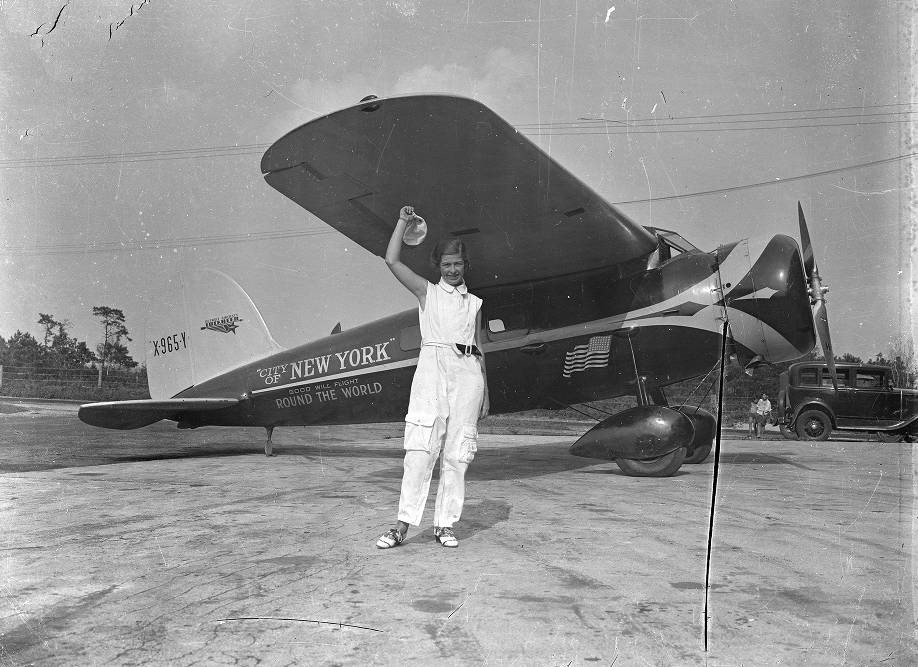
Amelia Earhart with her Lockheed Vega 5C, NR965Y, at Wheeler Field, Oahu, Hawaii, 11 January 1935. (Getty Images/Underwood Archives)
11 January 1935: At 4:40 p.m., local time, Amelia Earhart departed Wheeler Field on the island of Oahu, Territory of Hawaii, for Oakland Municipal Airport at Oakland, California, in her Lockheed Vega 5C Special, NR965Y. She arrived 18 hours, 15 minutes later. Earhart was the first person to fly solo from Hawaii to the Mainland.
(This Vega was not the same aircraft which she used to fly the Atlantic, Vega 5B NR7952, and which is on display at the Smithsonian Institution National Air and Space Museum.)
Earhart’s Lockheed Vega had been transported from California to Hawaii aboard the Matson liner SS Lurline. It arrived in Honolulu on 27 December 1934, accompanied by Earhrt’s advisor, Paul Mantz, and a mechanic, Ernest Eugene Tissot.
Amelia Earhart’s Lockheed Model 5C Vega, NC965Y. (Unattributed)
Built by the Lockheed Aircraft Company, the Model 5 Vega is a single-engine high-wing monoplane designed by John Knudsen (“Jack”) Northrop and Gerrard Vultee. It was a very state-of-the-art aircraft for its time. It used a streamlined monocoque fuselage made of spiral strips of vertical grain spruce pressed into concrete molds and held together with glue. The wing and tail surfaces were fully cantilevered, requiring no bracing wires or struts to support them.
The techniques used to build the Vega were very influential in aircraft design. It also began Lockheed’s tradition of naming its airplanes after stars or other astronomical objects.
Amelia Earhart’s Lockheed Vega 5C, NR965Y, being run up at Wheeler Field, 11 January 1935. Amelia is sitting on the running board of the Standard Oil truck parked in front of the hangar. (Hawaii Aviation)
Lockheed Model 5C Vega serial number 171 was completed in March 1931, painted red with silver trim, and registered X965Y. The airplane had been ordered by John Henry Mears. Mears did not take delivery of the new airplane and it was then sold to Elinor Smith. It was resold twice before being purchased by Amelia Earhart in December 1934.
Elinor Patricia Ward Smith poses with the Lockheed 5C Vega, then marked X965Y.
The Lockheed Model 5C Vega is 27 feet, 6 inches (8.382 meters) long with a wingspan of 41 feet (12.497 meters) and overall height of 8 feet, 2 inches (2.489 meters). Its empty weight is 2,595 pounds (1,177 kilograms) and gross weight is 4,500 pounds (2,041 kilograms).
Earhart’s Vega 5C was powered by an air-cooled, supercharged, 1,343.804-cubic-inch-displacement (22.021 liter) Pratt & Whitney Wasp C, serial number 2849, a single-row, nine cylinder, direct-drive radial engine with a compression ratio of 5.25:1. The Wasp C was rated at 420 horsepower at 2,000 r.p.m. at Sea Level, burning 58-octane gasoline. It was 3 feet, 6.63 inches (1.083 meters) long with a diameter of 4 feet, 3.44 inches (1.307 meters) and weighed 745 pounds (338 kilograms).
The standard Model 5C had a cruise speed of 165 miles per hour (266 kilometers per hour) and maximum speed of 185 miles per hour (298 kilometers per hour). The service ceiling was 15,000 feet (4,570 meters) and range in standard configuration was 725 miles (1,167 kilometers).
“Before parting with her ‘little red bus’ (as she affectionately called it), Amelia removed the upgraded Wasp engine and substituted an obsolete model; she wanted her well-tried engine for the new airplane, also a Lockheed Vega. It was a later model, in which Elinor Smith had been preparing to be the first woman to fly the Atlantic, a plan abandoned after Amelia successfully took that record. It was originally built to exacting specifications for Henry Mears of New York, who had a round-the-world flight in mind. Called the Vega, Hi-speed Special, it carried the registration 965Y and was equipped with special fuel tanks, radio, and streamlined landing gear and cowling. These latter appointments, together with a Hamilton Standard Controllable-Pitch Propeller, gave the plane a speed of 200 mph and Amelia had her eye on further records as well as her constant journeys across the continent.”
— The Sound of Wings by Mary S. Lovell, St. Martin’s Press, New York, 1989, Chapter 17 at Page 206.
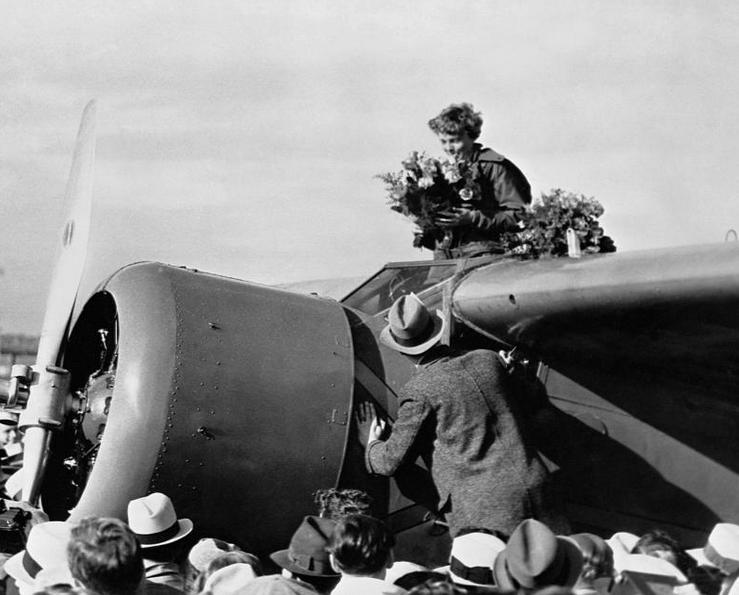
Crowds of spectators greet Amelia Earhart on her arrival at Oakland, California, from Hawaii, 12 January 1935. (Associated Press)
“. . . At Oakland Airport a good ten thousand had been waiting for several hours, yet when she came in she surprised them. They had been craning their necks looking for a lone aircraft flying high and obviously seeking a place to land. But Amelia did not even circle the field; she brought the Vega in straight as an arrow at a scant two hundred feet, landing at 1:31 p.m. Pacific time. The crowd set up a roar, broke through the police lines, and could be halted only when dangerously near the still-whirling propeller. From the road circling the airport, a chorus of automobile horns honked happily.”
— Amelia: The Centennial Biography of an Aviation Pioneer by Donald M. Goldstein and Katherine V. Dillon, Brassey’s, Washington and London, 1997, Chapter 13 at Page 132.
Amelia Earhart stands in the cockpit of her Lockheed Model 5C Vega, NR965Y, on arrival at Oakland Municipal Airport, 12 January 1935. (National Geographic/Corbis)
Amelia Earhart sold the Vega in 1936. It appeared in “Wings in the Dark,” (Paramount Pictures, 1935), and “Border Flight,” (Paramount Pictures, 1936) which starred Frances Farmer, John Howard and Robert Cummings. It changed hands twice more before being destroyed in a hangar fire 26 August 1943.
Lockheed Model 5C Vega NR965Y, on the set of a motion picture production, “Border Flight,” (Paramount, 1936). The woman to left of center is Frances Farmer. Roscoe Karns, who performed in both movies, is at center. (San Diego Air and Space Museum Archive, AL-73C Luqueer Album Image _00289)
Bell-Atlanta B-29B-60-BA Superfortress 44-84061, the Pacusan Dreamboat. (U.S. Air Force)
11 December 1945: Three days after Lieutenant Colonel Henry E. Warden and Captain Glen W. Edwards set a transcontinental speed record flying a prototype Douglas XB-42 from Long Beach, California, to Washington, D.C., in 5 hours, 17 minutes, Colonel Clarence S. Irvine and the crew of the B-29 Pacusan Dreamboat also set a record, flying from Burbank, California to overhead Floyd Bennett Field, New York, in 5 hours, 27 minutes, 8 seconds. The average speed for the 2,464-mile flight was 450.38 miles per hour (724.82 kilometers per hour).
Lieutenant General Clarence S. Irvine, U.S. Air Force
Irvine was Deputy Chief of Staff, Pacific Air Command, 1944–1947. He flew the Pacusan Dreamboat on several record-setting flights, including Guam to Washington, D.C., and Honolulu, Hawaii to Cairo, Egypt. He rose to the rank of lieutenant general in the United States Air Force, and served as Deputy Chief of Staff for Materiel.
Pacusan Dreamboat was a Bell Aircraft Corporation B-29B-60-BA Superfortress, built at Marietta, Georgia. The B-29B was a lightweight variant of the B-29, intended for operation at lower altitudes. It did not have the four power gun turrets and their .50-caliber machine guns. A radar-directed 20 mm cannon and two .50-caliber machine guns in the tail were the only defensive weapons. Much of the standard armor plate was also deleted. Pacusan Dreamboat was further lightened. The tail guns were removed and the tail reshaped.
The B-29B was equipped with four air-cooled, fuel-injected Wright R-3350-CA-2 Duplex Cyclone two-row 18 cylinder radial engines and specially-designed propellers. The engine nacelles were modified for improved cooling.
The Superfortress had been lightened to an empty weight of 66,000 pounds (29,937 kilograms). A standard B-29B weighed 69,000 pounds (31,298 kilograms) empty and 137,000 pounds (62,142 kilograms) fully loaded. Additional fuel tanks installed on the Dreamboat were able to carry 10,000 gallons (37,854 liters) of gasoline.
Colonel Clarence S. Irvine (standing, left) with the crew of Pacusan Dreamboat: W.J. Benett, G.F. Broughton, Dock West, W.S. O’Hara, F.S. O’Leary, K.L. Royer, F.J. Shannon, J.A. Shinnault, G.R. Stanley. (FAI)

 5 February 1949: An Eastern Air Lines Lockheed L-749A Constellation, serial number 2610, N115A, flew from Los Angeles to LaGuardia Airport, New York, in 6 hours, 17 minutes, 39-2/5 seconds, setting a new West-to-East transcontinental speed record for transport aircraft.
 The L-749A was powered by four 3,347.662-cubic-inch-displacement (54.858 liter) air-cooled, supercharged, fuel-injected, Wright Aeronautical Division Cyclone 18 745C18BD1 (R-3350-75), two-row 18-cylinder radial engines with a compression ratio of 6.5:1. This engine, also known as the Duplex-Cyclone, featured “jet stacks” which converted the piston engines’ exhaust to usable jet thrust, adding about 15 miles per hour (24 kilometers per hour) to the airplane’s speed. They had a normal power rating of 2,100 horsepower at 2,400 r.p.m., and 2,500 horsepower at 2,800 r.p.m. for takeoff, (five minute limit). The engines drove 15 foot, 2 inch (4.623 meter) diameter, three-bladed Hamilton Standard Hydromatic 43E60 constant-speed propellers through a 0.4375:1 gear reduction. The 745C18BD1 was 6 feet, 6.52 inches (1.994 meters) long, 4 feet, 7.62 inches (1.413 meters) in diameter and weighed 2,915 pounds (1,322 kilograms).