Tag Archives: Airliner

10 February 1960

Delta Air Lines’ Convair 880-22-M, N8802E, Delta Queen, retracting its landing gear on takeoff from Atlanta, 15 April 1972. (RuthAS)

10 February 1960: Delta Air Lines’ Superintendant of Flight Operations, Captain Thomas Prioleau Ball, Jr., made the delivery flight of Delta’s first Convair 880 jet airliner, Ship 902, named Delta Queen, FAA registration N8802E, from San Diego, California, to Miami, Florida. Other members of the flight crew were Captain James H. Longino, co-pilot, and First Officer Richard E. Tidwell, flight engineer.

Newspapers reported that Delta Queen‘s wheels started rolling on the runway at San Diego’s Lindbergh Field (SAN) at 10:11:46 a.m., Pacific Standard Time (18:11:46 UTC). The airplane took of and climbed to its cross-country cruising altitude of 33,000 feet (10,058 meters). The Convair 880 landed at Miami International Airport (MIA) at 4:42:08 p.m., Eastern Standard Time (21:42:08 UTC). The official flight time was 3 hours, 31 minutes, 54 seconds, for an average speed of 641.77 miles per hour (1,032.83 kilometers per hour) over the 2,266 mile (3,647 kilometers) route. This was a new United States National Record for Speed Over a Commercial Airline Route. The 880 cut 27 minutes, 1 second, off the time of an Eastern Air Lines Douglas DC-8B over the same route, 4 January 1960.

Screen Shot 2015-02-11 at 10.40.18Delta Queen was placed in scheduled service 15 May 1960.

The Convair 880 was a four-engine, swept-wing turbojet-powered commercial airliner. It was operated by a flight crew of three and could carry up to 110 passengers. The Convair 880-22-M was a modified version of the standard 880-22, intended for shorter range operations. It had leading-edge slats, a higher maximum takeoff weight, stronger landing gear, a tail skid and an improved anti-lock braking system. The Convair 880 was so-named because its design top speed was 880 feet per second (600 miles per hour, or 966 kilometers per hour), faster than its Boeing 707 or Douglas DC-8 rivals.

Miss San Diego, Leona McCurdy, christens Convair 880 Delta Queen with river water collected from around the Delta Air Lines system. (Delta)
Miss San Diego, Leona McCurdy, christens Delta Queen with water collected from rivers around the Delta Air Lines system. (Delta Air Lines)

The airplane was 129 feet, 4 inches (39.421 meters) long with a wingspan of 120 feet (36.576 meters) and overall height of 36 feet, 3.75 inches (11.068 meters). The 880 had an empty weight of 94,000 pounds (42,638 kilograms) and maximum takeoff weight was 191,000 pounds (86,636 kilograms).

The Convair 880-22-M was powered by four General Electric CJ805-3B turbojet engines. The CJ805-3B is a single-shaft, axial-flow turbojet with a 17-stage compressor section and 3-stage turbine, based on the military J79. The engine has a maximum continuous power rating of 9,800 pounds of thrust (43.593 kilonewtons) at Sea Level, and 11,650 pounds (51.822 kilonewtons) for Takeoff. The CJ805-3B is 9 feet, 2.4 inches (2.804 meters) long, 3 feet, 3.9 inches (1.013 meters) wide and 4 feet, 0.8 inches (1.240 meters) high. It weighs 2,875 pounds (1,304 kilograms).

The 880-22-M had a cruise speed of 0.82 Mach (556 miles per hour/895 kilometers per hour) at 30,000 feet (9,144 meters). The service ceiling was 41,000 feet (12,497 meters). Maximum range was 5,056 miles (8,137 kilometers).

The Convair Division of General Dynamics built 65 Convair 880 airliners at San Diego, California, between 1959 and 1962. Delta Air Lines retired its last one in January 1974.

Delta Queen, Convair 880-22-M N8802E. (Delta Air Lines)
Captain Thomas P. Ball

Thomas Prioleau (“Pre”) Ball, Jr., was a legendary airline captain. He was born 6 September 1906 at Norfolk, Virginia, the second son of Thomas Prioleau Ball, a bookkeeper, and Agnes Mae Bell Ball. He grew up in Florida. Ball learned to fly in 1928, soloing in a World War I Curtiss “Jenny” biplane.

Thomas P. Ball, Jr., married Miss Theresa Augusta Daniel at the Church of the Good Shepherd in Jacksonville, Florida, 27 December 1930. They would have to sons, Thomas Prioleaux Ball III and Espy Daniel Ball.

Ball worked as a station manager for Delta Air Lines at Charleston, South Carolina, and was hired as a copilot by the airline in 1936.

Soon after the United States entered World War II, Ball was commissioned as a second lieutenant in the U.S. Army Air Corps. By the end of the war, he had risen to the rank of colonel, serving as the Chief of the Prevention and Investigation Division of the Army’s Office of Flying Safety.

After the War, Ball returned to Delta Air Lines as a captain and soon became the chief pilot, dedicated to the meticulous training of the company’s pilots. In 1969, Ball became Delta’s Vice President of Flight Operations. On 25 May 1970, Ball was aboard Delta Flight 199, a Convair 880 under the command of Captain Harris B. Wynn, when it was hijacked to Cuba.

Four U.S. National Speed Records which were set by Captain Ball remain current. In addition to the record set with the Convair 880, on 6 November 1948, Ball flew a Delta Air Lines Douglas DC-6 from Los Angeles, California, to Charleston, South Carolina, in 6 hours, 24 minutes, 32 seconds, at an average speed of 344.19 miles per hour (553.92 kilometers per hour). On 18 March 1954, he flew a Douglas DC-7 from Los Angeles to Jacksonville, Florida, in 05:29:33, averaging 392.25 miles per hour (631.27 kilometers per hour). Finally, on 24 February 1962, Captain Ball flew a Douglas DC-8 from Miami, Florida, to Atlanta, Georgia, in 01:28:11, for an average of 406.1 miles per hour (653.56 kilometers per hour).

After making the delivery flight of the company’s first Boeing 747, Ball grounded himself when he noticed a deterioration in his eyesight. Thomas Prioleau Ball retired from Delta in 1971. He passed away in 2006 at the age of 99 years.

Convair 880 N55NW in Bahama Air livery, circa 1976. (Captain Charles Lindberg)
The world record-setting Convair 880-22-M, c/n 7, now registered N55NW, in Bahamas World livery, circa 1976. (Captain Charles Lindberg)

Convair 880-22-M N8802E, Delta Queen, (c/n 7) remained in service with Delta Air Lines until 1973 when it was sold to Boeing as part of exchange for an order of new Boeing 727-200 airliners. It was then sold to Transexecutive Aviation in 1974 and reregistered as N55NW. In 1976, the 880 flew as a charter airliner for Bahama World. It was then converted to a cargo freighter operating in the Caribbean. In 1979 the Convair was transferred to Groth Air Service, Inc., Castalia, Iowa, and assigned a new FAA registration, N880SR. The record-setting airliner was damaged beyond repair in a fire at Licenciado Benito Juarez International Airport, Mexico City, in May 1983.

Converted Convair 880 N880SR. (Captain Charles Lindberg)
Former Delta Air Lines Convair 880, N880SR. (Captain Charles Lindberg)

© 2019, Bryan R. Swopes

9 February 1969

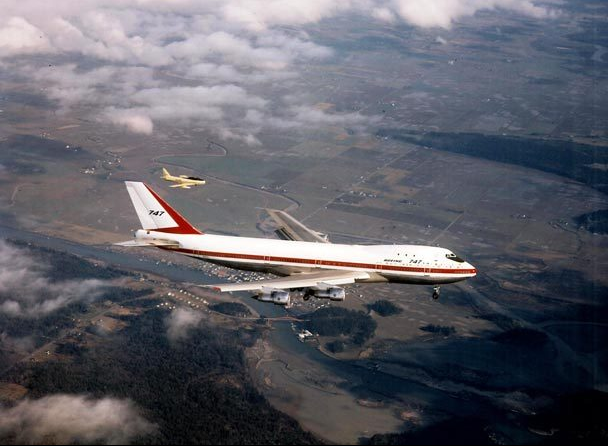
The prototype Boeing 747, N7470, City of Everett, takes off at Paine Field, 9 February 1969. (Boeing/The Museum of Flight)
The prototype Boeing 747, RA001, City of Everett, takes off at Paine Field, 9 February 1969. (The Museum of Flight)

9 February 1969: At 11:34 a.m., Boeing Chief Test Pilot Jack Wadell, with Engineering Test Pilots Brien Singleton Wygle, co-pilot, and Jesse Arthur Wallick, flight engineer, took off from Paine Field, Everett, Washington, aboard RA001, the prototype Boeing 747-121, and made a 1 hour, 15 minute test flight. The ship was named City of Everett after the home of the factory where it was built. It was originally registered N7470.

Boeing 747 RA001 on takeoff roll at Paine Field, 9 February 1969. (Boeing)
The test pilots who flew the first Boeing 747: Brien Wygle, Jack Waddell and Jess Wallick. (Seattle Times)
The test pilots who flew the first Boeing 747:  Left to right, Brien S. Wygle, Jack Waddell and Jesse A. Wallick. (Seattle Times)

The 747 was the first “wide body” airliner and was called a “jumbo jet.” It is one of the most widely used airliners and air freighters in service world-wide. The latest version is the 747-8, the “Dash Eight.” After 53 years, production ended with a total of 1,574 747s built.

Boeing 747-121 RA001, City of Everett, 9 February 1969. A Canadair CL-13B Sabre Mk.6, N8686F, is the chase plane, flown by test pilot Paul Bennett. (Boeing)
Boeing 747-121 RA001, City of Everett, 9 February 1969. A Canadair CL-13B Sabre Mk.6, N8686F, is the chase plane, flown by test pilot Paul Bennett. (Boeing/The Seattle Times)

The Boeing 747 is a very large swept wing, four engine commercial transport. The 747-100 series was the first version to be built. It was operated by a flight crew of three—pilot, co-pilot and flight engineer—and was designed to carry 366 to 452 passengers. The airplane is 231 feet, 10.2 inches (70.668 meters) long with a wingspan of 195 feet, 8 inches (59.639 meters) and overall height of 63 feet, 5 inches (19.329 meters). The wings are swept aft to 37° and have a total area of 5,500 square feet (511 square meters). The angle of incidence is 2°, and there are 7° of dihedral.

The interior cabin width is 20 feet (6.096 meters), giving it the name “wide body.” Its empty weight is 370,816 pounds (168,199 kilograms) and the Maximum Takeoff Weight (MTOW) is 735,000 pounds (333,390 kilograms).

Boeing flight crew (Image courtesy of Neil Corbett, Test and research Pilots, Flight Test Engineers)
Boeing 747 RA001 flight crew, left to right, Jack Wadell, Brien Wygle and Jess Wallick. (Image courtesy of Neil Corbett, Test and Research Pilots, Flight Test Engineers)

The 747-100 is powered by four Pratt & Whitney JT9D-7A high-bypass ratio turbofan engines. The JT9D is a two-spool, axial-flow turbofan engine with a single-stage fan section, 14-stage compressor (11 high- and 3 low-pressure stages) and 6-stage turbine (2 high- and 4 low-pressure stages). The engine is rated at 46,950 pounds of thrust (208.844 kilonewtons), or 48,570 pounds (216.050 kilonewtons) with water injection (2½-minute limit). This engine has a maximum diameter of 7 feet, 11.6 inches (2.428 meters), is 12 feet, 10.2 inches (3.917 meters) long and weighs 8,850 pounds (4,014 kilograms).

The 747-100 has a cruise speed of 0.84 Mach (555 miles per hour, 893 kilometers per hour) at 35,000 feet (10,668 meters). The maximum certificated operating speed is 0.92 Mach. The airliner’s maximum range is 6,100 miles (9,817 kilometers).

The prototype Boeing 747 during its first flight. (Boeing)

City of Everett last flew in 1995. It is on static display at The Museum of Flight, Boeing Field, Seattle, Washington.

Boeing 747-121, City of Everett, on take off from Boeing Field. The prototype has been re-registered N1352B. RA001 carried this registration number from July 1970 to April 1975. (The Museum of Flight)

© 2021, Bryan R. Swopes

8 February 1933

Boeing 247 NC13300 (Boeing)

8 February 1933: Boeing test pilot Leslie R. (“Les”) Tower and United Air Lines Captain Louis C. Goldsmith made the first flight of the Boeing Model 247, NX13300, a twin-engine airline transport, at Boeing Field, Seattle, Washington. The first flight lasted 40 minutes and Tower was quite pleased with the airplane. He took it up a second time later in the day.

The Boeing Model 247 instrument panel used gyroscopic-stabilized instruments for instrument flight. (Unattributed)
The Boeing Model 247 instrument panel used gyroscopic-stabilized instruments for instrument flight. (Boeing)

The 247 is considered to be the first modern airliner because of its all-metal semi-monocoque construction, cantilevered wing and retractable landing gear. It was 50 miles per hour (80.5 kilometers per hour) faster than its contemporaries, and could climb on one engine with a full load.

The airplane was built at Boeing’s Oxbow factory on the Duwamish River, then barged to Boeing Field where it was assembled and tested. The 247 was originally named “Skymaster,” but this was soon dropped.

Two months after the first flight, the first production 247, NC13301, was placed in service with United Air Lines. It was the first of ten 247s bought by United.

This postcard illustration shows the interior arrangement of a Boeing 247 airliner. (United Air Lines)

The Model 247 was operated by a pilot, co-pilot and a flight attendant and carried up to ten passengers. The airplane was 51 feet, 5 inches (15.672 meters) long, with a wingspan of 74 feet, 1 inch (22.581 meters) and overall height of 12 feet, 5 inches (3.785 meters). The empty weight was 8,921 pounds (4,046.5 kilograms) with a maximum takeoff weight of 16,805 pounds (7,622.6 kilograms).

The Duralamin skin panels were anodized, rather than painted, for corrosion protection. This saved weight, and resulted in the 247’s characteristic gray-green color.

Boeing 247 NC13301. (Boeing)

The airliner was powered by two air-cooled, supercharged, 1,343.804-cubic-inch-displacement (22.021 liters) Pratt & Whitney Wasp S1H1-G nine-cylinder radial engines with a compression ratio of 6.03:1. The S1H1-G had a Normal power rating of 550 horsepower at 2,200 r.p.m., to 8,000 feet (2,438 meters), and 600 horsepower at 2,250 r.p.m. for Takeoff. They drove three-bladed Hamilton Standard constant-speed propellers through a 3:2 gear reduction. The Wasp S1H1-G was 3 feet, 11.80 inches (1.214 meters) long, 4 feet, 3.61 inches (1.311 meters) in diameter, and weighed 930 pounds (422 kilograms).

The Boeing 247 had a maximum speed of 200 miles per hour (321.9 kilometers per hour) with a cruising speed of 188 miles per hour (302.6 kilometers per hour. It had a range of 745 miles (1,199 kilometers) and a service ceiling of 25,400 feet (7,742 meters).

A contemporary photo post card depicts United Air Lines stewardesses with a Boeing Model 247 airliner. The post mark on the reverse side is faintly visible.
A contemporary photo post card depicts ten United Air Lines stewardesses with a Boeing Model 247 airliner. The post mark on the reverse side is faintly visible. (United Air Lines)

75 Model 247s were built. 60 were bought by Boeing Air Transport.

NC13301, the first production Boeing Model 247 airliner. (NASM)

[Note: the windshield was canted forward to prevent instrument panel lighting from reflecting into the cockpit at night. Unfortunately, ground lighting was reflected instead. This was soon changed to a rearward slant and resulted in a slight increase in speed.]

Boeing 247 NC13300 (aviadejavu.ru)

© 2019, Bryan R. Swopes

5 February 1949

Eastern Air Lines' Lockheed Constellation NX101A (Eastern Air Lines)
Eastern Air Lines’ Lockheed L-749A-79 Constellation NX101A (Ed Coates Collection)

5 February 1949: An Eastern Air Lines Lockheed L-749A Constellation, serial number 2610, N115A, flew from Los Angeles to LaGuardia Airport, New York, in 6 hours, 17 minutes, 39-2/5 seconds, setting a new West-to-East transcontinental speed record for transport aircraft.

Captain Fred E. Davis was in command, with First Officer M.L. Jordan and Flight Engineer E. L. Graham, Eastern’s Chief Flight Engineer. The flight was timed by officials of the National Aeronautic Association.

The Constellation took off from Lockheed Air Terminal at Burbank, California, at 7:51:21 a.m., Pacific Standard Time (15:51:21 UTC), and passed over La Guardia at 5:08:02 p.m., Eastern Standard Time (22:08:02 UTC). The Constellation averaged 392 miles per hour over the 2,455 mile flight.

The following day, 6 February, Eddie Rickenbacker, Eastern Air Lines’ president and general manager, announced that that the company had ordered an additional seven Lockheed Constellations at a cost of more that $1,000,000 each, with the first one to be delivered to Miami, Florida, the following week.

The Lockheed L-749A Constellation was a longer-range development of the L-649, with fuel capacity increased by 1,130 gallons (4,278 liters).  It was operated by a flight crew of four, with two to four flight attendants. It could carry up to 81 passengers.

The airplane was 97 feet, 4 inches (29.667 meters) long with a wingspan of 123 feet (37.49 meters) and an overall height of 22 feet, 5 inches (6.833 meters). It had an empty weight of 56,590 pounds (25,668 kilograms) and maximum takeoff weight of 107,000 pounds (48,534.4 kilograms).

Three view illustration of the Lockheed L-749 Constellation.

The L-749A was powered by four 3,347.662-cubic-inch-displacement (54.858 liter) air-cooled, supercharged, fuel-injected, Wright Aeronautical Division Cyclone 18 745C18BD1 (R-3350-75), two-row 18-cylinder radial engines with a compression ratio of 6.5:1. This engine, also known as the Duplex-Cyclone, featured “jet stacks” which converted the piston engines’ exhaust to usable jet thrust, adding about 15 miles per hour (24 kilometers per hour) to the airplane’s speed. They had a normal power rating of 2,100 horsepower at 2,400 r.p.m., and 2,500 horsepower at 2,800 r.p.m. for takeoff, (five minute limit). The engines drove 15 foot, 2 inch (4.623 meter) diameter, three-bladed Hamilton Standard Hydromatic 43E60 constant-speed propellers through a 0.4375:1 gear reduction. The 745C18BD1 was 6 feet, 6.52 inches (1.994 meters) long, 4 feet, 7.62 inches (1.413 meters) in diameter and weighed 2,915 pounds (1,322 kilograms).

The L-749 had a cruise speed of 345 miles per hour (555.22 kilometers per hour) and a range of 4,995 miles (8,038.7 kilometers). Its service ceiling was 24,100 feet (7,346 meters).

N115A was leased to California Hawaiian Airlines, 1961–1962. It was purchased by Rutas Internacionales Peruanas SA (RIPSA) in 1966 and re-registered OB-R-833. In 1968 it was withdrawn from service and was scrapped in 1981. Photographs of the derelict record-setting airplane parked at Lima, Peru, in 1980, are just to sad to publish here.

An Eastern Air Lines Lockheed L-749 Constellation, N108A. (LIFE Magazine)

© 2019, Bryan R. Swopes