Tag Archives: Ace

Medal of Honor, Major George Andrew Davis, Jr., United States Air Force

Major George Andrew Davis, Jr., United States Air Force. (1 December 1920–10 February 1952)

MEDAL OF HONOR

GEORGE ANDREW DAVIS, JR.

The President of the United States of America, in the name of Congress, takes pride in presenting the Medal of Honor (Posthumously) to Major George Andrew Davis, Jr. (ASN: 0-671514/13035A), United States Air Force, for conspicuous gallantry and intrepidity at the risk of his life above and beyond the call of duty while serving with the 334th Fighter Squadron, 4th Fighter Wing, Fifth Air Force in action against enemy forces near Sinuiju-Yalu River, Korea, on 10 February 1952. While leading a flight of four F-86 Saberjets on a combat aerial patrol mission near the Manchurian border, Major Davis’ element leader ran out of oxygen and was forced to retire from the flight with his wingman accompanying him. Major Davis and the remaining F-86’s continued the mission and sighted a formation of approximately twelve enemy MIG-15 aircraft speeding southward toward an area where friendly fighter-bombers were conducting low level operations against the Communist lines of communications. With selfless disregard for the numerical superiority of the enemy, Major Davis positioned his two aircraft, then dove at the MIG formation. While speeding through the formation from the rear he singled out a MIG-15 and destroyed it with a concentrated burst of fire. Although he was now under continuous fire from the enemy fighters to his rear, Major Davis sustained his attack. He fired at another MIG-15 which, bursting into smoke and flames, went into a vertical dive. Rather than maintain his superior speed and evade the enemy fire being concentrated on him, he elected to reduce his speed and sought out still a third MIG-15. During this latest attack his aircraft sustained a direct hit, went out of control, then crashed into a mountain 30 miles south of the Yalu River. Major Davis’ bold attack completely disrupted the enemy formation, permitting the friendly fighter-bombers to successfully complete their interdiction mission. Major Davis, by his indomitable fighting spirit, heroic aggressiveness, and superb courage in engaging the enemy against formidable odds exemplified valor at its highest.

General Orders: Department of the Air Force, General Orders No. 20 (April 30, 1954)

Action Date: February 10, 1952

Service: Air Force

Rank: Major

Company: 334th Fighter Squadron

Regiment: 4th Fighter Wing

Division: 5th Air Force

Major George Andrew Davis, Jr., U.S.A.F., stands in the cockpit of North American Aviation F-86A-5-NA Sabre 49-1225, circa December 1951. (U.S. Air Force 050428-F-1234P-032)

George Andrew Davis, Jr., was born 1 December 1920, at Dublin, Erath County, Texas. He was the seventh of nine children of George Andrew Davis, a farmer, and Pearl Love Davis. George attended high school at Morton, Texas, and Harding College (now, Harding University), at Searcy, Arkansas.

Davis married Miss Doris Lynn Forgason in Maple, Texas, 21 February 1941. They would have three children, Mary Margaret Davis, George Andrew Davis III, and Charles Lynn Davis.

Soon after the United States entered World War II, on 21 March 1942, George Davis enlisted as a private in the U.S. Army Air Corps at Lubbock, Texas. He was 5 feet, 7 inches (170 centimeters) tall and weighed 135 pounds (61 kilograms). Davis had a light complexion, black hair and blue eyes. He was selected as an Aviation Cadet and sent to Kelly Field, San Antonio, Texas, for pre-flight instruction. Cadet Davis received primary flight training at Bonham Field, Bonham, Texas, a member of Class 43-B.

On completion of flight training, Davis was commissioned as a second lieutenant, Air Reserve, 16 March 1943. He was then sent to Bowman Field , Kentucky, for combat training in the Curtiss-Wright P-40 Warhawk.

Assigned to the 342nd Fight Squadron, 348th Fighter Group, Lieutenant Davis was deployed to the Southwest Pacific, serving in New Guinea and the Philippine Islands. With that unit, he flew both the North American P-51 Mustang and the Republic P-47 Thunderbolt. He was credited with destroying seven enemy aircraft.

Second Lieutenant Davis was promoted to the rank of First Lieutenant, Air Corps, Army of the United States, 3 February 1944, and to First Lieutenant, A.U.S., 2 March 1944. On 12 November 1944, he was promoted to Captain, Army of the United States.


Captain George Andrew Davis, Jr., Air Corps, Army of the United States, circa 1945. (U.S. Air Force)

Following World War II, Captain Davis was assigned to Bryan Field, just west of Bryan, Texas. A contemporary newspaper article described his experiences during the war:

. . . Credited with seven Japanese planes, Davis got two of them and won the Silver Star over Clark Field, near Manila, last Dec. 24. He was leading a flight of three Thunderbolts, escorting Liberators, when he saw the two Nips attacking the bomber formation. He immediately turned in pursuit of one, and chased it to within firing distance. Then he let his wingman shoot it down. Soon after that he saw eight to ten more enemy planes attacking American fighters and went after one of them. Three short bursts from his guns were enough to send one Nip crashing into the side of a mountain.

     Once again in position covering the bombers, he saw another enemy fighter heading for the big planes. He climbed after it, and fired from 200-yard range. Pieces flew off the Jap plane and it burst into flames and crashed.

     The official citation says “the superb protection afforded the bombers by this officer enabled them to carry out their runs with telling effect.”

     Davis got the DFC when he shot down two more planes over Leyte last Dec. 10. He and his flight of four Thunderbolts were attacked by four Nips over Ormoc Bay. Davis gave chase and caught one over Cebu and the other over Negros.

     The Oak Leaf cluster to the DFC came 10 days later over the Mindoro beachhead. Again his flight of Thunderbolts was attacked by the Nips and again Davis gave chase to one of them. He fired three different bursts into his target and a short time later the enemy crashed into the water.

The captain had flown a total of 705½ hours on 266 combat missions before he left for home. He was commanding officer of one of the 348th’s units. 

Fort Worth Star-Telegram, Tuesday,  7 August 1945, Section Two, Page 1, columns 7–8


Captain George A. Davis, Jr., USAAF, in the cockpit of his North American Aviation P-51K-10-NT Mustang, 44-12085, during World War II.

Following World War II, Captain Davis reverted to the rank of 1st Lieutenant, Air Corps Reserve, 16 Feb 1946. On 24 August 1946, he was appointed a 1st Lieutenant, Air Corps, with a date of rank retroactive to 16 February 1946. Lieutenant Davis was transferred to the United States Air Force when it was established as a separate military service, September 1947.

In 1950, Captain Davis flew as a member of the 1st Fighter Interceptor Group’s Sabre Dancers, an aerial demonstration team, based at George Air Force Base, California.

Film from the gun camera of Major Davis’ F-86E Sabre 51-2752 shows a MiG 15 smoking after being hit, 13 December 1951. (U.S. Air Force)

Captain Davis was promoted to the rank of Major in February 1951. He was assigned as commanding officer, 334th Fighter Squadron, 4th Fighter Interceptor Group, in Korea.

Major Davis was killed in action 10 February 1952, when his F-86 Sabre was shot down near the Yalu River. Both a Chinese pilot, Zhang Jihui, 12th Fighter Aviation Regiment ¹ and a Soviet pilot, Mikhail A. Averin, claimed the shoot down. Davis was posthumously promoted to the rank of Lieutenant Colonel, 15 April 1953.

The Medal of Honor was presented to Mrs. Davis by General Nathan F. Twining, Chief of Staff, United States Air Force, at a ceremony held at Reese Air Force Base, 14 May 1954.

In addition to the Medal of Honor, Lieutenant Colonel Davis was awarded the Distinguished Service Cross, three Silver Stars,  the Distinguished Flying Cross with three bronze oak leaf clusters in lieu of a fourth DFC, and eight Air Medals. He flew 266 combat missions in World War II, and 60 during the Korean War. An ace in both wars, he is credited with destroying 21 enemy aircraft.

Davis’ remains were not recovered. A cenotaph in his memory is at the City of Lubbock Cemetery, Lubbock, Texas.

¹ An interesting analysis can be found in “Who Shot Down Major Davis?” at https://www.historynet.com/shot-major-davis.htm

© 2022, Bryan R. Swopes

Francis Stanley Gabreski (28 January 1919–31 January 2002)

Lieutenant Colonel Francis Stanley Gabreski, United States Army Air Forces. (Getty Images)

28 January 1919: Colonel Francis Stanley (“Gabby”) Gabreski, United States Air Force, was born at Oil City, Pennsylvania. He was the second child of Stanislaw Gabryszewski, a railroad car repairer, and Jozefa Kapica Gabryszewsky, both immigrants from Poland. He attended Oil City High School, graduating in 1938.

Francis Gabreski, 1940. (The Dome)

After two years of study at the University of Notre Dame, on 29 July 1940, Francis S. Gabreski enlisted as a Flying Cadet, Air Corps, United States Army, at Pittsburgh, Pennsylvania. He was 5 feet, 8 inches (172.7 centimeters) tall and weighed 146 pounds (66.2 kilograms). After completing flight training, on 14 March 1941, Gabreski was commissioned as a second lieutenant, Air Reserve.

Lieutenant Gabreski was assigned as a fighter pilot with the 45th Pursuit Squadron, 15th Pursuit Group, at Wheeler Army Airfield, Territory of Hawaii. He flew  Curtiss P-36 Hawks and P-40 Warhawks. While at Wheeler, Gabreski met his future wife, Miss Catherine Mary Cochran. They planned to marry, but this was delayed  when the Imperial Japanese Navy attacked Hawaii on 7 December 1941.

On 1 March 1942, Gabreski was promoted to first lieutenant, Air Corps, Army of the United States (A.U.S.), and then to captain, 16 October 1942. Captain Gabreski was sent to Britain with the 56th Fighter Group.

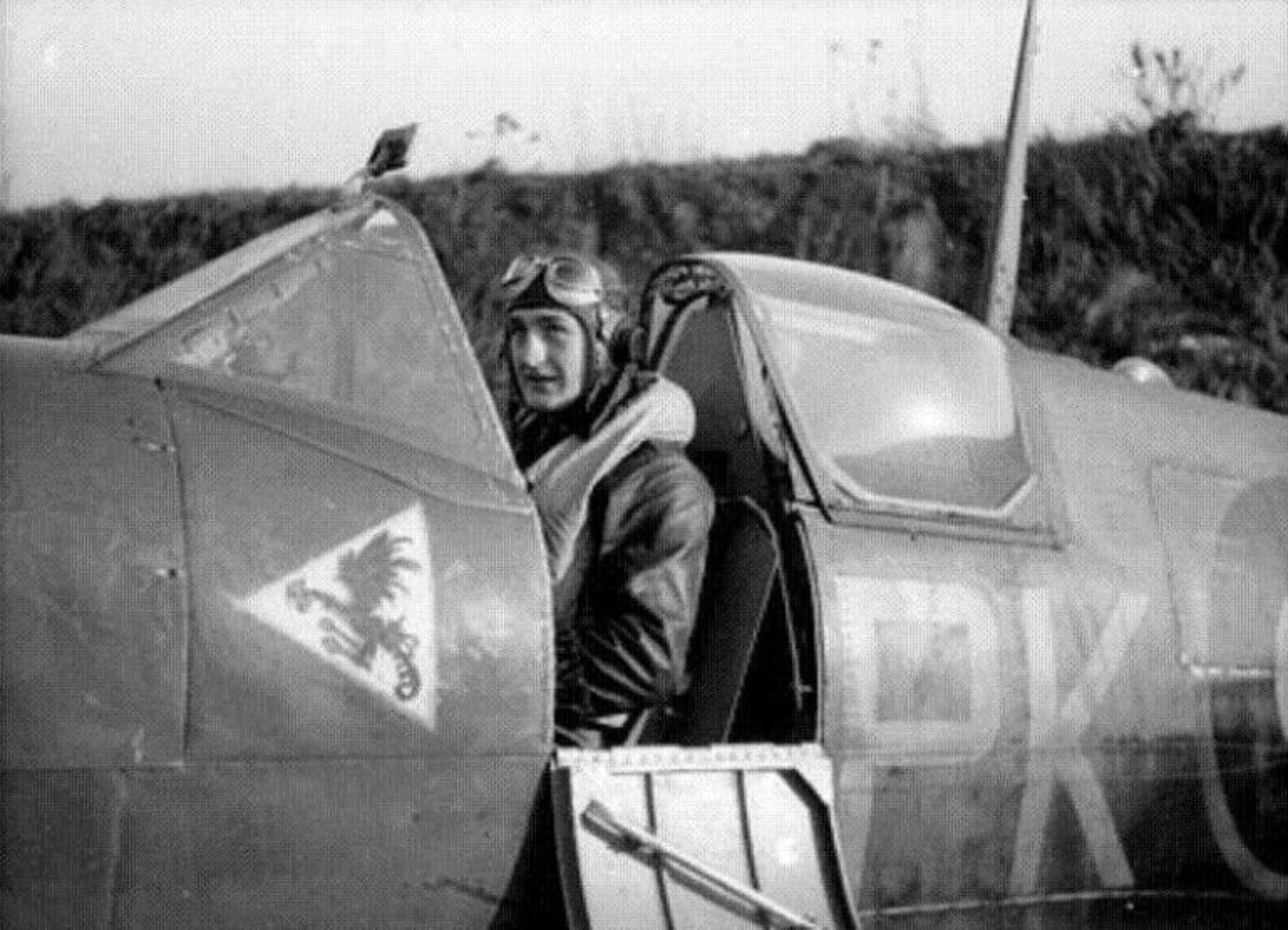
Because of his Polish lineage and his fluency in the language, Gabreski requested assignment to a Polish fighter squadron fighting with the Royal Air Force. His request was approved and he was assigned to No. 315 Squadron, based at RAF Northolt, London, England, where he flew the Supermarine Spitfire Mk.IX. (One of those Spitfires, Spitfire Mk.IXc BS410, is currently under restoration at the Biggin Hill Heritage Hangar.)

Captain Francis S. Gabreski, U.S. Army Air Corps, in the cockpit of his Supermarine Spitfire Mk.IX, PK E, BS410, with No. 315 Squadron, Royal Air Force, at RAF Northolt, England, 1943. This airplane was shot down 13 May 1943. It is currently under restoration. (Royal Air Force)

As American involvement in the European Theater increased, “Gabby” returned to the 61st Fighter Squadron, 56th Fighter Group, and flew the Republic P-47C Thunderbolt. He was promoted to the rank of Major, 19 July 1943.

Major Gabreski was promoted to the rank of lieutenant colonel, 23 January 1944. He took command of the 61st Fighter Squadron on 13 April 1944.

Lieutenant Colonel Francis S. Gabreski, commanding 61st Fighter Squadron, in the cockpit of his Republic P-47D-25-RE Thunderbolt, 42-26418, 1944. The marks indicate 28 enemy aircraft destroyed. (American Air Museum in Britain)

By July 1944, he had shot down 28 enemy fighters in aerial combat and destroyed another three on the ground, making him the leading American fighter ace up to that time.

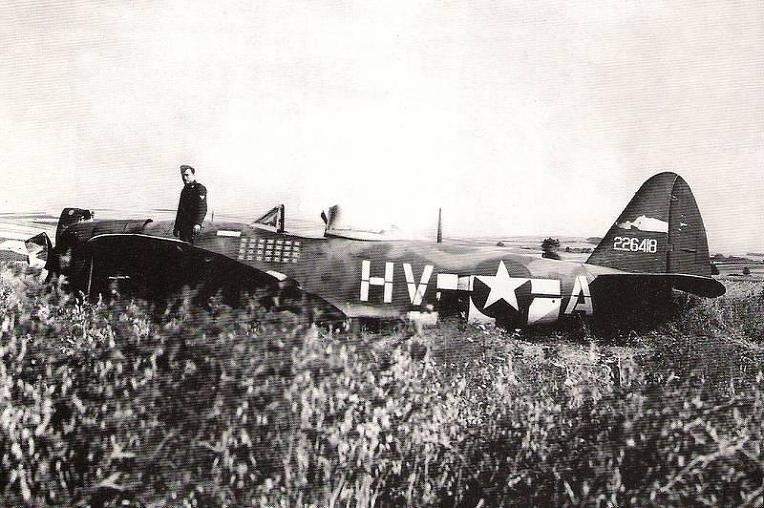
Lieutenant Colonel Gabreski’s Republic P-47D-25-RE Thunderbolt, 42-26418, RAF Boxted, Essex, England, 1944. (U.S. Air Force 68268 A.C./American Air Museum in Britain UPL 33594)
Lieutenant Colonel Gabreski, at right, with the ground crew of his Republic P-47D Thunderbolt, circa July 1944. Left to right, crew chief, Staff Sergeant Ralph H. Safford,of Ionia, Michigan; assistant crew chief Corporal Felix Schacki, Gary, Indiana; and armorer Sergeant Michael Di Franza, East Boston, Massachussetts. (American Air Museum in Britain)
Lieutenant Colonel Gabreski (standing, just left of center) with the pilots of the 61st Fighter Squadron, July 1944. (American Air Museum in Britain)

Having flown 193 combat missions and awaiting transport to the United States, on 20 July 1944 Gabreski decided to take “just one more.” As he made a low strafing run across an enemy airfield near Bassenheim, Germany, the tips of his propeller blades hit the ground, causing a severe vibration. He put his Thunderbolt down on its belly, climbed out and ran to avoid being captured. He evaded the enemy for five days before he was caught. Gabreski was held as a Prisoner of War at Stalag Luft I until April 1945.

Two German officers stand on the wing of Lieutenant Colonel Gabreski’s P-47D-25-RE Thunderbolt, 42-26418, near Bassenheim, Germany. (Luftwaffe)
Lieutenant Colonel Gabreski’s P-47D-25-RE Thunderbolt, 42-26418, near Bassenheim, Germany. (Luftwaffe)

Gabreski was promoted to the rank of Colonel, Army of the United States, 24 October 1945. He was released from active duty in September 1946. He then joined the Air National Guard with the rank of Lieutenant Colonel, 6 December 1946.

Gabreski resumed his college education, enrolling as one of the first students at the School of General Studies of Columbia University in 1947. He graduated with a bachelor of arts degree (B.A.) in political science, in 1949.

During the the Korean War, Lieutenant Colonel Gabreski served with the 4th Fighter Interceptor Wing and commanded the 51st Fighter Interceptor Wing. He is credited with shooting down 6.5 Mikoyan-Gurevich MiG 15 fighters netween 8 July 1951 and 13 April 1952, while flying North American Aviation F-86A and F-86E Sabres. (The “.5” represents credit shared with another pilot for one enemy airplane destroyed, 20 February 1952.) Gabreski flew 100 combat missions over Korea.

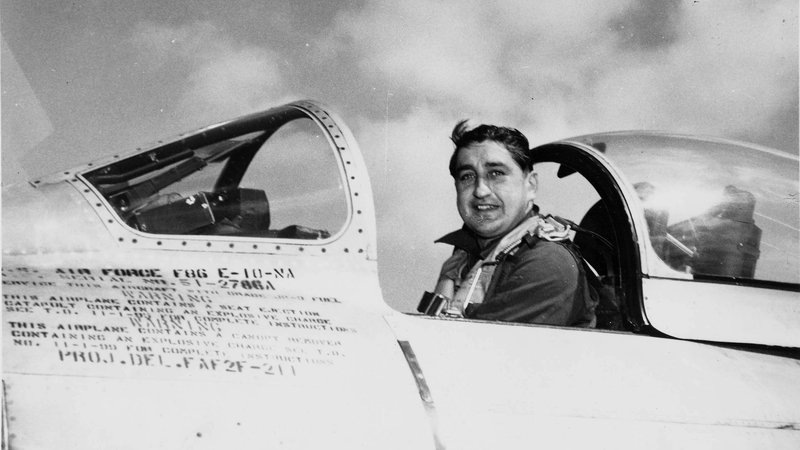
Colonel Gabreski in the cockpit of a North American Aviation F-86E Sabre, Korea, 1952.

After an assignment as Chief of Combat Operations, Office of the Deputy Inspector General, at Norton Air Force Base in southern California, Colonel Gabreski attended the Air War College at Maxwell Air Force Base, Montgomery, Alabama. He was then assigned as Deputy Chief of Staff, Ninth Air Force.

He went on to command two tactical fighter wings, the 354th and the 18th, flying North American Aviation F-100 Super Sabres.

Colonel Gabreski’s final fighter command was the 52nd Fighter Wing (Air Defense) based at Suffolk County Airport, New York, which was equipped with the McDonnell F-101 Voodoo interceptor.

Colonel Francis Stanley Gabreski, United States Air Force. (Imperial War Museum FRE 13934)

Colonel Gabreski retired from the Air Force 1 November 1967 after 27 years of service and 37.5 enemy aircraft destroyed (34.5 in air-to-air combat, and 3.0 on the ground). ¹At the time of his retirement, he had flown more combat missions than any other U.S. Air Force fighter pilot.

Lieutenant Colonel and Mrs. Francis S. Gabreski, 11 June 1945. (andrezejburlewicz.blog)

Gabby Gabreski married Miss Catherine Mary (“Kay”) Cochran, 11 June 1945, at Our Lady of the Angels Chapel, Campion College, Prairie du Chien, Wisconsin. They would have nine children. Mrs Gabreski died in a car accident in 1993.

Two of their sons graduated from the United States Air Force Academy at Colorado Springs, Colorado, and became U.S. Air Force pilots. His daughter-in-law, Lieutenant General Terry L. Gabreski, USAF, was the highest-ranking woman in the United States Air Force at the time of her retirement.

Colonel Gabreski was awarded the Distinguished Service Cross for his actions in combat on 26 November 1943, when he shot down two enemy Messerschmitt Bf 110 fighters. His other decorations include the Distinguished Service Medal, Silver Star with oak leaf cluster (two awards), Legion of Merit, Distinguished Flying Cross with two silver and bronze oak leaf clusters (thirteen awards), Bronze Star, Air Medal with one silver and one bronze oak leaf cluster (seven awards), and Prisoner of War Medal. He was awarded the Royal Air Force Distinguished Flying Cross, France’s Légion d’honneur and Croix de Guerre with Palm, Poland’s Krzyż Walecznych and the Belgian Croix de Guerre with Palm.

In 1991, Suffolk County Airport, New York, was renamed Francis S. Gabreski Airport in his honor.

Colonel Gabreski died  31 January 2002 at the age of 83 years. He is buried at Calverton National Cemetery, Long Island, New York.

Lieutenant Colonel Francis Stanley Gabreski, United States Air Force, 51st Fighter Interceptor Wing, standing in the cockpit of his North American Aviation F-86E Sabre, Korea, ca. 1952. (U.S. Air Force)
Lieutenant Colonel Francis Stanley Gabreski. Fighter Pilot. (U.S. Air Force)

¹ World War II aerial combat victory credits:


Korean War aerial combat victory credits:

© 2019, Bryan R. Swopes

Medal of Honor, Captain Joseph Jacob Foss, United States Marine Corps Reserve.

Captain Joseph Jacob Foss, United States Marine Corps
Captain Joseph Jacob Foss, United States Marine Corps Reserve

13 October 1942–15 January 1943: During a 95-day period in the early days of World War II, Captain Joe Foss, United States Marine Corps, shot down 26 enemy aircraft. He was the first American ace of World War II to match the World War I record of Captain Edward V. Rickenbacker.

Admiral William F. Halsey, U.S. Navy, awarded the Distinguished Flying Cross to Captain Foss for heroism and extraordinary achievement for having shot down seven enemy airplanes (six fighters and a bomber) from 13 October to 30 October 1942.

Joseph Jacob Foss was born near Sioux Falls, South Dakota, 17 April 1915. He was the oldest son of Frank Ole Foss, a farmer, and Mary Esther Lacey Foss. He was educated at Washington High School, Augustan College, Sioux Falls College and the University of South Dakota, graduating in 1940, having majored in Business Administration.

Beginning in 1938, Joe Foss began taking flight lessons. Through a Civil Aeronautics Administration course at the university, he gained additional flight experience, and received a private pilot certificate from the C.A.A.

2nd Lieutenant Joe Foss, USMCR, Naval Aviator
Lieutenant Joe Foss, USMCR, Naval Aviator

Foss had enlisted in the South Dakota National Guard in 1937, serving as a private assigned to the 147th Field Artillery Battalion until he joined the U.S. Marine Corps Reserve, 14 June 1940. Because of his prior service, the following day, Private Foss was promoted to private first class, and assigned to active duty as a aviation flight student. He successfully completed elimination flight training and qualified as an aviation cadet.

On 8 August 1940, Aviation Cadet Foss was sent to the Naval Air Station Pensacola, Florida, for pilot training. After graduating, 31 March 1941, Joseph Jacob Foss was commissioned a 2nd Lieutenant in the United States Marine Corps Reserve, and received the gold wings of a Naval Aviator.

Lieutenant Foss remained at Pensacola, assigned as a flight instructor. He was promoted to 1st lieutenant, 10 April 1942, with date of rank retroactive to 31 March 1942. His next assignment was to the Naval School of Photography, also located at Pensacola, and then to Marine Photographic Squadron 1 (VMD-1) at NAS North Island, San Diego, California, July 1942.

Lieutenant Foss requested training as a fighter pilot but he was considered to be too old. (He was 26.) While at San Diego, though, Foss was able to transition to the Grumman F4F Wildcat. He was promoted to the rank of captain, 11 August 1942. He was assigned to Marine Fighter Squadron 121 (VMF-121) as the unit’s executive officer.

Grumman F4F-3 Wildcat, circa 1942. (U.S. Navy)

VMF-121 was sent to Guadalcanal in the Solomon Islands aboard USS Copahee (ACV-12), a Bogue-class escort carrier. While still about 350 miles away from the island, the squadron was launched for Henderson Field, 9 October 1942. Joe Foss flew his first combat mission 13 October during which he shot down a Mitsubishi A6M Zero fighter (Allied reporting name, “Zeke”). His F4F Wildcat was badly damaged by enemy fighters.

Captain Foss and ammo loaders
Captain Joseph J. Foss, USMCR, in the cockpit of a Grumman F4F Wildcat, circa 1943. (Getty Images/Bettmann 515466188)

Captain Foss had extraordinary gunnery skills and frequently shot down more than one enemy aircraft per mission. His combat victories included nineteen Mitsubishi A6M Zero fighters, a Nakajima A6M2-N “Rufe” (a float plane variant of the Zero), three Mitsubishi G4M “Betty” medium bombers, two Mitsubishi F1M2 “Pete” reconnaissance float planes and an Aichi E13A “Jake” reconnaissance float plane.

During the his three month period, Captain Foss had to make three engine out landings as a result of damage sustained by his Wildcat from enemy aircraft, and was himself shot down near the island of Malaita. He was rescued by local fishermen.

Joe Foss was stricken by malaria and was sent to Australia for treatment. In April 1943 he was returned to the United States and assigned to Headquarters Marine Corps at Washington, D.C.

In a ceremony at the White House, 18 May 1943, President Franklin D. Roosevelt presented Captain Foss the Medal of Honor.

Screen Shot 2016-01-10 at 13.02.26

Captain Joseph J. Foss, United States Marine Corps. (LIFE Magazine)

Joe Foss was promoted to the rank of major, 1 June 1943. On 17 July took command of Marine Fighter Squadron 115 (VMF-115), then training at Marine Corps Air Station Santa Barbara, Goleta, California. The new fighter squadron was equipped with Chance Vought F4U-1 and Goodyear FG-1 Corsairs. The squadron departed San Diego, California, 13 February 1944 aboard USS Pocomoke (AV-9), a seaplane tender, and arrived at Espiritu Santo in the New Hebrides on 4 March. The fighters flew to a new base at Emirau in the Bismarck archipelago on 2 May and VMF-115 was assigned to Marine Air Group 12. The unit was in combat the following day. In the last half of the month, the squadron was visited by Col. Charles A Lindbergh. He flew four combat missions with VMF-115, 26–30 May.

Marine Fighter Squadron 115 (VMF-115) at MCAS Santa Barbara, Goleta, California, 1944. Major Joe Foss is in th e center of the back row, wearing flight helmet with goggles, standing in front the of Corsair's propeller blade.
Marine Fighter Squadron 115 (VMF-115) at MCAS Santa Barbara, Goleta, California, 1944. Major Joe Foss is in the center of the back row, wearing flight helmet with goggles, standing in front the of Corsair’s propeller blade.

Major Foss had a recurrence of malaria. On 21 September 1944, he was relieved of command of VMF-115 and returned to the United States for medical treatment, assigned to NAS Klamath Falls. In February 1945, he was back at MCAS Santa Barbara as an operations and training officer.

Major Joe Foss was released from active duty on 8 December 1945. On 20 September 1946 Foss was appointed a lieutenant colonel in the South Dakota Air National Guard. His resignation from the Marine Corps, dated 29 January 1947, was accepted as effective 19 September 1946. He commanded the 175th Fighter Squadron, which was equipped with the North American P-51D Mustang.

North American Aviation F-51D Mustang, 175th Fighter Squadron, South Dakota Air National Guard.
North American Aviation P-51D-25-NA Mustang 44-73564, 175th Fighter Squadron, South Dakota National Guard, 1946. (U.S. Air Force)

The 175th was redesignated as a Fighter Interceptor Squadron in 1951. Colonel Foss was recalled to active duty in the Air Force during the Korean War. He served as Director of Operations and Training, Air Defense Command, and was promoted to brigadier general, 20 September 1953. The 175th FIS began re-equipping with the Lockheed F-94A Starfire in 1 November 1954. In 1958, the squadron shifted to the Northrop F-89 Scorpion, and then the Convair F-102A Delta Dagger in 1960. Ten years later, North American Aviation F-100D Super Sabres came to the 175th.

Northrop F-89D-30-NO Scorpion, South Dakota Air National Guard.
Northrop F-89D-30-NO Scorpion 51-11419, an all-weather interceptor assigned to the South Dakota Air National Guard, at Sioux Falls, 1958. The nose cone of the right wing tip-mounted pod has been removed to show the fifty-two 2.75-inch Folding Fin Aerial Rockets. (John Mollison, SDANG)

While all this was happening, Joe Foss was involved in a political career. After serving two terms in the state legislature, Joseph J. Foss was elected Governor of the State of South Dakota in November 1954. The state’s 20th governor, he was the youngest to hold that office. He was elected a second time and served until 1959. He also served as a commissioner of the American Battle Monuments Commission.

Joe Foss was Commissioner of the American Football League and President of the National Rifle Association.

Brigadier General Joseph J. Foss, United States Air Force

Brigadier General Joseph J. Foss, U.S. Air Force, Air Chief of Staff, South Dakota Air National Guard, retired from military service, 15 April 1975. He had been awarded the Medal of Honor, Distinguished Flying Cross, Air Medal with two 516-inch gold stars (three awards), Presidential Unit Citation (Air Force) with oak leaf cluster (second award), Presidential Unit Citation (Navy and Marine Corps) with bronze star (second award), American Defense Service Medal, American Campaign Medal, Asiatic-Pacific Campaign Medal with two bronze stars (three campaigns), the World War II Victory Medal and the National Defense Service Medal with bronze star (second award), Air Force Longevity Service Ribbon with oak leaf cluster, Armed Forces Reserve Medal with silver hourglass device (20 years service), and the Air Force Small Arms Expert Marksman Ribbon.

Joseph Jacob Foss died at Scottsdale, Arizona, 1 January 2003. He was 87 years old. General Foss is buried at Arlington National Cemetery.

© 2019, Bryan R. Swopes

Medal of Honor, Major James Howell Howard, Air Corps, United States Army.
Lieutenant Colonel James Howell Howard, United States Army Air Corps, with his North American Aviation P-51B-5-NA Mustang, 43-6315, “DING HAO!” at RAF Boxted, 25 April 1944. (American Air Museum in Britain)

11 January 1944: Major James Howell Howard, Air Corps, United States Army, commander of the 356th Fighter Squadron, 354th Fighter Group, Ninth Air Force, led fifty P-51 Mustangs escorting three divisions of B-17 Flying Fortresses on a raid against Oschersleben, near Berlin, Germany.

As defending Luftwaffe fighters attacked the bomber formation, Major Howard immediately went on the offensive and shot down a twin engine Messerschmitt Bf 110 Zerstörer long range fighter. During this engagement, Howard became separated from his group, but climbed back to rejoin the bombers.

More than thirty German fighters were attacking the bomber formation and Major Howard single-handedly went after them. He shot down two, probably shot down two more and damaged at least another two. He continued to attack even after he had run out of ammunition and was low on fuel. When he returned to his base at RAF Boxted, his Mustang had just a single bullet hole.

For this action, James H. Howard was awarded the Medal of Honor, presented by Lieutenant General Carl Spaatz 11 January 1945. He is the only fighter pilot in the European Theater to have received this Medal. Howard was promoted to the rank of colonel.

Lieutenant Colonel James H. Howard adds another victory mark to his P-51B-5-NA Mustang, 43-6315, DING HAO! (U.S. Air Force)
Lieutenant Colonel James H. Howard adds another victory mark to his North American Aviation P-51B-5-NA Mustang, 43-6315, DING HAO! (U.S. Air Force)

The President of the United States in the name of The Congress takes pleasure in presenting the Medal of Honor to

HOWARD, JAMES H. (Air Mission)

Rank and organization: Lieutenant Colonel, U.S. Army Air Corps. Place and date: Over Oschersleben, Germany, 11 January 1944. Entered service at: St. Louis, Missouri. Birth: Canton, China. G.O. No.: 45, 5 June 1944.

Citation: For conspicuous gallantry and intrepidity above and beyond the call of duty in action with the enemy near Oschersleben, Germany, on 11 January 1944. On that day Col. Howard was the leader of a group of P-51 aircraft providing support for a heavy bomber formation on a long-range mission deep in enemy territory. As Col. Howard’s group met the bombers in the target area the bomber force was attacked by numerous enemy fighters. Col. Howard, with his group, and at once engaged the enemy and himself destroyed a German ME. 110. As a result of this attack Col. Howard lost contact with his group, and at once returned to the level of the bomber formation. He then saw that the bombers were being heavily attacked by enemy planes and that no other friendly fighters were at hand. While Col. Howard could have waited to attempt to assemble his group before engaging the enemy, he chose instead to attack singlehanded a formation of more than 30 German airplanes. With utter disregard for his own safety he immediately pressed home determined attacks for some thirty minutes, during which time he destroyed 3 enemy airplanes and probably destroyed and damaged others. Toward the end of this engagement 3 of his guns went out of action and his fuel supply was becoming dangerously low. Despite these handicaps and the almost insuperable odds against him, Col. Howard continued his aggressive action in an attempt to protect the bombers from the numerous fighters. His skill, courage, and intrepidity on this occasion set an example of heroism which will be an inspiration to the U.S. Armed Forces.

Lieutenant Colonel James Howell Howard, United States Army Air Forces, wearing the Medal of Honor, June 1944. (American Air Museum in Britain)
Major James H. Howard, center, with a group of pilots of the 354th Fighter Group, with a North American Aviation P-51 Mustang, at RAF Boxted, 1943. (American Air Museum in Britain)

James Howell Howard was born 8 April 1913 at Canton (Guangzhou), China. He was the second of three children of Dr. Harvey James Howard, an ophthalmologist at the University Medical School in Canton China (formerly, the Canton Christian College), and later, chief of the Department of Ophthalmology at the Peking Union Medical College Hospital in Beijing. His mother was the former Maude Irene Strobel.

When James was 11 years old, he and his father were kidnapped by Manchurian bandits and held for ten weeks before they were able to escape. The family left Shaghai aboard the 535-foot Pacific Mail cargo liner S.S. President Lincoln on 21 July 1923 and sailed for San Francisco, California, arriving there on 8 August 1923.

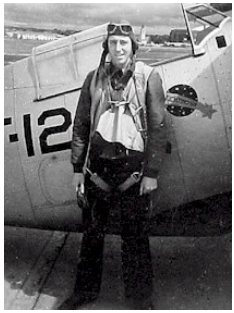
Ensign James H. Howard USNR, with  VF-6 Grumman F3F 6-F-12.

Howard attended The Haverford School, Montgomery, Pennsylvania, and later, John Burroughs School, St. Louis, Missouri. He graduated from Pomona College in southern California in 1937 with a Bachelor of Arts degree.

He had blond hair and blue eyes, was 6 feet, 2 inches (1.88 meters) tall and weighed 160 pounds (72.6 kilograms). He enlisted as an aviation cadet in the United States Naval Reserve, and began flight training at NAS Pensacola, Florida, 29 December 1937. He graduated as a Naval Aviator, 1 February 1939, and was commissioned an ensign, USNR.

In 1939, Ensign Howard served with Fighting Squadron SIX (VF-6) aboard USS Enterprise (CV-6) In 1940, he was assigned to the Naval Air Station San Diego San Diego on the southern coast of California.

On 21 June 1941, Ensign Howard resigned from the Navy and went to Burma as an employee of the Central Aircraft Manufacturing Company, which was a cover operation for the 1st American Volunteer Group, better known as the “Flying Tigers.” He commanded the AVG 2nd Pursuit Squadron. Flying the Curtiss-Wright Hawk 81-A3, Howard was credited with six Imperial Japanese Army Nakajima Ki-27 Army Type 97 fighters destroyed.

Five AVG pilots with a Curtiss-Wright Hawk 81-A3. James Howell Howard is at right, wearing an overseas cap with USN insignia.

Howard was commissioned as a captain, United States Army Air Corps, 31 January 1943, and assigned to the 354th Fighter Group. The group deployed overseas. Then Major Howard commanded the 356th Fighter Squadron at RAF Boxted. Major Howard was promoted to lieutenant colonel, February 1944, and to Colonel, 25 November 1945. As World War II came to an end, he was released from active duty, 30 November 1945.

Following the war, Colonel Howard remained active in the Army Air Forces reserve. In 1947, he was transferred to the newly established United States Air Force Reserve. He was promoted to the rank of brigadier general, 22 March 1948. He commanded the 96th Bombardment Wing (Very Heavy) based at Scott Field, near Belleville, Illinois.

Brigadier General James Howell Howard, United States Air Force Reserve.

On 18 July 1948, General Howard married Lieutenant Mary G. Balles, Women’s Army Corps, at Smoky Hill Air Force Base, Salina, Kansas. Lieutenant Balles was a personnel officer with the 52nd Fighter Wing at Mitchel Field, New York. They divorced six months later.

Howard later married the former Mrs. Florence Ochs Buteau, 31 December 1953 at Brooksville, Maryland.

In addition to the Medal of Honor, General Howard was also awarded the Distinguished Flying Cross with one oak leaf cluster (two awards); the Bronze Star Medal; and the Air Medal with one silver and four bronze oak leaf clusters (ten awards); the Presidential Unit Citation; American Defesne Service Medal with service star (two awards); European-African-Middle Eastern Campaign Medal with two campaign stars; World War II Victory medal; National Defense Service Medal with service star; Air Force Longevity Service Medal with four bronze oak leaf clusters (twenty years of service); and the Armed Forces Reserve Medal with silver hourglass device (twenty years of service).

Brigadier General Howard retired from the U.S. Air Force 1 June 1965.

He was the author of Roar of the Tiger (Orion Books, New York, 1991).

Brigadier General James Howell Howard, United States Air Force (Retired), died at the Veterans Affairs Medical Center, Bay Pines, Florida, 18 March 1995. He was buried at the Arlington National Cemetery, Arlington, Virginia.


North American Aviation P-51B-5-NA Mustang, 43-6315, AJ A, 356th Fighter Squadron, 354th Fighter Group, Ninth Air Force, at RAF Boxted, 1944. (American Air Museum in Britain)

James Howard’s P-51 Mustang was named DING HAO! and carried the victory marks from his AVG combat missions.¹ [“Ding Hao” was an American World War II slang term based on the Chinese phrase, 挺好的 (“ting hao de“) meaning “very good” or “number one”.]

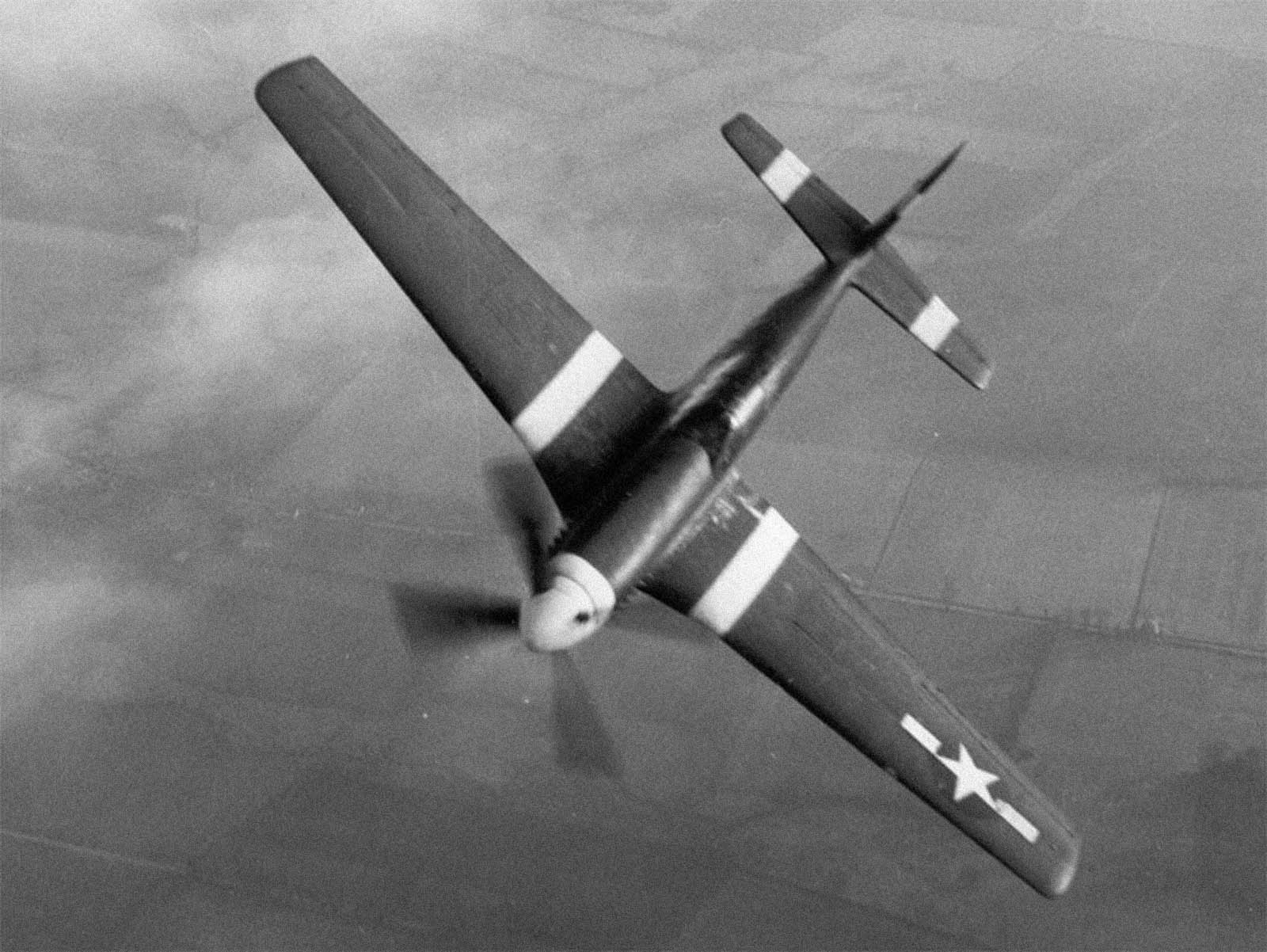
The North American Aviation P-51 Mustang is a single-place, single-engine long range fighter. It is a low-wing monoplane with retractable landing gear and is of all-metal construction. The fighter is powered by a liquid-cooled V-12 engine. It was originally produced for the United Kingdom’s Royal Air Force as the Mustang Mk.I. Two examples were provided to the U.S. Army Air Corps, designated XP-51. This resulted in orders for the P-51A and A-36 Apache dive bomber variant. These early Mustangs were powered by the Allison V-1750 engine driving a three-bladed propeller, which also powered the Lockheed P-38 Lightning and Curtiss P-40 Warhawk.

In 1942, soon after the first  production Mustang Mk.I arrived in England, Rolls-Royce began experimenting with a borrowed airplane, AM121, in which they installed the Supermarine Spitfire’s Merlin 61 engine. This resulted in an airplane of superior performance.

In the United States, the Packard Motor Car Company of Detroit, Michigan, had begun building Merlin engines under license from Rolls-Royce. These American engines were designated V-1650. North American modified two P-51s from the production line to install the Packard V-1650-3. These were designated XP-51B. Testing revealed that the new variant was so good that the Army Air Corps limited its order for P-51As to 310 airplanes and production was changed to the P-51B.

North American Aviation P-51B-1-NA Mustang 43-12433 with identification stripes, circa January 1944. (U.S. Air Force)

The P-51B and P-51C are virtually Identical. The P-51Bs were built by North American Aviation, Inc., at Inglewood, California. P-51Cs were built at North American’s Dallas, Texas. plant. They were 32 feet, 2.97 inches (9.829 meters) long, with a wingspan of 37 feet, 0.31-inch (11.282 meters) and overall height of 13 feet, 8 inches (4.167 meters) high. The fighter had an empty weight of 6,985 pounds (3,168 kilograms) and a maximum gross weight of 11,800 pounds (5,352 kilograms).

P-51Bs and Cs were powered by a right-hand tractor, liquid-cooled, supercharged, 1,649-cubic-inch-displacement (27.04-liter) Packard V-1650-3 or -7 Merlin single overhead cam (SOHC) 60° V-12 engine which produced 1,380 horsepower at Sea Level, turning 3,000 r.p.m at 60 inches of manifold pressure (V-1650-3) or 1,490 horsepower at Sea Level, turning 3,000 r.p.m. at 61 inches of manifold pressure (V-1650-7). (Military Power rating, 15 minute limit.) These were license-built versions of the Rolls-Royce Merlin 63 and 66. The engine drove a four-bladed Hamilton Standard Hydromatic constant-speed propeller with a diameter of 11 feet, 2 inches (3.404 meters) through a 0.479:1 gear reduction.

The P-51B/C had a cruise speed of 362 miles per hour (583 kilometers per hour) and the maximum speed was 439 miles per hour (707 kilometers per hour) at 25,000 feet (7,620 meters). The service ceiling was 41,900 feet (12,771 meters). With internal fuel, the combat range was 755 miles (1,215 kilometers).

In military service, armament consisted of four air-cooled Browning AN-M2 .50-caliber machine guns, mounted two in each wing, with 350 rounds per gun for the inboard guns and 280 rounds per gun for the outboard.

1,988 P-51B Mustangs were built at North American’s Inglewood, California plant and another 1,750 P-51Cs were produced at Dallas, Texas. This was nearly 23% of the total P-51 production.

DING HAO!, James H. Howard’s P-51B Mustang, was lost in combat 23 July 1944.

Lieutenant Colonel James H. Howard, U.S. Army Air Corps, with DING HAO!, his P-51B Mustang, at RAF Boxted, 1944. (U.S. Air Force)
Lieutenant Colonel James H. Howard, U.S. Army Air Corps, with DING HAO!, his P-51B Mustang, at RAF Boxted, 1944. At the time of this photo, the Mustang had been modified with a sliding, blown-plexiglas “Malcom hood” canopy. (U.S. Air Force)

¹ Major Howard may have flown a different airplane on 11 January 1944. A handwritten caption of the reverse of the top photograph reads, Howard in own P-51B at Boxted, 25/4/44 not AC in which he won MOH, Lt Col James Howard was awarded only Medal of Honour (highest US Award) to go to a fighter pilot flying in the ETO. Action on 11/1/44.

© 2019, Bryan R. Swopes