
0 ratings0% found this document useful (0 votes)
399 views54 pages11-Chemistry Structure of Atom
Molecular Formula is best of all
Uploaded by
Sonam KourCopyright
© © All Rights Reserved
We take content rights seriously. If you suspect this is your content, claim it here.
Available Formats
Download as PDF or read online on Scribd
0 ratings0% found this document useful (0 votes)
399 views54 pages11-Chemistry Structure of Atom
Molecular Formula is best of all
Uploaded by
Sonam KourCopyright
© © All Rights Reserved
We take content rights seriously. If you suspect this is your content, claim it here.
Available Formats
Download as PDF or read online on Scribd
(Chapter — 2) (Structure of Atom)
(Class - XI)
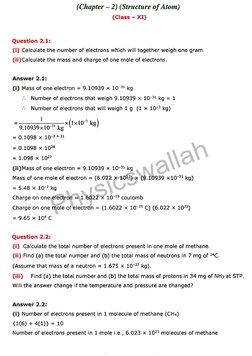
Question 2.4:
(i) Calculate the number of electrons which will together weigh one gram
(ii) Calculate the mass and charge of one mole of electrons.
Answer 2.1:
(i) Mass of one electron = 9.10939 x 10° kg
Number of electrons that weigh 9.10939 x 10⁻³! kg
Number of electrons that will weigh 1g (1 x 10° kg)
—_!_
9.10939 10"? kg
= 0.1098 x 10°37*3!
= 0.1098 x 10°
= 1,098 x 1027
(ii) Mass of one electron = 9.10939 x 10⁻³! kg
Mass of one mole of electron = (6.022 x°10%)»x (9.10939 x10 kg)
= 5.48 x 10-7 kg
x(1x107 kg)
Charge on one@électron = 1.6022" 10~° coulomb
Charge on one mole of electron = (1.6022 x 10⁻¹⁹ C) (6.022 x 1073)
= 9.65 x 10*C
Question 2.
(i) Calculate the total number of electrons present in one mole of methane.
(il) Find (a) the total number and (b) the total mass of neutrons in 7 mg of ¥C.
(Assume that mass of a neutron = 1.675 x 10⁻²? kg).
(iii) Find (a) the total number and (b) the total mass of protons in 34 mg of NH3 at STP.
Will the answer change if the temperature and pressure are changed?
Answer 2.2:
(i) Number of electrons present in 1 molecule of methane (CHs)
{1(6) + 4(1)} = 10
Number of electrons present in 1 mole I.e., 6.023 x 10²³ molecules of methane
(Chapter — 2) (Structure of Atom)
(Class - XI)
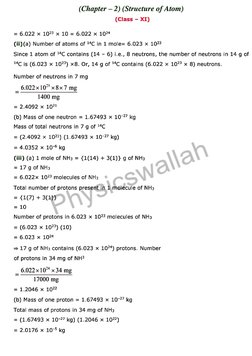
= 6,022 x 10? x 10 = 6.022 x 10%
(ii)(a) Number of atoms of “C in 1 mole= 6.023 x 10?
Since 1 atom of “C contains (14 - 6) |.e., 8 neutrons, the number of neutrons in 14 g of
4 js (6.023 x 10”) x8. Or, 14 g of *4C contains (6.022 x 10”? x 8) neutrons.
Number of neutrons in 7 mg
6.022x 10" x8x7 mg
1400 mg
= 2.4092 x 10⁷
(b) Mass of one neutron = 1.67493 x 10°27 kg
Mass of total neutrons in 7 g of 4C
= (2.4092 x 10²²) (1.67493 x 10°? kg)
= 4.0352 x 10° kg
( (a) 1 mole of NH3 = {1(14) + 3(1)} g of NH3
= 17g of NH3
= 6.022x 10⁷ molecules of NH3
Total number of protons present in 1 molecule of NH3
{1(7) + 3(4)}
= 10
Number of protons in 6.023 x 10²? malecules of NH3
= (6.023 x 10°) (10)
= 6.023 x 10%
= 17 g of NHa contains (6.023 x 10%‘) protons. Number
of protons in 34 mg of NH?
_ 6,022 10" x34 mg
~~ 17000 mg
= 1.2046 x 1072
(b) Mass of one proton = 1.67493 x 10°” kg
Total mass of protons in 34 mg of NH3
= (1.67493 x 10⁻²⁷ kg) (1.2046 x 1072)
= 2.0176 x 10⁻⁵ kg
(Chapter — 2) (Structure of Atom)
(Class - XI)
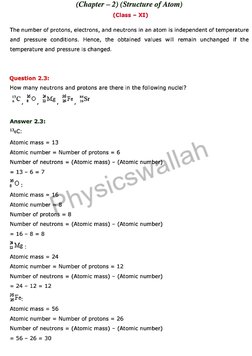
The number of protons, electrons, and neutrons in an atom is independent of temperature
and pressure conditions. Hence, the obtained values will remain unchanged if the
temperature and pressure is changed.
Question 2.3:
How many neutrons and protons are there in the following nuclei?
rc, ro 2Me Fe, SSr
Atomic mass = 13
Atomic number = Number of protons = 6
Number of neutrons = (Atomic mass) - (Atomic number)
=13-6=7
20:
Atomic mass = 16"
Atomic number ="8
Number of protons = 8
Number of neutrons = (Atomic mass) - (Atomic number)
=16-8=8
aM.
Atomic mass = 24
Atomic number = Number of protons = 12
Number of neutrons = (Atomic mass) - (Atomic number)
=24-12=12
ze,
Atomic mass = 56
Atomic number = Number of protons = 26
Number of neutrons = (Atomic mass) - (Atomic number)
= 56 - 26 = 30
(Chapter — 2) (Structure of Atom)
(Class - XI)
ss
or
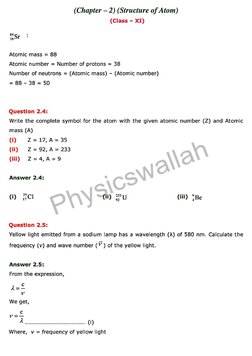
Atomic mass = 88
Atomic number = Number of protons = 38
Number of neutrons = (Atomic mass) - (Atomic number)
= 88 - 38 = 50
Question 2.4:
Write the complete symbol for the atom with the given atomic number (Z) and Atomic
mass (A)
(i) 2=17,A=35
(ii) Z=92,A= 233
(ili) Z=4,A=9
Answer 2.4:
(i) Fel Gi) 23U (iii) “Be
Question 2.5:
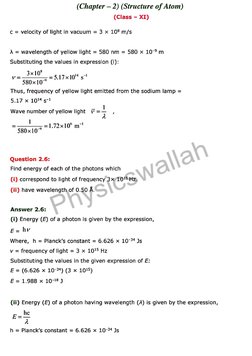
Yellow light emitted from a sodium lamp has a wavelength (A) of 580 nm. Calculate the
frequency (v) and wave number (*) of the yellow light.
Answer 2.5:
From the expression,
(i)
Where, v = frequency of yellow light
(Chapter — 2) (Structure of Atom)
(Class - XI)
= velocity of light in vacuum = 3 x 10° m/s
A = wavelength of yellow light = 580 nm = 580 x 10° m
Substituting the values in expression (I):
pa 3x10"
580x107
Thus, frequency of yellow light emitted from the sodium lamp =
5.17 x 10% 57
=5.17x10"
Wave number of yellow light 7 =
1
== = 1.7210" m?
580x10"
Question 2.6:
Find energy of each of the photons which
(i) correspond to light of frequency 3%/10* Hz,
(ii) have wavelength. of 0.50 A.
Answer 2.6:
(i) Energy (E) of a photon is given by the expression,
e=-hv
Where, h = Planck’s constant = 6.626 x 10°** Js
v = frequency of light = 3 x 10"5 Hz
Substituting the values in the given expression of E:
E = (6.626 x 10%) (3 x 10¹⁵)
E= 1,988 x 10°1#J
(ii) Energy (£) of a photon having wavelength (A) is given by the expression,
he
a
h = Planck's constant = 6.626 x 10°34 Js
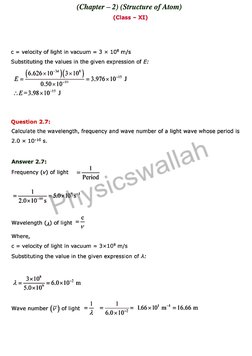
(Chapter — 2) (Structure of Atom)
(Class - XI)
¢ = velocity of light in vacuum = 3 x 10⁸ m/s
Substituting the values in the given expression of E:
(6.626x 10 )(3x10")
———=3.976x 10" J
0.50 x10"
E=3.98x10" J
Question 2.7:
Calculate the wavelength, frequency and wave number of a light wave whose period is
2.0 x 10⁷s.
Answer 2.7:
Frequency (v) of light ©=———
Period
1
Tyas THN
Ox s
c
Wavelength (4) of light =~
Where,
¢ = velocity of light in vacuum = 3x 10⁸ m/s
Substituting the value in the given expression of A:
7
3x10 =6.0%107 m
5.0x10
Wave number (17) of light =— 1.66 «10' m* = 16.66 m
(Chapter — 2) (Structure of Atom)
(Class - x1)
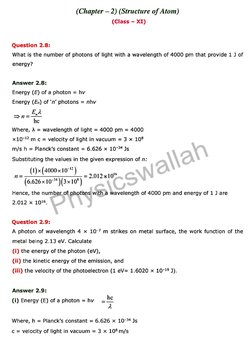
Question 2.8:
What is the number of photons of light with a wavelength of 4000 pm that provide 1 J of
energy?
Answer 2.8:
Energy (E) of a photon = hv
Energy (En) of ‘n’ photons = nhv
=>n= EA
he
Where, A = wavelength of light = 4000 pm = 4000
x10"! m c = velocity of light in vacuum = 3 x 10⁸
m/s h = Planck's constant = 6.626 x 10734 Js
Substituting the values in the given expression of n:
__(1)x(4000x10"")
"* (6.626x10-*)(3x10")
Hence, the numberof photons with @ wavelength of 4000 pm and energy of 1J are
2.012 x 1038.
2.01210"
Question 2.9:
A photon of wavelength 4 x 10⁻⁷ m strikes on metal surface, the work function of the
metal being 2.13 eV. Calculate
(i) the energy of the photon (eV),
(ii) the kinetic energy of the emission, and
(ili) the velocity of the photoelectron (1 eV= 1.6020 x 10-193).
Answer 2.9:
(i) Energy (E) of a photon = hy = He
Where, h = Planck’s constant = 6.626 x 10⁻⁴ Js
c= velocity of light in vacuum = 3 x 10% m/s
(Chapter — 2) (Structure of Atom)
(Class - XT)
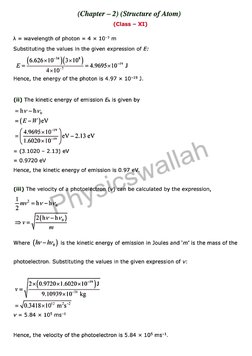
= wavelength of photon = 4 x 10⁻⁷ m
Substituting the values in the given expression of E:
E (6.62610 )(3x10")
4107
Hence, the energy of the photon is 4.97 x 10719 J.
=4.9695x10"" J
(ii) The kinetic energy of emission Ex is given by
=hy-hy,
=(E-W)eV
4.9695 x10"
( 1.6020x 10°"
= (3.1020 - 2.13) eV
= 0,9720 eV
Hence, the kinetic energy of emission is 0.97 eV.
Jev-a1s ev
(iii) The velocity of a photoelectron, (v)'can be calculated by the expression,
div? = hy Hyp
Where (/v’—hv,) is the kinetic energy of emission in Joules and 'm’ is the mass of the
photoelectron. Substituting the values in the given expression of v:
2x (0.9720 1,6020x10"")J
ve 9.10939x10"" ke
= ¥0.3418%10" ms?
v= 5.84 x 10⁵ ms“?
Hence, the velocity of the photoelectron is 5.84 x 10⁵ ms-}.
(Chapter — 2) (Structure of Atom)
(Class - XI)
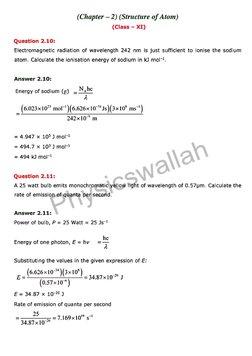
Question 2.10:
Electromagnetic radiation of wavelength 242 nm is just sufficient to ionise the sadium
atom, Calculate the ionisation energy of sodium in kJ mol-!.
Answer 2.10:
Eneray of sodium (e)
(6.023x10" mat")(6.626x10"" Js)(3« 10" ms")
242x107 m
= 4.947 x 10°] mol
= 494.7 x 10³) mol?
= 494 kJ mol?
Question 2.11:
A 25 watt bulb emits monochromatic yellow light of wavelength of 0.57um. Calculate the
rate of emission-of\quanta pet second.
Answer 2.11:
Power of bulb, P = 25 Watt = 25 Js!
Energy of one photon, E = hv ="
Substituting the values in the given expression of E:
(6.626x10™)(3x10")
(0.5710)
E = 34.87 x 1077)
=34.87x107" J
Rate of emission of quanta per second
25
=~, =7.169x 10" s*
34.87x10
(Chapter — 2) (Structure of Atom)
(Class - XI)
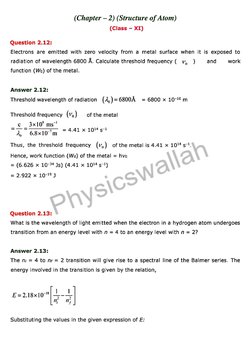
Question 2.12:
Electrons are emitted with zero velocity from a metal surface when it is exposed to
radiation of wavelength 6800 A. Calculate threshold frequency ( yy ) and work
function (Wo) of the metal.
Answer 2.12:
Threshold wavelength of radiation (4,)=6800A = 6800 x 10-9 m
Threshold frequency (Vy) — of the metal
c¢ _3x10* ms
= G axiom 7 41x 10Mst
Thus, the threshold frequency (¥,) of the metal is 4.41 x 10"
Hence, work function (Wo) of the metal = hvo
= (6.626 x 10° Js) (4.41 x 1051)
= 2.922 x 1079)
Question 2.13:
What is the wavelength of light emitted when the electron in a hydrogen atom undergoes
transition from an energy level with n = 4 to an energy level with n = 2?
Answer 2.13:
The nj = 4 to nr = 2 transition will give rise to a spectral line of the Balmer series. The
energy Involved in the transition Is given by the relation,
Substituting the values in the given expression of E:
(( ‘Chapter -2)(! Structure of. ‘Atom)
(Class - XI)
£=21810"| 1
e
=2uscio['
=2:18s10"(-)
16
E = ~ (4.0875 x 10793)
The negative sign indicates the energy of emission.
Wavelength of light emitted (4)
he
ince £ =<
(sino 2 )
Substituting the values in the given expression of A:
(6.62610 )(3x10")
~— 4,0873x10"
A=4.8631x10⁷ m
= 486.3x10⁷m
= 486 nm
Question 2.14:
How much energy is required to ionise a H atom if the electron occupies n = 5 orbit?
Compare your answer with the ionization enthalpy of H atom (energy required to remove
the electron from n =1 orbit).
Answer 2.14:
The expression of energy is given by,
—(2.18«10")Z?
n
Where,
Z = atomic number of the atom n
= principal quantum number
For ionization from m= 5to 7
(Chapter — 2) (Structure of Atom)
(Class - XI)
AE=E, -E,
- [ee ay) fae
() (5)
2.18%10"" le) (since 1
= 0.0872x 10 J
AE =8.72x10™ J
Hence, the energy required for ionization from p = Stan = ©
Energy required form, = 1to2 = ™,
is 8.72 x 10⁷°],
AE=E,-E,
2 seri |
()
=(2.18%10"")[1=0]
=2.18x10°% J
Hence, less energy is required to ionize an electron in the 5‘ orbital of hydrogen atom as
2.18x10⁷*)(1
(y
compared to that in the ground state.
Question 2.15:
What is the maximum number of emission lines when the excited electron of an H atom in
n = 6 drops to the ground state?
Answer 2.15:
When the excited electron of an H atom in n = 6 drops to the ground state, the following
transitions are possible:
(Chapter — 2) (Structure of Atom)
(Class - XI)
n=
| 4 Lines
| ned
2
a
5 Lines
n=l
Hence, a total number of (5 + 4 + 3 + 2 + 1) 15 lines will be obtained in the emission
spectrum.
The number of spectral lines prodiiced when’an electron in the nt level drops down to
the ground state’given by 22("—1)
Given, n=6
6(6-1)
Number of spectral lines = = 15
Question 2.16:
(i) The energy associated with the first orbit in the hydrogen atom Is -2.18 x 10° J
atom-!, What Is the energy associated with the fifth orbit?
(ii) Calculate the radius of Bohr’s fifth orbit for hydrogen atom.
Answer 2.16:
(i) Energy associated with the fifth orbit of hydrogen atom is
calculated as:
(Chapter — 2) (Structure of Atom)
(Class - XI)
18x10") 2 1gx10%
(y° 25
Es = -8.72 x 10°09
(ii) Radius of Bohr’s n™ orbit for hydrogen atom is given by, ro = (0.0529 nm) a?
For, n=5
rs = (0.0529 nm) (5)
-3225 nm
Question 2.17:
Calculate the wave number for the longest wavelength transition, in'the Balmer series of
atomic hydrogen
Answer 2.17:
For the Balmer series, nj = 2. Thus, the expression of wavenumber (i) is given by,
|oore m"
Wave number
)is inversely proportional to wavelength of transition. Hence, for the
longest wavelength transition, (Fas to be the smallest.
For (i7)to be minimum, nr should be minimum.
For the Balmer series, a transition from mi = 2 to nr = 3 is allowed.
Hence, taking ni = 3, we get:
(Chapter — 2) (Structure of Atom)
(Class - XI)
7 =(1.097x10"))
=
Ss
oe I y=
F =(1.097x10")} —-
= (1.097107 )| ——
==>
Is x
ale g|
= (109710)
V = 1.5236 x 10⁸m
Question 2.18:
What is the energy in joules, required to shift the electron-of the hydrogen atom from the
first Bohr orbit to the fifth Bohr orbit and what is the wavelength of the light emitted when
the electron returns to the ground state?
The ground state electron energy is=2.18°% 107"! ergs.
Answer 2.18:
Energy (E) of the nt» Bohr orbit of an atom is given by,
_(2.18%10") Zz?
r
Where,
Z = atomic number of the atom
Ground state energy = - 2.18 x 10" ergs
=-2.18 x 10" x 107)
=-2.18 x 1078J
Energy required to shift the electron from n = 1 ton = Sis given as:
AE=Es- Ei
( ‘Chapter -2)( ‘Structure of. ‘Atom, )
(Class - XI)
2.18x10")(1)°
(5)
isx10™}1
= (2.18% w)(3)
Wavelength of emitted light = "
_(6.626%10™)(3%10°)
~— (2.0928% 10")
= 9.498% 10 m
-2.18x10"")
2.0928 x10" J
Question 2.19:
The electron energy in hydrogen atom is‘given’by En = (-2.18 x 10⁷!®)/n?J, Calculate the
energy required to remove an éléctron completely from the n = 2 orbit. What is the longest
wavelength of light in ¢m that can be used to cause this transition?
Answer 2.19:
Given,
gp, --218x10"
Energy required for ionization from n = 2 is given by,
= 0.545 x 10°78J
(Chapter — 2) (Structure of Atom)
(Class - XI)
AE = 5.45 x 1079)
Here, A is the longest wavelength causing the transition.
(6.626x10™)(3x10°)
5.45x10"
647 x 10719 m
= 36474
=3.647x10⁷m
Question 2.20:
Calculate the wavelength of an electron moving with a velocity of 2/05 x 10? ms-*.
Answer 2.20:
According to de Broglie's equation,
Where, A = wavelength of moving
particle m = mass of particle v =
velocity of particle h = Planck’s
constant
Substituting the values in the expression of A:
6.626x10™ Js
9.10939 10" kg)(2.05x10" ms”)
433.548x10"' m
Hence, the wavelength of the electron moving with a velocity of 2.05 x 10? ms-tis 3.548
x 104m.
(( Chapter —2)( Structure of. ‘Atom)
(Class - XI)
Question 2.21:
The mass of an electron Is 9.1 x 10°! kg. If its K.E. is 3.0 x 10⁻⁵ J, calculate its
wavelength.
Answer 2.21:
From de Broglie’s equation,
h
my
Given,
Kinetic energy (K.E) of the electron = 3.0 x 10°53
Since K.E
2
2
2. Velocity (v) =
m
2(3.0x10*3)
~ ¥9.10939% 10" ke
= ¥6.5866x10'
v= 81.579 ms"
Substituting the value in the expression of A:
, 6.626x10™ Js
(9.10939x10⁷! kg)(811.579 ms”)
4=8.9625x10⁷ m
Hence, the wavelength of the electron is 8.9625 x 10⁻⁷ m.
Question 2.22:
The mass of an electron is 9.1 x 10 kg. If its K.E. is 3.0 x 1075 J, calculate its
wavelength.
Answer 2.22:
From de Broglie’s equation,
(Chapter — 2) (Structure of Atom)
(Class - XI)
Given,
my
2. Velocity(v) = PE
m
2(3.0x10⁷°J)
9.10939 x10"
= ¥6.5866 x10"
v=811.579 ms!
Substituting the value in the expression of A:
; 6.626% 10"! Js
(9.10939x107" kg)(811.579 m:
2=8.9625x10⁷ m
Hence, the wavelength of the electron is 8.9625 x 10⁻⁷ m.
Question 2.23:
(i) Write the electronic configurations of the following ions:
(a) H (b) Nat (c) OF (d) F
(ii) What are the atomic numbers of elements whose outermost electrons are represented
by (a) 3s" (b) 2p? and (c) 3p?
(iit) Which atoms are indicated by the following configurations?
(a) [He] 2s? (b) [Ne] 3s? 3p? (c) [Ar] 4s? 3.
Answer 2.23:
(i) (a) H- ion
The electronic configuration of H atom is 1s.
A negative charge on the species indicates the gain of an electron by it.
«. Electronic configuration of H~ = 1s?
(Chapter — 2) (Structure of Atom)
(Class - XI)
(b) Nation
The electronic configuration of Na atom is 1s? 2s? 2p® 3s".
A positive charge on the species indicates the loss of an electron by it.
Electronic configuration of Nat = 1s? 2s? 2p 35° or 1s? 2s? 2p®
(c) O?-ion
The electronic configuration of 0 atom is 1s? 2s? 2p,
A dinegative charge on the species indicates that two electrons are gained by it.
«. Electronic configuration of O?- ion = 1s? 2s? p®
(d) F- ion
The electronic configuration of F atom is 1s? 2s? 2p5.
A negative charge on the species indicates the gain of an electron by it.
«Electron configuration of F- ion = 1s? 2s? 2p®
(ii) (a) 35?
Completing the electron configuration of the element as
1s? 2s? 2p 3s},
.. Number of electrons present inthe atom of the element.
=24+24+6+d 501
.. Atomic number’of the element = 11
(b) 2p?
Completing the electron configuration of the element as
1s? 2s? 2p},
«. Number of electrons present in the atom of the element = 2+2+3
«Atomic number of the element = 7
(c) 3p°
Completing the electron configuration of the element as
1s? 25? 2p’.
.. Number of electrons present in the atom of the element = 2+2+5=9
«. Atomic number of the element = 9
) (a) [He] 2s*
The electronic configuration of the element is [He] 2s! = 1s? 2s'.
y. Atomic number of the element = 3
(Chapter — 2) (Structure of Atom)
(Class - XI)
Hence, the element with the electronic configuration [He] 2s? is lithium (Li).
(b) [Ne] 3s? 3p?
The electronic configuration of the element is [Ne] 3s? 3p?= 15? 2s? 2p® 3s? 3p.
.. Atomic number of the element = 15
Hence, the element with the electronic configuration [Ne] 3s? 3p is phosphorus (P).
(c) [Ar] 4s? 3a4
The electronic configuration of the element Is [Ar] 4s? 3d!= 1s? 2s? 2p 35? 3p 45? 3d1. ..
Atomic number of the element = 21
Hence, the element with the electronic configuration [Ar] 4s? 3d! is scandium (Sc).
Question 2.24:
What is the lowest value of n that allows g orbitals to exist?
Answer 2.24:
For g-orbitals, / = 4.
As for any valuen“of prificipal quantum number, the Azimuthal quantum number (/) can
have a value fromZero to (n ~ 1).
2. For = 4, minimum value of n = 5
Question 2.25:
An electron is in one of the 3d orbitals. Give the possible values of n, / and my for this
electron.
Answer 2.25:
For the 3d orbital:
Principal quantum number (n) = 3
Azimuthal quantum number (/) =
Magnetic quantum number (mi) = - 2, - 1, 0, 1,2
( ‘Chapter -2)(: Structure of. ‘Atom )
(Class - XI)
Question 2.26:
An atom of an element contains 29 electrons and 35 neutrons. Deduce
(i) the number of protons and
(ii) the electronic configuration of the element.
Answer 2.26:
(i) For an atom to be neutral, the number of protons is equal to the number of electrons.
.. Number of protons in the atom of the given element = 29
}) The electronic configuration of the atom Is
1s? 2s? 2p8 3s? 3p® 4s? 300,
Question 2.2:
Give the number of electrons in the species H} , H2 and O};
Answer 2.27:
He,
Number of electrons present in hydrogen molecule (H2) = 1+ 1=
«Number of electrons In H} =2-1=1
Ha:
Number of electrons in H2 = 1+1=2
03,
Number of electrons present in oxygen molecule (O2) = 8+ 8 = 16
16-1=15
.. Number of electrons in O}
(Chapter — 2) (Structure of Atom)
(Class - x1)
Question 2.28:
(i) An atomic orbital has n = 3, What are the possible values of / and m?
(ii) List the quantum numbers (m: and /) of electrons for 3d orbital.
(iii) Which of the following orbitals are possible?
1p, 2s, 2p and 3f
Answer 2.28:
(i) n = 3 (Given)
For a given value of n, / can have values from 0 to (n - 1).
«Forn=3
1=0,1,2
For a given value of /, m: can have (2/ + 1) values.
For/=0,m=0/=1,m=-1,0,1/=2,m=
2,-1,0,1,2
«Forn=3
1=0,1,2
mo =0
m =- 1,0, 19m ==
2,-1,0,1,2
(ii) For 3d orbital, / = 2,
For a given value of /, mican have (2/ + 1) values i.e., 5 values.
«For /=2m2=-2,
-1,0,1,2
(iii) Among the given orbitals only 2s and 2p are passible. 1p and 3f cannot exist.
For p-orbital, = 1.
For a given value of n, / can have values from zero to (n - 1).
=.For lis equal to 1, the minimum value of n is 2.
Similarly,
For Forbital, 1 = 4.
For = 4, the minimum value of n is 5.
Hence, 1p and 3f do not exist.
(Chapter — 2) (Structure of Atom)
(Class - x1)
Question 2.29:
Using s, p, d notations, describe the orbital with the following quantum numbers.
(a)n=1,/=0; 9 (b)n=3;/=1 (c)n=4;1=2; 9 (d)n=4;/=3.
Answer 2.29:
(a) n = 1,/ = 0 (Given)
The orbital is 1s.
(b) Forn = 3and/=1
The orbital is 3p.
(c) Forn = 4 and/=2
The orbital is 4d.
(d) Forn = 4and/=3
The orbital is 4f.
Question 2.30:
Explain, giving reasons, which of the following.sets of quantum numbers are not possible.
a n=0/=0m=0 mgood
2
b n=11=0m=0 weds
‘ 2
-dcime 1
© n=1l=1m=0 in ook
. 2
d n=2!=1m=0 in =
2
e n=3l=3m=-3 mast
* 2
f n=3l=1m=0 mak
(Chapter — 2) (Structure of Atom)
(Class - XI)
Answer 2.30:
(a) The given set of quantum numbers is not possible because the value of the principal
quantum number (n) cannot be zero.
(b) The given set of quantum numbers is possible.
(c) The given set of quantum numbers is not possible.
For a given value of n, ‘’ can have values from zero to (n - 1).
For n = 1,/ =O and not 1.
(d) The given set of quantum numbers is possible.
(e) The given set of quantum numbers is not possible. For n = 3, / = 0 to (3-1) /= Oto
2ie., 0, 1,2
(f) The given set of quantum numbers is possible.
Question 2.31:
How many electrons in an atom may have the following quantum numbers?
(a)n=4, ™, (b) = 3,/=0
Answer 2.31:
(a) Total number of electrons in an atom for a value of n = 2n?
«Forn= 4,
Total number of electrons = 2 (4)? = 32
The given element has a fully filled orbital as
1s? 2s? 2p® 3s? 3p® 4s? 3d10,
Hence, all the electrons are paired.
«. Number of electrons (having n = 4 and
(b) n= 3,/ = 0 indicates that the electrons are present in the 3s orbital. Therefore,
the number of electrons having n = 3 and / = Ois 2.
(Chapter — 2) (Structure of Atom)
(Class - XI)
Question 2.32:
Show that the circumference of the Bohr orbit for the hydrogen atom Is an integral multiple
of the de Broglie wavelength associated with the electron revolving around the orbit.
Answer 2.32:
Since a hydrogen atom has only one electron, according to Bohr’s postulate, the angular
momentum of that electron is given by:
h
mvr =n,
2
(1)
Where, n= 1, 2,3, ..
According to de Broglie’s equation:
h
my
or my =
(2)
Substituting the value of ‘mv’ from expression\(2) in'expression (1):
hr h
or 2ar =
Since ‘2nr’ represents the circumference of the Bohr orbit (r), it is proved by equation (3)
that the circumference of the Bohr orbit of the hydrogen atom is an integral multiple of de
Broglie’s wavelength associated with the electron revolving around the orbit.
Question 2.33:
What transition in the hydrogen spectrum would have the same wavelength as the Balmer
transition n = 4 to n = 2 of He* spectrum?
Answer 2.33:
For Het ion, the wave number (") associated with the Balmer transition, n = 4 ton
= 2is given by:
(Chapter — 2) (Structure of Atom)
(Class — XI)
Where, m = 2 m=4
Z = atomic number of helium
According to the question, the desired transition for hydrogen will have the same
wavelength as that of Het.
By hit and trail method, the equality given-by equation (1) is true only when
m = land ng =)2
.. The transition fof nz =2 to n= 1 in hydrogen spectrum would have the same wavelength
as Balmer transition n = 4 to n = 2 of Het spectrum.
Question 2.34:
Calculate the energy required for the process
He"),) > Hey +e
The lonization energy for the H atom in the ground state is 2.18 x10~!8 J atom"
Answer 2.34:
Energy associated with hydrogen-like species is given by,
zssio(
For ground state of hydragen atom,
(Chapter — 2) (Structure of Atom)
(Class - XI)
AE=E, -E,
=0- arenioe{t| J
ay
AE =2.18x10" J
For the given pracess,
He", > He, +e
An electron is removed from n = 1 ton = ©.
AE =8.72x10" J
«The energy required for the process is 8.72x10™ J.
Question 2.35:
If the diameter ofa Carbonatom. is 0.15 nm, calculate the number of carbon atoms which
can be placed sidé by side in a straight line across length of scale of length 20 cm long.
Answer 2.35:
1m =100cm
lcm = 10?m
Length of the scale = 20 cm
= 20x 102m
Diameter of a carbon atom = 0.15 nm
= 0.15 x 10m
One carbon atom occupies 0.15 x 10°? m.
.. Number of carbon atoms that can be placed in a straight line
__20x10%m
0.15x10%m
(Chapter — 2) (Structure of Atom)
(Class - XI)
=133.33x10"
=1.33x10"
Question 2.36:
2x 10° atoms of carbon are arranged side by side. Calculate the radius of carbon atom if
the length of this arrangement |s 2.4 cm,
Answer 2.36:
Length of the given arrangement
.4.cm
Number of carbon atoms present = 2 x 10°
« Diameter of carbon atom
_ 2.4x10⁷ m
2x10"
=1.2x10" m
«. Radius of carbon atom = Diameter
_ 12x10" m
- 2
=6.0x10""' m
Question 2.37: .
The diameter of zinc atom is 2.6A Calculate (a) radius of zinc atom in pm and (b)
number of atoms present in a length of 1,6 cm if the zinc atoms are arranged side by side
lengthwise.
(Chapter — 2) (Structure of Atom)
(Class - x1)
Answer 2.37:
(a) Radius of zinc atom — Diameter
_26A
— 2
=1.3x10" m
=130x10" m=130 pm
(b) Length of the arrangement = 1.6 cm
=16x10?m
Diameter of zinc atom = 2.6 x 10⁷° m
«. Number of zinc atoms present in the arrangement
16x10 m
"26x10" m
=0.6153x10° m
=6.153x10"
Question 2.38%
A certain particle carries 2.5 x 10⁶C of static electric charge. Calculate the number of
electrons present in it,
Answer 2.38:
Charge on one electron = 1.6022 x 101°C
= 1.6022 x 10°C charge is carried by 1 electron.
= Number of electrons carrying a charge of 2.5 x 10⁻¹⁶C
_ |
1.6022x 10°C
=1,560x10°C
=1560C
5x10""C)
(Chapter — 2) (Structure of Atom)
(Class - XI)
Question 2.39:
In Milikan’s experiment, static electric charge on the oll drops has been obtained by shining
X-rays. If the static electric charge on the ail drop is -1,282 x 10-¥#C, calculate the number
of electrons present on it.
Answer 2.39:
Charge on the oil drop = 1.282 x10-¥8C
Charge on one electron = 1.6022 x 10-*8C
Number of electrons present on the oll drap
1,282x10°'°C
1.602210"
= 0.8001 x10!
=8.0
Question 2.40:
In Rutherford’s experiment, geneéfally the.thin foil of heavy atoms, like gold, platinum etc.
have been used*to)be"bombarded by the a-particles. If the thin foil of light atoms like
Aluminium etc. is"Used, what difference would be observed from the above results?
Answer 2.40:
A thin foil of lighter atoms will not give the same results as given with the foil of heavier
atoms.
Lighter atoms would be able to carry very little positive charge. Hence, they will not cause
enough deflection of a-particles (positively charged).
Question 2.41:
Symbols j;Brand “Br can be written, whereas symbols };Brand"Br are not
acceptable. Answer briefly.
(Chapter — 2) (Structure of Atom)
(Class - XI)
Answer 2.41:
The general convention of representing an element along with its atomic mass (A) and
atomic number (Z) is 2X.
Hence, Br is acceptable but is “Br not acceptable.
Br canbe written but “Br cannot be written because the atomic number of an
element is constant, but the atomic mass of an element depends upon the relative
abundance of its isotopes. Hence, it is necessary to mention the atomic mass of an element
Question 2.42:
An element with mass number 81 contains 31.7% more neutrons as compared to protons.
Assign the atomic symbol.
Answer 2.42:
Let the number of protons in the element-be.x:
.. Number of neutrons in the element
=x + 31.7% of ¥
x + 0.317 x
1.317 x
According to the question,
Mass number of the element = 81
«(Number of protons + number of neutrons) = 81
=x+1317x=81
2317x=81
Hence, the number of protons in the element i.e., x is 35
Since the atomic number of an atom is defined as the number of protons present In its
nucleus, the atomic number of the given element is 35.
«The atomic symbol of the element is };Br
(Chapter — 2) (Structure of Atom)
(Class - XI)
Question 2.43:
An ion with mass number 37 possesses one unit of negative charge. If the jon contains
11.1% more neutrons than the electrons, find the symbol of the ion.
Answer 2.43:
Let the number of electrons in the ion carrying a negative charge be x.
Then,
Number of neutrons present
=x + 11.1% of x
=x+0111x*
=1.111x«
Number of electrons in the neutral atom = (x - 1)
(When an ion carries a negative charge, it carries an extra electron)
= Number of protons in the neutral atom = x - 1
Given,
Mass number of the ion = 37
a (x- 1) +1.111x = 37
2.111x = 38 x
=18
4)
(653-500)10° m
(653)(500)10"*
(1.987810 )(153x10")
(653) (500)
= 9.3149 x 10°99
Kinetic energy of the ejected photoelectron = 9.3149 x 10⁻²⁷)
= (1.9878 1
Since K.E = ym 3.149 x 10"
2(9.3149x10° J)
*='9,10939%10™ kg
= ¥2.0451x10' irs?
v= 4,52 x 10⁵ ms?
Hence, the velocity of the ejected photoelectron (v) is 4.52 x 10³ ms-.
Question 2.52:
Following results are observed when sodium metal is irradiated with different wavelengths.
Calculate (a) threshold wavelength and, (b) Planck's constant.
A(nm)
vemen) pos [= | os |
Answer 2.52:
(a) Assuming the threshold wavelength to be 4, nm(=,x10"m), the kinetic energy of
the radiation is given as:
(Chapter — 2) (Structure of Atom)
(Class - XI)
h(v=¥,) =a
Three different equalities can be formed by the given value as:
55x10" 10% ms!
1 1
he a |=
500x10" A,x10°m
he fa bey?
ait 2.5510" ms
walt x 1 (2.55% 10" ms”) (1)
Similarly,
he} V1) 13.4510" ms“) 2)
10"m| 4504, | 2
he fa td ae
sted in(5.35x10 3
Halas ;| 7m(535x10" ms") Q)
Dividing equation (3) by equation (1):
A, -400 .
4004, (5.35%10° ms)
4-500] (2.55x10" ms")
5004,
2.55) 6.5025
54, —2000 _ (233)
42, — 2000
17.6070A, - 52, =8803.537—2000
6805.537
A= T3607
Ay = 539.8 nm
A, =540 nm
So, threshold wavelength (4,)= 540 nm
(Chapter — 2) (Structure of Atom)
(Class - XI)
Note: part (b) of the question is not done due to the incorrect values of velocity given in
the question.
A, =540 nm
Question 2.53:
The ejection of the photoelectron from the silver metal in the..photoelectric effect
experiment can be stopped by applying the voltage\of 0.35 °V when the radiation 256.7
nm Is used, Calculate the work function foF silver metal.
Answer 2.53:
From the principle of conservation of energy, the energy of an incident photon (£) is equal
to the sum of the work function (Wo) of radiation and its kinetic energy (K.E) i.e.,
E=Wo+KE
= Wo = E-K.E
Energy of incident photon (E) = *
Where, c = velocity of radiation
h = Planck's constant
4 = wavelength of radiation
Substituting the values in the given expression of E:
(Chapter — 2) (Structure of Atom)
(Class - XI)
(6.626 x10™ Js)(3.0%10* m:
256.710" m
=7.744x10" J
_1.744x10""
“T6010 *
E= 4.83 eV
The potential applied to silver metal changes to kinetic energy (K.E) of the photoelectron.
Hence,
K.E = 0.35 V
K.E = 0.35 eV
~. Work function, Wo = E - K.E
= 4.83 eV - 0.35 eV
= 4.48 eV
$4,-2000 5.35)" _ 28.6225
4A, - 2000 -($3] "6.5025
54, —2000
42, -2000
17.6070A, - 52 8803537—_2000
6805.537
413 607
A, = 539.8 nm
4, = 540 nm
=4.40177
Question 2.54:
If the photon of the wavelength 150 pm strikes an atom and one of its inner bound
electrons is ejected out with a velocity of 1.5 x 10⁷ ms-, calculate the energy with which
it is bound to the nucleus.
Answer 2.54:
Energy of incident photon (&) |s given by,
(Chapter — 2) (Structure of Atom)
(Class - XI)
(6.626 «10™ Js)(3.0x10" ms")
- (150x10°? m)
= 1.325210" J
=13.252x10" J
Energy of the electron ejected (K.E)
4 (9.10939 10" kg)(1.5x10? ms" y
= 10.2480 x 10⁻¹⁷)
= 1.025 x 1078)
Hence, the energy with which the electron is bound to the nucleus can be obtained as:
=E-KE
= 13.252 x 10⁻¹⁶.— 10025\x 10:16)
12.227 x 10464
12.227 10" |
1,602%10"
=7.6x10" eV
54,-2000 _ (5.
42, ~2000 (
54,2000
42, ~2000
17.6070, ~54, = 803.537 -2000
6805.537
413 607
Ay = 539.8 xm
Ay =540 nm
2.55
J 28.6225
6.5025
0177
(Chapter — 2) (Structure of Atom)
(Class - XI)
Question 2.55:
Emission transitions in the Paschen series end at orbit n = 3 and start from orbit n and
can be represented as v = 3.29 x 10!5 (Hz) [1/3? - 1/n?]
Calculate the value of n if the transition is observed at 1285 nm, Find the region of the
spectrum.
Answer 2.55:
Wavelength of transition = 1285 nm
= 1285 x 10°° m (Given)
v=3.29x10" (+
7
.
Since V=>
3.0x10°
1285x10° m
Now,
v = 2.33 x 10164
Substituting the'Value of v in’the given expression,
3.29% w(t
9
11 _ 2.33x10"
9 nw 3.29x10%
1 67082x10 '
9
(Chapter — 2) (Structure of Atom)
(Class - XI)
Hence, for the transition to be observed at 1285 nm, n = 5.
The spectrum lies in the infra-red region,
Question 2.56:
Calculate the wavelength for the emission transition If it starts from the orbit having radius
1,3225 nm and ends at 211.6 pm. Name the series to which this transition belongs and
the region of the spectrum.
Answer 2.56:
The radius of the n" orbit of hydragen-like particles is given by,
re 0.5200 A
Z
For radius (1) = 1.3225 nm
= 1.32225 x 10⁻⁹ m
1322.25 x 10°? m
= 1322.25 pm
A
52.9
1322.25Z
52.9
Similarly,
211.6Z
52.9
iw
(Chapter — 2) (Structure of Atom)
(Class - XI)
=m =5 and nz=2
Thus, the transition is from the 5" orbit to the 2" orbit. It belongs to the Balmer series.
wave number (i7) for the transition is given by,
1,097 x 107 (3-3) mt
af 21
=1.097x10" m (3)
100
= 2,303 x 106m
Wavelength (A) associated with the emission transition is given by,
1
Az==
7
1
© 2.303x10° m™
= 0.434 x10 mA
= 434 nm
Question 2.57%
Dual behavior of matter proposed by de Broglie led to the discovery of electron microscope
often used for the highly magnified images of biological molecules and other type of
material. If the velocity of the electron in this microscope Is 1.6 x 10® ms“, calculate de
Broglie wavelength associated with this electron,
Answer 2.57:
From de Broglle’s equation,
ae
my
6.62610 Js
(9.10939 10" kg)(1.6x10° ms")
= 4.55 x 100m \ = 455 pm --de Broglie’s wavelength
associated with the electron is 455 pm.
(Chapter — 2) (Structure of Atom)
(Class - XI)
Question 2.58:
Similar to electron diffraction, neutron diffraction microscope is also used for the
determination of the structure of molecules. If the wavelength used here Is 800 pm,
calculate the characteristic velocity associated with the neutron.
Answer 2.58:
From de Broglie’s equation,
Where, v = velocity of particle
(neutron) h = Planck's constant
m = mass of particle (neutron)
} = wavelength
Substituting the values in the expression of velocity (v),
6.626 x10" Js
(1.67493 x 10⁻⁷ ka)(800x10"" mi)
= 4.94 x 10? mst
= 494 mst
“Velocity associated with the neutron = 494 ms+
Question 2.59:
If the velocity of the electron in Bohr's first orbit is 2.19 x 10⁶ ms", calculate the de
Broglie wavelength associated with it.
Answer 2.59: h
my
According to de Broglie's equation,
Where, A = wavelength associated with the
electron h = Planck's constant
m = mass of electron
(Chapter — 2) (Structure of Atom)
(Class - XI)
v = velocity of electron
Substituting the values in the expression of A:
; 6.626x 10 Js
4s,
(9.10939%10"! ke)(2.19«10" ms“)
= 3.3210" m =3.32x10"" mx 02
100
= 332x107 m
A = 332 pm
~. Wavelength associated with the electron = 332 pm
Question 2.60:
The velocity associated with a proton maving in a potential difference of 1000 V is 4.37 x
10° ms“, If the hockey ball of mass 0.1 kg is moving with this velocity)\calculate the
wavelength associated with this velocity.
Answer 2.60:
According to de Broglie’s expression,
ih
aoe
mv
Substituting the values in the expression,
_ 626x10™ Js,
(0.1 kg)(4.37x 10° ms“)
A=1.516x10™ m
Question 2.61:
If the position of the electron is measured within an accuracy of + 0.002 nm, calculate the
uncertainty in the momentum of the electron. Suppose the momentum of the electron is
h/4nm x 0.05 nm, is there any problem in defining this value.
Answer 2.61:
From Heisenberg’s uncertainty principle,
(Chapter — 2) (Structure of Atom)
(Class - XI)
Axx Ap ===> Apa toh
Av 4x
Where,
Ax = uncertainty in position of the electron
‘Ap = uncertainty in momentum of the electron
Substituting the values in the expression of Ap:
I % 6.626107! Js
0.002nm~ 4x(3.14)
= 1 ry 6.626x10™ Js
2x10 m 4x3.14
Ap
= 2.637 x 10°? Jsm
Ap = 2.637 x 10⁻² kgms-! (1 J = 1 kgms?s7?)
~ Uncertainty in the momentum of the electron = 2.637 x 10²³ kgms+,
h
Actual momentum = =——_____
4n,, x0.05 nim
_ 6.626 10™ Js
© 4x3,14 x 5.0010 nt
= 1.055 x 10°4kgms+
Since the magnitude of the actual momentum is smaller than the uncertainty, the value
cannot be defined.
Question 2.62:
The quantum numbers of six electrons are given below. Arrange them in order of
increasing energies. If any of these combination(s) has/have the same energy lists:
1.n=4,/= 2, m=-2,ms=-1/2
2.0 =3,1=2,m=1,ms= +1/2
3,054,151, =0,ms= +1/2
4.0 = 3,1 = 2,m=-2,ms= -1/2
5. = 3,1= 1, m= -1, mex 41/2
6.n=4,/= 1, m=0,ms= 41/2
(Chapter — 2) (Structure of Atom)
(Class - XI)
Answer 2.62:
For n = 4 and / = 2, the orbital occupied is 4d.
For n = 3 and / = 2, the orbital occupied is 3d.
For n = 4 and / = 1, the orbital occupied is 4p.
Hence, the six electrons i.e., 1, 2, 3, 4, 5, and 6 are present in the 4d, 3d, 4p, 3d, 3p, and
4p orbitals respectively.
Therefore, the increasing order of energies is 5(3p) < 2(3d) = 4(3d) < 3(4p) = 6(4p) <1
(4d).
Question 2.63:
The bromine atom possesses 35 electrons. It contains 6 electrans in 2p orbital, 6 electrons
in 3p orbital and 5 electrons in 4p orbital, Which of these electron experiences the lowest
effective nuclear charge?
Answer 2.63:
Nuclear charge experienced by an electron (présentin a multi-electron atom) is dependant
upon the distance between the nuclelis andthe orbital, in which the electron is present.
As the distance increasespthe effective nuclear charge also decreases.
Among p-orbitals,.4p orbitals are farthest from the nucleus of bromine atom with (+35)
charge. Hence, the electrons in the 4p orbital will experience the lowest effective nuclear
charge. These electrons are shielded by electrons present in the 2p and 3p orbitals along
with the s-orbitals. Therefore, they will experience the lowest nuclear charge.
Question 2.64:
Among the following pairs of orbitals which orbital will experience the larger effective
nuclear charge? (i) 2s and 3s, (ii) 4d and 4f, (iii) 3d and 3p
Answer 2.64:
Nuclear charge is defined as the net positive charge experienced by an electron in the
orbital of a multi-electran atom. The closer the orbital, the greater is the nuclear charge
experienced by the electron (s) in it.
(i) The electron(s) present in the 2s orbital will experience greater nuclear charge (being
closer to the nucleus) than the electron(s) in the 3s orbital
(Chapter — 2) (Structure of Atom)
(Class - XT)
4d will experience greater nuclear charge than 4f since 4d is closer to the nucleus.
iii) 3p will experience greater nuclear charge since it is closer to the nucleus than 3f.
Question 2.65:
The unpaired electrons in Al and Si are present in 3p orbital. Which electrons will
experience more effective nuclear charge from the nucleus?
Answer 2.65:
Nuclear charge is defined as the net positive charge experienced by an electron in a multi-
electron atom.
The higher the atomic number, the higher is the nuclear charge. Silicon has 14 protons
while aluminium has 13 protons. Hence, silicon has a larger nuclear charge of (+14) than
aluminium, which has a nuclear charge of (+13). Thus, the electfons\in.the 3p orbital of
silicon will experience a more effective nuclear chargelthan aluminium.
Question 2.66:
Indicate the number, of unpaired electrons in:
(a) P, (by Si, (c) Cr, (d) Fe and (e) Kr.
Answer 2.66:
(a) Phosphorus (P):
Atomic number = 15
The electronic configuration of P is:
1s? 2s? 2p® 3s? 3p?
The orbital picture of P can be represented as:
WW flee) fe) GOT
Is 2s Op 3s 3p
From the orbital picture, phosphorus has three unpaired electrons.
(b) Silicon (Si):
Atomic number = 14
(( ‘Chapter -2) (i Structure of. ‘Atom, )
(Class - XI)
The electronic configuration of Si is:
1s? 252 2p 3s? 3p?
The orbital picture of Si can be represented as:
0 Gn) ) GOT
Is 2 pp
From the orbital picture, silicon has two unpaired electrons.
(c) Chromium (Cr):
Atomic number = 24
The electronic configuration of Cr is:
1s? 2s? 2p® 3s? 3p6 4s" 30°
The orbital picture of chromium is:
6 0 0 ©) oh Oo Coo
ly 2s ps pts a
From the orbital picture, chromium has six unpaired électrons.
(d) Iron (Fe):
Atomic number = 26
The electronic configuration is:
1s? 2s? 2p8 3s? 3p® 4s? 3d®
The orbital picture of chromium is:
00 Gh © Ge ©) ee
2p 3s ap 3d
From the orbital picture, Iron has four unpaired electrons.
(e) Krypton (Kr):
Atomic number = 36
The electronic configuration is:
1s? 2s? 2p 35? 3p® 45? 3d” 4ps
The orbital picture of krypton is:
00 1 ©) GR 0 ee ee
ly 2s 2p 3x 3p 4s a ap
Since all orbitals are fully occupied, there are no unpaired electrons in krypton.
(Chapter — 2) (Structure of Atom)
(Class - XI)
Question 2.67:
(a) How many sub-shells are associated with n = 4?
(b) How many electrons will be present in the sub-shells having ms value of ~1/2 for n =
4?
Answer 2.67:
(a) n = 4 (Given)
For a given value of ‘n’, ‘’ can have values from zero to (n - 1).
21=0,1,2,3
‘Thus, four sub-shells are associated with n = 4, which are 5) py d and f.
(b) Number of orbitals in the n® shell = n2
Forn=4
Number of orbitals = 16
If each orbitaf'is\takénifully, ther’ it will have 1 electron with ms value of +
1
:. Number of electrons with ms value of (-4) is 16
You might also like
- Electron Mass, Charge, and Atomic CalculationsNo ratings yetElectron Mass, Charge, and Atomic Calculations33 pages
- Calculating Atomic Structure PropertiesNo ratings yetCalculating Atomic Structure Properties54 pages
- Atom Structure: Electrons, Protons, Neutrons CalculationsNo ratings yetAtom Structure: Electrons, Protons, Neutrons Calculations48 pages
- Atomic Structure Excercise & Exemplar Questions and SolutionsNo ratings yetAtomic Structure Excercise & Exemplar Questions and Solutions31 pages
- Chemistry Exercises on Atomic StructureNo ratings yetChemistry Exercises on Atomic Structure13 pages
- NCERT Class 11 Chemistry Atom SolutionsNo ratings yetNCERT Class 11 Chemistry Atom Solutions48 pages
- NCERT Solutions For Class 11 Chemistry Chapter 2 Structure of AtomNo ratings yetNCERT Solutions For Class 11 Chemistry Chapter 2 Structure of Atom17 pages
- Class 11 NCERT Atomic Structure SolutionsNo ratings yetClass 11 NCERT Atomic Structure Solutions48 pages
- Class 11 Chemistry Ncert Solution Chapter 2 Structure of AtomNo ratings yetClass 11 Chemistry Ncert Solution Chapter 2 Structure of Atom78 pages
- Structure of Atom: NCERT Class XI ChemistryNo ratings yetStructure of Atom: NCERT Class XI Chemistry51 pages
- Ncert Solutions For Class 11 Chemistry Jan18 Chapter 2 Structure of AtomNo ratings yetNcert Solutions For Class 11 Chemistry Jan18 Chapter 2 Structure of Atom42 pages
- Energy Calculations for Electrons and PhotonsNo ratings yetEnergy Calculations for Electrons and Photons62 pages
- Vedantu Scholarship Test for Classes 6-12No ratings yetVedantu Scholarship Test for Classes 6-1256 pages
- NCERT Solutions For Class 11 Chemistry Chapter 2 Structure of AtomNo ratings yetNCERT Solutions For Class 11 Chemistry Chapter 2 Structure of Atom26 pages
- Ncert Solutions Class 11 Chemistry Chapter 2 Structure of Atom 0No ratings yetNcert Solutions Class 11 Chemistry Chapter 2 Structure of Atom 070 pages
- Atom Structure: Calculations & ConceptsNo ratings yetAtom Structure: Calculations & Concepts13 pages
- Structure of Atom: Key Concepts and ExercisesNo ratings yetStructure of Atom: Key Concepts and Exercises44 pages
- Chemistry Concepts: Energy, Light, AtomsNo ratings yetChemistry Concepts: Energy, Light, Atoms12 pages
- NCERT Class 11 Chemistry: Atom StructureNo ratings yetNCERT Class 11 Chemistry: Atom Structure33 pages
- Atomic Structure Calculations and ProblemsNo ratings yetAtomic Structure Calculations and Problems6 pages
- 4d Electrons and Quantum Principles Explained100% (1)4d Electrons and Quantum Principles Explained18 pages
- CHM131 - CH 3 - The Electronic Structure of Atoms and Periodic Table PDF100% (1)CHM131 - CH 3 - The Electronic Structure of Atoms and Periodic Table PDF102 pages
- General Chemistry: Atomic Structure OverviewNo ratings yetGeneral Chemistry: Atomic Structure Overview43 pages
- Xi CH 2 Structure of Atom Practice SheetNo ratings yetXi CH 2 Structure of Atom Practice Sheet4 pages
- Ncert Solutions March9 For Class 11 Chemistry Chapter 2100% (1)Ncert Solutions March9 For Class 11 Chemistry Chapter 245 pages


