MODULE 2: Partnership Accounting
PARTNERSHIP FORMATION
Introduction
The partnership is a popular form of business because it is easy to form and
allows several individuals to combine their talents and skills in a particular
business venture. In addition, partnerships provide a means of obtaining more
equity capital than a single individual can obtain and allow the sharing of risks
for rapidly growing businesses.
Accounting for partnerships requires recognition of several important factors:
accounting viewpoint, the partnership is a separate business entity
conduit only, not separable from the business interests of the
individual partners
tax and financial accounting rules for specific partnership events
differ from those for other forms of business in several ways, such
as the value assigned to assets contributed in the formation of the
partnership.
Learning Objectives
Comprehend the legal characteristics of partnerships.
Understand initial investment valuation and record keeping.
Grasp the diverse nature of profit and loss sharing agreements and their
computation.
Understand the legal aspects of partnership liquidation.
Comprehend liquidations when either the partnership or the partners are
insolvent.
Learn about cash distribution plans for installment liquidations.
Partnership Defined
A partnership is an association of two or more persons who contribute
money, property, or industry to a common fund with the intention of dividing
the profits among themselves.
The term “persons” refers to natural or juridical which may either be an
individual, a corporation, and even other partnerships. Typical example of
partnership includes professional services, such as the practice of law or
accountancy, real estate development companies and a variety of small
manufacturing concerns.
Types of Partnerships
1. General Partnership – are those in which each partner is personally liable
to the partnership’s creditors if partnership assets are not sufficient to pay
such creditors. Such partners are referred to as general partners.
2. Limited Partnership – only one partner needs to be a general partner. The
remaining partners can be limited, which means that their obligations to
creditors are limited to their capital contributions. Thus, their personal
13
� properties are not put into risk and they play no role in the partnership
management, which is full responsibility of the general partner.
Formation of Partnership
A primary advantage of the partnership form of entity is ease of formation.
The agreement to form a partnership may be as informal as a handshake or
as formal as a many-paged partnership agreement. Each partner must agree
and sign to the formation agreement, and partners are strongly advised to
have a formal written agreement to avoid potential problems that could arise
during the operation of the business. The partnership agreement (Articles of
Partnership) should include the following items:
1. Name of the partnership;
2. The name, addresses of the partners, classes of partners, stating
whether the partners are general or limited;
3. The effective date of the contract;
4. The purpose/s and principal office the business;
5. The capital of the partnerships, stating the contribution of individual
partners, their description and agreed values;
6. The rights and duties of each partners;
7. The manner of dividing net income or loss among the partners including
salary allowance and interest on capital;
8. The conditions under which the partners withdraw money or other
assets for partnership use;
9. The manner of keeping the book of accounts;
10. The causes of dissolution; and
11. The provision for arbitration in settling disputes.
Accounting and Financial Reporting Requirements for Partnership
Most partnerships are small or medium-size entities, although some are large.
Partnerships do not issue stock; thus, its information needs typically differ from
those of corporations that have stockholders. A partnership has much more
flexibility to select specific accounting measurement and recognition methods
and specific financial reporting formats.
If a partnership wishes to issue general-purpose financial statements for
external users such as credit grantors, vendors, or others, it should use
Generally Accepted Accounting Principles (GAAP) as promulgated by the
International Accounting Standard Board (IASB) and other standard-setting
bodies, and the independent auditor can issue an opinion that the statements
are in accordance with GAAP.
If a partnership has only internal reporting needs, then the accounting
and financial reporting should meet the partners’ internal information
needs. In this case, the partnership may use non-GAAP accounting methods
and have financial reports in a format different from those required under
GAAP.
Other partnerships may use accounting methods that are proximate to
GAAP with some adjustments that fit the partners’ information needs, such as
recognizing increases in the fair value of nonfinancial assets at the time of
admission of a new partner. In these cases, if the financial statements are
presented to users external to the partnership, such as banks, vendors, or
regulatory bodies, the statements should clearly identify the specific
14
� accounting methods the entity used so that the users understand that the
information presented does not conform to GAAP.
Philippine Financial Reporting Standards for Small and Medium-Sized
Entities
In 2010, the International Accounting Standards Board (IASB) issued
“International Financial Reporting Standard for Small and Medium-sized
Entities,” more commonly known as Financial Reporting Standards for small
and medium-size enterprises (SMEs). SMEs are defined as those entities that
1. Do not have public accountability (i.e., do not have stock or issue bonds
in a public capital market) and
2. Publish general-purpose financial statements for external users.
The IASB is addressing the specific accounting and financial reporting
requirements for SMEs that are required to provide general-purpose financial
statements to external users. But these standards would not apply to
partnerships that do not have accountability and do not issue general purpose
financial statement to external users.
Accounting for Partnership Formation
At the formation of a partnership, it is necessary to assign a proper value to
the noncash assets and liabilities contributed by the partners. Thus, an item
contributed by a partner becomes partnership property. The partnership must
clearly distinguish between capital contributions and loans made to the
partnership by individual partners.
1. Cash investments – recorded at fair value most often known as face
value as far as cash valuation is concerned.
2. Noncash investment – recorded at the agreed value which is normally
the fair value of the property at the time of investment. Once
services are contributed to the partnership, a memorandum entry is
essential if it were no agreed value, otherwise a journal entry would be
required.
3. Liabilities – assumed by the partnership should be valued at the
present value (fair value) of the remaining cash flow
Formation of partnership in numerous ways
1. For the first time
2. Conversion of a sole proprietor to a partnership
3. Conversion of an old partnership to a new partnership
4. Admission of new partners
PARTNERSHIP OPERATION
Introduction
A partnership provides services or sells products in pursuit of profit. These
transactions are recorded in the appropriate journals and ledger accounts.
15
� Accounting for Partnership Activities
Accounting for partnership differs from accounting for a sole proprietor or a
corporation as far as sharing of profit and loss and the maintenance of the
partner’s ledger accounts. These partnership accounts consist of:
1. Capital accounts,
2. Drawings or personal accounts, and
3. Accounts for loans to and from partners.
Capital Accounts
Following are the items that affect capital account:
Capital Account
Permanent or account Initial/Original investment
withdrawal
Drawing in excess of a specified Additional investment
amount
Withdrawal of large and Share in net income (this may
irregular accounts be credited to drawing accounts)
Share in net losses(this may be
debited to drawing accounts)
Closing of a net debit balance in
the partner’s drawing account
Journal Entry:
Cash……………………………………………….xxx
A, Capital…………………………………………xxx
To record initial investment.
Partner’s equity is increased by additional investments at fair value at
the time of investment and any share of net income.
Partner’s equity is decreased by withdrawal of cash or other assets
and share of net losses.
Drawing Accounts
Following are the items that affect drawing account:
Drawing Accounts
Personal withdrawals in
anticipation of profits (temporary
withdrawal)
Periodic withdrawal
Journal Entry:
A, Drawing……………………………………….xxx
Cash………………………………………………xxx
To record withdrawal of cash.
16
� Accounts for loans to and from partners
A partnership may look to its present partners for additional financing. A loan
from a partner is shown as a payable on the partnership’s books, the same as
for any other loan.
Alternatively, the partnership may lend money to a partner in which case it
records a loan receivable from the partner.
Journal Entry:
Cash…………………………………………………..xxx
Loan Payable to A……………………………………xxx
Sign loan agreement with Partner A.
Allocating Profit or Loss to Partners
Profit or loss is allocated to the partners at the end of each period in
accordance with the partnership agreement.
1. Subsequent adjustments in assets and liabilities;
2. Admission of a new partner;
3. Retirement or withdrawal of a partner; and
4. Liquidation of partnership
All of the above reasons require the use of profit or loss ratio.
Most profit and loss sharing formula
1. Equally
2. Arbitrary ratio
3. Capital contribution ratio
a. Original capital or initial investment
b. Beginning capital of each year
c. Average capital
d. Ending capital of each year
4. Interest on capital balance and/or loan balances and the balance on
agreed ratio
5. Salaries to partners the balance on agreed ratio
6. Bonuses to partners the balance on agreed ratio
7. Interest on capital balance and/or loan balances, salaries to partners,
and bonus to partner and the balance on agreed ratio
PARTNERSHIP DISSOLUTION: CHANGE IN OWNERSHIP
Introduction
Changes in the ownership of a partnership occur with the addition of new
partners or the dissociation of present partners. New partners are often a
primary source of additional capital or needed business expertise. The legal
structure of a partnership requires that the admission of a new partner be
subject to the unanimous approval of the existing partners.
Accounting for Partnership Dissolution
Problems that arise upon dissolution as a result of the:
17
� 1. Admission of a new partner
a. Bonus Method
b. Revaluation Method (Goodwill recognition method)
2. Withdrawal or retirement of a partner,
a. Share in the profit and loss of the partnership
b. Adjustments in assets and liabilities to reflect fair market values
c. Loans to and from partnership
d. Drawing accounts
e. Capital interest accounts
3. Death or incapacity of a partner, and
The death of a partner dissolves the partnership. In the absence of
specific provisions to the contrary, profit and loss should be
summarized, the partnership asset should be appraised, and the
descendant’s interest in the partnership should be established as of the
date of death
4. Incorporation of a partnership
1. To retain the books of partnership and to record all assets and
liabilities at fair market value concomitant with the closing of the
partner’s capital accounts and the opening of a Common Stock
account.
2. To close out the partnership books completely and to open a new
set of books for the corporation
PARTNERSHIP LIQUIDATON
Introduction
Winding-up and liquidation of the partnership begins after its dissolution.
Liquidation is the process of converting partnership assets into cash and
distributing the cash to creditors and partners.
Distribution of Proceeds
1. Lump sum Distribution
2. Installment Distributions
Partnership Liquidation Five Steps
[Link] each partner’s capital account with loans to or from that partner.
[Link] gain or loss on assets sold to partners.
[Link] remaining assets are total loss – allocate to partners
[Link] any partner’s negative balance by allocating to remaining
partners using their Profit and Loss percentages.
5. Resulting balances will be amounts to be distributed to remaining
partners.
18
� ILLUSTRATIVE PROBLEMS
Multiple Choice Questions
1. Under the Uniform Partnership Act, loans made by a partner to the
partnership are treated as
a. advances to the partnership for which interest shall be paid from the
date of the advance.
b. advances to the partnership that are carried in the partners' capital
accounts.
c. Accounts Payable of the partnership for which interest is paid.
d. advances to the partnership for which interest does not have to be
paid.
2. A partner assigned his partnership interest to a third party. Which
statement best describes the legal ramifications to the assignee?
a. The assignment of the partnership interest does not entitle the
assignee to partnership assets upon a liquidation.
b. The assignment dissolves the partnership.
c. The assignee has the right to share in the management of the
partnership.
d. The assignee does not become a partner but has the right to share
in future partnership profits and to receive the proper share of
partnership assets upon liquidation.
3. In the Uniform Partnership Act, partners have
I. mutual agency.
II. unlimited liability.
a. I only.
b. II only.
c. I and II.
d. Neither I nor II.
4. Partnerships
a. are required to prepare annual reports.
b. are required to file income tax returns but do not pay Federal taxes.
c. are required to file income tax returns and pay Federal income taxes.
d. are not required to file income tax returns or pay Federal income taxes.
5. Langley invests his delivery van in a computer repair partnership with
McCurdy. What amount should the van be credited to Langley’s
partnership capital?
a. The tax basis.
b. The fair value at the date of contribution.
c. Langley’s original cost.
d. The assessed valuation for property tax purposes.
19
�Use the following information for questions 6, 7 and 8.
A summary balance sheet for the McCune, Nall, and Oakley partnership
appears below. McCune, Nall, and Oakley share profits and losses in a ratio of
[Link], respectively.
Assets
Cash ₱ 50,000
Inventory 62,500
Marketable securities 100,000
Land 50,000
Building-net 250,000
Total assets ₱ 512,500
Equities
McCune, capital ₱ 212,500
Nall, capital 200,000
Oakely, capital 100,000
Total equities ₱ 512,500
The partners agree to admit Pavic for a one-fifth interest. The fair market value
of partnership land is appraised at ₱100,000 and the fair market value of
inventory is ₱87,500. The assets are to be revalued prior to the admission of
Pavic and there is ₱15,000 of goodwill that attaches to the old partnership.
6. By how much will the capital accounts of McCune, Nall, and Oakley
increase, respectively, due to the revaluation of the assets and the
recognition of goodwill?
a. The capital accounts will increase by ₱25,000 each.
b. The capital accounts will increase by ₱30,000 each.
c. ₱18,000, ₱27,000, and ₱45,000.
d. ₱20,000, ₱25,000, and ₱30,000.
7. How much cash must Pavic invest to acquire a one-fifth interest?
a. ₱117,500.
b. ₱120,500.
c. ₱146,875.
d. ₱150,625.
8. What will the profit and loss sharing ratios be after Pavic’s investment?
a. [Link].
b. [Link].
c. [Link].
d. [Link].
Use the following information for questions 9, 10 and 11.
20
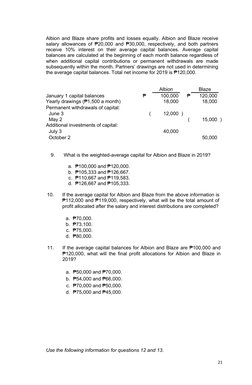
�Albion and Blaze share profits and losses equally. Albion and Blaze receive
salary allowances of ₱20,000 and ₱30,000, respectively, and both partners
receive 10% interest on their average capital balances. Average capital
balances are calculated at the beginning of each month balance regardless of
when additional capital contributions or permanent withdrawals are made
subsequently within the month. Partners’ drawings are not used in determining
the average capital balances. Total net income for 2019 is ₱120,000.
Albion Blaze
January 1 capital balances ₱ 100,000 ₱ 120,000
Yearly drawings (₱1,500 a month) 18,000 18,000
Permanent withdrawals of capital:
June 3 ( 12,000 )
May 2 ( 15,000 )
Additional investments of capital:
July 3 40,000
October 2 50,000
9. What is the weighted-average capital for Albion and Blaze in 2019?
a. ₱100,000 and ₱120,000.
b. ₱105,333 and ₱126,667.
c. ₱110,667 and ₱119,583.
d. ₱126,667 and ₱105,333.
10. If the average capital for Albion and Blaze from the above information is
₱112,000 and ₱119,000, respectively, what will be the total amount of
profit allocated after the salary and interest distributions are completed?
a. ₱70,000.
b. ₱73,100.
c. ₱75,000.
d. ₱80,000.
11. If the average capital balances for Albion and Blaze are ₱100,000 and
₱120,000, what will the final profit allocations for Albion and Blaze in
2019?
a. ₱50,000 and ₱70,000.
b. ₱54,000 and ₱66,000.
c. ₱70,000 and ₱50,000.
d. ₱75,000 and ₱45,000.
Use the following information for questions 12 and 13.
21
�Bloom and Carnes share profits and losses in a ratio of 2:3, respectively. Bloom
and Carnes receive salary allowances of ₱10,000 and ₱20,000, also
respectively, and both partners receive 10% interest based upon the balance in
their capital accounts on January 1. Partners’ drawings are not used in
determining the average capital balances. Total net income for 2019 is ₱60,000.
If net income after deducting the interest and salary allocations is greater than
₱20,000, Carnes receives a bonus of 5% of the original amount of net income.
Bloom Carnes
January 1 capital balances ₱ 200,000 ₱ 300,000
Yearly drawings (₱1,500 a month) 18,000 18,000
12. What are the total amounts for the allocation of interest, salary, and
bonus, and, how much over-allocation is present?
a. ₱60,000 and ₱0.
b. ₱80,000 and ₱20,000.
c. ₱83,000 and ₱0.
d. ₱83,000 and ₱23,000.
13. If the partnership experiences a net loss of ₱20,000 for the year, what
will be the final amount of profit or (loss) closed to each partner’s
capital account?
a. (₱30,000) to Bloom and ₱10,000 to Carnes.
b. (₱10,000) to Bloom and (₱10,000) to Carnes.
c. (₱8,000) to Bloom and (₱12,000) to Carnes.
d. ₱10,000 to Bloom and (₱30,000) to Carnes.
14. The XYZ partnership provides a 10% bonus to Partner Y that is based
upon partnership income, after deduction of the bonus. If the
partnership's income is ₱121,000, how much is Partner Y's bonus
allocation?
a. ₱11,000.
b. ₱11,450.
c. ₱11,650.
d. ₱12,100.
15. Drawings
a. are advances to a partnership.
b. are loans to a partnership.
c. are a function of interest on partnership average capital.
d. are the same nature as withdrawals.
16. If the partnership agreement provides a formula for the computation of
a bonus to the partners, the bonus would be computed
a. next to last, because the final allocation is the distribution of the
profit residual.
b. before income tax allocations are made.
c. after the salary and interest allocations are made.
22
� d. in any manner agreed to by the partners.
Use the following information for questions 17, 18 and 19.
Davis has decided to retire from the partnership of Davis, Eiser, and
Foreman. The partnership will pay Davis ₱200,000. Goodwill is to be
recorded in the transaction as implied by the excess payment to Davis. A
summary balance sheet for the Davis, Eiser, and Foreman partnership
appears below. Davis, Eiser, and Foreman share profits and losses in a ratio
of [Link], respectively.
Assets
Cash ₱ 75,000
Inventory 82,000
Marketable securities 38,000
Land 150,000
Building-net 255,000
Total assets ₱ 600,000
Equities
Davis, capital 160,000
Eiser, capital 140,000
Foreman, capital 300,000
Total equities ₱ 600,000
17. What goodwill will be recorded?
a. ₱40,000.
b. ₱120,000.
c. ₱160,000.
d. ₱200,000.
18. What partnership capital will Eiser have after Davis retires?
a. ₱100,000.
b. ₱140,000.
c. ₱180,000.
d. ₱220,000.
19. What partnership capital will Foreman have after Davis retires?
a. ₱240,000.
b. ₱300,000.
c. ₱360,000.
d. ₱420,000.
20. In partnership liquidations, what are safe payments?
a. The amounts of distributions that can be made to the partners,
after all creditors have been paid in full.
b. The amounts of distributions that can be made to the partners
with assurance that such amounts will not have to be returned to
the partnership.
c. The amounts of distributions that can be made to the partners,
23
� after all non-cash assets have been adjusted to fair market
value.
d. All the above are examples of the safe payments concept.
24
� ILLUSTRATIVE PROBLEM ANSWER KEY
Multiple Choice Questions
1. A
2. D
3. C
4. B
5. B
6. C The assets will be valued upward by ₱90,000 which, allocated
on a [Link] basis, yields ₱18,000 to McCune, ₱27,000 to Nall,
and ₱45,000 to Oakely.
7. D After the revaluation, the assets will be recorded at ₱602,500.
If Pavic is admitted for a one-fifth interest, the ₱602,500
represents 80% of the total implied capital. Dividing ₱602,500
by 80% gives a total capitalization of ₱753,150 for which
₱150,625 is required from Pavic for a 20% interest.
8. D Each of the original partners has given up 20% of their interest
to Pavic. Their profit and loss sharing ratios will therefore be
80% of what they were before the admission of Pavic.
McCune 20% x 80% = 16%
Nall 30% x 80% = 24%
Oakely 50% x 80% = 40%
Pavic = 20%
Expressed as: [Link]
9. C Albion: [(₱100,000 x 6) + (₱88,000 x 1) + (₱128,000 x 5)]/12
= ₱110,667
Blaze: [(₱120,000 x 5) + (₱105,000 x 5) + (₱155,000 x 2)]/12
= ₱119,583
10. B Capital: (₱112,000 + ₱119,000)x(10%) = ₱23,100
Salary: (₱20,000 + ₱30,000) = ₱50,000
Total: ₱23,100 + ₱50,000 = ₱73,100
11. B Albion: (₱100,000 x 10%) + ₱20,000 + ₱24,000 = ₱54,000
Blaze: (₱120,000 x 10%) + ₱30,000 + ₱24,000 = ₱66,000
12. B Interest: (₱500,000 x 10%) = ₱50,000
Salary: (₱10,000 + $20,000) = ₱30,000
Bonus: Condition not met = ₱0
Total allocations = ₱80,000 and over-allocations = ₱80,000 -
₱60,000 = ₱20,000
25
�13. B Bloom:
Interest allocation: ₱20,000
Salary allocation: ₱10,000
Carnes:
Interest allocation: ₱30,000
Salary allocation: ₱20,000
There is a total of ₱80,000 for positive allocations. To bring
them down to a ₱20,000 loss, a residual adjustment of
(₱100,000) is needed which is allocated (₱40,000) to Bloom
and (₱60,000) to Carnes. After these amounts are assigned
to the partners, each partner’s capital account will be
reduced by a net ₱10,000.
14. A B = .1x(₱121,000 - B)
B = ₱12,100 - .1B
1.1B = ₱12,100
B = ₱11,000
15. D
16. D
17. D
18. C
19. C
20. B
-END OF DISCUSSIONS-
26