0% found this document useful (1 vote)
387 views14 pages

Understanding Hydraulic Fracturing Process

Hydraulic fracturing, also known as fracking, is a process used to extract natural gas from shale rock formations deep underground. It involves drilling vertically until just below groundwater levels, then horizontally for up to a mile. Steel casing and cement are used to isolate the drilling from aquifers. A mixture of water, sand and chemicals is then pumped down at high pressure to fracture the shale and allow gas to flow up. The process is exempt from various environmental regulations and has led to concerns about groundwater contamination and land usage, as each fracking pad requires 5-8 acres and there are now over 6,000 wells drilled across Pennsylvania.

Uploaded by

api-284048334
Copyright
© © All Rights Reserved
We take content rights seriously. If you suspect this is your content, claim it here.
Available Formats
Download as PDF, TXT or read online on Scribd
0% found this document useful (1 vote)
387 views14 pages

Understanding Hydraulic Fracturing Process

Hydraulic fracturing, also known as fracking, is a process used to extract natural gas from shale rock formations deep underground. It involves drilling vertically until just below groundwater levels, then horizontally for up to a mile. Steel casing and cement are used to isolate the drilling from aquifers. A mixture of water, sand and chemicals is then pumped down at high pressure to fracture the shale and allow gas to flow up. The process is exempt from various environmental regulations and has led to concerns about groundwater contamination and land usage, as each fracking pad requires 5-8 acres and there are now over 6,000 wells drilled across Pennsylvania.

Uploaded by

api-284048334
Copyright
© © All Rights Reserved
We take content rights seriously. If you suspect this is your content, claim it here.
Available Formats
Download as PDF, TXT or read online on Scribd
  • Introduction: Introduces the topic of hydraulic fracturing with a leading question that sets the stage for subsequent explanations.
  • What is Hydraulic Fracturing?: Explains the basic concept and purpose of hydraulic fracturing technology to extract natural gas.
  • The Process Simplified: Details the simplified steps of the hydraulic fracturing process, describing the drilling and cementing methods.
  • Water Sources for Fracking: Addresses the origin of water used in the fracking process, raising questions about resource sourcing.
  • Fracturing Fluid Composition: Explores the components of fracturing fluid, focusing on the high water content and common additives.
  • Wastewater Disposal Methods: Discusses the disposal methods of fracking wastewater, including the containment and treatment processes.
  • Drilling Locations: Provides statistical information on drilling activities in Pennsylvania, including well counts and land use.
  • Impact on Land: Investigates the environmental impact of fracking on land, highlighting visible and potential changes.
  • Exemptions of Hydraulic Fracking: Lists the legislative exemptions that apply to hydraulic fracking, indicating regulatory aspects not enforced.
  • Contact and Queries: Provides contact information for further inquiries or discussion on the presentation topic.
  • References: Cites the sources referenced within the presentation, giving credit and providing further reading options.

What the Frack?

Hydraulic fracturing is the the most recent technology being


used to extract natural gas reserves.

https://www.google.com/search?q=hydraulic+fracturing&aq=0&um=1&ie=UTF8&hl=en&tbm=isch&source=og&sa=N&tab=wi&ei=vgZhUZzIHei40gGFzYDQDw&biw=1680&bih=959&sei=wAZhUY6iG86I0QGInYG4BQ#imgrc=XR2UmU9LDhaJ2M%3A%3BNk9QtVE_zZP7VM%3Bhttp%253A%252F%252Fwww.pioga.
org%252Fphoto_images%252F177_large.jpg%3Bhttp%253A%252F%252Fwww.pioga.org%252Fenvironment-safety%252Fhydraulic-fracturing%252F%3B1000%3B750

The Process Simplified

They begin this process by drilling a hole


just below the freshwater revivor, with
water and additives pumped into the hole
to cool the drill bit.

A steel pipe is then inserted down the


hole.

Once the pipe is in place, cement is forced


through the center of the pole.

A plug then pushes the cement out the


bottom and around the outside of the
pole.

http://www.youtube.com/watch?v=oHQu3SeUwUI

The Process Simplified

This process is what prevents


contamination of the freshwater aquifer.

The next step in this process is to drill


through the base of the hole, through the
plug.

At about 5,000 feet the drill bit then


begins to curve and will drill out to about a
mile horizontally.

The Process Simplified

The next step in this process is to drill


through the base of the hole, through the
plug.

At about 5,000 feet the drill bit then


begins to curve and will drill out to about
a mile horizontally.

Production casing is then inserted;


followed by cement.

A perforated gun is then sent down, by


wire.

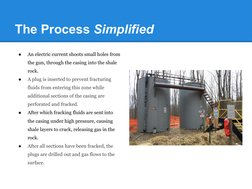
The Process Simplified

An electric current shoots small holes from


the gun, through the casing into the shale
rock.

A plug is inserted to prevent fracturing


fluids from entering this zone while
additional sections of the casing are
perforated and fracked.

After which fracking fluids are sent into


the casing under high pressure, causing
shale layers to crack, releasing gas in the
rock.

After all sections have been fracked, the


plugs are drilled out and gas flows to the
surface.

Where does the water come from?

How do they dispose of the frack


water?

Where are they drilling in PA?


As of August 2012

6,400 wells were drilled in


Pennsylvania
2,500 permits were provided
Roughly two wells per pad
Roughly 3,200 pads in
Pennsylvania
Each pad consumes
between 5-8 acres of land
APPROX 20,800 ACRES
OF LAND HAS BEEN
FRACKED ON

What happens to
the land?

Hydraulic Fracking is exempt from...

Comprehensive Environmental
Response, Compensation, and
Liability Act
Resource Conservation and
Recovery Act
Safe Drinking Water Act
Clean Water Act
Clean Air Act
National Environmental Policy
Act
Toxic Release Inventory under
the Emergency Planning and
Community Right-to-Know Act

Questions?
[email protected]

References
http://www.hydraulicfracturing.com/Process/Pages/information.aspx
http://www.energyfromshale.org/hydraulic-fracturing/hydraulic-fracturing-fluid
http://www.fractracker.org/2013/03/pa-gas-legislation/
http://electrictreehouse.com/notes-on-the-history-of-fracking/
http://exploreshale.org/#

What the Frack?
(https://www.google.com/search?q=hydraulic+fracturing&aq=0&um=1&ie=UTF-8&hl=en&tbm=isch&source=og&sa=N&tab=wi&ei=vgZhUZzIHei
The Process Simplified
●
They begin this process by drilling a hole 
just below the freshwater revivor, with 
water and addit
The Process Simplified
●
This process is what prevents 
contamination of the freshwater aquifer.
●
The next step in this proc
The Process Simplified
●
The next step in this process is to drill 
through the base of the hole, through the 
plug. 
●
At ab
The Process Simplified
●
An electric current shoots small holes from 
the gun, through the casing into the shale 
rock. 
●
A
Where does the water come from?
How do they dispose of the frack 
water?
Where are they drilling in PA?
As of August 2012
●
6,400 wells were drilled in 
Pennsylvania
●
2,500 permits were provided
●

You might also like