Skip to content
    Talk to an Expert
    Talk to an Expert

      Commercial Cylindrical Locks

      Talk To An Expert

      Grade 1 and Grade 2 Cylindrical Locksets for Commercial Doors

      A cylindrical lock, also called a bored lock, installs through two simple holes in the door: a cross bore for the lock body and an edge bore for the latch. That easy prep is why it is the most common commercial lockset on interior doors in schools, offices, and healthcare buildings. PDQ cylindrical locks cover Grade 1 and Grade 2, with the functions commercial doors need, from passage and privacy to classroom and storeroom.

      Every PDQ lever model complies with ADA, and every mechanical series carries a UL listing for 3-hour fire doors on single doors. Grade 1 GT and XGT locks are assembled in Lancaster, PA and backed by a 25-year (GT) or lifetime (XGT) limited warranty.

      Cylindrical Locks by Series

      Start with traffic. Grade 1 locks are built for high-use and exterior doors; Grade 2 locks cover lower-traffic interior doors at a lower cost. GT, XGT, and GP share the same levers and finishes, so you can mix grades in one building without a visual mismatch.

      PDQ GT Series Grade 1 cylindrical lock with Philadelphia lever
      Grade 1, Heavy Duty

      GT Series

      PDQ's standard Grade 1 cylindrical lock for busy commercial doors.

      • 2,200 lbf-in lever torque resistance, over 3x the ANSI/BHMA standard
      • Passage, privacy, classroom, storeroom, entrance, corridor, and more
      • Small format IC ready; large format IC with the Philadelphia lever

      Best for: Classrooms, offices, corridors, and exterior entrances

      PDQ XGT Series extra heavy duty Grade 1 cylindrical lock
      Grade 1, Extra Heavy Duty

      XGT Series

      The step up from GT for doors that take real abuse.

      • 3,000 lbf-in lever torque resistance, about 4x the ANSI/BHMA standard
      • Same levers, finishes, and functions as GT
      • Limited lifetime warranty

      Best for: Stairwells, high-abuse exterior doors, and vandal-prone openings

      PDQ GT135 LED classroom intruder cylindrical lock with red LED indicator
      Grade 1, Classroom Security

      135 Classroom Intruder Lock

      Lets staff lock the outside lever from inside the room with a key, without opening the door.

      • Optional red LED confirms the outside lever is locked at the push of a button
      • Complies with California Education Code (functions 135, 135LED, 145)
      • Available on the GT and XGT chassis

      Best for: K-12 classrooms, lecture halls, and offices that need lockdown

      PDQ GT276 indicator lock showing VACANT status
      Grade 1, Privacy Indicator

      GT276 Indicator Lock

      A Grade 1 privacy lock with an occupied/vacant indicator visible from outside the door.

      • Push button locks the outside lever; emergency release from outside
      • Unlocks by turning the inside lever or when the door closes
      • 3 lever styles, 5 finishes, 25-year limited warranty

      Best for: Single-occupant restrooms and private rooms in healthcare, education, and government buildings

      PDQ GP Series Grade 2 cylindrical lock with Philadelphia lever
      Grade 2, Heavy Duty

      GP Series

      A Grade 2 lock with the same trim as GT and XGT, for lower-traffic doors.

      • 1,500 lbf-in lever torque resistance, over 3x the ANSI/BHMA Grade 2 standard
      • 10 functions, including classroom and storeroom
      • 8-year limited warranty, assembled in Lancaster, PA

      Best for: Interior offices, conference rooms, and secondary classrooms in Grade 1 buildings

      PDQ SD Series Grade 2 cylindrical lock
      Grade 2, Standard Duty

      SD Series

      A value-engineered Grade 2 lock with the widest lever and backset choice.

      • 5 lever styles: Philadelphia, Boston, Miami, Memphis, Orlando
      • 2-3/8", 2-3/4", 3-3/4", and 5" backsets
      • Removable thru-bolts; IC ready (except Memphis lever)

      Best for: Interior commercial doors and retrofits with nonstandard backsets

      PDQ SF Series Grade 2 cylindrical lock
      Grade 2, Light Commercial

      SF Series

      PDQ's most cost-focused Grade 2 lock for high unit-count projects.

      • Passage, privacy, entrance, storeroom, and single dummy
      • Adjustable 2-3/8" to 2-3/4" backset; round or square rose
      • Grade 2 and UL listed when ordered with the fixed-backset UL latch

      Best for: Multifamily, student housing, senior living, and light commercial

      PDQ SX Series ball knob cylindrical lock
      Knob

      SX Series

      A ball knob lock that fits standard 160 or 161 door prep for knob-for-knob replacement.

      • 630 satin stainless, 5 standard functions, prepped for small format IC
      • UL listed for 3-hour single doors; 5-year limited warranty
      • Knob trim does not meet ADA; use levers on accessible routes

      Best for: Retrofit, repair, and replacement where knob hardware is allowed

      PDQ SV Series ball knob cylindrical lock
      Knob, Grade 2

      SV Series

      A Grade 2 ball knob lock for retrofits and lower-traffic doors.

      • 605, 613E, or 630; passage, privacy, classroom, storeroom, and more
      • Conventional cylinder or small format IC; UL listed for 3-hour single doors
      • Knob trim does not meet ADA; use levers on accessible routes

      Best for: Retrofits where knob hardware is allowed

      Compare PDQ Cylindrical Locks

      Model GradeKey FunctionsLever StylesFinishesIC Core ReadyWarranty
      GT 1Passage, privacy, entry, entrance, classroom, storeroom, corridor, communicating, intruder classroomPhiladelphia, Boston, Miami605, 606, 612, 613E, 619, 622, 625, 626Yes: SFIC; LFIC with Philadelphia25 yr
      XGT 1Same as GTPhiladelphia, Boston, MiamiSame as GTYes: SFIC; LFIC with PhiladelphiaLifetime
      135 Classroom 1Intruder classroom (F110), with or without LED indicatorPhiladelphia, Boston, MiamiSame as GTYes: SFIC; LFIC with Philadelphia25 yr (GT135), lifetime (XGT135); 2 yr LED electronics
      GT276 1Privacy with occupancy indicatorPhiladelphia, Boston, Miami605, 606, 613E, 622, 626No (non-keyed)25 yr
      GP 2Passage, privacy, entry, entrance, classroom, storeroom, communicating, dummyPhiladelphia, Boston, MiamiSame as GTYes: SFIC; LFIC with Philadelphia8 yr
      SD 2Passage, privacy, entry, entrance, classroom, storeroom, communicating, single dummyPhiladelphia, Boston, Miami, Memphis, Orlando605, 606, 613E, 622, 626Yes: SFIC (not Memphis); LFIC with Philadelphia5 yr
      SF 2 (fixed-backset latch)Passage, privacy, entrance, storeroom, single dummyPhiladelphia, Boston, Miami, Memphis, Orlando605, 606, 613E, 619, 622, 625, 626Yes: SFIC (not Memphis)3 yr
      SX 15 standard functionsBall knob (not ADA)630SFIC prepped standard5 yr
      SV 2Passage, privacy, entrance, classroom, storeroom, store door, communicating, dummyBall knob (not ADA)605, 613E, 630Yes: SFIC or conventional cylinder1 yr

      All mechanical series above are UL listed for 3-hour fire doors on single doors (SF with the UL latchbolt). Every lever model complies with ADA and ICC A117.1; ball knob models do not. Electrified and electronic versions: GT199 (25-year mechanical, 2-year electronic), GTS and SDS (see product pages for UL and warranty terms).

      Key: SFIC = small format interchangeable core (Best, Falcon, and Arrow compatible) · LFIC = Schlage-compatible large format interchangeable core.

      Ready to spec or order?Find A Sales Rep

      Need Certification Details?

      See every ANSI/BHMA, UL, and ADA listing for PDQ cylindrical locks and the rest of our hardware in one filterable matrix.

      PDQ GT Series Grade 1 cylindrical lock

      How to Choose a Commercial Cylindrical Lock

      A bright, empty school hallway with tan and blue tile walls, classroom doors on either side, and glass exit doors visible at the far end beneath hanging acoustic panels. The white PDQ star logo appears in the bottom right corner.


      Step 1

      Match the grade to the door's traffic

      ANSI/BHMA A156.2 grades cylindrical locks by cycle testing and strength. Grade 1 locks are tested to 1,000,000 cycles and belong on exterior doors, classrooms, corridors, and anything that sees heavy daily use. Grade 2 locks cover lower-traffic interior doors, like private offices and conference rooms, at a lower cost per opening. Because GT, XGT, and GP share the same levers and finishes, you can put Grade 1 where traffic demands it and Grade 2 everywhere else. See our guide to Grade 1 vs. Grade 2 door hardware. For Grade 2, see how the SD and SF Series compare.

      Not sure a cylindrical lock is the right body? A cylindrical lock mounts through a 2-1/8" bore and is the default for most commercial interior doors. A mortise lock sits in a pocket cut into the door edge, for heavier duty at a higher install cost (compare mortise and cylindrical locks). A tubular lock is a simpler, lighter-duty latch for interior doors, usually non-keyed (compare cylindrical and tubular locksets).

      PDQ GT135 LED classroom intruder lock

      Step 2

      Choose the function

      The function decides who can open the door, from which side, and how it locks. These six cover most commercial doors:

      • Passage (F75): never locks. Corridors, closets, and doors that only need to latch.
      • Privacy (F76): push button inside, emergency release outside. Restrooms. The GT276 adds an occupied/vacant indicator.
      • Office or entrance (F109): push-turn button inside, key outside. Private offices.
      • Classroom (F84): key outside locks the outside lever; the inside lever always opens the door.
      • Classroom intruder (F110): a key from inside or outside locks the outside lever, so a teacher never has to step into the hall. See PDQ's classroom lock with an LED lock indicator.
      • Storeroom (F86): outside lever is always locked; a key opens it. A storeroom lock is the right call for supply, mechanical, and IT rooms that should never be left unlocked by accident.

      PDQ XGT cylindrical lever lock in a satin finish installed on a wood door in a gray hollow metal frame, with the latch bolt visible on the door edge

      Step 3

      Pick the commercial door lever, finish, and fire rating

      On any door along an accessible route, ADA requires hardware you can operate without tight grasping or twisting. A commercial door lever meets that; a round knob does not, so reserve knob locks for retrofits where knobs are allowed. PDQ offers Philadelphia, Boston, and Miami levers across Grade 1 and 2, plus Memphis and Orlando on SD and SF. Satin chrome (626) is the most common commercial door handle finish, and 626 is available with an antimicrobial coating for healthcare.

      On a fire-rated door, the lock must be UL listed and latch every time the door closes. PDQ's mechanical cylindrical locks are UL 10C listed for 3-hour single doors up to 4' x 8'. For a pair of fire-rated doors, ask your rep about the 3/4" throw fire latch.

      PDQ small format interchangeable core with control key

      Step 4

      Decide on keying

      Keyed GT, XGT, GP, SD, and SF locks ship with a 6-pin cylinder keyed to 5 pins in a Schlage C compatible keyway, and can be keyed into an existing master key system. If you manage a lot of doors, choose interchangeable core (IC). With IC, you rekey by swapping the core with a control key in seconds instead of pulling the lock.

      GT, XGT, GP, SD, and SF accept 6- or 7-pin small format IC (Best, Falcon, and Arrow compatible), and GT, XGT, and GP accept Schlage-compatible large format IC with the Philadelphia lever. See PDQ key systems.

      Where PDQ Cylindrical Locks Fit

      University campus building

      Education

      Classroom doors need to lock fast without anyone stepping into the hall. Specify the 135 classroom intruder lock on instructional spaces, with the LED version where staff should confirm lock status at a glance. Use GT storeroom functions on supply and mechanical rooms, and the GT276 indicator lock on single-occupant restrooms.

      Aerial view of North Georgia Medical Plaza, a two-story stone and brick medical office building with a covered entrance canopy, large windows, and a landscaped parking lot surrounded by trees.

      Healthcare

      Healthcare doors cycle all day and get cleaned constantly. GT and XGT in 626 with the optional antimicrobial coating suit patient-facing doors, the GT276 shows occupancy on patient and staff restrooms, and storeroom functions secure medication and supply rooms.

      Carhartt corporate office building

      Commercial Offices

      Put GT on suite entries and high-traffic corridors, and GP on private offices and conference rooms for the same lever and finish at a lower cost. Where tenants need badge or phone access, the GTS and SDS add electronic access on the same cylindrical door prep.

      Cylindrical Lock FAQs

      What is a cylindrical lock?

      A cylindrical lock is a commercial lockset whose chassis mounts through a 2-1/8" hole bored through the door face, with the latch installed through a smaller hole in the door edge. It is also called a bored lock. Because the door prep is simple and standardized, cylindrical locks are the most common choice for commercial interior doors. PDQ makes Grade 1 and Grade 2 cylindrical locks in passage, privacy, classroom, storeroom, and other functions.

      What is the difference between Grade 1 and Grade 2 cylindrical locks?

      Both grades come from ANSI/BHMA A156.2. Grade 1 locks must pass 1,000,000 test cycles plus higher strength and torque tests, so they suit exterior doors, classrooms, and corridors. Grade 2 locks are tested to a lower standard and fit lower-traffic interior doors like private offices. For example, PDQ's Grade 1 GT resists 2,200 lbf-in of lever torque, and the Grade 2 GP resists 1,500 lbf-in. See our guide to Grade 1 vs. Grade 2 door hardware.

      What is the difference between a mortise lock and a cylindrical lock?

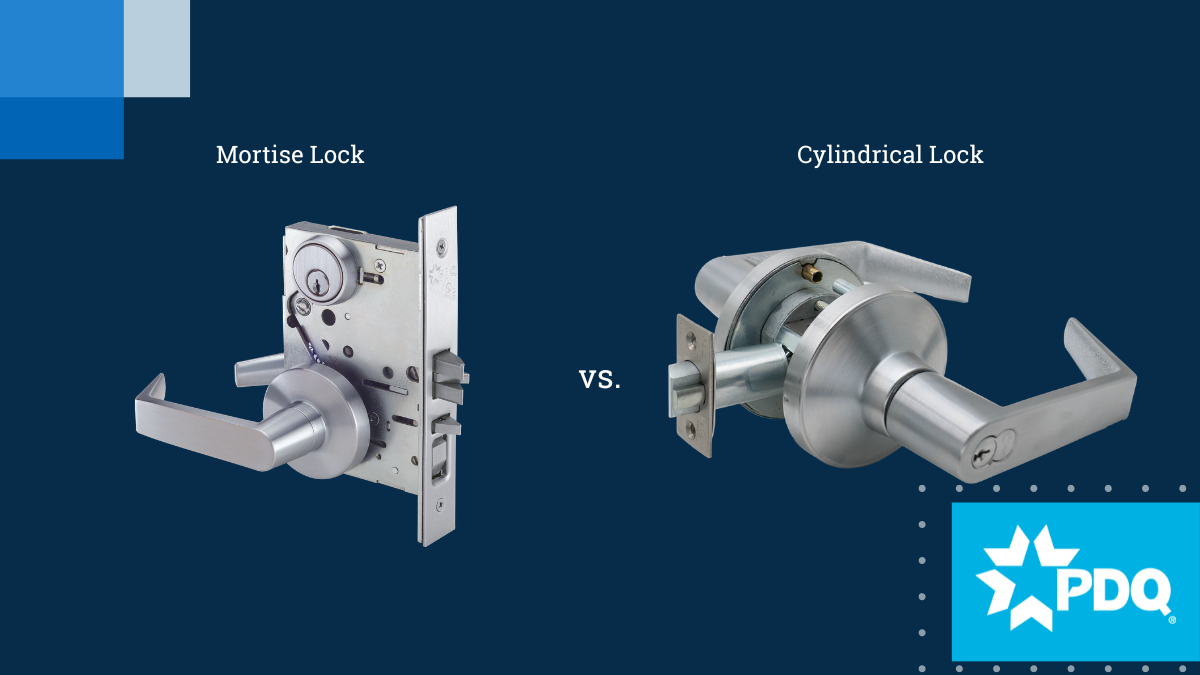
      A mortise lock sits in a pocket cut into the door edge, while a cylindrical lock mounts through two bored holes. Mortise locks are typically heavier duty and cost more to install; cylindrical locks are faster to install and easier to replace across many doors. Read our full mortise lock vs. cylindrical lock comparison.

      What is the difference between a cylindrical and a tubular lockset?

      Both install in a bored door, but they are built differently. A cylindrical lock has a chassis that carries the lever load and comes in Grade 1 and Grade 2 with keyed functions like classroom and storeroom. A tubular lock uses a simpler latch that connects the two sides through the bore, so it is lighter duty and most often used for non-keyed interior doors. See cylindrical vs. tubular locksets.

      Which lock function should I use for a classroom or storeroom door?

      For classrooms, a classroom intruder function (ANSI F110) lets a teacher lock the outside lever with a key from inside the room, without stepping into the hall. PDQ's 135 classroom lock offers that function with an optional LED that confirms the door is locked. A standard classroom function (F84) locks only from the outside. For storerooms, use the storeroom function (F86): the outside lever stays locked at all times and opens only with a key. Check local and state requirements with your authority having jurisdiction.

      Can PDQ cylindrical locks use interchangeable cores?

      Yes. GT, XGT, 135, GP, SD, SF, and SV accept small format interchangeable cores compatible with Best, Falcon, and Arrow (not with the Memphis lever on SD and SF). GT, XGT, and GP also accept Schlage-compatible large format IC with the Philadelphia lever. The SX ships prepped for small format IC, and the GT276 privacy lock is non-keyed.

      Cylindrical Lock Guides

      Cylindrical lock vs. mortise lock
      Guide

      Mortise Lock vs. Cylindrical Lock: Which Do You Need?

      Two PDQ employees assembling lock hardware components on a factory workbench, with bins of parts and a cordless drill in use.
      Guide

      A Guide to ANSI Grade 1 vs. Grade 2 Door Hardware

      www.pdqlocks.comhubfsSchool Safety Blog Header-1
      Guide

      Enhancing School Safety with Advanced Hardware Solutions

      Complete the Opening

      A lock is one part of the door. Pair it with PDQ mortise locks and key systems, consider an interconnected or tubular lock where it fits better, or add access control with an electrified or electronic cylindrical lock. Or browse the full PDQ product catalog.

      PDQ MR Series Mortise Lock with a sleek, polished handle and robust design, showcasing high-quality craftsmanship and durability.

      Mortise Locks

      MR Series mortise locks for main entrances, stairwells, and the doors that see the most use.

      SFIC Key & Core

      Key Systems

      Conventional cylinders, small and large format interchangeable cores, and high security keyways.

      PDQ CL Series interconnected lock

      CL Interconnected Lock

      Grade 2 latch and deadbolt in one unit; turning the inside lever retracts both. Matches SD trim.

      PDQ TJ Series tubular lock

      TJ Tubular Lock

      Non-keyed interior functions (passage, privacy, communicating, dummy) with lever styles that match the MR mortise lock.

      PDQ GT199 electrified cylindrical lock

      Electrified Cylindrical Lock

      The GT199 adds hardwired access control to the Grade 1 GT chassis, field-changeable fail safe or fail secure.

      PDQ Spirit GTS electronic cylindrical lock

      Electronic Cylindrical Locks

      Wireless Spirit GTS and SDS locks with card, phone, PIN, and key access. No wiring needed.

      Need Help Choosing a Cylindrical Lock?

      Tell us about your project and a PDQ rep will help you match locks and functions to your doors, set up keying, and get submittals and pricing.