
 Live Science Plus


Pangaea: Discover facts about Earth's ancient supercontinent
Pangaea is Earth's most recent supercontinent, which existed 320 million to 195 million years ago.


Marilyn Perkins

Pangaea was a massive supercontinent that formed between 320 million and 195 million years ago. At that time, Earth didn't have seven continents, but instead one giant one surrounded by a single ocean called Panthalassa.
The explanation for Pangaea's formation ushered in the modern theory of plate tectonics, which posits that the Earth's outer shell is broken up into several plates that slide over Earth's rocky shell, the mantle.
Over the course of the planet's 4.5 billion-year history, several supercontinents have formed and broken up, a result of churning and circulation in the Earth's mantle, which makes up 84% of the planet's volume, according to the U.S. Geological Survey. This breakup and formation of supercontinents has dramatically altered the planet's history.

"This is what's driven the entire evolution of the planet through time. This is the major backbeat of the planet," said Brendan Murphy, a geology professor at the St. Francis Xavier University, in Antigonish, Nova Scotia.
Pangaea is the most recent supercontinent to exist, with Rodinia and Columbia (also known as Nuna) coming before it. A huge landmass called Gondwana also existed before becoming part of Pangaea, but whether or not it can be classified as a supercontinent is debated.

Brendan Murphy is a geology professor at St. Francis Xavier University in Novia Scotia, Canada. Some of his research focuses on how mountains are formed and the connection between tectonic plate movement and igneous processes, which relate to the behavior, formation and movement of magma and lava.
What evidence do scientists have for Pangaea’s existence?
More than a century ago, the scientist Alfred Wegener proposed the notion of an ancient supercontinent, which he named Pangaea (sometimes spelled Pangea), after putting together several lines of evidence. The word "Pangaea" comes from the Greek "pan," which means "all," and "gaia" or "Earth," according to the Online Etymology Dictionary.
Pangaea formed between 320 million and 195 million years ago
The first and most obvious clue about Pangaea's existence was that the "continents fit together like a tongue and groove," something that was quite noticeable on any accurate map, Murphy said. Another telltale hint that Earth's continents were all one land mass comes from the geologic record. Coal deposits found in Pennsylvania have a similar composition to those spanning across Poland, Great Britain and Germany from the same time period. That indicates that North America and Europe must have once been a single landmass. And the orientation of magnetic minerals in geologic sediments reveals how Earth's magnetic poles migrated over geologic time, Murphy said.
Get the world’s most fascinating discoveries delivered straight to your inbox.
In the fossil record, identical plants, such as the extinct seed fern Glossopteris, are found on now widely disparate continents. And mountain chains that now lie on different continents, such as the Appalachians in the United States and the Atlas Mountains spanning Morocco, Algeria and Tunisia were all part of the Central Pangaea Mountains, formed through the collision of the supercontinents Gondwana and Laurussia.

The formation of the continents by the separation of Pangaea due to continental drift.
How was Pangaea formed?
The supercontinent formed through a gradual process spanning a few hundred million years.
Tectonic plate movement is the reason why Pangaea formed, broke up, and why continents still shift positions today. Earth's outermost layer is composed of several tectonic plates, which glide over the interior layer of earth called the mantle. As these plates move around, they can cause landmasses to inch together, break apart, and transform.
The Pangaea timeline spans hundreds of millions of years. In the early Phanerozoic eon (541 million years ago to now), almost all of the continents were in the Southern Hemisphere, with Gondwana, the largest continent, spanning from the South Pole to the equator, according to a chapter in the scientific book "Ancient Supercontinents and the Paleogeography of Earth" (Elsevier, 2021). The Northern Hemisphere was largely covered by the Panthalassic Ocean. Another ocean — called Iapetus, after a mythical Greek titan — between the paleo-continents Laurentia, Baltica and Gondwana, began to close during the Ordovician period (485 million to 444 million years ago) and then disappeared during the Silurian period (444 million to 419 million years ago), when Baltica and Avalonia collided with Laurentia to form Laurussia, according to the chapter, "Phanerozoic paleogeography and Pangea."
Finally, about 320 million years ago, there was a major geological collision, geologically speaking, as Gondwana, Laurussia, and other nearby landmasses smashed together and created Pangaea.
However, the supercontinent of Pangaea wasn't quite as big as most people think it was. "Pangea never included all the continents at any one time," according to the chapter. For instance, during the Carboniferous period (359 million to 299 million years ago) the Paleotethys ocean divided Pangaea from Asian landmasses to the east including Tarim, North China, South China, and Annamia.
Later, during the Permian period (299 million to 251 million years ago), "many former peri-Gondwanan terranes drifted off the north-east Gondwana margin, commencing the opening of the Neotethys Ocean," according to the chapter.
How and when did Pangaea break apart?

The movement of mainlands on the planet Earth in different periods from 225 million years ago to present due to continental drift.
Pangaea broke up in several phases between 195 million and 170 million years ago. The breakup began in the early Jurassic period, when the Central Atlantic Ocean opened, according to the chapter. The supercontinent fractured largely along previous sutures.
Gondwana (what is now Africa, South America, Antarctica, India and Australia) first split from Laurasia (Eurasia and North America). Then about 150 million years ago, Gondwana broke up. India peeled off from Antarctica, and Africa and South America rifted, according to a 1970 article in the Journal of Geophysical Research. Around 60 million years ago, North America split off from Eurasia.

An animation of Africa and South America drifting apart.
What was Pangaea's climate like?
Having one massive landmass made for very different climatic cycles. For instance, the interior of the continent may have been utterly dry, as it was locked behind massive mountain chains that blocked all moisture or rainfall, Murphy said.
But the coal deposits found in the United States and Europe reveal that parts of the ancient supercontinent near the equator must have been a lush, tropical rainforest, similar to the Amazonian jungle, Murphy said. (Coal forms when dead plants and animals sink into swampy water, where pressure and water transform the material into peat, then coal.)
"The coal deposits are essentially telling us that there was plentiful life on land," Murphy told Live Science.
Climate models confirm that the continental interior of Pangaea was extremely seasonal, according to a 2016 article in the journal Palaeogeography, Palaeoclimatology, Palaeoecology. The researchers in this study used biological and physical data from the Moradi Formation, a region of layered paleosols (fossil soils) in northern Niger, to reconstruct the ecosystem and climate during the time period when Pangaea existed. Comparable with the modern-day African Namib Desert and the Lake Eyre Basin in Australia, the climate was generally arid with short, recurring wet periods that occasionally included catastrophic flash floods.
The climate also influenced where animals lived. During the late Triassic, Reptile-like animals in the family Procolophonidae lived in one region, while mammal relatives, known as cynodonts, lived in another, a 2011 study in the journal Proceedings of the National Academy of Sciences found. Cynodonts inhabited one tropical area of Pangaea, where monsoon-like rains fell twice a year. Up north, procolophonids lived in temperate regions where it only rained once a year. It's likely that the cynodonts needed a water-rich area, which restricted their movements on Pangaea, the researchers said.
"It's interesting that something as basic as how the body deals with waste can restrict the movement of an entire group," Whiteside said in a statement. In drier areas, "the reptiles had a competitive advantage over mammals," which is likely why they stayed there, Whiteside said.

A graphic depiction of what the supercontinent Pangaea would have looked like.
What animals lived on Pangaea?
Pangaea existed for more than 100 million years, and during that time many animal groups thrived. During the Permian period, insects such as beetles and dragonflies flourished, as did the predecessors of mammals, the synapsids. But the existence of Pangaea overlapped with the worst mass extinction in history, the Permian-Triassic (P-TR) extinction event. Also called the Great Dying, it occurred around 252 million years ago and caused 96% of all marine species and around 70% of terrestrial species to go extinct, according to the Geological Society of America.
The early Triassic period saw the rise of archosaurs, a group of animals that eventually gave rise to crocodiles, birds and a plethora of reptiles, including pterosaurs. And about 230 million years ago some of the earliest dinosaurs emerged on Pangaea, including theropods, largely carnivorous dinosaurs that mostly had air-filled bones and feathers similar to birds.

Frequently mistaken for a dinosaur, this animal — called dimetrodon — was a synapsid, and died out 40 million years before the first dinosaurs appeared. It lived during the early Permian period.
How did Pangaea impact evolution?
Supercontinents like Pangaea likely played a key role in fueling the diversity of life on Earth.
While Pangaea existed, land bridges between regions provided critical migration pathways for different species. These bridges allowed species, including early dinosaurs, to move across the continent and adapt to local environments. These migration corridors were crucial for the development of diverse ecosystems within the supercontinent, as species could spread quickly to favorable regions.
After Pangaea broke apart, landmasses and the animals on them became more isolated. Over millions of years, these isolated populations followed divergent evolutionary paths. This phenomenon, called allopatric speciation, allowed unique species to arise on different continents. One example of this diversification is seen in the evolution of marsupials in what is now Australia. After Gondwana split into smaller landmasses, including South America, Africa, and Australia, the animals on each continent evolved independently. Marsupials in Australia adapted to unique niches in their isolated environment, developing into a variety of forms, from kangaroos to koalas, that were distinct from mammals on other continents.
Will there be another supercontinent like Pangaea?
The current configuration of continents is unlikely to be the last. Supercontinents have formed several times in Earth's history, only to be split off into new continents. Right now, Australia is inching toward Asia, and the eastern portion of Africa is slowly peeling off from the rest of the continent.
Based on the emergence of other supercontinents in the Precambrian supereon (4.5 billion to 541 million years ago), it appears that supercontinents occur periodically every 750 million years, according to a 2012 study in the journal Gondwana Research.
Most scientists believe that the supercontinent cycle is largely driven by circulation dynamics in the mantle, according to a 2010 article in the Journal of Geodynamics.
Beyond that, the details get fuzzy. While the heat formed in the mantle likely comes from the radioactive decay of unstable elements, such as uranium, scientists don't agree on whether there are mini-pockets of heat flow within the mantle, or if the entire shell is one big heat conveyor belt, Murphy said.
Current research on Pangaea
Scientists have created mathematical, 3D simulations to better understand the mechanisms behind continental movement. In a 2018 article in the journal Geoscience Frontiers, Earth scientists Masaki Yoshida and M. Santosh explained how they produced simulations of large-scale continental movements since the breakup of Pangaea about 200 million years ago. The models show how tectonic plate motion and mantle convection forces worked together to break apart and move large land masses. For example, Pangaea's large mass insulated the mantle underneath, causing mantle flows that triggered the initial breakup of the supercontinent. Radioactive decay of the upper mantle also raised the temperature, causing upward mantle flows that broke off the Indian subcontinent and initiated its northern movement.
Yoshida and Santos created additional geological models to predict mantle convection and continental movement patterns 250 million years in the future. These models suggest that over millions of years, the Pacific Ocean will close as Australia, North America, Africa, and Eurasia come together in the Northern Hemisphere. Eventually, these continents will merge, forming a supercontinent called "Amasia." The two remaining continents, Antarctica and South America, are predicted to remain relatively immobile and separate from the new supercontinent.
Another proposed supercontinent, dubbed Pangaea Ultima, has also been suggested. This would involve the Atlantic and Indian oceans closing up and joining the Americas to Europe and Africa, eventually connecting all Earth's landmasses.
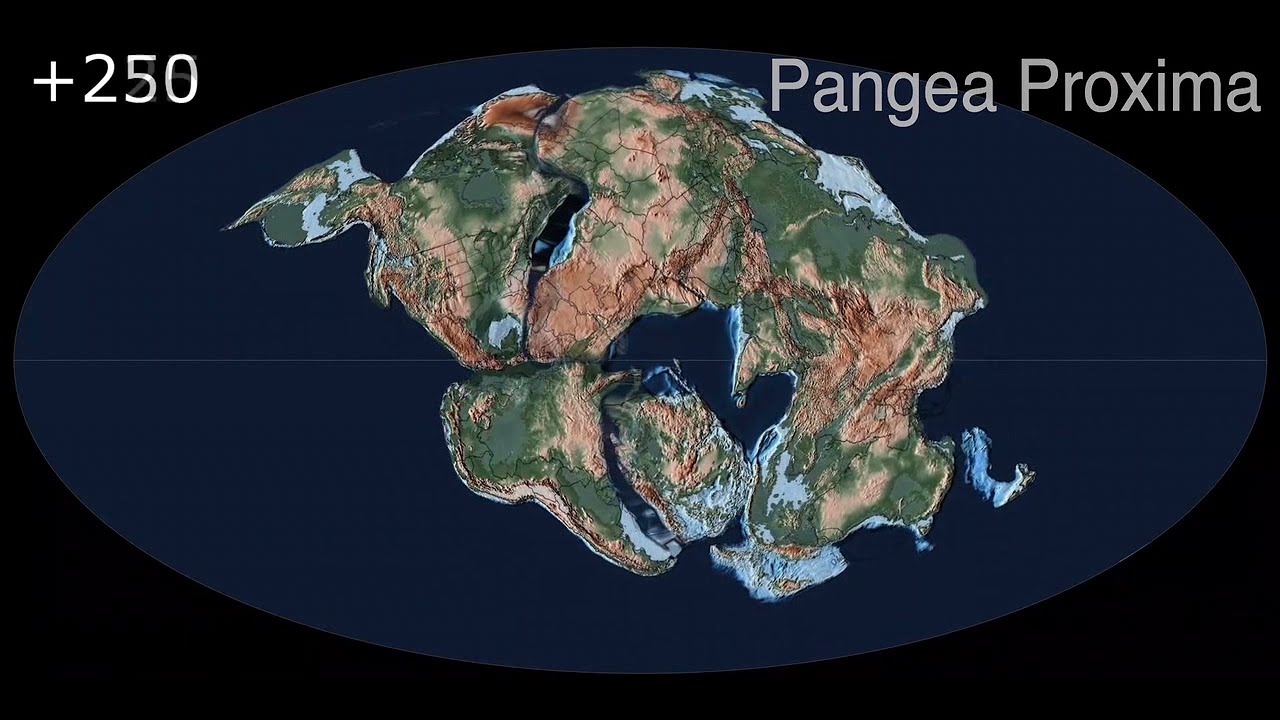
Should Pangaea Ultima — also known as Pangaea Proxima — form, Earth would likely become inhabitable for mammals, according to research published in 2023 in the journal Nature Geoscience. The researchers modelled the climatic conditions on the proposed supercontinent and found it would be far hotter than Earth today.
The large landmass would lack the cooling effect from the ocean, while the aging sun would be more active, leading to Earth absorbing more radiation from it. Finally volcanic activity driven by the merging continents would result in a massive spike in CO2. From this, they calculated that just 8% of Pangaea Ultima would be habitable for mammals.
"While there are some very specialist mammals today that can inhabit regions such as the Sahara, it remains to be seen whether these mammals would become preferentially selected and descendants would reradiate into Pangaea Ultima and dominate," first-author Alexander Farnsworth, a climatologist at the University of Bristol in the U.K. told Live Science at the time. "Perhaps reptiles are better adapted? Or something completely different?"
Additional reporting by Carol Stoll, Live Science contributor
Additional resources
Enroll in the free online Coursera course "Our Earth: Its Climate, History, and Processes" offered by the University of Manchester in the U.K. You can also learn more about plate tectonics from the U.S. Geological Survey's online text,"This Dynamic Earth: The Story of Plate Tectonics. And check out this interactive map that shows where modern countries could have sat on the Pangaea supercontinent.

Laura is the managing editor at Live Science. She also runs the archaeology section and the Life's Little Mysteries series. Her work has appeared in The New York Times, Scholastic, Popular Science and Spectrum, a site on autism research. She has won multiple awards from the Society of Professional Journalists and the Washington Newspaper Publishers Association for her reporting at a weekly newspaper near Seattle. Laura holds a bachelor's degree in English literature and psychology from Washington University in St. Louis and a master's degree in science writing from NYU.
- Marilyn PerkinsContent Manager