



"Let’s see if you can identify the ingredients,” says Friar Marcus, the history expert at Anantara Convento di Amalfi Grand Hotel on Italy’s Amalfi Coast. The bartender pours a shot of the pale, straw-coloured liqueur in my glass. I take a sniff and can straightaway identify the primary ingredient.
“Fennel,” I say. Friar Marcus looks surprised (and impressed). He doesn’t know that saunf is a common digestive in India and that I grew up chewing fennel seeds after most meals. I also identify basil and juniper. The amaro masterclass is going rather well, if I say so myself.
Amaro is an herbal liqueur commonly consumed as a digestif in Italy. Digestifs are less about drinking and more about extending a meal. After long lunches and late dinners, it is common for restaurants to offer a small glass of amaro, limoncello, grappa or another house speciality.
Some Italians swear by specific amaros for digestion, while others simply drink them out of habit and pleasure.
Every region has its favourites, often linked to local herbs and recipes passed through the generations. The word “amaro” translates to bitter, and the drink is a bittersweet one with high alcohol content, typically 16-40%. Italy has many well-known commercial amaro brands such as Ramazzotti, Fernet-Branca and Montenegro, but what I’m tasting is the bespoke Amaro Dei Cappuccini made by Friar Marcus for Anantara Convento di Amalfi Grand Hotel.
Perched on a vertical cliff face overlooking the town of Amalfi, the hotel is housed in what used to be a monastery dating back to 1212. It then became a Cistercian Abbey and eventually a Capuchin convent in 1583. In the 19th century, the convent was given to a local noble family and later converted into the Cappuccini Hotel in 1882—with the monks’ quarters repurposed into guest rooms and the original chapel and cloister ruins retained. The hotel was renovated in 2023 under the Anantara brand. The amaro I taste is but a natural progression.
In medieval times, monasteries maintained extensive herb gardens, and the monks skillfully mixed various medicinal herbs to produce healing concoctions for everything from digestive issues to malaria. Friar Marcus explains that his amaro is based on a recipe he found in a 13th-century book in the library of this very convent. He shows me a scan of the original manuscript, written in Latin, on his phone.
It took him nearly a year of experimenting with the monks’ recipe to find the exact proportions to make an amaro suitable to modern palates. He dropped the bay laurel leaf from the original recipe as it gave the amaro an unappetising taste.
The Amaro Dei Cappuccini was created in 2024 and contains only five botanicals: wild fennel, myrtle, olive leaves, juniper, and basil picked from the hotel’s garden. These are macerated in alcohol, steeped for two weeks to one month, and mixed with about 100g of sugar per litre.
“Each ingredient has its purpose, like fennel for digestion, basil for its disinfectant properties, olive leaves protecting the liver, and myrtle protecting the stomach from acids,” explains Friar Marcus. The resultant liqueur has 30% ABV and a bittersweet taste with top notes of fennel.
I try it neat at room temperature, then chilled, and finally with a large cube of clear ice, the flavours getting more pronounced with each iteration. Amaro is certainly an acquired taste. The bitterness can feel sharp at first sip, but linger long enough and softer notes begin to emerge, like citrus, herbs and sweetness.
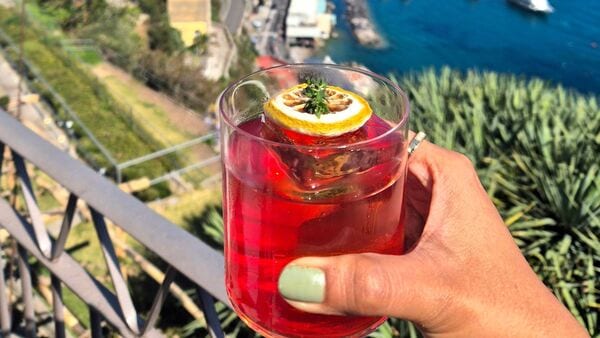
Amaro cocktails are popular in Italy, and the hotel’s bar manager Luigi Gallo mixes up one of his signatures for me. Amalfitano has Amaro Dei Cappuccini, Campari, sweet vermouth and sparkling lemonade made from Amalfi sfusato lemon (the iconic Amalfi Coast elongated lemon with tapered edges).
The drink is a take on the classic Americano (Campari, sweet vermouth and club soda) but is much more complex with the addition of amaro. The fizzy lemonade makes it quite refreshing, and perfect for the unusually warm early April afternoon. I take it out on the restaurant’s terrace where the bright-red drink looks picture-perfect against the cobalt-blue Tyrrhenian Sea framed by Amalfi’s pastel-hued cliffside facades.
As I sip the cocktail, I think about the Italian saying dolce far niente, the sweetness of doing nothing. I put away my phone, kick off my shoes and curl up in my seat, gazing out at the impossibly beautiful view in front of me.
It’s almost 4pm, a slight breeze swirls in from the sea, and the heady aroma of lemons from nearby trees fills the air. In that moment, I understand the phrase, it’s all about sweet idleness, albeit with a bittersweet drink in my hand.
Prachi Joshi is a Mumbai-based travel and food writer.