- 函数式编程教程
 《函数式编程入门教程》
 字符串(Strings)

字符串是一组包含空格的字符,我们可以说它是一维字符数组,以NULL字符(\\0)结尾。字符串也可以视为预定义的类,大多数编程语言都支持该类,如C,C++,Java,PHP,Erlang,Haskell,Lisp等。
下图显示了字符串" Tutorial"在内存中的外观。
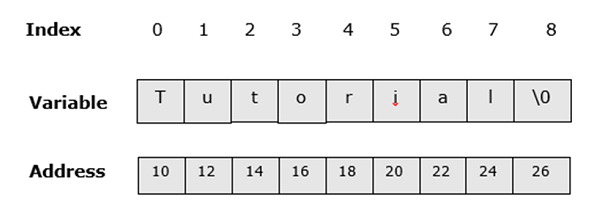
C++创建字符串
下面的程序是一个示例,显示了如何使用C ++创建字符串,C ++是一种面向对象的编程语言。
#include <iostream>
using namespace std;

int main () {
   char greeting[20] = {'H', 'o', 'l', 'i', 'd', 'a', 'y', '\0'};
   cout << "Today is: ";
   cout << greeting << endl;
   return 0;
}
Today is: Holiday
Erlang中的字符串
以下程序是一个示例,显示了如何在Erlang(一种函数编程语言)中创建字符串。
-module(helloworld).
-export([start/0]).
start() ->
   Str = "Today is: Holiday",
   io:fwrite("~p~n",[Str]).
"Today is: Holiday"
C++字符串运算
不同的编程语言在字符串上支持不同的方法。下表显示了C ++支持的一些预定义的字符串方法。
| S.No. | Method & 描述 |
|---|---|
| 1 | Strcpy(s1,s2) 它将字符串s2复制到字符串s1中 |
| 2 | Strcat(s1,s2) 它将字符串s2添加到s1的末尾 |
| 3 | Strlen(s1) 它提供字符串s1的长度 |
| 4 | Strcmp(s1,s2) It returns 0 when string s1 & s2 are same |
| 5 | Strchr(s1,ch) 它返回指向字符串s1中字符ch的第一个出现的指针 |
| 6 | Strstr(s1,s2) 它返回一个指向字符串s1在字符串s1中首次出现的指针 |
以下程序显示了如何在C ++中使用上述方法-
#include <iostream>
#include <cstring>
using namespace std;

int main () {
   char str1[20] = "Today is ";
   char str2[20] = "Monday";
   char str3[20];
   int  len ;
   strcpy( str3, str1); //copy str1 into str3
   cout << "strcpy( str3, str1) : " << str3 << endl;

   strcat( str1, str2); //concatenates str1 and str2
   cout << "strcat( str1, str2): " << str1 << endl;

   len = strlen(str1);  //String length after concatenation
   cout << "strlen(str1) : " << len << endl;
   return 0;
}
strcpy(str3, str1)   :  Today is
strcat(str1, str2)   :  Today is Monday
strlen(str1)         :  15
Erlang字符串操作
下表显示了Erlang支持的预定义字符串方法的列表。
| S.No. | Method & 描述 |
|---|---|
| 1 | len(s1) 它将字符串s2提供给字符串s1 |
| 2 | equal(s1,s2) |
| 3 | concat(s1,s2) 它在字符串s1的末尾添加字符串s2 |
| 4 | str(s1,ch) 返回字符串s1中字符ch的索引位置 |
| 5 | str(s1,s2) 它返回字符串s1中s2的索引位置 |
| 6 | substr(s1,s2,num) 此方法根据起始位置和起始位置的字符数从字符串s1返回字符串s2 |
| 7 | to_lower(s1) 此方法以小写形式返回字符串 |
以下程序显示了如何在Erlang中使用上述方法。
-module(helloworld).
-import(string,[concat/2]).
-export([start/0]).
   start() ->
   S1 = "Today is ",
   S2 = "Monday",
   S3 = concat(S1,S2),
   io:fwrite("~p~n",[S3]).
"Today is Monday"
祝学习愉快!(内容编辑有误?请选中要编辑内容 -> 右键 -> 修改 -> 提交!)