Chicago; about 70 local software developers turned out. Chicago is a great city for architecture. Much better than New York. Here they build skyscrapers just because they love them.
 Can I talk about hotels for a minute? There are about a million different ways to rate hotels. That makes user review sites, like TripAdvisor, somewhat hit-or-miss. One person’s hovel may be another person’s palace.
I’m sad to say that the Congress Plaza Hotel where we did the event at this morning does not qualify as anyone’s palace. The usual nice words you might use to describe such a hotel would be “threadbare” or “shabby.” Other words (“maccabre,” “Barton Fink,” and “scuzzy”) come to mind. This was entirely my fault; I set a target budget for hotels in each city and didn’t do the research to make sure the hotels would be entirely nice.
I’ll bet you can tell almost everything you need to know about the quality of a hotel based on how often they replace the sheets and towels. Another good indicator, for some bizarre reason, is plasma TVs. The nice chains, inexplicably, have old fashioned big-ass tube TVs. The ancient rotting edifices have 32” plasmas. I don’t know why this is. Maybe they think that having a plasma TV they can advertise on their web site will make them seem fancy.
 Anyway, the Congress Plaza Hotel is the kind of 850 room monstrosity that Lot Polish Airlines would fill up with a 777 full of passengers, on their way to Warsaw, if the plane was stuck in Chicago overnight due to mechanical failure.
Oh. And the staff was actually on strike. So people coming to the demo had to cross a picket line. I’m sorry about that. I never thought to ask if there was a strike at the time we booked. I guess shabby hotels just treat their employees shabbily. Apparently Chicago considered passing a law requiring hotels to tell people about these strikes when they booked rooms and meetings. It didn’t pass.
The lesson from Chicago is that using cheap hotels is not a good idea for business meetings. Psychologically, I think that people tend to associate the environment they’re in with the presentation. When a demo is in a modern, new, shiny business hotel, it’s like a little one hour vacation in luxuryland. You go to the bathroom and it’s marble everywhere and individual cloth hand towels. And you think nice things about the demo. But when you go to a demo at the Congress Plaza and the rug is stained and there are fluorescent lights everywhere and the bathroom looks like LaGuardia airport, some of that general depressing aura of shabbiness will rub off on the product being presented.
 After the demo was over I walked two blocks south to the Hilton where the Inc. 500 Conference was in progress. There I spoke to a bunch of small companies about how we hire people at Fog Creek. A lot of the material I talked about is available on this site, as a series of articles I wrote about a year ago:
- Finding Great Developers
- A Field Guide to Developers
- Sorting Resumes
- The Phone Screen
- The Guerrilla Guide to Interviewing
You can get the whole series plus one bonus chapter in book form, as well.

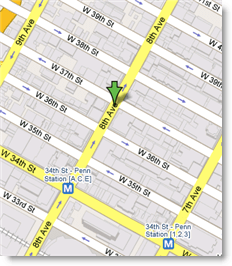
I’m flying back to New York now, on We’ve Pretty Much Just Given Up Airlines. On Monday morning, if you’re in the city, please join me and the FogBugz development team at 9:00am for the FogBugz 6.0 World Launch, at the New York Marriott East Side Hotel. It’s free, but you have to register to reserve a space.
 A bunch of Microsoftees had to cancel because they are having their annual company meeting today in a gigantic football stadium. The size of that company is insane. Can you imagine Safeco Field filled to the brim with software developers? And that’s just the Vista Shutdown Menu Team.
 Design is the art phase, where you’re doing new, creative work. Even though what you’re doing is completely new, after you’ve gone through a few software development cycles you’ll start to get a pretty good idea of how much time it takes to design a new version of your software. I’ve usually worked with relatively long development cycles of 12-18 months, and it’s always taken me about two months to get a detailed, first-draft spec containing enough detail for the development team to create very granular estimates.
 Debugging is the science phase. Science is difficult to schedule because you’re looking for things, and predicting when you’re going to find them is remarkably difficult. Unless you know in advance how many bugs you’re going to find, you don’t have an ice cube’s chance in the Sahara to work out a detailed estimate of how long this phase will take. Here at Fog Creek we’ve learned that for a new release of FogBugz, this phase takes at least 12 weeks, sometimes a little more, and we just leave it at that.
 The demo went relatively smoothly, despite a few first-time kinks. At some point I was fiddling around so much with the report generator that I queued up a backlog of lengthy Monte Carlo simulations on the web server which made FogBugz lose interest in continuing with the demo; this not the kind of thing that happens in production web servers (part of the problem is that the laptop is running XP which has a kind of 3/4-baked implementation of IIS, version 5.1, which is not what anyone would run on a real server). Anyway, I had to restart IIS in the middle of the demo. Ooops. Hopefully that won’t happen again.
 The night before, in rehearsals, I discovered that the Fn+F7 trick that is supposed to turn on external monitors on this Thinkpad was actually freezing the computer solid, due to some kind of buggy interaction between the Intel 965 graphics chip software and the IBM/Lenovo Presentation Director software. I never did solve that problem, so I learned to use the Intel software to turn on the external monitor instead of pressing Fn+F7.
 Flying in September after Labor Day is really not that bad, despite the scare stories you might have heard in the press; once everyone gets home from summer vacations the number of passengers in airports and on flights drops quite dramatically and flights start operating closer to schedule with much shorter lines. So far I don’t think we’ve waited in one line at an airport. Here are my favorite tricks for planning air travel to avoid chaos, delays, and cancellations:
 If the flight you’re booked on is cancelled, don’t wait in line with the crowds for the single, overworked airline representative. Get on the phone to your airline’s frequent flyer priority number. They can rebook you just as well.
 I’ve been using Vista on my home laptop since it shipped, and can say with some conviction that nobody should be using it as their primary operating system — it simply has no redeeming merits to overcome the compatibility headaches it causes. Whenever anyone asks, my advice is to stay with Windows XP (and to purchase new systems with XP preinstalled).
 A long long time ago when Windows 3.0 first came out, Microsoft organized a huge, permanent “Windows Seminar” team of intelligent, charismatic young people who went from city to city giving demos of Windows, Word, and Excel. Back then, showing someone cut and paste from one GUI window to another was astonishing.
 Very little has been finalized, but it looks like the first round will hit Vancouver, Seattle, Chicago, New York, Princeton, Philadelphia, Boston, Toronto, Waterloo, Washington, Atlanta, Dallas, Austin, Denver, San Francisco, Berkeley, Newark (CA), Mountain View, Santa Monica, Irvine, and San Diego. The second round will hit Auckland, Christchurch, Brisbane, Melbourne, Sydney, Munich, Copenhagen, Amsterdam, London, Cambridge, and Dublin. Whenever my squirt nephew decides to have his bar mitzvah, we’ll come to Tel Aviv.