Every time you use an app on your phone, or search for something on the Internet, there is a data center humming behind the scenes, accessing, processing, and storing information. Today’s Artificial Intelligence boom is fueling the need for new data centers that are massive in scale and demand enormous amounts of land, water, and power to operate. Many communities are unexpectedly in the crosshairs of these profit-rich mega projects as wealthy tech companies and AI investors work to build them at a rapid pace, often without community interests in mind. With more questions than answers about Data Centers, communities and local governments are pushing back against developers through growing public activism and new legislation to help keep these projects out of their backyards.
The data tells the real story
As new data-driven technologies have evolved, so has the size and scope of the data centers supporting them. Just twenty years ago, fewer than 1,000 data centers existed nationwide. The current AI boom has changed the landscape entirely, demanding greater resources and significant upscaled infrastructure that is extremely costly and resource intensive. As of 2026, statistics show that the United States hosts more than 4,000 data centers – more than any other country. Virginia and Texas currently have the most operating data centers, followed by California, Ohio, and New York.More than 1,500 new data centers are in various stages of development nationwide, according to a Pew Research Center analysis of data from Data Center Map. Currently, 38% of Americans live within five miles of at least one data center.
Boon vs burden
Data centers promise significant economic benefits. They create construction jobs, generate local tax revenue, and can attract additional technology investments to a region. Many communities, especially those in rural or less affluent areas, initially welcome data center projects because they promise economic development and increased infrastructure spending. Yet, unlike manufacturing plants or corporate campuses, data centers employ few permanent workers once construction is complete. This has led some residents and policymakers to question whether the long-term economic return justifies the substantial use of land, power, and water resources.
Electric shock
AI workloads require enormous amounts of electricity, placing additional demands on regional power grids. Policymakers are increasingly evaluating how utilities can support new facilities without shifting infrastructure costs to residential customers.
The U.S. Department of Energy expects that, taken together, all U.S. data centers will consume as much as 12% of all U.S. electricity by 2028. In 2023, data centers consumed about 4.4% of total U.S. electricity or roughly 176 terawatt-hours.
In the U.S., Virginia has more data centers than any other state (over 600), two-thirds of which are in the northern Virginia suburbs of Washington, D.C. In 2023, the state’s data centers consumed about 26% of Virginia’s total electricity supply which is a higher share than in any other state.
Draining the well
Data Centers generate enormous amounts of heat that must be managed by water-intensive cooling systems. This is raising concerns in communities that are already facing water supply challenges. According to the Environmental and Energy Study Institute, large data centers can consume up to five million gallons per day or about 1.8 billion gallons annually, equivalent to the water use of a town populated by up to 50,000 people. With increasing water challenges such as expanding worldwide drought conditions, balancing technology vs human need for water will need to be an important conversation when Data Centers are proposed.
Why it matters to agriculture
Data Centers require land…lots of it. In 2024, the average data center site covered about 224 acres or roughly the size of 450 football fields. This represents a 144% increase since 2022. Rural agricultural zones can provide massive, flat plots of cheap land away from dense expensive urban areas. Farmland also sits adjacent to major interstate roads, power grids and fiber optics towers making them a prime target for developers. The challenge is finding the right balance: supporting new technology and economic growth while protecting farmland and keeping rural communities strong.
Not in my backyard
Community opposition has ramped up in a big way as data center projects move closer to residential areas. Residents have raised concerns about noise and pollution from cooling systems and backup generators, increased traffic during construction, and potential strains on local infrastructure. According to a 2026 survey conducted by the Annenberg Public Policy Center, opposition to new data centers in local communities rose significantly, with 61% of Americans reporting opposition to facilities being built in their area. The findings suggest that while many people support AI innovation, they are more cautious about hosting the infrastructure required to power it. Community activism is also influencing political decisions. Data center policy trackers report that more than two dozen proposed projects were canceled in 2025 due to local opposition, while numerous municipalities enacted temporary moratoriums or development pauses to reassess their regulations.
Fighting back through legislation
In response to public outcry, local governments are becoming more active in regulating data center development. Municipalities and counties across the country have updated zoning ordinances, expanded environmental review requirements, and imposed setbacks and operational restrictions. Some communities have enacted temporary moratoriums on new projects while they assess the long-term implications of AI infrastructure expansion. States are also stepping up with more than 40 now considering data center-related legislation addressing issues such as energy costs, water use, taxation, utility regulation, and transparency requirements. In addition, several states are exploring measures that require developers to bear a larger share of infrastructure costs while protecting residential ratepayers from increased utility expenses.
Here are some examples of ways communities are stepping up to manage the rapid growth of Data Centers:
Useful examples of data centers legislation from the eCode360® Library
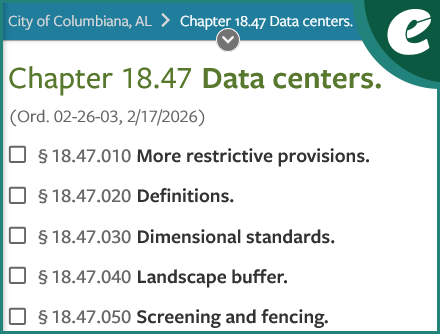
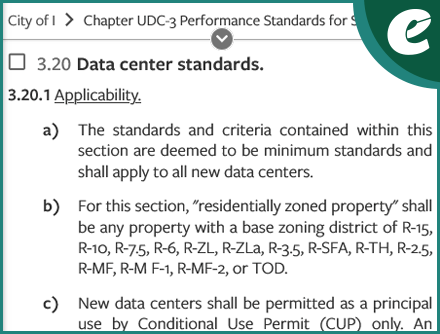
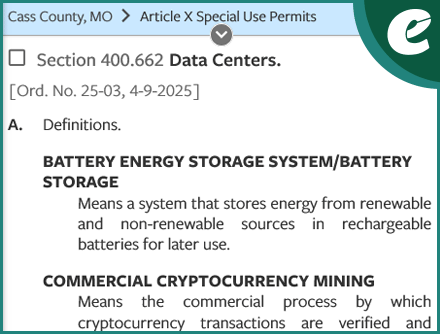
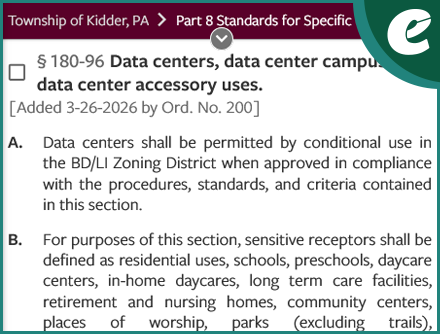
If your community is interested in drafting or updating legislation related to data centers, here are some useful examples that can be found in our eCode360 Library:
Updating your municipal code is vitally important
Submit your code updates as soon as possible and ensure constituents and local government officials are always referencing and working with the most up-to-date resources. Make it part of your Board meeting close-out process to send your adopted legislative changes to ICC Code Solutions when everything from that meeting is already right at hand.
Sources:
- The Harvard Gazette: Why are communities pushing back against data centers?
- World Resources Institute: From Energy Use to Air Quality, the Many Ways Data Centers Affect US Communities
- EarthJustice: What you need to know about AI Data Centers
- AAAS: Data Center Growth: Implications for Local Communities
- Lincoln Institute of Land Policy: Data Drain: The Land and Water Impacts of the AI Boom
- The Conversation: 5 ways data centers endanger their local communities and the country as a whole
- MRSC: How Can Local Governments Prepare for Data Centers?
- EcologyCenter: What to Know About Data Centers & their Community Impact
- Regional Planning Center: The Rise of Data Centers in the Grid
- MultiState: Data Centers Confront Local Opposition Across America
- Gallup: Americans Oppose AI Data Centers in Their Area
- Stanford University: Thirsty for power and water, AI-crunching data centers sprout across the West
- Caltech: Ask a Caltech Expert: Adam Wierman on the Pros and Cons of Data Centers
- Farm Bureau Intel: Balancing Data Center Growth with American Agriculture
- Time: Community Backlash to AI Data Centers Is Growing Across the U.S.
- Top 250 Data Center Companies in the World as of 2024
- eCode360 Code Library


