

What is design thinking? A guide to the 5 stages and principles


Explore more from
Design basics
Create, collaborate, and ship in Figma
All your design work, in one place.


Design thinking is a creative, iterative approach to solving complex problems. It starts with the user, focusing on their needs, pain points, and expectations, and uses that insight to guide product decisions. The process encourages collaboration, continuous feedback, and quick experimentation to find solutions that are useful, feasible, and sustainable.
Teams use design thinking to build stronger connections with users, shape better experiences, and build more adaptable products. Its human-centered approach encourages creativity and diverse viewpoints to uncover insights early, reduce risks, and move quickly from concept to real-world solutions.
Read on to learn:
- How design thinking works and why it’s important
- Four design thinking rules
- The five stages of the design thinking process
- Methods and examples of this approach
- Benefits of design thinking
- Design thinking FAQ
How does design thinking work?

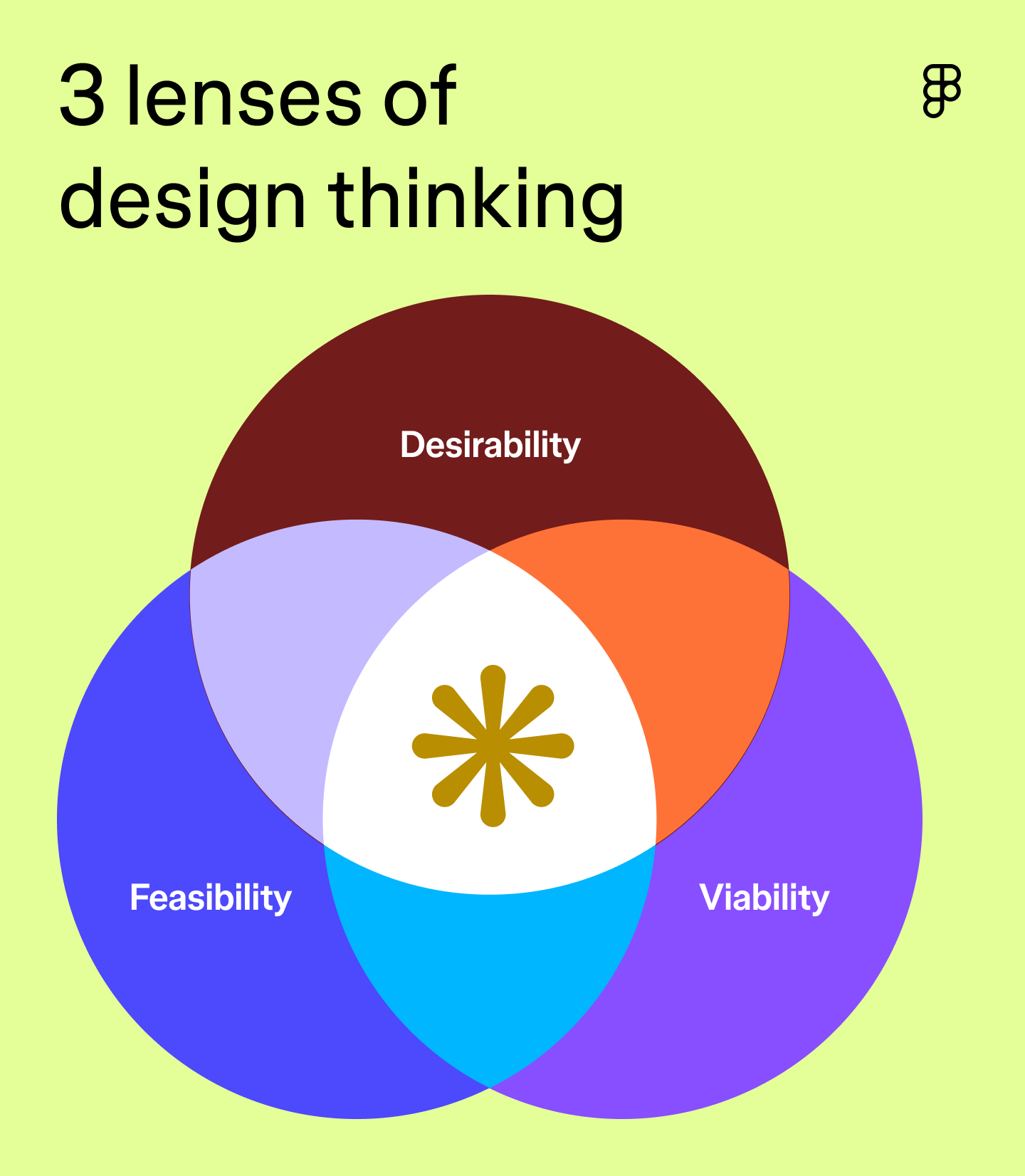
Design thinking is deeply rooted in understanding users’ needs and emphasizes realistic and achievable concepts. When applying this approach, use three lenses to evaluate your ideas.
- Desirability. Is this useful? Does the solution meet a real user need?
- Feasibility. Do you have the resources and technology to build or implement this solution?
- Viability. Will this solution work long-term for the business or organization?
A strong idea lives at the intersection of all three. Design thinking helps teams get there by surfacing insights early, encouraging experimentation, and building on feedback throughout the process.
The rise of design thinking
Some design historians claim the term “design thinking” dates from the 1930s, but the term itself gained widespread traction in 2008 when Tim Brown, then chair of design consultancy IDEO, published an article in the Harvard Business Review. He described design thinking as a repeatable process for innovation—one that balances creativity with strategy, and user empathy with execution.
While its roots are in product and industrial design, design thinking is now used across disciplines: software, education, service design, healthcare, and more.
Want to start thinking like a designer?
Bring your biggest ideas to life with Figma Make’s AI tools. Start with a design and prompt your way to a prototype in minutes.
Four design thinking principles
The d.school at Stanford outlined four principles to help teams apply design thinking. Each helps shape how teams think, collaborate, and move ideas forward when working through complex design problems.
- The human rule. Design starts with people. Every decision—what to build, how it works, how it looks—should be grounded in real needs and lived experiences. When teams prioritize the user perspective, the result is almost always more useful.
- The ambiguity rule. Uncertainty goes hand in hand with out-of-the-box thinking. Design thinking encourages teams to stay curious, explore open questions, and test ideas before locking in direction. The goal isn’t to avoid ambiguity—it’s to work through it..
- The re-design rule. Most problems have been solved in some form before. Design thinking doesn’t assume a blank slate. It invites teams to learn from what already exists, identify what still holds up, and build from there.
- The tangibility rule. Ideas get better when they’re visible. Use prototyping to bring concepts to life. Low-fidelity prototypes and high-fidelity prototypes help design thinkers communicate and test ideas in the real world.
Five stages of design thinking


Design thinking is non-linear. You don’t always move step by step. Sometimes you loop back, repeat a stage, or work on several parts in parallel. What matters is momentum: learning as you go and refining the solution along the way.
These five stages give teams a shared framework for exploring problems and building thoughtful solutions.
Stage 1: Empathize
Start by understanding the people you're designing for. What are they trying to accomplish? Where do they get stuck? What matters most in their day-to-day?
This requires active listening, observing behaviors, and asking the right questions to better imagine user experiences and challenges. Conduct user interviews to gain new insights and perspectives from the people who will use your products. The goal is to shift the focus away from assumptions and toward lived experience.


Design thinking method: Empathy mapping helps teams better understand their users’ attitudes and behaviors. This guides innovative and creative thinking that accurately meets customers’ wants and needs.
Example: Imagine you have an online storefront for a camping gear brand and you’re considering a website redesign. You can conduct user interviews to reveal frustrations and understand common shopper challenges, like difficulty finding and comparing product details.
Stage 2: Define
Use your research to frame the problem clearly. What specific challenge are you solving? Who’s affected, and what might be getting in their way?


Design thinking methods: Write a focused problem statement and map key user needs. Methods like user personas can help clarify root causes and prevent you from solving symptoms. The 5 whys is another problem-solving technique you can use during the define stage to drill down into the root cause of the problem and identify potential solutions. By repeatedly asking “why?,” your team can challenge assumptions and explore user-centered solutions.
Example: In the online storefront example, you might define the problem as “Users struggle to compare product features quickly” and then ask “why?” until you uncover the root of the issue. If important details (like dimensions, tech specs, or availability) are buried in long descriptions, scattered across multiple tabs, or not displayed side-by-side, users are forced to open several browser tabs or scroll back and forth, making quick comparisons difficult and increasing the likelihood they abandon the purchase altogether.
Stage 3: Ideate
Now it’s time to explore possible solutions. Hold short, structured brainstorming sessions with your team. The goal isn’t to find the answer—it's to brainstorm ideas you can test.


Design thinking methods: Mind mapping helps teams break away from linear thinking. This visual tool is helpful during brainstorming to organize thoughts and ideas and their relationship to one another in a structured format. Affinity diagrams can also help you reveal themes and patterns in feedback during these collaborative brainstorming sessions so you know where to focus your attention next.
Example: With the help of a problem-solving mind map to identify causes, side effects, and reactions, you and your team can brainstorm new solutions for your online storefront navigation, such as improved filtering or parallel AR visualizations of products. Each solution creates a new branch to explore on the map.
Stage 4: Prototype and test
Test early and often. Get hands-on and start building prototypes of your best ideas and put them in front of users to validate, streamline workflows, and reduce product development risk.
Design thinking method: Story boards visually represent a user’s journey, highlighting how they interact with a product. During the prototype phase, this helps designers understand the user experience and identify areas for improvement in the design.
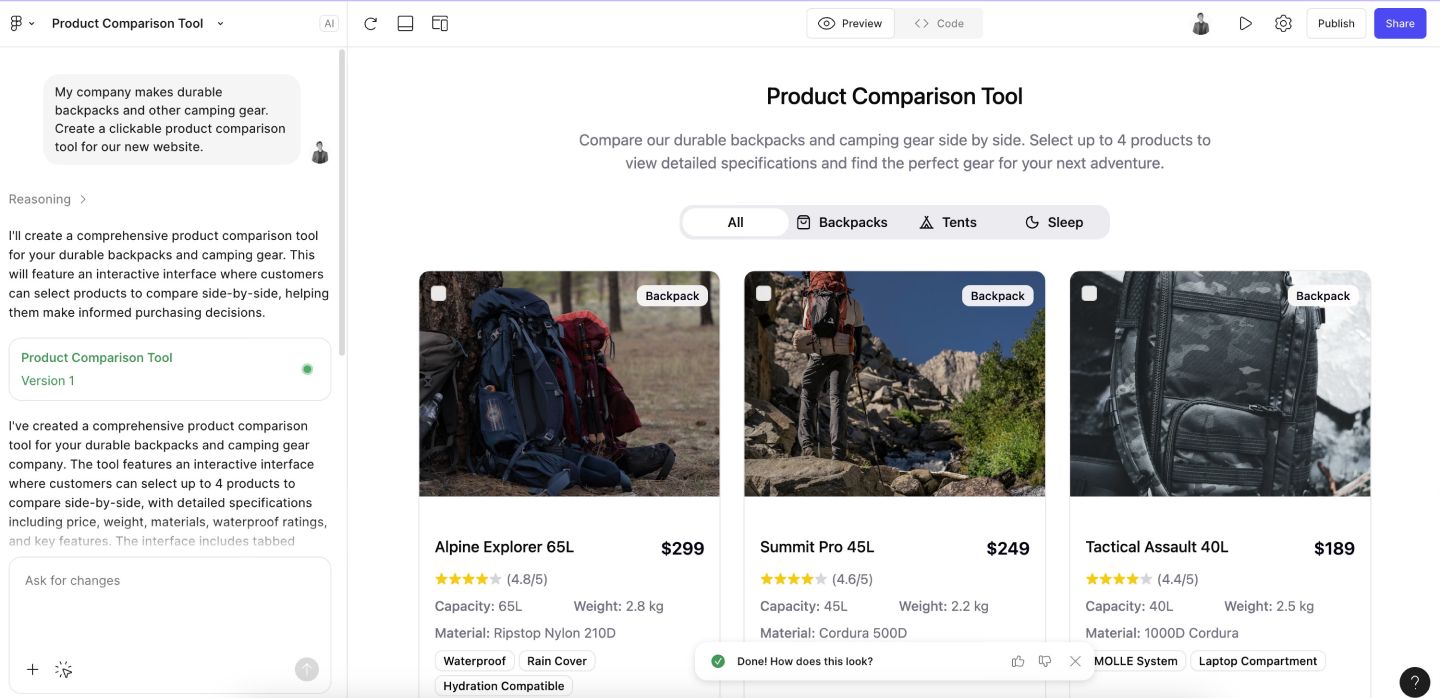
Example: Use Figma Make to create a clickable product comparison tool prototype for testing. Release the prototype to target users (shoppers) and gather feedback to refine. Consider methods like moderated usability testing (remote or in-person), unmoderated remote tests, A/B testing between different design versions, heatmaps and session recordings, and live interviews for qualitative insights.

Stage 5: Implement
Once you’ve validated a direction, move into development. Even at this stage, keep iterating. Use analytics, feedback loops, and lightweight A/B testing to refine as you go. This will ensure your final solution is successful. Once your solution is implemented, track and analyze key performance indicators (KPIs) to guide future product development or improvements.
Design thinking method: During the final phases of the design thinking framework, usability testing helps evaluate and identify usability issues within an app design or product design. This informs improvements and modifications based on real user experiences ahead of launch.
Example: After launching your product comparison tool, set up event tracking using analytics tools such as Google Analytics to capture relevant user interactions (like the number of comparisons generated, clicks on “add to cart” from the comparison page, and time spent comparing products). Monitor key performance indicators (KPIs) such as conversion rate, average order value, feature usage, user satisfaction ratings, and abandonment rate.
Regularly review session recordings or heatmaps to identify pain points or areas for improvement. Use these insights to refine the tool and guide future iterations, ensuring your solution continually meets user needs and drives measurable business results.
Benefits of design thinking
Design thinking gives teams a way to solve complex problems with focus, flexibility, and a better understanding of users. Whether you’re launching a new product or improving an existing one, it helps keep work grounded in real needs and real feedback.
Here’s what design thinking makes possible:
- Increased customer satisfaction. Design thinking starts with real user needs. By reframing the problem from the user's point of view, teams build solutions that are more relevant, usable, and satisfying.
- Boost innovation. This process pushes teams to explore ideas beyond the obvious. By challenging assumptions and testing early, design thinking helps uncover new opportunities that more traditional workflows might miss..
- Improve collaboration. The shared structure of design thinking makes it easier for cross-functional teams to align. Starting with a stakeholder analysis and continuing through prototyping and testing, it keeps everyone involved and informed.
- Reduce risk. Prototyping and early feedback help catch issues before a solution goes into development. Teams can iterate quickly and apply learnings along the way, reducing costly late-stage changes.
Design thinking FAQ
Keep reading for answers to frequently asked questions about design thinking.
What’s the difference between design thinking and agile methodology?
Design thinking helps teams define the right problem to solve by focusing on user needs and creative exploration. Agile is a way to deliver solutions quickly through short, iterative development cycles.
Design thinking usually comes first—it shapes what you build and why. Agile shapes how and when you ship it. In product development, they work well together.
What’s the relationship between user-centered design (UCD) and design thinking?
User-centered design and design thinking are two closely related approaches that prioritize understanding and meeting user needs through empathy, collaboration, and iteration.
UCD is about designing products and experiences by continuously incorporating user feedback and usability principles. Design thinking encompasses a broader problem-solving methodology that blends empathy with creativity and business viability to address complex challenges.
Design thinking often uses user-centered design within its process but goes a step further by considering technological feasibility and business outcomes. This makes it effective for tackling wider organizational and societal problems, not just product usability.
Do you need certification to practice design thinking?
Practicing design thinking relies more on internalizing its mindset and methods and applying them consistently to your projects. No formal certification is required, but many organizations offer programs and design thinking courses to deepen understanding and skills.
Who can use design thinking?
From designers and product managers to educators and business owners, anyone can use design thinking to solve complex challenges. The human-centered approach is broadly applicable.
How can I start using design thinking on a small team?
Start simple. Talk to users, sketch quick ideas, and test early. FigJam makes it easy to run a fast brainstorm or map out a user journey. Figma Make can help you turn those ideas into interactive prototypes—even without a dedicated design team.
What are wicked problems in design thinking?
“Wicked problems” are complex, multifaceted, and persistent challenges with no single solution. They are difficult to define, and there may be no way to determine when they are truly “solved.”
The stakeholders, requirements, and boundaries surrounding wicked problems are often in states of flux. Some examples include major social issues like poverty, climate change, and healthcare disparities.
In design thinking, wicked problems are addressed through empathy, iteration, and collaboration. Teams are encouraged to understand needs, reframe problems, and experiment with creative user-centered solutions. Emphasis is placed on learning, adaptability, and multiple perspectives, which are essential when addressing tricky yet widespread issues.
What is the IDEO model of design thinking?
IDEO’s model outlines five key phases:
- Empathize
- Define
- Ideate
- Prototype
- Test
It’s a flexible, human-centered process that encourages teams to explore widely, test early, and keep users at the core of their decisions.
Dive into design thinking with Figma
Design thinking isn’t a rigid formula; it’s a problem-solving method that encourages exploration and discovery and empowers teams to think outside the box. If you’re ready to use design thinking to help solve your users’ problems, Figma can help. Here’s how:
- Kick off the design thinking process with user research, using FigJam’s research plan template to identify research goals.
- Browse the design thinking resources shared by the Figma Community.
- Bring your ideas to life and create interactive, polished prototypes for user testing with prototyping in Figma.
Ready to engage your users with design thinking?
Apply design thinking principles and unlock your creativity with a variety of free tools and templates.


