WHR 2025 – 100 Haijin part 13

World Haiku Review Spring 2025

One Hundred Haijin after Shiki

Susumu Takiguchi

Part Thirteen

Akutagawa Ryunosuke


Masaoka Shiki (1867-1902) famously predicted that haiku could become extinct by the end of the Meiji Era (1868-1912). How wrong he was! And how delighted we are that he was wrong, without being unkind to him! This is indeed a cause for celebration.

One way of celebrating it could be to choose at random one hundred Japanese haiku poets who have helped to prove him wrong. If we chose one hundred best the case would be strong. But if we chose randomly, and not necessarily the best, one hundred from among, say, about five hundred who have been leading figures in the modern history of haiku in Japan, the case would be even stronger.

With this in mind, I would like to serialise my narratives in World Haiku Review about the one hundred Japanese haijin whom I shall choose at random and talk about. There is no particular reason why the number should be one hundred. It could be two hundred or fifty. Just over one hundred years have passed since the end of the Meiji Era, and a little bit longer since Shiki died. So, the number one hundred would not be bad. To write about more than one hundred haijin could be exhausting. If the number was fifty, the endeavour could be unsatisfactory and frustrating as more would surely be desired to be introduced. One thing which is certain is that it is not really intended to follow the fashion to use the number one hundred in haiku books, originally emanating from the ancient waka anthology Hyaku-Nin-Isshu (one poem each by one hundred poets). Being a heso-magari (contrarian) I would in fact have liked to avoid this cliché.


Part Thirteen
Akutagawa Ryunosuke
Too clever for his own good

Akutagawa (surname) Ryunosuke (given name)
01 March 1892 ~ 24 July 1927
Following the academic convention of Japanese studies, Japanese full names are written in the order of the country’s practice, i.e. surname followed by given name.

水洟や鼻の先だけ暮れ残る

mizubana ya hana no saki dake kure-nokoru 

running at the nostrils…
on the tip of the nose, the sun
still has not set


Arguably this is the most famous of all one thousand or so haiku poems written by this genius Japanese writer Akutagawa Ryunosuke during his entire life, which was tragically cut short by his suicide at 35. He gave a title to this haiku: Self-mockery. It is said to be one of his early works but because he chose this particular haiku to entrust with someone close to him just before he took his life by overdose it is now regarded as his death poem. (Some say Akutagawa wrote this haiku in calligraphy on the shikishi format soon before his suicide.)

Akutagawa was one of the brainiest writers of modern Japan. He was also one of the most cynical, witty and satirical. He criticised, mocked, joked and teased by satire. One of his short novels is called Hana, or nose. 

This little novel was written when the author was still a university student. It received a great accolade from Natsume Soseki, the doyen novelist at the time, which catapulted this amateur writer into a full-time professional. And the rest is history. He got the inspiration to write this story from an ancien Japanese literary anthology. It depicts human folly, neurotic worry about other people’s opinion of one, obsessive concern about one’s defects and inadequacies. 

The hero of the novel is a fifty-year old medieval priest but with an elephantine long nose dangling down below his chin. It tormented him from childhood in every way but most intensely by making him worried to death about other people laughing at and talking about him behind his back. He pretended to be totally unconcerned. But inside, he was desperate to find just any measures to shorten his nose as his pride was deeply wounded. 

Rescue was there. A doctor recommended boiling his nose and getting his disciple to stamp it well, and boil it again, resulting in massive discharge of blackheads. The priest could not believe his eyes when he saw his long nose having shrunk to above his upper lip just like anybody else’s! He was so overjoyed that he just could not leave his new nose alone, fondling, touching and caressing it to make double-sure that it really was short and normal. He was having a blissfully relaxed time as he was now convinced that nobody would laugh at him any more.

However, several days later it dawned on him that somehow something had gone amiss because people were laughing at him even more loudly now. He thus came to the realisation that people were actually so mean that they resented his nose having become normal and that he was happy for it.

Before long, the priest started to regret having had his nose shortened. And then, one night he felt his nose bloated. The following morning he found the nose back to the good old length. He told himself, “Now no one should and will laugh at me”.

Akutagawa’s running-nose haiku is believed to have something to do with the story of the long-nosed priest, especially because of its title of self-mockery. The fact that Akutagawa entrusted it with someone just before he committed suicide (some exceptionally asserts that it was not suicide but miscalculateddose or even it was a case of him momentarily going insane, as his mother did) gives it a profound meaning and context. It is obvious that he was re-examining his life as it began to look as though all was not necessarily well. Being a deep thinker he might well have been his harshest critic. One cannot help thinking of the play of Cyrano de Bergerac here. 

Let us see what is going on in the haiku itself, which I think has many interesting and revelatory hidden meanings. It is said that he had an inferiority complex about his long face. This is odd because most people think he was rather handsome beside looking frightfully intellectual. He certainly did not look like an ordinary person, even if he comes of ordinary stock (His father was a milk merchant.) So, he took great interest in the tale of the long-nosed priest. He might even have empathised with him. The subject common to both is various negative emotions or feelings of humanity: pride, inferiority complex, obsessive concern about the opinions of others about oneself, true or imagined, jealousy etc.. In short, it’s all too human but it’s all in the mind!

What about the tip of Akutagawa’s nose? One assumes that the setting sun is on it while the world is getting dark all around him. I always had an image that the sun is lighting it while the running nose is also lit, perhaps with its tip swelling itself into a tiny ball, hanging in the air delicately balanced between gravity and its pull of stickiness. My own father used to let the running nose run without wiping it with a piece of tissue, which became too tedious for him after a while. That isthe image I had when I first read this haiku. Darkness can be interpreted as the dark mood the author was sinking into when he contemplated his death. The tip of the nose may symbolise that somewhere in him there was still a will to live or the life itself which was just about worth living. However, the nose is running like life running out of him. Without positive intervention he would die. Akutagawa may have been seeing this irony with a detached sense of humour, which was nothing but self-mockery.

Mizubana (watery mucus from the nose) is thin, transparent and watery, unlike the yellowish jelly-like substance discharged when you catch real cold. This may also be a metaphor for something seemingly innocuous but deadly if left unchecked. The conjecture can be extended to such an extent that this was actually nothing but a cry for help, not at the time of writing it long time before but at the very time when he was in a state of mental and emotional distress and his resolve to terminate his life became imminent.

All this makes the haiku witty, humorous and even sardonic as well as profoundly tragic.


Now let us see some more examples o
Akutagawa’s haiku:

木枯らしや目刺しに残る海の色

kogarashi ya mezashi ni nokoru umi no iro

winter wind…
still seen on the dried fish
the colour of the sea


Another famous haiku by Akutagawa. Mezashi is dried fish, usually smallish sardine or small Japanese horse mackerel mildly or fully dried under the sun. If grilled, it regains some moisture and becomes tender. Often, six of them are bound together by a bamboo stick or straw pierced through their eyes as the name (piercing through the eye) indicates. It is preserved food and popular at the Japanese breakfast table. It is a spring kigo but Akutagawa used kogarashi (winter wind) as the main kigo. 

Even dried, mezashi still has a blue sheen which he calls the colour of the sea. Thus, the sea, fish, the fisherman who caught it and dried into tasty food and the poet who presumably would be eating it as his favourite food are all encompassed in a little human-nature drama, mundane but an essential part of the whole.

The haiku is held to have been written in Taisho 6 (1917). It is understood that someone in Nagasaki, his friend or a fan, sent the mezashi to Akutagawa as a present. The latter was very pleased with it enough to want to compose a haiku on it. In a way, the haiku is an aisatsu-ku (a greeting haiku) in that the author wanted to express his gratitude by the act of composing it. If this was the case, the sea he referred to would be the water west of Nagasaki area, famed for delicious fresh fish, including sardines, which the author as a Tokyo native would look upon with admiration. The colour of the sea transported by these fish plays the role of a messenger of goodwill to which the author responded with this excellent haiku.


松風をうつつに聞くよ夏帽子

matsu-kaze wo utsutsu ni kiku-yo natsu-bohshi

wind through the pine trees…
I listen to it fully awake wit
my summer hat on


You would not be blamed to think not much of this haiku if you were not told of the background of it. It was written in 1923, the year when the Great Kanto Earthquake occurred, leaving estimated 105,000 dead or missing and devastating better part of Tokyo and surrounding prefectures. Akutagawa was wandering among the rubble soon after the disaster and when he was around the Zojo-ji Temple a keen sense that this was not a dream but real overwhelmed him. The severity of the earthquake must have deprived him of the sense of reality until the changed landscape hit home. It happened on 1 September which means that it was the time of zansho, or the remnant of hot summer heat, hence the summer hat. I would venture to guess that it was a panama hat which was favoured by many men of letters. Akutagawa was quite a dandy with a flair for good taste and distinct style. Whether the pines were burnt or not is a moot point. The sound made by the wind would have been more sad and forlorn if the pine needles were all burnt up. 

It was only four years before he committed suicide. By venturing out he chose to expose himself to the results of the catastrophe, death, destruction and sorrow. As a complicated writer, he had different worlds, a real world, his intellectual world, the world he depicted in his novels and fantasy world his mental condition may have been creating. One is tempted to speculate that he wanted to witness, experience and ponder upon the real and woken world by facing up to the huge disaster which struck Japan. This sentiment is expressed in the word utsutsu which means reality and consciousness. Akutagawa wanted to make sure that he was woken, conscious and sane. 

花曇り捨てて悔いなき古恋や
hana gumori sute-te kui naki furu-koi ya

cherry-cloudy day
no regret to abandon
an old love affair


Hana-gumori is the season word for spring when you cannot enjoy warm and pleasant day with cherry blossoms to view because it is cloudy. However, the Japanese people’s love for the blossoms is such that they enjoy it nonetheless. The denial of full cherry viewing gives them a special kind of appreciation of the flowers, i.e. a mixture of disappointment with mild melancholy and resignation, and even an unusual sense of quiet sense of delight akin to unrequited or lost love. It is a sense of joy a human being feels over something not because you have it but because you have not. Basho wrote a haiku appreciating not being able to see Mt. Fuji because of rain, a similar sentiment. This may well be outside the western sensibility. 

Physically Akutagawa was rather short and slim (lanky, rather), a feature he was not proud of and sometimes a target of mockery like his friend Dazai Osamu, another great literary figure, teasing him for his height, or lack of it. But he had a longish and attractive face with a glint in his eye, and incredibly intellectual-looking aura. Thus it was that his life was not one without love affairs, sometimes controversial. They tended to be negative, tragic even, and affected not only his life but also the stories he wrote. His first love was for the family’s maid, an affair doomed to failure in a still feudalistic society. His illicit love affair with a married woman turned a nightmare for him as the woman became a stalker and harassed him with or without being with him. As if to compensate for it all, his last love was pure and poetic. A tanka writer, the woman he met at Karuizawa through a friend of his became involved with him through correspondence. She confessed her love for him in one of these letters, to which Akutagawa did not reply directly. However, he wrote his feelings in 25 tanka which were published in the Myojo. She appears as a model in his novels. One would not be blamed for assuming that the haiku in question refers to the obsessive woman who tormented Akutagawa and from whom he dearly wished to free himself.

青蛙おのれもペンキぬりたてか
ao-gaeru onore mo penki nuri-tate-ka

green frog…
have you also had yourself
just painted?

A green frog is a frog that lives on a low tree or grass. It is about 7 cm long but unlike its smaller cousin it does not have a distinct black line behind the eyes but just black blotches. When on a leaf it is green but on moving to tree trunks or to the ground it turns brown, using this camouflage to protect itself from predators. When green, the frog blends into the surrounding green leaves and becomes invisible, well almost. It has a shine like gloss paint which is the quality Akutagawa focused on. Unlike old and dull paint it gives a fresh and rich feeling pertaining to summer extravagance. The freshly applied paint is something no one else would or could think of in a haiku, proving the author’s individuality or uniqueness. Ao means blue in modern Japanese but has since ancient times been used when the colour green is described. But then, midori (green) was and still is used to describe the beauty of very black hair! It does not mean that the ancient Japanese people were colour-blind.

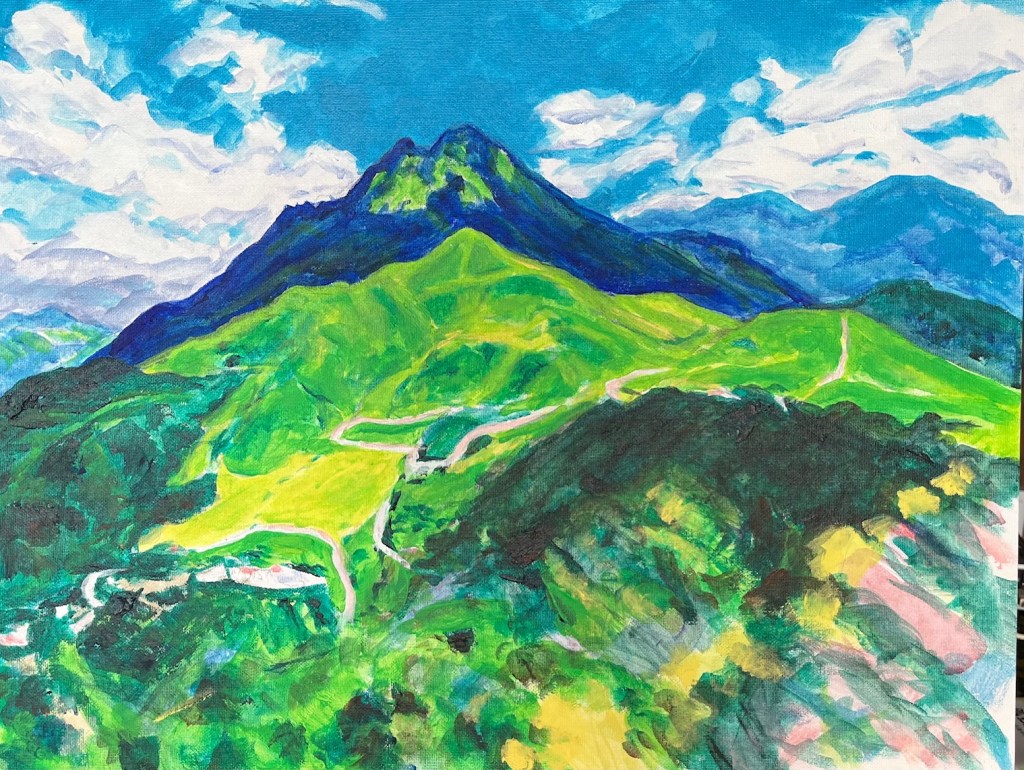
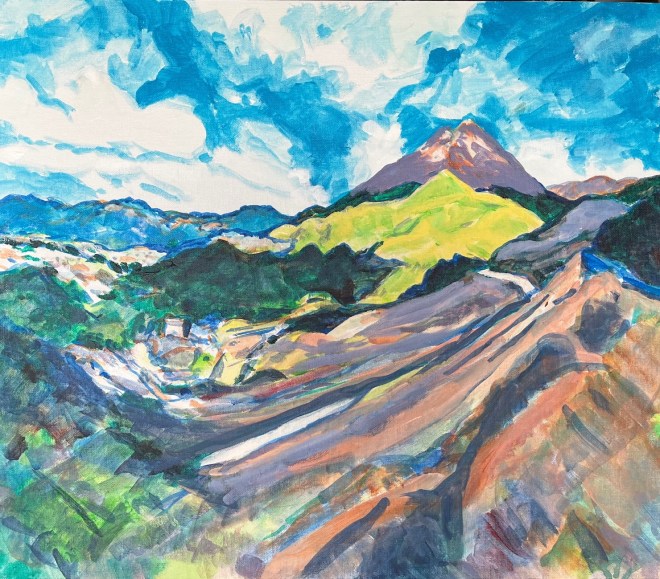
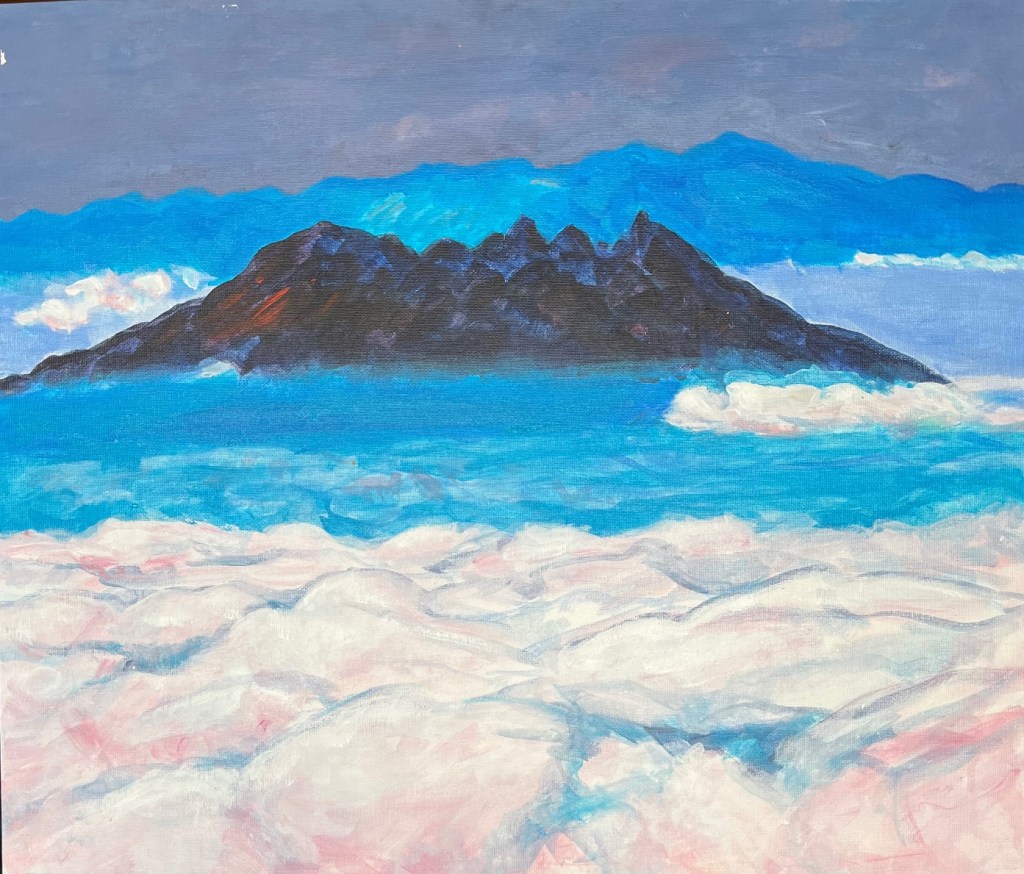
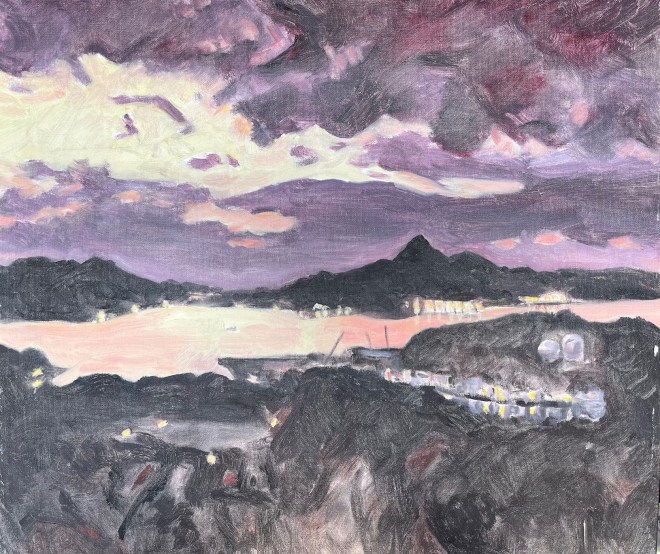
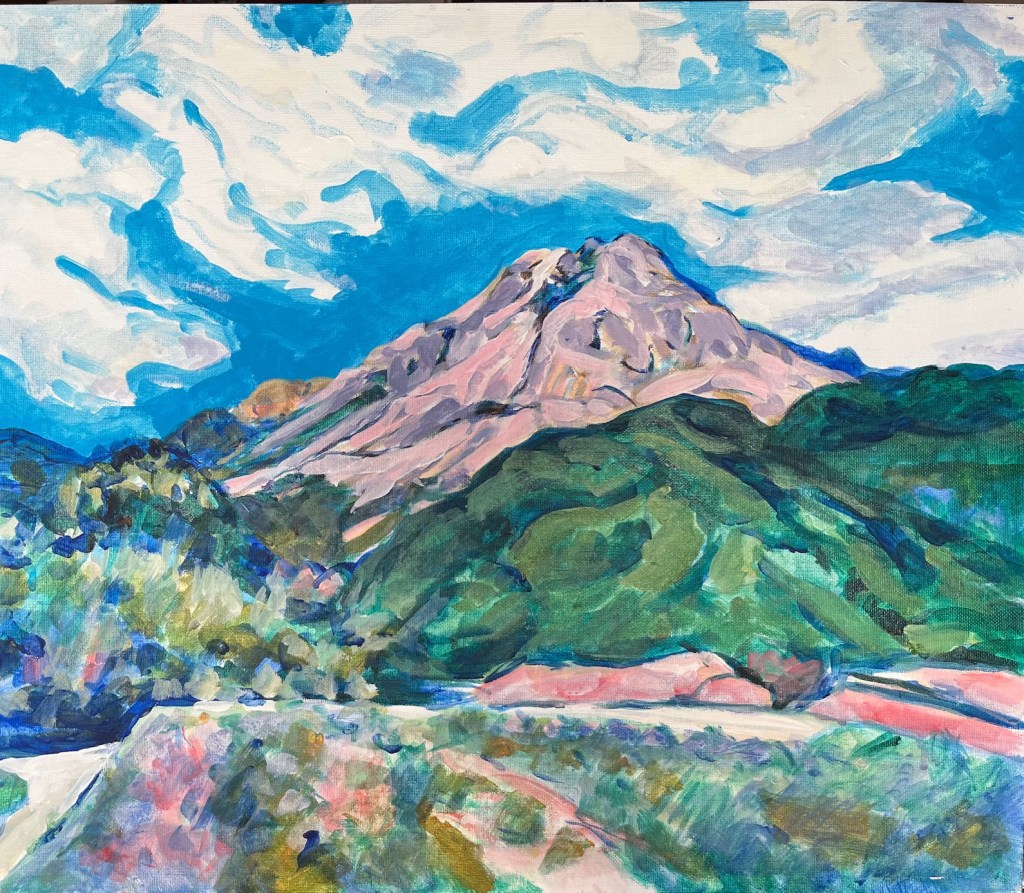
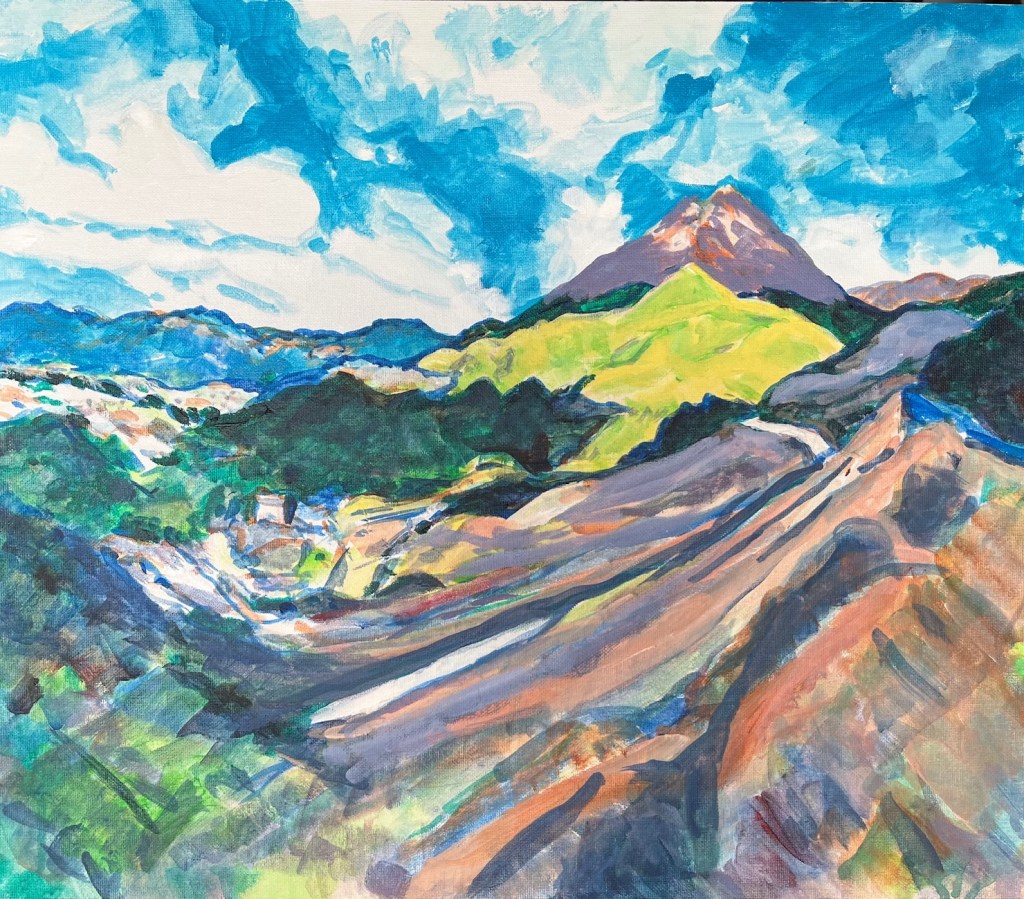
Mountains of Japan

World Haiku Review, Spring 2025

These ten paintings are by Susumu Takiguchi.

Mt Asaki on a Stormy Evening

Mt Yufu Early Summer

Mt Yufu Mountain Paths

Mt Fuji Above the Clouds

Mt Aso Nekodake

Mt Aso in Morning Sun

Mt Akasaki in Storm

Mt Fugendake Nagasaki

Mt Akasaki in Sasebo

Mt Aso Nekodake Autumn

WHR 2025 – Haibun

World Haiku Review Spring 2025

Mt Fugendake Nagasaki – painting by Susumu Takiguchi

Haibun


Brijesh Raj

touch of winter…
…the soft warmth
of fur on foot

The hilltop sanatorium hosts a nuanced calm. The kind our persian cat Faye relishes. Little squirrels browse through the grass, play tag and scale trees with staccato hugs. Ignoring the senior humans in their stone and wood bungalows.


afternoon still
the crack of dried leaves
beneath squirrels

 
She watches through flower shaped ventilation ports cut in the balcony. A little paw s.l.o.w.l.y tops the wall, followed by another and a hunter’s head with ears coned forward and pupils dilated. Although her perfect, dilute calico camouflage is marred by a vivid blue knitted infant’s sweater embroidered with red and white flowers.

high pitched squeaks
the squirrel’s tail
keeps time

A few yards away, a pheasant pair carry a smidgen of brown to an evergreen, whilst a wagtail khol-brushes a shrub a few hops away.

in and out…
the fluorescent bob
of a pigeon’s neck

The old clock tower rings in the prenight, as little winged creatures stir in the grass. Its tones are dignified and sonorous. Much like the handlebar-mustached caretaker’s.

brown tipped frond
the violent touch
of claw and wind

The day creeps by deceptively fast. Yellow and white garden flowers stand still trying to catch the last of the dying day. A chirrup, a whirr and a warble airbrush the shrubbery. Dusk slips past the canopy fish netting the sky, carefully ranged orange peels and tightly curled up dogs.

barred owls
blink
and they’re gone


Shunya

The voice that matters trades his cpap mask for arterial and central lines, endotracheal and ryle’s tubes. It would free his veins and arms and reduce the load on the heart, they say. He continues to frown at the, no food nor water except through the tube, instruction.

rise and rise
a riptide
of tears

It is conspicuously slow, this heavy tread of time whilst the world sleeps. Outside, apples fall from their trees. Some before their time.

empty bed
the space within
without

*Shunya…zero


Jennifer Gurney


Becoming a Mom

Sitting in the lobby of the hospital where you were born, we stood at the sound of the elevator dinging each time it opened. For what felt like hours, but maybe it was just minutes. When it was you, my breath caught in my lungs. I had anticipated this very moment my entire life. The tears sprung all on their own. I heard no sound and saw no sight other than you. I tried to take a step but was frozen in place, transfixed by the knowledge of your existence.

placed in my arms the
very first moment my heart
grew a new chamber


My House Seems Empty


occasionally
yours join mine, even if only
as an echo

My son was here for Mother’s Day weekend and I was thinking how cool it was to hear his footsteps on the stairs again.nEspecially for the first time at my new home, where I’ve lived for less than a year. I got to thinking about his footsteps on the stairs in all of our homes when he was growing up. Then this prompt arrived and … serendipity. I’ll keep working on it to maybe add another section to include that part. We’ll see. Might be okay to leave it sad.


Country Roads

I’ll never forget
entering West Virginia
singing Country Roads

Note: Powerful memory. We were on a 10-state road trip visiting potential colleges. My then-teenage son turned on John Denver when we came to an incredible vista in WV and we all started singing, seeing the landscape that inspired this iconic song. This is now layered over the memory of my first concert: front-row seats at a John Denver concert in Kalamazoo, Michigan when I was 20. When I hear this song now, 12 and nearly 30 years later, I’m in the stadium and in the mountains simultaneously….


Joshua St. Claire
 
Family Dinner

We stopped over to grab a bite at my in-laws’ house. We just opened the door and walked in. My daughter didn’t do anything. She wasn’t being loud or even approaching it. We just walked in the door and, in a second, it was upon her. Right for the face. Its jaws are like a steel vise. My mother-in-law acted quickly and grabbed the break stick and pepper spray. Blood spurted all over everything, all of us. All I could see was blood, flapping flesh, and a jawbone. The ambulance came. It really is a miracle. Praise God that the doctors saved her face. She looks normal, but you can still see the scar on her jaw when she is in the sun and she screams whenever she sees a dog—even a poodle on TV. Afterward, despite the break stick and the pepper spray, the dog walked off ate some kibble and took a nap, like nothing happened. It had to be put down, of course, and, now, my in laws aren’t talking to us. They just keep saying, “you killed my baby, you killed my baby, you killed my baby…”

pit bull adoption
a sticker on the window reads
“who rescued who”

***

Beauty Mark

I tell him
that her imperfections make her more beautiful.
broken tulips
                      a fork in the road


Neena Singh

Trepverter

I freeze when a verbal conflict erupts with a loved one. My mind becomes blank, my heart races, and I retreat into a protective shell of silence

As the storm subsides, and calm returns, my mind shifts into overdrive, replaying the moments with words I could have said.

late-blooming cherry—
the pause between thunder
and its echo

 
trepverter means “stepwords,” or the words you come up with “on your way out” when it is too late to use them


WHR 2025 – Vanguard Haiku

World Haiku Review Spring 2025

Mt Aso in Morning Sun – painting by Susumu Takiguchi

Vanguard Haiku

First Place


dusty attic trunk …
the parts of mother’s heart
never open to me

Chen-ou Liu

Second Place


street lights
dancing with ghost
a bomb-ripped village

Iliyana Stoyanova

Third Place


war zone …
I roam the streets today
looking for the past

Subir Ningthouj

Seven Honourable Mention

(in no particular order)


draped over his lawn
a pall of leaves undisturbed
by the gardener’s death

Maxine Kim Green

still attached
to the old days
a watch on a chain

Ernest Wit

hospice visit—
on the window
my reflection

Meera Rehm

city park
a policeman and a bird left
a note on my car
 
Slobodan Pupovac


when he smiles
the rest of his face
joins in


Owen Bullock

old movies
how much younger
they look now

Joshua St. Claire


front line
from both sides
human voices

Vladislav Hristov

WHR 2025 – Shintai Haiku

World Haiku Review Spring 2025

Mt Akasaki in Storm – painting by Susumu Takiguchi

Shintai Haiku

First Place


visiting a friend
my second cup of tea
bitter and cold

Elisa Theriana


Second Place


the roads 
that I didn’t take 
moonlit night

Maria Concetta Conti

Third Place


not because of winds— 
March comes in like a lion 
with a tariff war 

Priscilla H. Lignori

Seven Honourable Mention

in no particular order


too soon
      for white lilies… 
                    baby’s last breath

Julie Ann Espinoza


night blooming jasmine 
the hint of love
he leaves in her hair

Brijesh Raj


Winds may roar on
mountains and whisper to willow trees,
but only poets hear them sing  

Richard West


daydreaming 
among blossoming cherries
the empty wheelchair


Natalia Kuznetsova

 
the last station…
not enough linden blossoms
to fill our silence

Steliana Cristina Voicu


I hold your hand
and even as the day shortens
you hold mine

Kristina Todorova

war cemetery
withered flowers
on young soldiers’ graves

Eufemia Griffo

WHR 2025 – Neo Classical Haiku

World Haiku Review Spring 2025

Mt Yufu mountain paths – painting by Susumu Takiguchi

Neo Classical Haiku

First Place

sidewalk cracks a smile for the daisies

Edward Cody Huddleston

Second Place


faith in humanity –
from the ashes of war
dandelions sprout

Paul Callus

Third Place


spring morning
I inhale
the chirping of birds

Fatma Zohra Habis

Seven Honourable Mention


the camellia, the plum —
almost out of, almost into
spring.

Marie Shimane


breaking through hard ground
like acts of love sometimes do—
purple crocuses 

Priscilla H. Lignori


collapsed building
the rubble covered
with cherry petals


Iliyana Stoyanova

 
war’s end
   both sides surrender
to cherry blossoms


Lev Hart


keeping us all
in suspense
camellia buds

David Jacobs

 
power outage –
the spring stars are
visible now

Tomislav Maretić


some hear the bees hum
while others see the blossoms —
spring remains the same

Kristina Todorova

WHR 2025 – Editors Choice

World Haiku Review Spring 2025

Mt Fuji Above the Clouds – painting by Susumu Takiguchi

Editors Choice


sidewalk cracks a smile for the daisies


Edward Cody Huddleston

 
Let me come clean from the outset that I do not normally value a one-liner as a useful haiku form. This one by Huddleston is therefore definitely an exception.

Why do I not think much of one-line haiku? First and foremost, I simply have not encountered any examples of it worth even glancing at since early 2000s, except for some rare freak occurrences, say 7 or 8 on a scale from 1 to1000. It would be easier to prospect for a gold nugget. This empirical evidence has been more than enough to put me right off this practice. It also serves as proof that my view is not based on prejudice or lack of experience judging from the vast number of one-liners I have had to read for the last 25 years.

Another simple reason for my rejection is the fact that so many one-liners are no more than simply putting three liners into one. The reader still has to do an irksome job of working out the invisible breaks to try to make sense of the poem. This hinders his/her comprehension, let alone appreciation. Breaking up a one-liner into (usually) three independent/interdependent parts and reading them again and again to try to understand the surface and in-depth meanings is after all not much different from a three-liner. What then is the point? The same can and do make it difficult for the reader to appreciate kireji if there is one in the one-liner.

So, why have we started to be bothered about one-liner haiku? An innocent and naïve answer could be that some non-Japanese poets looked at (printed) haiku written by the Japanese and concluded wrongly that English haiku should also be written in the one-line format to look like the genuine Japanese haiku, or to look unlike traditional English poems (which is constructed in lines). There was a ‘cult’, or linguistic sensor around the early part of the 2000s among American-led haiku leaders to reject in English haiku anything, even a hint, which reminded them of traditional English poems. In the formal, or traditional formats especially artistic ones, the Japanese haiku have rarely been written in one line but in two, three, four or even ten lines

To write haiku in the three-line format is undoubtedly one of the greatest achievements of English haiku and early pioneers who invented it cannot be praised enough. It has many advantages which have helped the development of English haiku and which the readers of this magazine hardly need to be told. It is therefore very difficult to beat it as a haiku form, which probably sealed the fate of the one-liner haiku in the estimation of this editor. There are other reasons why the one-line haiku is not recommended, which shall not detain us here.

So, back to the haiku of the Editor’s Choice. Its first impact is the good visual effect. Daisies are found everywhere in the world and have universal popularity, causing immediate fondness in the observers’ heart. Sidewalk (pavement in British English) is also a universal feature and closely connected with people’s daily life, a very apt thing for haiku-writing, including familiar damages to it such as unrepaired potholes or swell caused by trees’ root systems. The combination of the two gives the haiku unmistakeable sense of familiarity, warmth, humour, brightness and joy of the arrival of spring. Good choice of words makes it flow naturally and read well without causing awkward hindrance to comprehension so common in one-line haiku. One’s understanding of the haiku is instant and clear. Three liner would have made it less so.

This haiku is an extremely rare and shining example that one-line haiku can sometimes strike gold but it is still more akin to a miracle than to a routine occurrence.


WHR Spring 2025

World Haiku Review Spring 2025

Mt Akasaki on a stormy evening, painting by Susumu Takaguchi

Contents

Editorial – on this page

Editors Choice Haiku

Haiku page 1 – Neoclassical

Haiku page 2 – Shintai

Haiku page 3 – Vanguard

Haibun

100 Haijin – part 13, Akutagawa Ryunosuke

Mountains of Japan – paintings by Susumu Takiguchi

Editorial

Quality, quality, quality!


The World Haiku Review has held quality as its supreme guideline since its inception in 2000. Around that time haiku was in a state of flux with conflicting views, different schools of thought and even an altercation which was by no means infrequent. It was a noisy and chaotic place where misconceptions and biased dogmas rubbed shoulders with well-researched views and knowledgeable remarks. My hope was that it was creative chaos in disguise from which true haiku would find its place of honour in the end.

 
In the chaos described above, there were so many mutually exclusive beliefs and opinions in terms of such questions as the definition of haiku, the difference or otherwise between haiku and senryu, the concepts of kireji, toriawase, kigo, hai-i (haiku spirit) , etc., that to try and find the meeting of minds among dissenting voices was a non-starter. Hearing all these disagreeing voices, the WHR realised early on that to continue to be involved in these polemics which were often pointless, superficial, misleading or plain mistaken, was simply a gross waste of time. As a result, all the restrictions for submitting works to WHR for example were practically removed and the only criterion that has remained to this day is none other than ‘quality’. 

The relentless drive for higher quality has generated yet another drastic measure starting from this WHR issue of discontinuing the ‘Zatsuei’ (haiku of merit) section from all three haiku categories (the Neo-classic, Shintai and Vanguard), leaving only the best three and seven honourable mentions for each category, i.e. the best 30 in all three categories from the vast number of submissions.

The ‘Zatsuei’ was a very popular feature but now had to be abolished in the interest of achieving even higher quality. Ascthe number of poems published on WHR will thus be radically reduced, there i now much less chance for poets to have their work selected and published in WHR with extremely narrow gate through which only exceptionally superb haiku poems can pass. But people should not be discouraged by it. It is more challenging for them to try but much more rewarding if they are successful. On their own part they only have to double or triple their effort to raise their work’s quality. That way, poets and WHR will mutually try to raise the quality constantly and surely. Who would oppose to the enhancement of quality?

This measure must not be construed as ‘elitist’. On the contrary, relatively unknown poets or even beginners often have produced amazing haiku poems while the so-called seasoned or famous poets are known to have submitted what can only be described as ‘mediocre’. 

Overall, it is a good thing to happen and I am convinced that in time it will prove to be a powerful tool to improve the standards of haiku-writing world-wide and thereby to deepen people’s love for haiku. 

 Susumu Takiguchi


Spring 2025 is on the Way

Since so many of you are waiting for the Spring 2025, let me assure you that its on the way and will go up this month. I am working on it now.

Due to personal problems it will be a much smaller issue, keeping quality foremost.

Your wait is almost over. Please bear with us as we try to bring you the very best.

Thank you for your patience and thank you for being with us, some of you for a long time. World Haiku Review is only possible because of your great support.

Wish you all the best, wherever in the world you are.

Happy writing, happy reading, never give up.

Spring 2025 Issue

We are back and submissions are now open for the Spring 2025 Issue

Deadline – Monday 31 March 2025 at 23:59 your local time.

Theme – HUMANITY” and/or any Seasonal Subjects at your northern or southern hemisphere location during spring (autumn) months

Here is the submissions call –

Dear Kuyu,

When the world goes crazy, we still write haiku. When fakes, aggression and destruction seem to prevail, we doggedly carry on writing haiku nonetheless. That’s the way not only can we remain sane, truthful and peaceful but also can preserve what’s left of human decency, creative joy and dignity. Haiku has little monetary value. It brings no conspicuous physical benefits. That is precisely its most precious asset…uselessness.

HAIKU POEMS IN ENGLISH OR IN ENGLISH TRANSLATION: TEN haiku poems which are inspiring, refreshing and exciting, and which have not been published or are not considered for publication elsewhere. Please make sure to send them to BOTH of the following addresses: [email protected] AND [email protected] (New site especially designed for WHR submissions). If you send them only to one address, they could get lost in the procedure. Also, please do not send them in attachments, which will not be opened for security reasons, but within the email text.

DEADLINE: Monday 31 March 2025 at 23:59 your local time.

SUGGESTED THEMES: “HUMANITY” and/or any Seasonal Subjects at your northern or southern hemisphere location during spring (autumn) months (These themes are not obligatory but shown here only as a suggestion). The only criterion for selection is quality.

Book Reviews have been discontinued for the time being.

The rest of the detailed guidelines can be found on the About page, HERE. Please read and follow them.

We wish to endeavour to present a unique haiku magazine which, while deeply rooted in tradition, is full of new ideas, innovative features or critical views. It will continue to aim at the highest standards and top quality.

Kengin to all,

Susumu Takiguchi
Managing Editor and Editor-in-Chief, World Haiku Review
Chairman, The World Haiku Club