Week 2 — Year of Short Stories 2026

2026 is another year of short stories. In this weekly series, I talk about the stories I’m working on, from idea and draft to submission.

This is week two: Jan. 10 – Jan. 16.

Stats

  • Stories Finished: 0
  • Submissions Currently Out: 2
  • Submissions Total: 0
  • Rejections: 2
  • Acceptances: 0

Finding a Groove

I’m still getting back into the rhythm of short story writing, but it’s less daunting than it was in 2024. I’ve done this before, and now it’s just a matter of doing it better.

I’m going to have a standard block of stats at the top of these posts. I haven’t decided exactly what those will be yet. I’ll finalize it when I feel more settled into a process.

Last week, I thought about splitting out the weekly stats from the yearly stats, but now I’m second-guessing that. The numbers just don’t change very much from week to week, and I don’t think it would be very interesting. Last week I also included a “stories in progress” count, but it’s hard to decide what that means. I have quite a few half-finished stories and first drafts in need of revision. Whether a story is “in progress” mostly comes down to whether I’m spending time thinking about it or actively rearranging the words.

What really matters is stories that are done done, and stories submitted to publishers. So I’m sticking to that for now.

This is also an appropriate time to note that for some people (like myself), there’s an allure to this kind of unnecessary bookkeeping. It can make you feel productive. It can also be an excuse to procrastinate by poking around the outskirts of writing-related activities without getting the core work done.

Goals and Results

Last week, I said that I had three goals.

#1 – The Rewrite

One of my stories had come back from the publisher with a rewrite request. The story centers on two characters who are friends, and it lightly hints at a bit more than that. The problem was that I submitted to a themed issue around relationships. The rewrite request, logically enough, suggested that I put the hinted relationship clearly on the page.

I have to admit, I had a hard time getting started on that rewrite. I’m not sure if it was because I had to dive back into a story that I’ve considered “done” for a while, or some other mental block. However, when I actually sat down to do it, the rewrite was fairly straightforward. It was easy to identify a handful of places that needed to change.

The story is better now. It makes sense: the characters have stronger feelings toward each other, and that only increases the tension when they find themselves at odds. Even if the publisher ends up rejecting the rewritten story, this is a good result. Their suggestion helped me improve it in a way that I wouldn’t have gotten to on my own.

#2 – Critiques

I knew going into the new year that I was going to be doing another year of short stories. While I continued doing some writing in 2025, I had not done any critiques on Critters. So I reset my count around the start of the year, but I had to complete three critiques to get caught up to the point where I could submit my own work to the queue.

I completed my three critiques across two weekly batches—Critters runs on a Wednesday to Wednesday schedule—and then discovered that I only got 2.5 credits. Now half-credits are normal for critiques of stories under 2000 words, as a way to encourage people to look at the longer stories. But the story was well over 2000. So I completed one more just to ensure I was fully caught up, and sent a message to Andrew Burt, who runs the site.

Burt responded very quickly and fixed the issue. So now I’ve got credit to spare. (That guy should be canonized a Saint of the Writing Internet for the time, energy, and money he has dedicated to that site over the years!)

Critters is a standard part of my process when I’m writing short stories. Now that I’m caught up, I’ll be doing roughly a critique per week for the rest of the year, and I always run my stories through Critters in the rewrite process.

#3 – More Revision

My final goal was to find more time for revisions. At the end of 2025 I found myself in the unusual (for me) position of having three short story first drafts written and waiting for edits. I want to start the year by polishing up those stories. If I’m going to hit my goal of 50 submissions this year, I need more stories to submit.

So far, I’m finding the writing spreadsheet helpful for this. My writing goal is an average of 100 words of new writing per day, and 10 minutes of revision time. The spreadsheet tracks that and tells me how ahead or behind I am for the year so far. As of Week 2, I’m about an hour and a half behind on my revisions, but seeing that number does actually work as a motivator, and I’m catching up.

Thanks to that rewrite request and Critters critiques, I found myself naturally in a revising state of mind. However, I didn’t revise one of those 2025 stories. I revised a completely new story. Which brings me to…

Taco Cat

I wrote yet another story. I exacerbated my too-many-first-drafts problem. But it’s okay. I’m pretty happy about it.

I mentioned in Week 1 that I was going to keep a story in progress stashed on my phone, so I could write in little bits of down time throughout the day. The result was that I wrote an 1100-word flash fiction piece over the course of the week. It’s currently titled Taco Cat Employee Manual 7.1, and it’s a strange little story in the form of a hacked fast food employee manual from a cyberpunk dystopian future.

So even though it still feels a little weird to write fiction on my phone, it feels like a resounding success two weeks in. It’s a great alternative to social media or mindless mobile games. I’ve already started a new phone story and put a few hundred words into that one.

Revising on the tiny screen, however, does not feel so good. My revision process involves copying and pasting, making notes and referring back to those notes repeatedly. I end up changing things that can thread throughout a story. None of this works very well on the small screen. I’m going to keep trying to figure out ways to make it work, even if that ends up being something like jotting ideas and notes during the day and doing the brunt of the editing work in front of the computer at night and on the weekends.

Goals for Next Week

  1. Submit a story to Critters
  2. Revise a story—Red Eyes
  3. Do just enough new writing

Critters limits the number of stories that go out to the group each week, to ensure that they all get a decent number of critiques. Usually, it takes a couple of weeks for a story to percolate up through the queue. So this week I want to do some cursory cleanup on one of my stories—probably Taco Cat—and submit it to Critters for additional feedback. It’ll likely go out in early February.

Next, I’m going to work on revisions for a story that went through Critters over a year ago: Red Eyes. Unfortunately, I think these edits are going to be significant and complicated, and it’s a long story.

Finally, I plan to do just enough new writing to keep up with the very modest quota I set for myself in my spreadsheet. The bottleneck in my process is clearly revision at this point, but hey, writing new things is fun.

Week 1 — Year of Short Stories 2026

2026 is another year of short stories. In this weekly series, I talk about the stories I’m working on, from idea and draft to submission.

Jan. 1 – Jan. 9

Due to the new year, I had to incorporate a partial week here at the start. This “week” was nine days.

  • Stories in Progress – 2
  • Submissions This Week – 0
  • Submissions Currently Out – 3

Yearly Totals

  • Submissions: 0
  • Rejections: 1
  • Acceptances: 0

Starting the Year

It’s always hard to get back into the swing of things after a vacation. Tacking on some New Year’s resolutions doesn’t help. Just when I would prefer to slow-roll into the new year, I’ve got to do all that stuff 2025-me promised? What a drag.

Firstly, I set up a writing spreadsheet. It’s not as detailed as some I’ve tried in the past, which will hopefully make it easier to keep up to date. For now, I’m tracking my daily words and rough minutes of revision time, aiming to write a minimum of about 100 words per day on average. I know that’s not a lot, but it’s a minimum, and at this point I’m just getting in my reps.

To aid in this, I made a plan to always have a short story in progress on my phone. This gives me the opportunity to jot down a few words when I might otherwise waste time. I’d guess writing on a phone sounds awful to most authors, but I’ve found that e-books and audio-books on my phone have greatly increased my capacity for reading. Why not try the same thing with my writing? There are usually a few times during the day when I have a spare few minutes, and the phone is always in my pocket. Besides, it’s not too onerous when I’m only jotting down a hundred words at a time.

Secondly, I reset my critique ratio on Critters. For those who aren’t familiar, Critters has a system that requires submitting about three critiques a month to be allowed to submit your own stories for critique. I haven’t done any critiques for the better part of a year, so I requested a reset. This wipes out my deeply negative ratio, putting my count at only -1. I plan to submit a couple critiques this upcoming week so I can put a story written in 2025 into the queue for feedback.

Submissions and Responses

I have a few submissions still out from late 2025. One of those came back this week as the first form rejection of 2026. Nothing too exciting there.

I also got something of a soft rejection. I had submitted a story with admittedly very light romance elements to a themed contest, and they responded with the suggestion that I resubmit with the relationship angle more front-and-center. The wording was ambiguous as to whether that was just politeness or significant interest, but I’ll likely give it a shot and resend.

Goals for Next Week

My to-do list is already longer than I’d like, and I’m working on being realistic about the time I have and what I can get done. It’s a balancing act between self-honesty and pushing myself to be a little more productive.

Top of the list is that story rewrite, since that’s the most time-sensitive. Next is catching up on critiques, as that will facilitate revisions. Getting “finished” stories polished is my fastest track to having more to submit, and that’s key if I want to meet my goals for the year. Lastly, I’d like to work on ways to fit more revision time into my week. This might mean putting some new story writing time on the back-burner, so I’m not simply wracking up more and more stories that aren’t ready for submission.

The Short Fiction Posts

In 2026, I’m once again focusing on short stories, so this seems like a perfect time to revive a series of six posts I did in 2024, all focused on short stories.

In this series, I cover why short stories are important to read and write, how they’re generally categorized by publishers, and how to revise and submit for publication. Finally, I wrapped it all up with a comparison of the two most popular websites for tracking your submissions: Duotrope and Submission Grinder.

Some Short Story Submissions

After focusing intensely on submitting short stories in 2024, I have to admit, I fell off hard in 2025. However, I haven’t been completely dormant. I’ve been writing a little and submitting a little, so I figured it’s about time for an update.

The Joy of Simultaneous Submissions

I have two stories out on submission right now, and both have been rejected a few times, mostly by big pro markets.

I submit to these big markets first, simply because an acceptance will come with a bigger check and more prestige. It would be fun to have my name on a cover that has been graced with genre greats; the magazines that I read when I was young.

Am I confident that my stories are a high enough caliber for those markets? No, but judging the quality of fiction is such a personal, opinionated thing, and doubly so when you’re the one who wrote it. So why not? It’s worth a shot.

The big magazines and websites can afford to be picky and demanding. They often have months-long slush pile backlogs, and don’t allow multiple or simultaneous submissions. Once you’ve submitted, your story could be in limbo for a quarter, six months, sometimes even longer. All for that <1% chance at a big acceptance.

The stories I have out right now are past all that. They had their shot. Now I’m submitting to lower-paying and less well-known markets. There are three reasons why this is nice.

  1. There are a lot of them! Even in the face of limited reading windows, narrow topics/genres, and themed issues, most stories have at least a couple reasonable places to submit in a given month.
  2. They have smaller slush piles, and that often equates to higher acceptance rates and faster responses.
  3. Many of them accept simultaneous submissions, which means you can send a story to several places at once.

So even though I only have two stories I’m currently submitting, I’ve been able to make 11 submissions, which isn’t too bad.

Timing the Market

Another thing I’ve noticed is that there seem to be a lot of markets that open for submissions in the summer, and close at the end of July or August. There are reading windows all year round, but there are also these larger trends. December and January seem to be the worst times to submit, with so many people out on holiday in the US and Europe.

I still check the Duotrope themed submissions calendar and publishing news pages fairly frequently. Their “Fiction publishers that have recently opened to submissions” list is a great way to track reading windows without trying to keep tabs on all the markets in your genres. The theme deadlines list is easy to glance through to see if anything matches any of the stories that I’m currently shopping around.

Drafts and Critiques

I’m still very behind on my rough drafts and critiques. I wrote a couple stories this year, and I’m now sitting on four that are somewhere between “technically complete” and “needs a final polish.”

The downside of using Critters for critique is that I’m not very good at keeping up my three(ish) critiques per month, so when I have stories I want to submit, I tend to have to do a couple months of critiques to get caught back up. However, with my finished stories out on submission, I really have no excuse. Aside from revision being the toughest part of the job.

The rest of August is going to be busy. I have a family vacation planned for the end of the month, and the kids are back in school the week after.

I’ve set myself a lofty goal of trying to get all four stories edited before the end of the year. That works out to almost one story per month. Doesn’t sound too implausible…until you compare it to my track record for the year so far.

That’s all the news that’s fit to print. How is your summer writing going? Let me know in the comments.

A Revision Checklist

After my recent re-read of Self-Editing for Fiction Writers, I decided to create a revision checklist. For this list, I started with items from the book, then added some of my own based on my weaknesses and what I typically look for. I’ve split these into several categories to help focus. If you want to make your own checklist, you can split items up into whatever categories make sense to you.

There is a lot to keep track of when revising a story. Too much, in fact, to keep track of all at once. This is why it pays to make multiple revision passes, working from big to small, and working on  only a few things at a time. The checklist is a convenient tool for keeping track of it all.

One checklist like this can’t cover everything. It’s just a starting point. There will be changes that are specific to each story. The “general purpose” checklist can also change with your writing style. As you rid yourself of bad habits, you may find that you don’t need to check for those things anymore. If you want to focus on something new (maybe something that comes up repeatedly in reader feedback), you can add it to the checklist.


Story

☐ Introduce important characters early
☐ Describe character physically when first introduced.
☐ Can any characters be merged?
☐ Avoid using multiple channels to show the same characterization or plot point (dialogue, action, narration, etc.)

Chapter/Scene

☐ New scene or chapter when location/timeframe/POV changes
☐ Pacing - should this feel faster or slower?
○ Adjust scene or chapter length
☐ Focus on important aspects for scene
○ Characters/characterization
○ Physical action
○ Dialogue
○ Background info
○ Tone

Dialogue

Mechanics

☐ Avoid swifties (alternatives to "said," adverbs on "said")
☐ Single attribution per character per POV/scene
☐ Avoid tagging with redundant explanations
☐ Beats (action in dialogue)
○ Do two things at once — illuminate character, reveal something
○ Punctuate an emotional shift

Character

☐ Each line fits character/shows character
☐ Dialect - word choice, cadence, grammar. No phonetics.

Misc

☐ Read aloud!
○ Read each character’s dialogue consecutively, out loud, to hear inconsistencies in voice.
☐ Avoid big soliloquies - back and forth flow
☐ Complexity - misunderstandings, indirect questions, leaving things unspoken

Details

☐ Avoid weak words - seemed, mostly, some, a little, a bit, slightly, somewhat, sort of, kind of, like, as though
☐ Avoid cliches and idioms
☐ Avoid italics and ”emphasis” quotes
☐ Avoid phrasing that draws attention to itself
☐ Avoid description in a dependent clause (accidentally simultaneous actions)
☐ Avoid repetition
☐ Use exclamation points very judiciously
☐ Use brand names judiciously
☐ Use expletives judiciously
☐ Use adjectives judiciously
☐ Replace adverbs with better verbs

Narration

☐ Bad/excessive summary or exposition.
○ Work in exposition along the way
○ Provide information at the point it becomes relevant
☐ Narration follows POV character's focus

Characters

☐ Avoid summarizing character feelings
○ Show through action/dialogue
○ Have a character react to or describe another
☐ Time spent/level of detail on character should reflect importance

Point of View

☐ Establish POV as quick as possible in a scene.
☐ Evaluate POVs
○ What info is necessary? Is an omniscient perspective necessary
○ What perspective is most interesting?
○ More distance makes perspective changes less jarring
☐ Limit interior monologue

Pacing

☐ Should this feel faster or slower?
○ More or less description
○ Sentence and paragraph lengths

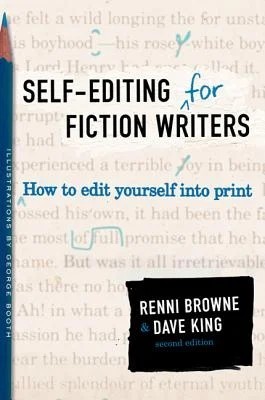
Self-Editing for Fiction Writers — Reference Desk #22

Bookshop.org affiliate link

Renni Browne and Dave King aren’t household names. They aren’t famous authors like Chuck Palahniuk, or Chuck Wendig, or any of your classic famous authorial Chucks. They’re editors. Their advice isn’t wild or shocking, and it doesn’t claim to make writing easy or save you the hard work. It’s just twelve fairly straightforward ideas that can be used to edit fiction and make it better. The result is one of my favorite books on writing.

This book has been on my shelf for years. I have the second edition from 2004, and the original was published a good decade before that. It’s not exactly timeless, but it’s about as close as you can get while including references to a broad swath of literature. I take it out every few years when I’m planning to do a lot of editing, which is why I recently re-read it.

Each chapter focuses on one thing: Show and Tell, Dialogue Mechanics, Interior Monologue, etc. The authors explain a few problems they look for when editing, then provide short examples from published books, workshops, and manuscripts. Each chapter finishes with a bulleted checklist that can be used for your own work. Finally, they provide a couple of exercises that you can try, if you want to use the book as a sort of self-guided class.

After the last chapter, there are two brief appendixes. The first contains the editors’ answers to the exercises. The second is a list of recommended books for writers, split out into craft, inspiration, and reference. Lastly, there is a solid index, so you can easily find that half-remembered advice without needless skimming.

This structure is something worth noting. So many books on writing are meandering or mix anecdotes, ideas, and advice in ways that make them difficult to use as tools. This book has a few anecdotes and asides, but it’s organized so that you don’t have to wade through any of that when you’re busy trying to find some specific thing that resonated. It’s worth reading the book from cover to cover, but it’s also designed in a way that allows it to be useful as a reference.

If there is a weakness in this book, it’s a focus on a modern, mainstream, “popular” writing style. The authors don’t talk much about the exceptions to the rules, or how to make strange and unusual fiction. This is not a guide that will help much if you’re writing House of Leaves, or Poison for Breakfast, or This is How You Lose the Time War.

I don’t think that’s a major failing. Self-Editing for Fiction Writers advocates for clean, concise, clear fiction. That’s a pretty good starting point for any writer. I suspect the authors would suggest that this is table stakes for fiction. If you want to do something more, something wild and crazy that breaks the rules, you will do it more effectively if you have a good grounding in the basics first. This book provides that.

Year of Short Stories — Week #48

2024 is my year of short stories. In this weekly series, I talk about the stories I’m working on, from idea and draft to submission.

  • Stories in Progress – 1
  • Submissions This Week – 0
  • Submissions Currently Out – 5
  • Acceptances This Year – 1
  • Rejections This Year – 28 (11 higher tier)

Submissions

No rejections or new submissions this past week (or rather, this past 4-5 days, since I was late in posting last week’s update). My lone submission the previous week was Dr. Clipboard’s Miracle Wonder Drug, which had just come back to me with a contest honorable mention.

Since I do a lot of my writing work on the weekends, I often resend stories and write blog posts in the same day. Before I do that, I look at the Duotrope Theme and Deadline Calendar, and the Publishing News. The calendar gives me a convenient list of themed issues and anthologies with deadlines in the next month, and the news page gives me a list of new publishers and those that have recently opened to submissions. These two lists are incredibly valuable when you’re sending out short stories.

Most weeks, I don’t find anything particularly exciting in the theme calendar, but it’s still worth checking because I occasionally find an upcoming issue or anthology whose theme fits one of the stories that I’m resubmitting that week.

Last week was one of those weeks, and I found an anthology that sounds perfect for Dr. Clipboard. Sure enough, I got a response within a few hours, holding the story for further consideration.

Further Consideration

This is the first time I’ve gotten this style of response for a story submission. As is typical for anything related to short story submissions, Aeryn Rudel has an article. He puts holds, further consideration, and short listing all in the same bucket—a story that someone at the publisher read and liked enough to consider publishing it.

Since most markets are inundated with submissions and will only end up publishing a fraction of the stories they like, it makes sense for them to keep their options open until the end of their submission window.

Not every publisher notifies the writer that their story is being held. They’ll just hold it and either send an acceptance or rejection when they’ve made a final decision. As a writer, you can appreciate a publisher that communicates the hold, or you can be frustrated to have yet another reason to get your hopes up, and possibly disappointed if that hold results in a rejection.

Personally, I’d rather have the additional information. Even if the story ends up being rejected, a positive, personalized response still tells me that the story is probably solid, and I just need to find the right publication for it.

Stories in Progress

I still have some projects lingering from my truncated November “PerShoStoWriMo.” I haven’t gotten a lot of words down for those stories, but they’re still taking up brain space, and I may spend more time with them in the coming weeks.

I’m still in the process of condensing the critiques I received for Red Eyes into actionable changes. In some cases this is a straightforward rewording or cut, but in other cases it requires a fair amount of thought to figure out how I want to address a concern (or if I want to address it at all). I may write a post in the future about this process.

The most interesting piece of feedback I received was that the length of the story is good. It clocks in around 6,500 words, which is long for me, and I explicitly asked readers if they saw any good places to trim that word count. A few readers ignored the question, but most of them said there were no good places to make a significant cut. A couple even said that they’d like to see a longer version of the story. One suggested a novelette, the other suggested a full-blown novel.

While I don’t plan to follow that advice, the unified response does alleviate my fears that the story is too long. I suppose I’m just stuck with a longer story, and I’ll have to deal with that when I’m finished editing and have to look for markets to submit to.

Goals for Next Week

  • Continue revising Red Eyes
  • Spend some time on one of those other story ideas

Year of Short Stories — Week #37

2024 is my year of short stories. In this weekly series, I talk about the stories I’m working on, from idea and draft to submission.

  • Stories in Progress – 1
  • Submissions This Week – 2
  • Submissions Currently Out – 6
  • Acceptances This Year – 1
  • Rejections This Year – 18 (9 personalized)

The Subs and the Pubs

Last week, Dr. Clipboard and Bluefinch came back to me, so this week I sent them out again–one to a publisher that usually responds in a few days, and one that typically takes more than a month. Luckily, I snuck this submission in right at the end of their quarterly deadline. I’m hoping that will make the response slightly faster.

Tom, Dick, and Larry also came back, with one of those odd rejections that mostly sounds like a form letter, but has just enough specificity that I suspect it’s not. The end result is the same, but these editors don’t seem to understand that I have to categorize the response for my stats!

The Edits

I continued to trim Red Eyes, shaving another hundred words off, and making a few other adjustments. I’m hoping I can trim around 400 more in this round of edits, to get it down to about 6,000 words.

I logged back into Critters.org after taking several months off. I’m several critiques behind, so I’m planning to do a couple per week to get caught up. I’ll need to get my ratio to 75% again by the time Red Eyes goes out for critique. Since it takes several weeks to get a story through the queue, and I haven’t submitted it yet, I should have plenty of time.

Goals for Next Week

  • Trim Red Eyes to 6,000 words
  • Finish 2 critiques

Year of Short Stories — Week #29

2024 is my year of short stories. In this weekly series, I talk about the stories I’m working on, from idea and draft to submission.

  • Stories in Progress – 3
  • Submissions This Week – 0
  • Submissions Currently Out – 3
  • Acceptances This Year – 1
  • Rejections This Year – 17 (7 personalized)

No Submissions, No Responses

My stories are currently submitted to publishers with longer turnaround times, so I had no responses this week. It was a nice break to get caught up on other writing tasks. I still haven’t submitted those drabbles that have been sitting around. More on that below.

The Writing Pipeline

Recently, I’ve been thinking about my writing pipeline. When I find myself doing the same type of work (like editing drafts) for too long, I lose focus and slow down. It is good to actually finish projects instead of endlessly jumping between half-finished things, but when I’m getting stuck on a project, it’s better to make some progress on another piece than grind ineffectively.

This week, I tried to diversify my writing more than I have been. I spent some dedicated brainstorming time generating new story ideas, which I haven’t done in quite a while. I also started outlining the new story I mentioned last week, The Vine. Finally, I wrote more of Portrait of the Artist in Wartime, a story where I suspect I will end up with a large word count and have to pare down.

What I didn’t do this week is any editing of Red Eyes, which is the story I was stuck on.

Next week, I’m going to try the same tactic and split my time among a few projects, and I might go back to Red Eyes to see if I can be more productive.

The List

The last thing I did this week is finish compiling my big list of potential publications for submitting drabbles.

One interesting discovery (which is obvious in retrospect) is that many publications will pay a fixed amount per story, and while $5-20 per story doesn’t seem like much, it ranges from a respectable semi-pro to top-tier professional pay rate when the story is exactly 100 words.

My next step will be to rearrange these publications into a rough ranking. I’d like to try more simultaneous submissions, but that will be limited by the amount of time I want to spend submitting.

Goals for Next Week

  • Work on brainstorming, The Vine, Portrait, and Red Eyes – whatever feels most productive
  • Submit some drabbles

Year of Short Stories — Week #19 and #20

2024 is my year of short stories. In this weekly series, I talk about the stories I’m working on, from idea and draft to submission.

  • Stories in Progress – 2
  • Submissions Past Two Weeks – 1
  • Submissions Currently Out – 5
  • Rejections This Year – 11 (4 personalized)

This week is the last week of school, so my kids are keeping me busy with concerts and events. I’m also packing and getting everything set up to move house next week. Once again I’ve been slacking on my short story reports, so we’re doubling up this week and last.

Submissions

My first submission for The Bluefinch and the Chipmunk came back with a rejection, so I sent it back out. This was my only submission for the week, although a few other stories should be coming back soon, if the duotrope estimates are anything to go by.

Writing

I finally completed a draft of Red Eyes, a story that I revived from the trunk, although it’s still a pretty big mess. This pass was mostly to find the core of the story and assess what the big, structural problems are. Now I need to take some time to decide how those things should be fixed. I also need to make it shorter, because this story is awfully long.

I’ve been doing a lot of revision lately. This is a good thing, because it’s one of my weaker points and I want to get better. However, too much revision makes me feel like I’m churning on the same stories, so I’m planning to shift focus to fresh stories for a week or two. The first of these will be Portrait of the Artist in Wartime, which I’ve been talking about for a while, but not really working on.

I intend to knock out a half-assed draft just to get a feel for where I want to go with it. Hopefully that will leave me feeling refreshed and ready to tackle more revisions.

Goals for Next Week

  • Rough draft of Portrait.