and now for something different…

So far, each day’s @inktober stories have brought me down different rabbit holes.

Today’s is about the Right to Roam in the UK! Disclaimer: I’m a hobbyist, not an academic, so this knowledge is from Wikipedia and various websites rather than Serious Peer-Reviewed Research. Inaccuracies are mine.

View across a publicly accessible field, framed by a bush. It is a sunny day.

There is a particularly British pride about walking and open country, so I expected all this to go back – well, at least more than a century. I knew about the Mass Trespass in Kinder Scout in 1932 (Ramblers link) from a family holiday in the Peak District (our family holidays come with research), but I had not realised that the parliamentary Acts were so new. The Kinder Scout Trespass was more violent than I expected too – but remember this was treated as trespassing on private land.

The Access to Countryside Act was only passed in 1949, which created the basis for Areas of Outstanding Natural Beauty, national parks and public rights of way. The Countryside and Rights of Way Act 2000 then gave access to about 8% of England – over “mountain, moor, heath and down”.

Basically, the question is: who does the land belong to?

The Right to Roam movement aims to expand right of access to more than the 8% of land in England and 3% of rivers, and to activities other than walking (so watersports and wild camping). Here is a summary from the Ramblers, an English charity.

It was and is a class issue. (This is England, after all)

I have never been particularly bold in exploring the outdoors by myself, but in my little corner of England – I suppose I will have to.

A sheltered path lined with fallen leaves, leading to a kissing gate. From a path in Hertfordshire.

Devotionalia

Author: G.C. “Grim” Baccaris (as G. Grimoire) | Choice-based (IFDB)

play time: 15-20 mins

The reader plays the last remaining priest devoted to an unnamed being, whose worship takes the form of daily ritual.

Loneliness and duty run through the story: this priest houses not-quite-human children, and they too make up part of the priest’s daily duties. While there may be loneliness in unanswered prayer, there is, ultimately, solace and a kind of community in this sort of care. And if a religion lives only with belief (deity is an entirely different matter), then the player/character holds existential power.

The overall aesthetic, both in writing and visual design, is appropriately gloomy and formal. There are subtle nods to a deeper backstory, but the focus still lies squarely on the earthly: the priest, the children, the physical setting.

Different levels of choice are made transparent to the reader with the text formatting to indicate its importance in the narrative’s progress. The story has shallow branching which converges in a suitably ambiguous ending, as befits a deity which may or may not exist – whose existence may, in fact, depend on the player’s choices.

IFComp 2021: 4×4 Archipelago

Author: Agnieszka Trzaska (IFDB) | Choice-based

A Twine-powered roguelite*/D&D imagining. It’s surprisingly expansive with lots of side quests – I took well over 2 hours. There is some inevitable lawnmowering, but with enough random in it to make it interesting. I think it stands up to replay, mainly because of the different main quests. I found the speed of progress largely determined by the starting class and characteristics.

*it’s been a while but I think that’s right? Procedurally generated, permadeath if you don’t reload from game save, turn-based combat

Otherwise a well constructed RPG, with all the bits you would expect (map, money system, combat, side quests, lore). This did well in IFComp, ranking 8th out of 71.

IFComp 2020: Academic Pursuits, Savor

Academic Pursuits (As Opposed To Regular Pursuits)

By ruqiyah (IFDB)

This game is ostensibly about unpacking and furnishing your new office. It has a simple mechanic, but has enough intriguing details to make it more than an (ahem) academic exercise. To tell more would probably be spoilers…!

If you liked this, Bruno Dias’s New Year’s game Not All Things Make it Across should scratch the same itch. Unpacking, after all, is a liminal space sort of activity – marking a transition from one location to another, and in this case one stage of life to another.


Savor

By Ed Nobody (IFDB). CW for suicide.

Seeking a cure for chronic pain, you meet a dying man in a strange house surrounded by strange creatures.

Foreboding from the start, it uses the “creepy country house” setting to good effect. The landscape echoes the story. The style is what I’ll describe as baroque, partly due to some turns of phrase which suggest the author’s first language is not English.

The branching tends to be lawnmowery, where redundant choices dead-end and lead back to the main path. Some choices are obviously signposted, and I would have liked more consistency in the formatting – especially since some choices that result in a premature ending are not signalled as such. What makes it more frustrating is the sheer speed at which the text is revealed. Mathbrush’s review on IFDB suggests that this is incredibly deliberate, yet something which even the author couldn’t stand on repeated playthroughs…

Another thing that struck me, in the time waiting for text to appear: the player’s main motivation appears to be a mystical curse, but in most aspects is chronic pain – a relatively common experience. Sans an obvious supernatural cause, I had to wonder why it warranted this treatment in the text.

IFComp 2020: Big Trouble in Little Dino Park

Authors: Seth Paxton and Rachel Aubertin. (IFDB)

You play a kid working your summer job in a theme park with a teeth-grindingly twee theme. But everything goes wrong when the dinosaurs are let loose!

It’s technically sound, though some proofreading would have ironed out a few typos here and there. It did have the breadth I expect of an IFComp game, though with the multiple ways to die I almost expected a running tally or achievement board.

The biggest thing for me was that I found it hard to be invested in the player character. With few details on who the player character is, the stakes for their survival becomes relatively low. The way the story is laid out also means the player’s first time navigating the park is during the attack: without me, the player, being able to make a plan, the deaths might as well be random.

The setup is not bad, really; with more preamble and more distinctive characters I might even get invested in it. But as it is now, it feels more like a skeleton not given enough flesh.

IFComp 2019: The Milgram Parable, The Good People, Each-uisge

Only a year late, that’s not too bad, eh?! I spent a little time catching up on IFComp games today.

The Milgram Parable

By Peter Eastman. (IFDB)

Starting with the story of Stanley Milgram’s psychological experiments, The Milgram Parable reads like an allegory, using the setting of a corporate militia. All the elements are there: unquestioning obedience, limited information and one to one meetings with superiors. I guess the sporadic binary choices come with the narrative territory, too.

So the game forces you to make increasingly abstract choices. Showing compassion at the start of the game yields the admonishment that you are quick to judge using very little information; this is what the game forces you to do. Ironic? Purposeful? Maybe. The scope of the game is so narrow, the stakes and emotional impact so vague, that the decisions start to feel academic.


The Good People

By Pseudavid. (IFDB)

This is a conversation-powered, living poem in which two people uncover a village previously submerged by a dam. As they uncover layers of the physical landscapes, so they also uncover the landscapes of the PC’s childhood and family.

Everything is fragmentary, forgotten, which creates a sort of creeping horror. The unpredictable visual design adds to that.

The game has a striking use of images throughout, and whether by design or browser variability, the text design occasionally looks buggy – text sometimes appears in unexpected places, or laid out in odd ways. Here I chose to see that as part of the effect of the game.

The Good People was intriguing, not least because it scratched my particular itch of exploring abandoned landscapes and memories.


Each-usige

By Jac Colvin. (IFDB)

MacLeod the neighbour has a kelpie – the water horse of yore – the same kind of creature that drowned the PC’s aunt.

The story was compact; the writing descriptive and the storyline fairly straightforward. Each decision has realistic moral stakes, and if we’re talking about moral decisions in IFComp 2019, this was much more convincing than, say, the Milgram Parable. Overall this was a polished piece of work and very competently done.

That itch bundle: Golf Peaks, Winterlore

Golf Peaks

Afterburn Games. itch.io page. Isometric point and click. Time to completion: incomplete.

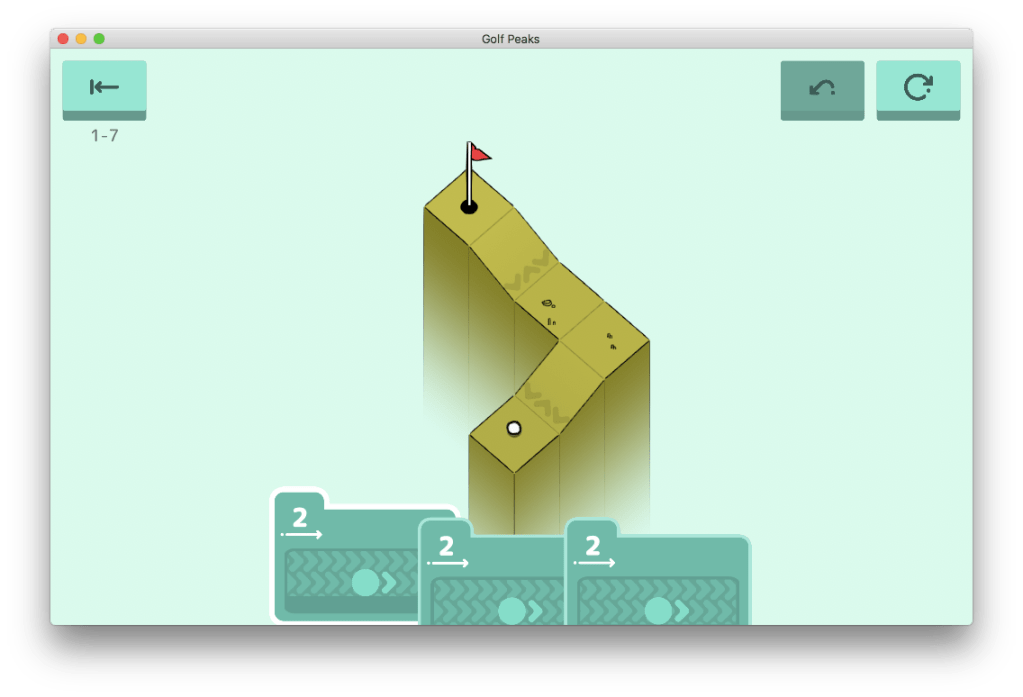
Screenshot from game showing a path for a golf ball to take and cards depicting movements

A card-based movement game, and you really don’t need to like or even know golf! It scales up in complexity which I found well-balanced. There is rather more of it than I expected, though it definitely hasn’t overstayed its welcome!


Winterlore

Moroi Springs. Point and click.

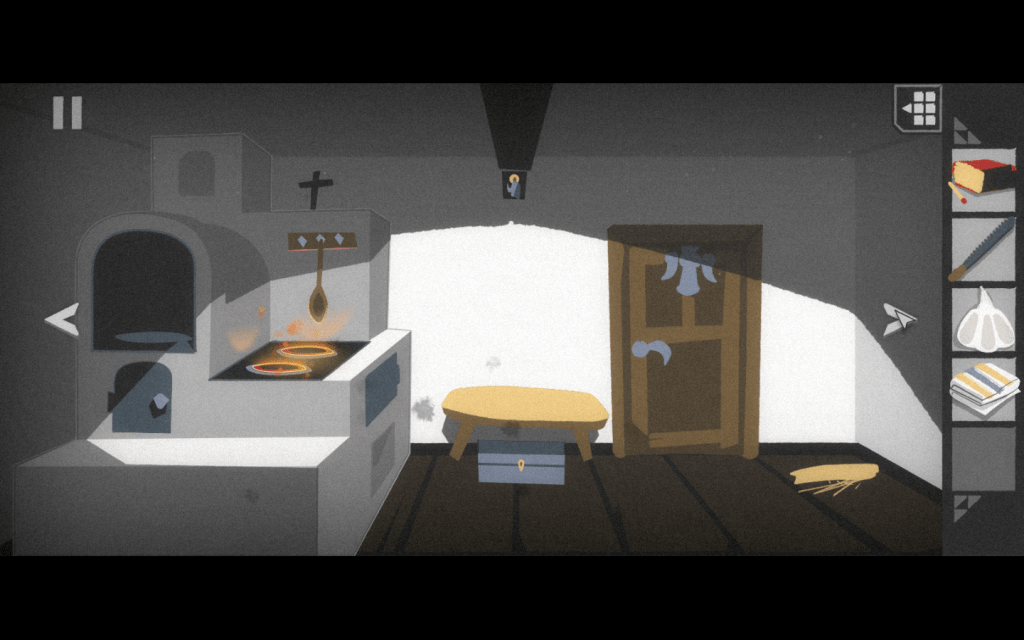
Ozana goes on a journey of healing and remembrance after her grandmother’s death – though of course she never physically travels anywhere. The story plays out in a single cottage.

Screenshot from game showing cottage with a woodstove, with a simple pastel illustration style

I wanted to like this game. It has all the elements that I usually enjoy: folklore, creepy old women prophets, point and click puzzles. But there were puzzles that didn’t really need to be puzzles, and some frustrating mechanics. I also may have locked myself out of progressing in the game by doing things in the wrong order?!

I appreciate the efforts to make this game player-friendly, though. The game itself links to the official walkthrough; instructions are explicitly displayed. I just wish that the puzzles had used knowledge of folklore more than simpler pattern-matching. I was reminded of Year Walk, though that game is substantially creepier, and the numerous ‘escape the room’ point and click games on which I grew up.

That itch bundle: Sagebrush, Hidden Folks

Sagebrush

Redact Games. First person perspective. Time to completion: 2h 44min

I finished Sagebrush, an atmospheric exploration game where you explore what’s left of a cult compound, and find out what happened to it via journals and voice recordings.

Screenshot from game showing outdoor scene under a starlit night sky

Sagebrush is quite sparse in some sense, not least because it is literally set in an arid landscape. But it oozes atmosphere, from the lo-fi rendering to lighting changes throughout. On a side note, recommend that you fiddle with the accessibility settings if you have difficulty making out details. I had to increase the in-game brightness to maximum…

Good writing, with a twist that seems believable. The end sequence I found protracted, but wrapped most things up.


Hidden Folks

Adriaan de Jongh. Isometric point and click. Time to completion: 3h

Game header image, showing a hand-drawn streetside scene

Hidden Folks was on my wishlist for the longest time, and I’d forgotten about it until the bundle! This is Where’s Waldo, but on an epic scale. There is some truly gorgeous artwork, and adjusting from the initial impression of “wow, there’s far too much!” to scanning the image, to admiring details, is incredibly satisfying.

Characters are sketched out in a line or two, with some effort towards wider representation… at least with non-English names. The sound effects are entirely human-generated, which means the soundtrack release is called Mouth Sounds! It is delightful!

That itch.io bundle

The itch.io Bundle for Racial Justice and Equality raised an astounding eight MILLION dollars for the NAACP Legal Defense and Educational Fund and Community Bail Fund. It is a feat, and a bundle, that invites hyperbole, and for good reason. As of its close last Tuesday, over 800 thousand people contributed – meaning people contributed on average $10, for almost $9000 worth of games and art and literature. This means 814,738 people who now have indie, often leftist games: certainly an incredible prospect!

The question now, of course, is how to go through all these games?!

Much like IFComp, it can often seem like being a kid in a candy shop, overwhelmed by the sheer variety available. I’m working through it, bit by bit. Over the next few weeks, I’ll try to regularly post initial impressions of the games I have tried! They’re probably going to be narrative more than action, and only the ones which can run on a Mac.

Honeysuckle

By Cat Manning. (Texture; IFDB)

[Mentions abusive relationships.]

Being the wife of an august wizard brings its own dangers. Something is off in the house, and in your husband’s absence, you must investigate.

The PC is wife to the wizard who is now her husband. They were, if not colleagues, then teacher and student, yet he dismisses her own “unruly” research, allowing her to continue only because “it seems to please her”. This echoes sexist assumptions of skill common to numerous other fields – from game development to medicine – which often casts women as the amateurs, forever the apprentice to their male counterparts. And, most notably, she plays into this as well, describing herself as an amateur.

The use of the verb ‘consider’ turns an invasion of privacy into something more like observing, but it quickly becomes clear that the PC’s husband is not who he says he is, that the PC is not safe, that prying is the only way to survival. Unusually for Texture games, Honeysuckle is strongly location-based.

What I most enjoyed – if one may call it ‘enjoyed’ – was the subversion of the traditional player as the chosen one, the powerful one, the one with the gifts. In Honeysuckle, the PC is, initially, utterly disempowered. She is the apprentice, the junior one, the amateur. She is the humble one – the humbled one – who does not speak up because she knows few will listen.

Honeysuckle stands up as a modern retelling of Blackbeard: a predatory husband; the PC just one in a line of victims. The difference, of course, being the outcome. In the same way, this game has similar themes to Sara Dee’s Tough Beans. Both have female PCs who are babied by their male partners, and both find their salvation in his destruction. But where Tough Beans is unambiguous in its outcome, Honeysuckle is a little more ominous: each of its ending branches is wracked with uncertainty.

Honeysuckle is a game about alchemy and escaping domestic peril, and it is straightforward in that front. Several aspects of the story, however, are far from fantasy for a significant part of the population. Although its ending is ambiguous, Honeysuckle envisions the possibility – with both means and opportunity intact – of escape.