7 TV: Beneath the Mountains of Madness Part 13 – Gestation Vats

Episodes 3 and 4 of Crooked Dice’s 7TV campaign ‘Beneath the Mountains of Madness’ include some wonderfully gribbly items of scenery, described in Ep 3 as ‘Organic Chambers’ and in Ep 4 as ‘Gestation Vats’ which “bubble furiously as proto-Shoggoths take form in the seething fluids.”

The map illustrations show ridged, circular fleshy chambers atop stone platforms with tentacles emerging from bubbling fluids to rest limply against the sides of the vat.

A map showing the scenery used in Episode 4 the 7TV Feature Pack 'Beneath the Mountains of Madness'
Copyright Crooked Dice

Some wonderful sculpts for these were made available by Crooked Dice as STLs through the BTMOM Kickstarter campaign. I purchased the STL from My Mini Factory and had four copies printed.

When considering what colour scheme to use for these vats, I decided I wanted bruised flesh tones for the vats and that the tentacles would be black, a la Shoggoth. For the colour of the fluids, my mind kept going back to the cover of a wonderfully pulpy horror novel I read in my youth called ‘The Sucking Pit’ , by Guy N. Smith. As you can see below, it features a swirling mess of green and orange goop, lotsa teef and a dash of skulls. I fetched my copy of the book down off the shelf and wondered how best to recreate the look of the Sucking Pit for these vats.

After an undercoat of Colour Forge Matt black, I airbrushed on a base coat of Vallejo Model Colour 72.014 purple, followed by a coat of Citadel Bugman’s Glow, trying to leave the purple showing between the vat’s ridges.

The first two steps in the painting of a gestation vat.

Staying with my airbrush, I added a layer of Citadel Cadian Fleshtone, followed by a layer of Citadel Kislev Flesh. I was happy with the general fleshy effect this gave, but wanted to make the vats ‘pop’ a bit more.

The third and fourth stages in the painting of a gestation vat.

Swapping to bristled brushes, I lightened the Kislev Flesh with some white and drybrushed it on. The layers of the 3D print immediately sprang to sight, but after an initial panic I decided I liked the look and fully committed to the drybrushing.

The fifth stage in painting a gestation vat.

After painting the teeth around the top of the vats in Army Painter Skeleton Bone, I created some shadow by brushing some ‘Marine Juice’ into the recesses between the horizontal fleshy ridges and where the claw-like appendages grasp them. A quick splash of the same to shade the teeth and that was the vats’ exteriors sorted.

The “seething fluids” were given a base coat of Vallejo Game Colour Scorpion Green, which I shaded with Citadel Contrast Ork flesh.

The sixth and seventh steps in painting a gestation vat.

Then it was a matter of highlighting the fluids, first with VGC Scorpion Green, then a mix of that and Vallejo Model Colour Yellow Green and highlighting further with a lightened shade of the same. I added ribbons of Army Painter Lava Orange here and there too and decided the fluids now looked suitably icky.

I did initially think I’d paint the fluids using my airbrush, to get smoother shades of colour, but combined concerns about getting green or orange where I didn’t want it on the fleshy parts (oo-er) and how well the orange would cover the green if airbrushed on, made me opt to apply the colours using a bristled brush instead. The final results aren’t quite what I had in my mind’s eye, but I’m happy enough with them.

Now that the fluids were painted green, the uniformity of the fleshy colours of the vats’ exteriors began to bug me, so I applied a wash of (IIRC) Army Painter Soft Tone ink over the lowest of the ridges and the ‘claws’ to make the vats’ bases and claw ‘columns’ a bit more distinct from the other fleshy ridges.

Now there were just the tentacles to paint. I decided to use one of the Vallejo ‘Space Dust’ colour shift paints I have, as there’s a nicely iridescent Electric Blue/Intense Violet that I thought could be particularly ‘Shoggothy’. A base coat of gloss black and a daubing of shifter paint later, I called the four gestation vats done.

The only snag with colour shift paints is that you can’t really shade them, so in the photo above and below the tentacles may look a little… flat, but in real life they look much better as light plays on them and as you look at the vats whilst moving around the scenery.

A gestation vat, a circular, fleshy tub of seething green fluids.

I don’t think I’ll paint my Shoggoth miniatures solely using shifter paints, but I’ll experiment with a dry brush of it for some hopefully eerie iridescence.

As always – thanks for reading!:)

If you’ve enjoyed these hobby ramblings, you’ll find links to the previous BTMOM posts below.

7TV: Beneath the Mountains of Madness Part 1 – Introduction

7TV: Beneath the Mountains of Madness Part 2 – Antarctic Pressure Ridges

7TV: Beneath the Mountains of Madness Part 3 – XPS Rock Formations

7TV: Beneath the Mountains of Madness Part 4 – 3D Printed Rock Formations

7TV: Beneath the Mountains of Madness Part 5 – Antarctic Stalagmites

7TV: Beneath the Mountains of Madness Part 6 – Antarctic Ice Formations

7TV: Beneath the Mountains of Madness part 7 – Long Sun Research Base Derrick & Air Shaft

7TV: Beneath the Mountains of Madness Part 8: Long Sun Research Base

7TV: Beneath the Mountains of Madness Part 9: Step-by-Step Painting Guide for MDF Long Sun Research Base

7TV: Beneath the Mountains of Madness Part 10: Antarctic Nissen Hut

7TV:Beneath the Mountains of Madness Part 11: Antarctic Survey Tent

7TV:Beneath the Mountains of Madness Part 12: Elder Thing City

7 TV: Beneath the Mountains of Madness Part 12 – Elder Thing City Board

Episodes 3 and 4 of Crooked Dice’s 7TV campaign ‘Beneath the Mountains of Madness’ are set in the eerie, cyclopean “dread city” of the Elder Things. Inside gigantic buildings the OSR agents find an Elder Thing laboratory, repurposed by the Ahnenerbe scientists for grotesque biological experiments (the setting for Episode 3 ‘The Dread City’) and the Nazi’s Command centre (the setting for Episode 4 ‘The Waking Doom.)

The maps for both episodes show huge, paved stone floors. I initially thought I’d represent these by buying an appropriately-styled gaming mat. However, after my first experiments working with XPS foam (on scenery for Episodes 1 and 2) and the discovery that my local model shop sold two foot by two foot tiles of XPS foam, about an inch thick – for (IIRC) £15, I concluded it would be cheaper to scratch build my own board, which would be actually textured.

I set about measuring a grid pattern on the foam, creating 2 inch by 2inch squares to represent titanic flagstones far larger than the human protagonists. I originally planned to texture both sides of the piece of foam, making a double-sided board with a central section untextured on one side, where a large raised platform sits in Episode 3 and four smaller untextured sections on the flip side, where smaller platforms are located in Episode 4. However, sanity prevailed and I decided to completely texture all of one side.

I used a metal ruler and a pencil to scour the grid pattern into the XPS foam and the made the resulting squares look more like flagstones by using a pencil to round off the corners. Also, by running the pencil at an angle along the sides of each square, varying the pressure applied as I went, I created uneven edges for the flagstones, giving them a far less uniform and more pleasing shape. I then created random cracks across the board, texturing the sides of the cracks in a similar manner to sides of the flagstones.Next came the first of two particularly fun steps.

My wife has collected several rocks form various holidays that are kept in our garden. I chose one that had some good texture on it and that I could easily grasp in one hand and then pummelled the foam with it, bashing, pressing and rolling the stone to create a variety of randomly placed dents. On the right of the photo below you can see the improvement this made.

I then took a length of kitchen foil and scrunched it into a rough ball. This had a finer ‘grain’ to it then the rock and I pressed and rolled the foil against the foam to add a further and finer level of texture as you can see in the image below.

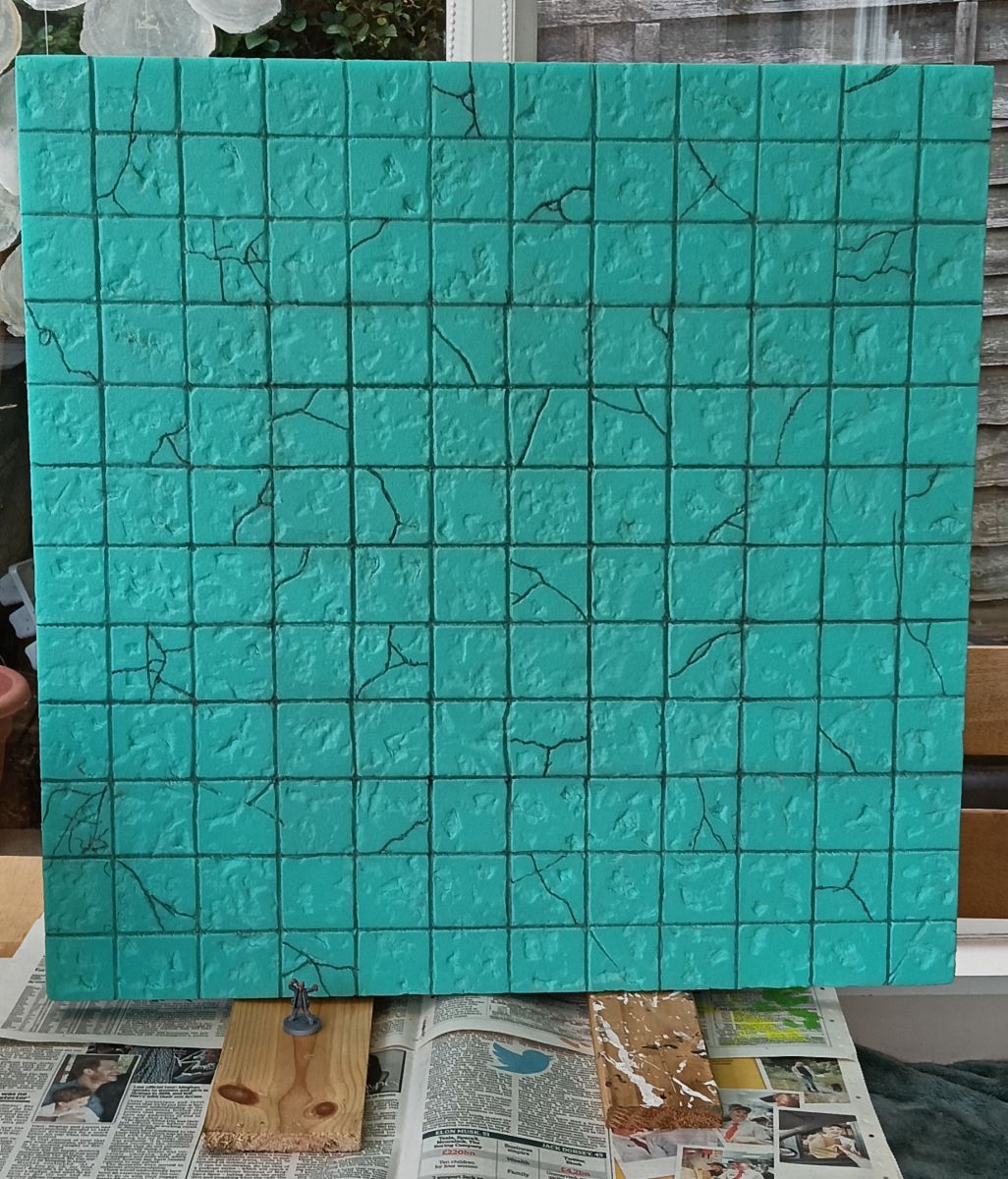
After much bashing and thumping (our cats appeared, curious as to just what the heck I was doing to disturb their 16 hours of beauty sleep) I was pleased with the texture achieved and covered the board with a coat of modpodge, so the spray undercoat wouldn’t melt the foam. Once the modpodge dried, the board now looked like this and was ready to be painted.

Oplus_16777216

I used a couple of coats of Colour Forge matt black spray to undercoat the board and then sponged on a layer of Vallejo Model Colour 869 Basalt Grey. Sponging left plenty of shadows in the gaps, cracks and dents. A coat of Citadel Nuln Oil then gave a more pleasing, darker finish that further accentuated the detail, as you can see from the four flagstones on the left below.

Once the Nuln Oil had dried, I lightly sponged on a lighter grey and finished off with a rough and ready drybrush of pure white. After a coat of Colour Forge spray matt varnish, OSR Agent Forscale helped to demonstrate the final result.

Sponging was a really fast technique, so the two coats of grey and the white drybrushing took next to no time at all. I’m very happy with the final result and I anticipate that this board will get plenty of use in other games of 7TV beyond the ‘Beneath the Mountains of Madness’ feature pack. Here’s the finished board.

As always – thanks for reading!:)

If you’ve enjoyed these hobby ramblings, you’ll find links to the previous BTMOM posts below.

7TV: Beneath the Mountains of Madness Part 1 – Introduction

7TV: Beneath the Mountains of Madness Part 2 – Antarctic Pressure Ridges

7TV: Beneath the Mountains of Madness Part 3 – XPS Rock Formations

7TV: Beneath the Mountains of Madness Part 4 – 3D Printed Rock Formations

7TV: Beneath the Mountains of Madness Part 5 – Antarctic Stalagmites

7TV: Beneath the Mountains of Madness Part 6 – Antarctic Ice Formations

7TV: Beneath the Mountains of Madness part 7 – Long Sun Research Base Derrick & Air Shaft

7TV: Beneath the Mountains of Madness Part 8: Long Sun Research Base

7TV: Beneath the Mountains of Madness Part 9: Step-by-Step Painting Guide for MDF Long Sun Research Base

7TV: Beneath the Mountains of Madness Part 10: Antarctic Nissen Hut

7TV:Beneath the Mountains of Madness Part 11: Antarctic Survey Tent

7 TV: Beneath the Mountains of Madness Part 11 – Antarctic Survey Tent

This post is shining a spotlight on the Survey Tent piece of scenery from the ‘Long Sun Research Base’ that features in Episode 2 of Crooked Dice’s 7TV Feature Pack ‘Beneath the Mountains of Madness’ (BTMOM).

Similar to the Nissen Hut I looked at in part 10 of this series of BTMOM blogs, this Survey Tent is a 3D printed piece that comes with snow drifts around its edges, which again could be painted as sand or earth depending in which gaming environment your scenario is set.

I wanted to add a splash of colour to the Research Base with this tent and for a while considered painting it a bright orange, but in the end I decided on a brown colour more suited to BTMOM’s 1940’s setting. I under and base coated the tent in Army Painter Fur Brown , using up what was left in the spray can I used to undercoat my Zulu’s (but that’s another project). I then used my airbrush to layer on Vallejo Model Colour 70821 German Camo Beige, being careful to leave the Fur Brown showing through in creases and recesses. This took next to no time to do and after using a fine detail brush to line some Citadel Nuln Oil around the edges of the tent’s window flaps and at the entrance for some extra definition, the tent was done.

The snow was painted in my now well-practised method of using a brush to apply a good, even cover of Vallejo Model Color (VMC) Blue Green 70.808, followed by airbrushing on several layers of matt white, thicker in some places than others to let the blue green base coat show through a little in places.

I felt very happy with the finished effect of the shading on the material of the tent and initially railed against the thought of lightly airbrushing white onto it to represent frost, to make the tent fit in with the Nissen Hut and other wooden huts. In the end I decided that not doing so would irritate me every time I looked at it, so I took the plunge and put the airbrush into action. Here’s the finished resut, with trusty OSR Agent Forscale in situ.

The tent still adds some pleasing colour to the base, which you can see in full by visiting the link to Part 8 of this series of blogs below.

Well,as I write this it’s New Year’s Eve in 2025, so I will look forward to finally getting to play an episode of BTOMOM in the New year, having spent all f my hobby time in 2025 working on building and painting scenery and miniatures for it and I’m still just over half way through the metaphorical pile).

As always – thanks for reading and I wish you a very Happy New Year! 🙂

If you’ve enjoyed these hobby ramblings, you’ll find links to the previous BTMOM posts below.

7TV: Beneath the Mountains of Madness Part 1 – Introduction

7TV: Beneath the Mountains of Madness Part 2 – Antarctic Pressure Ridges

7TV: Beneath the Mountains of Madness Part 3 – XPS Rock Formations

7TV: Beneath the Mountains of Madness Part 4 – 3D Printed Rock Formations

7TV: Beneath the Mountains of Madness Part 5 – Antarctic Stalagmites

7TV: Beneath the Mountains of Madness Part 6 – Antarctic Ice Formations

7TV: Beneath the Mountains of Madness part 7 – Long Sun Research Base Derrick & Air Shaft

7TV: Beneath the Mountains of Madness Part 8: Long Sun Research Base

7TV: Beneath the Mountains of Madness Part 9: Step-by-Step Painting Guide for MDF Long Sun Research Base

7TV: Beneath the Mountains of Madness Part 10: Antarctic Nissen Hut

7 TV: Beneath the Mountains of Madness Part 10 – Antarctic Nissen Hut

The majority of the scenery for the ‘Long Sun Research Base’ that features in Episode 2 of the 7TV Feature Pack ‘Beneath the Mountains of Madness’ (BTMOM) is MDF scenery in the form of huts and a mining derrick (you can see my full base in Part 7 of this blog), but there are also some STL files for 3D printed rock formations, crates and other structures – one of which is a Nissen Hut.

Nissen Huts (according to Wikipedia) are pre-fabricated structures comprising a 210° cylindrical skin of corrugated iron placed over a steel and wood frame. They’re named after Canadian engineer Lt. Col. Peter N. Nissen, who designed them in World War I.

As I decided to go ‘all in’ with my Long Sun Research Base, I purchased the necessary STL files and had them 3-D printed through athird-party service. The Nissen Hut came in three sections and pleasingly, has snow drifts around its edges as part of its sculpt. These could be painted as sand or earth depending on what gaming environment you wished to use the hut.

I ‘ummed’ and ‘ahhed’ about how best to paint the metal sections and decided to under and base coat them black using Colour Forge Matt Black spray and then airbrush on Army Painter Plate Metal. I airbrushed sparingly to let some of the black undercoat show through and then drybrushed more heavily with Plate Metal to pick up the hut’s edges. I’m pleased with the final effect and I think I saved myself the mental torture of base coating in Plate Metal and applying a black wash, only to watch it all run down the hut’s curved roof and pool on the snow drifts.

There’s some nice detail in the form of foot prints and caterpillar tracks sculpted into the snow drift. In BTMOM the hut is the garage for the Bases’s experimental snow cat). I decided to have black and yellow hazard stripes on the door to add some accent colour to the base, which is otherwise very much a brown, white and metal colour palette. I masked off the door with tape before airbrushing on the Plate Metal, so it remained black. Once the Plate Mail was applied, I removed the tape, drybrushed the door with grey to highlight the horizontal slats and added more masking tape to allow for yellow stripes to be added.

Due to the undulating surface of the door, it was tricky to get the masking tape to sit evenly, so one of the yellow stripes looks three rows deep and the other four, which bugs me a little, but I can live with it. I airbrushed on several layers of Citadel Averland Sunset and once dry, edge sponged matt black to weather the yellow stripes and partly conceal the lower, thicker stripe.

I brushed a base coat of Vallejo Model Color (VMC) Blue Green 70.808 onto the snow drift and once that was dry, airbrushed on several layers of matt white, thicker in some places than others to let the blue green base coat show through a little in places. I also lightly airbrushed white onto the sides and ends of the hut, to represent frost.

The opposite end of the hut to to the door has two windows, and I again decided to take the opportunity to add some colour to the base by carefully painting the window panes in orange. I next added a smaller section of Averland Sunset into the middle of each pane, leaving the orange showing all around it and finally a dab of 1:1 mixed Averland Sunset and matt white for a bright centre to the yellow sections. This was the most fiddly and time-consuming part of the whole painting process, as it would have been very easy to splat orange or yellow onto the metallic mullions and transoms. I finished by adding thin lines of Citadel Nuln Oil along the edges of the windows, and the curve where the roof meets the ends of the hut, to give them all some further definition. I’m please with the end result of the windows, as whilst the weather outside may be frightful it looks delightfully warm and cosy inside. Maybe the some of the base’s team members are enjoying J&B Rare Blended Scotch Whisky on the rocks whiIst playing chess in there (I.Y.K.Y.K) 😉

As always – thanks for reading. 🙂

If you’ve enjoyed these hobby ramblings, you’ll find links to the previous BTMOM posts below.

7TV: Beneath the Mountains of Madness Part 1 – Introduction

7TV: Beneath the Mountains of Madness Part 2 – Antarctic Pressure Ridges

7TV: Beneath the Mountains of Madness Part 3 – XPS Rock Formations

7TV: Beneath the Mountains of Madness Part 4 – 3D Printed Rock Formations

7TV: Beneath the Mountains of Madness Part 5 – Antarctic Stalagmites

7TV: Beneath the Mountains of Madness Part 6 – Antarctic Ice Formations

7TV: Beneath the Mountains of Madness part 7 – Long Sun Research Base Derrick & Air Shaft

7TV: Beneath the Mountains of Madness Part 8: Long Sun Research Base

7TV: Beneath the Mountains of Madness Part 9: Step-by-Step Painting Guide for MDF Long Sun Research Base

7 TV: Beneath the Mountains of Madness Part 9 – Step-by-Step Painting Guide for MDF Long Sun Research Base

As promised in Part 8 of this series of posts about my hobby journey ‘Beneath the Mountains of Madness’ , this is a step-by-step (mostly) illustrated guide to how I assembled and painted the MDF buildings that comprise the majority of the base.

As a reminder, here’s how my Long Sun Research Base looks:

This blog post is looking specifically at the MDF huts. You’ll find more information about the derrick and basalt grey rock formations in previous posts (please see the links at the bottom of this post) and I’ll be looking at the survey tent and Nissen hut in future posts.

So, where did I begin with the MDF huts? I gave the kits a wipe down with a slightly damp cloth whilst they were still intact on their ‘sprues’ to remove any excess scorching from the laser cutting, before cutting the parts of each individual kit free. Trust me here and save yourself some pain in the neck and lots of time. Do NOT simply push MDF pieces free from their sprue. They are very likely to break and require fiddly repairing. Yes, it may feel tedious, but trust me – cutting MDF parts free is the way to go.

Any pieces that had noticeable bumps or nubs remaining where the parts connected to the sprue were given a gentle sanding with fine grain sandpaper (just your standard stuff from The Range, B&M or Home Bargains here in the UK, nowt fancy) to smooth them down and aid assembly. I then like to dry fit all the parts to make sure the kit goes together well and to set my expectations for any fiddly bits of the assembly process, before bringing adhesive into the equation.

I use a tacky PVA glue (again, standard stuff from The Range, B&M or Home Bargains) to build MDF kits. I didn’t glue the roof onto any of the huts in case I ever need to have miniatures move inside the huts during a game, or for if I fail my sanity roll and end up deciding to add detail and furniture to their interiors (truly – that way lies madness).

Once the glue had dried, I used a pencil to trace the footprint of each hut onto foamex board and drew what felt to be a satisfying edge for the base of each hut, depending on its size and shape. The bases were cut out, the huts glued on with tacky PVA and once dried, I mixed up some Geek Gaming Scenics Modelling Compound (which is essentially sculptamould, but much cheaper – sculptamould being a plaster-based compound with paper pulp – think fancy paper mache) and used it to fashion some crude snow drifts around the base of each hut. I tried to build the drifts up to the same approximate height on each hut for consistency and to make it appear that the snow had been cleared away from the doorways of each hut.

These snowdrifts were totally unnecessary and took a bit of time to create, but the huts shown in Crooked Dice’s official photos for BTMOM have similar drifts around them (you can even buy STL files for modular snowdrifts from Crooked Dice to 3D print) and I really like the effect they give. I quickly realised if I didn’t try to make my own, then every time I looked at my finished huts I would most likely have wished I had. So I bit the bullet and went for it and I’m pleased I did, as I’m very happy with how they’ve turned out.

The Modelling Compound can take over a day to fully dry, so you need to be patient with it, but after a couple of days I had all my huts assembled and based with show drifts in place. Now – how to paint them?

I decided not to bother with an undercoat, as the colour of the ‘raw’ MDF is very similar to the wooden effect I wanted to achieve. Crooked Dice’s Long Sun Research Base huts are painted a grey colour, but research showed me that real world historic Antarctic huts are faded and variegated natural wooden colours, so it seemed a simpler option to try and emulate this.

Trying to think logically (not easy for me) about the order in which I needed to apply the paint, I started by airbrushing Vallejo Model Color (VMC) Blue Green 70.808 onto the show. This looked quite garish, but I had a vision in mind for how I wanted the snow to look – so again, I bit the bullet and (snow) ploughed on. Next I airbrushed a rough and ready coat of VMC German Camo Beige 70.821 over the hut’s wooden structure, to give something for the rest of the shading to adhere to, after which the hut looked like this.

You can see in the photo above how the airbrushed blue green had rubbed off in places where i handled the hut by its base. Also, where the Modelling Compound had shrunk a little whilst drying and pulled back from the edges of the hut. Never fear, solutions were at hand.

Next I layered on some VMC Gold Brown 70.877 to give the wood some ‘warmth’, applying the paint in vertical strokes to match the direction of the woodwork. I didn’t apply and paint to the roof as I planned to add a snow effect to it later and thought it a waste of time to bother painting the roof any more than I already had.

Next I layered on some VMC Flat Brown 70.983, in vertical movements, aiming roughly for the centre of each plank…

Followed by a layer of VMC Chocolate Brown 70.872, again in the centre of the planks and concentrating on the tops of the walls and doors.

The next step really brought things together and was when I realised that for once, I was in the fortunate and rare position of having what i pictured in my mind’s eye brought into reality in front of my eyes. I airbrushed white over the blue green snow, also applying white to the roof and the huts lower section, to represent snow blown up against the hut’s sides. I could have left the hut as it was now and it would have been fine for table top standard, but I wanted to do that bit of extra work to really make it pop (and again, knew that if I didn’t, then every time I looked at the hut I would have wished I had).

Which brings me to the final photo in this step-by-step guide. It’s worth comparing the photo below to the one above to show just what results a bit of extra patience and work can achieve. I edge sponged some Chocolate Brown onto the sides of the hut to give some grainy texture to the smooth areas of MDF. I then applied some Tamiya Diorama Texture Paint Snow Effect to fill the gaps where the Modelling Compound had pulled away from the sides of the hut and onto the ground in front of the hut’s door. I pressed the feet of a 28mm miniature into this as it was drying to leave some footprints. Finally, I watered down some Snow Effect, liberally sponged it onto the hut’s roof and, more sparingly, to its sides. The Snow Effect dries quite sturdily. Repeated handling over years may rub some it off the hut’s sides, but in the short term, believe me – it ain’t going nowhere. It’s fantastic stuff and much, MUCH cheaper than the Citadel ‘Technical Paint’ Valhallan Blizzard.

The eagle-eyed amongst you may have noticed the sudden appearance of hatches over the hut’s windows. I painted and added snow effect to every single hatch in one sitting, production line style, using the methods described above. I think they add a nice final ‘authentic’ touch to the huts.

There you have it. I hope some of the techniques described above may be useful to you in your own hobby time and if nothing else, do take heart from the fact that small amounts of perseverence and extra work can yield significant results.

As always – thanks for reading. 🙂

If you’ve enjoyed these hobby ramblings, you’ll find links to the previous BTMOM below.

7TV: Beneath the Mountains of Madness Part 1 – Introduction

7TV: Beneath the Mountains of Madness Part 2 – Antarctic Pressure Ridges

7TV: Beneath the Mountains of Madness Part 3 – XPS Rock Formations

7TV: Beneath the Mountains of Madness Part 4 – 3D Printed Rock Formations

7TV: Beneath the Mountains of Madness Part 5 – Antarctic Stalagmites

7TV: Beneath the Mountains of Madness Part 6 – Antarctic Ice Formations

7TV: Beneath the Mountains of Madness part 7 – Long Sun Research Base Derrick & Air Shaft

7TV: Beneath the Mountains of Madness Part 8: Long Sun Research Base

7 TV: Beneath the Mountains of Madness Part 8 – Long Sun Research Base

I’ve finished painting almost all the scenery for the Long Sun Research Base, the setting for episode 2 of ‘Beneath the Mountains of Madness’ – I just need to create a few snow drifts as scatter scenery from Sculptamold. to fill a couple of gaps.

I decided to take advantage of the dry, sunny weather this October weekend and set up all the scenery for the first time to see how it looked.

You can see the map from the feature pack for Episode2 in the image below.

Image Copyright Crooked Dice

And here’s my scenery to represent it:

And if I say so myself, I’m really happy with how it looks. With my having a young family, hobby time is hard to come by, so the scenery above represents several months of work. The eagle-eyed amongst you may have noticed I’ve rotated the Nissen Hut so the placement of the experimental OSR Snowcat feels more natural to me (plus the Snowcat’s missing searchlight, which is waiting to be pinned back into place).

The ever helpful OSR Agent Forscale is ready to take you on a brief tour around the deserted base…. (Hmm. Is that an Enno Morricone soundtrack I can hear playing in the background…?)

…before you’re evac’ed by air, circling the base one last time.

The sun’s position in the sky when I took these photos was pure serendipity, the long shadows echoing the bases’s name.

In the next few blog posts I make, I’ll take a closer look at some of the individual structures in the base and will be posting a step-by-step guide to how I’ve painted the MDF huts.

If you’ve enjoyed these hobby ramblings, you’ll find links to the previous BTMOM below.

7TV: Beneath the Mountains of Madness Part 1 – Introduction

7TV: Beneath the Mountains of Madness Part 2 – Antarctic Pressure Ridges

7TV: Beneath the Mountains of Madness Part 3 – XPS Rock Formations

7TV: Beneath the Mountains of Madness Part 4 – 3D Printed Rock Formations

7TV: Beneath the Mountains of Madness Part 5 – Antarctic Stalagmites

7TV: Beneath the Mountains of Madness Part 6 – Antarctic Ice Formations

7TV: Beneath the Mountains of Madness part 7 – Long Sun Research Base Derrick & Air Shaft

As always, thanks for reading! 🙂

7 TV: Beneath the Mountains of Madness Part 7 – Long Sun Research Base, Derrick & Air Shaft

Wow, it’s been nearly three months since I last managed any hobby time! Firstly the weather was too hot here in West Yorkshire to be able to paint or use my airbrush, then (lucky me) I’ve been away on holiday, then finishing my diploma, it’s been too hot again and finally, the weather’s cooled down, it’s raining and I’ve made some hobby time to catch up with this epic BTMOM project.

I’ve been making good progress with the various kits that comprise the Long Sun Research Base for Episode 2: ‘The Rising Fear.’ I’ve a couple of MDF huts to finish painting but can share other buildings in these next few blog posts. Today’s is the derrick and a scratch built air shaft.

You can see the set up for Episode2 in the image below. The derrick and air shaft are on the right of the image, in the North East corner, part of the villainous set up area:

Image Copyright Crooked Dice

There’s a nice STL available for the air shaft from My Mini Factory as you can see below…

…. but as the shaft is mostly hidden during gameplay by the derrick sat above it, I thought I’d save myself some money and scratch build my own.

All four corners of the table are one level high ‘hills’ which I’ve crafted from XPS foam. Plonking the partially constructed derrick onto this hill, I marked where the air shaft would need to be located to be under the derrick kit and hacked a suitably rough-looking hole through the XPS foam and added a ‘sausage’ of Milliput around the edge, which I began to blend in with the edge of the air shaft.

I bodged a few pebbles from the garden and a trimmed wooden skewer into the Milliput to act as rocks and wooden posts for the rope ladder. The rope ladder’s made from plasticard and twine. A simple build that was fiddly as heck to create, thanks to the risk of supergluing my fingers to the twine when fixing the ladder’s steps into place.

When textured and painted up, I’m very happy with how it looks. Cruder than the STL, but I think it does the trick admirably.

The Derrick’s an MDF kit. It has many narrow and thin components and some of it, especially the ‘feet’, feel quite fragile. I braced the ‘feet’ with strips of MDF on the underneath and inside, so they can’t move laterally as easily and so hopefully will be less likely to snap off. The derrick was undercoated black and airbrushed with a metallic colour for the main structure and several shades of light brown for the platforms, based on reference photos I found of the colour of the wood used on real life Antarctic structures. I added some snow effect (more on that in a mo’) and here’s the finished piece sat atop the air shaft:

And a look at just the derrick from the rear.

Occult and Science Reserve Agent Forscale (freshly-painted) is kindly stepping up to help show how large the derrick as we also take a closer look at the snow effect I applied.

After deciding roughly where I wanted the snow to sit on the wooden platforms, I airbrushed those areas with white (I found mowing over my carefully-applied wooden colours to be somewhat nerve -wracking ) and then applied a thick dollop of snow effect with a brush. Once this had dried, I watered down some snow effect and sponged it on, to further cover the airbrushed white and add some transition between it and the brushed on snow effect.

I didn’t use my usual snow goop mix of PVA and Colour Forge Basing Snow, as the PVA seems to dry with little brown spots present (see my pressure ridges in Part 2). I thought about using Citadel Valhallan Blizzard but it’d work out blummin’ expensive to buy enough of it to use on all the scenery that makes up the Long Sun Research Base. Happily, I spied ‘Tamiya Diorama Texture Paint Snow Effect’ in my local model shop (a shout out to ‘Halifax Modeller’s World’ here) and bought a 100ml tub of it to try. I’m very happy to report that for me, this Tamiya product is just as good as the Valhallan Blizzard and as it’s much cheaper it’ll be my go to resource for snow effect for the rest of this project.

So, with the air shaft and derrick completed, at least we now know how everybody will be getting beneath the Mountains of Madness. H’mm. Maybe I should try and find some cheap children’s jewellery and add a chain to the derrick…?)

If you’ve enjoyed these hobby ramblings, you’ll fin d links to the previous BTMOM below.

7TV: Beneath the Mountains of Madness Part 1 – Introduction

7TV: Beneath the Mountains of Madness Part 2 – Antarctic Pressure Ridges

7TV: Beneath the Mountains of Madness Part 3 – XPS Rock Formations

7TV: Beneath the Mountains of Madness Part 4 – 3D Printed Rock Formations

7TV: Beneath the Mountains of Madness Part 5 – Antarctic Stalagmites

7TV: Beneath the Mountains of Madness Part 6 – Antarctic Ice Formations

As always, thanks for reading! 🙂

7 TV: Beneath the Mountains of Madness Part 6 – Antarctic Ice Formation

Not long after the ‘Beneath the Mountains of Madness’ (BTMOM) Kickstarter arrived, I did a huge amount of exploring as to what rock, ice and snow scenery was available online that I could use as scatter scenery to help fill my gaming table with cover and interruptions line of sight.

I found a LOT , amongst them some ‘crystal clusters ; by Printable Scenery, which I’m pretty sure I bought from a supplier on Etsy, but my record-keeping has failed me here. There’s three different sizes of crystal clusters in the set, on one, two and three inch bases.

They’ve painted up nicely as ice formations with the simple recipe of an undercoat in Colour Forge Matt White spray, basecoat in Vallejo Model Colour White, liberal coat of Citadel Pylar Glacier contrast paint and once that had fully dried, a drybrush of Vallejo white to make the edges pop a little more.

Here’s trusty Occult and Science Reserve Agent Forscale, cataloguing each of the three different sizes of cluster.

These ice formations will get plenty of use in all bar one of the main episodes in the BTMOM feature pack, so I’ll certainly get my money’s worth out of them. You’ll find Printable Scenery’s superb scenery ranges here and Crooked Dice’s range of miniatures, scenery and the 7TV rules and feature packs here.

I’m very much looking forward to sharing my continuing journey Beneath the Mountains of Madness with you. Agent Forscale, three of his fellow OSR agents, an Alpha Mutated Husky and three Mutated Huskies have now crossed my painting table too and will be making an appearance on this blog in glorious technicolour (TheOtherOneColour…?) soon.

You can find out more about BTMOM and the other scenery I’ve painted and/or created for the campaign in these other blog posts:

7TV: Beneath the Mountains of Madness Part 1 – Introduction

7TV: Beneath the Mountains of Madness Part 2 – Antarctic Pressure Ridges

7TV: Beneath the Mountains of Madness Part 3 – XPS Rock Formations

7TV: Beneath the Mountains of Madness Part 4 – 3D Printed Rock Formations

7TV: Beneath the Mountains of Madness Part 5 – Antarctic Stalagmites

As always, thanks for reading! 🙂

7 TV: Beneath the Mountains of Madness Part 5 – Antarctic Stalagmites

Amongst the scatter terrain shown in the maps for Episode 3 and 5 of Crooked Dice’s ‘Beneath the Mountains of Madness’ Feature Pack are several stalagmites. I liked the look of these and thought they would make for fun terrain pieces. Some browsing on johnny interweb soon located a seller on E-bay who provides custom made pieces for the classic range of 3.75 inch Kenner / Palitoy Star Wars figures. And yes, I went down the rabbit hole for a while looking at all the goodness available because I was five years old when Star Wars came out and Star Wars figures and toys were an integral part of my very happy childhood.

The seller is Legion Gifts and amongst the many lovely items available from them are scene settings for the Wampa’s ice cave on Hoth, including…. lots of stalagmites. There’s four separate stalagamite clusters available priced from £2.99 to £5.49 at the time of writing (February 2025), plus other even more imposing ice formations and I ordered one of each.

With them being scaled for 3/75″ Star wars figures, they all look very fitting for 28mm/32mm miniatures and I was highly pleased when they arrived and I got to plonk them down next to OSR Agent Forscale.

I went to undercoat them in matt white and then had a sudden bout of indecision (not unusual, with me being a Pisces). Should I paint them as rock formations (basically in black /basalt grey) or as ice? Hmm. Ice probably wouldn’t shape itself into these formations but after some umming and ahhing I decided to go with the rule of cool and plumped for a similar icy blue colour as the pressure ridges I’d already greatly enjoyed painting.

Except I quickly realised that wasn’t going to work. Slapping Citadel Pylar Glacier over these was just going to see most of it run straight down and off the stalagmites. Hmmn. The stalagmites are surprisingly well detailed, with lots of facets, rather than them being overly rounded and smooth, So, after undercoating in Colour Forge Matt White Spray and basecoating by brushing on Vallejo Model Colour White 70.951, I carefully applied Citadel Pylar Glacier to various individual facets, aiming for those that generally faced ‘upwards’. My test pieces turned turned out well, so I had at the others and once the Pylar Glacier was dry, I drybrushed each stalagmite formation with the Vallejo White. A coat of spray gloss varnish and done. They won’t win any painting awards but look perfectly fine for my needs. Well, judge for yourself.

If you like what you’re seeing, you’ll find Legion Gifts on Ebay. And you’ll find Crooked Dices range of miniatures, scenery and the 7TV rules and feature packs here.

This next formation’s my favourite. I like the varying heights of the stalagmites and the way they curl around.

I’m very much looking forward to sharing my continuing journey Beneath the Mountains of Madness with you. You can find out more in the other blog posts below:

7TV: Beneath the Mountains of Madness Part 1 – Introduction

7TV: Beneath the Mountains of Madness Part 2 – Antarctic Pressure Ridges

7TV: Beneath the Mountains of Madness Part 3 – XPS Rock Formations

7TV: Beneath the Mountains of Madness Part 4 – 3D Printed Rock Formations

As always, thanks for reading! 🙂

7 TV: Beneath the Mountains of Madness Pt 4 – 3D Printed Rock Formations

Crooked Dice offered several sets of STL files during their ‘Beneath the Mountains of Madness’ (BTMOM) Kickstarter campaign. I don’t own a 3D printer and had never purchased an STL file to have something printed for me by a third party print service. So, I looked at the various scenery options available in these packs with some envy, but didn’t purchase any.

Once the BTMOM Kickstarter was fulfilled and Crooked Dice began to release items at retail, I discovered that individual items from each of these STL sets had been made available from Crooked Dices My Mini factory page. Between the Kickstarter ending and being fulfilled, I had been busy making my own scenery from XPS foam, such as the pressure ridges (see Part 2 of the series of blog posts) and Elder platforms, which we’ll get to in a future blog post. So, I no longer needed everything from each of the original STL sets. There are certain scenery pieces that I had been puzzling about how to scratch build, so I decided to do my research, select a business to do some 3D printing for me and buy the STL files these more intricate and organic scenery pieces.

To make a long story short, I ended up using Highlands 3D Prints. I’d messaged the owner asking some questions about 3D printing, what material to choose, how much certain STL files may cost to print etc etc and the owner was extremely helpful, making me feel confident to purchase the files I really wished for. I’ll get around to showing you all of these after they’re painted and my gaming group have had chance to play through the Episodes of BTMOM they feature in (don’t hold your breath, I still a LOT of painting to do). I can highly recommend Highlands 3D Prints, you will find their website here. They sell many different 3D printed items ‘off the peg’ as well as providing the custom service that served me so well.

The first few files I’ll share with you are these rock formations. I’d already scratch built some formations from XPS foam (see Part 3) but really liked the design of these rock,s which remind me of Giant’s Causeway in Northern Ireland. (I’ve been lucky enough to visit the Causeway and it’s amazing. Very otherworldly.) Trusty Occult and Science Reserve (OSR) Agent Forscale is helpfully giving an indication of their size in most of these photos.

To paint these formations, I used my now tried-and-trusted method for painting basalt; undercoat in Colour Forge matt black spray. Brushed on Vallejo Model Colour 869 Basalt Grey. Wash with Citadel Nuln Oil. Dry brush with a couple of shades of lightened Basalt Grey and a final very light drybrush of pure white. The drybrushing does show up some of the fine layers that comprise the 3D print, as you can see in the photo below, but not enough for me to find it too irritating. It’s just part and parcel of the nature of 3D prints.

I love this rock archway in particular.

I’ve added some snow gloop here and there, given the Antarctic nature of the terrain. Looks stark and perhaps a little forced, being so concentrated in clumps. I’m going to experiment with sponging snow gloop onto scenery and if it seems to work well, I’ll revisit these rock formations in the future and add some more graded snow effect.

This rock spire is suitably tall:

And the final one of the three sits nicely midway between the other two:

These formations will see use in both Episodes 1 and 2 of BTMOM and may throw them into the mix for Episode 5 as well.

I’m very much looking forward to sharing my continuing journey Beneath the Mountains of Madness with you. You can find out more in the other blog posts below:

7TV: Beneath the Mountains of Madness Part 1 – Introduction

7TV: Beneath the Mountains of Madness Part 2 – Antarctic Pressure Ridges

7TV: Beneath the Mountains of Madness Part 3 – XPS Rock Formations

As always, thanks for reading!

Design a site like this with WordPress.com
Get started