Final Exam Review Details
- Date: Wednesday, December 2nd
- Time: 3:00 PM – 5:00 PM
- Location: Hybrid (In-person and Zoom)
- Egmont Key (224) in the Student Union
- Penji is where you will find the Zoom link: https://web.penjiapp.com/
I recommend coming to class December 2nd, not just for the final exam review, but also because that is the only time Professor Donnelly will be reviewing ch.21 before the final. She also mentioned review for the final if there is time.
Remember the final practice exam & recording is on the Study Union WordPress. I still reccommend using the past exams, practice exams, and practice questions on my WordPress, especially if it is a specific unit or chapter you would like to review.
Hello everyone, and welcome to the SI page for CHM 2046 with Professor Donnelly. This is where I will be sharing session dates along with helpful information and resources.
My name is Ariel, and I will be your Supplemental Instruction Leader for this course. I am a biomedical sciences major here at UCF. I love to read, embroider, and bake. I love learning different hobbies, so if you have any hobby recommendations please let me know!
I also really love Chemistry ||, so I am excited to help you understand more of the material and I hope to see you at my SI sessions!
15 minutes before each session please check in with Penji: https://web.penjiapp.com/
SI Session Details
| Day | Time | Location |
| Monday | 3:00PM – 3:50PM | CB1 119 |
| Wednesday | 10:30AM – 11:20AM | BA1 110 |
| Wednesday | 3:00PM – 3:50PM | CB1 119 |
| Friday | 10:30AM – 11:20AM | Zoom |
days
hours minutes seconds
until
Exam 4 (Ch.19 & 20)
My Recommended Study Plan
- Read each chapter thoroughly.
- Study each section
- Read your section notes as though you are the teacher. Use the Feynman Technique by explaining the material in your own words as if you were teaching someone else.
- After reading each section’s notes, write down everything you remember without looking at your notes. Then review your notes and fill in anything you missed. This is Active Recall.
- Complete the practice questions
- Complete practice questions available in the textbook, study module, questions you have worked on in previously in class, and the materials I have posted here on WordPress.
- If you are short on time, you may skip this step and move directly to the practice exam. However, I strongly recommend completing the practice questions if you have enough time, as they will help you prepare for the exam.
- Complete the past exam (and practice exam if you have time) I have posted here.
- Review Mistakes & Re-Study Weak Areas
Disclaimer: The practice questions & exam reviews are made completely by me without the help of the professor. I am human and I am, therefore, subject to mistakes. I have done my best to ensure that there is none, but please let me know if you find a mistake. Regardless, this should not be your only source of studying. These practice questions and exams should be used alongside your professor’s materials and the textbook. The textbook has a lot of practice problems at the end of each chapter that you can use to test yourself.
Chapter 12: Intermolecular Forces
Chapter 12 Practice Questions Answer Key
Chapter 14: Colligative Properties
Chapter 14 Practice Questions Answer Key
Chapter 15 Chemical Kinetics
Chapter 15 Practice Questions Answer Key
Chapter 16 Chemical Equilibrium
Chapter 16 Practice Question’s Answer Key
Chapter 17 Acids & Bases
Chapter 17 Practice Questions Answer Key
You will need to be able to know which acids/bases are strong or weak. There are two ways to this. Either you can use the following flow chart or use the following tables to memorize the common strong acids/bases used in General Chemistry 2. Any other acids/bases not in the tables can be treated as weak acids/bases in General Chemistry 2.
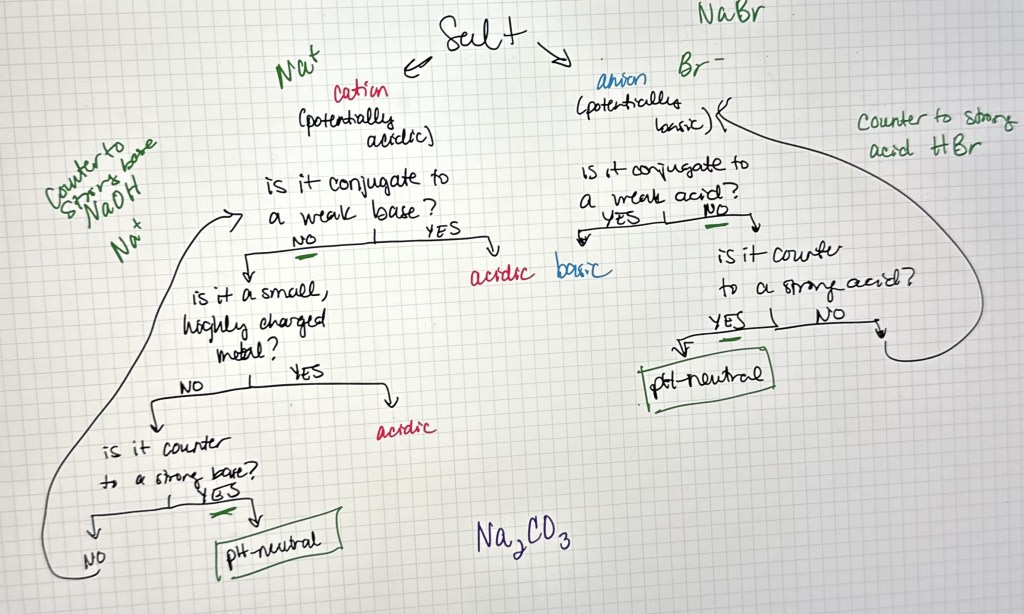
Strong Acids
| Hydrochloric Acid (HCl) | Nitric Acid (HNO2) |
| Hydrobromic Acid (HBr) | Perchloric acid (HClO4) |
| Hydroiodic Acid (HI) | Sulfric Acid (H2SO4) Diprotic |
Strong Bases
| Lithium Hydroxide (LiOH) | Strontium Hydroxide [Sr(OH)2] |
| Sodium Hydroxide (NaOH) | Calcium Hydroxide [Ca(OH)2] |
| Potassium Hydroxide (KOH) | Barium Hydroxide [Ba(OH)2] |
Chapter 18 Aqueous Ionic Equilibrium
Chapter 18 Practice Questions Answer Key
Chapter 19 Thermodynamics
For this exam, you will need to derive the equation ΔG° = −RT ln(K) from ΔG = ΔG° + RT ln(Q) on the reference sheet.
Chapter 19 Practice Questions Answer Key
Chapter 20 Electrochemistry
OIL RIG is an acronym to help you remember the difference between oxidation & reduction.
OIL = Oxidation Is Loss
- Oxidation occurs when a substance loses electrons.
- Its oxidation state increases.
- Example: Mg → Mg²⁺ + 2e⁻
RIG = Reduction Is Gain
- Reduction occurs when a substance gains electrons.
- Its oxidation state decreases.
- Example: Cu²⁺ + 2e⁻ → Cu
How to Remember:
- OIL = Losing electrons.
- RIG = Gaining electrons.
How to balance redox equations in acidic solutions?
Step 1: Assign oxidation states to all atoms and identify the substances being oxidized and reduced.
Step 2: Separate the overall reaction into two half-reactions: one for oxidation and one for reduction.
Step 3: Balance each half-reaction with respect to mass in the following order:
- Balance all elements other than H and O.
- Balance O by adding H₂O.
- Balance H by adding H⁺.
Step 4: Balance each half-reaction with respect to charge by adding electrons. Make the sum of the charges on both sides of the equation equal by adding as many electrons as necessary.
Step 5: Make the number of electrons in both half-reactions equal by multiplying one or both half-reactions by a small whole number.
Step 6: Add the two half-reactions together, canceling electrons and other species as necessary.
Step 7: Verify that the reaction is balanced with respect to both mass and charge.
How to balance redox equations in basic solutions?
Step 1: Assign oxidation states to all atoms and identify the substances being oxidized and reduced.
Step 2: Separate the overall reaction into two half-reactions: one for oxidation and one for reduction.
Step 3: Balance each half-reaction with respect to mass in the following order:
- Balance all elements other than H and O.
- Balance O by adding H₂O.
- Balance H by adding H⁺.
- Neutralize H⁺ by adding enough OH⁻ to neutralize each H⁺. Add the same number of OH⁻ ions to each side of the equation. Combine H⁺ and OH⁻ on the same side into H₂O.
Step 4: Balance each half-reaction with respect to charge by adding electrons.
Step 5: Make the number of electrons in both half-reactions equal by multiplying one or both half-reactions by a small whole number.
Step 6: Add the half-reactions together, canceling electrons, water molecules, and other species as necessary.
Step 7: Verify that the reaction is balanced with respect to both mass and charge.
Remember:
- Acidic solutions: Use H₂O and H⁺ to balance oxygen and hydrogen.
- Basic solutions: Use H₂O and OH⁻ to balance oxygen and hydrogen. If H⁺ is used during balancing, neutralize it with OH⁻.
- No H or O atoms to balance? You may not need H₂O, H⁺, or OH⁻.
Chapter 20 Practice Questions Answer Key
Chapter 21: Nuclear Chemistry
What happens during alpha (α) decay?
- Emits a helium nucleus (⁴₂He).
- Mass number: decreases by 4.
- Atomic number: decreases by 2.
What happens during beta-minus (β⁻) decay?
- Emits an electron (⁰₋₁e).
- Mass number: no change.
- Atomic number: increases by 1.
What happens during beta-plus (β⁺) decay?
- Emits a positron (⁰₊₁e).
- Mass number: no change.
- Atomic number: decreases by 1.
What happens during electron capture?
- Captures an electron (⁰₋₁e).
- Mass number: no change.
- Atomic number: decreases by 1.
What happens during gamma (γ) emission?
- Emits gamma radiation (energy).
- Mass number: no change.
- Atomic number: no change.
Beta-plus decay and electron capture both decrease the atomic number by 1, but beta-plus emits a positron, while electron capture takes in an electron.
| Decay type | Mass number | Atomic number |
|---|---|---|
| Alpha (α) | −4 | −2 |
| Beta-minus (β⁻) | No change | +1 |
| Beta-plus (β⁺) | No change | −1 |
| Electron capture | No change | −1 |
| Gamma (γ) | No change | No change |

