


Bumantara and a World Federation. Revisiting Sutan Takdir Alisjahbana’s Ideas on a Culture of Inclusion in Times of Crisis
By Fathun Karib
In September 2024, the German Institute for Japanese Studies (DIJ) held a workshop titled “De-centering Academia: Inter-Asian Perspectives” in Tokyo, Japan. This workshop addressed two key processes of de-centering that occur in today’s academic landscape. First, new educational institutions in Asia are emerging as significant centers of higher learning, challenging the dominance of established institutions in Europe and the United States. Second, this shift involves transforming the prevailing Western-centric view of knowledge production. One aspect of this de-centering is the decolonization of knowledge, which seeks to include marginalized perspectives in academic discussions. In the workshop, I offered an alternative approach to de-centering academia and deconstructing Southeast Asia as a term in area studies. One part of the presentation looked at Sutan Takdir Alisjahbana’s thinking of offering an alternative term for the Southeast Asian area.

The article will discuss Sutan Takdir Alisjahbana’s ideas on Bumantara and a World Federation. Alisjahbana was a prominent Indonesian author and intellectual (February 11, 1908–July 17, 1994). Born in Natal, North Sumatra, he made significant contributions to Indonesian literature through his novels and poems. He served as the founding editor of “Pujangga Baru”, an influential Indonesian literature magazine. During the 1930s, fifteen years before Indonesia gained independence, Alisjahbana participated in a significant and well-known debate among intellectuals called the “Polemik Kebudayaan” or cultural polemic. This debate centered on the future of Indonesian culture, discussing whether it should continue to derive from traditional Indonesian cultural roots or adopt a modernized and westernized approach. Alisjahbana additionally played an essential role in the development of the modern Indonesian language. His novel “Kalah dan Menang” (Defeat and Victory) earned him the “Order of the Sacred Treasure” from the Emperor of Japan in 1987. In 2016, Florian Coulmas, a German linguist and professor of Japanese society and sociolinguistics at the University of Duisburg-Essen, recognized Alisjahbana as one of the twenty historical figures honored as “Guardians of Language.”
This article will revisit Alisjahbana’s thinking as part of the dialogue in responding to the workshops theme of de-centering academia. It will focus on examining the Bumantara concept offered by Alisjahbana. Additionally, it will delve into his proposal for a “World Federation” as a solution for addressing ongoing global crises. In a recent conversation at the Dialogue in Human Geography (Han et al., 2025), I discussed how the concept of Bumantara could serve as an alternative concept for the region, providing a different framework from the emerging “Indo-Pacific” ideas that have been gaining traction in recent academic discourse. Despite Alisjahbana’s modernist inclinations towards liberal and functionalist perspectives, his concept of Bumantara present an opportunity for Southeast Asians to explore and develop distinct de-centering projects that depart from his original ideas.

Bumantara
In the late 1980s, Alisjahbana expressed concerns about the future of humanity. From his modernist perspective, he saw the development of ASEAN (Association of Southeast Asian Nations) as a positive step towards the future integration of people in the region. He believed Southeast Asia’s development toward cultural unity in the future could serve as a model for global unity. Alisjahbana highlighted Indonesia’s history as the largest and most populous country, which successfully transformed its diverse ethnic languages into “Bahasa Indonesia” (the Indonesian language) through the Sumpah Pemuda (Indonesian Youth Pledge) in 1928 (Alisjahbana, 1993, 13). He argued that Southeast Asian nations could further advance the regional integration of Southeast Asia through cooperation in culture and language.
He offered a new concept, Bumantara, derived from the regional lingua franca, to replace the Western term Southeast Asia for the region. During the speech of his Doctor Honoris Causa from the University Sains Malaya at Penang in 1987, Alisjahbana said;
I would like to propose a new name for Southeast Asia as well for the people who inhabit it, in order that the organization for cooperation which started with the declaration of Bangkok 20 years ago in the future can develop more naturally and become the integrating force for this region as well as for its people. The name that I would like to propose is Bumantara i.e. a combination of the words Bumi (land) and Antara (in between), because in fact what we call Southeast Asia which consists of Burma, Laos, Thailand, Vietnam, Kampuchea, Malaysia, Singapore, Indonesia, the Philippines and Brunei is the unification of the regions as well as the people which are different from China in the East with a population of thousand million as well as from India in the West with a population of 800 million (1987, 16–17).
Alisjahbana outlined several dimensions of our global crisis (1987, 49–51). First, countries prioritize their interests in the political arena, leading to competition and conflict. One of the most significant threats to global peace is the competition related to nuclear production. Second, nations also compete economically in terms of commodity and market expansion. Alisjahbana stated, “The national states are competing with each other in the promotion of their own products through the expansion of their industry, their agriculture, their mining and in the struggle of the world market” (Alisjahbana 1987, 50). Third, religious conflicts arise among followers of different world religions. Last, advancements in technology and science can become sources of conflict themselves. He pointed out that “the danger of the destruction and pollution of nature deriving from the progress of science and technology, human carelessness and greed which can only be overcome by a new human consciousness, i.e., man has to realize, that he is only a small link in the great chain of natural equilibrium” (1987, 51).
Bumantara, or Southeast Asia, is a strategic region that can play a significant role in addressing various dimensions of existing conflicts. A key factor among the Bumantara people is their cultural capacities. Alisjahbana (1987, 36) emphasizes the local genius of the Bumantara “as the strength of its creative aesthetic power, parallel to an openness to accept, assimilate, and synthesize the concepts and ideas of other cultures in an integrative structure, realizing a new form of equilibrium and greatness.” From this point of view, Bumantara people can incorporate elements and traits from different parts of the world that align with their native potential, allowing them to strengthen their characteristics and national identity. In this context, Alisjahbana followed D.G.E Hall, an historian of Southeast Asia, that “[t]he art and architecture which blossomed so gorgeously in Angkor, Pagan, Central Java and the old Kingdom of Champa are strangely different from those of Hindu and Buddhist India” (1987, 34). In this context, although world culture from India, China, Islam, and the West shape Bumantara people, they can absorb and integrate the various cultures brought by people outside their region into their own cultural identity and produce new culture including arts and architecture.
In Alisjahbana’s ideas, culture serves as an integrating force, with the Bumantara people’s ability to absorb, process, and cultivate various world cultures being the key factor. His view is that the development of ASEAN from 1967 to 1987 demonstrates how regional cooperation can enhance integration and become a crucial element for global unity. He said that “the creation of ASEAN as the first step of cooperation of the Southeast Asian countries will develop into an example of how the will to cooperate and mutual understanding are able to create an ever more intensive and widening integration in all social and cultural life” (Alisjahbana 1987, 60). He optimistically emphasized that “[i]n this way Bumantara has the possibility of becoming the catalyst in the amalgamation and integration of the cultures of the world in the present crisis and the process of transformation of our time which is full of possibilities besides being full of dangers (Alisjahbana 1987, 56–57).
A World Federation
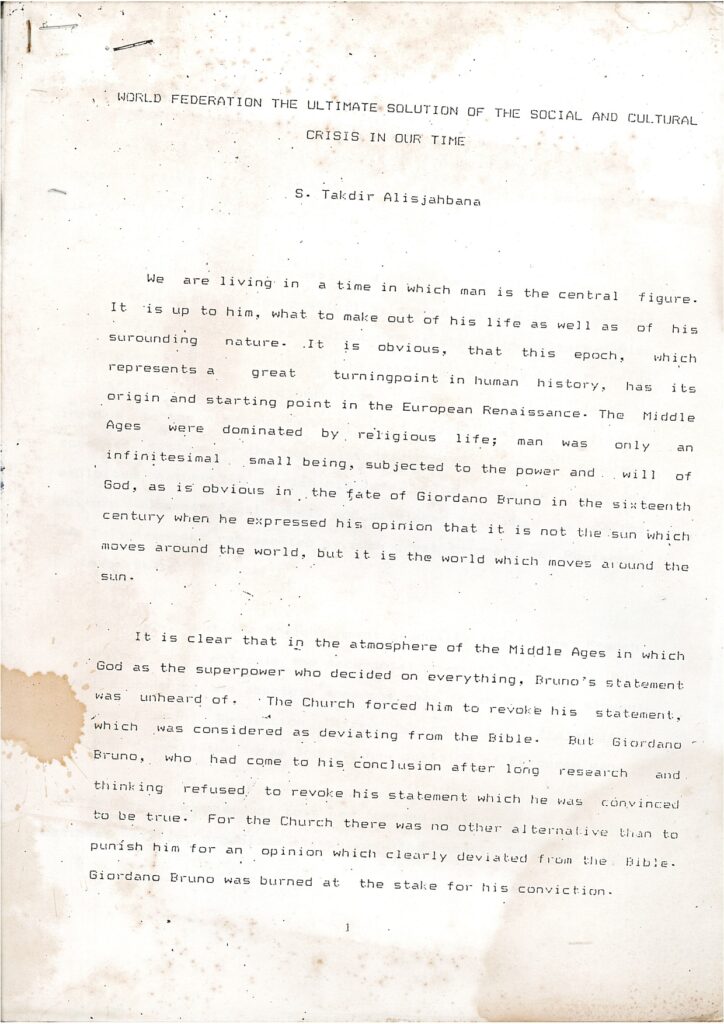
First page of the unpublished paper Alisjahbana, Sutan Takdir (1993): “World Federation: the Ultimate Solution of the Social and Cultural Crisis in Our Time. Photo via Sutan Takdir Alisjahbana Family Archives.
Alisjahbana expresses concern about modern institutions’ inability to address the current global crisis. He identifies two main issues (Alisjahbana 1987, 49): First, national states are concerned about their self-interest in security and competing over welfare. Nation-states should change their behaviour and “have to realize that the time of absolute sovereignty has passed with the speed of transportation and communication…” (Alisjahbana 1992, 3). Second, the United Nations should establish steps and regulations to promote cooperation and manage conflicts. Although the United Nations partly achieved resolving conflict between states, he recognized that “we are still very far from a satisfactory world organization for solving the many and still increasing military, political, and economic tensions and conflicts between nations, especially because of the globalization of social and cultural relations in the world (Alisjahbana 1990, 16). In his work on Bumantara , Alisjahbana begins to envision the concept of a World Federation as a means to foster relationships between nations and prevent global destruction. He said that
The insufficient consciousness of this situation is clearly expressed by the conflict in UNESCO as an institution for educational and cultural cooperation and in the failure of the United Nations Organization to create step-by-step regulations and institutions for cooperation and integration on the long road towards the ultimate goal of a world federation if mankind wants to escape its own annihilation and would like to bring an end to the wasteful armament race in a time when a great number of the human race still suffering from hunger and many kinds of diseases (Alisjahbana 1987, 49–50).
In the early 1990s, Alisjahbana revisited and further developed the vision of a World Federation. In his paper “The Problem of Violence in the Context of Future Humanity” (1992), Alisjahbana argued that the nature and magnitude of violence witnessed in the twentieth and twenty-first century were distinct from any previous violence. He said, “[i]n our time, however, when man has a much greater command over atomic power, everything becomes different, since the overwhelming power of atomic explosion” (Alisjahbana 1992, 2). Concerns about nuclear weapons are central to this paper and Bumantara’s work. The threat of atomic weapons continues to be a significant concern for Alisjahbana when addressing issues related to a World Federation in his various works: “The Crisis of Renaissance Man as the Crisis of the Whole of Humanity in Our Time” (1990), “A Philosophy for Future: Toward a Culture of Inclusion” (1993a), “World Federation: The Ultimate Solution of the Social and Cultural Crisis in Our Time” (1993b). He views the competition between America and Russia as a potential pathway to nuclear conflict. Alisjahbana states that “…it will be easy to destroy the whole world and the whole of humanity many times over. Therefore, atomic energy, and especially atomic weaponry, is not only the concern of the superpowers who possess the atomic weapons but also of the whole of humanity” (Alisjahbana 1992, 3).
The historical Development of a World Federation
Alisjahbana explores the formation of a World Federation by developing historical arguments related to the evolution of human groupings, from tribes to nation-states and ultimately to a world federation. In his writing “World Federation: The Ultimate Solution to the Social and Cultural Crisis of Our Time” (1993), he emphasizes that world history has been characterized by the unity of human groups emerging through both conflict and collaboration. According to Alisjahbana, two key technological factors—transportation and communication—facilitate the unification of the world into a federation. These advancements enable more intense and closer interactions by reducing the barriers of distance. He remarked that “conflict is inherent in the life of the individual as well as society and culture, we even can say that conflict is the very basis of progress and evolution on our planet” (1993, 8). At the same time, cooperation has played a significant role in fostering unification throughout history. Alisjahbana’s perspective can be viewed as structural-functional because he considers conflict and cooperation to be essential and dynamic elements in humanity’s evolution. This structural-functional approach aligns with modernization theory, similar to the ideas proposed by sociologist Talcott Parsons.
Concerning the nation-states, Alisjahbana argues that “national states that insist on their independence and sovereignty are already outdated; they are the primary sources of conflict over power and economic prosperity” (1993, 9). In this context, while the nation-state emerged as a modern, unified institution in the sixteenth century, he believed in the 1990s that the competition among nation-states for power and economic interests fuelled the ongoing crisis. Alisjahbana pointed out that “the basic problem is that the advanced and rich nations of the West want to maintain their historically privileged position while the developing nations of the third world intend to have a greater share in the progress and prosperity of our time” (1993, 14). The competition and struggles for power and economic interests are producing inter-connected challenges such as population growth, migration issues and precariarity, deforestation, and pollution. It is interesting that Alisjahbana (1993, 14–15) recognized the issue of environment:
There is also the threat of the disappearance of the forest in some tropical countries through reckless cutting of trees for commercial and other economic purposes, which can have disastrous consequences for the world through the fact that it makes the ozon layer thinner. There is further a common danger of pollution of water and air with [sic] endanger not only human life but also the flora and fauna on which human existence depends.
Three examples from world history serve as models for the potential formation of a World Federation. The first example is the creation of the United States of America (Alisjahbana 1993, 9). In this case, the 50 states share equal rights and responsibilities, which can be used as a reference point. Alisjahbana argues that, as a victor in World War II, the U.S. had the opportunity to initiate the formation of a World Federation but failed to seize that chance. However, it is essential to note that the United Nations, which Alisjahbana critiques, were initiated and overseen by the United States, one of the victorious powers of the war. Therefore, the criticism of the UN’s ineffectiveness can reflect the United States’ failure to effectively lead other nation-states in the aftermath of World War II. As a second example, Alisjahbana (1993, 13) discussed the unification of Europe through the establishment of the European Union, which took place on November 1, 1993. This event occurred just a few days before the presentation of the World Federation script on November 18, 1993. He highlights this event as an example of unification, referencing the long history of development among European nations that ultimately led to the formation of the European Union.
The Youth Pledge of 1928, declared by Indonesia’s youth, influenced Alisjahbana’s experiences. This pledge was an agreement to uphold ‘one homeland’, ‘one nation’, and ‘one language’. From the beginning of his work and ideas, Alisjahbana drew inspiration from this declaration and decided to focus his efforts on the concept of ‘one language.’ His various contributions significantly advanced the culture and development of the Indonesian and Malay languages, particularly in the areas of grammar for both Indonesia and Malaysia. In this context, Alisjahbana perceived the formation of the Indonesian nation and state as a significant example connected to the broader concept of a World Federation. From this perspective, Indonesia is recognized as a country with a large population and a significant role in Southeast Asia (Alisjahbana, 1993, 13). The formation of the Indonesian state has evolved in the region through cooperation among countries, particularly with the establishment of the Association of Southeast Asian Nations (ASEAN). Indonesia’s role is crucial both in the area and internationally, as it has established the Non-Aligned Movement, which aims to unify developing nations and reduce the influence of both Western and Eastern blocs. In this regard, Alisjahbana wanted to argue that Bumantara has a strategic position for the future, particularly concerning the potential formation of a World Federation.
Culture as Integrating Force

Sutan Takdir Alisjahbana Family Archives.
In addressing the global crisis, Alisjahbana emphasized the importance of culture as a means of fostering new collective bonds and unity. He believed that the philosophy of the future relies heavily on what he termed the “Culture of Inclusion”. German idealists notably shaped his perspective thought, which views mind and spirit as fundamental human forces driving the progress of civilization. One of the German philosophers who influenced him was Eduard Spranger, who identified six core values inherent in humans that serve as mechanisms for life and the advancement of civilization. In his work “A Philosophy for the Future: Toward a Culture of Inclusion” (Alisjahbana 1993), Alisjahbana proposed six sets of values—namely theoretical, economic, religious, aesthetic, political, and solidarity values—as foundational principles for building communities and civilizations.
As in his previous writings, Alisjahbana emphasized the transformation of transportation and communication, which is becoming increasingly rapid and diminishing the distance and interaction between people. This advancement is primarily due to developments in science and technology that connect various human cultures. He sees this as a force for uniting humanity, with culture serving as an integrating element. However, he also recognizes that the development of modern science and technology has led to the creation of nuclear and atomic bombs, which pose a threat to the world. Despite these contradictions in modern science and technology, Alisjahbana chooses to adopt an optimistic outlook. He appreciates the positive contributions of science and technology, such as radio, television, newspapers, and mass media. He argues that prevailing philosophical views on race, nationalism, and religion will evolve as transportation and communication technologies continue to advance. He believes that these technologies can help overcome exclusivity and conflict, thereby opening the door to dialogue and mutual understanding among diverse groups and cultures. These ideal forms the foundation of Alisjahbana’s argument in support of a culture of inclusion.
In his exploration of a culture of inclusion, Alisjahbana posits that his foundational belief is: “All societies and cultures are my own potentialities and possibilities. The people we consider to be ‘others’ could be our own if we had been born among them” (1993, 3). He emphasizes that transportation and communication play crucial roles in providing opportunities for individuals from diverse cultural backgrounds to live in regions or countries that differ culturally from their own. Alisjahbana envisions that although individuals may be born in a specific country with a particular culture, they have the potential to experience different cultures either directly—by visiting or settling in a culturally distinct society—or indirectly through communication technologies such as radio, television, books, and other media. Experiences and perspectives that were once viewed as foreign can be integrated into our sense of identity. This process leads to the understanding that “there are no others; there is only our human race on a shrinking planet, which is in danger of total annihilation through our own actions resulting from the tremendous progress of science and technology” (1993, 3). In the future, the culture of inclusion will serve as the foundation for forming a world federation, as stated by Alisjahbana:
As stated, the borders between nations disappear. A new world society and culture emerge greater than any in the past, while the nation states have to organize themselves in a new world-federation. Only then can the devastating danger to the world and humanity be overcome, since the member states of the world federation would not need to arm themselves in the organization of the world-federation. But today we are still very far from that situation. A new attitude of universal solidarity has to emerge so that the rhetoric of exclusion disappears, to be replaced by the universal communication of togetherness and solidarity, in other words by a Culture of Inclusion (Alisjahbana 1993, 4).
The cultural approach under the Culture of Inclusion initiative, aimed at integrating Bumantara into a World Federation, focused on establishing three key institutions. First, in 1987, Alisjahbana founded Bumantara Studies at the Universitas Nasional (National University). Secondly, to explore the future of humanity, he, along with international thinkers who shared similar insights, established the Institute for Philosophy and the Future of Humanity, also based at the National University of Jakarta. This institute was created as a result of a congress titled “The International Philosophical Congress on Traditional Cultures, Philosophy, and the Future,” held in Jakarta in 1990. The congress gathered 150 participants from 28 countries across Southeast Asia, Europe, and Australia (Alisjahbana 1991, 92). Following the congress, the institute published the journal “Philosophy and the Future of Humanity,” releasing its first edition in 1991. The third initiative was the creation of the Toyabungkah Cultural and Arts Center in Bali. This center serves as a realization of the culture of inclusion that Alisjahbana championed. It aims to provide an experimental space for artists from around the world to gather, engage in dialogue, exchange cultural ideas, and collaborate on new creations.
Conclusion
After the death of Sutan Takdir Alisjahbana in 1994, the ideas and views surrounding Bumantara and a World Federation, fruits of his thoughts in addressing the development of regional studies, forming a broader unit of human unity beyond the nation-state, and offering solutions to global crises, also disappeared with him. To me, the relevance of Alisjahbana’s projects lies not in his optimism, idealistic views or universal humanism, which implies that humans have the intention to unite. Instead, his ideas are significant because they illustrate the possibility of imagination and its realization, demonstrating that regional unity and concepts of human unity are not fixed or rigid.
Bumantara and the World Federation refer to specific territorial units that offer alternative opportunities for those living in this era. The spatial and territorial categories of humanity can change; for instance, the nation-state as a modern unit emerged after the 30-year conflict between the Spanish Empire and the Netherlands in the seventeenth century, following the Treaty of Westphalia. In other words, as a form of spatial and territorial unity, the nation-state has its time of emergence and the potential for disappearance.
Another point of relevance is Alisjahbana’s courage to propose concepts and terms that had not previously existed. He combined the notions of ‘Bumi’ and ‘Antara’ to create an alternative regional concept of Southeast Asia and introduced the idea of a world federation as an alternative to the United Nations. The courage in formulating this term is crucial for the de-centering of academic projects. Thinkers from Asia, particularly those from Southeast Asia, such as Indonesia, must have the courage to develop new conceptual propositions and introduce original terms to challenge the hegemony of Western intellectual frameworks.
Despite the various shortcomings in Alisjahbana’s thinking, we can derive valuable lessons from these two points of relevance by exploring his efforts to conceive and articulate the concepts of region and crisis. The endurance of these new ideas over time will, of course, depend on various factors, especially the political and economic forces that shape them, which can ultimately influence the fading of concepts like those proposed by Alisjahbana.
References
Alisjahbana, Sutan Takdir. 1987. Bumantara: The Integration of Southeast Asia and Its Perspectives in the Future. Jakarta: Center of Southeast Asia or Bumantara, Universitas Nasional, Jakarta, Indonesia.
Alisjahbana, Sutan Takdir. 1990. “The Crisis of renaissance Man as the Crisis of the Whole of Humanity in our Time”, Indonesia Circle. School of Oriental & African Studies. Newsletter 19(53): 13–18.
Alisjahbana, Sutan Takdir. 1991. “The Institute for Philosophy and the Future of Humanity,” Philosophy and the Future of Humanity 1: 92–96.
Alisjahbana, Sutan Takdir. 1992. “The Problem of Violence in the Context of the Future of Humanity”. Paper Presented at the International Colloquium on “The Problem of Violence” organized by International Association of the Future of Humanity, Cuttack, India, 6–8 August 1992, Canti Dasa, Bali.
Alisjahbana, Sutan Takdir. 1993. “A Philosophy for the Future: Toward a Culture of Inclusion.”Paper Presented at the International Conference on “Other in Discourse: the Rhetoric and Politics of Exclusion”, 6–9 May 1993, Toronto, Canada, Organized by Victoria University.
Alisjahbana, Sutan Takdir. 1993. “World Federation: the Ultimate Solution of the Social and Cultural Crisis in Our Time. Unpublished Paper.
Coulmas, Florian. 2016. Guardian of Language; Twenty Voices through History. Oxford University Press.
Han, Cheng, Priya Chacko, Fathun Karib, David M. Malitz and Yang Yang. “Indo-Pacific: In What Sense a Region?” Dialogue in Human Geography, online first: 1–9.
About the Author
Fathun Karib, Ph.D., is a joint appointment postdoctoral fellow under the ARI-DIJ Research Partnership on Asian Infrastructures and affiliated to the Inter-Asia Engagements and Science, Technology, and Society clusters at Asia Research Institute, National University of Singapore. He holds a PhD in Sociology from the State University of New York at Binghamton. His current research interests include energy and environmental history, critical agrarian studies, the Anthropocene/Capitalocene, the political economy of disaster, commodity frontiers, and the history of geology as a science.
Citation: Fathun Karib, Bumantara and a World Federation. Revisiting Sutan Takdir Alisjahbana’s Ideas on a Culture of Inclusion in Times of Crisis, in: TRAFO – Blog for Transregional Research, 02.04.2026, https://trafo.hypotheses.org/64923
OpenEdition suggests that you cite this post as follows:
Forum Transregionale Studien (April 2, 2026). Bumantara and a World Federation. Revisiting Sutan Takdir Alisjahbana’s Ideas on a Culture of Inclusion in Times of Crisis. TRAFO – Blog for Transregional Research. Retrieved April 4, 2026 from https://doi.org/10.58079/15zth


