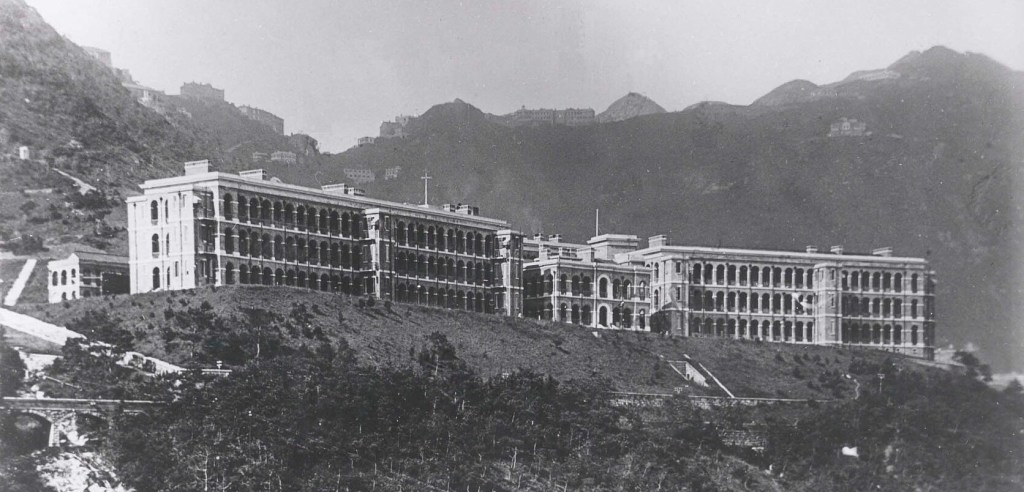
Adult education in a prisoner-of-war camp

Bowen Road Military Hospital in Hong Kong , c. 1925 (copyright expired)

I’ve been reading my father’s wartime diaries, which cover periods of his life as a prisoner in Hong Kong. He was in Bowen Road Hospital at the time of the British surrender, suffering from shrapnel wounds, and was then taken to the former British barracks at Sham Shui Po. As an acting second lieutenant (temporary in his case, but the Japanese didn’t know that), he moved to the Argyle Street officers’ camp in April 1942. His diary is patchy, and is written in pencil on small sheets of paper; the section I’ve been reading covers the period between December 1941 and late April 1942.

Most of the entries discuss food – the meals he had eaten that day, and those he imagined eating. If food was his main concern at this time, he also tends to list the state of his bowels. The Japanese, usually referred to in abusive terms, feature relatively rarely. The rest of the entries tend to be taken up with thoughts of home and the snippets of news he’d picked up about the progress of the war, punctuated by the odd angry complaint about the British army’s treatment of its men.

He also records his daily activities, which invariaby include a regular parade as well as occasional physical exercises, roll calls, and on one occasion an escape. And he records his attempts to expand his knowledge, to counter the confines and boredom of camp life by working his brain.

Following his injury, my dad was briefly taken to a temporary hospital in the university library, where he “borrowed” two books on foreign languages. After almost three months of imprisonment, he decided to spend five hours a day on languages. On 23rd March, he reported that he had fallen short of his target by half an hour, adding that “today was not a good day for non-stop study” (partly because he’d spent part of the morning attending a lecture on military history).

The next day he grappled with French tenses in the morning, then “went for an hour’s French lesson with M. Matthieu”. The following morning he worked on his Japanese (using one of his pilfered books) before attending a lecture on the Indian Ocean. The following day he again studied Japanese “until 2 pm when I developed a headache” (though this didn’t prevent him from going to another lecture on military history).

On the 27th “the morning & afternoon passed quietly studying Japanese” By the following day he was complaining that he had “got a little behind in my work programme which I must catch up before the end of the month”; the next day saw him working “very hard”, and the following morning was devoted entirely to studying Japanese, followed in the evening by a talk on flowers that had him reflecting on home. In March 30th, he faced a setback: the guards had searched his hut while the prisoners were at roll-call, and seized his “notes on the Malay language”.

Unsurprisingly, his enthusiasm for this rigorous “work programme” flagged. There’s a week’s gap in the diary, and by the time it resumes he had established a new and slightly less demanding regime (and was also learning Malay). On April the 9th he reported that he couldn’t find his French teacher, who he supposed had been taken out by their captors on an inspection tour, so he attended another lecture, this time on fuel supply. He spent most of the 10th and 11th working on his Japanese before his studies were interrupted on the 12th by Japanese demands for constant roll-calls after four men escaped. By the 15th he was back to his routine, and on the 16th his French class resumed.

During his time at Sham Shui Po, then, much of my father’s energy was spent on what appears to have been largely self-directed study. Possibly it was supported by some sort of exchanges with native language speakers, though I wonder exactly what that involved. Only in the French lessons does there seem to have been some sort of organised course, led by a native speaker (it sounds as though this might have been a civilian).

On the 18th of April, though, this all changed: the officers were to to pack their belongings for transfer to the Argyle Street camp, where his first concern was to try to find some cigarettes and a bed. But he was still interested enough in adult education to sign up on 22nd April for classes in Japanese, Cantonese, and Book-keeping, and in the following few days he attended lectures on publishing and Gallipoli, and started plotting to wangle a transfer to hospital “as I badly want a change of company”.

Life at Argyle Street sounds rather more organised with its classes than Sham Shui Po had been. It was, after all, a camp full of officers. But that was possibly also why my father fancied “a change of company”, as his fellow prisoners would have been acutely conscious that his status as an officer (and gentleman) was temporary; to them he would have seemed a jumped-up battery serjeant major.

I imagine he was rather relieved when on 16th May the camp commander decided to send the wartime officers back to Sham Shui Po, though this does beg the question of whether the regular officers had complained about them to the Japanese.

As Midge Gillies shows in her book The Barbed Wire University, self-help education was quite common among prisoners of war, forming part of an informal economy of entertainment and improvement that countered the loss of control and freedom that the camp represented. In my dad’s case, the experience led to a reasonable grasp of spoken French, a smattering of Japanese (which he said had driven him half mad), and a grounding in German; he also picked up some Punjabi from Sikh gunners, and he remembered enough of it to baffle Bengali waiters in the 1970s.

But let’s put all that active attainment into perspective. He also witnessed several murders of Chinese civilians (male and female) and a couple of executions of his comrades, which marked him for life; suffered long term effects of malnutrition; was badly beaten for protesting being used as slave labour; and stood as witness in the post-war trial of a leading British collaborator. The prisoners may have built their own world of improving activity, but all in all it was a bloody awful experience.

Class prejudice, social surveys and adult education: a WW2 example

In 1946, a 27-year-old lieutenant colonel published an article in the Sociological Review on the educational values of ‘Local Survey Courses’.The aim of these courses was ‘to stimulate human interests and arouse awareness of the locality and its social problems’ among women members of the armed forces.

The background, reported Lt-Col Hardiman, was the discovery that the British Army discussion materials designed to give the troops a better idea of what they were fighting for proved completely unsuitable for the women: ‘On account of the profound ignorance of many of the recruits, talks were incomprehensible to them and discussions desultory’.

New Picture

The solution to this problem, Lt-Col Hardiman wrote, was to replace talks by study visits to places of local interest such as the town hall or a housing scheme. But because the students were unable to interpret what they saww, they were ‘passive’ and ‘acquired little or no positive knowledge’.

Only by providing a structured questionnaire, and training study group leaders in how best to prompt the subsequent discussions, would the students produce ‘practically useful results’. And because the courses produced practical results, and involved active learning in co-operative groups, they were ‘more productive of social attitudes and social skills needed in modern affairs than the orthodox methods of schooling’.

Clearly, the article is riddled with upper class condescension, and even contempt, for the working class women (mostly young) who joined the women’s services. But should we dismiss it as nothing more than an expression of unthinking class prejudice, of a kind that no serious sociology journal could contemplate publishing today?

Or should we see class relations in past times as a product of context, even as part of a history of socialisation? Margaret Hardiman, born in India to a businessman father and privately educated, was the product of an exclusive social milieu. Before the Second World War, a bright young woman from such a background would have had very little personal contact with working class women. Interaction with shop assistants, maid servants or waitresses was bounded by clear rules and reinforced by training and disciplinary measures.

What the War did was to push the classes together –  and this could be a shock for all those involved. I’ve written elsewhere about some aspects of adult education during the Second World War ( if you’re interested, you can read more here), and what is clear to me is how far the main adult education movements in the War were shaped by these gendered personal encounters between the classes.

In Hardiman’s case, we can also see the interplay of elite background with higher education and career: she graduated from the LSE in 1939 and then joined the Auxiliary Territorial Service before serving under the army veteran and socialist educationalist George Wigg in the Army Education Corps.

After the War she went on to become an anthropologist at the LSE and the University of Ghana. She seems to have been highly regarded in developing countries as well as at home. While some of her youthful social attitudes will strike us as dated and patronising, I’m still pleased to come across an article that helps us understand better the role of women in army education during WW2.


1940: when work camp trainees paraded through Dublin, saluting De Valera

On 8 December 1940, the 1st Battalion of the Construction Corps marched through Dublin. The 408 men wore uniform, had undergone initial training at the massive Curragh army camp, carried a blue flag bearing the Corps emblem, and were led by the Number 1 Army Band. As they passed Government Buildings on Merrion Street, they saluted the Taoiseach, Éamon DeValera, and four of his Ministers.

From The Irish Times, 3 October 1940

From The Irish Times, 3 October 1940

The Construction Corps was in fact a labour corps, recruited from the unemployed. Bryce Evans, writing in the Irish labour history journal Saothar, traced its origins to proposals from Seán Lemass, who had taken a keen interest in imitating the Civilian Conservation Corps, part of Roosevelt’s New Deal. With rising unemployment following the outbreak of the Second World War, Lemass’ ideas were revived. The Construction Corps, run by Ministry of Defence, was the result.

Recruitment, of young unmarried unemployed men, began at the start of October 1940. As in Britain, the authorities argued that work, decent food and camp life would together help rebuild men’s bodies after the damaging effects of unemployment. The men lived in hutted or tented camps, far from the cities, and worked on land reclamation or peat digging in areas such as Connemara. And although born of war-time conditions, it lasted until 1948.

The Construction Corps badge

The Construction Corps badge

The Dublin parade took place early on in the Corp’s life. It is particularly interesting for me because this was such a public event, watched and applauded by thousands of Dubliners. There was much comment on the men’s bodies: according to an Irish Press reporter,

No onlooker could have failed to appraise these young men, their good colour, fitness and their smart military bearing.

The reporter duly drew a contrast with the unemployed ‘street corner’ city boys who were now ‘erect, healthy and determined’. In similar vein, the Catholic Herald thought that ‘This is what weakening bodies and minds have needed too long . . . we may hope for a better manhood when the trial is over’.

Ireland’s work camp system was distinctive, developing as it did in a nation where the land had historical resonance, where wartime conditions were leading to a steady flow of young men to Britain, and where severe economic disruption led to a series of significant but poorly co-ordinated government interventions. Nevertheless, as anyone familiar with work camp systems will know, manhood and health were pervasive themes: working men’s bodies degenerated if left idle for too long – hard work, solid food and outdoor living could ‘recondition’ these weakened frames.