
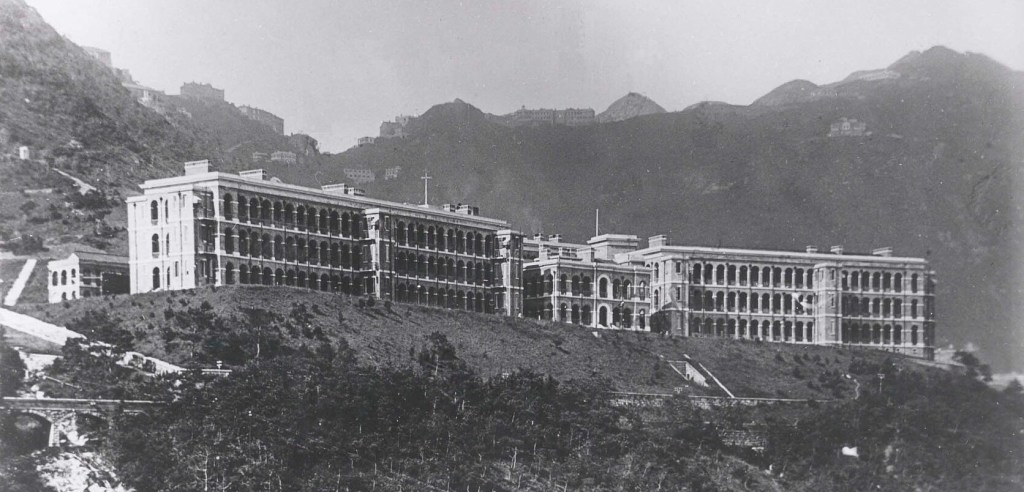
I’ve been reading my father’s wartime diaries, which cover periods of his life as a prisoner in Hong Kong. He was in Bowen Road Hospital at the time of the British surrender, suffering from shrapnel wounds, and was then taken to the former British barracks at Sham Shui Po. As an acting second lieutenant (temporary in his case, but the Japanese didn’t know that), he moved to the Argyle Street officers’ camp in April 1942. His diary is patchy, and is written in pencil on small sheets of paper; the section I’ve been reading covers the period between December 1941 and late April 1942.
Most of the entries discuss food – the meals he had eaten that day, and those he imagined eating. If food was his main concern at this time, he also tends to list the state of his bowels. The Japanese, usually referred to in abusive terms, feature relatively rarely. The rest of the entries tend to be taken up with thoughts of home and the snippets of news he’d picked up about the progress of the war, punctuated by the odd angry complaint about the British army’s treatment of its men.
He also records his daily activities, which invariaby include a regular parade as well as occasional physical exercises, roll calls, and on one occasion an escape. And he records his attempts to expand his knowledge, to counter the confines and boredom of camp life by working his brain.
Following his injury, my dad was briefly taken to a temporary hospital in the university library, where he “borrowed” two books on foreign languages. After almost three months of imprisonment, he decided to spend five hours a day on languages. On 23rd March, he reported that he had fallen short of his target by half an hour, adding that “today was not a good day for non-stop study” (partly because he’d spent part of the morning attending a lecture on military history).
The next day he grappled with French tenses in the morning, then “went for an hour’s French lesson with M. Matthieu”. The following morning he worked on his Japanese (using one of his pilfered books) before attending a lecture on the Indian Ocean. The following day he again studied Japanese “until 2 pm when I developed a headache” (though this didn’t prevent him from going to another lecture on military history).
On the 27th “the morning & afternoon passed quietly studying Japanese” By the following day he was complaining that he had “got a little behind in my work programme which I must catch up before the end of the month”; the next day saw him working “very hard”, and the following morning was devoted entirely to studying Japanese, followed in the evening by a talk on flowers that had him reflecting on home. In March 30th, he faced a setback: the guards had searched his hut while the prisoners were at roll-call, and seized his “notes on the Malay language”.
Unsurprisingly, his enthusiasm for this rigorous “work programme” flagged. There’s a week’s gap in the diary, and by the time it resumes he had established a new and slightly less demanding regime (and was also learning Malay). On April the 9th he reported that he couldn’t find his French teacher, who he supposed had been taken out by their captors on an inspection tour, so he attended another lecture, this time on fuel supply. He spent most of the 10th and 11th working on his Japanese before his studies were interrupted on the 12th by Japanese demands for constant roll-calls after four men escaped. By the 15th he was back to his routine, and on the 16th his French class resumed.
During his time at Sham Shui Po, then, much of my father’s energy was spent on what appears to have been largely self-directed study. Possibly it was supported by some sort of exchanges with native language speakers, though I wonder exactly what that involved. Only in the French lessons does there seem to have been some sort of organised course, led by a native speaker (it sounds as though this might have been a civilian).
On the 18th of April, though, this all changed: the officers were to to pack their belongings for transfer to the Argyle Street camp, where his first concern was to try to find some cigarettes and a bed. But he was still interested enough in adult education to sign up on 22nd April for classes in Japanese, Cantonese, and Book-keeping, and in the following few days he attended lectures on publishing and Gallipoli, and started plotting to wangle a transfer to hospital “as I badly want a change of company”.

Life at Argyle Street sounds rather more organised with its classes than Sham Shui Po had been. It was, after all, a camp full of officers. But that was possibly also why my father fancied “a change of company”, as his fellow prisoners would have been acutely conscious that his status as an officer (and gentleman) was temporary; to them he would have seemed a jumped-up battery serjeant major.
I imagine he was rather relieved when on 16th May the camp commander decided to send the wartime officers back to Sham Shui Po, though this does beg the question of whether the regular officers had complained about them to the Japanese.
As Midge Gillies shows in her book The Barbed Wire University, self-help education was quite common among prisoners of war, forming part of an informal economy of entertainment and improvement that countered the loss of control and freedom that the camp represented. In my dad’s case, the experience led to a reasonable grasp of spoken French, a smattering of Japanese (which he said had driven him half mad), and a grounding in German; he also picked up some Punjabi from Sikh gunners, and he remembered enough of it to baffle Bengali waiters in the 1970s.
But let’s put all that active attainment into perspective. He also witnessed several murders of Chinese civilians (male and female) and a couple of executions of his comrades, which marked him for life; suffered long term effects of malnutrition; was badly beaten for protesting being used as slave labour; and stood as witness in the post-war trial of a leading British collaborator. The prisoners may have built their own world of improving activity, but all in all it was a bloody awful experience.
 thelearningprofessor