Overview
Test Series
A triangular matrix is a type of square matrix used in linear algebra where the numbers above or below the main diagonal are arranged in the shape of a triangle. A matrix itself is simply a set of numbers written in rows and columns. There are different types of matrices such as row matrices, column matrices, rectangular matrices, diagonal matrices, zero matrices, identity matrices, and triangular matrices. In a triangular matrix, either the lower or the upper part is filled with zeros, which makes it easier to solve equations and perform calculations in mathematics.
A triangular matrix is a special type of square matrix where all the values above or below the diagonal are zero. The triangular matrix can be classified into two types which are given below:
Maths Notes Free PDFs
| Topic | PDF Link |
|---|---|
| Class 12 Maths Important Topics Free Notes PDF | Download PDF |
| Class 10, 11 Mathematics Study Notes | Download PDF |
| Most Asked Maths Questions in Exams | Download PDF |
| Increasing and Decreasing Function in Maths | Download PDF |
Let us explore the different types of triangular matrices including upper triangular matrix and lower triangular matrix, their definitions, their types, and their properties.
An upper triangular matrix can be defined as a square matrix in which all the elements below the main diagonal are zero. In other words, an \(n \times n\) square matrix \(A=[a_{ij}]\) is called an upper triangular matrix if and only if \(a_{ij} = 0\), for all \(i>j\).
\(U=\left\{\begin{matrix}u_{ij}&:i\leq j\\0&:i>j \\\end{matrix}\right.\) is a common notation for an upper triangular matrix.
Upper Triangular Matrix Examples
Below are a few examples of upper triangular matrix:
A lower triangular matrix can be defined as a square matrix in which all the elements above the main diagonal are zero. In other words, an \(n \times n\) square matrix \(A=[a_{ij}]\) is called a lower triangular matrix if and only if \(a_{ij} = 0\), for all \(i<j\).
\(L=\left\{\begin{matrix}l_{ij}&:i\geq j\\0&:i<j \\\end{matrix}\right. \) is a common notation for a lower triangular matrix.

Lower Triangular Matrix Examples
Below are a few examples of lower triangular matrix:
There are different types of triangular matrices that we will learn in this section. Given below is a list of some special types of triangular matrices:
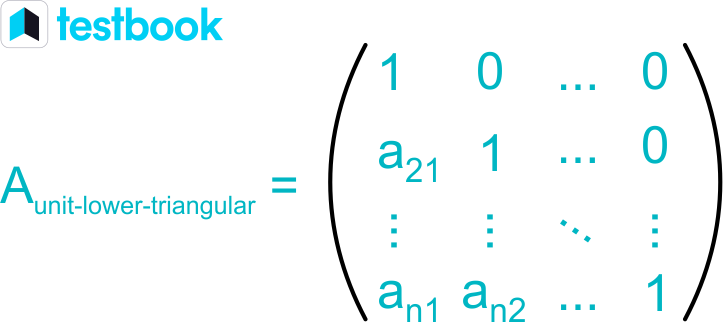
Unit Triangular Matrix: A triangular matrix is said to be a unit triangular matrix if all the elements of the main diagonal are equal to \(1\). A unit triangular matrix can be further classified into unit upper triangular and unit lower triangular matrix.
Strictly Triangular Matrix: A triangular matrix is said to be a strictly triangular matrix if all the elements of the main diagonal are zero. A strictly triangular matrix can be further classified into strictly upper triangular and strictly lower triangular matrix.
Strictly Upper Triangular Matrix: A strictly upper triangular matrix has zero entries on the downward diagonal and non-zero entries above it.

Unit Upper Triangular Matrix: A unit upper triangular matrix is a matrix that has \(1\) as entries on the downwards diagonal and non-zero entries above it.

Strictly Lower Triangular Matrix: A strictly lower triangular matrix has zero entries on the downwards diagonal and non-zero entries below it.

Unit Lower Triangular Matrix: A unit lower triangular matrix is a matrix that has \(1\) as all entries on the downwards diagonal and non-zero entries below it.

Let us learn how to convert a matrix to an upper triangular matrix with examples.
Example: Transform \(A=\begin{bmatrix}1&-1&2\\2&1&3\\3&2&4\\\end{bmatrix}\) into an upper triangular matrix by suitable row transformation.
Solution: Given \(A=\begin{bmatrix}1&-1&2\\2&1&3\\3&2&4\\\end{bmatrix}\)
Apply row transformation, \(R_{2}\to R_{2}-2R_{1}\)
\(\Rightarrow\) \(A=\begin{bmatrix}1&-1&2\\0&3&1\\3&2&4\\\end{bmatrix}\)
\(R_{3}\to R_{3}-3R_{1}\)
\(\Rightarrow\) \(A=\begin{bmatrix}1&-1&2\\0&3&1\\0&5&-2\\\end{bmatrix}\)
\(R_{3}\to R_{3}-\frac{5}{3}R_{2}\)
\(\Rightarrow\) \(A=\begin{bmatrix}1&-1&2\\0&3&1\\0&0&-\frac{1}{3}\\\end{bmatrix}\)
Thus, the matrix \(A=\begin{bmatrix}1&-1&2\\0&3&1\\0&0&-\frac{1}{3}\\\end{bmatrix}\) is now an upper triangular matrix.
Let us learn how to convert a matrix to a lower triangular matrix with examples.
Example: Transform \(A=\begin{bmatrix}2&1&3\\7&5&2\\3&2&1\\\end{bmatrix}\) into a lower triangular matrix by suitable row transformation.
Solution: Given \(A=\begin{bmatrix}2&1&3\\7&5&2\\3&2&1\\\end{bmatrix}\)
Apply row transformation, \(R_{2}\to R_{2}-2R_{3}\)
\(\Rightarrow\) \(A=\begin{bmatrix}2&1&3\\1&1&0\\3&2&1\\\end{bmatrix}\)
\(R_{1}\to R_{1}-3R_{3}\)
\(\Rightarrow\) \(A=\begin{bmatrix}-7&-5&0\\1&1&0\\3&2&1\\\end{bmatrix}\)
\(R_{1}\to R_{1}+5R_{2}\)
\(\Rightarrow\) \(A=\begin{bmatrix}-2&0&0\\1&1&0\\3&2&1\\\end{bmatrix}\)
Thus, the matrix \(A=\begin{bmatrix}-2&0&0\\1&1&0\\3&2&1\\\end{bmatrix}\) is now a lower triangular matrix.
Learn about Determinant of 4 x 4 Matrix


The determinant of a triangular matrix is the product of the elements of the main diagonal. Now let us discuss the determinant of the upper triangular and lower triangular matrix with examples.
Determinant of Upper Triangular Matrix
The determinant of the upper triangular matrix is the product of the main diagonal entries of the upper triangular matrix.
Example: Find the determinant of the upper triangular matrix \(A=\begin{bmatrix}1&4&2\\0&3&4\\0&0&1\\\end{bmatrix}\).
Solution: The given matrix is an upper triangular matrix as its elements below the diagonal are all zeros.
Hence its determinant is the product of its diagonal elements.
\(\Rightarrow\) \(det(A) = (1)(3)(1) = 3\).
Therefore, the determinant of the given upper triangular matrix is \(3\).
Determinant of Lower Triangular Matrix
The determinant of the lower triangular matrix is the product of the main diagonal entries of the lower triangular matrix.
Example: Find the determinant of the lower triangular matrix \(A=\begin{bmatrix}2&0&0\\5&1&0\\6&7&3\\\end{bmatrix}\).
Solution: The given matrix is a lower triangular matrix as its elements above the diagonal are all zeros.
Hence its determinant is the product of its diagonal elements.
\(\Rightarrow\) \(det(A) = (2)(1)(3) = 6\).
Therefore, the determinant of the given lower triangular matrix is \(6\).
The inverse of a triangular matrix is also a triangular matrix. Inverse exists only if none of the diagonal elements is zero. Now let us discuss the inverse of an upper triangular and lower triangular matrix with examples.
Inverse of Upper Triangular Matrix: The inverse of an upper triangular matrix is also an upper triangular matrix.
Example: Find the inverse of the upper triangular matrix \(A=\begin{bmatrix}2&1\\0&-1\\\end{bmatrix}\).
Solution: The determinant of the matrix \(|A| = -2 \neq 0\), this implies the inverse of the given upper triangular matrix exists.
Now we know, \(A^{-1}=\frac{1}{|A|}\begin{bmatrix}-1&-1\\0&2\\\end{bmatrix}\)
\(\Rightarrow\) \(A^{-1}=\frac{1}{(-2)}\begin{bmatrix}-1&-1\\0&2\\\end{bmatrix}\)
\(\Rightarrow\) \(A^{-1}=\begin{bmatrix}0.5&0.5\\0&-1\\\end{bmatrix}\)
Thus, we can see that the inverse of an upper triangular matrix is an upper triangular matrix.
Inverse of Lower Triangular Matrix: The inverse of a lower triangular matrix is also a lower triangular matrix.
Example: Find the inverse of the upper triangular matrix \(A=\begin{bmatrix}2&0\\2&1\\\end{bmatrix}\).
Solution: The determinant of the matrix \(|A| = 2 \neq 0\), this implies the inverse of the given lower triangular matrix exists.
Now we know, \(A^{-1}=\frac{1}{|A|}\begin{bmatrix}1&0\\-2&2\\\end{bmatrix}\)
\(\Rightarrow\) \(A^{-1}=\frac{1}{2}\begin{bmatrix}1&0\\-2&2\\\end{bmatrix}\)
\(\Rightarrow\) \(A^{-1}=\begin{bmatrix}0.5&0\\-1&1\\\end{bmatrix}\)
Thus, we can see that the inverse of a lower triangular matrix is a lower triangular matrix.
The eigenvalues of a triangular matrix are the diagonal entries of the matrix. Now let us discuss the eigenvalues of the upper triangular and lower triangular matrix with examples.
Eigenvalue of Upper Triangular Matrix: The eigenvalues of the upper triangular matrix are the diagonal entries of the upper triangular matrix.
Example: Find the eigenvalues of the upper triangular matrix \(A=\begin{bmatrix}1&4&2\\0&3&4\\0&0&5\\\end{bmatrix}\).
Solution: The given matrix is an upper triangular matrix as its elements below the diagonal are all zeros.
Hence its eigenvalues are the diagonal elements.
The diagonal elements are \(1\), \(3\), and \(5\).
Therefore, the eigenvalues of the given upper triangular matrix are \(1\), \(3\), and \(5\).
Eigenvalue of Lower Triangular Matrix: The eigenvalues of the lower triangular matrix are the diagonal entries of the lower triangular matrix.
Example: Find the eigenvalues of the lower triangular matrix \(A=\begin{bmatrix}7&0&0\\5&4&0\\6&1&3\\\end{bmatrix}\).
Solution: The given matrix is a lower triangular matrix as its elements above the diagonal are all zeros.
Hence its eigenvalues are the diagonal elements.
The diagonal elements are \(7\), \(4\), and \(3\).
Therefore, the eigenvalues of the given lower triangular matrix are \(7\), \(4\), and \(3\).
Some of the important properties of the triangular matrix are listed below:
Upper and lower triangular matrices are very useful in mathematics, computer science, and real-life problem solving. These matrices make calculations faster and easier because many entries are zero. Below are some important applications explained in simple words
Any invertible square matrix can often be written as the product of a lower triangular matrix (L) and an upper triangular matrix (U).This process is called LU decomposition. It is widely used to solve linear equations quickly, especially when the system is large.
The determinant of a triangular matrix is simply the product of the numbers on its diagonal.This makes it much faster to calculate compared to other matrices.
If a matrix is an invertible triangular matrix, the inverse of this matrix is also triangular. This makes it easier to simplify the process of finding matrix inverses.
Triangular matrices are employed in computer algorithms and numerical methods.They minimize the number of calculations that are required, and this saves time and memory.
The eigenvalues of a triangular matrix are simply the numbers along the main diagonal.This characteristic makes triangular matrices highly applicable to linear algebra and physics.
In engineering problems, triangular matrices are employed for stability tests, control systems, and simulations.In data science and machine learning, they emerge in optimisation and matrix factorisation techniques.
An upper triangular matrix has all zero elements below the main diagonal, while a lower triangular matrix has all zero elements above the main diagonal. The key difference is in the position of the zero values around the diagonal.
|
Point of Difference |
Upper Triangular Matrix |
Lower Triangular Matrix |
|
Definition |
A square matrix where all elements below the main diagonal are zero. |
A square matrix where all elements above the main diagonal are zero. |
|
Position of Non-Zero Elements |
Non-zero values can appear on or above the diagonal. |
Non-zero values can appear on or below the diagonal. |
|
Determinant |
Product of diagonal elements. |
|
Inverse (if it exists) |
Inverse is also an upper triangular matrix. |
Inverse is also a lower triangular matrix. |
|
Use in LU Decomposition |
Appears as the "U" part of LU decomposition. |
Appears as the "L" part of LU decomposition. |
Example 1: Classify the following matrices into upper and lower triangular matrices:
i). \(\begin{bmatrix}1&4&2\\0&3&4\\0&0&1\\\end{bmatrix}\)
ii). \(\begin{bmatrix}1&0&0\\2&8&0\\4&9&7\\\end{bmatrix}\)
iii). \(\begin{bmatrix}1&0&0\\0&1&0\\0&0&3\\\end{bmatrix}\)
iv). \(\begin{bmatrix}2&3&5\\0&8&9\\0&0&7\\\end{bmatrix}\)
v). \(\begin{bmatrix}1&2&3&4\\0&0&3&4\\0&0&0&5\\\end{bmatrix}\)
Solution:
i). \(\begin{bmatrix}1&4&2\\0&3&4\\0&0&1\\\end{bmatrix}\): Upper triangular matrix.
ii). \(\begin{bmatrix}1&0&0\\2&8&0\\4&9&7\\\end{bmatrix}\): Lower triangular matrix.
iii). \(\begin{bmatrix}1&0&0\\0&1&0\\0&0&3\\\end{bmatrix}\): Lower as well as upper triangular matrix.
iv). \(\begin{bmatrix}2&3&5\\0&8&9\\0&0&7\\\end{bmatrix}\): Upper triangular matrix.
v). \(\begin{bmatrix}1&2&3&4\\0&0&3&4\\0&0&0&5\\\end{bmatrix}\): Neither upper triangular nor lower triangular matrix because it is not a square matrix.
Example 2: Find the determinant of the matrix \(A=\begin{bmatrix}1&0&0\\2&8&0\\4&9&7\\\end{bmatrix}\).
Solution: The given matrix is a lower triangular matrix as its elements above the diagonal are all zeros.
Hence its determinant is the product of its diagonal elements.
\(\Rightarrow\) \(det(A) = (1)(8)(7) = 56\).
Therefore, the determinant of the given matrix \(A\) is \(56\).
We hope that the above article is helpful for your understanding and exam preparations. Stay tuned to the Testbook App for more updates on related topics from Mathematics, and various such subjects. Also, reach out to the test series available to examine your knowledge regarding several exams.
|
If you are checking Triangular Matrix article, also check the related maths articles: |
|

Download the testbook app and unlock advanced analytics.

Scan this QR code to Get the Testbook App