
You are currently browsing the tag archive for the ‘Embedded Java’ tag.

Tomorrow (April 24th) I will be at the JAX Conference in Mainz, Germany for the Embedded Experience Day, talking about “Java in the Internet of Things: Small, Smart, Connected” (at 14:00).
There will also be an “Embedded Werkstatt” (open 10:00-17:00) with different exhibits and demos and the opportunity to ask the experts and discuss embedded topics.
See you tomorrow in Mainz!
Cheers,
— Terrence

Today (April 23rd) is the LAST DAY to submit a proposal for JavaOne San Francisco 2013.
For more information, see here.
Cheers,
— Terrence
PS: My offer for extra credit for doing something fun with Java ME Embedded on Raspberry Pi still stands!

Now that a lot of folks are kicking the tires with Java ME Embedded (see the last couple of blog posts), I just wanted to make sure you know where to go with questions:
- Lots of good resources are here and here (including “Getting Started Guides”, FAQ, videos, and API documentation)
- Check out the OTN Java ME Embedded forum and ask questions – our experts are monitoring these regularly
- Email us at: [email protected] – we’ll get back to you
Cheers,
— Terrence
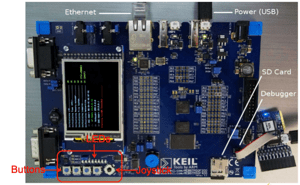
Following up on yesterday’s release, Oracle evangelist Angela Caicedo has put together a great blog posting with all steps and code you need to develop and run your first Java application on an ARM Cortex-M3 developer board.
Alternatively, it you’d rather just sit back and watch, you can check out her webcast “Getting started with Java ME Embedded on KEIL” (part 1, part 2).
Or, if you have a Raspberry Pi lying around, you could use that.
In any case, it has never been easier to get started with embedded Java applications!
Cheers,
— Terrence
 A few weeks ago, Oracle made available an updated release of Java ME Embedded, version 3.3, as an Early Access (EA) for Linux on Raspberry Pi (see blog entry).
Today, we are following up with the release on ARM Cortex-M3 for the ARM RTX RTOS on the KEIL MCBSTM32F200 developer board (*see note on Cortex-M4 below).
Why is this important?
With this release, Oracle now provides a Cortex-M3/M4 reference binary of the feature-rich, standards-based Java ME Embedded runtime, scaling from mid-range embedded systems such as Linux-based platforms all the way down to micro controller-type devices with limited memory and small RTOS or minimal kernels. System requirements:
- Minimal Java ME Embedded configuration: 32-bit MCU, 130 KB RAM, 350 KB Flash/ROM
- Full Java ME Embedded configuration: 700 KB RAM, 2000 KB Flash/ROM
Yes, that is Kilobytes, not Megabytes (!)
So take your existing Java skills, use familiar tools like NetBeans and Eclipse, and develop highly-functional, robust embedded applications for a wide range of embedded use cases and devices in a snap.
For example, you can begin developing your code on a powerful and flexible desktop-class system like Raspberry Pi. Later, you take the unmodified application binary and simply deploy it directly to the resource-constrained target devices running Java ME Embedded.
Sounds easy? It is: No cross-compilation, no complexities due to platform dependencies, no dealing different sets of architectures, tools, compilers, libraries, and versions, and significantly reduced integration and testing effort … in fact, many typical embedded software development pain points just evaporate (embedded developers: if you are crying tears of joy now, I understand – I’ve been there myself 😉
And on top of the rich set of functionality already provided by Java ME Embedded 3.2, version 3.3 adds a number of new features, such as an expanded and more flexible access to peripherals (such as ADC, DAC, Pulse Counter, and watchdog), improved logging functionality, tooling enhancements, additional new sample code, and more. Still in the same, low footprint.
Ok, great! What next?
- Watch the brand-new webcast “Getting started with Java ME Embedded on KEIL” (part 1, part 2)
- Order a KEIL MCBSTM32F200 from your favorite distributor (such as Mouser, Element14, or a number of others)
- Review the Java ME Embedded 3.3 documentation, included “Getting Started Guides” and “Release Notes”
- Download the Java ME Embedded 3.3 binary for KEIL MCBSTM32F200 from Oracle Technology Network (OTN)
- Download and install the Java ME SDK 3.3 EA and/or the NetBeans and Eclipse plug-ins
- Check out Angela Caicedo’s blog post “Getting started with Java ME Embedded on KEIL”
To learn more:
- Java ME Embedded: Introduction and Highlights.
- Oracle Embedded Java: General Overview
Getting in touch:
- Ask questions on the OTN Java ME Embedded forum
- Email us at: [email protected]
Stay tuned for more to come.
Cheers,
— Terrence
* Note: While the MCBSTM32F200 is the officially supported board, the release also works on the MCBSTM32F400 (which is the Cortex-M4 version)

Have you been working on a cool application, solved a tricky embedded problem, or helped deliver an industrial-grade solution using Java?
There is a lot of great stuff happening in the embedded Java space. The world wants to hear about it.
Submit your proposal to JavaOne 2013 in San Francisco and present your work to thousands of like-minded Java developers!
The Call for Papers has been extended by a week, to April 23rd (watch the web pages for updates).
PS:
Get extra credit from me for using Java ME Embedded on Raspberry Pi. Check it out and do something fun and inspiring with it.
Cheers,
— Terrence

Check out the Jan/Feb 2013 edition of Java Magazine – featuring a big focus on embedded:
- Page 8: News: Hitachi SuperJ Framework, M2M Survey by Beecham
- Page 20: Embedded Everywhere – Java and the Internet of Things
- Page 26: Top 10 Reasons for Using Java in Embedded Apps
- Page 31: Java Arrives on a $25 Board
- Page 36: The Future of Money
Also, be sure not to miss the other great content, from JavaOne Latin America and Devoxx 2012 to coding tips & tricks, invokedynamic, Java 8 compiler plug-ins, Java books, the events listing and more.
Find Java Magazine here (free subscription required for some content).
Cheers,
— Terrence

JFokus is focusing (that’s right!) on embedded for it’s upcoming event Feb 4-6 in Stockholm:
- A dedicated 2-day track on “Embedded, M2M & Internet of Things”
- An embedded lab with Java on Raspberry Pi (sorry, already sold out …)
Mattias and the JFokus crew have put together a great embedded track, with a cross-section of talks on what’s hot and relevant in the embedded space right now. Here a selection:
- Opening keynote by Oracle’s Henrik Ståhl, Senior Director of Product Management for Java
- Axel Hensmann from Gemalto (Cinterion) on why they are using Java on their wireless modules
- Gerrit Grunewald will be undoubtedly delivering some cool tricks and visuals with Java on BeagleBoard, Raspberry Pi, and HTML5
- Nighthacker Stephen Chin with a Raspberry Pi BOF
- Simon Ritter will be serving coffee and pi (the Java and the Raspberry kind)
- I will be doing the closing keynote on “Java in the Internet of Things: Smart, Small, Connected“
- And more embedded sessions in between ….!
And, this being one of northern Europe’s premier Java conferences, there are another 5 tracks packed with Java content, from the Java Platform, enterprise and web development, cloud, and other software development topics.
Hope to see you in Stockholm!
Cheers,
— Terrence

It’s the ultimate recursion: Making Java with Java 😉
Last year, Vinicus Senger already proved you could make Java (the hot one) with Java (the equally hot one), with his “Having Fun with Home Automation and Java EE” project. See this parleys.com video.
Now, Sasha Wolter created the next iteration. As part of a project for the Deutsche Telekom Developer Garden he built a voice-controlled coffee machine, using the Raspberry Pi, Oracle Java, a Nespresso machine, and some network APIs of Deutsche Telekom.
The project was recognized by Tropo, the German “Spiegel Online”, Gizmorati’s “10 Mindblowing Raspberry Pi Projects”, an The Platform’s “5 Phenomenal Applications with the Raspberry Pi”.
Very cool!
Cheers,
— Terrence

Support for Java in the M2M space is growing rapidly.
Cinterion and Qualcomm have already announced their support for Java using the Oracle Java ME Embedded 3.2 platform.
Two days ago, Qualcomm and AT&T announced their “Internet of Everything” development platform, supporting Oracle Java ME Embedded 3.2.
Yesterday, Telit introduced two Qualcomm-based modules for global M2M markets, with support planned for Oracle Java ME Embedded 3.2 as well.
Cheers,
— Terrence

 Across the Universe
Recent Comments