Jewish American Heritage Month

May is Jewish American Heritage Month. This is the time to recognize the experiences and contributions of Jewish Americans. In 1980, the first Jewish American Heritage Week was celebrated in April of the year. In 2006, it was elevated to a month-long recognition and moved to the month of May.

Percentage of Jewish population in each state in 2015.
By Irvadm [CC BY-SA 4.0 (https://creativecommons.org/licenses/by-sa/4.0)%5D, via Wikimedia Commons

The Berman Jewish DataBank estimates that as of 2015 there were 6,829,930 Jewish people living in the United States. That is 2.14% of the total population.

Timeline of Jewish American History

1654 First record of Jewish settlers coming to North America. Twenty-three Sephardi Jews arrived in New Amsterdam (which became New York in 1664). In 1655, the directors of the Dutch West India Company, who governed the colony, agreed to allow them to settle there permanently.
\”The Early History of the Jews in New York, 1654-1664\” in Publications of the American Jewish Historical Society by Samuel Oppenheim

1730 The New York Jewish community created the first synagogue in North America.
\”The Congregation Shearith Israel\” in Publications of the American Jewish Historical Society by N. Taylor Phillips
America\’s First Synagogues [streaming video]

1763 The Touro Synagogue was built in Newport, Rhode Island. It is the oldest continuously operating synagogue in the United States.
\”House of Worship: At Touro Synagogue, the Jewish Story is the American Story\” in National Parks by Ethan Gilsdorf

1774 Francis Salvador became the first Jewish elected official in America. He was elected to the South Carolina legislature. In 1776, he died fighting for the patriot cause in the American Revolution.
\”Francis Salvador, A Prominent Patriot of the Revolutionary War\” in Publications of the American Jewish Historical Society by Leon Huhner

Interior of the Touro Synagogue in Newport, RI. Built in 1763. It is the oldest continuously operating synagogue in the US.
By S.d.touro [CC BY-SA 4.0 (https://creativecommons.org/licenses/by-sa/4.0)%5D, from Wikimedia Commons

1802 In Philadelphia, Pennsylvania the first Ashkenazi synagogue was built in the United States.

1819 Philanthropist Rebecca Gratz founded the Female Hebrew Benevolent Society, a charity organization that is still in operation.

1843 German Jewish immigrants form the B\’nai B\’rith fraternal order.

1845 Lewis Charles Levin, of Pennsylvania, became the first Jewish person to serve in the House of Representatives.

         David Levy Yulee, of Florida, became the first Jewish person to serve in the Senate.

1854 Isaac Mayer Wise founded The Israelite newspaper (It became The American Israelite in 1874). It is the longest-running English language Jewish newspaper still in publication the United States.

1860 Morris Raphall became the first Rabbi to open a session of the US Congress with prayer.

1861-65 Judah P. Benjamin became the first Jewish person to serve in a government Cabinet in North America. He served the Confederate States of America as Attorney General, then Secretary of War, and finally as Secretary of State.
Judah P. Benjamin by Pierce Butler

 Rebecca Gratz (1781-1869).
Painted by Thomas Sully in 1831. [Public domain], via Wikimedia Commons

1880-1924 About 27 million people immigrated to the US during this period. Approximately 2 million of them were Jewish people from Central and Eastern Europe.
Jewish Immigration to the United States from 1881-1910 by Samuel Joseph
Troubled Waters: The Origins of the 1881 Anti-Jewish Pogroms in Russia by Irwin Michael Aronson

1883 Emma Lazarus composed the poem \”The New Colossus\” to raise money to build a pedestal for the Statue of Liberty. In 1903, a plaque engraved with the poem was placed in the statue\’s pedestal. A famous line from that poem is \”Give me your tired, your poor, your huddled masses yearning to breathe free…\”
Emma Lazarus by Esther H. Schor
Liberty\’s Voice: The Story of Emma Lazarus by Erica Silverman

1885 The first Yiddish language newspaper Yidishes Tageblatt (The Jewish Daily News) was published in the United States. It ceased publication in 1928.

1887 Washington Bartlett, of California, became the first Jewish person elected as governor of a US State.

1906 Oscar Straus became the first Jewish person to serve on the US Cabinet. He served as Secretary of Commerce until 1909.
The American Spirit by Oscar S. Straus
Under Four Administrations: From Cleveland to Taft by Oscar S. Straus

1910 The first Ladino language newspaper Lah Amerikah began publication. It continued until 1925.
\”Asymmetric Fates: Secular Yiddish and Ladino Culture in Comparison\” in The Jewish Quarterly Review by Sarah Abrevaya Stein

Louis D. Brandeis (1856-1941) in 1916.
By Harris & Ewing [Public domain], via Wikimedia Commons

1915 Leo Frank was lynched in Marietta, Georgia.
The Leo Frank Case by Leonard Dinnerstein
An Unspeakable Crime: The Prosecution and Persecution of Leo Frank by Elaine Marie Alphin

1916 Louis Brandeis became the first Jewish person to serve on the Supreme Court.
Letters of Louis D. Brandeis by Louis Dembitz Brandeis
Other People\’s Money and How the Bankers Use It by Louis Dembitz Brandeis

1920 Henry Ford acquired the Dearborn Independent newspaper and used it to publish 91 anti-Semitic propaganda articles over the next several years, including the Protocols of the Elders of Zion.

1924 Immigration Act of 1924 strictly limited the number of immigrants entering the United States, which resulted in a decline of Jewish immigration from Europe.

1933 Fleeing persecution from the Nazi government in Germany, Albert Einstein immigrated to the United States and became a resident scholar at the Institution for Advanced Study in Princeton, New Jersey. He obtained US citizenship in 1940. 
The Meaning of Relativity by Albert Einstein
On a Beam of Light: A Story of Albert Einstein by Jennifer Berne

Albert Einstein (1879-1955) in 1935.
By Sophie Delar, photographer; published in 1955 by \”unknown press organization\” per source (RR Auction and Einstein\’s World) [Public domain], via Wikimedia Commons

1941-45 Approximately 500,000 Jewish Americans served in the armed forces during World War II.
GI Jews: How World War II Changed a Generation by Deborah Dash Moore

1945-52 President Truman issued a directive to allow immigration preference for those displaced by World War II. An estimated 80,000 Jewish immigrants arrived to the US during these years.

1955 Jonas Salk developed the polio vaccine.
Splendid Solution: Jonas Salk and the Conquest of Polio by Jeffrey Kluger

1963 Betty Friedan published The Feminine Mystique, which sparked the modern feminist movement. In 1966, she co-founded the National Organization for Women.
Success and Solitude: Feminist Organizations Fifty Years after The Feminine Mystique by Sarah Maxwell

1993 The United States Holocaust Museum opened in Washington DC.

2000 Joe Lieberman became the first Jewish American nominated for Vice President by one of the two major political parties.


Tarleton\’s library has a large collection of materials relevant to the Jewish American experience. Such as these titles:

The Chosen Folks: Jews on the Frontiers of Texas by Bryan Edward Stone
The Columbia History of Jews & Judaism in America ed. by Marc Lee Raphael
God, Faith & Identity from the Ashes: Reflections of Children and Grandchildren of Holocaust Survivors by Menachem Z. Rosensaft
Jewish \”Junior League\”: The Rise and Demise of the Fort Worth Council of Jewish Women by Hollace Ava Weiner
Jewish Women Pioneering the Frontier Trail: A History in the American West by Jeanne E. Abrams
Jews and Gentiles in Early America, 1654-1800 by William Pencak
The Jews of the United States, 1654-2000 by Hasia R. Diner
Lone Stars of David: The Jews of Texas by Hollace Ava Weiner
Memories of Two Generations: A Yiddish Life in Russia and Texas by Z. Gurwitz
Still Jewish: A History of Women and Intermarriage in America by Keren R. McGinity
Who is a Jew? Reflections on History, Religion, and Culture by Leonard J. Greenspoon

National Poetry Month: Limericks and Concrete Poems

Earlier in this National Poetry Month of April, I posted about book spine haiku.  Besides haiku, two other poetry forms you might remember from your childhood are limericks and concrete poems.  While the Tarleton Libraries have many books with adult versions of these poetic forms, this post focuses on a few children\’s books in our Curriculum Collection, used by future teachers, on the lower level of the Dick Smith Library on the Stephenville campus.

Limericks usually tell a story about a person, in an exaggerated way meant to make the limerick funny. A limerick must have five lines. Lines 1, 2, and 5 must rhyme with each other. Lines 3 and 4 must rhyme with each other, as well. Limericks are also written in anapestic meter, which means that in each three-syllable word or phrase, the emphasis is always on the third syllable. Lines 1, 2, and 5 each contain three anapestics, or eight to ten syllables, and lines 3 and 4 contain two anapestics, or five to seven syllables.1

These poems often start out with \”There was an old [someone] of [somewhere].\”

Edward Lear, of course, is the master of limericks, particularly nonsense for children.  Edward Lear from the Poetry for Young People series, edited by Edward Mendelson and illustrated by Laura Huliska-Beith, contains a number of his limericks.

Another fun book is Grimericks, written by Susan Pearson and illustrated by Gus Grimly, contains 20 \”grim limericks\” (hence the title) with ghoulish characters pictured throughout.

More examples of limericks in the library\’s collections are here:  https://zeus.tarleton.edu/login?url=https://search.ebscohost.com/login.aspx?direct=true&bquery=limerick&type=1&site=eds-live.

In concrete poetry, the words of a poem are arranged on the page to form a visual image that relates to the subject of the poem.2

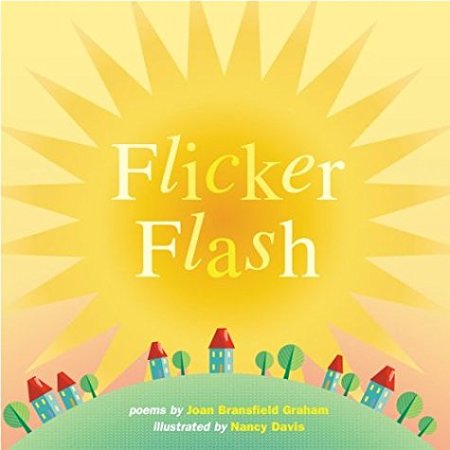
Sometimes the poems clearly forms shapes.  Joan Bransfield Graham\’s Flicker Flash, with illustrations by Nancy Davis, has poetry about light.  The arrangement of words in the poem “Firefly” is in the shape of a firefly.

The first poem in the book A Poke in the I is called \”A Seeing Poem,\” and the words in the poem create an image of a light bulb above a person\’s head.  In later poems in this book, selected by Paul Janeczko with illustrations by Chris Raschka, the imagery is even more subtle.

More examples of concrete poetry in the library\’s collections are here:  https://zeus.tarleton.edu/login?url=https://search.ebscohost.com/login.aspx?direct=true&bquery=%26quot%3bconcrete+poetry%26quot%3b+OR+%26quot%3bconcrete+poems%26quot%3b&cli0=FC&clv0=Y&type=0&site=eds-live.

1Comstock, Nancy. \”Limerick.\” Salem Press Encyclopedia of Literature, 2014. EBSCOhost, https://zeus.tarleton.edu/login?url=https://search.ebscohost.com/login.aspx?direct=true&db=ers&AN=98402281&site=eds-live.

2Fuller, Melynda. \”Concrete Poetry.\” Salem Press Encyclopedia of Literature, 2017. EBSCOhost, https://zeus.tarleton.edu/login?url=https://search.ebscohost.com/login.aspx?direct=true&db=ers&AN=87321587&site=eds-live.

Jazz Appreciation Month

April is Jazz Appreciation Month. Jazz is a uniquely American musical art form. It originated in the African-American community in New Orleans, Louisiana in the late 1800s. The Great Migration helped to spread Jazz to other parts of the country. The development of commercial radio programming in the 1920s made Jazz a national and international phenomenon.

New Orleans, March 2010. Jazz dance at \”Maison\”, 508 Frenchmen Street. Detroit Brooks on banjo, Dr. Michael White on clarinet, Gregg Stafford, trumpet.
By Seamus Murray (originally posted to Flickr as Maison) [CC BY 2.0 (https://creativecommons.org/licenses/by/2.0)%5D, via Wikimedia Commons. 

Our library has a large collection of Jazz books, audio recordings, and other items.

Books:
The Contradictions of Jazz by Paul E. Rinzler
Giants of Jazz by Studs Terkel
Jazz: A History of America\’s Music by Geoffrey C. Ward
Jazz Icons: Heroes, Myths and the Jazz Tradition by Tony Whyton
Jazz Improvisation for Keyboard Players by Dan Haerle
Jazz Italian Style: From its Origins in New Orleans to Fascist Italy and Sinatra by Anna Harwell Celenza
Jazz: Its Evolution and Essence by Andre Hodier
Jazz Masters of the Thirties by Rex Stewart
The Jazz Tradition by Martin T. Williams
Texan Jazz by Dave Oliphant
Understanding Jazz by Leroy Ostransky
Where\’s the Melody? A Listeners\’ Introduction to Jazz by Martin T. Williams
Why Jazz Happened by Marc Myers

Thelonious Monk in 1947.
William P. Gottlieb [Public domain], via Wikimedia Commons.

Digital Audio Recordings:
Billie Holiday: The Commodore Master Takes by Billie Holiday
Cole Porter Songbook by Cole Porter
Count Basie and Oscar Peterson: Yessir, That\’s my Baby by Count Basie
Ella Fitzgerald, the Best of the Concert Years by Ella Fitzgerald
The European Tour by John Coltrane
Gentle Duke by Duke Ellington
Miles Davis Plays for Lovers by Miles Davis
Satchmo Serenades by Louis Armstrong

Ella Fitzgerald in 1947.
By William P. Gottlieb  [Public domain], via Wikimedia Commons.

Biographies:
Billie Holiday: Wishing on the Moon by Donald Clarke
Count Basie: Swingin\’ the Blues, 1936-1950 by Ken Vail
Duke Ellington and His World: A Biography by A.H. Lawrence
Ella Fitzgerald: The Complete Biography by Stuart Nicholson
John Coltrane and Black America\’s Quest for Freedom: Spirituality and the Music by Leonard L. Brown
Louis Armstrong: An Extravagant Life by Laurence Bergreen
Miles Davis: A Biography by Ian Carr
Monk\’s Music: Thelonious Monk and Jazz History in the Making by Gabriel Solis

Louis Armstrong in 1953.
By World-Telegram staff photographer [Public domain], via Wikimedia Commons.

Let us know if you need help finding additional library resources on Jazz or any other topic by calling 254-968-9249 or emailing [email protected].

Thank you to our Student Workers!

Over the last couple of weeks, we have been honoring our student workers, and I wanted to share a little bit more about what they do in the library. Every day, our student workers:

  • Man service desks so we can keep the library open until 2am
  • Shelve books and keep the stacks neat
  • Process new books and mend old ones
  • Retrieve items from offsite storage
  • Answer questions and help out those who need it at all the service desks around the library
  • Process ILL requests to get things in for Tarleton folks and out to other libraries
  • and so much more!
We really couldn\’t keep the library going without them. Thank you so much to all our student workers!

Read Posters

Each year the Dick Smith Library selects two organizations or individuals who embody at least one of Tarleton’s Core Values.  They are invited to pose with their favorite books for our READ posters.

You can view previous READ Posters at https://www.tarleton.edu/library/read-archive/index.html

Yesterday we revealed this year honorees.  Congratulations to Tarleton Cheer and the TREAT program.
 

Book Spine Haiku: Libraries and Poetry

In honor of National Library Week and National Poetry Month, here is a relevant book spine haiku:

Lost in a Good Book, Here Lies the Librarian, The Lifelong Reader

Lost in a good book,
here lies the librarian,
the lifelong reader.
-by Amanda Pape

Book spine poems are formed by arranging books so that the titles on their spines make a poem (and no, it doesn\’t have to rhyme). Sometimes they\’re composed of many books, but book spine haiku uses only three books.

A haiku is a traditional Japanese poem divided into seventeen phonic units, the equivalent of syllables. The English version of a haiku is an unrhymed poem with seventeen syllables, arranged in three lines of five, seven, and five syllables, in that order.1

So the challenge for book spine haiku is to find three books with titles fitting those limits that work together to create a poem that makes some sense. The Haiku Handbook: How to Write, Share, and Teaching Haiku, in the Reference collection on the main floor of the Dick Smith Library, provides some tips on technique that might help if you are challenged to create a book spine haiku.

More examples of haiku in the library\’s collections are here:  https://zeus.tarleton.edu/login?url=https://search.ebscohost.com/login.aspx?direct=true&bquery=SU+haiku&cli0=FT1&clv0=Y&type=1&site=eds-live

1Rholetter, Wylene. \”Haiku.\” Salem Press Encyclopedia of Literature, 2014. EBSCOhost, https://zeus.tarleton.edu/login?url=https://search.ebscohost.com/login.aspx?direct=true&db=ers&AN=87322448&site=eds-live.

Meet Our Student Worker Landry!

Introducing the one and only…Landry Little!!

Landry is new to the library team and works at the Periodicals desk. Though she is new, we already feel like she is part of the family and we can’t remember how we got along without her!

Landry is a freshman who comes to use from Claude, Texas and is majoring in Communications with a focus in Public Relations and Event Management. Her goal after graduation is to find a position that enables her to work with and help people. She is definitely a people person! If she’s not in the library or in class, you can find her lounging in a hammock while reading or busting some moves on the tennis court. She enjoys meeting new people and is truly a kindhearted person.


If you are ever in need of assistance and this lovely gal is around we know she would be more than happy to help in any way she can!

Women\’s Studies Journals

In honor of Women\’s History Month, here\’s a list of women\’s studies journals the Dick Smith Library provides online access to:

Cover of vol. 37 issue 3 of Frontiers

Australian Feminist Studies – a peer-reviewed journal that publishes interdisciplinary articles relevant to feminist and women\’s studies.

Black Women, Gender + Families – a peer-reviewed journal that published articles on the study of black women within the fields of history, social sciences, and the humanities. It ceased publication in 2012.

The European Journal of Women\’s Studies – a peer reviewed journal that publishes research in the field of gender studies in the European context.

Feminist Formations – a peer-reviewed journal that publishes interdisciplinary articles in the areas of feminist, gender, and sexuality studies. Before 2010, this publication was titled NWSA Journal.  

Frontiers: A Journal of Women Studies –  a peer-reviewed and interdisciplinary journal that publishes articles on women\’s history, cultural theory, literature, art, etc.

Journal of Feminist Studies in Religion – a peer-reviewed journal that publishes articles of feminist scholarship on religion.

Journal of Middle East Women\’s Studies – a peer-reviewed journal that publishes articles in the fields of social science and humanities relevant to Middle East gender, sexuality and women\’s studies.

Nashim: A Journal of Jewish Women\’s Studies & Gender Issues – a peer-reviewed journal that publishes research in Jewish women\’s and gender studies. 

NORA: Nordic Journal of Women\’s Studies – a peer-reviewed journal that publishes feminist and gender research located in or relevant to Nordic countries (Denmark, Finland, Iceland, Norway, Sweden).

Signs – a peer-reviewed journal that publishes articles relevant to feminist scholarship.

Tulsa Studies in Women\’s Literature – a peer-reviewed journal that publishes articles on women\’s literature and feminist criticism across time periods, places, and genres.

Cover of vol. 41 issue 1 of Signs.

Women in German Yearbook – a peer-reviewed journal that publishes articles on feminist approaches to German literature, language, and culture.

Women\’s History Review – a peer-reviewed journal that publishes articles in the field of women\’s history.

Women\’s Studies – a peer-reviewed journal that publishes scholarship about women in the fields of literature, history, art, sociology, law, political science, economics, anthropology, and the sciences.

Women\’s Studies in Communication – a peer-reviewed journal that publishes research on gender and communication.

Women\’s Studies International Forum – a peer-reviewed journal that publishes interdisciplinary feminist research. Before 1982, this publication was titled Women\’s Studies International Quarterly.

Women\’s Studies Quarterly – a peer-reviewed journal that publishes articles on contemporary developments in feminist theory and scholarship.

To find more resources in this area check out our Women\’s Studies Subject Guide.

Winner of the 2018 Friends of the Dick Smith Library Scholarship

Congratulations are in order for Periodicals\’ student worker, Nicole Holtby, who was recently awarded the Friends\’ scholarship for the 2018 academic year.

Upon learning she\’d received the honor, she said, \”I was so shocked and surprised – and so grateful!\” 

Nicole, a senior, is an accounting major originally from Thousand Oaks, California. Following graduation, she hopes to land a position with the Comptroller of the U.S. Currency Department as a bank examiner. Nicole says this will allow her to travel throughout the country before deciding where she\’d like to live permanently.

She is the Secretary of the Institute of the Management Accounts (IMA) club, and Society Member Events Chair for the National Society for Leadership and Success (NSLS). Nicole also plays the violin, has an overall GPA 3.94, and has dated her boyfriend, Sterling, for five years. In her spare time, she enjoys bullet journaling, watching Netflix, and reading her favorite authors, Victoria Lawie and Ilona Andrews.

The Friends of Dick Smith Library established the scholarship benefiting the library\’s student workers in 2016. Donations are always welcome

Congrats, Nicole!

More Historical Fiction with Female Characters by Female Authors

In honor of Women\’s History Month, here are more historical fiction books in the library\’s collection that feature female characters or subjects, and are written by female authors:

The Dressmaker\’s War begins in 1939, and is about a talented English would-be modiste named Ada who makes some bad choices and is trapped by the Nazis into making dresses for German women at Dachau.  Unfortunately, Ada continues to make some bad choices after the war ends and she returns home, but they are complicated by postwar conditions in England (that were particularly unfriendly to working-class women, as was the judicial system) and her not-supportive family.  Mary Chamberlain\’s novel is compelling, and there is a historical note and acknowledgements at the end.  This title is available as an e-book in our OverDrive collection.


Salt to the Sea is historical fiction based on some little-known real-life events and places – Operation Hannibal, the sinking of the Wilhelm Gustloff, and the fate of the original Amber Room.  The story takes place in January 1945, near the end of World War II, when the German navy launched Operation Hannibal to evacuate citizens and military wounded across the Baltic Sea ahead of the approaching Russian army.  The Wilhelm Gustloff was a former cruise ship used in this evacuation.  The Amber Room in the Catherine Palace in St. Petersburg, Russia, was looted by the Nazis, hidden, and never found again (it was later reconstructed in the palace).  All play a part in the narrative.

The story is told by four first-person narrators:
– Joana, a Lithuanian woman around age 21 who has medical training,
– Emilia, a Polish 15-year-old,
– Florian, a 19-20-year-old Prussian trained in art restoration, and
– Alfred, a young German sailor.

Joana is traveling with a group of refugees that include a blind girl, a shoemaker, and a little orphan boy.  Emilia is originally traveling alone, but is saved from an attack by a Russian soldier by Florian.  The two of them meet up with Joana\’s group and eventually wind up in the port city of Gotenhafen (now known as Gdynia), where Alfred is helping to prepare the Gustloff for the evacuees.

Part of the intrigue of the book is that few people know about Operation Hannibal or the Gustloff, despite the immense disaster.  The Amber Room is somewhat peripheral to the story – it provides the motivation for Florian\’s actions – but it is especially interesting given that amber is the national gem of Lithuania, where author Ruta Sepetys\’ father is from. This e-book is also available in our OverDrive collection.


The Translation of Love, by debut author Lynne Kutsukake, explores a little-used setting for historical fiction:  post-World War II Japan, during its occupation by the United States.  The story is told through five voices:  twelve-year-old girls Fumi and Aya, their male teacher Kondo, Fumi\’s older sister Sumiko, and Cpl. ­Yoshitaka (Matt) Matsumoto.  Aya is a Japanese-Canadian \”repatriated\” with her native Japanese father to his homeland after the war.  Sumiko works as a bar girl, entertaining American occupation troops, to buy food and medicine for her family after her father\’s bookstore is bombed out.  Kondo moonlights translating and writing letters in English, mostly for bar girls whose American boyfriends have gone home.  And Matt, a Japanese-American whose family was interred in the war (despite his older brother earning a Purple Heart when killed in action in Europe), works for General Douglas MacArthur\’s office as a translator.

Sumiko goes missing and Fumi gets the English-speaking Aya to write a letter for her to MacArthur asking for his help finding her.  The girls end up giving the letter to Matt, and he and an office typist, Nancy (another Japanese-American, but one still trapped in Japan since Pearl Harbor) decide to help the girls find Sumiko.  Kondo gets pulled into their story as well.

In an article, the Japanese-Canadian Kutsukake said,

The idea came from a book called Dear General MacArthur, written by Japanese historian Rinjirō Sodei. The book is a study of the letters written to General MacArthur during the occupation period…So I began thinking about what kind of person would write a letter to General MacArthur…. I wanted the person to be a 12-year-old because General MacArthur quite famously called Japan \”a nation of 12-year-olds.\”

Nancy Wu is an appropriate narrator for the e-audiobook (available in our OverDrive collection), and makes the 12-year-olds sound just their ages.  This was a great debut novel about a time-and-place setting few know much about.

Design a site like this with WordPress.com
Get started