Beyond Debate by Shahir Masri a Review

The goal of this blog is to create a list of what I call super facts. Super facts are important and true facts that are nevertheless highly surprising to many, misunderstood, or disputed among the public. They are special facts that we all can learn something important from. However, I also make posts that are not super facts but feature other interesting information, such as this book review and book recommendation.

A Note About Liars on Amazon

I’ve noticed that most of the reviews for this book were positive but there were a few negative reviews from what I refer to as climate deniers. These reviews were not just misguided fossil fuel talking points, but they were obviously written by people who had not read the book or by people who skimmed the book and who did not make an honest effort to understand the content of the book. You can tell because the objections they raise were addressed and clearly debunked in the book in a way that was easy to understand.

I’ve read many books on climate science and there are always a bunch of negative reviews written by people who have no clue about the content of the book. Writing reviews for books you have not read is the same as lying, especially if you are slamming the book. There are reviewers who literally seem to be at war with the truth, and they spend their time trying to bury it, and in the process, they are shamelessly lying. Why would someone dump lots of fake reviews over books they haven’t read?

BEYOND DEBATE: Answers to 50 Misconceptions on Climate Change by Dr. Shahir Masri

Below I am listing the two versions of this book (kindle and paperback). I bought the paperback version.

  • Paperback –  Publisher : Dockside Sailing Press (July 14, 2018), ISBN-10 : 0692157417, ISBN-13 : 978-0692157411, 329 pages, item weight : 1.09 pounds, dimensions : 5.5 x 0.75 x 8.5 inches. It costs $6.44 on US Amazon. Click here to order it from Amazon.com.
  • Kindle –  Published : Dockside Sailing Press (April 12, 2021) ASIN : B092DPY7LL, 245 pages, it costs $9.99 on US Amazon. Click here to order it from Amazon.com.
The front cover features a photo of snowy mountains in the background and sea ice in the foreground, as well as the title and author name. The title is “BEYOND DEBATE: Answers to 50 Misconceptions on Climate Change” by “Shahir Masri” front cover | Beyond Debate by Shahir Masri a Review
BEYOND DEBATE: Answers to 50 Misconceptions on Climate Change. Click on the image to go to the Amazon page for the paperback version of the book.

Amazon’s Description of the Book

What if volcanoes are heating the planet? Maybe solar cycles are to blame? Isn’t carbon dioxide good for plants? These are but a few of the questions on global warming that are addressed in this book. If you are concerned that global warming may be a serious problem, but find it hard to know what to believe or how to help in the face of conflicting arguments, you will want to read this book. You don’t have to be a scientist to understand Dr. Shahir Masri’s explanations and solutions. They proceed along common-sense lines that are easy to follow. Climate change poses a major threat to public health and the environment. Yet, political squabbles and misinformation have stalled policy and enabled little progress to be made in solving the crisis.

Similarly, the notion of a “climate debate” has created the illusion of a divided scientific community, when in fact most scientists agree that human activity is causing the planet to warm. At a time when open discussion is essential, talk of global warming has become entrenched in politics and all but taboo in unfamiliar company. In Beyond Debate, Shahir Masri clears up 50 of the most common misconceptions surrounding climate change. He simplifies the science and resolves the confusion so that everyone may better understand the issue. Now is not the time for silence, but rather a time for conversation and collective action to address greenhouse gas emissions and begin to solve the climate crisis. Action begins with understanding, which Beyond Debate so eloquently offers. Masri conveys a sense of urgency while describing opportunities for hope.

This is my five-star review for BEYOND DEBATE

Fix your misconceptions. Don’t fall for disinformation. Be curious and learn.

There are a lot of misconceptions, misunderstandings as well as disinformation surrounding climate change or if you call it global warming, global weirding, or climate disruption. This book provides answers and explanations to 50 misconceptions. Some of the misconceptions are common but basic misunderstandings. Other misconceptions require more in depth explanations.

In addition, the book gives you an introduction into how the greenhouse effect works, covering 200+ years of scientific discoveries by some famous scientists. Did you know that without the various greenhouse gases in the atmosphere (water vapor, carbon dioxide, methane, nitrous oxide, and ozone), our planet would be 60 degrees colder than it is. It would be a snowball earth. This book is for those of us who are curious and want to learn more about this topic.

An example of a basic misconception is Chapter 4, “Earth’s Natural cycles explain recent warming”, well they don’t. For example, the Milankovitch cycles, earth’s precession, axial tilt, and the eccentricity of earth’s orbit, are too slow and would favor cooling right now, not warming. It is not the sun (chapter 5) and not volcanoes (chapter 3). Volcanoes release less than 1 % of the CO2 released currently by human activities, and they are part of the carbon cycle, and CO2 from volcanoes have the wrong isotope mix to correspond to the increase of CO2. He explains that the carbon atom comes in different isotopes (different number of neutrons) and that the mix is different for different carbon sources and that the carbon added to the atmosphere comes from burning fossil fuels based on the isotope mix.

I can add that in addition different potential causes for global warming result in different ways the warming happens (like a fingerprint) and the fingerprint of the current warming is that of greenhouse gases (he does not explain this enough). Another thing to ask yourself is if you think the current global warming is natural, why do paleoclimatologists and others who have dedicated their lives to studying naturally occurring climate change not think this warming is natural.

Another basic misconception is addressed in Chapter 23, “Climate models don’t account for the most abundant greenhouse gas, water vapor”, which is false, they do account for water vapor. Some people believe that because water vapor is a more powerful and abundant greenhouse gas than CO2, it should be what is causing global warming. That’s not how it works. We are not increasing water vapor in the atmosphere by emitting it and even if we did it would rain back down. Therefore, water vapor is not driving global warming. If a greenhouse gas isn’t increasing it can’t cause rising temperatures, no matter how abundant it is.

However, an increase in carbon dioxide warms the atmosphere which in turn increases the amount of humidity the atmosphere can hold (positive feedback loop) thus water vapor gives the greenhouse effect a boost. It gives CO2 and methane a bit of a helping hand as the emissions and increase of these gases heats things up, but water vapor is not driving it. This is not hard to understand and yet this misconception refuses to go away.

Some other examples are chapter 8, “Climate Change is Chinese hoax” – this is a funny one. Climate science is 200+ year old European science. Chapter 12, “Climate change is just a theory” – see “evolution is just a theory”. Chapter 15, “there is still uncertainty about climate change” – that we know it is happening and that we are the cause is well established but there is uncertainty about other related things. Chapter 36, “glaciers aren’t melting, Antarctica is even gaining ice” – glaciers and sea ice are melting rapidly. Antarctica was gaining ice for four decades despite warming but there are good explanations for this (for example, precipitation). Now Antarctica is losing ice. Chapter 43, “Electric cars aren’t that green” – they are much cleaner than gas cars, but it depends on where you live. Chapter 49, “It’s too late for climate” – no it isn’t.

So, as you can see, this is a fact packed book addressing and correcting a lot of misconceptions. It is very educational and great for anyone ready to learn and understand. It is also well organized and well written. Reading this book will make you smarter and I highly recommend it to anyone who is curious about this topic. I think we all have some misconception on this topic. Let’s correct them.

The back cover features an overview of the book and a photo and a brief introduction of the author “Shahir Masri”. | Back cover for BEYOND DEBATE: Answers to 50 Misconceptions on Climate Change By Dr. Shahir Masri
BEYOND DEBATE: Answers to 50 Misconceptions on Climate Change. Click on the image to go to the Amazon page for the Kindle version of the book.

Wind Energy is Indeed Clean Energy

Superfact 87: Wind energy is a clean, renewable, and sustainable power source that produces no atmospheric emissions or water pollution during operation. Manufacturing and installation have a small carbon footprint that is much smaller than the carbon footprint of the fossil fuels they potentially replace.

Wind turbines with a background of mountains, clouds and a blue sky. | Wind Energy is Indeed Clean Energy
Photo from pexels.com

There is a lot of disinformation being spread about wind power. One recent example is the TV series Landman which presents demonstrably false claims as facts. In Texas where I live the problem with deceitful anti-renewable propaganda is especially severe. It is important to check with reputable sources before you believe what you come across. Wind energy is not 100% clean and not without issues but it is much safer and cleaner than the fossil fuels they potentially replace. Below is a two minute video that explains this.

The graph below from Our World in Data depicting lifetime greenhouse gas emissions (construction, operation, disposal) show that the lifetime greenhouse gas emissions of coal power are 88 times higher than those of wind power and kill 615 times as many people as wind power. The lifetime greenhouse gas emissions of natural gas are 40 times higher than those of wind power and kill 460 times as many people as wind power. The difference is staggering. When someone tells you that there’s nothing clean about wind power, they are not just lying to you, they are lying very big.

In the graph below, greenhouse gas emissions is measured of CO2 equivalents per Gigawatt-hour of electricity over the lifecycle of the power plant. 1 Gigawatt-hour is the annual electricity consumption of 150 people in the EU. Death rate from accidents and air pollution is measured as deaths per Terawatt hour of electricity production. 1 terawatt hour is the annual electricity consumption of 150,000 people in the EU.

The graph depicts death rates and greenhouse gas emissions per unit for different energy sources including coal, oil, natural gas, biomass, hydropower, wind, nuclear power, and solar.
Death rates from fossil fuels and biomass are based on state-of-the art plants with pollution control in Europe and are based on older models of the impacts of air pollution on health. This means these death rates are likely to be very conservative. For further discussion see our article: OurWorldinData.org/safest-sources-of-energy. Electricity shares are given for 2021. Data sources: Markandya & Wilkinson (2007); UNSCEAR (2008: 2018); Sovacol et al. (2016); IPCC AR5 (2014); UNECE (2022); Ember Energy (2001). OurWorldinData.org – Research and data to make progress against the world’s largest problems. Licensed under CC-BY by the authors Hannah Ritchie and Max Roser. Citation : Hannah Ritchie (2020) – “What are the safest and cleanest sources of energy?” Published online at OurWorldinData.org. Retrieved from: ‘https://archive.ourworldindata.org/20260202-100556/safest-sources-of-energy.html’ [Online Resource] (archived on February 2, 2026).

As you can see wind power is safe and emits very little greenhouse gases over its lifetime. In addition, there is no water impact associated with the operation of wind turbines, but a relatively small amount is used in manufacturing. There are other issues with land use, sounds, rare earth mining, waste, and effects on wildlife particularly birds.

However, these issues are in general smaller than depicted must be compared to issues with the fossil fuels they replace. For example, 15 billion tons of fossil fuels (including 9 billion tons of coal) are mined every year and burned whilst the annual mining for all clean energy technologies is around 7 million tons (2,000 times less). More about birds in the next section. Overall wind energy is a clean, renewable, and a sustainable power source. You can read more about this here, here, here, or here.

I am referring to this fact as a super fact because, it is true, an important topic, and yet it’s a fact that is difficult for many people to believe. Too much misinformation has been spread about wind power. I expect some people to dismiss this fact out of hand. But that is the point of super facts, they are true but hard to believe for many, or surprising, and perhaps even shocking.

Wind power saves a lot more birds than it kills

It may come as a surprise to some, but wind power is not a major cause of bird death. Wind farms are estimated to be responsible for losing less than 0.4 birds per gigawatt-hour (GWh) of electricity generated, compared to over 5 birds per GWh for fossil fueled power stations. This means that replacing fossil fuels with wind power saves a lot more birds than wind power turbines take. In addition, cats, windows, cars, poison and powerlines are examples of things that kill a lot more birds than wind power does. Cats kill thousands of times more birds than wind power does, and this usually does not bother us. Note I love both dogs and cats.

It is difficult to make exact estimates of bird deaths but below are some interesting graphs from reputable sources, confirmed by many other studies and analysis, such as this overview from MIT and this analysis by Hannah Richie. The numbers aren’t the same, but they make the same point. You can read more about this here.

The graph shows that Wind Turbines kill 328,000 birds per year in the US, Electrocutions kill 6,250,000 birds, Collisions with powerlines kill 32,500,000 birds, Poison kills 72,000,000 birds, Vehicle collisions kill 214,500,000 birds, Collisions with glass kill 676,500,000 birds, and cats kill 1,850,700,000 birds per year in the US.
From Wikipedia: Universiteit van Nederland, CC BY 3.0 https://creativecommons.org/licenses/by/3.0, via Wikimedia Commons
Bar graph showing cats killing an estimated 2,400 million birds per year, buildings killing an estimated 599 million birds per year, automobiles killing an estimated 200 million birds per year, pesticides killing an estimated 67 million birds per year, powerlines killing an estimated 28 million birds per year, communication towers killing an estimated 6.6 million birds per year, and wind turbines killing an estimated 1.2 million birds per year. | Wind Energy is Indeed Clean Energy
An alternative graph taken from Hannah Richie / Our World in Data, using alternative sources essentially showing the same thing. Sources: Loss et al. (2015), (2013), US Fish and Wildlife Service; Subramnayan et al. (2012), American Bird Conservancy (2021).

That does not mean we shouldn’t do our best to reduce bird deaths from wind power stations. However, don’t fall for the misinformation that is trying to paint it is a big problem specifically for wind power.

Wind power turbines by the seashore. The sun is setting. | Wind Energy is Indeed Clean Energy
Photo from pexels.com

Wind Power is Inexpensive

Finally, a bit of a deviation from the main topic. In addition to being a relatively clean, renewable, and sustainable power source, wind power is now relatively cheap, which explains its recent success around the world. I am bringing this up because another widespread myth about wind power is that it is expensive and wouldn’t survive without subsidies.

Practically all energy sources are subsidized, and fossil fuels have a long history of government subsidies. Below is the average unsubsidized levelized cost of energy according to Lazard. Levelized means that construction costs, land rent, and other costs not directly caused by electricity generation are taken into consideration. Notice how cheap wind is (blue line). This graph is for the United States.

The image shows 8 graphs representing the price of Nuclear, Gas (peaker), Thermal Solar, Coal, Geothermal, Natural Gas, Solar Panels, and Wind. Today Wind is the cheapest.
Average unsubsidized levelized cost of energy. Notice that the light blue line indicates that wind power is pretty cheap. Mir-445511, CC BY-SA 4.0 https://creativecommons.org/licenses/by-sa/4.0, via Wikimedia Commons.

Windpower is not only relatively cheap. Wind power is one of the most efficient and sustainable energy sources available. The energy required to manufacture, install, and maintain wind turbines is small compared to the energy they produce over their lifespan. This is known as their energy return on investment (EROI), which is quite favorable for wind energy. The Institute of Environmental Management and Assessment (IEMA) states that the average wind farm will pay back the energy that was used in its manufacture within 3-5 months of operation. This article in the journal Renewable Energy found that the average windfarm produces 20-25 times more energy during its operational life than was used to construct and install its turbines. It included data from 119 turbines across 50 sites going back 30 years.

It is important to be aware that there are many false claims floating around about wind power. The sound from wind power stations does not cause cancer, it does not use any other energy sources while operating; it solely harnesses the kinetic energy from the wind to generate electricity, meaning it only relies on wind to function as its primary energy source. Windpower is not a major cause if bird deaths. To read more about false claims about wind power click here.

Conclusion

There are positive and negative aspects of wind power, like any other source of energy. One issue with wind power (and solar) is that it is an intermittent source of energy. When the wind is not blowing you need other sources of energy (until there is sufficient energy storage). This is less of a problem when you have a mix of energy sources and in practice it has not been a big problem so far. However, what we know is that Wind Energy is indeed clean energy, much cleaner than the fossil fuels they potentially replace, and also relatively cheap, even without subsidies.

Other Posts by Me Related to Wind Power


To see the Other Super Facts click here

Early Homo Sapiens lived at the same time as many other human species

Super fact 86 : Early humans, early homo sapiens, lived at the same time as many other human species including Neanderthals, Denisovans, Homo floresiensis, Homo naledi, Homo luzonensis. Homo heidelbergensis, Homo erectus, and maybe other species as well.

Photo of a reconstruction of a Neanderthal man. | Early Homo Sapiens lived at the same time as many other human species
Reconstruction of a Neanderthal by Natural History Museum. Werner Ustorf, CC BY-SA 2.0 https://creativecommons.org/licenses/by-sa/2.0, via Wikimedia Commons.

Homo sapiens co-existed with several other Homo species. Homo erectus and Homo heidelbergensis are direct ancestors to Homo sapiens that survived long enough to exist at the same time as Homo sapiens.

Homo sapiens emerged around 300,000 years ago in Africa and Homo erectus died out around 100,000 years ago and Homo heidelbergensis died out around 200,000 years ago. Homo floresiensis died out 50,000 years ago, the most recent Homo luzonensis is 50,000 years old but they may have survived longer, Homo naledi existed approximately 335,000 to 236,000 years ago, Neanderthals interbred with homo sapiens and died out around 40,000 years ago, the Denisovans also interbred with homo sapiens and died out around 30,000 to 50,000 years ago. You can read more here and here.

You may wonder how different species can interbreed with each other. More on that later in this post.

I consider this a super fact because it is true, surprising to those who did not know this, and ancient human history is kind of important. Even if you knew that homo sapiens lived along other homo species the fact that the world used to be so crowded with different homo species may come as a surprise. Where did they all go?

Direct Ancestors of Homo Sapiens

Homo heidelbergensis is widely considered a pivotal common ancestor to Homo sapiens, Neanderthals, and Denisovans. Since Homo Erectus is a direct ancestor to Homo heidelbergensis it is also a direct ancestor to Homo sapiens, Neanderthals, and Denisovans. Homo Erectus is also a direct ancestor to Homo floresiensis but Homo heidelbergensis is not considered an ancestor to Homo floresiensis. The picture below shows the direct ancestors to Homo Sapiens.

The skulls are from left to right Australopithecus africanus 3.3 - 2 million years ago, Homo habilis 2.4 to 1.5 million years ago, Homo erectus 1.6 to 600 thousand years ago, Homo heidelbergensis 700 thousand to 200 thousand years ago, early homo sapiens 300 thousand to 45 thousand years ago, anatomically modern human 130 thousand years ago until now.
Skulls of successive (or near-successive, depending on the source) human evolutionary ancestors, up until ‘modern’ Homo sapiens. Mya – million years ago, kya – thousand years ago. SimplisticReps, CC BY-SA 4.0 <https://creativecommons.org/licenses/by-sa/4.0&gt;, via Wikimedia Commons.

Geographic spread of Homo Sapiens and other Homo Species

Homo heidelbergensis is an ancestor to Neanderthals, Denisovans and Homo sapiens (and Homo erectus is an ancestor to Homo heidelbergensis). However, whilst Neanderthals emerged in Europe and Asia, Denisovans evolved in Asia, and Homo sapiens emerged in Africa.

The map shows the movement of Homo heidelbergensis originating in Africa and moving into Europe and Asia with Neanderthals (in yellow) emerging in Europe and moving into Asia. The Denisovans emerged in Asia and spread further east. | Early Homo Sapiens lived at the same time as many other human species
The evolution and geographic spread of Denisovans as compared with Neanderthals, Homo heidelbergensis and Homo erectus. John D. Croft at English Wikipedia, CC BY-SA 3.0 https://creativecommons.org/licenses/by-sa/3.0, via Wikimedia Commons.

The map below indicates where skeleton remains of Neanderthals had been found as of 2017.

This map of Europe and West Asia shows the region where Neanderthals have been found.
Known Neanderthal range in Europe (blue), Southwest Asia (orange), Uzbekistan (green), and the Altai mountains (violet), as inferred by their skeletal remains (not stone tools). There were 165 such places by 2017. Nilenbert, N. Perrault, auteur du guide complet du canotageI, CC BY-SA 3.0 <http://creativecommons.org/licenses/by-sa/3.0/&gt;, via Wikimedia Commons.

Interbreeding and Defining a Species

Homo Neanderthalensis and Homo Sapiens (or Homo Sapiens Sapiens) interbred, and so did Homo Denisova and Homo Sapiens, and Homo Neanderthalensis interbred with Homo Denisova. What a mess! Homo Neanderthalensis and Homo Sapiens were different species, so it may seem strange that they could interbreed. However, species is a complex concept.

Speciation is considered relative. It is often said that two animals belong to the same species if they can interbreed in nature and produce viable, fertile offspring. However, it is not that simple. An animal A may be able to successfully interbreed with an animal B, and that animal B may be able to successfully interbreed with an animal C, but animal A and C cannot interbreed. Animal A could be said to be a different species relative to animal C but animal B could be said to be the same species as both animal A & C. A great geography related example of this is ring species. In a ring species, gene flow occurs between neighboring populations of a species, but at the ends of the ring the populations don’t interbreed.

The picture depicts different subspecies as little colored circles centered around a big lake. The color changes a little bit at the time. All the circles next to each other can interbreed.
Illustration of ring species, an example of how speciation can be relative. All the circles next to each other can interbreed but at the end it no longer works. Andrew Z. Colvin, CC BY-SA 4.0 <https://creativecommons.org/licenses/by-sa/4.0&gt;, via Wikimedia Commons.

For the case of Neanderthals and Homo sapiens (and Denisovans); at certain points in history, you could consider Homo Neanderthalensis and Homo Sapiens to be different subspecies rather than different species. That is why you sometimes hear the terms Homo Sapiens Neanderthalensis and Homo Sapiens Sapiens. I can add that Homo sapiens certainly got around, as you can see on the map below.

A world map showing portions of Africa being yellow and red, and portions of Asia being yellow and dark yellow with red arrows representing migrating Homo Sapiens. The map features several time markers representing the arrival of Homo Sapiens. | Early Homo Sapiens lived at the same time as many other human species
The spread of Homo Erectus (yellow), Homo Sapiens (red) and Homo Neanderthalensis (dark yellow). NordNordWest, Public domain, via Wikimedia Commons.

Is Thomas Wikman a Neanderthal ?

I can add that genetic testing can reveal how much Neanderthal DNA you have. I took a test with 23AndMe to find out about my ancestry (it was 98% Scandinavian and Finnish) and to find out about my risk for genetic illnesses. 23AndMe also told me that I was in the 99 percentiles with respect to carrying Neanderthal genes, meaning that I had unusually many Neanderthal genes. I joined the 23AndMe Neanderthal club (you had to be in the 98 percentile).

However, I quit after people in the club started saying that we should demand reparations from those with less Neanderthal genes because they exterminated us. It might have been a bizarre joke, but I decided not to stay around to find out. Later, after 23AndMe went bankrupt, I deleted mine and my wife’s data and quit. I was afraid 23AndMe might sell the DNA data to health insurance companies.

Man geneticist. Doctor sits at table in genetic laboratory. Chains of DNA or RNA. Sequencing human genome. Doctor studies DNA. Geneticist conducts scientific experiments Geneticist looks at test tubes
Geneticist sequencing human genome Asset id: 2479929725 by FOTOGRIN

This is some other evolution and natural history related posts


To see the other Super Facts click here

The Evolution of Whales is No Longer a Mystery

Super fact 85 : Scientists recognized that whales descended from land animals already in the 19th century. However, it was not until the 1980’s that intermediate fossils for whale evolution were found. In addition, molecular and genetic / DNA studies showed that Hippopotamus and whales were closely related. Until then the evolution of whales was a bit of a mystery and creationists frequently mocked the lack of intermediate fossils for whale evolution.

This graph shows pictures of a sperm whale, gray whale and hippopotamus on the right, and two whale ancestors at the top and they are connected via lines ultimately showing the common connection point on the far left. | The Evolution of Whales is No Longer a Mystery
All living cetaceans including whales, dolphins, porpoises, sperm whales and hippopotamids / hippopotamus belong to a suborder of artiodactyls called whippomorpha. Just like humans and chimpanzees have a common ancestor hippopotamus and whales have a common ancestor. Note: I created this image by inserting a few pictures from Wikipedia commons including a mother sperm whale and her calf off the coast of Mauritius, a gray whale in captivity, a hippopotamus and two pre-historic whales (from the section Evolution of Whales – Intermediate Fossils). All pictures are shown below.
The picture shows a mother and  calf sperm whale swimming in the ocean.
Sperm whales from Wikimedia commons. A mother sperm whale and her calf off the coast of Mauritius. The calf has remoras attached to its body.
The picture shows a gray whale in water. | The Evolution of Whales is No Longer a Mystery
A gray whale in captivity. Marine Mammal Commission, Public domain, via Wikimedia Commons.
Portrait of a Hippopotamus in water in Saadani National Park. Muhammad Mahdi Karim, CC BY-SA 4.0 <https://creativecommons.org/licenses/by-sa/4.0&gt;, via Wikimedia Commons.

Scientists realized hundreds of years ago that whales were a lot more like mammals than fish, in fact they were mammals. However, the fact that no intermediate fossils between land dwelling mammals and whales had been found presented a mystery and attracted the mockery by creationists. It was said that there was a missing link. Then intermediate fossils were found, and then a lot more of them.

In addition, DNA analysis of modern whales and hippopotamus showed that they were related and had a common ancestor. Just like chimpanzees and humans have a common ancestor, but chimpanzees are not an ancestor to humans, hippopotamus and whales have a common ancestor, but whales did not evolve from hippopotamus. To read more about the evolution of whales click here, or here, or here, or here, or here, or here, or here.

The thing with gaps in the fossil record or so called missing links is that as they are filled out new gaps are created, smaller gaps. Therefore, you can always claim that there are gaps. So be careful when you hear creationists speaking of missing links or gaps in the fossil record. Instead focus on the intermediate fossils that we have found and keep finding.

The fact that we’ve found a lot of intermediate fossils for the evolution of whales and that DNA tells us that Hippos and Whales are related and have a common ancestor probably comes as a surprise to many. It was certainly a surprise to me when I heard it the first time. It is true and kind of important to know. Therefore, I consider this a super fact.

Evolution of Whales – Intermediate Fossils

The first intermediate fossil found between land mammals and whales was Pakicetus found in Pakistan in 1983. You may wonder how we know that Pakicetus was related to whales. This evidence includes its fossilized ear bone (auditory bulla), which possesses a unique, thickened shape called an involucrum that is found only in cetaceans. Pakicetus also shares whale-like teeth, an ankle bone and a skull structure similar to other early whale like creaturs. Since the discovery of Pakicetus a lot more whale ancestors (intermediate fossils) have been found. Below is a list with illustrations of the various intermediate fossils.

Pakicetus: The illustration shows a four legged carnivorous mammal with a tail and an elongated snout.
Pakicetus inachus, a whale ancestor from the Early Eocene of Pakistan, after Nummelai et al., (2006), pencil drawing, digital coloring. It lived 48-49 million years ago. Nobu Tamura (http://spinops.blogspot.com), CC BY 3.0 <https://creativecommons.org/licenses/by/3.0&gt;, via Wikimedia Commons.
Indohyus: The illustration shows a four legged carnivorous mammal with a tail and an elongated snout. | The Evolution of Whales is No Longer a Mystery
Indohyus major, a herbivorous whale ancestor from the Middle Eocene of Kashmir, pencil drawing, digital coloring. It lived 48-49 million years ago. Nobu Tamura (http://spinops.blogspot.com), CC BY 3.0 <https://creativecommons.org/licenses/by/3.0&gt;, via Wikimedia Commons.
Ambulocetus: The illustration shows a four legged carnivorous mammal with a tail and an elongated snout.
Ambulocetus natans, a primitive whale from the Early Eocene of Pakistan, pencil drawing, digital coloring. It lived 48-49 million years ago. Nobu Tamura (http://spinops.blogspot.com), CC BY 3.0 https://creativecommons.org/licenses/by/3.0, via Wikimedia Commons.
Kutchicetus: The illustration shows a carnivorous mammal with short legs, a tail and an elongated snout. It is swimming in the ocean.
Kutchicetus minimus, an early whale from the middle Eocene of India. Pencil drawing, digital coloring. It lived 48 million years ago. Nobu Tamura, CC BY 3.0 https://creativecommons.org/licenses/by/3.0, via Wikimedia Commons.
Remingtonocetus: The illustration shows a carnivorous mammal with short legs, a tail and an elongated snout. It is swimming in the ocean.
Remingtonocetus harudiniensis, an archaeocete whale from the Middle Eocene of India, pencil drawing, digital coloring. It lived 48 million years ago. Nobu Tamura (http://spinops.blogspot.com), CC BY 3.0 https://creativecommons.org/licenses/by/3.0, via Wikimedia Commons.
Maiacetus. It lived 47.5 million years ago. | The Evolution of Whales is No Longer a Mystery
Maiacetus. It lived 47.5 million years ago. Nobu Tamura (http://spinops.blogspot.com), CC BY-SA 3.0 https://creativecommons.org/licenses/by-sa/3.0, via Wikimedia Commons.
Rodhocetus: The illustration shows a mammal with short legs swimming in the ocean. It has flat feet, a tail and an elongated snout. It looks even more like a sea creature now.
Rodhocetus kasrani, an archaeoceti whale from the late Eocene of Pakistan, digital. It lived 45 million years ago. Nobu Tamura, CC BY 3.0 <https://creativecommons.org/licenses/by/3.0&gt;, via Wikimedia Commons.
Dorudon: The illustration shows a mammal with fins swimming in the ocean. It has flat feet, a tail and an elongated snout. It looks even more like a sea creature now.
Dorudon atrox, an ancestral whale from the Late Eocene of Egypt, pencil drawing, digital coloring. It lived 35 million years ago. Nobu Tamura, CC BY 3.0 https://creativecommons.org/licenses/by/3.0, via Wikimedia Commons.
Aetiocetu: The illustration shows a fish or whale looking creature swimming in the ocean.
Aetiocetus cotylalveus, an early baleen whale from the Late Oligocene of Oregon, pencil drawing, digital coloring. It lived 27 million years ago. Nobu Tamura (http://spinops.blogspot.com), CC BY 3.0 https://creativecommons.org/licenses/by/3.0, via Wikimedia Commons.
Squalodon: The illustration shows a fish or dolphin looking creature swimming in the ocean. | The Evolution of Whales is No Longer a Mystery
Squalodon calvertensis, a toothed whale from the Late Miocene of North America, pencil drawing, digital coloring. It lived 25 million years ago. Nobu Tamura, CC BY 3.0 <https://creativecommons.org/licenses/by/3.0&gt;, via Wikimedia Commons.
Janjucetus: The illustration shows a fish or whale looking creature swimming in the ocean.
Janjucetus hunderi, a Mysticeti whale from the Oligocene of Australia, digital work. It lived 25 million years ago.  Nobu Tamura   email:[email protected]   http://www.palaeocritti.comderivative work: Niusereset, CC BY 3.0 <https://creativecommons.org/licenses/by/3.0&gt;, via Wikimedia Commons.
Kentriodon: The illustration shows a dolphin looking creature swimming in the ocean.
Kentriodon pernix, an odontocete dolphin-like whale from the Miocene, pencil drawing, digital coloring. It lived 20 million years ago. Nobu Tamura (http://spinops.blogspot.com/2012/06/kentriodon-pernix.html?q=Kentriodon), CC BY 3.0 https://creativecommons.org/licenses/by/3.0, via Wikimedia Commons.
Aulophyseter: The illustration shows a creature that looks a bit like a sperm whale swimming in the ocean. | The Evolution of Whales is No Longer a Mystery
Aulophyseter morricei, a sperm whale from the Middle Miocene of California. It lived 20 million years ago. Nobu Tamura, CC BY 3.0 <https://creativecommons.org/licenses/by/3.0&gt;, via Wikimedia Commons.
Cetotherium: The illustration shows a creature that looks like a modern gray whale swimming in the ocean.
Cetotherium furlongi, a baleen whale from the mid-Late Miocene of Europe, Russia and North America, digital. It lived 18 million years ago. Nobu Tamura (http://spinops.blogspot.com), CC BY 3.0 <https://creativecommons.org/licenses/by/3.0&gt;, via Wikimedia Commons.
Brygmophyseter: The illustration shows a creature that looks like a sperm whale swimming in the ocean.
Brygmophyseter shigensis (aka as Nagacetus shigensis), a sperm whale from the Mid Miocene of Japan. Digital. It lived 15 million years ago. Nobu Tamura (http://spinops.blogspot.com), CC BY 3.0 https://creativecommons.org/licenses/by/3.0, via Wikimedia Commons.


To see the other Super Facts click here

Birds are Avian Dinosaurs

Super fact 84 : Modern birds are classified as part of the clade Dinosauria. They are direct descendants of small, feathered maniraptoran dinosaurs that survived the Cretaceous-Paleogene extinction event 66 million years ago. Maniraptoran dinosaurs in turn are a major subgroup of coelurosaurian theropod dinosaurs. In other words, birds are avian dinosaurs.

3D illustration showing two carnivorous dinosaurs and two large herbivores looking up at a burning asteroid. | Birds are Avian Dinosaurs
Some dinosaurs survived the Cretaceous-Paleogene extinction event 66 million years ago. Shutterstock Asset id: 2196200279 by funstarts33

Birds are descendants of specialized maniraptoran theropod dinosaurs that survived the extinction event that killed most dinosaurs 66 million years ago. Maniraptoran dinosaurs in turn are a major subgroup of Tyrannoraptora, which include the well-known Tyrannosaurus Rex. Tyrannoraptora  in turn is a major subgroup of coelurosaurian theropod dinosaurs. Both the well-known dinosaur called velociraptor, and birds belong to the group Maniraptora. Even though the velociraptor was not a bird they shared many bird-like features, including feathers, wishbones, hollow bones, and similar wrist joints.

A colorful velociraptor covered in feather. It does not look like it could fly.
Velociraptor with feathers (well a little bit). Shutterstock Asset id: 2636534673 by Shutterstock AI Generator

Birds evolved during the Jurassic period from two-legged, carnivorous, and often feathered dinosaurs, and are the only surviving dinosaurs. They have been classified as avian dinosaurs since the 1980’s. In other words, they are dinosaurs. Initially feathers evolved among dinosaurs for insulation, sexual display, and camouflage rather than flight. One of the early birds was Eoconfuciusornis. It lived 131 million years ago, long before the Cretaceous-Paleogene extinction event 66 million years ago. Eoconfuciusornis could fly and it had colorful feathers.

A black bird with a long retrix / tail sitting on a tree. | Eoconfuciusornis 130 million years ago. | Birds are Avian Dinosaurs
Eoconfuciusornis 130 million years ago. Nobu Tamura, CC BY 3.0 https://creativecommons.org/licenses/by/3.0, via Wikimedia Commons

I brought up this fact in a recent post and I hinted that it was a super fact. It is true, surprising and kind of important. After all birds are all around us. In this post I am exploring the fact that birds are dinosaurs a little bit more than I did in my previous post. Below are a couple of modern birds.

A shoebill stork is a large gray-blue bird with a huge beak.
A shoebill stork standing at Ueno Zoo, Tokyo, five feet tall. Bob Owen, CC BY 2.0 https://creativecommons.org/licenses/by/2.0, via Wikimedia Commons
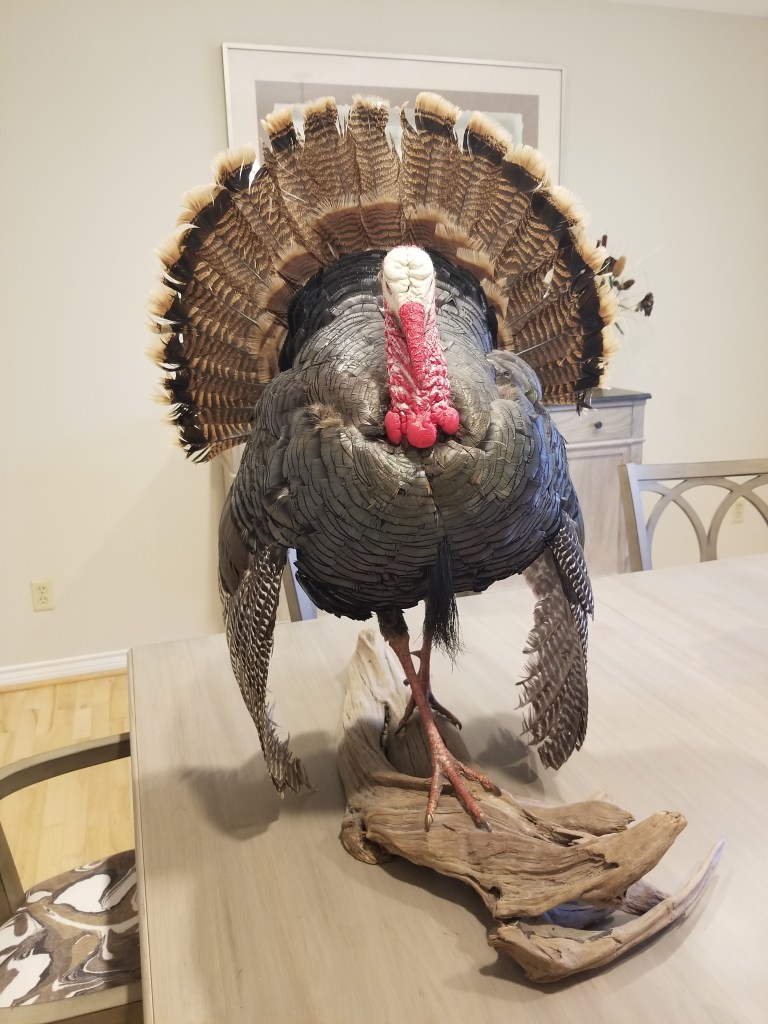
A taxidermy mount of a turkey standing on our dining room table. | Birds are Avian Dinosaurs
A wild turkey in our dining room.
Feathered Dinosaurs

A lot of dinosaurs had feathers, and some could fly. That included many types of dinosaurs other than birds. Dinosaurs with feathers include, for example, Velociraptor, Deinonychus, Archaeopteryx (could fly), Microraptor (could fly), Rahonavis (could fly), Gallimimus, Ornithomimus, Yutyrannus huali, Psittacosaurus, Psittacosaurus, Sinosauropteryx, Sinornithosaurus, Eoconfuciusornis, Wulong, Psittacosaurus, Sciurumimus, Kulindadromeus, Caudipteryx, Utahraptor, Deinonychus, and even young T-Rex and many others. We know that at least some dinosaurs had feathers as well as colors based on fossil finds. Below are some illustrations.

A Gallimimus dinosaur covered in hair and feathers.
Life restoration showing an adult with feathers, based on those known from the related Ornithomimus. Picture is from here. PaleoNeolitic, CC BY 4.0 https://creativecommons.org/licenses/by/4.0, via Wikimedia Commons
A bird like dinosaur with feathers. It has huge claws.
Life restoration of Pyroraptor olympius. Picture is from here. Mette Aumala, CC BY-SA 4.0 https://creativecommons.org/licenses/by-sa/4.0, via Wikimedia Commons.
Birds are Avian Dinosaurs | Reconstruction of the 2014 microraptorine dromaeosaur dinosaur, Changyuraptor yangi. This is a dinosaur with four wings.
Reconstruction of the 2014 microraptorine dromaeosaur dinosaur, Changyuraptor yangi. This is a dinosaur with four wings. The picture is taken from here. Emily Willoughby ([email protected], http://emilywilloughby.com), CC BY-SA 4.0 <https://creativecommons.org/licenses/by-sa/4.0&gt;, via Wikimedia Commons
Greyish bird like creature with a reptile like head.
Artistic restoration of D. albertensis Artistic restoration of D. albertensis. Picture from here. Fred Wierum, CC BY-SA 4.0 <https://creativecommons.org/licenses/by-sa/4.0&gt;, via Wikimedia Commons
Six dromaeosaurs are shown, all covered with feathers. Microraptor gui (flying), Velociraptor mongoliensis, Austroraptor cabazai, Dromaeosaurus albertensis, Utahraptor ostrommaysorum, Deinonychus antirrhopus. A human is shown on the left. Most of the dinosaurs are bigger than the human.
Size of Utahraptor (5) compared with other dromaeosaurs and a human. It is the biggest one in the picture. The picture is from here. Fred Wierum, CC BY-SA 4.0 <https://creativecommons.org/licenses/by-sa/4.0&gt;, via Wikimedia Commons.

Terror Birds and Other Giant Birds

After the Cretaceous-Paleogene extinction event 66 million years ago birds continued evolving. Some of them became large standing 1 – 3 meters (3-10 feet) and weighing hundreds or even thousands of pounds. From about 53 million years ago until 100,000 years ago there were large birds that we refer to as Terror Birds. They lived at the same time as humans. However, there were other large and scary birds. Dromornis stirtoni was a flightless bird that lived 7-8 million years ago, it was over three meters in height (10 feet) and weighed 500-600 kilograms (1,100 to 1,300 pounds). Below are some illustrations.

pencil drawing, digital coloring of Paraphysornis brasiliensis, a Terror Bird. | Birds are Avian Dinosaurs
Paraphysornis brasiliensis, a Terror Bird, 8 feet tall weighing 400–530 pounds, this is a terror bird from the Early Miocene of Brazil,: Snowmanradio (talk)Paraphysornis_BW.jpg:  Nobu Tamura (http://spinops.blogspot.com), CC BY 3.0 <https://creativecommons.org/licenses/by/3.0&gt;, via Wikimedia Commons.
The Kelenken, Devincenzia, Phorusrhacos, and Titanis birds are all larger than the human standing on the left hand side. Kelenken guillermoi is the largest.
Size comparison of some phorusrhacids (Terror Birds), including Kelenken, Devincenzia, Phorusrhacos, and Titanis. Picture taken from here. PaleoNeolitic, CC BY 4.0 <https://creativecommons.org/licenses/by/4.0&gt;, via Wikimedia Commons.
A flightless bird with huge yellow beak. | Birds are Avian Dinosaurs
A pencil-drawn reconstruction of Dromornis stirtoni. Picture is taken from here. Nobu Tamura (http://spinops.blogspot.de), CC BY-SA 3.0 http://creativecommons.org/licenses/by-sa/3.0/, via Wikimedia Commons