I recently learned from Allen Downey’s blog that Our World in Data is providing API access to their data. Our World in Data hosts datasets across several important topics, from population and demographic change, poverty and economic development, to human rights and democracy. From Nov 2024, Our World in Data “[offers] direct URLs to access data in CSV format and comprehensive metadata in JSON format” (this is what they call the Public Chart API).
See this link for full documentation on the chart data API. Allen Downey’s blog post shows how to use this API in Python; in this post I’ll show the corresponding code in R.
Downloading metadata
The chart data API page tells us what APIs are available to us. The starting point is a base URL which we denote by <base_url>. This is what’s available to us:
<base_url> – The page on the website where you can see the chart.<base_url>.csv – The data for this chart, usually what we want to download.<base_url>.metadata.json – The metadata for this chart, e.g. chart title, the units, how to cite the data sources.<base_url>.zip – The dataset, metadata, and a readme as zip file.
Let’s start by looking at the metadata for average monthly surface temperature:
library(tidyverse)
library(httr)
library(jsonlite)

# define URL and query parameters
url <- "https://ourworldindata.org/grapher/average-monthly-surface-temperature.metadata.json"
query_params <- list(
  v = "1",
  csvType = "full",
  useColumnShortNames = "true"
)

# get metadata
headers <- add_headers(`User-Agent` = "Our World In Data data fetch/1.0")
response <- GET(url, query = query_params, headers)
metadata <- fromJSON(content(response, as = "text", encoding = "UTF-8"))
The returned metadata object is a list with a few keys:
# view the metadata keys
names(metadata)

#> [1] "chart"          "columns"        "dateDownloaded" "activeFilters"
The chart element gives us high-level information of the chart:
glimpse(metadata$chart)

#> List of 5
#>  $ title           : chr "Average monthly surface temperature"
#>  $ subtitle        : chr "The temperature of the air measured 2 meters above the ground, encompassing land, sea, and in-land water surfaces."
#>  $ citation        : chr "Contains modified Copernicus Climate Change Service information (2025)"
#>  $ originalChartUrl: chr "https://ourworldindata.org/grapher/average-monthly-surface-temperature?v=1&csvType=full&useColumnShortNames=true"
#>  $ selection       : chr "World"
There’s more information on the dataset in metadata$columns$temperature_2m
names(metadata$columns$temperature_2m)
#>  [1] "titleShort"            "titleLong"             "descriptionShort"      "descriptionProcessing" "shortUnit"             "unit"
#>  [7] "timespan"              "type"                  "owidVariableId"        "shortName"             "lastUpdated"           "citationShort"
#> [13] "citationLong"          "fullMetadata"
(Why temperature_2m? Looking at metadata$columns$temperature_2m$shortName, it seems like temperature_2m is the short name for the dataset.)
Downloading the dataset
Here is code downloading the average monthly surface temperature for just the USA:
# define the URL and query parameters
url <- "https://ourworldindata.org/grapher/average-monthly-surface-temperature.csv"
query_params <- list(
  v = "1",
  csvType = "filtered",
  useColumnShortNames = "true",
  tab = "chart",
  country = "USA"
)

# get data
headers <- add_headers(`User-Agent` = "Our World In Data data fetch/1.0")
response <- GET(url, query = query_params, headers)
df <- read_csv(content(response, as = "text", encoding = "UTF-8"))

head(df)
#> # A tibble: 6 × 6
#>   Entity        Code   year Day        temperature_2m...5 temperature_2m...6
#>   <chr>         <chr> <dbl> <date>                  <dbl>              <dbl>
#> 1 United States USA    1941 1941-12-15            -1.88                 8.02
#> 2 United States USA    1942 1942-01-15            -4.78                 7.85
#> 3 United States USA    1942 1942-02-15            -3.87                 7.85
#> 4 United States USA    1942 1942-03-15             0.0978               7.85
#> 5 United States USA    1942 1942-04-15             7.54                 7.85
#> 6 United States USA    1942 1942-05-15            12.1                  7.85
Allen Downey notes that the last column is undocumented, and based on context is probably the average annual temperature.
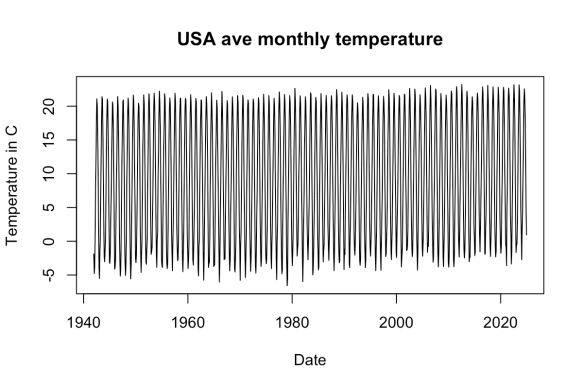
Here’s a simple plot of the data:
plot(df$Day, df$temperature_2m...5, type = "l",
     main = "USA ave monthly temperature",
     xlab = "Date", ylab = "Temperature in C")
If you wanted the entire dataset, just use csvType = "full" in the request parameters, like so:
# define the URL and query parameters
url <- "https://ourworldindata.org/grapher/average-monthly-surface-temperature.csv"
query_params <- list(
  v = "1",
  csvType = "full",
  useColumnShortNames = "true",
  tab = "chart"
)

# same code for the http request works, see above
How do you know which filters you can apply? There is no extensive documentation of what filters you can apply, but as you click on the base URL to change the chart, the URL changes. You can then use this to infer the query parameters to add.
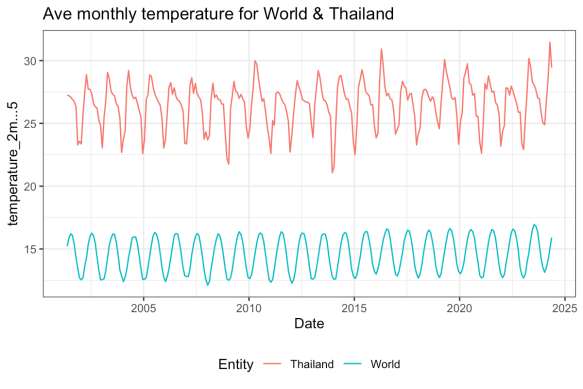
For example, I clicked around on the chart to get this URL: https://ourworldindata.org/grapher/average-monthly-surface-temperature?tab=chart&time=2001-05-15..2024-05-15&country=OWID_WRL~THA. The code below shows how you can download the data and reproduce the chart:
# define the URL and query parameters
url <- "https://ourworldindata.org/grapher/average-monthly-surface-temperature.csv"
query_params <- list(
  v = "1",
  csvType = "filtered",
  useColumnShortNames = "true",
  tab = "chart",
  time = "2001-05-15..2024-05-15",
  country = "OWID_WRL~THA"
)

# get data
headers <- add_headers(`User-Agent` = "Our World In Data data fetch/1.0")
response <- GET(url, query = query_params, headers)
df <- read_csv(content(response, as = "text", encoding = "UTF-8"))
ggplot(df) +
  geom_line(aes(x = Day, y = temperature_2m...5, col = Entity)) +
  labs(title = "Ave monthly temperature for World & Thailand",
       x = "Date", y = "Temperature in C") +
  theme_bw() +
  theme(legend.position = "bottom")


![\begin{aligned} G(z) = \mathbb{E} [z^X] = \sum_{x=0}^\infty p(x) z^x, \end{aligned}](https://s0.wp.com/latex.php?latex=%5Cbegin%7Baligned%7D+G%28z%29+%3D+%5Cmathbb%7BE%7D+%5Bz%5EX%5D+%3D+%5Csum_%7Bx%3D0%7D%5E%5Cinfty+p%28x%29+z%5Ex%2C+%5Cend%7Baligned%7D&bg=ffffff&fg=333333&s=0&c=20201002)

, and


![\begin{aligned} \mathbb{E}\left[ \dfrac{X!}{(X-k)!} \right] = G^{(k)}(1^-) \end{aligned}](https://s0.wp.com/latex.php?latex=%5Cbegin%7Baligned%7D+%5Cmathbb%7BE%7D%5Cleft%5B+%5Cdfrac%7BX%21%7D%7B%28X-k%29%21%7D+%5Cright%5D+%3D+G%5E%7B%28k%29%7D%281%5E-%29+%5Cend%7Baligned%7D&bg=ffffff&fg=333333&s=0&c=20201002)
![\begin{aligned} \mathbb{E}[X] &= G'(1-), \\ \text{Var}(X) &= G''(1^-) + G'(1^-) - [G'(1^-)]^2. \end{aligned}](https://s0.wp.com/latex.php?latex=%5Cbegin%7Baligned%7D+%5Cmathbb%7BE%7D%5BX%5D+%26%3D+G%27%281-%29%2C+%5C%5C+%5Ctext%7BVar%7D%28X%29+%26%3D+G%27%27%281%5E-%29+%2B+G%27%281%5E-%29+-+%5BG%27%281%5E-%29%5D%5E2.+%5Cend%7Baligned%7D&bg=ffffff&fg=333333&s=0&c=20201002)
 points are placed uniformly at random on a circle. What’s the probability that all
  . For each
  , define the event
  as the event where all
  and moving clockwise.
 are not disjoint. That means that there is some configuration of points where the clockwise semicircle starting from
  covers all points. Consider moving clockwise from
  half the circle. But by the same logic, the arc reaching
 , let
, let  be the expected number of rolls until the total sum becomes at least
  . What we want is
  .
. , and
, and
 . Here’s the induction step going from
  to
to ![\begin{aligned} E_k &= \mathbb{P}(\text{roll more than } k-1) + \sum_{i = 1}^{k-1} \mathbb{P}(\text{roll a } k - i) \cdot (1 + E_i) \\ &= \frac{n-k-1}{n} + \sum_{i=1}^{k-1} \frac{1}{n}\cdot \left[ 1 + \left(\frac{n+1}{n} \right)^{i-1} \right] \\ &= 1 + \frac{1}{n}\sum_{i=1}^{k-1} \left(\frac{n+1}{n} \right)^{i-1} \\ &= 1 + \frac{1}{n} \cdot \frac{(\frac{n+1}{n})^{k-1} - 1}{\frac{n+1}{n} - 1} \\ &= 1+ \left( \frac{n+1}{n} \right)^{k-1} - 1 \\ &= \left( \frac{n+1}{n} \right)^{k-1}. \end{aligned}](https://s0.wp.com/latex.php?latex=%5Cbegin%7Baligned%7D+E_k+%26%3D+%5Cmathbb%7BP%7D%28%5Ctext%7Broll+more+than+%7D+k-1%29+%2B+%5Csum_%7Bi+%3D+1%7D%5E%7Bk-1%7D+%5Cmathbb%7BP%7D%28%5Ctext%7Broll+a+%7D+k+-+i%29+%5Ccdot+%281+%2B+E_i%29+%5C%5C+%26%3D+%5Cfrac%7Bn-k-1%7D%7Bn%7D+%2B+%5Csum_%7Bi%3D1%7D%5E%7Bk-1%7D+%5Cfrac%7B1%7D%7Bn%7D%5Ccdot+%5Cleft%5B+1+%2B+%5Cleft%28%5Cfrac%7Bn%2B1%7D%7Bn%7D+%5Cright%29%5E%7Bi-1%7D+%5Cright%5D+%5C%5C+%26%3D+1+%2B+%5Cfrac%7B1%7D%7Bn%7D%5Csum_%7Bi%3D1%7D%5E%7Bk-1%7D+%5Cleft%28%5Cfrac%7Bn%2B1%7D%7Bn%7D+%5Cright%29%5E%7Bi-1%7D+%5C%5C+%26%3D+1+%2B+%5Cfrac%7B1%7D%7Bn%7D+%5Ccdot+%5Cfrac%7B%28%5Cfrac%7Bn%2B1%7D%7Bn%7D%29%5E%7Bk-1%7D+-+1%7D%7B%5Cfrac%7Bn%2B1%7D%7Bn%7D+-+1%7D+%5C%5C+%26%3D++1%2B+%5Cleft%28+%5Cfrac%7Bn%2B1%7D%7Bn%7D+%5Cright%29%5E%7Bk-1%7D+-+1+%5C%5C+%26%3D+%5Cleft%28+%5Cfrac%7Bn%2B1%7D%7Bn%7D+%5Cright%29%5E%7Bk-1%7D.+%5Cend%7Baligned%7D&bg=ffffff&fg=333333&s=0&c=20201002)
 , we get
 ,
,  .
.

 . For each observation
  , and an observation
  which we want to predict. Both the lasso and fused lasso model the predictions as
 . The lasso estimates the coefficients as the solution to the minimization problem
![\begin{aligned} \hat\beta = \underset{\beta}{\text{argmin}} \; \left[ \frac{1}{2n} \sum_{i=1}^n \left( y_i - \beta_0 - \sum_{j=1}^p \beta_j x_{ij} \right)^2 + \lambda \sum_{j=1}^p |\beta_j | \right], \end{aligned}](https://s0.wp.com/latex.php?latex=%5Cbegin%7Baligned%7D+%5Chat%5Cbeta+%3D+%5Cunderset%7B%5Cbeta%7D%7B%5Ctext%7Bargmin%7D%7D+%5C%3B+%5Cleft%5B+%5Cfrac%7B1%7D%7B2n%7D+%5Csum_%7Bi%3D1%7D%5En+%5Cleft%28+y_i+-+%5Cbeta_0+-+%5Csum_%7Bj%3D1%7D%5Ep+%5Cbeta_j+x_%7Bij%7D+%5Cright%29%5E2+%2B+%5Clambda+%5Csum_%7Bj%3D1%7D%5Ep+%7C%5Cbeta_j+%7C+%5Cright%5D%2C+%5Cend%7Baligned%7D&bg=ffffff&fg=333333&s=0&c=20201002)
 is a hyperparameter. (Note that the intercept
  is not included in the penalty term: this is usually the case for regularized models.) The penalty term encourages the coefficients
  to shrink to zero, giving sparsity.
![\begin{aligned} \hat\beta = \underset{\beta}{\text{argmin}} \; \left[ \frac{1}{2n} \sum_{i=1}^n \left( y_i - \beta_0 - \sum_{j=1}^p \beta_j x_{ij} \right)^2 + \lambda_1 \sum_{j=1}^p |\beta_j | + \lambda_2 \sum_{j=2}^p |\beta_j - \beta_{j-1} | \right], \end{aligned}](https://s0.wp.com/latex.php?latex=%5Cbegin%7Baligned%7D+%5Chat%5Cbeta+%3D+%5Cunderset%7B%5Cbeta%7D%7B%5Ctext%7Bargmin%7D%7D+%5C%3B+%5Cleft%5B+%5Cfrac%7B1%7D%7B2n%7D+%5Csum_%7Bi%3D1%7D%5En+%5Cleft%28+y_i+-+%5Cbeta_0+-+%5Csum_%7Bj%3D1%7D%5Ep+%5Cbeta_j+x_%7Bij%7D+%5Cright%29%5E2+%2B+%5Clambda_1+%5Csum_%7Bj%3D1%7D%5Ep+%7C%5Cbeta_j+%7C+%2B+%5Clambda_2+%5Csum_%7Bj%3D2%7D%5Ep+%7C%5Cbeta_j+-+%5Cbeta_%7Bj-1%7D+%7C+%5Cright%5D%2C+%5Cend%7Baligned%7D&bg=ffffff&fg=333333&s=0&c=20201002)
 and
and  are hyperparameters. On top of penalizing the size of the coefficients, the fused lasso also penalizes the differences between successive coefficients. This encourages the coefficient profile (the plot of
  vs.
vs.  for several mass over charge ratios (
 ). The goal is to find
  . Assume that they are computed from z-scores
  (test statistics following normal distributions). Let
 ![\mathbb{E}[\mathbf{X}] = \boldsymbol{\mu}](https://s0.wp.com/latex.php?latex=%5Cmathbb%7BE%7D%5B%5Cmathbf%7BX%7D%5D+%3D+%5Cboldsymbol%7B%5Cmu%7D&bg=ffffff&fg=333333&s=0&c=20201002) and let
and let  . Without loss of generality, assume that each test statistic
  has variance 1. With this, we can express the p-values as
![\begin{aligned} p_i = 2 \left[ 1 - \Phi (|X_i|) \right], \end{aligned}](https://s0.wp.com/latex.php?latex=%5Cbegin%7Baligned%7D+p_i+%3D+2+%5Cleft%5B+1+-+%5CPhi+%28%7CX_i%7C%29+%5Cright%5D%2C+%5Cend%7Baligned%7D&bg=ffffff&fg=333333&s=0&c=20201002)
 is the CDF function of the standard normal distribution.
 .
. such that
  for all
  and
and  is independent of
  . The test statistic for the Cauchy combination test, proposed by Liu & Xie 2020 (Reference 1), is
![\begin{aligned} T(\mathbf{X}) = \sum_{i=1}^d w_i \tan \left[ \pi \left( 2 \Phi (|X_i|) - \frac{3}{2} \right) \right] = \sum_{i=1}^d w_i \tan \left[ \pi \left( \frac{1}{2} - p_i \right) \right]. \end{aligned}](https://s0.wp.com/latex.php?latex=%5Cbegin%7Baligned%7D+T%28%5Cmathbf%7BX%7D%29+%3D+%5Csum_%7Bi%3D1%7D%5Ed+w_i+%5Ctan+%5Cleft%5B+%5Cpi+%5Cleft%28+2+%5CPhi+%28%7CX_i%7C%29+-+%5Cfrac%7B3%7D%7B2%7D+%5Cright%29+%5Cright%5D+%3D+%5Csum_%7Bi%3D1%7D%5Ed+w_i+%5Ctan+%5Cleft%5B+%5Cpi+%5Cleft%28+%5Cfrac%7B1%7D%7B2%7D+-+p_i+%5Cright%29+%5Cright%5D.+%5Cend%7Baligned%7D&bg=ffffff&fg=333333&s=0&c=20201002)
 for each
 ![\tan \left[ \pi \left( \frac{1}{2} - p_i \right) \right]](https://s0.wp.com/latex.php?latex=%5Ctan+%5Cleft%5B+%5Cpi+%5Cleft%28+%5Cfrac%7B1%7D%7B2%7D+-+p_i+%5Cright%29+%5Cright%5D&bg=ffffff&fg=333333&s=0&c=20201002) has the standard Cauchy distribution (see
has the standard Cauchy distribution (see  has the standard Cauchy distribution.
 ,
,  follows a bivariate normal distribution. Suppose also that
 ![\mathbb{E}[\mathbf{X}] = \mathbf{0}](https://s0.wp.com/latex.php?latex=%5Cmathbb%7BE%7D%5B%5Cmathbf%7BX%7D%5D+%3D+%5Cmathbf%7B0%7D&bg=ffffff&fg=333333&s=0&c=20201002) . Let
. Let  be a standard Cauchy random variable. Then for any fixed
  and any correlation matrix
  , we have
 with
with  .
. ‘s are large, or equivalently when a smaller number of
  ‘s are very small. We can see this intuitively: small
 ![\tan [\pi(1/2 - p_i)]](https://s0.wp.com/latex.php?latex=%5Ctan+%5B%5Cpi%281%2F2+-+p_i%29%5D&bg=ffffff&fg=333333&s=0&c=20201002) ‘s, so the test statistic will be dominated by a few very large p-values. See Section 4.2 of Reference 1 for a power comparison study.
‘s, so the test statistic will be dominated by a few very large p-values. See Section 4.2 of Reference 1 for a power comparison study. are independent
  variables and
  is a random vector independent of the
  ‘s with
  , it is well-known that
  also has a
  are independent standard normal variables, then
  has a
has a  and
and  be i.i.d.
  , where
  is a diagonal matrix with strictly positive entries on the diagonal. Let
  be a random vector independent of
  such that
 , but as long as the dependence structure for the two random vectors is the same, the linear combination of their ratios remains Cauchy-distributed! Here is the formal statement:
 into a standard
  and
and ![X = \tan \left[ \pi \left( \frac{1}{2} - U \right)\right]](https://s0.wp.com/latex.php?latex=X+%3D+%5Ctan+%5Cleft%5B+%5Cpi+%5Cleft%28+%5Cfrac%7B1%7D%7B2%7D+-+U+%5Cright%29%5Cright%5D&bg=ffffff&fg=333333&s=0&c=20201002) , then
, then  ,
,![\begin{aligned} \mathbb{P} \left\{ X \leq x \right\} &= \mathbb{P} \left\{ \tan \left[ \pi \left( \frac{1}{2} - U \right)\right] \leq x \right\} \\ &= \mathbb{P} \left\{ \frac{1}{2} - U \leq \frac{1}{\pi}\tan^{-1} x \right\} \\ &= \mathbb{P} \left\{ \frac{1}{2} - \frac{1}{\pi}\tan^{-1} x \leq U \right\} \\ &= 1 - \left[ \frac{1}{2} - \frac{1}{\pi}\tan^{-1} x \right] \\ &= \frac{1}{2} + \frac{1}{\pi}\tan^{-1} x, \end{aligned}](https://s0.wp.com/latex.php?latex=%5Cbegin%7Baligned%7D+%5Cmathbb%7BP%7D+%5Cleft%5C%7B+X+%5Cleq+x+%5Cright%5C%7D+%26%3D+%5Cmathbb%7BP%7D+%5Cleft%5C%7B+%5Ctan+%5Cleft%5B+%5Cpi+%5Cleft%28+%5Cfrac%7B1%7D%7B2%7D+-+U+%5Cright%29%5Cright%5D+%5Cleq+x+%5Cright%5C%7D+%5C%5C++%26%3D+%5Cmathbb%7BP%7D+%5Cleft%5C%7B+%5Cfrac%7B1%7D%7B2%7D+-+U+%5Cleq+%5Cfrac%7B1%7D%7B%5Cpi%7D%5Ctan%5E%7B-1%7D+x+%5Cright%5C%7D+%5C%5C++%26%3D+%5Cmathbb%7BP%7D+%5Cleft%5C%7B+%5Cfrac%7B1%7D%7B2%7D+-+%5Cfrac%7B1%7D%7B%5Cpi%7D%5Ctan%5E%7B-1%7D+x+%5Cleq+U%C2%A0+%5Cright%5C%7D+%5C%5C++%26%3D+1+-+%5Cleft%5B+%5Cfrac%7B1%7D%7B2%7D+-+%5Cfrac%7B1%7D%7B%5Cpi%7D%5Ctan%5E%7B-1%7D+x+%5Cright%5D+%5C%5C++%26%3D+%5Cfrac%7B1%7D%7B2%7D+%2B+%5Cfrac%7B1%7D%7B%5Cpi%7D%5Ctan%5E%7B-1%7D+x%2C+%5Cend%7Baligned%7D&bg=ffffff&fg=333333&s=0&c=20201002)
 , so the LHS inside the probability is always in
  to get the PDF of
 ![\begin{aligned} f_X(x) &= \dfrac{d}{dx} \left[ \frac{1}{2} + \frac{1}{\pi}\tan^{-1} x \right] \\ &= \frac{1}{\pi (1 + x^2)}. \end{aligned}](https://s0.wp.com/latex.php?latex=%5Cbegin%7Baligned%7D+f_X%28x%29+%26%3D+%5Cdfrac%7Bd%7D%7Bdx%7D+%5Cleft%5B+%5Cfrac%7B1%7D%7B2%7D+%2B+%5Cfrac%7B1%7D%7B%5Cpi%7D%5Ctan%5E%7B-1%7D+x+%5Cright%5D+%5C%5C++%26%3D+%5Cfrac%7B1%7D%7B%5Cpi+%281+%2B+x%5E2%29%7D.+%5Cend%7Baligned%7D&bg=ffffff&fg=333333&s=0&c=20201002)
 is a noise objective function that is differentiable w.r.t. to its parameter
  . We want to minimize
 ![\mathbb{E}[f(\theta)]](https://s0.wp.com/latex.php?latex=%5Cmathbb%7BE%7D%5Bf%28%5Ctheta%29%5D&bg=ffffff&fg=333333&s=0&c=20201002) .
. are stochastic realizations of
  at timesteps
  .
. denote the gradient of
  w.r.t.
  , Adam keeps track of
  , an estimate of the first moment of the gradient
  , and
, and  , an estimate of the second raw moment (uncentered variance) of the gradient
  (
( represents element-wise multiplication). The Adam update is
 and
and  are hyperparameters. The full description of Adam is in the Algorithm below:


 , infinitesimal
  , and replacing
  (see Section 5 of Reference 1 for a few more details).
 defines the rate of weight decay per step. Loshchilov & Hutter (2019) note that for standard SGD, this weight decay is equivalent to L2 regularization (Proposition 1 of Reference 4), but the two are not equivalent for the Adam update. They present Adam with L2 regularization and Adam with decoupled weight decay (AdamW) together in Algorithm 2 of the paper:
 and
and  for tasks A and B respectively. Let
  . Our neural network is parameterized by
  . Catastrophic forgetting says that when further training on task B (to reach new optimal parameters
  ),
), 
 :
:
![\begin{aligned} \log p(\theta | \mathcal{D}) &= \log p(\mathcal{D}_A | \theta) + \log p(\mathcal{D}_B | \theta) + \log p(\theta) - \log p(\mathcal{D}_A) - \log p(\mathcal{D}_B) \\ &= \log p(\mathcal{D}_B | \theta) + \log p(\theta) - \log p(\mathcal{D}_A) - \log p(\mathcal{D}_B) \\ &\qquad + [\log p(\theta | \mathcal{D}_A) - \log p(\theta) + \log p (\mathcal{D}_A) ] \\ &= \log p(\mathcal{D}_B | \theta) + \log p(\theta | \mathcal{D}_A) - \log p(\mathcal{D}_B). \end{aligned}](https://s0.wp.com/latex.php?latex=%5Cbegin%7Baligned%7D+%5Clog+p%28%5Ctheta+%7C+%5Cmathcal%7BD%7D%29+%26%3D+%5Clog+p%28%5Cmathcal%7BD%7D_A+%7C+%5Ctheta%29+%2B+%5Clog+p%28%5Cmathcal%7BD%7D_B+%7C+%5Ctheta%29+%2B+%5Clog+p%28%5Ctheta%29+-+%5Clog+p%28%5Cmathcal%7BD%7D_A%29+-+%5Clog+p%28%5Cmathcal%7BD%7D_B%29+%5C%5C++%26%3D+%5Clog+p%28%5Cmathcal%7BD%7D_B+%7C+%5Ctheta%29+%2B+%5Clog+p%28%5Ctheta%29+-+%5Clog+p%28%5Cmathcal%7BD%7D_A%29+-+%5Clog+p%28%5Cmathcal%7BD%7D_B%29+%5C%5C++%26%5Cqquad+%2B+%5B%5Clog+p%28%5Ctheta+%7C+%5Cmathcal%7BD%7D_A%29+-+%5Clog+p%28%5Ctheta%29+%2B+%5Clog+p+%28%5Cmathcal%7BD%7D_A%29+%5D+%5C%5C++%26%3D+%5Clog+p%28%5Cmathcal%7BD%7D_B+%7C+%5Ctheta%29+%2B+%5Clog+p%28%5Ctheta+%7C+%5Cmathcal%7BD%7D_A%29+-+%5Clog+p%28%5Cmathcal%7BD%7D_B%29.+%5Cend%7Baligned%7D&bg=ffffff&fg=333333&s=0&c=20201002)

 , we assume that the precision matrix is diagonal having the same values as the diagonal of
  is equivalent to minimizing
 is the loss for task B only,
  .
. Statistical Odds & Ends