Bean Setting – Brackley / Headington Quarry

In my final year at university I was in a band called Bean Setters – the name inspired by the fact that we played these tunes together (finishing off by going into the Great Western Morris tune ‘Nine Men’s Morris’). I would have first heard the Headington Quarry ‘Bean Setting’ on the LP Morris On – but I see I’ve already posted that tune on its own, just under a year ago, so there’s no need to say any more about that.

The Brackley version (which properly seems to be called ‘Bean Setters’, I think) was adapted by John Jones, then foreman of Oyster Morris, as a Badby dance. The tune is a version of ‘The Lass of Dallowgill’, and John got us to sing the following verses – adapted from North Country sword dance tradition – before the music struck up:

We are six actors bold
Ne’er came on stage before
And we will do our best
And our best can do no more

You’ve seen us al come on
Think of us what you will
Music strike up and play
‘The Lass of Dallowgill’

In an article on ‘The Hinton and Brackley Morris’ in the Journal of the English Folk Dance and Song Society, Vol. 7, No. 4 (Dec., 1955), Fred Hamer wrote of ‘Bean Setting’

This is the dance best remembered by surviving Brackley men and for which they have a special affection. After a performance in Brackley of the Headington version of the dance by the Bedford Morris Men I was button-holed by old Brackley men who said that we did not do the dance properly – our sticks were not long enough, we did not use them correctly and the figures and tune were wrong. Enquiry showed that they could give me the tune and the figures of the Brackley dance. My notation has been verified more than once since then, and I discovered later that Kenworthy Schofield had obtained a version of the dance in 1937, though the distinctive movement was then confused with that of “Shooting”.
The dance was of particular significance; I was told that every movement “meant something”. This is the only Morris dance I know which has a traditional explanation
for all the movements.
The dance was always preceded by the Fool (in Brackley a Man-woman) who was there to “clear the ground”, carrying, besides his usual bladders and cow’s tail, a tin of pebbles. The tin was rattled and the cow’s tail was used to sweep the ground in a wide circle before the men entered.

The Brackley dances were revived in 1959 by Roger Nicholls, a teacher at Magdalen College School, Brackley, who taught the traditional dances to a bunch of boarders at the school. There’s a film of these boys dancing ‘Bean Setting’ and ‘Jockey to the Fair’ on the BFI website at https://player.bfi.org.uk/free/film/watch-brackley-morris-dancers-1966-online

Bean Setting (Brackley) / Bean Setting (Headington Quarry)

Played on C/G anglo-concertina

Rigs o’Marlow

When I go to Marlow Fair
With the ribbons in my hair
All the boys and girls declare
Here comes the Rigs o’Marlow

I probably first heard this well-known morris tune on the LP Son of Morris On, where it’s played by the great John Watcham. And I’m pretty sure it was also in the Oyster Ceilidh Band’s set for ‘Nottingham Swing’.

These days, of course, I’m playing it for Headington quarry to dance to, and I try to at least conjure up the spirit of how William Kimber played the tune. Here’s how Sharp noted it when he first met Kimber, just after Christmas in 1899. My musical theory isn’t advanced enough to know if 12/8 is the most accurate time signature. However I can guarantee that – unless Bill’s old concertina was very flat – he didn’t play it in the key of B flat.

Rigs o'Marlow and Old Mother Oxford - as noted by Cecil Sharp, December 1899

Rigs o’Marlow – as noted by Cecil Sharp, December 1899. From the VWML Archive Catalogue.

Here it is played by Kimber himself, on an HMV 78rpm records released in 1947

Billy Kimber – Rodney / Rigs of Marlow

And here’s my take on it.

Rigs o’Marlow

Played on C/G anglo-concertina

The Wild Morris / Ye Wild Morris

Two tunes which I originally heard in the late 1970s on Son of Morris On.

‘The Wild Morris’ was noted by Cecil Sharp noted in 1910 from Charlie Baldwin who – approaching the end of his life – was a resident of the workhouse in Newent. Charlie Baldwin had played for the morris at Cliffords Mesne:

Always played ’em off the green to this tune. They went off in the same order as they came on in the march only quicker and dancing instead of marching.

You’ll find more information on Charlie Baldwin and his tunes on the GlosTrad website.

The Wild Morris, as noted by Cecil Sharp from Charles Baldwin; image from the VWML Archive Catalaogue.

The Wild Morris, as noted by Cecil Sharp from Charles Baldwin; image from the VWML Archive Catalaogue.

‘Ye Wild Morris’ on the other hand dates back – according to Alfred Moffat and Frank Kidson’s 1922 publication Dances of the Olden Time – to c1729. And, I suspect, has absolutely no connection with any morris dance tradition.

The Wild Morris

Played on C/G anglo-concertina

Ye Wild Morris

Played on G/D anglo-concertina

The Waterlog Jog / Mox the Rog’s Jog

In a few days’ time, it will be one year since I heard the news that my friend Mike Eaton had died. Mike was my best friend at school. He and his family were instrumental in making me a folkie, and this exciting music, unlike anything I’d heard before, created a yet closer bond between us. We sang together in harmony, and we played music together – not particularly well, but that was beside the point. We were at University together, he was best man at my wedding and, although as years went by we didn’t see each other so often, Mike and I remained close friends. I covered some of this in a post on my A Folk Song A Week blog a little while after Mike’s death.

In commemoration of Mike’s well-lived life, and our enduring friendship, here’s two tunes that he wrote – possibly on violin, possibly on tin whistle – back in our schooldays, in 1977. Somewhere I might still have the original copy of these tunes that Mike gave me back then; so far the closest I can find is a sheet music copy that I wrote out at the time. I can’t guarantee it, but I’ve a feeling that, even if I hadn’t had these tunes written down, I’d still have remembered them. They’re both very simple, both clearly inspired by the Irish tunes we were listening to at the time (mostly as played by Steeleye Span, the Chieftains, and the Oyster Ceilidh Band). But they work well, and I still enjoy playing them.

Here’s the ABC notation, if anyone else wants to give them an airing:

X:182
T: The Waterlog Jog
C: © Mike Eaton, 1977
M: 6/8
K: G
L: 1/8
d2c||:B2G BdB | G2A B2G | FAF D2E | F2G A2c | B2G Bdb | G2A B2G | FAF DEF |1 G3d2c :|2 G3A2B ||
|:c2A BGG | cAA BGG | FAF D2E | F2G A2B |c2A BGG | cAA BGG | FAF DEF |1 G3A2B :|2 G3|]

X:183
T: Mox the Rog’s Jog
C: © Mike Eaton, 1977
M: 6/8
K: G
L: 1/8
B2c||:ded dBG | ded dBG | BAG AGA | BAG ABc | ded dBG | ded dBG | BAG AGA |1 BGG G2c |2 BGG GAB ||
|:c2zB2z | A2z G2 z | FED DEF | GED GAB | c2zB2z | A2z G2 z | FED DEF |1 G3 GAB :|2 G3|]

Mike dancing

“Mox the Rog” demonstrates his inimitable dancing style, August 1990. Gregory Isaacs provides the music.

The Waterlog Jog / Mox the Rog’s Jog 

Played on G/D anglo-concertina

Pottings Polka

As far as I am aware, Sue Harris has only ever released two solo albums. The second of these, Pastorela, was released in 2002 but I heard it for the first time just before Christmas – and very good it is too. All the tracks feature solo hammered dulcimer, apart from the two songs, where the dulcimer is plucked. Her previous solo LP, Hammers and Tongues, on the Free Reed label, was released in 1978, and I suspect I bought it pretty soon after its release. This record features Sue’s voice and dulcimer (no oboe) and has contributions from John Kirkpatrick, Martin Brinsford, Alan Harris and Jeannie Harris. The tracks are a mix of traditional songs, music hall songs, and self-composed dance tunes, several of which I learned at the time.

For some reason I’ve not played this one very often over the years, but it’s a lovely tune, and seems like a good one to kick-start 2025.

N.B. I’ve checked both the John Kirkpatrick and Sue Harris tune book, and the LP sleeve, and there is no apostrophe in Pottings. Make of that what you will.

Pottings Polka

Played on C/G anglo-concertina

Trip to Stowmarket / Alison’s Rant

Two one-row tunes. The first was written by the late Steve Dumpleton. I learned it from Polkaworks’ wonderful CD Borrowed Shoes, although I had previously heard Steve play it, with Rees Wesson, at one of Katie Howson’s Melodeons and More events at Mendlesham in Suffolk.

‘Alison’s Rant’ was written for my sister-in-law, in advance of a significant birthday, being careful to explain that, in this context, a rant referred to a type of country dance, not someone having a right old moan!

X:73
T: Alison’s Rant
C: © Andy Turner 1999
N: Written for my sister-in-law’s 40th birthday
M: 4/4
K: G
BA GF E2D2 | BA GF E2D2 | c2c2B2G2 | FG AB A2D2 |
BA GF E2D2 | BA GF E2D2 | cA Bc d2F2 |1 G2B2G2z2 :|2 G2B2G2E2||
|:D2E2 FD EF | G2A2 BG AB | c2c2B2G2 | FG AB A3G |
F2E2DE FD | G2A2 BG AB | cB ce d2F2 |1 G4G2E2 :|2 G4G2z2 |]

Trip to Stowmarket

Played on one-row melodeon in C

Alison’s Rant

Played on one-row melodeon in G

Tansey’s Favourite

The record that made me a folkie was Steeleye Span’s Below the Salt – released in 1972, but I first heard it around this time 49 years ago. There’s a great instrumental set, ‘The Bride’s Favourite / Tansey’s Fancy’ – two quite similar tunes which I’ve never quite manged to untangle (not helped by the fact that the Woodpecker Band compacted them into one 48-bar jig, with bits of both tunes).

But then the other day, with my recently-acquired Bb/F Jeffries in my hand, this tune just sprung into my head, and my fingers found that they knew it. Ah, that’s ‘Tansey’s Fancy’, I thought. Well, I was sort of right. What I was playing was the first tune in the Steeleye set, which they actually label ‘The Bride’s Favourite’. But Steeleye were wrong – they’d got the tune titles the wrong way round. And, looking at flute-player Seamus Tansey’s LP in the Leader Masters of Irish Music series (a copy of which I picked up a few years ago in the excellent Oxfam music shop in Durham), I see that it’s actually his Favourite, rather than his Fancy.

Whether it would still be his favourite when played more like an English country dance tune than an Irish jig, and in B flat, who knows…

Tansey’s Favourite

Played on Bb/F anglo-concertina

Sheriff’s Ride / Monk’s March / Walk of the Twopenny Postman

I believe I got my 31-key G/D Jeffries anglo around Christmas 1981. My playing had reached the point where getting a decent box was absolutely game-changing, and I think this was one of the first tune sets that I worked out on the new instrument (or it might have been that I’d got the arrangement worked out already, but the superior instrument – especially the increased capacity of the bellows – meant that now I could actually achieve what I wanted to). I remember playing it at the Heritage club in Oxford, where Andy Cheyne christened it my “Peripatetic morris set”. Funnily enough I’d strung the tunes together without spotting the common theme in the tune titles.

‘The Sheriff’s Ride’ is a version of the ‘Raggle Taggle Gypsies’ tune from Lichfield, and I would have first heard it on the Albion Country Band’s Battle of the Fields LP (a record which I’m not the only person to consider the best ever English traditional folk-rock album).

‘Monk’s March’ is from Sherborne in Gloucestershire, and may or may not have any connection with the 17th century General George Monck – I certainly doubt if his political ambivalence was uppermost in the minds of Sherborne morris dancers in the 19th century, or indeed, since. Again, I’d have first heard this on an Ashley Hutchings LP, in this case Son of Morris On.

Finally, I learned ‘The Walk of the Twopenny Postman’ from Oyster Morris musician Alan Greenwood, a lovely, wonderfully laid-back bloke who, sadly, we lost earlier this year. He pointed out to me that the tune is actually a slowed down version of the Irish jig ‘Garryowen’. But what I didn’t know till this morning was that the title is actually a corruption of ‘Mr. Walker, the Twopenny Postman’. This is what the Traditional Tune Archive has to say about it:

The tune is contained in the 1839 music manuscript collection of W.H. Giles, of Bampton, Oxfordshire. The source for the title is a comic song about a philanderer called “Mr. Walker, the Twopenny Postman,” published in the Cruickshanks’ Universal Songster, or Museum of Mirth, vol. 2 (1826) and similar songsters, set to the air “Garry Owen.”

There’s several copies on the Bodleian Ballads site. It’s one of those humorous songs where the humour has not survived the intervening 200 years especially well; I don’t think I’ll be adding the song to my repertoire.

Sheriff’s Ride / Monk’s March / Walk of the Twopenny Postman

Played on C/G anglo-concertina

Redowa Polka / Ty Coch

Here’s two jolly polkas from the Geckoes / Chameleons repertoire – it actually felt quite odd to be playing them on my own, with not a guitar, keyboard or bass in sight.

I learned ‘The Redowa Polka’- as I suspect most people did originally back in the early 1980s – from The Sussex Tune Book. This one was sourced from the manuscripts of Michael Turner of Warnham. You’ll find other versions on the Traditional Tune Archive site. The site also helpfully clarifies the difference between a Polka Redowa and a Redowa Polka:

Redowa is the name of a waltz-like dance movement popular in the nineteenth century, in ¾ time. The dance originated in Bohemia and involved a change of weight that, while appearing graceful to the onlooker, involved a level of skill that could only be brought off by better dancers. Eventually hybrid forms were created—the Polka Redowa and the Redowa Polka. The Polka Redowa was a polka dance set to redowa music in ¾ time; while a Redowa Polka was a redowa dance set to polka music in 2/4 time.

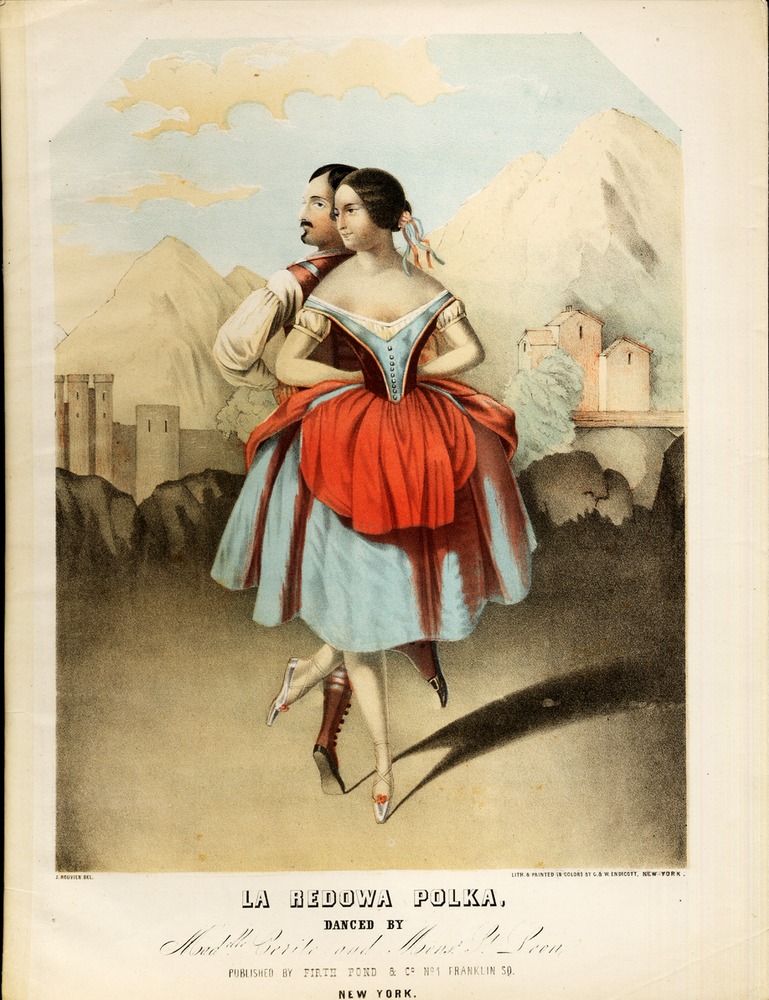
La Redowa Polka, sheet music published in New York, from the Lester S. Levy Collection of Sheet Music

La Redowa Polka, sheet music published in New York, from the Lester S. Levy Collection of Sheet Music

I first heard ‘Ty Coch’ on the first LP by Welsh band Ar Log. They give the tune its full title – ‘Tŷ Coch Caerdydd’ (‘The Little Red House of Cardiff’). You can hear their arrangement on YouTube – it’s the final tune in this set. Then when I moved to Oxfordshire in the late 1980s I found that the tune was part of the repertoire at the famous English music sessions in Eynsham – introduced by Andy Cheyne, I suspect, who had been a student in Swansea.

It is, of course, a major key version of the Playford tune ‘Red House’.


Redowa Polka / Ty Coch

Played on C/G anglo-concertina

Ray’s Wedding

At the end of May 1992, I visited Willy and Nancy Taylor at their home near Wooler, in Northumberland. As I recall, the address was simply “8, North Middleton” – and that was about as many dwellings as there were in North Middleton. We were made very welcome by Willy and Nancy. Willy and I played a few tunes, and Nancy prepared a proper afternoon tea – ham salad, and bread and butter, cake, and plentiful cups of tea (a previous visit to their home by our friend Michelle Soinne had prompted her to compose the wonderful tune ‘The High Tea’). One thing I remember vividly about the visit was that, despite the fact that it was a very warm May day, they had a fire burning in the grate – I suppose that if you’ve spent a lifetime shepherding on the Northumbrian hills, you never quite get rid of the cold in your bones.

When Willy and I started playing tunes, it seemed that he mostly wanted to try out tunes which he’d only recently learned. He had the musical notation for them all, and I busked along as best I could.

This tune is one that I really should play more often than I do. It was written by Bobby Tulloch, and I assume that this was Bobby Tulloch the Shetland naturalist.

Ray’s Wedding

Played on C/G anglo-concertina


And here as a special bonus, is the tune as played by Willy Taylor

Willy Taylor- fiddle

Andy Turner – G/D anglo-concertina

The Shepherds at the 1990 National Folk Music Festival. Andy Turner sitting in with Will Atkinson, Joe Hutton, Alistair Anderson, Willy Taylor and Tom Gilfellon.

Sitting in with The Shepherds, Sunday afternoon dance at the 1990 National Folk Music Festival, Sutton Bonington. From left to right: the back of Hugh Rippon calling, me, Will Atkinson, Joe Hutton, Alistair Anderson, Willy Taylor and Tom Gilfellon. I’m afraid I don’t know the name of the sound engineer at the back.