Darby and Joan / Bedford Races

The first tune here was composed by Oxford-based musician, composer, collector and watercolourist John Baptist Malchair – someone who, almost two centuries after his death, was to play an important part in the Magpie Lane story. About twenty years ago I spent a few hours in the Bodleian Library leafing though Tunes composed by John Malchair for the 3 stringed violin also others for the common violin, a manuscript collection of tunes composed by Malchair, written out – and in some cases with a bass part or piano accompaniment added – by his friend, and fellow composer, William Crotch. The entry in the Bodleian Summary Catalogue of Western MSS says

The originals were composed by Malchair in about 1783-99, and this book was copied out by Crotch for Malchair perhaps chiefly in about 1800. The volume remained with Malchair till 1804, when he gave it to Crotch, who added many personal notes at various later dates…

Bought from mr. T. W. Taphouse on Dec. 10, 1878, for £2.

I won’t claim to have studied this manuscript extensively, but of all the tunes I saw that day, this is the one which jumped out at me as most obviously intended to sound like a country dance tune. And a very good tune it is – slowed down a bit it would make an absolutely cracking morris tune.

Darby and Joan, by John Baptist Malchair

Darby and Joan, by John Baptist Malchair

As would ‘Bedford Races’, a tune from the MSS written by Northamptonshire poet and fiddle-player, John Clare. I learned this from George Deacon’s John Clare and the Folk Tradition – highly recommended – but you’ll also find it transcribed into ABC on Chris Partington’s website.


Darby and Joan / Bedford Races

Played on C/G anglo-concertina

An Adventure at Margate / Nipper

Two tunes I learned in the 1970s. The Oyster Ceilidh Band used to play ‘An Adventure at Margate’ for the dance of the same name, having got dance and tune from the first of Bert Simons’ Kentish Hops pamphlets. Simons’ source was given simply as “Skillern (1780)”. That’s Twenty Four Country Dances for the Year 1780 With proper Directions to each Dance as they are performed at Court Almacks Bath Pantheon and All Public Assemblies which was printed for T. Skillern, No 17 St Martin’s Lane, London, and is now reproduced in full on the VWML website (Note to self: remember to check out some of the other tunes in this book).

An Adventure at Margate and Lady Cunningham's Reel, from Skillern's

An Adventure at Margate and Lady Cunningham’s Reel, from Skillern’s “Twenty Four Dances for the year 1780”

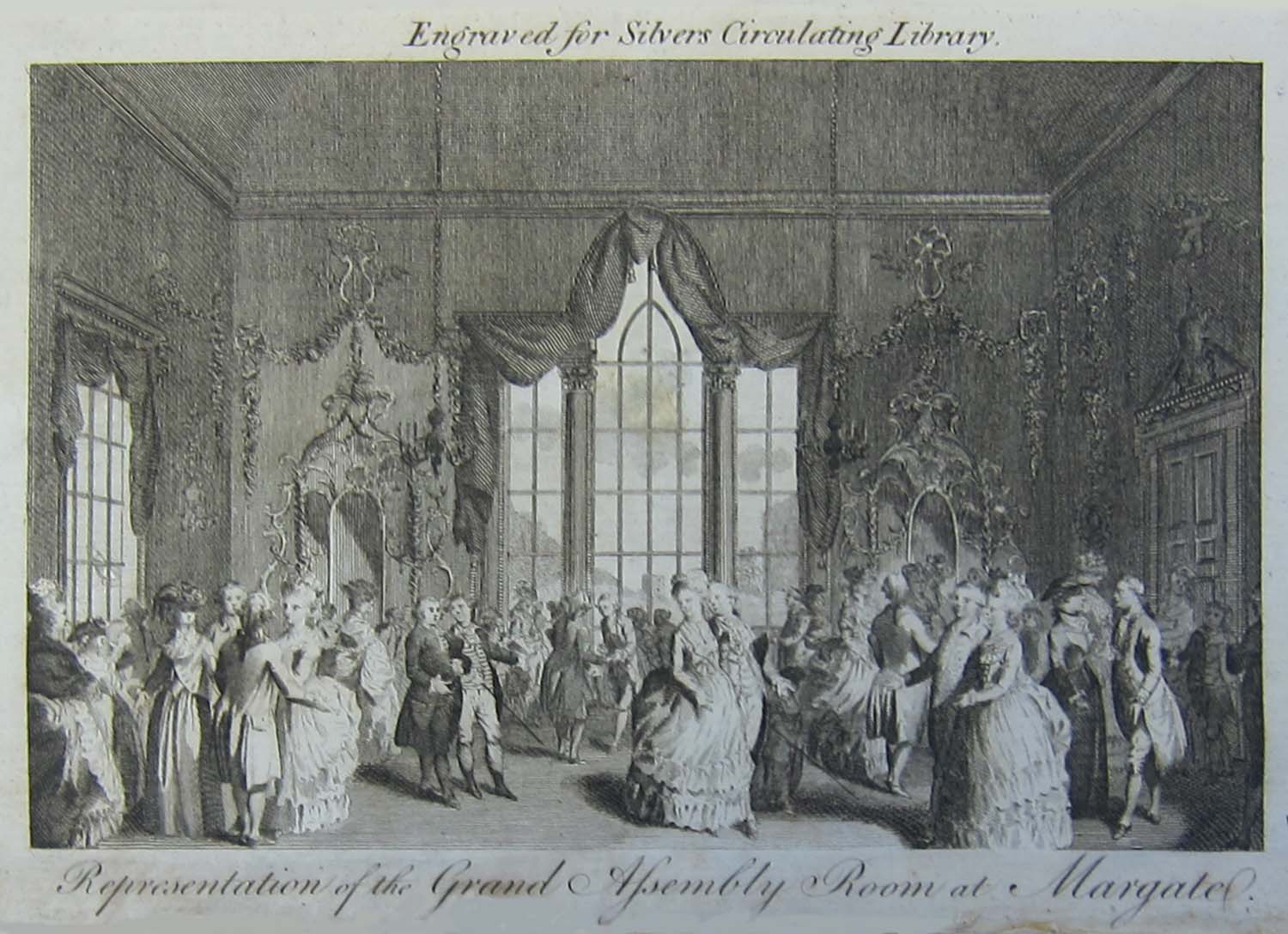
People began to visit Margate to take a seaside holiday from the 1730s and by the 1750s visitors could go to dances at the town’s first assembly rooms, at the Black Horse. These faced competition from 1769 onwards from a new hotel and assembly room in Cecil Square, which continued until destroyed by a fire in 1882. Margate’s Assembly Rooms were not as grand or prestigious, I’m sure, as those at Bath or Almack’s, but they look pretty impressive nonetheless – definitely not for riff-raff. (Thanks to Margate’s Seaside Heritage and the Margate in Maps and Pictures website for this information).

The Grand Assembly Room, from A new Catalogue for Silvers Circulating Library 1787 - from Margate in Maps and Pictures

The Grand Assembly Room, from A new Catalogue for Silvers Circulating Library 1787 – from Margate in Maps and Pictures

‘Nipper’ was written by John Kirkpatrick, and I learned it from the LP Shreds and Patches – probably my favourite of the albums John made with Sue Harris in the seventies and eighties. On the record it’s paired with Sue’s tune ‘Applecore’ which I posted here a few weeks ago. In the 1980s the ‘Nipper’ and ‘Applecore’ set was played at pretty much every dance by the Old City Band (a band I first wangled my way into as maternity cover for their regular caller). We frequently played late-night gigs at Leeds Castle on a Saturday night. These were fairly well-paid, but often pretty excruciating gigs; nevertheless, the actual playing was always enjoyable. Staccs!


An Adventure at Margate / Nipper

Played on C/G anglo-concertina

Silver Wings Polka

Every now and then one of those games does the round on Facebook: 10 favourite albums, 10 albums that had a big influence on you, 10 albums you listened to in your youth and still listen to today… And there’s one record which features in my list very time: Harthope Burn by Will Atkinson, Willy Taylor and Joe Hutton. If there were any justice, that record would have done for Northumberland what Buena Vista Social Club did for Cuba. Instead of which, as far as I know, it’s never been released on CD and has been unavailable for decades.

All 3 musicians on the LP were superb players, but if I had to pick one, it would be mouth organ maestro Will Atkinson, one of the greatest musicians I’ve ever heard, on any instrument, in any genre. ‘Silver Wings Polka’ is Will’s solo on the record. Googling it now, I see that it was written by the Aberdeenshire dance band leader Adam Rennie (1897-1960). Rennie recorded it on the B side of a 1950s Parlophone 78, and that recording is now available on the compilation Strict Tempo: Scottish Country Dance Music from the 1950s Volume 1.

There’s a transcription of the tune as played by Rennie at the Traditional Tune Archive. It’s in F, with a recurrent accidental note which, obviously, Will Atkinson didn’t play on his mouth organ. I can’t play that note on my one-row melodeon, either, and actually I wouldn’t even if I could – Will’s non-chromatic version is much better.

Will Atkinson playing with Polkabilly, Whitby 1989

Will Atkinson playing with Polkabilly, Whitby 1989


Silver Wings Polka


Played on one-row melodeon in C

Italian Waltz

On the LP Boscastle Breakdown there’s a recording of the well-known tune ‘Penny on the water’ played by the Dorset Trio. They call it ‘The Italian Schottische’, but as Reg Hall pointed out in his notes, it’s “no more Italian than Corfe Castle”. The same is probably  true of this waltz from Suffolk melodeon player Oscar Woods. I first heard it on that other classic 1970s Topic album of  Southern English dance music, English Country Music From East Anglia (the “White album”) – and sure enough, checking the LP notes, I see that it “is unlikely to have any Italian associations. Oscar says that somebody called it that and the name stuck”.

More recently the tune has appeared on Rig-A-Jig-Jig, Volume 9 in the Voice of The People collection. And you can find the dots for the tune in Before the Night Was Out, published by the East Anglian Traditional Music Trust.

Oscar Woods and Billy Bennington - from the EATMT website

Oscar Woods and Billy Bennington – from the EATMT website


In more normal times, last weekend would have been the English Country Music Weekend. Begun by Rod and Danny Stradling in 1976, this ran until 1986, before being revived in 1995. I made a brief appearance at the 1986 event in Frittenden, but didn’t start going properly till it came to Bampton in 2015. I’m now hooked – basically it’s a chance to see old friends, spend the entire weekend playing country dance tunes with likeminded souls, and drink quite a lot of beer. I really hope that we’ll have returned to some sort of normality by this time next year, and I’ll be able to make a return trip to Croston in Lancashire, for the 2021 ECMW, postponed from 2020.

Katie Howson posted some photos on Facebook from the first ECMW she helped organise at Snape, in 1981. I doubt I’d heard of ECMW back then or, if I had, assumed it was an invitation-only event. Looking at the photos, and seeing people reminisce, it’s clear I missed a cracking weekend. Needless to say, Oscar Woods featured in several photos and, it being Suffolk, I expect there were a fair few other one-rows in evidence at the event. Anyway, it prompted me to sit upstairs for a couple of hours last Sunday, playing tunes in C.

Here’s the first of them. And it’s one of those tunes I enjoy just as much on the one-row as on the anglo. I love the simplicity afforded by playing it on an instrument with only 2 bass buttons. But then I also love the lightness and crispness of the anglo, and relish the chance to slip in a few of those “fairground” chord sequences.


Italian Waltz


Played on C/G anglo-concertina


Italian Waltz


Played on one-row melodeon in C