Duke Energy Rate Increase History in NC
Duke Energy is a (regulated) monopoly, which means their rate increases are overseen by the North Carolina Utilities Commission (NCUC). When Duke wishes to adjust rates, they file a request with the NCUC that includes a proposed rate change and the supporting evidence for it. This request goes through a review process including public hearings and comments with the NCUC ultimately making a final ruling on the approval of the request. While it’s not the most thrilling read, you can track the current request and all the filings and comments here.
Rate increase requests in NC are not uncommon. Duke regularly files for rate adjustments either based on changes in fuel cost or as part of a “base rate case” which analyzes the company’s total cost changes and adjusts rates accordingly.
Duke Energy Progress Rate Increases, 2017–2025
Before the current request, Duke Energy proposed a multiyear rate increase in 2022, which totaled an 18.7% increase by the end of 2025. This was the first time that Duke Energy proposed a gradual, multiyear rate increase. When the proposed increases were layered on top of the rate increases that were already approved, electricity rates were forecasted to rise by an average of 5.7% annually over the span of 4 years (versus the 2.8% average annual increase over the previous 5 years).
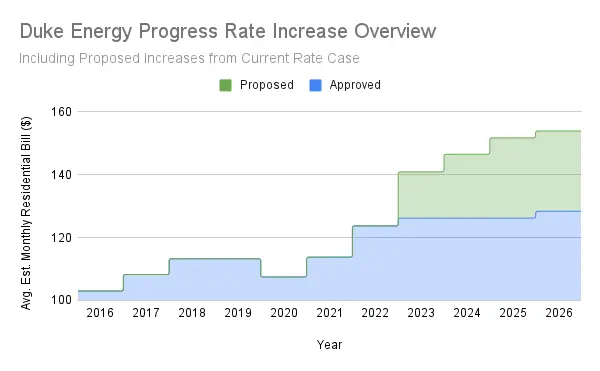
Before that, Duke Energy Progress proposed a 16.7% residential rate increase in 2017. A 6.2% residential rate increase was later approved in 2018. Following that case, another 5.7% rate increase was approved for residential customers that went into effect in May 2021. Additionally, starting in December 2021 Duke Energy Progress rates rose by 9.5% to account for higher fuel costs for its natural gas plants.
Duke Energy’s 2027–2028 NC Rate Increase: Where It Stands
Fast forward to recent times… In November 2025, Duke Energy asked the North Carolina Utilities Commission (NCUC) to approve new multiyear rate increases for its two NC utilities. For residential customers, Duke Energy Progress requested an 18.1% increase over two years, and Duke Energy Carolinas requested about 16%. Coming after Duke Energy Corp. reported $4.9 billion in profits in 2025, the proposed increases made headlines and drew widespread opposition from customers, consumer advocates and Attorney General Jeff Jackson.
Under public pressure, Duke reached settlements with the NC Public Staff over the summer that roughly cut the residential increases in half.
- For Duke Energy Carolinas, the residential increase dropped to 11.6% and then to 9.5% (5.9% in 2027 and 3.6% in 2028).
- For Duke Energy Progress, the residential increase dropped to 9.3% (5.7% in 2027 and 3.6% in 2028).
For a typical Duke Energy Progress home using 1,000 kWh per month, that’s about $9.62 more per month starting in 2027 and another $5.89 per month in 2028.

When Will Duke Energy’s New Rates Take Effect?
Attorney General Jackson declined to sign either settlement and continues to push for lower rates. However, the Utilities Commission can approve the settlements without his support. Hearings have concluded, and both cases are now in the decision phase. One remaining piece is a proposed tariff for data centers and other large energy users, which Duke settled with several parties in October. If current cases stay on schedule, a decision is expected in November, with new rates taking effect January 1, 2027.
Commercial and Industrial Rate Increases
In general, commercial and industrial rate changes move in the same direction as residential rates. In recent cases, though, residential customers have been asked to absorb a larger share of the increase.
In its original November 2025 request, Duke proposed the following average increases for 2027 and 2028:
| Residential (2 Year Total) | Commercial (2 Year Total) | Industrial (2 Year Total) | |
|---|---|---|---|
| Duke Energy Progress | 18.1% | 13.8% | 11.7% |
| Duke Energy Carolinas | 16.3% | 12.6% | 10.6% |
The 2026 settlements lowered increases for all customers but kept the same pattern. Under the pending Duke Energy Carolinas settlement, residential rates would rise about 9.5% over two years, compared with about 7.4% averaged across all customer classes. Attorney General Jeff Jackson has criticized the settlements for asking residential customers to cover more of the increase than industrial users.
The settlements also include a proposed large-load tariff for data centers and other very large energy users, meant to keep those customers’ grid costs from shifting onto everyone else. New rates are expected to take effect January 1, 2027, pending NCUC approval.
What Happens Next
Based on past rate cases, the initially proposed rates are typically modified during the review process. We anticipate that these numbers will change, but it’s hard to tell where they’ll eventually land.
Why Is Duke Energy Raising Rates?
According to Duke Energy’s November 2025 filing announcement, the rate increases would pay for three main areas.
Grid reliability and storm hardening. Duke has expanded “self-healing” grid technology, which automatically reroutes power around outages, to about 75% of its North Carolina customers. It has also replaced more than 116,000 distribution poles and upgraded over 13,000 wood transmission poles to steel or concrete over the past five years.
Serving a growing state. Duke added about 150,000 North Carolina customers over the last two years, mostly homes and small businesses, and expects demand to keep climbing with new manufacturing and data centers. To meet it, Duke plans to boost output at its existing nuclear plants, build new natural gas plants previously approved by the NCUC, and invest $1.7 billion in battery storage and nearly $400 million in new solar and solar-plus-storage projects.
Shareholder returns. Part of every rate increase goes to shareholder earnings, set by the “return on equity” regulators allow. Duke originally requested a 10.95% return. Under the 2026 settlements, that dropped to 9.8% for Duke Energy Carolinas and 9.8% for Duke Energy Progress, which is one of the main reasons the residential increases were cut roughly in half.
Customer programs. The pending settlements include $20 million in shareholder-funded support for bill assistance and home repairs that help income-qualified households access weatherization. Duke also points customers to existing energy efficiency programs like Home Energy House Call and Smart $aver, as well as PowerPair, which offers incentives for installing home solar and battery storage. Separately, a proposed large-load tariff for data centers is intended to ensure the largest energy users pay for the grid costs they create.
How Much Will Your Duke Energy Bill Go Up?
If the NCUC approves the pending settlements, a typical residential customer using 1,000 kWh per month would see the following increases:
Duke Energy Progress
- Starting January 2027, monthly bills would be $9.62 higher
- Starting January 2028, monthly bills would be another $5.89 higher
By 2028, the typical Duke Energy Progress customer would pay $15.51 more each month, or about $186 more per year.
Duke Energy Carolinas
- Starting January 2027, monthly bills would be $6.53 higher
- Starting January 2028, monthly bills would be another $4.66 higher
By 2028, the typical Duke Energy Carolinas customer would pay $11.19 more each month, or about $134 more per year.
As energy rates continue to rise in North Carolina, energy efficiency, weatherization and renewable energy will become increasingly important for keeping monthly energy costs affordable. If you’re looking to build a new home, or you’re a builder who wants to offer more efficient homes in your market, let us know! We work with single-family and multifamily builders across the Carolinas to create efficient homes that meet a range of energy and sustainability standards.
Will Duke Energy Raise Rates Again?

Will rates continue to rise? [author vigorously shakes 8 ball….] All signs point to yes. We originally wrote a version of this article back in 2022, and have had a hard time keeping the article up to date with all the rate increases in the works.
Since then, Duke’s 2023 multiyear rate increases were approved and later upheld by the NC Supreme Court. Customers have also seen higher fuel charges and a storm recovery charge for Hurricane Helene added to their bills. The current rate case would add another increase starting in 2027. Altogether, Energy & Policy Institute’s research shows that rate changes alone have increased monthly bills by 45% between 2020 and 2025, an increase of about $50 a month.
So if you ask us (and history) our answer is a loud, YES, rates will likely increase again. Especially when factoring in large population growth (shout out to Garner, NC growing 10.4% as the 10th fastest growing city in the nation), the influx of data centers to fuel the AI boom, and the need to replace aging grid infrastructure, rate increases will be required to pay for these investments.
Duke Energy Rates vs. Solar: Cost per kWh Compared
As utility rates rise, the value of the energy your solar system produces rises with them. Every kilowatt-hour you generate is one you don’t have to buy from the utility, which reduces your exposure to future rate increases. In a sense, your upfront investment locks in the price of a large share of your power for the 25–30+ year life of your system.
One of the best ways to compare the value of solar and energy efficiency vs the cost of grid energy is by looking at their Levelized Cost of Energy (LCOE). This calculation looks at total energy generation and divides it by total cost.
For our average 10.3kW solar system with 1 battery in 2026, the levelized cost of solar energy would be between 9 and 10 cents per kWh. To get that number, we take the energy generated by the system over its 30-year lifetime and divide it by its cost. This works out to roughly 413,400 kWh generated / $41,500 = 9.96 cents per kWh.
Now compare that with grid power. A typical Duke Energy Progress customer using 1,000 kWh per month currently pays about $175.68, or roughly 17–18 cents per kWh all-in. If rates rise a moderate 3% a year, the average cost of that same power over the next 30 years comes to roughly 28 cents per kWh.
Whew. That was 2 paragraphs of math. Thanks for sticking with us. Whether you followed all that or not, the simple truth of the matter is the same: utility rates are rising, solar rates never will. And with new solar leasing options, your out of pocket expense for solar from Day 1 could be $0.

How Duke’s Carbon Plan Affects Future Rates
Just how big Duke’s future rate increases will be, depends on what type of resources Duke invests in to replace their aging power plants. Those decisions are made through Duke’s Carbon Plan, a long-range resource plan the NCUC reviews every two years.
Duke’s Carbon Plan is a byproduct of NC House Bill 951 from 2021 which required the NCUC to outline a pathway to achieving 70% emissions reductions by 2030 and carbon neutrality by 2050. Much has changed since then. In 2024, the NCUC extended the 70% target beyond 2032. Then in July 2025, the legislature passed Senate Bill 266 over Governor Stein’s veto, eliminating the 2030 target entirely but keeping the 2050 carbon neutrality requirement.
Without the interim target, Duke’s latest Carbon Plan, filed in October 2025, leans more heavily on new natural gas and nuclear, keeps some coal plants running longer, and drops wind. Duke projects the plan would raise customer bills about 2.1% per year through 2035, on top of the rate case increases described above.
Whether this approach saves money is hotly debated. Supporters point to a Public Staff estimate that removing the 2030 goal could save ratepayers $13 billion. Critics, including clean energy groups and the governor, argue that more reliance on natural gas leaves customers more exposed to volatile fuel prices, and that the law lets Duke charge customers for new power plants while they’re still under construction.
The NCUC is expected to issue its decision on the 2026 Carbon Plan by the end of this year. In the meantime, this year’s competitive solar and battery procurement was paused by the Commission chairman in April, which clean energy groups are challenging.
Duke’s plan is not the only option, however. The North Carolina Sustainable Energy Association (NCSEA) and other groups have provided alternative plans that focus more on modern, clean energy-generating resources like solar and wind. These plans hit the 2030 carbon deadline required by the law AND at a lower cost – which would mean less drastic rate increases for homeowners.
You can read more about the benefits of including more renewables in the Carbon Plan in this article and on Episode 71 of the Squeaky Clean Podcast by NCSEA.
Ready to Invest in the Sun?
Wondering how much solar can really save you? You’re in the right place! Our solar educators are on standby to answer your questions and connect you with a solar designer who will customize your system & take a deep dive into your savings numbers with you.
If there’s one thing we know to be true, energy rates are only going to continue rising in NC, making that clean, renewable energy you generate at your home even more valuable as time goes on! If you’re a Duke Energy Carolinas customer, we’re in the final stretch of PowerPair incentive availability (worth up to $9,000)! Now’s the time to generate your own clean energy and shield yourself from rate hikes.
Schedule a call, or request a free solar assessment to get started →