I’ve added a BLUEHOLME Prentice random character generator to my Player & Gamemaster Resources page. I’ve also added it to the compiled list of known generators post. As with the others I created, it generates a random level 1 PC, in plain text, suitable for printing or copying. You can simply reload the page to generate another one. I find these generators useful for solo games or where you need to quickly start a game session.
This generator also correctly generates a spellbook if needed, according to the PC’s INT score and chance to know, min and max spells. Enjoy!
Thieves typically fight as Clerics, that is to say, slightly worse than fighters, but they are limited to leather armor and cannot use a shield. So they are not suited for front-line combat. They do, however, have access to magic swords and bows, so with their rear attack or backstab ability, thieves are best suited for surprise or missile attacks.
As a referee, consider allowing the rear or backstab attack any time a thief can reasonably surprise someone from behind – and not necessarily only when a thief can move silently and hide in shadows as per their skills. The latter requirements make the backstab nearly impossible at lower levels. In my games, If a player can describe a plausible way their thief can sneak into position without being heard or noticed, I allow the backstab after a round or two. And during melee this is sometimes easier to do, given that the general noise and chaos of battle might mask any external sounds or movement.
Missile fire once melee has started can be problematic, with the risk of hitting an ally (if you use such rules), but see below about missile use in other situations.
Avoiding Melee
Try to use clever means of avoiding combat, such as distractions, e.g. thrown food, treasure or rocks used to create noise as a misdirection. Also don’t forget that a thief with a high charisma can be useful in negotiating a party’s way out of a combat, or even making an ally. But if you have to, run away. A thief in leather armor will be faster than any metal-armored party members, so remember that old adage about just needing to be faster than the slowest person in your party.
Thieves of even low levels can climb sheer surfaces well (in the original incarnation of the class, at least), so if the geography or architecture allows it, you should consider climbing above a melee to a perch where a bow or crossbow can be used to pick off opponents who haven’t yet joined combat, or who attempt to flee combat.
Oil
Consider oil as a missile weapon, or as a deterrent to pursuit. In OD&D oil is mentioned only in the latter context; thrown oil that was set alight did not do damage until the Holmes Basic D&D rules came along. Either way, if the thief is scouting ahead for a party, the oil may come in handy if the thief has to flee an encounter.
Scouting
As far as scouting, think tactically. Most thieves won’t be able to see in the dark without magical assistance, and holding a torch or lantern and trying to sneak about unnoticed in a dark dungeon are at odds with one another. So scouting is best done in environments where there are dimly lit or shadowed areas to hide in, or objects to obscure direct view of the thief as they move around.
Clerics are slightly worse than fighters in melee at low levels (same attack matrix at level 1, but slightly lower HP on average), but the availability of plate armor and shield gives them good defensive capabilities, so they can be useful as part of a front-rank shield wall that protects the weaker players. Fighters with spears can be in the second rank.
Missile Weapons
Keep at hand holy water and oil, both are good alternatives to direct melee with undead if that one turn attempt fails. Even if oil cannot be used as a thrown grenade in your games, it can offer a pool of fire that can deter direct attack, or at least slow down a pursuit. My own preference is to allow thrown oil, but not as a Molotov-style fire bomb – the oil must be lit separately, by a thrown torch or similar.
I also allow clerics to use slings in my campaigns (despite slings not being in the OD&D rules at all, they are a common addition), so they can be somewhat useful from afar when the fighters are pulling out their bows. Sling bullets are blunt weapons, after all. They don’t get two shots per round with the sling as fighters do with bows in standard OD&D or White Box, but they’re another missile option should your referee allow it.
Make Allies
Most PC clerics are Lawful in alignment or at least act in a good way in games without alignment (Chaotic or evil PCs in general are a problem in a game meant to be about PC cooperation). This is up to the referee of course, but you can play on this “goodness” and try to make friends of local churches or temples with donations and quests. They will sometimes pay you back with potions or scrolls, or even free healing services for your other party members. I also sometimes have the local temple offer up low-level Clerics to tag along on adventures.
One of the boons I have had high-level priests offer my Cleric players in my games is a one-time blessing of a standard weapon, which has the effect of a stored bless spell, and can be triggered once only at the start of a combat.
Creative Use of Spells
Cure light wounds (CLW) is typically taken as a Cleric’s first spell. Understandable, but I love it when players use non-standard spells creatively. If you can befriend the local temple (see above), and procure healing potions, consider light instead. Most refs allow it to be cast in an opponent’s eyes, and it is also useful to counter the darkness spell. Detect Evil can be useful to ferret-out evil NPCs that may try to join the party with bad intentions. The reverse of Purify Food & Water could poison enough food or water to sicken a dozen bandits and take the fight out of them. And even if you find yourself needing a healing spell and did not learn it that day, you can try to find a safe place to hunker down overnight and gain access to CLW the next morning.
This is second in a series of posts on how to keep your low-level PCs alive in old-school adventures. This one deals with the Fighter, and is based on an older post, with some updates.
Armor
First, let’s talk protection. In OD&D and B/X, plate armor is relatively cheap, on the order of 50gp or so. Make sure you buy it during character creation, even at the expense of cheaper weaponry, like spears (see below). In later editions and some clones it can be quite pricey, so take advantage of it if it’s cheap in your chosen system. After you’ve been on a few adventures and have saved up some gold, plate armor makes a great gift for your hireling meatshields. My own gaming group does this to great effect – nothing says you care and boosts loyalty like the gift of decent armor.
Weapons
Next, weapons – the fighter’s bread and butter. I suggest you equip Mogo the Mighty with a spear. Why the spear? First, you can use a spear one- or two-handed, and in many OSR systems it does more damage when used two-handed (and if not, try to convince your referee to house-rule it to do more damage when used that way). Spears can be thrown. They can be used as a trap-finder and general prodding device. Spears can attack from the second rank, and can even be set against a charge to do double damage. Best of all, spears are one of the cheapest weapons to buy, leaving you more money for that plate armor (see above).
Tactics
Tactics can be even more important for fighters than with Magic-users, just because fighters are expected to, well, fight. But you may as well be smart about it. A line of fighters with plate armor, shields and spears is an impressive sight and keeps the bad guys away from the soft and chewy Magic-Users. Most humanoids will need a 16 or 17 to hit AC 2 (plate & shield), and while they are dealing with that, the second rank can attack with longer reach weapons like, well, spears (you may be sensing a pattern here).
If possible, attack enemies in pairs, so their non-shield flank is exposed by at least one of you, or if your opponents are outnumbered, a group can move to attack from the rear. Every little bonus helps.
Don’t be afraid to try the so-called non-combat maneuvers (a bad name, since they can and should be used in combat, or to enter combat). Go ahead and flip that table to get more cover, swing from that chandelier to crash into the enemy’s front line, jump through the window to take an enemy by surprise, gang up and tackle the bad guy, or push your opponent with your shield so they fall into the pit. These work best in rules-light games, where the referee can adjudicate your attempts with a simple die roll or roll-under ability check, either for the PC or the opponent. For referees, 2d6 rolls make a decent check for these kind of ad-hoc actions. As a bonus, they make combats fun and memorable, even when they fail.
Missile Weapons
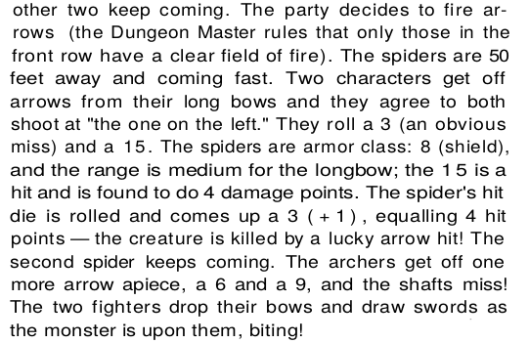
Before you even consider melee, you should be trying to make best use of your missile weapons. Bows in OD&D and S&W White Box fire twice per round and are only usable by fighters (assuming the original three classes).
Holmes Basic D&D – Missile Combat Example
But even in other systems allowing one shot per round (or fewer), you’d be crazy not to use a weapon with such a long range. The heavy crossbow seems like a bad choice since it can only be fired once every 2-3 rounds, but it has a very long range, and can be pre-loaded, fired, and dropped before melee ensues. You just have to make sure you are in a position to use it. So send that thief or MU with an invisibility spell or potion up ahead to scout things out, then if you are going to attack, try to work in a round or two of missile fire, either by drawing the bad guys out to you from a higher or more secure vantage point, or by sneaking to within missile weapon range. And if you can’t afford a bow because you spent all your coin on plate armor, buy a sling and fill your pockets with stones.
Run Away!
Sometimes you’ll need to flee, either due to overwhelming odds, or bad luck. Either way, don’t just turn and run. In most old-school, systems, a fighting retreat allows a gradual exit from combat without exposing one’s rear flank to a free attack. If enemies follow a fighting retreat, a well-armored fighter or fighters can still risk it, while allowing other party members to flee. Or, worst case, just make sure the best armored in the group flee last (the more lightly armored PCs will run faster anyway). Also remember that OD&D has some rules around pursuits in the dungeon and wilderness. If you’re a fighter and last in line to flee, burning oil, food and/or gold might deter a pursuit.
Avoiding Melee
Lastly, despite your fighter wanting to, well, fight, don’t just think that every encounter should end in melee. Take advantage of the affects of charisma or reaction rolls and try to talk your way into a favorable outcome, meaning getting treasure or someone to help you without a fight. Many intelligent dungeon denizens will entertain help in fighting their sworn enemy, whoever that may be (ask them). Some referees will even give you XP for cleverly avoiding combat (I do this).
This is based on an older blog post of mine from 2013, I’ve updated it with some more options on playing Magic-Users, with some ideas for the referee as well. I have already written a post like this one for each of the four, canonical D&D classes, and those will all be published here as well.
Avoiding Melee
Ah, the freshly-minted, first-level character sheet, clean and free of eraser marks. It represents hope for every player that this character will be great, fearlessly battling underground evil and surviving to fame, riches and second level!
Unfortunately, first-level magic users (MUs) do not fare so well in melee combat. New players tend to want to jump in and attack everything in sight, with no thought given to the odds. Perhaps this comes from playing newer editions or video games, but when playing with an old-school referee, this is quickly fatal.
Referee: You open the door and get assaulted by the stench of rotted meat and body odor. Twelve orcs look up at you from their meal of freshly-killed mystery meat and grin, drawing their weapons.
Festivus (MU): I rush into the room and attack the closest orc with my dagger!
You get the idea. As players, you need to think tactically in old-school dungeons.
Referee: You open the door and get assaulted by the stench of rotted meat and body odor. Twelve orcs look up at you from their meal of freshly-killed mystery meat and grin, drawing their weapons.
Festivus (MU): I quickly shut the door and run back east, around the corner. I’ll prepare my sleep spell and cast it when the orcs pile into the hallway.
Creative Spell Use
Low-level magic users can still be very beneficial in old-school adventures. The sleep spell is, of course the canonical example, but often overlooked is charm person. The latter is long-lasting and once charmed, the former foe can be used as a source of valuable information. The light spell can be cast into an opponent’s eyes, which will blind them with a failed saving throw.
Hired Help
One of the best ways for a MU to avoid melee is to hire some muscle. You’ll probably have enough gold to hire a Fighter or two after a few adventures. Consider using that charm person spell to enhance your retainer’s loyalty.
Defensive Weapons
For referees, if you allow MUs in your campaign to use the staff as a weapon, you can allow them to parry with it instead of attack, at -2 to the opponent’s to-hit roll. This is an easy way to increase the survival odds for the MU that won’t upset the game balance. It’s not an offensive capability, after all, and could be combined with a backpedal for a sort of ‘parrying retreat’ that would get the MU out of the front line of attack.
The Thrown Dagger
MUs can throw daggers, of course, and they are cheap – so a MU can buy several to use as throwing weapons, if they are allowed in your games (OD&D and most of the clones thereof do not even mention the use of the dagger as a missile weapon). Still, they’re best used from a distance as a fire-and-forget weapon, before melee starts. I do allow them, with the same range as a hand axe – always assumed to be at medium range, or within 30 feet.
Spells and More Spells
MUs with high INT scores (say 15+) can be given an extra first-level spell, meaning they could memorize two sleep spells. Some referees don’t like sleep, with no saving throw it seems over-powered for a first-level spell. But keep in mind that it affects the rolled number of hit dice in a given area, perhaps including PCs if the caster is not careful. It also does not affect undead (your party clerics need to feel useful anyway). Also see this for more on the sleep spell.
The other common way to effectively give low-level MUs more spells is to adopt the Holmes scroll creation rules, that is that any MU can create a scroll of a spell in their spellbook for 100gp and one week per level. So a 2nd level spell scroll would take two weeks to create, and cost 200gp. I really like this option, and allow it in most of my games.
I’ve created a character generator for Labyrinth Lord (LL). I had created one for LL OEC some time ago, so this was overdue. I may work on some of the more complex games (as far as character options) next, perhaps LL AEC or S&W Core/Complete.
For this generator, there were a few assumptions I made, most due to the expanded weapon and armor tables in LL as compared to B/X.
It is possible to generate a thief with studded leather armor. The rulebook says they are limited to leather armor, but does not say precisely which type.
Magic-Users can use darts as a missile weapon. The rules just say they can use “small weapons such as a dagger”, so I added the dart to the mix in keeping with the AD&D weapons table that LL is based on. In practice the dart and dagger are pretty closely matched as missile weapons anyway.
I’ve created a character generator for Moldvay Basic D&D. It generates a random, level one character and is similar to my other generators. I did this pretty much by-the-book, although I did make one change to use the Expert set saves for Dwarves and Halflings. As far as I can tell, these are considered the “correct” saves for those classes (OSE chose to do this, for example).
I thought I’d post the player quickstart I’m using for my Labyrinth Lord OEC campaign. If you’ve seen the other quickstarts, there is not much new, apart from a few house rules I’ve added, the rest is rules-as-written. But if you want to run a LL OEC game, I hope it’s useful. You can download it in PDF or LibreOffice formats.
I mentioned starting a Labyrinth Lord Original Edition Characters (OEC)campaign recently, and having created some house rules. I tried to keep them as minimal as possible, my main goal was to slightly increase the power of the Fighting Man and give Magic-Users (MUs) some extra flexibility to cast utility spells by way of the Holmes scroll rules (a MU of any level can create a scroll of any spell they know for 100gp and 1 week per spell level). I’ve created a player quickstart, like I did for a few other games, which allows the MU to start play with a scroll of one 1st-level spell, or 100gp (I’ll post the quickstart in the next few days).
I’ve also incorporated the special trait tables for demi-humans from the Non-Human Player Codex, to add some flavor. I don’t think this gives demi-human PCs too much power, the trait abilities are minor, and I am still using the by-the-book level limits for
Halflings, Dwarves and Elves.
The save vs. death rule is one I’ve been using in my games recently. I’ve found it works very well in play, without eliminating the pervasive fear of death that makes old-school games so exciting. If anything, leaving the PC who saves vs. death alive with 1hp but no second chance and no possibility of non-magical healing increases the tension during a combat.
Ability Scores
All classes get +1 to open door attempts and +600 coins carry capacity for a STR 15+, with corresponding penalties for a STR of 6 or less.
Fighting Men get +1 to damage rolls for a STR 15+.
Combat
If a Fighting Man kills his opponent, he can immediately attack another foe who is within melee range (one only).
Variable weapon damage is used.
Spears do double damage if set against a charge, and can attack from the second rank. They do d8 damage if used two-handed.
Firing missile weapons into melee is risky (-4 to-hit). On a miss, roll a random friendly target and re-roll attack with no bonuses or penalties.
Wounds/Dying
PCs at zero or negative HP must save vs. death to survive, adding any CON bonus/penalty and +1 for Fighting Men. If they fail they are dead, otherwise they live with 1 HP and cannot regain more without magical healing or a full day’s rest.
Any PC can bind wounds of another (or themselves) after any combat to heal 1d3 HP, but this can never restore full HP.
Class and Racial Abilities/Limitations
Elves, Dwarves and Halflings roll one special trait from the Non-Human Player Codex.
Clarification on weapon use: Dwarves and Halflings cannot use lances, polearms, two-handed swords, or longbows (but can use other two-handed weapons).
Halflings gain +1 to missile attack rolls and can sneak quietly & hide when not in metal armor.
Magic-using Elves can cast spells in Elven chain armor (in addition to magic armor).
Magic-Users know read magic as an extra spell each day.
Holmes scroll rules in effect for MUs.
Simplified Encumbrance
PCs can carry a reasonable amount of equipment (the easiest way to do this is to have them note where they are carrying each item) and 1,200 coins (one large sack), no more.