TO DRINK UP THE SEA

Islands of Weirdhope, the maritime expandalone to ECO MOFOS!!, by the fearsome pairing of David Blandy and Daniel Locke, is currently crowdfunding.
Scant hours left! The Backerkit campaign ends Tuesday. Go back it NOW.
You should back it because I am part of it. I will be in Four Fathoms Deep, an adventure anthology launching together with the core rulebook. I will be in very good company.
I am still writing my adventure. But I have a title, and I have a blurb:
+
TO DRINK UP THE SEA
The tide is falling—continuing to fall. The tide has been falling for three days, now.
On the sand are jellyfish lumps, drying out. Look closer! Their tentacles are bundles of optic fiber.
On the surf is a dolphin, poisoned, dying. “Stay away!” he wheezes. His blowhole sputters blue blood.
In the middle of the bay the waves are breaking. What is it—a shoal, a wreck?
A head, a metal head, the size of a comet. Tomorrow the tide will fall: you will see its temples. Tomorrow the tide will fall: you will see its eyes.
Its eyes are open. It is awake. Tomorrow the tide will fall: you will see its hungry mouths.
+
This is a follow up to TO PUT AWAY A SWORD, the dead-mecha adventure I wrote for ECO MOFOS!!.
In SWORD the giant robot was an obvious metaphor for hyper-capitalist ecocidal industry. In SEA the giant robot will be the same. I keep writing about the same things; hyper-capitalist ecocidal industry is personal to me, I guess? I live in a petrogas town. Every breath I take reminds me of hyper-capitalist ecocidal industry.
+
Was going to post some images / references that make up my moodboard for this adventure.
The first is the Salton Sea Monster, from the Hellboy / BPRD comics:

A kaiju sitting at the edge of a dead sea, spewing a deadly gas. I can’t help read her as a refinery gas flare.
But she also lays eggs. BPRD as a whole concludes by the world ending—but also beginning again, with the earth now an Eden for the amphibian people born from monsters like her.
+
Another is “Dragon’s Breath”, one of five short stories in AS Byatt’s The Djinn In The Nightingale’s Eye.

I’ve never liked this story, but also I’ve never forgotten it: its disgusting dragon(s) like lava flows, like landslides. I believe Byatt wrote the story for / during the Siege of Sarajevo?
In it is the sense of unavoidable catastrophe. That to be human is to dodge around it, prod at it, find boredom in it, rescue what you can from it.
+
The most recent is from my own life.

Last week, Senyar, a tropical cyclone, formed in the Straits of Malacca. This never happens in the Strait of Malacca, you understand? Ours are relatively halcyon waters, protected from monsoons, weather systems, tsunamis.
Not any more, I guess.
Hundreds have lost their lives in Sumatra and Thailand.
Senyar hit my hometown last Thursday. The wind wailed; the trees did jigs. I shut what I could, and tried to sleep. The next morning I woke to mess: pools of rainwater in the living room; a porch strewn with pots and branches; trunks and power lines had fallen all around town. (Later the news would report a hundred homes damaged.)
After checking in on loved ones the next thing I did was hurry to our favourite beach, to check in on our favourite mangrove trees. These trees would’ve been worst-hit by the storm.

They survived—though the bedrock around them has eroded further. I worry for them.
Still: our mangroves survived. They survived when concrete did not. During the night, a jetty platform owned by the Petron refinery collapsed into the sea. This is a platform where the tankers moor, to offload crude.
That morning I squinted at the jetty’s rump remainder, water gushing from its broken edge. (No oil spills, thankfully!)

Is the giant in TO DRINK UP THE SEA the cyclone storm, or the petroleum platform?
I don’t know yet. I’ll be writing to find out. It will be an ecocidal disaster, of course. But perhaps such disasters will be calamities for each other—
And I hope imagine us rescue ourselves from them, and belonging, transformed, to the world that comes after.
+
Go back Islands of Weirdhope >>>HERE<<<
CHAPTER SERF

CHAPTER SERF is a tabletop roleplaying game and adventure, set in Warhammer 40K, where you play those hooded peasant weirdos you sometimes spot in the backgrounds of the art.
Full PDF downloadable >>>HERE<<<
Printer-friendly version >>>HERE<<<
A5-booklet format version >>>HERE<<< (thank you @tubilak!)
+
Here’s the pitch:

+
CHAPTER SERF is a game about candles.
As a fan of Warhammer 40K, I think about Space Marines a lot. Space Marines are:
- Feudal aristocrats, with all the uncaring impunities that affords;
- Literal grandsons of God, with monastic habits;
- Genetically engineered super soldiers;
- Children, kidnapped and brainwashed before puberty.
These are not well-adjusted, fully-developed persons. When do they ever get the opportunity?
What would it be like, to serve such persons? To run their supply chains? Keep their households? Satisfy their desires? Clean up their messes?
+

In artwork and cinematics; on miniature bases and in bitz boxes; described in comics and novels, Space Marine architecture is replete with candles.
So many candles.
A Space Marine doesn’t think about where candles come from, or what candles cost. (They think about war and xenos and traitors, stuff like that.)
A Space Marine wants candles—so there should and must be candles.
CHAPTER SERF is a game about getting an emotionally-arrested, casually-genocidal bossman demigod—to whom it would be sacrilege to say no—the candles they want.
+

I keep trying to write fan TTRPGs for 40K.
The first was Paper Route, also set on a giant flying cathedral of a spaceship. I never finished it. It was called “Paper Route” because the ship was cargo hauler, transporting a planet’s worth of office paper. There were orks with origami guns, and paper-wasp tyranids, and eldar scooped up alongside a whole forest.
Where my mind was at with Paper Route was: “40K should be funny.”
The second 40K TTRPG thing I made was for Kieron Gillen / Rowan Rook & Decard’s DIE RPG. It was an adventure called “POWERSWORD PURGATORY”—a bunch of 30-year-olds, former regulars at ye-olde-FLGS, get Jumanji-ed into POWERSWORD (ie: not-Warhammer 40K) for one last hurrah.
With “POWERSWORD” I was trying to work through how I felt about the fandom, and 40K’s place in culture now. Its drift from Thatcher-era DIY nihilism to corporate-IP neatness; its earnest embrace of “xenophobia is justified actually” power fantasies.
+

CHAPTER SERF is my third attempt. And my strongest, maybe?
Because it isn’t a piss-take. There are jokes in it, of course. It wouldn’t be 40K without jokes. But I am taking the Warhammer 40K setting seriously. I’m not being meta, nor winking at the reader.
I finally have something genuine to say, through all that grimdark set-dressing—about the weight of inhuman institutions crushing ordinary humanity, and what we make of the scraps soul left us:
Forcing a mother to betray her own son;
Saving a labourer from lobotomising servitorhood;
Arranging the funeral of a Space Marine’s discarded lover;
+

Design-wise, I am most pleased with CHAPTER SERF’s favour mechanic.
The Imperium of Man is an extremely feudal network of bickering fiefdoms, each with iron monopolies on different facets of far-future life.
It made sense to me, to link what stuff you can have with how much factions like you. Buddy with the Mechanicus and you get access to fancy bionics and lightning guns. Piss off the astropaths? No psychic powers for you.
This is essentially a gear list married to a faction / major NPC relationship map. I like it because it removes the need for players to worry about dollars and cents—a thing that makes no sense in most 40K TTRPG framings.
+

I hope people find CHAPTER SERF a fun idea. I am pretty proud of it! I particularly enjoyed writing the various vocations / professions—thinking up what sort of servants Space Marines would want / need.
I started making some sketches for it, but I can’t really spare the time to make all the art that I need—so the PDF is text, only, I’m afraid.
I did the layout myself, in Google Slides, which I know is the least efficient way to do things—but hey! If that isn’t 40K I don’t know what is.
Full PDF downloadable >>>HERE<<<
Printer-friendly version >>>HERE<<<
A5-booklet format version >>>HERE<<< (thank you @tubilak!)
LIFE CYCLE
A seed from a divine source, the tree it grows into, and the demon that follows.
+++

THIRTY YEARS AGO, AS THE SUN SET
Prau Sa Pritiya danced. Her chest shivered, her hips swayed—she so stirred the god of hunters that he shook his house of sky.
That night there was a meteor shower: the stars fell, and set the forest afire. That night the god of hunters fell in love with Prau Sa Pritiya.
+

STAR SEED
Divine milt. Freshly spilt, it burns hot as a furnace. Any tool forged in its heat comes alive: able to speak and move of their own volition.
After three days the stuff has cooled enough to touch. A star seed fits in the palm of your hand. A fruit with firescale-like skin; glowing flesh inside.
Peel, eat. It is chewy and sweet and seedless. You will give birth to a child, on the next full moon. If you don’t have a womb, this will be fatal.
+++

THIS EVENING, ON THE MUDDY ROAD
Feet squelching to a six-count rhythm, rung by skin drums. The whole village marches behind a litter: borne by six men, bearing Lady Hind Eye.
Her eyes are two citrines. Her skin is wood. She wears an aureole of antlers. They promenade her now, at rains’ end, so the deer know to start fawning.
+

LADY HIND EYE
God of fortune, god of finding, god of deer.
They fell as star seeds. Her sisters were eaten by animals, and became animals themselves. Only she was swallowed by the ground. She became a tree.
The brush surrounding her is littered with antlers. Stags leave them as gifts—thanking their aunt for finding them a mate.
She stands in a niche, carved into her trunk. She does not speak, but always listens; she knows all that happens in the forest. Her niblings are hopeless gossips.
Offering: A bunch of lychees. A fistful of fertilizer.
Blessing: For a day, Lady Hind Eye smiles at any statement you make about her forest that she knows to be true.
+++

TEN YEARS HENCE, WHERE A FOREST ONCE STOOD
Winged insects swarm your lantern. Cricket song ceases. In its absence you notice a rustling: on the ground, all over; under your feet.
A sting on your ankle. Another. A bite between your toes. You stumble to the nearest rock, try to brush off this assault. This is when you see him.
+

THE MAN MADE OF EARTH
When a sacred tree is felled, and a termite nest consumes its stump, that nest eats pulp and grievance and becomes a mound demon.
Mud in the shape of a man. Moves the same way a mountain range does, in animations made to illustrate tectonic shift: geography sped up.
Civilisation is a house built to shelter us from nature, from time. The mound demon’s sole appetite is to bring houses down.
+

MOUND DEMON
Hiding, bargaining, sabotaging. Punch (d6). Mud flesh (1 armour). 12 luck.
Light sources become crowded by alate termites whenever a mound demon is nearby. Disintegrates any single piece of worked wood to dust at a touch.
Once per turn: may spit a baby-sized glob of glue as far as a knife throw. If hit you are stuck fast; you will need help and time to get free.
Once per turn: may cover a trunk-wide patch of ground in a bitey mass of soldier termites; d4 damage every turn you end there.
+++
( Image sources:
https://bctkpd.com/2019/07/24/3335/
https://www.channelnewsasia.com/asia/indonesia-bogor-gong-workshop-dying-craft-3262456
https://amoghavarshaiaskas.in/sambar-deer/
https://mytravelindonesia.com/travel-agency-bali-indonesia/travel-guide/the-significance-of-the-banyan-tree-in-balinese-culture/
https://en.wikipedia.org/wiki/Macrotermes_carbonarius
https://www.scientificamerican.com/article/alarming-sonar-results-show-glaciers-may-be-melting-faster-than-we-expected/
https://warisanpetani.blogspot.com/2018/12/mb-67-busut-jantan.html )
A CROCODILE, EATING

(Photo by Shuyi)
A CROCODILE, EATING is an installation work, ritual performance, and shrine.
It is part of WEIRD HOPE ENGINES, a contemporary visual art exhibition about tabletop roleplaying games, running at Bonington Gallery, Nottingham, UK from now until 10 May 2025.
If you ask me to build a world, I will build a crocodile.

On linoleum flooring, stones are arranged into the shape of a saltwater crocodile. Embedded in the stones, on the crocodile’s back, are bowls, jars and platters of all kinds.
At the snout of the crocodile, on a rickety stool. At regular intervals, this printer noisily begins to print on coloured paper—stories about generational pain, family trauma, personal curses.

A printed notice reads:
The crocodile is kind. They love us. They eat our pain. Help them eat.
1. Take a sheet, read its prayer aloud. Help the crocodile understand.
2. Tear up the sheet. Help the crocodile chew; they have no more teeth.
3. Place the shreds of your sheet in a jar. Help the crocodile swallow.
4. If the jars overflow, wedge your shreds between the stones. The crocodile must swallow.
5. Thank the crocodile aloud. They are too full to reply.
The crocodile is kind. They love us. We have so much pain. They must eat.
This crocodile has many origin stories:
+

Specifically its cover. A loving and reverent tableau by Nadhir Nor, who presents the titular crocodile of the adventure as a sumptuous feast—each organ served on its own platter; spiced, wreathed in perfume; the meat arranged as both lingam and yoni, filled with flowers and water.
+
2. Modern magic.


(Excerpts from my proposal doc for A CROCODILE, EATING)
Southeast Asian magical practice, when depicted in anthropological or art contexts, is often rendered in a particular aesthetic language, designed to read as authentic:
Black-and-white photographs. A woman in traditional clothes. Verdigrised bowls and platters and incense holders. Fresh-cut flowers. Muted, archaic, like a temple complex unearthed by archaeologists.
But magic as it is practiced today isn’t like that. Curses are between feuding neighbours, in low-cost housing. They are cast in a flat, by a gig worker, with victims’ faces printed by an inkjet printer with clogged nozzles.
Temples are painted in bright pink, lined with linoleum, beautified with artificial flowers, lit with white fluorescent tubes—affordable, long-lasting, bright.
Which bits of a ritual are essential, and which bits can you abridge? Can you cast a blessing over WhatsApp?
True magic and belief care more about being practical, than reading as authentic.
+
3. The tomb at Pengkalan Kempas.

(Image source)
The tomb of Syeikh Ahmad Majnun, a 15th-Century saint, was used to swear oaths. At the foot of the tomb is a pillar, with a hole. You would place your hand in this hole, and speak your oath. If you spoke lies, the hole would close on your hand and crush it.
As shipping a whole oathstone to Nottingham wasn’t practical, A CROCODILE, EATING is built from Cornish pebbles, bought from a garden-supply store.

Whatever works, you know? Again: magic is practical.
+
4. Hang Tuah’s footprint.

This shrine marked the spot where the Malay demigod Hang Tuah once stepped, thereby indenting the rock with his footprint.
It was used by locals: to ask for children, to ask for love, to ask for fortune. People would leave live chickens as offerings. (Nearby villagers would take these chickens home, to eat.)
Religious authorities destroyed the shrine some time in early 2023, on the basis that it promoted idolatry.
When I build a shrine I am always rebuilding the Hang Tuah shrine.
+
5. Shrines as art.


(Image source)
Both Sharon and I have been thinking about shrines, lately.
We have come to see them as an artistic and political counterargument to national institutions, official religions, corporate IPs, platform monopolies—the exclusive franchises of power, money, and the state.
Despite nationalism’s efforts to centralise and clone a national identity, still we mutate, still we bootleg, still we graffiti, becoming once again ourselves.
And—particular to post-colonial societies—in doing so we casually continue the work of liberation, sneaking the idea of freedom away from our own architects and elites and prime ministers, who would seek to seize its meaning for their own purposes.
The churches or mosques or temples to demos that the federal government builds are ours to transform. To take from. To ignore.
“No need. We’ve got our own shrines at home.”
Along with David Blandy, we made ShrineShare, an exhibition-in-a-folder of personal shrines by sixteen artists from around the world.
A CROCODILE, EATING is me sharing mine.
+
6. Games as shrines.

(My home group, with custom T-shirts our GM Amanda made. Mine says: “Impostor Syndrome? Not In This Economy”)
Tabletop roleplaying games resist dogma. As much you might like to appeal to RAW or Jeremy Crawford, play always and inevitably mutates to fit the mood and metre of your own table.
The rules system you use might furnish a set of cultural mores, an architectural vernacular—
But it is you and your players who actually make the game: your habits, your house-rules; your preferred procedures of handling particular situations; your in-jokes and callbacks and thematic fixations.
In play, a TTRPG is a shrine dedicated to your home game, a set of unique rites—always unique, always local, always small-scale.
+
7. TTRPGs in galleries.


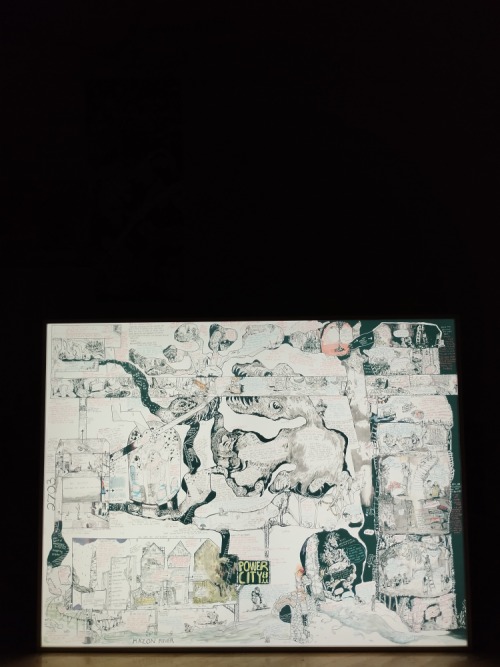


(Works by Scrap World, Amanda Lee Franck, Chris Bisette, Laurie O'Connel, David Blandy)
How do you present a roleplaying game in an art gallery?
I am no visual artist. I have no paintings or sculptures I can present, to transport visitors into a different world.
As a writer I mainly think in texts, narratives. I could have presented something narrative for WEIRD HOPE ENGINES: invited audiences to sit and play through an adventure; given them rules and characters and a scenario to play through.
Would’ve been unsatisfactory, though. While imaginative and experiential, such a work would not really have been visual. And TTRPGs take time—“sit down, participate for half-an-hour” time—which is a lot to ask, even of the most eager gallery visitor.
“Games as shrines” gave me a solution.
I’d make a shrine in the gallery. You’d play the shrine by performing some simple ritual actions. The shrine is tangible, made of stone and accompanied by a diffuser putting benzoin oil into the air. Its associated meanings and practices evoke a world, a cosmology.

You pray to the crocodile. The prayers are real and in earnest. You feed the crocodile. The crocodile changes with every prayer; as the exhibition continues the crocodile grows and is furred in colour.
+
8. Pain.


None of the prayers you offer to A CROCODILE, EATING are fictional. All of them—stories of family loss; fraught relationships with parents, with homes; abuse, cultural misogyny, ethnic tension, toxic masculinity—are true.
Some of them come from my own life. At least half come from my friends, who shared with me their stories via THE CAT IS KIND, a prototype shrine I made a week before leaving for Nottingham.
You would ritually offer “a story that aches” to this cat-shaped piggy-bank, and the cat would eat that ache for you.
+
9. Port Dickson.


Everything I make is ultimately about Port Dickson, the small Malaysian town in which I live.
Port Dickson is defined by its relationships to places across the sea. It is a town of petrochemical industry; exporting diesel and jet fuel abroad.
In return, from the First World, we received unwanted textiles by the container-load, in huge bundles—there are many “bundle” shops in my town, thrift stores essentially, where locals sort through the piles of discarded factory uniforms and fast fashion for still-usable garments to sell second-hand.
(Fun fact: all of the coats I wore in the UK I bought from the bundle!)
We fuel your civilisation, process your trash.

For A CROCODILE, EATING to embody my context it has to communicate the flavour of this relationship:
The shrine’s rites do not allow gallery visitors to say their own prayers. You are only ever feeding the crocodile burdens imported from somewhere else.
The sense of an exhausted land, continually asked to take on more weight from without—growing more exhausted and strange, changing.
+
10. Sincerity.

For this shrine to work it had to be real.
I took my shoes off whenever I stepped onto the linoleum. I prayed as I built the crocodile, stone by stone. Every time I entered and left the gallery space I faced my small, tired crocodile god, and I bowed to them, and believed.
I hope my belief makes the shrine real, and you feel this, if and when you visit, yourself.
+++

WEIRD HOPE ENGINES, curated by Dying Earth Catalogue (who are David Blandy, Rebecca Edwards, and Jamie Sutcliffe), featuring works by:
- Angela Washko
- Andrew Walter
- Amanda Lee Franck
- Chris Bisette
- Laurie O'Connel
- Scrap World
- Shuyi Zhang
- Tom K Kemp + Patrick Stuart
- Zedeck Siew
- Adam Sinclair + Lotti Closs
At Bonington Gallery, Nottingham, until 10 May 2025.
JUDGEMENT IS A BLADE

She is a good sorcerer, but a poor disciple. She finds it difficult to concentrate. When she arrives the bell has been struck—the lesson has already started. The teacher looks at her sideways.
The teacher sighs, closes his eyes, and continues. “Judgement is a blade,” he says.
“When you judge another,” the teacher says, “you thrust a dagger at their chest. It may be that you cause a wound.”
She sits on her meditation cushion, and tries to settle.
“When you judge yourself,” the teacher says, “you stab a sword into your belly. It is certain that you inflict injury.”
Lids shut, brow furrowed, she tries to focus. Focus!
“When you judge yourself for judging,” the teacher says, “you swallow a knife. The blade travels through you, and stays in you. From throat to gut to bowel, it will cut, and cut, and cut.”
For emphasis the teacher strikes his bell: its chime runs up the rafters, then back down again.
“O my disciples, set down the blade of judgement. Take up the bell of understanding, instead. When you understand yourself, you ring a bell in your lap. You feel its voice in your body. It leads you to love and equanimity.”
But she is not listening to the bell, nor to the lesson. She fidgets with the sharp point of a pen in her blouse pocket. What excuse can she make, to leave early?
She is a poor disciple, but a good sorcerer. She has a tendency to hyperfixate. The teacher has taught her, not as he intended—she has an idea for a cursing-spell! She must write it down.

+
BROTH TO BLADES
A curse sent by contact.
Pact: a major power of metal, and a minor power of retribution.
Price: a silver coin, covered with the blood of a living thing now dead, offered to a power of hospitality who rules where this curse is cast.
Procedure: a shaving from a bladed weapon that has killed before. Grind this into powder while speaking the third and ninety-third formulas of ill-intent. Mix this powder into the meal of your victim while making the eighth gesture of cutting. Your victim must eat this meal.
For the next day and a half, when you call on your power of retribution and speak the third formula of self-assessment, everything in your victim’s digestive tract is transformed into knives.
It is possible for victims of this curse to perform simple actions without harm, provided they move slowly and are not distracted. Actions taken under stress always hurt—each dealing damage equivalent to three spears stabbing.

+++
A magic system / ruleset is taking shape in my head:
Spells require pacts with powerful gods or spirits (ie: the real-world idea that magic practice is largely the exercise of diplomacy with entities abroad in the world); and a price (services should be paid for; you want to square accounts with the eldritch as much as possible).
The procedure is how you cast the spell; the bits in italics indicate elements absolutely necessary for the spell, if you must do things quick and dirty—but performing the full ritual is safest.
+++
( Image sources:
https://www.travelfish.org/beginners_detail/thailand/133
https://practiceofzen.com/2018/01/31/nothing-special/dai-bosatsu-zendo-meditation-hall/
https://itoldya420.getarchive.net/amp/media/les-jongleurs-indiens-eae487 )
THE PONTIANAK, IN FICTION
The following is one of a pairs of essays I wrote as a Stretch Goal for A PERFECT WIFE.
Pretty basic stuff for hantu aficionados, of course. But it is designed as orientation for GMs / players who are unfamiliar with the Malaysian context—a primer of the pontianak’s pop-cultural significance; an author’s note for why I wanted to treat her story the way I did.
This essay—alongside another essay titled “The Supernatural, in Southeast Asia—will appear as appendices in the zine, which you can support
>>>HERE<<<
Three days left!
+

Malaysian culture is replete with monsters.
Many are gendered female, and cluster around childbirth, that oldest and bloodiest of terrors. A toyol is created from the flesh of a dead fetus. The penanggalan seeks the blood of new mothers and infants. A woman who perishes while pregnant or in labour may rise as a langsuir or pontianak.
If you have read through or played this adventure, you have already met the pontianak.
She is pretty famous! She lends her name to a city in Indonesia. She headlines horror movies: the first was a Cathay-Keris production, Pontianak (1957); the latest is Glen Goei and Gavin Yap’s Dendam Pontianak (2019). One of the three protagonists in Charlene Teo’s litfic novel Ponti (2018) is the aging star of a fictional 1970s pontianak film.

There is much scholarship about the pontianak. A frequently-cited paper is Alicia Izharuddin’s The laugh of the pontianak: darkness and feminism in Malay folk horror (2019). Alicia focuses on one of the pontianak’s trademark features—her laugh, popularly a cackle of wild abandon—as a site of radical resistance.
Nothing scares men more than a woman “laughing at patriarchy, laughing at power, laughing from below.”
+
It is said the pontianak “can only be subdued by striking a nail to the back of her neck” (Lee & Balaya, 2016). So thwarted, she turns “into a beautiful woman and a good wife until the nail is removed” (Lim, 2008).
With fortitude, craft and cunning, a hero may snare this female creature for himself. Vanquish the monster, get the girl! Because the monster is the girl.
A notable depiction of the pontianak-as-perfect-wife appears in Gergasi (1958):
A hunter, driven by the prospect of winning a “woman of incredible beauty”, stalks a fanged and taloned pontianak. He watches her kneel by a stream to drink. In this private moment she looks tired: an old crone.
He attacks her from behind with hammer and nail.
She screams. Falls into the water. When he fishes her out again, she is a transformed: a young woman—confused, afraid. Quiet, she shrinks away from him. He tells her: “You have awakened from a terrible dream. Let us go home.”
“Home?” she asks. She has no idea where she is, who he is.
“My home,” he says. “Do not doubt. Believe in me. I am human, just like you.” He yanks her into his arms. “Let us build a palace of happiness together.”
+
Watching such a scene today feels uncomfortable. Physical assault at a moment of vulnerability. A man taking control of a woman when she is too disoriented to consent. Penetration used as a guarantee of marriage.

The nail is a straightforward symbol: with it, the pontianak is pinned in place, like a moth specimen in a lightbox.
The pontianak-as-captive-wife narrative is rare, nowadays. Nowadays she is allowed to be a sympathetic villain. In Shuhaimi Baba’s Pontianak Harum Sundal Malam (2004), she rises to exact vengeance on her murderers. We acknowledge the fact that women suffer at the hands of bad men, sometimes!

It is satisfying to see justice done. To bad men—and to monsters. The pontianak typically meets one of the following ends:
- She is banished by devout Islamic prayer;
- She fades away, having exacted her revenge;
- She escapes into the dark, so a sequel can be made.

In all cases:
With the avatar of abhorrent femininity gone, a conventional ever-after is possible. The male lead safely marries his lady love, starts a family. Baby-making and heteronormative gender roles resume. The order of the world is upheld.
+
A PERFECT WIFE is set in the aftermath of a pontianak story. Dr Azman is a good man, enjoying the just reward he believes he deserves. All is well, in the order of the world. Yet Sara wonders why her happy ending feels pyrrhic.
What will you do about it?
+++
A PERFECT WIFE is a modern-horror adventure for TTRPGs, published as a print art zine and PDF. Its publication is helping fund flights and expenses for Amanda Lee Franck, Scrap World, and myself, to travel to Nottingham for WEIRD HOPE ENGINES, in March 2025.
SUPPORT US >>>HERE<<<
A PERFECT WIFE - Now On Kickstarter!
What happens when a toxic man forcibly marries a murderous vampiress?
A PERFECT WIFE is an adventure of contemporary supernatural horror, featuring the Malaysian pontianak, set in modern-day Kuala Lumpur.
A TTRPG zine with art by Amanda Lee Franck and Scrap World, layout design by David Blandy, and text + design (+ some art) by me!
This is also a fundraiser! Everybody working on the zine is part of a visual art exhibition called WEIRD HOPE ENGINES, happening in Nottingham in March 2025. Proceeds from our zine will go towards paying for air tickets and travel expenses to get me and Scrap and Amanda to the UK.
SUPPORT US >>>HERE<<<

(Draft layout)
The zine version of A PERFECT WIFE is an expanded, up-punched version of the adventure I posted on this blog:
- Sharper-drawn setting details and locations;
- A shift away from a genericised Asian city, to Kuala Lumpur specifically;
- Double the number of NPCs;
- Player-character background packages;
- A less-straightforward string of clues, for more satisfying investigative play;
- Proper cartography and better art.
To wit, here’s Sara from the blog post:

And here is Sara, in the zine:

But that’s just my art; strictly dilettante-grade stuff.
You are here for Amanda and Scrap, who both contribute sick, hand-painted, full-colour art to the adventure, oozing with moody dread:


I mean, come on.
We hope that all this is enough to entice you to back us. As of writing, we’ve already raised enough for a print run of the zine (with a fold-out of the location, and A5 art prints of Amanda’s and Scrap’s paintings), but we still need help with the flights-and-travel fundraising bit.
SUPPORT US >>>HERE<<<
Still not convinced? What’s it gonna take?
You know what? I’ll write something for you. I’ll write you a bespoke NPC, that you can use your game, when you play A PERFECT WIFE at your table.
I’ll even make art of this NPC for you. Original hand-drawn pen art which I’ll physically mail to you.
I’m not joking. This—alongside the option of having Amanda draw you a creepy (maybe cute) owl—is literally one of the add-ons you can append to your backer rewards on the Kickstarter.

(The show that we will all be part of. More info here.)
If it sounds like I’m begging—I am.
I’ve admired Scrap and Amanda for years. What a privilege to have worked with them on this zine, to have them make art from my words, my imagination.
It would be a dream turned real for me to be able to meet them for the first time, and thank them in person.
SUPPORT US >>>HERE<<<
A PERFECT WIFE
(It is Vampire Weekend! Have a pontianak-themed urban-horror investigative adventure. I wrote it with Kuala Lumpur in mind, but it should work for any big city just fine.)
+++
DISAPPEARANCES
An inner-city neighbourhood, too ugly for gentrification. Refugees have settled here. They fled war in their own country. But they have not escaped violence.
People work basement sweatshops, or clean toilets in nightclubs. They stumble home in the morning dark. At dawn, their neighbours find gore blotching the dumpsters.
The first disappearance was a year ago. Now it happens with alarming regularity—every fortnight. The neighbourhood is tense. Most agree the following precautions work:
- Cross the road if you spot rats.
- Walk on if your name is called.
- Do not look for the baby crying.
+++

THE COMMUNITY CENTRE
A school for refugee children. A girl in pink polka dots tugs the sleeve of a hijabi woman. “Shingalong time, Missh Shara?” she asks.
Sara gives in. Poor Yinyin! Her father vanished over the weekend. Sara offers cash for information about what happened to him. The authorities don’t seem to care.
Sara cares. She teaches English here, weekdays. Last year, when she miscarried, she bled all over the felt carpeting. She paid to have it cleaned. A faint stain remains.
+

YINYIN, THE ORPHAN
Sniffling, hiding, remembering.
A bundle of giggles, playing with her friends—but as soon as she is allowed a moment on her own she crouches, hugs herself, sobs.
Yinyin tells you her Papa is short a finger on his left hand, and has a picture of a scary black cat on his right arm. Yinyin tells you she loves her Papa.
“Shaturday night, Papa wentsh out to buy shtuff at the shop. Papa hashn’t come home. Will you ashk Uncle Yat when Papa will be home?”
+

SARA, THE WIFE
Literature, pastry arts, embroidery.
At brunch her friends coo: “Look. At. You! You’re glowing!” Then they smile, half-cringing. They know she knows they’re lying.
Sara has not been sleeping well. Hormones, she thinks. She is six months into her second pregnancy. This will be her firstborn child. She will not disappoint her husband the doctor again.
She has a nail embedded into the back of her neck. She cannot feel it. Her hijab means nobody else sees it.
+++

THE NEIGHBOURHOOD
Shop signs in a language you cannot read. Even the thoroughfares feel like alleys. Whenever you turn a corner, roll an encounter:
- Music blaring from a phone. A gang of six 38-ers. They whistle passers-by over, to squeeze for snack money.
- Excited yaps. Seven dogs, four puppies. An elderly man has brought them rice and curry, in styrofoam packets.
- The flutter of yellow paper. Ideograms and a tiger, drawn in red ink. Somebody has lost their protective talisman.
- Squeaks from a smelly drain. A rat pokes its head out, peers at you for a full minute, then continues on its way.
- Police tape. “Move along, move along,” Sub-inspector Rafiq repeats, bored. A severed finger has been found.
- “Eh-hek, eh-hek, eeeeeeeeeh!” A baby has begun to cry, close by. Just behind that pile of boxes. Sara’s baby.
+

38-ER, GANG MEMBER
Machete use, boasting, escaping.
Tattooed on their bare shoulders: the number “38”, stylised to look like the symbol for the sacred sound Aum.
Are these disappearances the work of some rival triad, trying to take over their turf? They were protective amulets. They move in groups. One in every group carries a gun.
They are still losing. Three senior members have gone missing. Their boss Uncle Day has not left his club in weeks.
+

SARA’S BABY, THE GHOSTLING
Stalking, mimicking, exsanguination.
There was no funeral because she lost them so early. She buried their remains, mourned them in private. She doesn’t know their spirit is still abroad.
Usually invisible; materialises to attack. Appears as a child with corpse-green pallor; talons; and proboscis-like umbilical cord.
Will never harm Sara. Hungers for her affection. Often spies on her at the Community Centre. May copy her teaching voice: “Quiet please!” “Sit down, children!” Make a check, or obey.
DEALING WITH SARA’S BABY
As resilient as an ordinary five-year-old. Harmed by mundane weapons. If slain, reappears the next new moon. Even full funeral rites will not put them to rest.
The wrong that made them was done to their mother.
+++

REFUGEES
It is a close-knit neighbourhood. Folk gossip about your business. Some are becoming familiar faces. At every location, roll to see who also happens to be here:
- An eleven-year-old. Suki. Organising, hauling, shortcut-taking. With five siblings to support, she has stopped school. Is a gofer for most businesses. Has keys to most back doors.
- A one-armed man. Uncle Tin. Marksmanship, bushcraft, forgetting. His panther tattoo marks him as a former resistance fighter. Cheap rum in his pocket. An assault rifle in his flat.
- A woman, heavy makeup. Sanda. Dancing, drinking, scrimping. Go-go dancer. Annoyed that the the new girls at the club pinching her regulars. Uncle Day’s favourite niece.
- A bald head, robes. Brother Pha. Selling, haggling, spellcraft. Peddles a camphor liniment. “I bless, I bless!” Claims it wards against evil. It stings spiritual entities like pepper spray.
- Always taking a call. Mr Nong. Spying, deception, pistol-use. Seems helpful, but feeds you bad leads. Actually a private investigator keeping an eye on things for Dr Azman.
- Waddles like a duck. Mya. Cooking, scolding, knife-use. She is expecting twins—two boys. “My hubby’s so happy.” Unless you get involved, will be the next person to disappear.
+++

THE SHOP
No signboard; doesn’t need one. Sells cosmetics; produce and spice pastes for dishes from the old country; third-hand phones.
Also roasted sunflower seeds; cheap rum; smuggled cannabis—enjoyed at tables in the alley out back.
+

UNCLE YAT, THE SHOPKEEPER
Smuggling, gossiping, electronics.
“See this panther here?” He points to a tattoo on his left arm. “We fought. We believed! But we lost. That’s life.” He takes another drag of his spliff, and chortles.
Yinyin’s father was here, Saturday, drinking. “Putting the charm on some girl. Real pretty! And getting real close, touching his face, all that. They left together.”
Yat gets quiet. “After what we’ve been through? We all deserve some happiness.” Yat thinks she was a go-go girl. “They work at the club. Go ask Day.”
+++

THE POLICE KIOSK
Community board: empty. Front desk: empty. Air-conditioning: freezing. You have to press the call buzzer four times before an officer appears, irritated.
Whatever you say, she will ask if you want to make a report. “Here, the form. Write. Sign.”
+

SUB-INSPECTOR RAFIQ, THE OFFICER
Report-writing, delegating, pistol use.
Takes cigarettes breaks to escape the kiosk’s chill. Obliged to set up a cordon around any scenes of obvious violence. Treats his job as a pensioner’s hobby.
A grey moustache, holding your attention. Friendly but unhelpful. Mention Sara and his eyes narrow; he asks whether you know Dr Azman.
“Because I do. The doctor’s wife has pure intentions, yes. But she is naive. These refugees? They are bad people. We should protect pure women from bad realities.”
+++

THE CLUB
A poor person’s idea of what wealth looks like: lots of glass; lots of pleather. Driving dangdut. Dancers gyrating on stages in front of murals of elephants, phoenixes, panthers.
Upstairs, a 38-er with a shotgun guards an armoured door. To meet the boss, you must be vouched for.
+

UNCLE DAY, THE BOSS
Speechifying, martial arts, rifle-use.
A fifty-year-old veteran with hippie dreads. Panther-themed ink. Day was a military commander. Now he fights on a different plane.
“My people’s true war is spiritual. You appear on a lucky day—very lucky. It is fate. Preordained! What insight do you bring, heavenly messenger?”
Confirms that there are many fresh faces on weekends. “Beautiful girls are sacred animals, you understand? We cannot turn away beauty!”
+++
THE WOMAN OF YOUR DREAMS
This happens on the next weekend night, to the most cishet male person among you:
Maybe she is in some sort of trouble, and her car won’t start. Maybe she is on a corner, smoking—one black eye. Maybe she is on the podium, enduring gropes and jeers.
She is beautiful. Exactly your type. You can save her, be her hero. She will be grateful.
There are warning signs. There is no car. She will not describe her assailants. She leads you down a dead end. Her fragrance is sweet, like rotting flower garlands. Every dog in the neighbourhood bays.
She lowers her eyes, bites her lip. How can she repay you? she asks. This is a game she likes. Gratification delayed. It makes the end delicious.
Show suspicion, fear? She gets annoyed. Why aren’t you playing along?
Her neck twists around. She grins, chin over the nape of her neck. Arms at wrong angles, fingers ending in talons. She lopes after you, running backwards with a digitigrade gait.
+
SARA, THE PONTIANAK
Pretending, pursuing, disembowelling.
The pontianak is a nightmare: born when an unhappy mother dies at childbirth; made when life is destroyed, trying to satiate the demands of the patriarchy.
The pontianak is a predator: she eats men. Women are exempt—except when they are pregnant with a male foetus. Baby flesh tastes best.
The pontianak is reversal. In human form, her physical features are tailored to appeal to potential victims. She must reveal her monstrously twisted form to feed.
The pontianak is fear. She wants her victims to know. She has tells. She always smells of rotting flowers. Dogs hate her: one will flee; a pack will attack.
+

SARA’S POWERS
She may whisper to any man she can see. The target hears this whisper over any distance. She materialises by his ear.
She may laugh, a high-pitched cackle. Men who hear this laugh develop debilitating fever a day later. Breaks after a week.
She may touch your clothes. Unerringly locates any man wearing any article of clothing she has previously touched.
She may fly. Moves through the air as if running on solid ground.
She may change shape. Besides taking human woman’s shape, she may also transform into a bay owl.
+
DEALING WITH PONTIANAKS
As resilient as three human persons. Harmed by mundane weapons. If slain, reappears the next new moon.
A known solution is imprisonment: a specially-prepared nail, stabbed into the back of her neck. This transforms the pontianak into a human woman.
Unaware of the nail, amnesiac, she is easily groomed by her captor. Often she is made to perform sanctioned gender roles—marriage, family-making—roles she previously abandoned.
The pontianak remains within. Her children may be born as monsters. If the nail is removed, she remembers what she is, and once again goes free.
+
DEALING WITH SARA
A pontianak always has a nest—typically a banana plant, banyan, or frangipani. This is where the root of her spirit resides; where she retreats if her body is slain.
Kill the pontianak, wait for her to retreat to her tree. Trap her inside with mystic wards. Burn the tree. This destroys her permanently.
Sara’s banana plant is in the back garden of her house.
+++

THE HOUSE
A two-storey bungalow, in one of the city’s oldest suburbs. The neighbours are cousins of sultans, hedge-fund managers, architects.
The perfectly manicured back garden has spider lilies, frangipanis—and a single banana stem, in a person-sized urn. “Easier to control the corm, so it grows neat,” Dr Azman explains.
The banana’s trunk has a girdle woven from coarse black thread. Look closer: the thread is human hair.
+

DR AZMAN, THE HUSBAND
Gardening, surgery, spellcraft.
Has a driver with a concealed-carry licence. Went to boarding school with the current Defence Minister. Framed: doctorates in a variety of medical fields; a masters in anthropology.
“Black magic? Bloodsucking spirits?” He shrugs. “Charlatans, placebo effect, criminal types using spooky stories to hide trafficking operations.”
You notice a vial on a cord around his neck. Inside: a single hair, suspended in dark oil. He buttons up his shirt without a word. He asks Sara to bring tea. “You’ve met my wife?”
+
DR AZMAN’S WIFE
Dr Azman wanted a wife. He did not leave such a thing to the vagaries of love; he made one for himself. Etched the nail in her neck; wove the girdle around her tree.
Dr Azman wants a son—though he is willing to accept a daughter. His first try failed. His perfect wife does have some downsides.
Dr Azman is trying again. Curious how gestation goes easier if his wife’s spirit is let out, given leave to feed. Nourishment for the foetus? Once every two weeks.
When he removes her nail she blusters and threatens. She doesn’t mean those things, he knows. He wears protection, as a precaution.
Dr Azman’s vial contains oil distilled from the flesh of Sara’s original corpse. Sara may never harm the person who wears this vial.

+++
Some notes:
- This was written with page references—ie: “turn to pg xx”—because that’s what I do as a matter of course in drafting. But I couldn’t get internal hyperlinks to work with Tumblr’s text editor; my html-fu isn’t good enough. Sorry. Hope it is still legible nonetheless.
- The original version of this was written as a monster entry for an urban fantasy game. Stripped the system-specific stuff out; expanded the adventure bits (locations, characters, shape of What Is Going On). Basically rewrote the whole thing.
- Writing for a contemporary setting is interesting. Felt okay to use an even more basic version of the system-neutral “stat block” I usually use. Mechanics aren’t a prerequisite to contextualise action in modern-day reality, consider we (most of us, anyway) actually live here.
- Malaysian hantu / monsters are overwhelmingly gendered female; most are created from childbirth and its horrors. They are nightmares of the patriarchy (and its callous treatment of women’s bodies) made manifest.
- Every Malaysian writer eventually writes a pontianak story. This is mine, I guess? The one bit in the pontianak mythos that arrests me most is the idea that she can be captured, turned into a “proper” woman. And that this is spoken of as some sort of victory, some sort triumph against evil—men win, in the end, always and forever.
- The refugee angle is me working through Malaysian society’s xenophobia towards of asylum seekers. I have written about it before; it is still relevant now.
- This adventure explicitly casts the husband as the villain. He should get his comeuppance. Any way the situation develops, Sara—an innocent woman—will not come out of this unscathed.
- Felt okay to sketch the NPCs, but not the monsters, because I’m not a good enough artist. Your imagination is better than I.
+
Image credits:
- https://www.reddit.com/r/UrbanHell/comments/ufb8de/random_alley_in_cheras_kuala_lumpur_malaysia/
- https://www.sabahpost.net/2019/12/06/polis-tembak-mati-3-pengedar-dadah-rampas-syabu-dan-senjata-api/
- https://www.hmetro.com.my/mutakhir/2021/08/747004/balai-polis-sungai-besi-dihias-indah-sempena-hari-kebangsaan
- https://www.reddit.com/media?url=https%3A%2F%2Fi.redd.it%2Flmb0m4v472n81.jpg
- Nick Gray on Flickr
- https://g.co/kgs/7wu8NTh
- https://naturerules1.fandom.com/wiki/Oriental_Bay_Owl
- https://www.bikemap.net/en/r/7659968/
- https://www.secret-retreats.com/blog/general-info/list-of-edible-flowers-in-asia-floral-delights-in-asian-cuisine-part-1.html
Mechanics as Bits
EDIT:
Freddie Foulds over on Bluesky found the post for me! It was a Chris McDowall post: Alien Dojos.
This is now a fan post about the genius that is Alien Dojos.

Every martial art described there (for use with Into The Odd) has a resolution mechanic that involves doing something tactile with dice, beyond just rolling.
For “Bafistan Fist Fighting” each punch is a d6, “rolled” by “throwing them into the air and punching them”—but you have to punch them in such a way they still land on the table; if you miss your punch, or punch them off the table, that’s a failure.
Or, how about “Five Way Stick”:
Initiate: When fighting with a Martial Stick (d6, Bulky) stack 5d6 in front of you and try to flick the top die from the stack. If any other than the top tie fall, fail and treat the roll as 1. Continue down the stack until you fail or choose to stop.
These are:
- Functional subsystems (clear resolution mechanics);
- Thematically appropriate to fiction they are meant to represent (little minigames of player dexterity to resolve character actions involving martial arts);
- Physical spectacle (at the very least you will be focused on the “roll”, if not dodging flying dice);
- Goofy as shit (a virtue in itself).
I want to make rules like this.
+++
Today I spent a few hours watching this Alien-abduction themed actual play of Dread, on Smosh. I liked it a lot! More than I thought I would!
(Please don’t laugh at me too much for my very vanilla Internet media consumption! I am an old, and very uncool. Today I was watching YouTube between digging up banana corms.)
I almost never watch actual plays, mind you. I tried Critical Role and bounced right off; I have seen maybe two Dimension 20 sessions ever; the last AP series I followed really was HarmonQuest, which was—what, the twenty-teens?

+
Watching the Smosh Dread thing got me wondering:
How often do mechanics / system talk come up in the course of big mainstream actual plays?
I don’t mean:
- “Pull from the Jenga tower.” (simple resolution mechanics); or
- “I cast Fireball!” (diegetic, arguably)
But:
- “Okay so let’s look it up. Fireball is 20ft x 20ft, and *doesn’t* set stuff on fire.” (non-diegetic rules clarification); or:
- “You have four ‘Mercury’ symbols, and from last round you have the "somebody will betray you” narrative trigger, let’s consult the relevant oracle table …“ (complex resolution mechanics)
This analysis by Trilemma of the transcript of a Critical Role episode [and additional commentary by Thomas Manuel] goes a ways towards answering how much general rules talk occurs, though it doesn’t make a distinction between the types of rules talk in the sense I’m thinking of.
+
Here’s a (totally untested) hypothesis:
If actual plays are edited / watched for the uninterrupted flow of action / banter / emotion at the table (as ones geared towards general, non-TTRPG-enthusiast audiences like Smosh and HarmonQuest certainly are);
and:
If certain kinds of complex mechanics tend to divert attention into cul-de-sacs of meta-narrative detail, interrupting said flow of action / banter / emotion (these are generally absent from the APs I can sit through, or at least edited out);
then:
The games that work best for actual play are basically party games, with light and (more importantly, for this post) VISCERAL resolution mechanics:
- Jenga-d suspense;
- The sleep rituals in stuff like Werewolf;
- An overdramatic rock-paper-scissors game; etc
Or, alternatively, they are games whose systems can get out of the way enough to function like party games. I’d argue that D&D counts as one such game. It is go-to mainstream TTRPG actual play system because yes, of Name Brand Recognition—
But also because it is possible to not play with any actual D&D rules (and therefore avoid the tedium of looking up what stuff like Conditions mean) and still be playing D&D culturally.
+
Basically:
How suitable a tabletop roleplaying game is for actual play depends on how easily its mechanics can function as bits or performances, in the improv sense.
+++
So this is very shaky ground for me; I don’t watch actual plays and I am talking out my ass. But through the sewage of my bullshit is perhaps the firmer ground of a design opportunity, maybe?
Namely:
Could we be designing TTRPG mechanics as performances / for performativity?
+
I’d argue that Dread is so well-known because its simple core mechanic is a novel for precisely this reason: you and your friends enact your suspense around the Jenga Tower physically and viscerally (even if it is anxious silence), for each other (if not for an outside audience).
There is the sense that you are acting. Doing something.
+

How else could we manage this?
Rolling dice or revealing a card are already performances, technically—but for our purposes here I’d argue that they are very "small”; they don’t have enough presence.
How can we treat dice rolls with the pomp of ritual, construct more ceremony around a card-based resolution system?
Boardgames are already good at fun counters and tactile props and click-y dials—but these are also small, in that they live mainly on the table. You are still sitting on your ass.
Props that make you get up! Rulesets that necessitate play-fighting!
LARP totally fits. Throwing pouches and yelling “Magic Missile! Magic Missile!” 10 out of 10 no notes.
+
Finger games (rock paper scissors; lat ta li lat ta li tam pong; thumb war) fit.
A chase scene in fiction resolved by a game of tag is maybe too on the nose, but also fits.
+
I’ve been trying to find this blogpost I vaguely recall, that proposes exactly the kind of thing I’m thinking about.
It suggested a list of unusual fighting styles (or maybe martial arts) for D&D. It has stuck in the substrate of my mind because the proposed fighting styles all had non-standard, action-based resolution mechanics.
Ie: the GM tosses a handful of dice; you (the player) try to punch as many of them in mid-air with your fists; how many you get determines how many hits you score in fiction.
Something like that. Imagine that goofy shit at the table!
I can’t find this post any more. Does anybody else remember something like it? Help! I want to find it again!
+++
GNS is not a Theory; it is a Tradition
This post is a brain-fart—me trying to jot a thought, lurking and seeing TTRPG folks react to GNS Theory for the upteenth time.
+
Context:
GNS Theory seeks to frame, understand, categorise, and model tabletop roleplay—and, via this framework, suggest solutions and improvements to the craft of TTRPG design as a whole. Understanding GNS Theory, it is asserted, will allow you to create better-designed (“more coherent”) games.
Edwards compares the utility of understanding GNS to that of understanding physics:
I use a physics analogy: prior to the insights of Newtonian physics, bridges could be built. Some of them were built rather well. However, in retrospect, we are well aware that in order to build the bridge, the designer must have been at the very least according with Newtonian physics through (1) luck, (2) imitation of something else that worked, (3) use of principles that did not conflict with Newtonian physics in a way that mattered for the job, or (4) a non-articulated understanding of those principles. I consider the analogy to be exact for role-playing games.
+
“Is GNS Theory right or wrong?” is usually the question when TTRPG folks talk about it. This feels unusual for an art theory—but is perhaps understandable in GNS’s specific case.
Edwards presents his ideas as actionable: a science by which you can make better games; principles you can rely on to build your own bridge. It becomes paramount, then, that those principles be factual. Otherwise the bridge collapses.
(Edwards infamously called people who enjoyed “incoherent” games [according GNS standards] brain-damaged, but the less said about this the better.)
Also because nerds are perverts about taxonomy:
Here is a sorting hat that will let us categorise and self-select our fandoms and selves.
We love this tribal shit. “Are you a Gamist? Narrativist? Simulationist? Take this quiz! Argue in the comments!”
+
GNS is two decades old by this point.
It was the chief theoretical framework of the Forge. It guides the work of designers like Vincent Baker and Paul Czege. Game lines like Burning Wheel and its descendants are entirely informed by GNS conclusions about players and player behaviour, resulting in specific strengths, quirks, and frustrating design “solutions”.
On the other hand:
From the Noughties onwards there has been any number of interesting and excellent games made without adherence to (or even knowledge of) GNS. Tabletop roleplaying games have flowered much since the Forge’s heyday.
+
All that long-winded shit to get to the thought I had:
Rather than asking: “Is GNS true? Does GNS work? Does GNS accurately describe tabletop roleplaying games?”
It is probably more useful to consider GNS as a TTRPG art tradition. A school or movement or genre, that creators and designers have chosen to belong to / define themselves by / work in the lineage of.
Similar to:
- Dadaism as a movement; or
- Animation that falls within the anime genre due to context and lineage; or
- Tanztheater / Pina Bausch’s place in contemporary dance; or
- How employing Method techniques results in specific styles; or
- Music theory, which should be more accurately called the “harmonic style of 18th Century European composers”.
But Dada is not the whole of art; nor is anime synonymous with animation. Pina Bausch is just one albeit influential choreographer; nowadays method acting has an antiquated, faintly ridiculous legacy.
Meanwhile, European music theory today is often seen as the scientific yardstick by which all music should be measured, just as nerds are wont to do with GNS vis a vis tabletop roleplaying games in general.
But we should remember that GNS is a lens, one way of considering and practicising the craft of TTRPGs. It is one lens amongst a multitude. Whether it is a good lens is up to you. Some designers have followed its precepts, and made games informed by said precepts; such games vary in quality but share a particular vibe.
A bridge built in the Moorish style isn’t necessarily superior or more stable than a bridge built any other other way; but you may find it beautiful, provided you are partial to Moorish architecture.
I think that analogy works for GNS.
