
The hills between baroque Noto and the quiet town of Palazzolo Acreide have a name in Italian: “balze,” or ruffles, like the gathered frills of a dress caught mid-swirl. It’s from them that a 19th-century estate takes its name. Dimora delle Balze is a fortified stone masseria set among olive groves and organic fields with a citrus grove, three courtyards, and an old watchtower.
Elena Lops noticed it from the outside. Her husband was born in Palermo, and the family had been looking for a home in Sicily, somewhere quieter than the island’s famously busy west. They found this house in a corner of the island that, by her account, was still almost unknown. She had seen only its exterior.
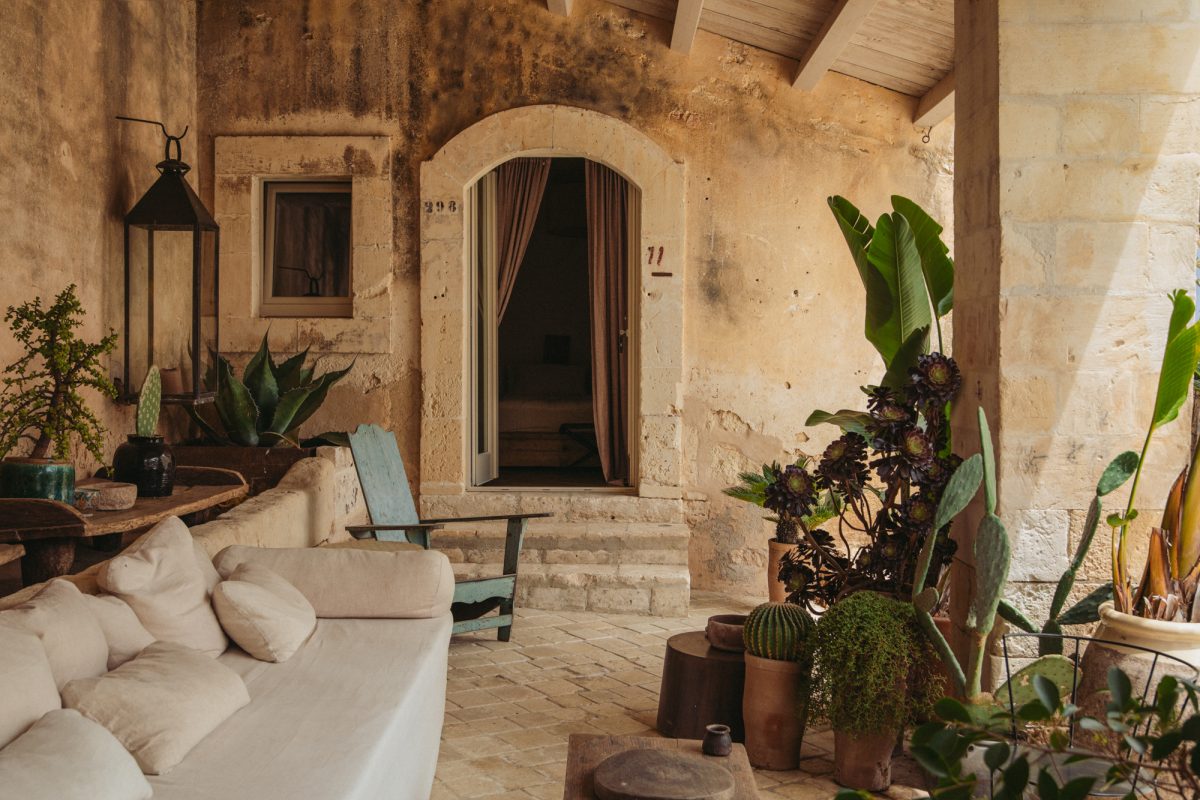
“I felt a connection with the soul of the place,” she says. Inside was another story. The masseria had belonged to a local baron from Palazzolo Acreide, one of several properties he held in the area. This was the last of them, left to heirs who let it fall into ruin. Doors had collapsed, and the ground itself was damaged. “It was almost shocking to discover that such a beautiful place had been left in such poor condition,” she says.
The sensible thing in Sicily might have been to start over. Elena says the local habit is to knock down and rebuild, and that permits tend to favor it. She chose the harder road: a conservative restoration, which under Italian law means leaving untouched what already exists and proceeding with great care. It took nearly nine years, and every permit had to be fought for.
The plan was never to establish a boutique hotel. The house was meant for private gatherings and family celebrations, and only over time did it open its doors to guests.

Since Dimora delle Balze began as a family home, Elena says guests are treated as part of the family. This year marks a decade since it opened to guests, and the Michelin Guide has awarded it a Michelin Key.
She never thought of it as a burden. “I would do it again,” she says. Elena tells me there was always something new to see as the project unfolded, whether a wall revealed or a room finding its shape. She calls the project her fourth child, and she is quick to add that it is not finished. The restaurant was renovated just two years ago, and many of the latest changes are hers alone, made without the help of designers.
Elena didn’t come to this project from architecture. Her background is in fashion, and she is matter-of-fact about what that gave her.


“When you come from fashion, you are used to a culture of beauty,” she says. Design, to her, is a neighboring country. For the interiors she worked with two designers: Draga Obradovic, who shaped the rooms and living spaces, and Stefano Guidotti, who handled the lighting. Together they let the building lead. Rooms run from about 200 to 450 square feet, with bathrooms folded inside them.
There are 11 rooms in all, set in the old stables, outbuildings, and a main house. Each takes its name from a work of Sicilian art, literature, or film and is tied in some way to the figure it honors. The Proibito room borrows the Italian title of Forbidden, the 1932 film by Sicilian-born director Frank Capra. Around the main courtyard, where the living areas are found, were once the baron’s own bedrooms. A few of the rooms have beds and headboards unlike any other in the house, and the wooden furniture is made locally.


Outside, the courtyards are paved with stone from nearby Modica. The central one is marked by a palm tree and an antique sundial. A shaded winter garden, dressed in hand-painted ceramics from Caltagirone, is a place to slow down, and another courtyard, scattered with restored classical columns, looks out over the Manghisi Valley. By the pool, the old manger has become an outdoor living area.
Brass candlesticks and the ceramic Teste di Moro of Caltagirone were also gathered over the years from antique markets across southern Italy. Elena and Draga traveled to Morocco for about two weeks and came back with floor tiles whose patterns and pigments were developed for the house alone, a nod to the Arab hands that once shaped Sicily.
What turned up in the old living rooms was overhead: the vaulted ceilings had once been painted, a different color in each room. Where the original paint survived, it was left just as it was. Where it had crumbled, artisans who still practice the old craft rebuilt it the way it was done in the 1800s, using the same pigments that had been there before. Elsewhere in the house, the original stone walls came to light beneath layers of plaster.

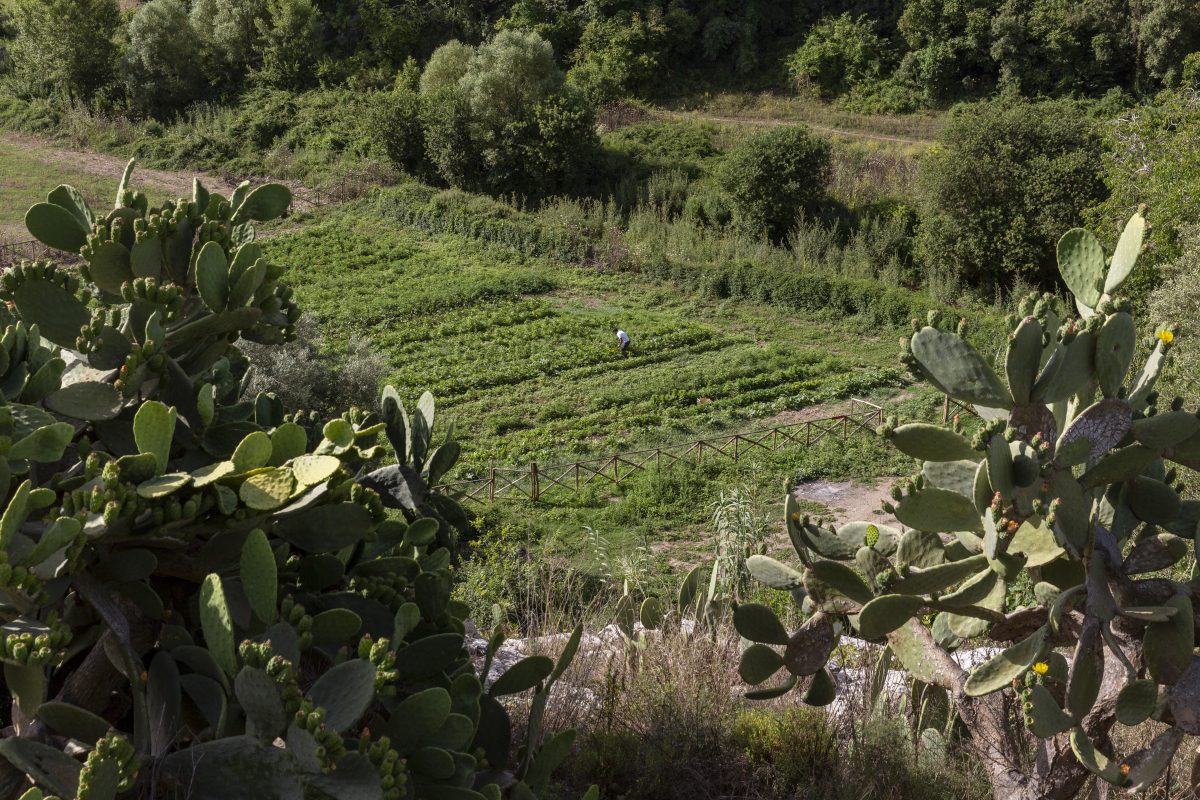
The estate also sits over 2,000 feet above sea level, in the middle of roughly 67 acres of organic fields. Elena’s son, Anthony, leads Passo Ladro, an organic farm project that grew out of the pandemic in 2020.
The family has long cared about what it eats, and some members are gluten intolerant, so growing food without pesticides, “only what nature gives us,” felt to Elena like a natural extension of the household. Cocktails are made with herbs from the grounds, and guests can take cooking and pastry classes, or study art and photography.

Past the gate, there’s plenty of southeast Sicily to explore: Greek and Roman ruins, baroque towns, and beaches like Lido di Sacramento and Fontane Bianche. The house itself keeps a short season, opening around Easter and shutting its doors at the end of October.
When Elena first began, hardly anyone was interested in this part of the island. Others have since followed, buying up land and pinning their hopes on the hills around her.


