Tag: writing

Dooner’s Hotel

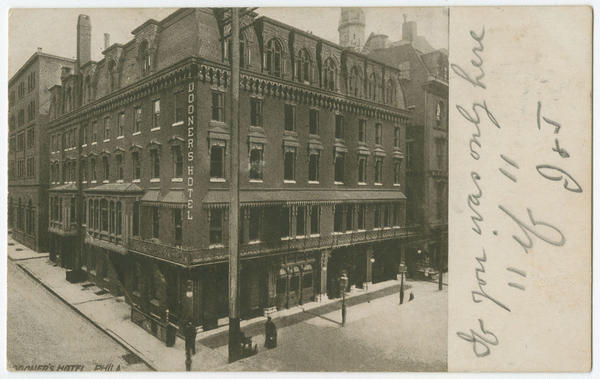
Dooner’s Hotel (photo from Library Company of Philadelphia)

In 1928, well-known author Christopher Morley (Parnassus on Wheels, Haunted Bookshop) and Thomas A. Daily collaborated on an affectionate tribute to “The House of Dooner, the Last of the Friendly Inns,” on Tenth Street above Chestnut in Philadelphia (next to St. Stephen’s Episcopal Church), which closed in 1924. The little volume wistfully captured the spirit of an age that had recently passed, while offering a curious glimpse into the manly domain once occupied by some prominent SFDS parishioners, and a caution about the changing world order at the turn of a different century.

Morley described Dooner’s men’s hotel as a comfortable home and gathering place for Philadelphia locals and occasional celebrities. He characterized it using the works of deceased authors: it was “A Mark Twain kind of place. An Edgar Allen Poe kind of place. A fireman save my child kind of place. A sleep with the window closed kind of place and hang your scapular on the back of a chair. A terrapin soup and catch the late train for Villanova kind of place…A Comédie Humaine (Balzac’s French novels about life in the 1800s) kind of place. A Joyce Kilmer (Catholic poet died in World War I. Remembered for a poem called “Trees.”) kind of place” that was “as masculine as firemen’s suspenders.”

Morley wrote that “The Dooners, father and son – sons, I should say…were publicans” — tavern owners. “The house the elder Dooner established, and which the sons inherited and carried on, was an authentic institution.” What did that mean? Morley described something ordinary, clubby, and timeless: “the gist of Dooner’s, as I think about it this moment, was that the right kind of person knew as soon as he stepped into it that it was real. The steam that floated up from those plates of cabbage was a genuine exhalation…” Its patrons included permanent residents; visitors – traveling salesmen, academics, and others — often regulars; and locals who gathered in the saloon and public spaces to relax, meet with friends, and participate in a number of men’s groups — especially relating to Ireland — which met there. These included the Hibernian Society, the Friendly Sons of Saint Patrick, the Kelly Street Choir, the Koemmenich Society (a musical group), a number of private supper clubs, and more.

Dooner’s was said to be a “mind your own business” kind of place with its own strict code of ethics, “and the house was a restful, well-mannered club for those who were likeminded.” It was probably not strong on diversity. Nonwhite staff are described in the casually racist parlance of the day. Women were approached with caution and considered potentially dangerous. Dooner’s did have a women’s parlour on the ground floor, with a separate entrance and exit from the street. But when proprietor Peter Dooner once found a “notorious woman” there, “placidly enjoying the good fare with one of her many admirers,” he reportedly ejected her, saying “we don’t want your kind here” and warned her to inform her friends. In a similar way, a college president who flipped a coin to determine who would pay for the next round in the main saloon was evicted for “gambling.”

A comfortable bachelor refuge, Morely found that “There was something essentially Catholic, I mean Papist, about that place as I remember it: one surrendered to it as the troubled soul does (eventually, I dare say) to the Church Universal… I expect there was usually some dust under the beds, and the engravings on the walls were sure to be of the Landseer type (Thomas Landseer was a British artist of the 1800s best known for engravings based on his brother Edwin’s painting of dogs, horses, and stags); the ventilation was dense (in an age when everyone smoked), and I expect some of the guests slept in their union suits (one-piece long underwear); yet there was a kind of obese holiness about it too.” Daily agreed that “Indeed, there was a ‘dim religious’ air about the place – neither pagan nor Christian, but a savouring of both; a sort of human-natural religion – particularly on Sunday mornings when foot-loose bachelors foregathered there for a late breakfast.” It was very much a men’s club: “Tradition has it that, save for the elderly housekeeper, no woman ever set foot above the ground floor of Dooner’s.”
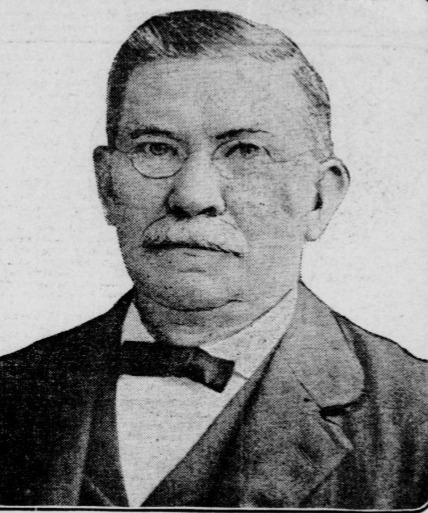
Peter S. Dooner

Daily related the hotel’s origin story:

His original hotel at Eighth and Chestnut was successful and filled a need:

The new building was designed for comfort, not to impress:

When Peter Dooner passed away in 1906, his sons took over the business and kept all of its traditions intact. “Dooner’s was a solid institution then. The one thing that was to destroy it was still slumbering in that twisted brain of fanaticism from which, in the midst of war’s alarms, it was to spring full-armed.”

Beyond the insulated walls of Dooner’s, the swirling social and political unrest that led up to World War I — supposed to be the War to End All Wars — energized those who thought the world’s problems could be solved by single-mindedly imposing their own personal values on everyone else. The particular fanaticism that Dooner’s couldn’t weather was Prohibition, which banned the manufacture, transportation and sale of intoxicating liquors from 1920 to 1933. Frank Dooner, who had bought out the interests of his siblings, kept the hotel going as long as he could, but realized that it “was a losing fight…Its venerable decencies and human frailties withered in the hot dry air of virulent virtue; and so the house whose motto was ‘Mind your own Business’ went down before the will of those who never are content to mind theirs.”

It was unfortunate that places like Dooner’s, which provided affordable, comfortable accommodations suitable for returning servicemen; and places to gather, socialize, and restore the rhythms of ordinary life in troubled times, had to close down just when they were most needed. The blight would also trickle down to the Little Sisters of the Poor, a mendicant order that depended on charity to serve the city’s neediest, and which Dooner’s had long supported with a lavish annual Christmas banquet and generous donations.

Dooner’s Hotel was demolished in 1924, to make room for a massive extension to the Federal Reserve Bank next door – ironically, just five years before the 1929 stock market crash and banking panic plunged the world into the Great Depression.

Sons of Peter Dooner associated with St. Francis de Sales, included Edward, the eldest (who lived at 4345 Baltimore Avenue; later 4230 Spruce St.); Thomas Francis (known as Frank. 4508 Chester Ave.; later 327 South 46th); and William (4705 Sansom), who had all worked at the hotel; and Albert J., of whom Morley wrote:. “The youngest son, Albert, now a distinguished organist and choirmaster and a composer of real talent and charm, is the only one of the boys who had no part in the conduct of the House of Dooner.” Instead, he founded the SFDS men’s and boy’s choir, over which he presided as choirmaster and organist from 1921 to 1957, forming his own historically-inspired male bastion against a too-rapidly changing world.

A Change of Tune

With a flick of a long ago editor’s pencil, she disappeared from the parish history. The 1940 parish anniversary book began its choir story with the arrival of the “distinguished” Albert J. Dooner in 1921. The 1989 parish anniversary book looked back further to claim “Tudor Strang” as first choirmaster at St. Francis de Sales in 1911 — but he was actually an organist/choirmaster for several local Episcopal churches, who played in a single organ concert at SFDS. It’s time to restore Margaret Marie Marshall to her proper place in the parish chronicles!

Margaret Marie Marshall, the original organist/choirmaster at St. Francis de Sales, left the parish quietly, without acknowledgement of her twenty years or more of service, around the time that Monsignor Crane became Bishop in 1921. “Did she fall or was she pushed?” Did she resign or was she let go? The answer to the question of how she left is probably “yes,” a bit of both, due, in part, to a new movement in church music centered in Philadelphia.

Up into the early 1900s, music offered a rare oppourtunity for Catholic women to contribute to the male-dominated liturgy. Margaret Marie Marshall was personally and professionally invested in all the possibilities, as a church organist and “concert and oratorio soprano,” who sang and also taught other soloists, first from her home at 2126 Vine Street, and later, when she moved to 3413 Baring Street. Her life seemed dedicated to her work: she lived with her father, a retired grocer, and several sisters, until they all passed away. One of her sisters was known for dramatic readings, and the other was also a church organist. It is unclear where Marshall received her training: she was listed in the Musical Blue Book of America, but, according to the U.S. Census data, her formal education ended with eighth grade.

Marshall’s musical programmes at St. Francis de Sales initially included both men and women. According to family records, golf champion J.J. McDermott’s mother sang in St. Francis de Sales Choir in the early 1900s. At General Mulholland’s funeral in 1910, Marshall’s “augmented choir” included a female soloist, Anna Elizabeth Kelley, who sang Gounod’s “Ave Maria” and Koenan’s “Come Unto Me.” A quartet sang “Nearer My God to Thee.”

An article in Adoremus claims that Philadelphia-German composer Albert RoSewig, who delighted in “the florid and sentimental style of the classical music of his day,” set the tone for music in Philadelphia around the turn of the century — and Marshall’s ambitious programmes seemed to follow that lead. In December 1902, her “special Christmas program for both morning Masses” included Eduardo Marzo’s Mass at the first; and “Hayden’s Mass No. 6, Huntzer’s ‘Veni Creator,‘” and the “Angel’s Messenger” by Homer Bartlett at the second. In 1904, the Blessing of the School included “an augmented choir of selected voices under the direction of Miss Margaret Marie Marshall, organist.” A 1912 listing for Easter services noted that she would be directing a “vested choir of sixty voices” with works including the “Grand Verdi March” and pieces by Harry Rowe Shelley, Alban Lipp, Victor Hammerl, and Édouard Batiste – all romantic 1800s composers. A Solemn Pontifical Mass commemorating the fifth anniversary of the dedication of the church in 1916 featured an “augmented choir under the direction of Miss Margaret Marie Marshall, the organist,” rendering Gounod’s St. Cecilia Mass. 

But the end of the Victorian era of embellished music, sentimental hymns, and women’s voices was already in sight. In 1903, Pope Pius X had issued an Apostolic Letter on the simplification and reform of church music, which, as Anne L. Silverberg notes, “restricted both the style of appropriate liturgical music and its execution.” It expressed a strong preference for Gregorian chant — in which all the singers follow one melodic line in Latin based on medieval modes rather than modern scales — and multipart singing “unaccompanied by instruments, a decided change from the nineteenth century when orchestras and soloists were frequently heard in American and European churches.” She notes that “The Motu Proprio also forbade women from singing liturgical music and called for boy choirs to sing music with high vocal parts.”

Philadelphia would become a centre for a new American Catholic musical movement embracing the changes, when “Nicola Montani led the nation in reform” and “founded the St. Gregory Guild in Rittenhouse Square to spread the message of the Motu Proprio and to furnish suitable musical publications.” Lucy E. Carroll notes that “From 1906 to 1923 he served at St. John the Evangelist in Philadelphia, with terms as music director at Hallahan High School, West Philadelphia Catholic Girls High School, and St. Mary’s Academy.” He worked as an editor for two music company publishers, founded the Society of St. Gregory in 1914, began the Catholic Choirmaster magazine, then published his St. Gregory Hymnal and Catholic Choir Book in 1920, renewed in 1947. The young Albert J. Dooner was among his avid pupils.

Montani crusaded for his own ideas of pure Renaissance style music without any of what he perceived as “operatic,” “theatrical,” or “balletic” elements. An article in Adoremus reports that “Montani’s voice was a strong one, and his determination to rid the liturgy of anything that even smelled of the profane was his driving force.  Masses by Charles Gounod, August Durand, and Luigi Cherubini were black-listed, with many traditional hymn collections.” These would include much of the music in Marshall’s repertoire.

Montani also had strong views on women, which Albert Dooner shared. Dooner would write in 1926 that women’s voices lacked a purity and spiritual quality of boys’ voices, and their singing was far too dramatic for the liturgy. He also maintained that the proper place for a choir was in the front of the church. Since women were prohibited in the sanctuary, they were therefore disqualified from being in the choir, even though most American choirs sang from a choir loft at the back of the church.

Montani’s stern influence gradually made itself felt in the archdiocese, and Marshall may have felt the pressure. The Solemn Papal Mass commemorating the anniversary of the dedication of St. Francis de Sales Church in 1917 was tersely described as featuring a “male choir of forty voices under the direction of Margaret M. Marshall,” with no musical programme listed.

As church music changed, Marshall turned her energy to other channels. The Catholic Standard and Times reported her war work in July 1918: “Margaret Marie Marshall, Division No. 22, has started ‘liberty sings’ in the different divisions of the Auxiliary, and each Friday night she instructs the members of the chapter in patriotic songs. The meetings close, each night with the singing of the ‘Star Spangled Banner.’” In August, the paper observed that “The ‘community sing’ movement is being enthusiastically received among Catholic societies and organizations. This was evidenced by the fact that 1,500 persons attended the community sing of the Knights of Columbus Red-Cross last Monday night at the Knights of Columbus Hall, Thirty-eighth and Market streets. These ‘sings’ are being conducted under the direction of Miss Margaret Marie Marshall, organist of St. Francis de Sales’ Church, assisted by her sister, Miss Mary Agnes Marshall, organist of St. Anthony’s Church. The former is organizing the movement among the various divisions of the Ladies’ Auxiliary of the A. O. H. (Ancient Order of Hibernians).

Was there friction over music at de Sales? In November, Margaret continued her community outreach – from Most Blessed Sacrament Parish: “For the entertainment of men in the nation’s fighting forces, an elaborate fall and winter programme has been prepared by the Women’s Auxiliary of the Archbishop Ryan Catholic Association, with headquarters at Fifty-fourth street and Chester avenue, in the Most Blessed Sacrament parish. Beginning with a big community sing on Friday night of this week, under the direction of Margaret Marie Marshall, affairs will be held every two weeks and possibly more frequently, according to the committee in charge.“

Marshall may have become less enthusiastic about her musical endeavors at St. Francis de Sales. In November 1918, for the Solemn Pontifical Mass commemorating the seventh anniversary of the dedication of St. Francis de Sales Parish, The Catholic Standard and Times reported simply that “The music of the Mass will be rendered under the direction of Margaret Marie Marshall, organist and choir leader.” When the memorial tablet “to men and women of the parish who served in the late world war” was unveiled at a Solemn Military Mass in 1920, “The musical programme was in charge of Margaret M. Marshall.” And when the church was consecrated with a Solemn Pontifical Mass in November 1920, it was reported that “A splendid musical programme will be rendered on the occasion of the Thanksgiving Mass and Vespers, under the leadership of Margaret Marie Marshall, Organist and director,” but none of the musical works were listed.

Marshall’s last mention at St. Francis de Sales appears to have been at a reception for newly-installed Cardinal Dougherty, just back from Rome in May 1921, when “A chorus of welcome was sung by the children, who formed a pretty picture as they stood grouped on the steps and displaying the Cardinal’s colors, American flags and emblems of welcome. After the chorus, which was rendered under the direction of the Sisters, Servants of the Immaculate Heart of Mary, assisted by Miss Margaret Marshall and Miss Sophia E. Maley, Natalie McElroy, one of the little pupils, delivered a touching address of welcome in splendid style.”

It was a delightful image, indeed, though it suggested that Marshall had been relegated to working with the schoolchildren, under the direction of the IHM Sisters.

Bishop Crane sang his first Solemn Pontifical Mass at St. Francis de Sales in September 1921, with the proud notice that “Special musical programmes will be rendered at the Mass and at Vespers by the parish choir of thirty-five boys and thirty men, under the direction of Albert J. Dooner, organist and choirmaster.” The younger brother of prominent parishioner Edward J. Dooner, Albert had received a degree in music from the University of Pennsylvania in 1912, continued his studies under Montani, and was already acclaimed as an organist and composer for the new church music. He would find his place as founder of the parish’s renowned pre-Vatican II boy choir, and would preside as its celebrated organist and choir director from 1921 to 1957.

After leaving St. Francis de Sales, Margaret Marie Marshall appears to have focused on the pupils of her own music studio for several years, before becoming organist and choir director at the recently-built chapel/school of St. Ambrose at Roosevelt Boulevard and C Street, far away from the city centre, around 1929. She was buried from St. Agatha’s Church (38th and Spring Garden) in 1952 — three years before Pope Pius XII cracked open the door to re-allow women’s choir participation in his Musicæ Sacræ encyclical of December 25, 1955.