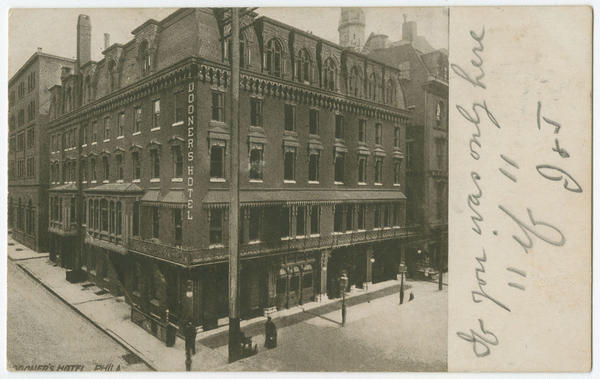
In 1928, well-known author Christopher Morley (Parnassus on Wheels, Haunted Bookshop) and Thomas A. Daily collaborated on an affectionate tribute to “The House of Dooner, the Last of the Friendly Inns,” on Tenth Street above Chestnut in Philadelphia (next to St. Stephen’s Episcopal Church), which closed in 1924. The little volume wistfully captured the spirit of an age that had recently passed, while offering a curious glimpse into the manly domain once occupied by some prominent SFDS parishioners, and a caution about the changing world order at the turn of a different century.
Morley described Dooner’s men’s hotel as a comfortable home and gathering place for Philadelphia locals and occasional celebrities. He characterized it using the works of deceased authors: it was “A Mark Twain kind of place. An Edgar Allen Poe kind of place. A fireman save my child kind of place. A sleep with the window closed kind of place and hang your scapular on the back of a chair. A terrapin soup and catch the late train for Villanova kind of place…A Comédie Humaine (Balzac’s French novels about life in the 1800s) kind of place. A Joyce Kilmer (Catholic poet died in World War I. Remembered for a poem called “Trees.”) kind of place” that was “as masculine as firemen’s suspenders.”
Morley wrote that “The Dooners, father and son – sons, I should say…were publicans” — tavern owners. “The house the elder Dooner established, and which the sons inherited and carried on, was an authentic institution.” What did that mean? Morley described something ordinary, clubby, and timeless: “the gist of Dooner’s, as I think about it this moment, was that the right kind of person knew as soon as he stepped into it that it was real. The steam that floated up from those plates of cabbage was a genuine exhalation…” Its patrons included permanent residents; visitors – traveling salesmen, academics, and others — often regulars; and locals who gathered in the saloon and public spaces to relax, meet with friends, and participate in a number of men’s groups — especially relating to Ireland — which met there. These included the Hibernian Society, the Friendly Sons of Saint Patrick, the Kelly Street Choir, the Koemmenich Society (a musical group), a number of private supper clubs, and more.
Dooner’s was said to be a “mind your own business” kind of place with its own strict code of ethics, “and the house was a restful, well-mannered club for those who were likeminded.” It was probably not strong on diversity. Nonwhite staff are described in the casually racist parlance of the day. Women were approached with caution and considered potentially dangerous. Dooner’s did have a women’s parlour on the ground floor, with a separate entrance and exit from the street. But when proprietor Peter Dooner once found a “notorious woman” there, “placidly enjoying the good fare with one of her many admirers,” he reportedly ejected her, saying “we don’t want your kind here” and warned her to inform her friends. In a similar way, a college president who flipped a coin to determine who would pay for the next round in the main saloon was evicted for “gambling.”
A comfortable bachelor refuge, Morely found that “There was something essentially Catholic, I mean Papist, about that place as I remember it: one surrendered to it as the troubled soul does (eventually, I dare say) to the Church Universal… I expect there was usually some dust under the beds, and the engravings on the walls were sure to be of the Landseer type (Thomas Landseer was a British artist of the 1800s best known for engravings based on his brother Edwin’s painting of dogs, horses, and stags); the ventilation was dense (in an age when everyone smoked), and I expect some of the guests slept in their union suits (one-piece long underwear); yet there was a kind of obese holiness about it too.” Daily agreed that “Indeed, there was a ‘dim religious’ air about the place – neither pagan nor Christian, but a savouring of both; a sort of human-natural religion – particularly on Sunday mornings when foot-loose bachelors foregathered there for a late breakfast.” It was very much a men’s club: “Tradition has it that, save for the elderly housekeeper, no woman ever set foot above the ground floor of Dooner’s.”
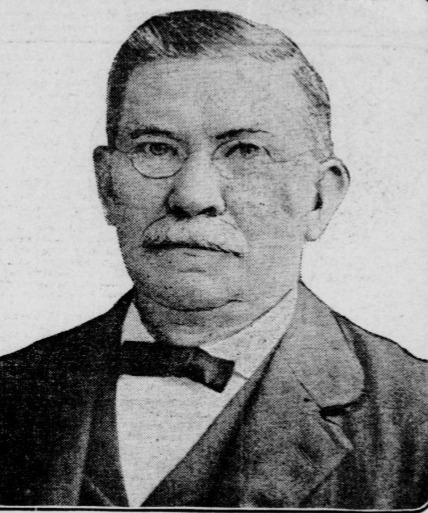
Daily related the hotel’s origin story:
“It was the Grand Centennial Exposition of 1876 that brought Dooner’s into being. Peter Samuel Dooner, foreman of the pressroom of the Philadelphia Times, conceived the idea – probably on a night when the devil was loose in those dingy depths – that it would be more pleasant and profitable to provide food and other refreshments for the expected multitudes of visitors to the Centennial, than to go on forever feeding rolls of white paper into grimy presses. So he jumped – first his job – and then directly into the benevolent business of the boniface, for which he had no previous training whatever. But he had something better, a positive genius for the giving of joy…”
His original hotel at Eighth and Chestnut was successful and filled a need:
“The place of his modest beginning was outgrown in six years. He was forced rather suddenly to move, and thus it came about that the true House of Dooner arose – almost overnight – on the island site (the boundaries being Tenth, Kelly, and Chance streets, and a nameless rear alley) upon which it was to endure for nearly half a century.
The new building was designed for comfort, not to impress:
The outward appearance of Dooner’s was never anything to brag about. The necessary haste of its construction cannot be advanced as an alibi for this. The edifice was the ordinary product of its time, a time when American architecture was having an epidemic of the Mansard disease, not to mention a combination of other ailments. The house was four-square and solid, but it was not beautiful; homely, perhaps, is the happiest word for it.”
When Peter Dooner passed away in 1906, his sons took over the business and kept all of its traditions intact. “Dooner’s was a solid institution then. The one thing that was to destroy it was still slumbering in that twisted brain of fanaticism from which, in the midst of war’s alarms, it was to spring full-armed.”
Beyond the insulated walls of Dooner’s, the swirling social and political unrest that led up to World War I — supposed to be the War to End All Wars — energized those who thought the world’s problems could be solved by single-mindedly imposing their own personal values on everyone else. The particular fanaticism that Dooner’s couldn’t weather was Prohibition, which banned the manufacture, transportation and sale of intoxicating liquors from 1920 to 1933. Frank Dooner, who had bought out the interests of his siblings, kept the hotel going as long as he could, but realized that it “was a losing fight…Its venerable decencies and human frailties withered in the hot dry air of virulent virtue; and so the house whose motto was ‘Mind your own Business’ went down before the will of those who never are content to mind theirs.”
It was unfortunate that places like Dooner’s, which provided affordable, comfortable accommodations suitable for returning servicemen; and places to gather, socialize, and restore the rhythms of ordinary life in troubled times, had to close down just when they were most needed. The blight would also trickle down to the Little Sisters of the Poor, a mendicant order that depended on charity to serve the city’s neediest, and which Dooner’s had long supported with a lavish annual Christmas banquet and generous donations.
Dooner’s Hotel was demolished in 1924, to make room for a massive extension to the Federal Reserve Bank next door – ironically, just five years before the 1929 stock market crash and banking panic plunged the world into the Great Depression.
Sons of Peter Dooner associated with St. Francis de Sales, included Edward, the eldest (who lived at 4345 Baltimore Avenue; later 4230 Spruce St.); Thomas Francis (known as Frank. 4508 Chester Ave.; later 327 South 46th); and William (4705 Sansom), who had all worked at the hotel; and Albert J., of whom Morley wrote:. “The youngest son, Albert, now a distinguished organist and choirmaster and a composer of real talent and charm, is the only one of the boys who had no part in the conduct of the House of Dooner.” Instead, he founded the SFDS men’s and boy’s choir, over which he presided as choirmaster and organist from 1921 to 1957, forming his own historically-inspired male bastion against a too-rapidly changing world.

 When Al Smith ran for President of the United States in 1928, and lost in a landslide to Herbert Hoover, it was said he was defeated by “The Three Ps: Prohibition (which he was against), Prejudice (he was Catholic), and Prosperity (less of an issue when the Great Depression began in October 1929).

