Tag: music

Dooner’s Hotel

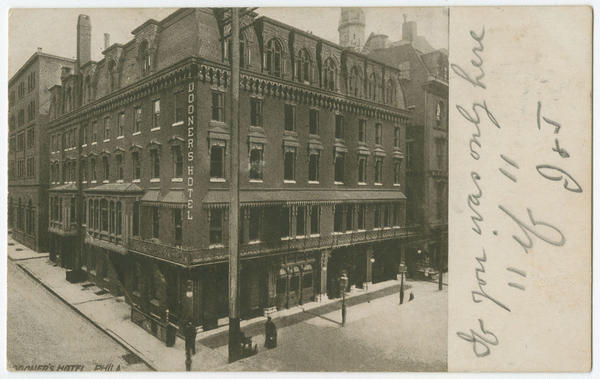
Dooner’s Hotel (photo from Library Company of Philadelphia)

In 1928, well-known author Christopher Morley (Parnassus on Wheels, Haunted Bookshop) and Thomas A. Daily collaborated on an affectionate tribute to “The House of Dooner, the Last of the Friendly Inns,” on Tenth Street above Chestnut in Philadelphia (next to St. Stephen’s Episcopal Church), which closed in 1924. The little volume wistfully captured the spirit of an age that had recently passed, while offering a curious glimpse into the manly domain once occupied by some prominent SFDS parishioners, and a caution about the changing world order at the turn of a different century.

Morley described Dooner’s men’s hotel as a comfortable home and gathering place for Philadelphia locals and occasional celebrities. He characterized it using the works of deceased authors: it was “A Mark Twain kind of place. An Edgar Allen Poe kind of place. A fireman save my child kind of place. A sleep with the window closed kind of place and hang your scapular on the back of a chair. A terrapin soup and catch the late train for Villanova kind of place…A Comédie Humaine (Balzac’s French novels about life in the 1800s) kind of place. A Joyce Kilmer (Catholic poet died in World War I. Remembered for a poem called “Trees.”) kind of place” that was “as masculine as firemen’s suspenders.”

Morley wrote that “The Dooners, father and son – sons, I should say…were publicans” — tavern owners. “The house the elder Dooner established, and which the sons inherited and carried on, was an authentic institution.” What did that mean? Morley described something ordinary, clubby, and timeless: “the gist of Dooner’s, as I think about it this moment, was that the right kind of person knew as soon as he stepped into it that it was real. The steam that floated up from those plates of cabbage was a genuine exhalation…” Its patrons included permanent residents; visitors – traveling salesmen, academics, and others — often regulars; and locals who gathered in the saloon and public spaces to relax, meet with friends, and participate in a number of men’s groups — especially relating to Ireland — which met there. These included the Hibernian Society, the Friendly Sons of Saint Patrick, the Kelly Street Choir, the Koemmenich Society (a musical group), a number of private supper clubs, and more.

Dooner’s was said to be a “mind your own business” kind of place with its own strict code of ethics, “and the house was a restful, well-mannered club for those who were likeminded.” It was probably not strong on diversity. Nonwhite staff are described in the casually racist parlance of the day. Women were approached with caution and considered potentially dangerous. Dooner’s did have a women’s parlour on the ground floor, with a separate entrance and exit from the street. But when proprietor Peter Dooner once found a “notorious woman” there, “placidly enjoying the good fare with one of her many admirers,” he reportedly ejected her, saying “we don’t want your kind here” and warned her to inform her friends. In a similar way, a college president who flipped a coin to determine who would pay for the next round in the main saloon was evicted for “gambling.”

A comfortable bachelor refuge, Morely found that “There was something essentially Catholic, I mean Papist, about that place as I remember it: one surrendered to it as the troubled soul does (eventually, I dare say) to the Church Universal… I expect there was usually some dust under the beds, and the engravings on the walls were sure to be of the Landseer type (Thomas Landseer was a British artist of the 1800s best known for engravings based on his brother Edwin’s painting of dogs, horses, and stags); the ventilation was dense (in an age when everyone smoked), and I expect some of the guests slept in their union suits (one-piece long underwear); yet there was a kind of obese holiness about it too.” Daily agreed that “Indeed, there was a ‘dim religious’ air about the place – neither pagan nor Christian, but a savouring of both; a sort of human-natural religion – particularly on Sunday mornings when foot-loose bachelors foregathered there for a late breakfast.” It was very much a men’s club: “Tradition has it that, save for the elderly housekeeper, no woman ever set foot above the ground floor of Dooner’s.”
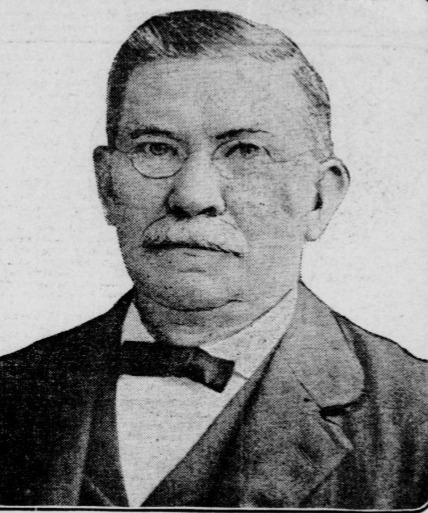
Peter S. Dooner

Daily related the hotel’s origin story:

His original hotel at Eighth and Chestnut was successful and filled a need:

The new building was designed for comfort, not to impress:

When Peter Dooner passed away in 1906, his sons took over the business and kept all of its traditions intact. “Dooner’s was a solid institution then. The one thing that was to destroy it was still slumbering in that twisted brain of fanaticism from which, in the midst of war’s alarms, it was to spring full-armed.”

Beyond the insulated walls of Dooner’s, the swirling social and political unrest that led up to World War I — supposed to be the War to End All Wars — energized those who thought the world’s problems could be solved by single-mindedly imposing their own personal values on everyone else. The particular fanaticism that Dooner’s couldn’t weather was Prohibition, which banned the manufacture, transportation and sale of intoxicating liquors from 1920 to 1933. Frank Dooner, who had bought out the interests of his siblings, kept the hotel going as long as he could, but realized that it “was a losing fight…Its venerable decencies and human frailties withered in the hot dry air of virulent virtue; and so the house whose motto was ‘Mind your own Business’ went down before the will of those who never are content to mind theirs.”

It was unfortunate that places like Dooner’s, which provided affordable, comfortable accommodations suitable for returning servicemen; and places to gather, socialize, and restore the rhythms of ordinary life in troubled times, had to close down just when they were most needed. The blight would also trickle down to the Little Sisters of the Poor, a mendicant order that depended on charity to serve the city’s neediest, and which Dooner’s had long supported with a lavish annual Christmas banquet and generous donations.

Dooner’s Hotel was demolished in 1924, to make room for a massive extension to the Federal Reserve Bank next door – ironically, just five years before the 1929 stock market crash and banking panic plunged the world into the Great Depression.

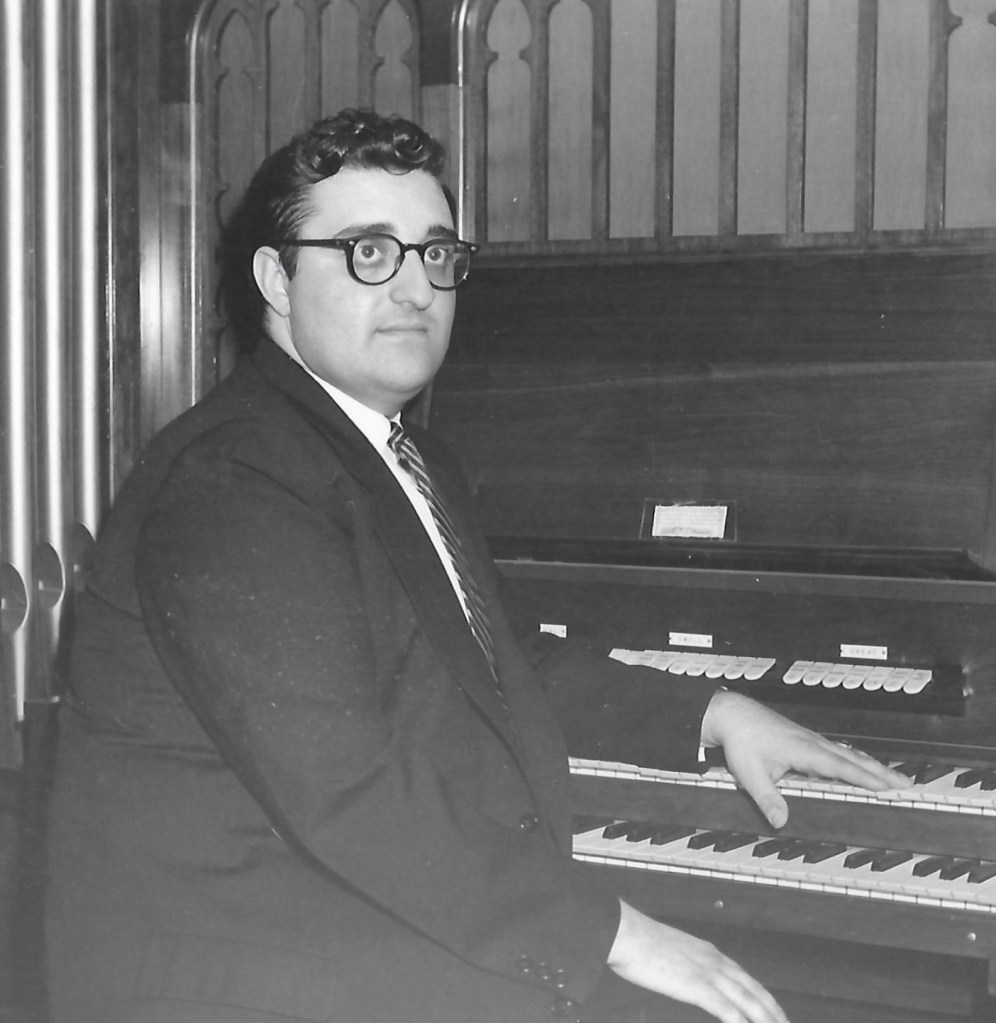
Sons of Peter Dooner associated with St. Francis de Sales, included Edward, the eldest (who lived at 4345 Baltimore Avenue; later 4230 Spruce St.); Thomas Francis (known as Frank. 4508 Chester Ave.; later 327 South 46th); and William (4705 Sansom), who had all worked at the hotel; and Albert J., of whom Morley wrote:. “The youngest son, Albert, now a distinguished organist and choirmaster and a composer of real talent and charm, is the only one of the boys who had no part in the conduct of the House of Dooner.” Instead, he founded the SFDS men’s and boy’s choir, over which he presided as choirmaster and organist from 1921 to 1957, forming his own historically-inspired male bastion against a too-rapidly changing world.

A Change of Tune

With a flick of a long ago editor’s pencil, she disappeared from the parish history. The 1940 parish anniversary book began its choir story with the arrival of the “distinguished” Albert J. Dooner in 1921. The 1989 parish anniversary book looked back further to claim “Tudor Strang” as first choirmaster at St. Francis de Sales in 1911 — but he was actually an organist/choirmaster for several local Episcopal churches, who played in a single organ concert at SFDS. It’s time to restore Margaret Marie Marshall to her proper place in the parish chronicles!

Margaret Marie Marshall, the original organist/choirmaster at St. Francis de Sales, left the parish quietly, without acknowledgement of her twenty years or more of service, around the time that Monsignor Crane became Bishop in 1921. “Did she fall or was she pushed?” Did she resign or was she let go? The answer to the question of how she left is probably “yes,” a bit of both, due, in part, to a new movement in church music centered in Philadelphia.

Up into the early 1900s, music offered a rare oppourtunity for Catholic women to contribute to the male-dominated liturgy. Margaret Marie Marshall was personally and professionally invested in all the possibilities, as a church organist and “concert and oratorio soprano,” who sang and also taught other soloists, first from her home at 2126 Vine Street, and later, when she moved to 3413 Baring Street. Her life seemed dedicated to her work: she lived with her father, a retired grocer, and several sisters, until they all passed away. One of her sisters was known for dramatic readings, and the other was also a church organist. It is unclear where Marshall received her training: she was listed in the Musical Blue Book of America, but, according to the U.S. Census data, her formal education ended with eighth grade.

Marshall’s musical programmes at St. Francis de Sales initially included both men and women. According to family records, golf champion J.J. McDermott’s mother sang in St. Francis de Sales Choir in the early 1900s. At General Mulholland’s funeral in 1910, Marshall’s “augmented choir” included a female soloist, Anna Elizabeth Kelley, who sang Gounod’s “Ave Maria” and Koenan’s “Come Unto Me.” A quartet sang “Nearer My God to Thee.”

An article in Adoremus claims that Philadelphia-German composer Albert RoSewig, who delighted in “the florid and sentimental style of the classical music of his day,” set the tone for music in Philadelphia around the turn of the century — and Marshall’s ambitious programmes seemed to follow that lead. In December 1902, her “special Christmas program for both morning Masses” included Eduardo Marzo’s Mass at the first; and “Hayden’s Mass No. 6, Huntzer’s ‘Veni Creator,‘” and the “Angel’s Messenger” by Homer Bartlett at the second. In 1904, the Blessing of the School included “an augmented choir of selected voices under the direction of Miss Margaret Marie Marshall, organist.” A 1912 listing for Easter services noted that she would be directing a “vested choir of sixty voices” with works including the “Grand Verdi March” and pieces by Harry Rowe Shelley, Alban Lipp, Victor Hammerl, and Édouard Batiste – all romantic 1800s composers. A Solemn Pontifical Mass commemorating the fifth anniversary of the dedication of the church in 1916 featured an “augmented choir under the direction of Miss Margaret Marie Marshall, the organist,” rendering Gounod’s St. Cecilia Mass. 

But the end of the Victorian era of embellished music, sentimental hymns, and women’s voices was already in sight. In 1903, Pope Pius X had issued an Apostolic Letter on the simplification and reform of church music, which, as Anne L. Silverberg notes, “restricted both the style of appropriate liturgical music and its execution.” It expressed a strong preference for Gregorian chant — in which all the singers follow one melodic line in Latin based on medieval modes rather than modern scales — and multipart singing “unaccompanied by instruments, a decided change from the nineteenth century when orchestras and soloists were frequently heard in American and European churches.” She notes that “The Motu Proprio also forbade women from singing liturgical music and called for boy choirs to sing music with high vocal parts.”

Philadelphia would become a centre for a new American Catholic musical movement embracing the changes, when “Nicola Montani led the nation in reform” and “founded the St. Gregory Guild in Rittenhouse Square to spread the message of the Motu Proprio and to furnish suitable musical publications.” Lucy E. Carroll notes that “From 1906 to 1923 he served at St. John the Evangelist in Philadelphia, with terms as music director at Hallahan High School, West Philadelphia Catholic Girls High School, and St. Mary’s Academy.” He worked as an editor for two music company publishers, founded the Society of St. Gregory in 1914, began the Catholic Choirmaster magazine, then published his St. Gregory Hymnal and Catholic Choir Book in 1920, renewed in 1947. The young Albert J. Dooner was among his avid pupils.

Montani crusaded for his own ideas of pure Renaissance style music without any of what he perceived as “operatic,” “theatrical,” or “balletic” elements. An article in Adoremus reports that “Montani’s voice was a strong one, and his determination to rid the liturgy of anything that even smelled of the profane was his driving force.  Masses by Charles Gounod, August Durand, and Luigi Cherubini were black-listed, with many traditional hymn collections.” These would include much of the music in Marshall’s repertoire.

Montani also had strong views on women, which Albert Dooner shared. Dooner would write in 1926 that women’s voices lacked a purity and spiritual quality of boys’ voices, and their singing was far too dramatic for the liturgy. He also maintained that the proper place for a choir was in the front of the church. Since women were prohibited in the sanctuary, they were therefore disqualified from being in the choir, even though most American choirs sang from a choir loft at the back of the church.

Montani’s stern influence gradually made itself felt in the archdiocese, and Marshall may have felt the pressure. The Solemn Papal Mass commemorating the anniversary of the dedication of St. Francis de Sales Church in 1917 was tersely described as featuring a “male choir of forty voices under the direction of Margaret M. Marshall,” with no musical programme listed.

As church music changed, Marshall turned her energy to other channels. The Catholic Standard and Times reported her war work in July 1918: “Margaret Marie Marshall, Division No. 22, has started ‘liberty sings’ in the different divisions of the Auxiliary, and each Friday night she instructs the members of the chapter in patriotic songs. The meetings close, each night with the singing of the ‘Star Spangled Banner.’” In August, the paper observed that “The ‘community sing’ movement is being enthusiastically received among Catholic societies and organizations. This was evidenced by the fact that 1,500 persons attended the community sing of the Knights of Columbus Red-Cross last Monday night at the Knights of Columbus Hall, Thirty-eighth and Market streets. These ‘sings’ are being conducted under the direction of Miss Margaret Marie Marshall, organist of St. Francis de Sales’ Church, assisted by her sister, Miss Mary Agnes Marshall, organist of St. Anthony’s Church. The former is organizing the movement among the various divisions of the Ladies’ Auxiliary of the A. O. H. (Ancient Order of Hibernians).

Was there friction over music at de Sales? In November, Margaret continued her community outreach – from Most Blessed Sacrament Parish: “For the entertainment of men in the nation’s fighting forces, an elaborate fall and winter programme has been prepared by the Women’s Auxiliary of the Archbishop Ryan Catholic Association, with headquarters at Fifty-fourth street and Chester avenue, in the Most Blessed Sacrament parish. Beginning with a big community sing on Friday night of this week, under the direction of Margaret Marie Marshall, affairs will be held every two weeks and possibly more frequently, according to the committee in charge.“

Marshall may have become less enthusiastic about her musical endeavors at St. Francis de Sales. In November 1918, for the Solemn Pontifical Mass commemorating the seventh anniversary of the dedication of St. Francis de Sales Parish, The Catholic Standard and Times reported simply that “The music of the Mass will be rendered under the direction of Margaret Marie Marshall, organist and choir leader.” When the memorial tablet “to men and women of the parish who served in the late world war” was unveiled at a Solemn Military Mass in 1920, “The musical programme was in charge of Margaret M. Marshall.” And when the church was consecrated with a Solemn Pontifical Mass in November 1920, it was reported that “A splendid musical programme will be rendered on the occasion of the Thanksgiving Mass and Vespers, under the leadership of Margaret Marie Marshall, Organist and director,” but none of the musical works were listed.

Marshall’s last mention at St. Francis de Sales appears to have been at a reception for newly-installed Cardinal Dougherty, just back from Rome in May 1921, when “A chorus of welcome was sung by the children, who formed a pretty picture as they stood grouped on the steps and displaying the Cardinal’s colors, American flags and emblems of welcome. After the chorus, which was rendered under the direction of the Sisters, Servants of the Immaculate Heart of Mary, assisted by Miss Margaret Marshall and Miss Sophia E. Maley, Natalie McElroy, one of the little pupils, delivered a touching address of welcome in splendid style.”

It was a delightful image, indeed, though it suggested that Marshall had been relegated to working with the schoolchildren, under the direction of the IHM Sisters.

Bishop Crane sang his first Solemn Pontifical Mass at St. Francis de Sales in September 1921, with the proud notice that “Special musical programmes will be rendered at the Mass and at Vespers by the parish choir of thirty-five boys and thirty men, under the direction of Albert J. Dooner, organist and choirmaster.” The younger brother of prominent parishioner Edward J. Dooner, Albert had received a degree in music from the University of Pennsylvania in 1912, continued his studies under Montani, and was already acclaimed as an organist and composer for the new church music. He would find his place as founder of the parish’s renowned pre-Vatican II boy choir, and would preside as its celebrated organist and choir director from 1921 to 1957.

After leaving St. Francis de Sales, Margaret Marie Marshall appears to have focused on the pupils of her own music studio for several years, before becoming organist and choir director at the recently-built chapel/school of St. Ambrose at Roosevelt Boulevard and C Street, far away from the city centre, around 1929. She was buried from St. Agatha’s Church (38th and Spring Garden) in 1952 — three years before Pope Pius XII cracked open the door to re-allow women’s choir participation in his Musicæ Sacræ encyclical of December 25, 1955.

Gender Bender

71. St. Francis de Sales

We come to thee, O happy Saint

To claim thy care and love,

To beg thy guidance through this life,

To endless bliss above.

Chorus

Oh, pray for us, St. Francis,

For dangers hover near;

Oh pray for us, St. Francis,

To conquer every fear.

While in the rosy bloom of youth,

To God thy soul was given,

And true, through life, thy spotless soul

‘Mid suffering soared to heaven.

Thy purity has won for thee

A crown of fadeless light;

Oh, may its beauty shine on us

And cheer the gloom of night.

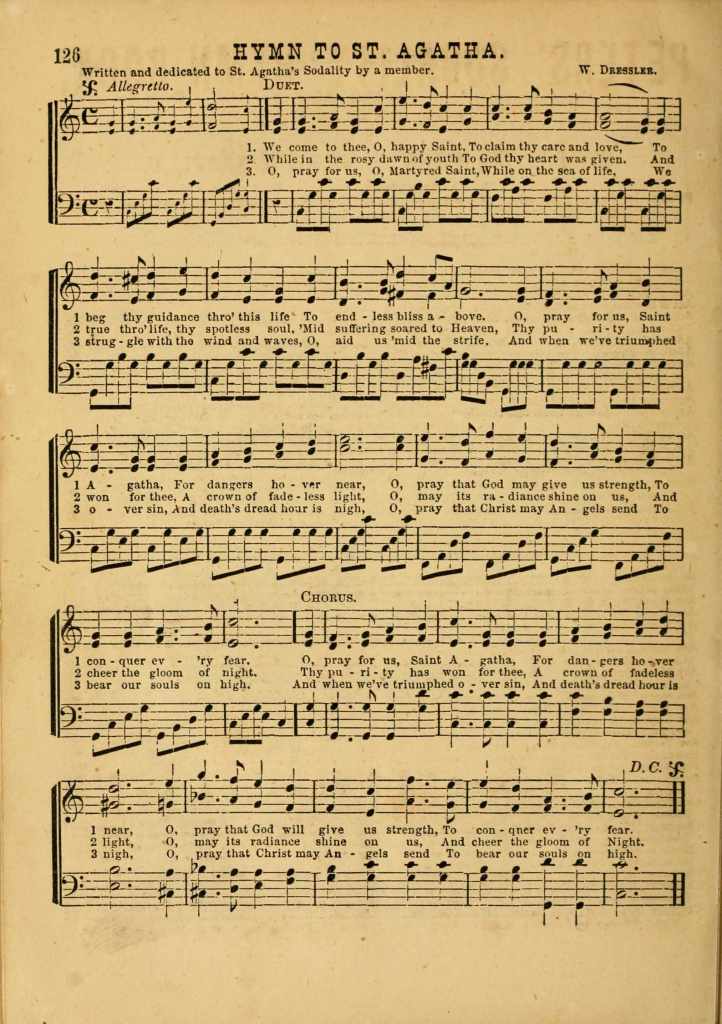
              The verses above are from a hymnal printed for SFDS by the Catholic Standard in 1926, under the direction of Rev. Charles McGinley who was the Director of the women’s BVM Sodality organization at the time.

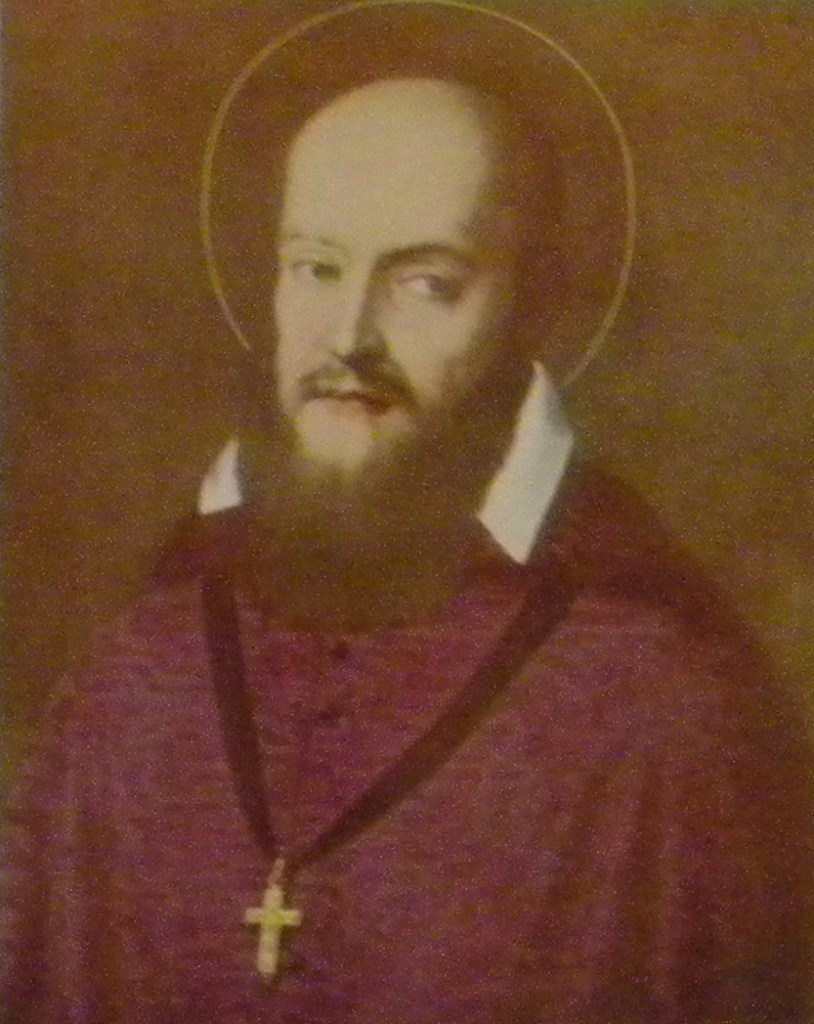
              The words to the hymn are somewhat peculiar for our Patron Saint – particularly the second verse, about “the rosy bloom of youth” and the suffering of a spotless soul. Saint Francis de Sales wasn’t tortured or martyred; he became the Bishop of Geneva in 1602 and died peacefully of a heart ailment at what was then a respectable age of 55. It seems odd that the hymn doesn’t reference his patient efforts to keep the faith alive during the Protestant Reformation; his advice on the Devout Life or his other inspirational writings (“We shall steer safely through every storm, so long as our heart is right, our intention fervent, our courage steadfast, and our trust fixed on God. If at times we are somewhat stunned by the tempest, never fear. Let us take breath, and go on afresh“); or his designation as patron saint of journalists and the deaf (a role Pope Francis is now highlighting).

              Curiously, an internet search finds the same song used to honor Saint Charles Borromeo in Monterrey, CA in 1914: “…then all the people form a long procession. In the center is carried the statue of San Carlos, and, while the choir sings the Hymn to San Carlos, they march slowly around the church… ‘We come to thee, O happy Saint/ To claim thy care and love,/ To beg thy guidance through this life,/To endless bliss above…’” Here, too, the words don’t fit the life of that 16th century Bishop known for founding seminaries.

              Hymnary.org, which tracks different versions of hymns printed over time, provides an answer. Its first recorded instance of the verses, is as a Hymn to St. Agatha, “dedicated to St. Agatha’s Sodality by a member” in 1872 and popular from 1872 to 1935. Ah, now it all fits! St. Agatha made a vow of virginity in rosy youth; kept her purity, through the suffering of torture and imprisonment; and soared to heaven to claim a martyr’s crown, around the year 251 AD.

              So why was the hymn repurposed? Since saintly feast days fall once a year, usually on a weekday, there hasn’t been much call for special songs – surprisingly, even for use in the annual Forty Hours or for institutions named for saints. The International Commission on English in the Liturgy, now working on a new English language breviary, notes that music has existed for a number of saints but “Many of the nearly 300 Latin hymns, some dating back to the early centuries of the Church, have never had an official English translation…” If a need arose for an anthem, churches improvised. The US Conference of Catholic Bishops has now approved the Green Book of the hymns of the Proper of Saints, so more official songs could eventually be available in English, but here’s a challenge and an opportunity for our own parish tribute to our patron St. Francis de Sales!

SFDS Boy Choir: Wheels of Change

Recently surfaced choir documents offer a glimpse back into the years when proudly magnificent SFDS Parish was pressed between the rollers of Vatican II, neighbourhood change, and the Baby Boom “youthquake” of the 1960s.

The first cracks showed in 1966, as English began to replace Latin in the Mass, and Peter La Manna, Director of the renowned Boy Choir, had trouble finding suitable new music. He wrote to Monsignor Mitchell: “My dilemma is that I can’t find Masses in English which can compare with those masterpieces…The men in the choir are so reluctant to making a complete switch to English because of the obviously lower compositional standards.”

Some of La Manna’s challenges seem odd today. In 1967, he wrote to Monsignor Mitchell: “One of the things which I have been begging for is the erection of two announcement boards for the numbers of the hymns. I think that it was feared that it would cheapen the architecture of the church. This is not necessarily true, and something in good taste could be placed on the two pillars along the front of the church. I have also asked for an announcement before Mass concerning the hymns at Solemn Mass and the fact that people should join in the singing of the Our Father and the responses. I have had no luck with that request.”

Money became tight as the parish shrunk and La Manna fought for funds to pay the Men’s choir: “For forty-five years the men of the choir have been paid…Bishop McShea…paid all of the men a uniform fee of $20 per month…to help pay for their carfare and gas expenses…” He also begged for new uniforms for the boys: “We have been asked to make a telecast on December 14 for KYW-TV. If we do this we will have to borrow cassocks from the altar boys again because ours are not fit for color TV.” Another time, he lamented that “For over a year I have asked for new cassocks. The ones which we have are in shreds...” and “these ragged vestments are not good for the morale of the group…” La Manna made the case that the choir was a critical “binding force within the parish. Many families have postponed moving out of the parish because their sons were members of the choir…” though he did admit that “the attendance at Solemn Mass is very poor...”

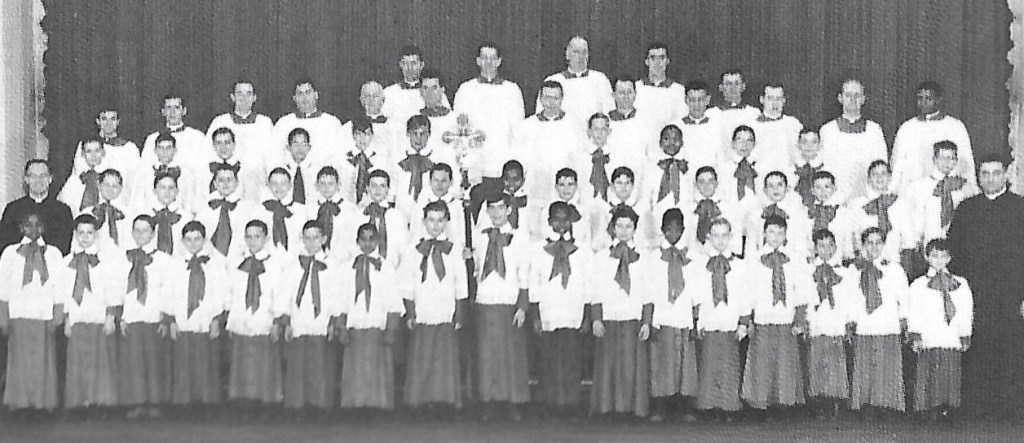
SFDS Boy Choir in 1965

As baroque pageantry gave way to 1960s streamlining, La Manna mourned the new simplicity. He felt that that people needed to “see evidence of their contributions…in the beauty of their church, in the flowers on the altar, etc. …I heard many remarks…that there had never been such a dull and unmarked feast of Christ the King at de Sales as there was this year. Also that there has never been a novena to Our Lady when her altar looked so bare. I know that these are small things, but when I came here Father Curran said to me, de Sales has won her reputation by making small things important, and by providing the parishioners with a liturgy which is edifying and beautiful.” La Manna felt some of this was due to a lack of continuity in the Rectory, where, until recently, “there were always curates here who were ‘trained’ under the programs and policy of the past.” He also gently suggested to Monsignor Mitchell that “when I first came here the homily was limited to seven minutes at Solemn Mass. Now it goes as long as twenty minutes. Our attendance has dropped drastically because we are sometimes in there an hour and twenty minutes, and it used to be slightly over an hour.” In La Manna’s view, shortening the processionals was not an option.

Changing priorities. In truth, the decorations, sermon length, and pageantry probably were of little consequence. Between 1963 and 1973 the number of parish families dropped from 4,233 to 1,232, and school students from 1,158 to 621, as the Catholic population citywide shifted to the suburbs. And there was also the famously divisive Venturi renovation!

Bruce Shultz arrived at SFDS as organist in 1969 and gradually, under choir director Dr. Michael Geheb, and then Rev. Hermann Behrens, an inclusive group of men and women (and choir babies!) built a tradition of excellence for a new era. Today’s choir family, under the direction of Isabel Boston, offers a diverse repertoire from Latin Chant to Spirituals, and welcomes new members.

Color OUR Collections: SFDS Coloring Book Goes Online Feb, 7-11

Every February, the NY Academy of Medicine invites archives around the world to share free coloring books online based on materials in their collections. This year’s SFDS Parish Coloring Book celebrates neighborhood businesses advertised in the parish bulletins of the 1940s and 1950s. Check out all the offerings – from SFDS, to Drexel University, to the Vatican Libraries, to the Palace of the Grand Dukes of Lithuania, and beyond, starting February 7 at https://library.nyam.org/colorourcollections/

Weekly Parish Dances

tuesday dances 1946 (2)“The 1940’s and 50’s were part of a big dance hall era,” Joe Ruane recalls, and dancing was the popular pastime: “our crowd would go to St Joe’s (his home parish in Collingdale) on Sunday night; de Sales Tuesday and Friday night. On Wednesday night I would go to the Carousel Hall in Clifton Heights which my father owned which had a big band…and then I would…go to the Arcade Hall on the 5000 block of Baltimore Avenue where my friends hung out. Saturday would be Holy Cross, Springfield.” 

From the 1930s to the 1960s, Saint Francis de Sales offered regular Tuesday night dances in the parish auditorium for all the “young people of the parish and their friends.”  A typical 1950 Monthly Bulletin notice advertised: Music for the occasion is played by the well known and very popular orchestra of George Sommer. Admission is seventy-five cents. Good music and a very beautiful auditorium provide the atmosphere for a very enjoyable evening. All the young folks of the parish (no High School students) are cordially invited to attend these Tuesday evening Socials. We would like to see many of our young married couples attending and can assure them of a very enjoyable evening.”

George Sommer, with his “Big Band” sound, was known as “one of the best dance bands in the city and one of the most popular.” Information about the band appeared in Billboard Magazine, and they played at ballrooms across the city.

What about the High School students? They had their own dance night at de Sales auditorium every Friday. John Deady recalls that “I attended the Friday night dances. Admission $.50. On the stair case going up to the stage (rectory side) is a closet. There was a turntable in the closet where 45 rpm records were stacked. Cokes were sold at the kitchen on the other side of the stage. Did not go to the Tuesday night dances. Understand it was a wide age group that attended them.”

The Tuesday and Friday groups likely catered to slightly different musical tastes. A 1959 Parish Bulletin opined: “Older people often express disapproval of rock and roll because it is so noisy and so violent, and the music accompanying it seems so unbearably monotonous. But for oldsters to be unsympathetic toward rock and roll for these reasons does not make it morally wrong.”

Joe Ruane’s father, incidentally, was a disk jockey for the dances in Collingdale, and Joe recalls a big event there: “a pre-publication test run of Bill Haley’s ‘Rock Around the Clock’ in 1953.” However, Catholic high school students were discouraged from joining the dance floor at American Bandstand, Dick Clark’s famous TV dance program, broadcast from its 4548 Market Street TV Studio (Today’s Enterprise Center for minority entrepreneurs). That was still considered too “fast!”


Philadelphia Orchestra at de Sales

Michael Murray and Philadelphia Orchestra at St. Francis de Sales, Feb 1980 (PAHRC)

Did you know we were digital sound pioneers? On February 1, 1980, Michael Murray and the Philadelphia Orchestra conducted by Eugene Ormandy recorded the Saint Saens Symphony No. 3 in C in our church – with recording company Telarc using then new Soundstream technology to capture the sound.

Michael Murray, the organist, recalls  that “a few months prior to the recording, the Telarc folks and I visited half a dozen churches in the Philadelphia area to try out organs, before settling on the St. Francis de Sales instrument.”

Fran Byers writes that the recording took a lot of preparation:  Bruce Schultz “had to ‘re-pitch’ the whole organ to conform with Maestro Eugene Ormandy’s pitch for the orchestra in order to make the sound ‘brighter.’ The organ was originally set to 435 pitch since 1911, which is flat compared with 440 (modern) and Ormandy wanted 442, to make the sound brighter. Every pipe had to be tuned or cut to make its pitch sharper. The organ is still at that pitch. All 6,000-plus pipes had to be physically cut after being taken out of position. It was quite a project. Also, the pitch of the organ is heavily dependent on the weather. The hotter the temperature, the sharper the organ’s sound. In winter, the pitch can go below 440, which makes it flatter than standard pitch.   It took about a week to prepare the organ, with round-the-clock work.”

Father Leo Oswald later recollected that “it was freezing cold, so space heaters were brought in… There was too much reverberation, so the area was draped…” Fran remembers “26 pews were taken out, 13 on each side of the middle aisle…The sound engineer and his equipment were in the lower church. They closed off the neighboring streets.  At one point, there was a siren outside, which had to be cut off.”

“Only a small handful of us were allowed in the church to observe and hear the recording, “ Fran recalls, “We sat in front of the St. Joseph altar. I recall Sister Carmella being there, as well as Dr. Harry Wilkinson and Father Oswald,” and Bruce was with the orchestra.

Years later, Michael Murray remembers that “several orchestra members mentioned really enjoying making music in those reverberant acoustics. The players were accustomed to the rather dry acoustics of the Academy of Music.”  Reviewers still note that the innovative recording exemplifies the best of Ormandy’s “Philadelphia Orchestra Sound.”

Musical Heritage

choir-singer-md

In many cultures, minstrels and griots sing ballads that preserve and tell history. In that spirit, did you know that our choir’s musical repertoire is a chronicle of our parish?

Isabel Boston, Choir Director, notes that some of the choir favorites were written right here for our church. Albert J. Dooner, Choir Director and Organist from 1921 to 1957, composed a number of pieces: “Dooner’s beautiful Ave Verum Corpus is still part of our regular repertoire. Jubilate Deo is used occasionally as a postlude for a big event. We would have sung it for Monsignor’s installation had we been upstairs with the organ. We sang Dooner’s Mass to St. Francis de Sales for the 125th Anniversary Mass.”

Bruce Shultz, who has been our Parish Organist since 1969, created the “Mass for John Paul II (our regular mass during ordinary time) and his Mass for Patience (usually sung during Advent).”  Also, “we sing ‘Behold the Lamb of God’ by Bruce’s teacher and mentor, Harry Wilkinson… and a few by Harry’s teacher, Harry Banks.”

Some hymns have special connections: Isabel notes that “Eternal Father, which we sing each year on Memorial Day, holds an association to our Ninth pastor, Father Hilferty, and his naval career” and “The hymns ‘Alleluia, Alleluia, Let the Holy Anthem Rise,’ and ‘Praise My Soul, the King of Heaven’ remind me of Fr. Janton; he really liked those. Father Hermann Behrens, beloved Choir Director who passed away unexpectedly in 1996, was from Germany, so “Any good German hymn reminds us of Fr. Hermann, but especially ‘A Mighty Fortress’ and ‘Now Thank We All Our God,’ or the German choral version we occasionally sing, ‘Nun Danket Alle Gott.’ He also introduced many of the Bach pieces to the choir repertoire. Music is a continuing tribute.

Christmas music is rich with history: “Silent Night” and “Adeste Fidelis” have been sung almost every year since our church was built, and the “Halleluiah Chorus” is a perennial favorite. “O Little Town of Bethlehem” is notable for its local roots: it was written in Philadelphia by an Episcopal minister, just after the Civil War.

The Second Vatican Council proclaimed sacred music “a treasure of inestimable value…” because it enriches the Liturgy. In our parish it also provides a living connection through 126 years of our parish story, from all  “those who have gone before us”  to the families in the pews today. Treasure, indeed.