Tag: Cardinal Dougherty

Cardinal Dougherty’s 1922 Non-clave

When Pope Benedict XV died on January 22, 1922, Bishop Crane, pastor of St. Francis de Sales and Assistant Bishop of Philadelphia, made the official archdiocesan announcement from St. Francis de Sales Rectory, advising that “Priests and people are earnestly requested to pray for the happy repose of his soul…” and “The Reverend Pastors are further directed to drape their churches in black for thirty days.”

Cardinal Dougherty, Bishop Crane’s boss, was out of town on a “vacation voyage to the West Indies,” and had to quickly leave his cruise and make his way home to Philadelphia to prepare for a trip to Europe, arriving in a blizzard Friday evening January 27 to leave again on Saturday morning January 28. According to the rules of the time, the conclave to elect a new Pope had to occur within ten days of the Pope’s death, so, in an era of steamship travel, the timing was very tight for the Cardinal to be at the Vatican by February 2. (Airplane travel was, as yet, impractical: Alcock and Brown of Britain had made the first historic and perilous nonstop transatlantic flight from Newfoundland to Ireland in a biplane just three years before, in 1919, and Charles Lindbergh would not make his famous New York to Paris solo flight until 1927).

Let us not imagine the Cardinal rushing about frantically on his way, however. Travel by ship was a grave and ceremonial affair, whatever the occasion, and this was the first time that a cardinal from Philadelphia was eligible to vote – one of two American cardinals — so it was a big event.

The Catholic Standard and Times reported that when His Eminence arrived in Philadelphiaon Friday evening, “He was met at Broad Street Station (Pennsylvania Railroad Station was at Broad and Market St.) at 8 o’clock by a committee of priests headed by the Right Rev. Bishop Crane.” Early the next morning, after his summer gear was hurriedly unpacked and replaced with sombre Vatican formals, a “private car was attached to the 8 o’clock express from Philadelphia to New York…and placed at the disposal of the Cardinal and his party. When His Eminence arrived at Broad Street Station a few minutes before 8 o’clock, a number of priests were assembled to wish him ‘bon voyage’ At the request of the newspaper men, the Cardinal stepped to the observation car and posed for a photograph…” He also granted an interview to the Catholic Standard and Times while aboard the train.

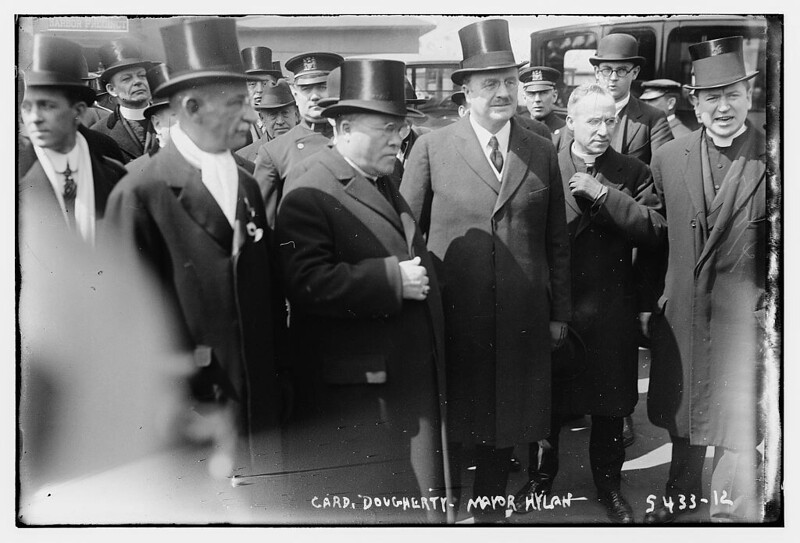
A large group of clergy rode with the Cardinal on the train to New York – among them, Bishop Crane and Reverend Hugh Lamb (another future assistant bishop and pastor of SFDS who would manage the Philadelphia end of things from SFDS when Cardinal Dougherty participated in the 1939 conclave). Upon arrival, they were met by representatives of “the Mayor’s Committee for the Reception of Distinguished Visitors.” Then, “Headed by a squad of motorcycle police, the Cardinal’s party entered automobiles at the station, which were provided through the courtesy of Rodman Wanamaker (heir to the Wanamaker’s Department Store fortune), of New York, and were driven to Pier 57, where the Lorraine was docked. It was precisely 10.30 o’clock when His Eminence boarded the ship. As the Cardinal strode down the gangplank of the liner he faced a battery of cameras and motion picture machines, and at the request of the photographers posed for pictures.”

The Very Rev. Joseph A. Whitaker, S. T. L., chancellor, accompanied Cardinal Dougherty to Rome as his assistant, and Cardinal Begin, the Cardinal-Archbishop of Quebec, travelled to the Conclave as a fellow passenger aboard the same ship. Bishop Crane would return to Philadelphia to keep things running until the cardinal’s return.

Cardinal Dougherty “graciously” granted more newspaper interviews in his stateroom once aboard, admitting that “It is very improbable that we shall reach Rome in time to enter the Conclave, the likelihood being that by the time we arrive a new Pope will have been elected.” The cardinal’s pessimism was justified: the record speed for a transatlantic crossing was 4.5 days and the conditions this time were not ideal. It had snowed heavily through the night, the snow was predicted to continue with gale force winds, and news reports alarmed “many ships caught in worst storm of years along coast.”  (The blizzard would later be memorialized as the “Knickerbocker Storm,” after the roof of the Knickerbocker Theatre in Washington DC, collapsed under the weight of snow on the evening of January 28, killing 98 people and injuring 133)

U.S. Weather Bureau Weather map for United States East Coast January 28, 1922 (wikimedia)

At 11:30 AM, the newspaper men were shooed away, the decks were cleared, then, finally, “The shrill notes of the siren announced at 12 o’clock that the Lorraine, was departing and at that time she left the port of New York,” scheduled to arrive at Havre in France on February 5.

Cardinal Dougherty and Cardinal Begin received the news of the new Pope’s election by radio a week later while still at sea. By then it was predicted that after arriving at Le Havre they would reach Paris on Tuesday, February 7, and Rome on the 9th. So it was Bishop Crane of St. Francis de Sales who, on February 6, 1922, announced to the Philadelphia archdiocese that “‘Habemus Pontificem.’ With profound gratitude to God, we announce to you the glad news that a successor to the late Pope Benedict XV has been elected in the person of His Eminence, Achille Cardinal Ratti, Archbishop of Milan, who has chosen the name of Pius XI” and reminded the clergy “P. S.—Please remove mourning draperies from the church and have this letter- read at all the Masses on Sunday, February 12. “+M. J. C.”

Cardinal Dougherty was not the only one to miss the Conclave. In total, three Europeans were ill; the Brasilian cardinal knew he didn’t have time to get there and didn’t attempt the journey; and the two Americans and the Canadian tried but didn’t arrive in time. Of the fifty-three cardinals who were able to vote, thirty were Italian; five French; four Spanish; three German; two each from the United Kingdom, Austria, and Poland; and one each from Belgium, the Netherlands, Hungary, and Portugal. (By contrast, in 2025, the 135 cardinal electors eligible to vote for the successor to Pope Francis now represent seventy one countries spread across Europe, Asia, Africa, Oceania, and all of the Americas).

Some placating was, apparently, in order when Cardinal Dougherty returned to Philadelphia on April 1. Bishop Crane arranged for him to be met in New York by a large reception committee of clergy and distinguished laity – among them Bishop Crane, Reverend Hugh Lamb, various current and former SFDS assistant priests, and several SFDS parishioners including Thomas Slattery (one of the Sponsors at the blessing of the church bells in 1916), Timothy Wholey (who donated the statues of St. Anne and St. Francis de Sales to the parish), and Joseph Durkin (early pew-holder) — among many others from around the city. When the cardinal’s train pulled in to Broad Street Station in Philadelphia, he was greeted by cheering, flag-waving crowds, city dignitaries, a squad of police, a full military band, a procession of flags, and several hundred Knights of Columbus marching before him in procession.

In a fulsome speech at the Cathedral, Bishop Crane carefully framed the trip as a victory:

“After witnessing the magnificent demonstration along the Parkway and looking into the happy and contented faces of this immense congregation, need I tell Your Eminence that throughout the length and breadth of this diocese there is universal rejoicing tonight upon your safe return to your beloved people, both clergy and laity. When the death of the late and lamented Pope Benedict XV was announced to a grief-stricken world, you promptly obeyed the call of the duty which belongs to your exalted office. You at Once made speedy preparations for the journey to Rome. On that stormy Saturday morning when you left your home to board the steamship La Lorraine, you were accompanied by the. prayers of your loyal and faithful children…We had hoped against hope that the deliberations of the Conclave might be prolonged so as to enable you to take part in the election of the successor to the saintly Pope Benedict XV. Rut on account of the long distance to the Eternal City and the brief, duration of the Conclave you were doomed to disappointment. We shared in your disappointment…” However, “You had the unique honor of assisting at the Coronation of the new pontiff; you had the intimate privilege of private conversation with him. It put you in close touch with the aims, the aspirations and the ideals of the Chief Shepherd of Christ’s flock on earth. Yours was a splendid opportunity of welding even closer, if possible, the ties that bind this diocese to the centre of unity, the Holy Roman Apostolic See…”

Bishop Crane’s speech was followed by another lengthy address, highlighting every important moment thus far in the Cardinal’s illustrious career, culminating in his personal audience with the new Pope.

Curiously, there’s a postscript. A few years later, in 1927, Cardinal Dougherty felt a need to use the Catholic Standard and Times to publicly denounce an obscure news item that he said he had recently been shown. The Catholic Standard and Times offered the background, that “A copyrighted Universal Service cablegram dated at Rome, September 19, and published in a local paper (where?) on September 20,” had reportedly claimed that, “…only the Pope’s intervention dissuaded Cardinal Dougherty, of Philadelphia, from offering his resignation as a Prince of the Church in 1922” after he was unable to participate in the conclave “although he used the fastest ocean liner and although the special train placed at his disposal by the Italian Government made the trip from Naples to Rome in record time…” The Catholic Standard and Times then emphasized that “His Eminence Characterizes Recent Newspaper Articles, That There Was Opposition to Sacred College Meeting in Conclave Before Arrival of American Cardinals, as Falsehood Out of Whole Cloth and as Calculated to Do Harm.”

The news item that infuriated the cardinal was not widely circulated and does not appear to have been archived, but it seems to have hit a sensitive nerve. One detail stands out, however: Cardinal Dougherty should have recalled that his ship had docked at Havre in 1922. It was the other American, Cardinal O’Connell of Boston, who landed in Naples then raced across the country, heartbreakingly arriving at the Vatican just one hour after the doors had been sealed. At the time, it was reported that Cardinal O’Connell’s “fortitude and resignation in a most trying situation” were “commented upon favourably by all the Italian newspapers” – which is an entirely different use and meaning of the word “resignation”! Cardinal O’Connell certainly could have had reason for despair: due to the unpredictability of travel, he had likewise arrived a day late and was shut out of the previous conclave in 1914. One of the first acts of the new Pope in 1922, was to extend the travel period before future conclaves to make it more feasible for non-Europeans to participate.

The 1922 conclave was notable for another reason, when it was reported that “For the first time in history women will be permitted to be present in the quarters occupied by the conclave. They are Sisters of Mercy, who will preside over the destinies of the cardinals’ kitchens, which heretofore have been supervised by monks.”
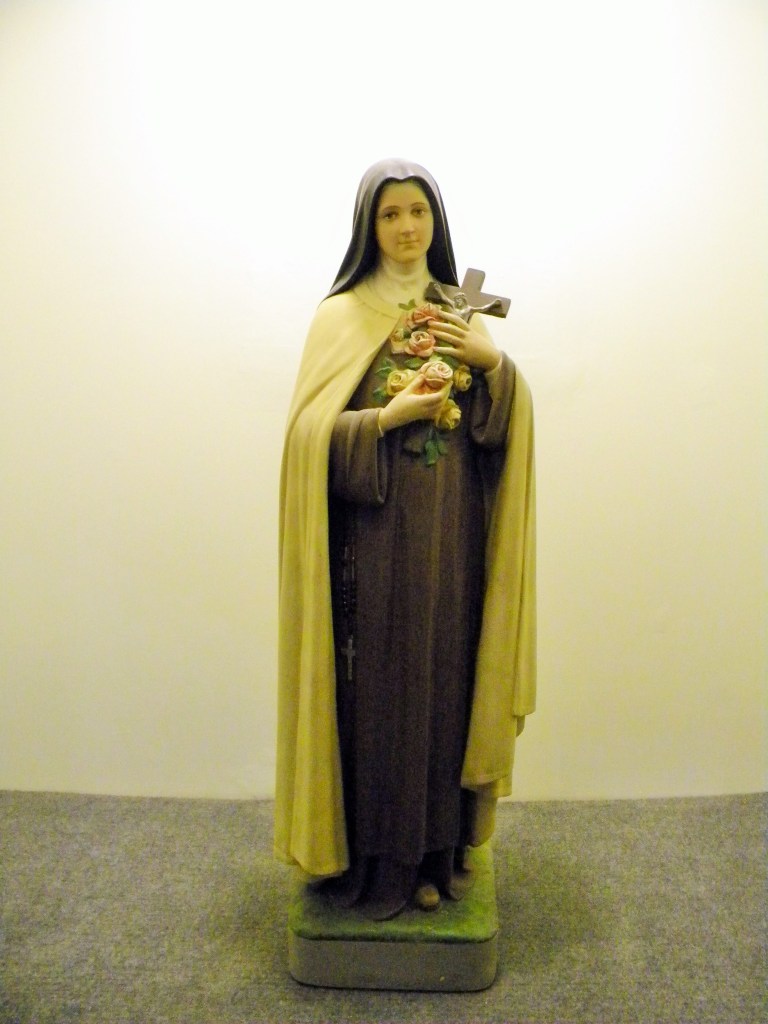
Canonization of St. Thérèse

When “Sister Teresa, Carmelite Nun of Lisieux, generally known as the ‘Little Flower of Jesus,’” was canonized on May 17, 1925, our second pastor, Bishop Crane, was not personally present at the event, but still managed to have eyes at the Vatican!

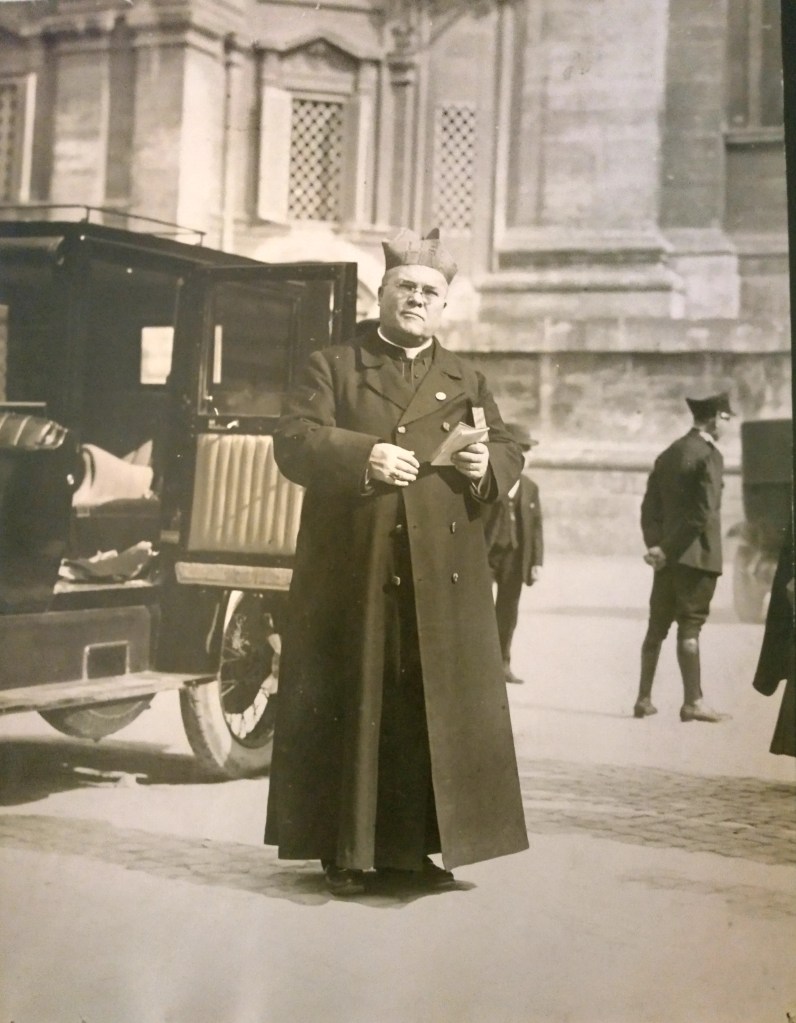
Catholic News Service reported that “The canonization ceremonies—the first during the reign of the present pope (Pius XI)—were carried out with all the splendor prescribed by the ancient ritual of the Church…” Philadelphia Cardinal Dougherty – Bishop Crane’s boss — was among the cardinals and bishops in the magnificent procession. Viewers included “twenty-one members of various royal families of Europe; the sister, nephew and cousin of the sovereign pontiff, and a multitude, estimated at sixty thousand persons.” CNS reported that among those “given places of prominence were: Timothy Healy, Governor General of the Irish Free State…; John Coyle, of Philadelphia (president of the American Catholic Union and Private Chamberlain to His Holiness by Pope Pius XI), and Miss Langton, niece of Bishop Crane, Auxiliary of Philadelphia”.

The latest in technology made the ceremony accessible: when the Pope “pronounced the words whereby the new saint is formally proclaimed” it was reported that “Due to the installation of microphones and four amplifiers—the first time such installation has been made in St. Peter’s—the voice of the supreme pontiff could be heard in all parts of the vast edifice.” An ancient tradition made it memorable: “A custom, which has lain dormant since the downfall of the temporal power of the popes, in 1870,” was revived so that “the outside of the Basilica of St. Peter was brilliantly illuminated” by “Five thousand large lanterns and twenty five hundred torches…replicas of those used in former days, specially reconstructed for the purpose…At first, it was proposed to substitute electric lights for candles in the lanterns and the torches, but this suggestion was rejected because one of the most picturesque features of illumination is the blowing of the flames in the breezes, which always play about the great dome…When the hour for the illumination arrived, the first of the “sampietrini”—the personnel attached to the basilica—stationed at the top of the cross, lighted the first torch, crying out as he did so: “In nomine Patris, et Filii et Spiritus Sancti”. Almost instantaneously, 7,500 torches and lanterns, tended by his 300 assistants, burst into flame, and the outlines of the great basilica were etched in fire against the dark background of the heavens….” A report says that “Cardinal Dougherty, Bishop Schrembs, of Cleveland, Bishop Gallagher, of Detroit, and Bishop Turner, of Buffalo, viewed the spectacle from a terrace in front of the residence of Cardinal Sincero.” We don’t know where Miss Langton sat for this!

Meanwhile, back in Philadelphia, the SFDS Parish Monthly Bulletin reported Bishop Crane’s plan to dedicate a permanent shrine for St. Thérèse in a new basement “Lady Chapel” of our church on the day of her canonization. “In preparation for this a novena will be conducted on the afternoon of Sunday May 10” followed by devotions each day at 4 PM and 8 PM. “A beautiful statue of the Little Flower has been secured (located today in the former confessional on the parking lot side of the church) and this will be unveiled and blessed at 4 o’clock on the afternoon of May 17…” The Parish Monthly Bulletin published a request “to secure sufficient old gold and silver to have made up a reliquary to hold the relic of St. Therese. Those who have old articles of jewelry, watches, rings, etc., silver plate, spoons, etc., are asked to submit them with their intention that they may be incorporated into the Reliquary.” (Novenas featuring the relic were held regularly for the next few years. We do not know what became of the relic upon the death of Bishop Crane).

Miss Stella Langton returned triumphantly from Rome on 29 June, and Bishop Crane went out on the U.S. Coastguard cutter to meet her. Never in the best of health, “The bishop climbed the rope ladder from the cutter’s deck to that of the Ohio, arriving safely amid the cheers of passengers who lined the rails.” Mission accomplished!

Archbishop Dougherty’s Big Trip

Before digital media and modern tech, when the world moved at a more stately pace, an overseas trip was a major undertaking – especially if an honor would be received at the other end. Accounts of Archbishop Dougherty’s journey to Rome in 1921, to be installed as a cardinal, focused largely on getting there and back!

The Philadelphia Inquirer recorded the expedition’s start: “Entering an automobile” (still somewhat exotic transport) at 7:30 AM sharp on February 19, 1921, Archbishop Dougherty “was accompanied to Broad Street Station by Monsignors Nevin S. Fisher and Michael J. Crane (our second Pastor, also travelling). In the line of march which escorted him to the station was a bodyguard of mounted policemen, a detail of Fourth Degree Knights of Columbus, representatives from other Catholic orders, a band, and color guard. The guard carried the papal colors of gold and white and the American flag. Two cadets from the school of St. Francis de Sales Church, Edward Lipp and Edward Walsh, bore the colors.” And that was only the beginning.

A Catholic News Service reported that, including our Msgr. Crane, “Four hundred clergymen and laymen of Philadelphia accompanied Archbishop Dougherty to New York… Seven special (train) cars were required to bring the big delegation to Hoboken…” where “Thousands of men and women who awaited his arrival at the pier knelt as he passed through their midst to the vessel and when he reached the decks hundreds of others greeted him and filed up to congratulate him and kiss the episcopal ring…” It noted “When the visitors had gone ashore Archbishop Dougherty stood on the starboard side of the liner amidships… Just before the liner pulled cut, at a given signal, came the parting salute of flowers. The red carnations worn by the Philadelphia party, roses, violets and orchids were thrown in the air and showered down on the smiling prelate as the Niew Amsterdam moved out into the river.”

As to accommodations for the week-long voyage, the Inquirer noted that “An altar has been set up on board the vessel and His Grace will read mass each morning. A private dining salon has been set aside for the use of the party. According to the Catholic Standard and Times, “While the vessel was crossing the Atlantic, the Archbishop delivered an address on Washington’s birthday, eulogizing the ‘Father of Our Country.’” Upon arrival in France on February 28, “the party was greeted at Boulogne by a delegation of Knights of Columbus… and a group of prominent French Catholics, who escorted the Archbishop to Paris.” The Philadelphia group then continued to Rome on a special train, where, finally, “amid ceremonies of stirring solemnity and grandeur, Dennis Cardinal Dougherty received from Pope Benedict XV on Thursday. March 10, 1921. the full insignia of his exalted rank as a Prince of the Catholic Church.”

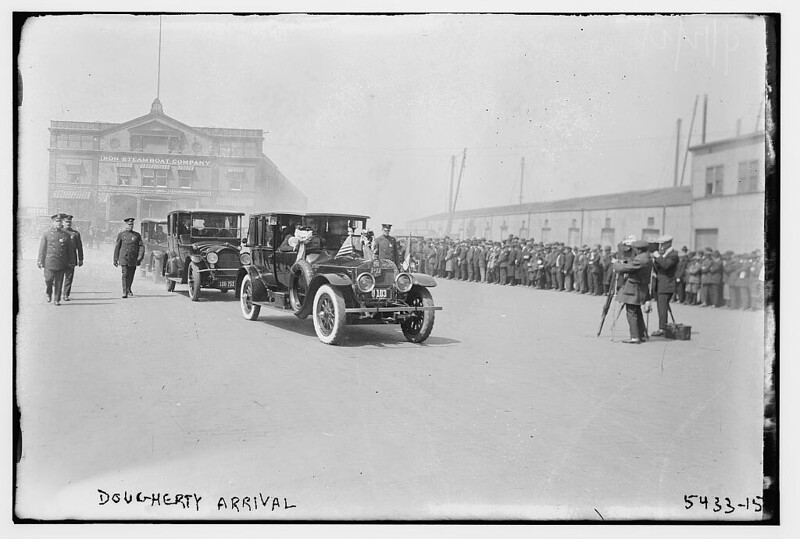
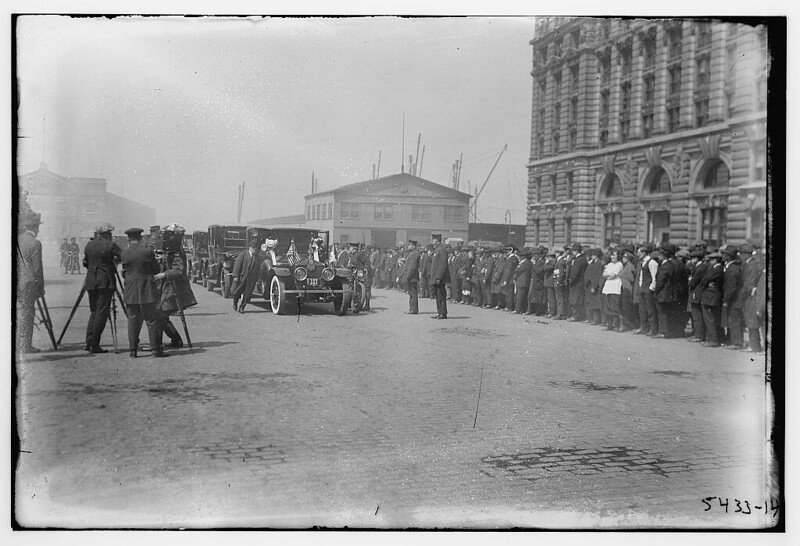
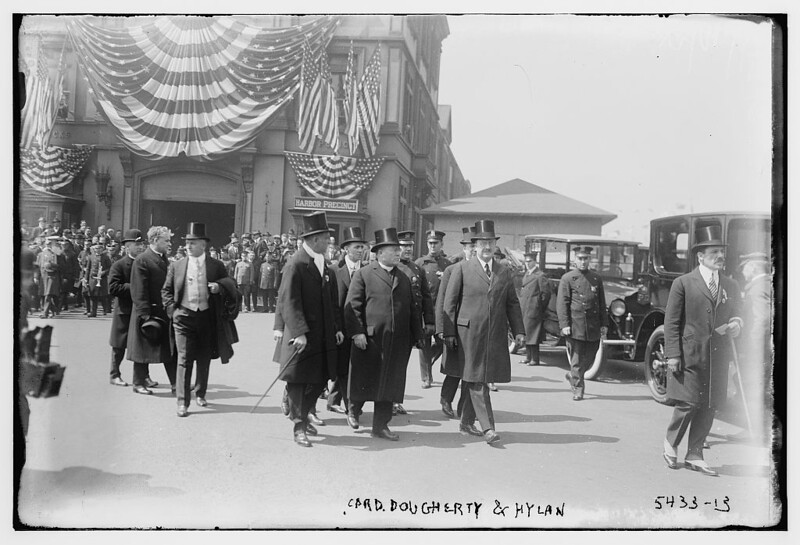
Coming home, the new Cardinal sailed from Paris on April 6, aboard the RMS Olympic (a sister ship to the Titanic, reportedly just as luxurious, but less moist), “accompanied by his party of clergy and laity who had escorted him to Rome…” Arriving in New York, April 13, he was greeted onboard by dignitaries. Then, “During his passage up New York Harbor…the Cardinal was cheered by thousands…hundreds were congregated around Pier A, where the boats docked, and the street along which the automobile procession was to pass was dense with people for several blocks…The Cardinal and his party left Pennsylvania Station in two special trains the following evening at 6 o’clock… The train bearing His Eminence arrived at North Philadelphia Station at 8.05 o’clock” where he was greeted by “Bishop Rhinelander, of the Protestant Episcopal Diocese of Pennsylvania, and Rabbi Krauskopf. of Keneseth Israel Synagogue. Clad in the robes of his high office, the Cardinal rode down Broad st. on which, for almost 10 miles, from Logan to extreme South Philadelphia, more than half a million citizens of all races and creeds greeted him with hymns of thanksgiving, deafening cheers, pealing bells and the stirring strains of music. Through this long human lane, amid sputtering red torches and spotlights, under triumphal arches, proceeded 150 automobiles carrying silk-hatted dignitaries of the city, the Church, and the professions in the special escort to the Cardinal…” And he hadn’t even won a Superbowl!

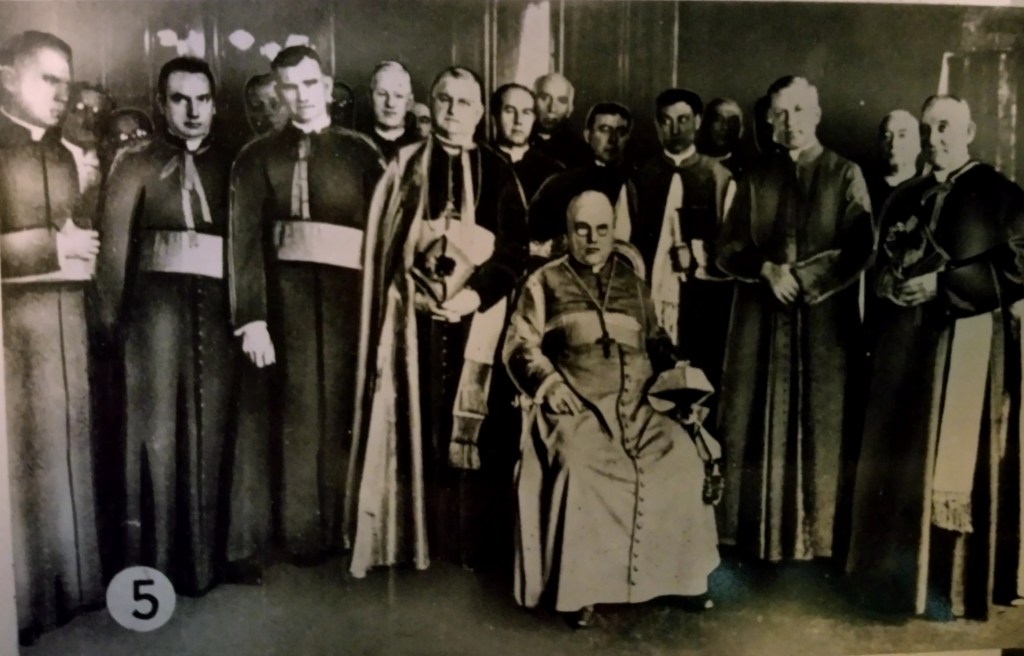
“In this picture the Cardinal-elect sits in the parlor of the American College, Rome, awaiting the visit of the Vatican Emissary to give formal notice of his elevation to the Cardinalate. Figures in the front row from right to left are : Msgr. Patrick J. Supple, a classmate from Boston; Msgrs. Grosso and Respighi, Papal Masters of Ceremonies; Msgr. McCullough, Philadelphia; Bishop Allen, Mobile, Ala.; Msgrs. Fitzpatrick and Crane, Philadelphia; Msgr. O’Hern, rector, and Msgr. Mahoney, spiritual director of North American College.” (Funeral booklet for Cardinal Dougherty June 1951)

Arrival back in New York, April 1921 (Library of Congress, Prints & Photographs Division)

A Sister Named Francis de Sales

The St. Francis de Sales Parish rectory often helps people trying to  research family history through parish birth, marriage, or death records, but every now and then, there’s an unusual request —  as when someone, last year, hoped to find out about a long-ago religious relative who simply shared the same name as our Parish.

Jeannie obligingly checked our books and found no record here of a Sister Francis de Sales. Monsignor Joe, who happened to be in the office, thought the address on her death certificate — 225 North Camac Street (near today’s Convention Center) – might be the historic home of the Visitation Sisters when they first came to Philadelphia. With that clue, we spent a pleasant morning pooling our knowledge and resources to uncover an interesting corner of Philadelphia history.

david (3)
St. Francis de Sales institutes the Order of the Vistiation with St. Jane Chantal in 1610 (detail of a window by Nicola D’ascenzo. St. Francis de Sales Church, Philadelphia).

The Sisters of the Visitation were founded in Savoy (France), in 1610, by St. Francis de Sales and St. Jane Chantal, as shown in the middle long window on the 47th street side of our church. The order opened a monastery in the United States, in Mobile, Alabama, in 1833. In 1898, they were invited to start a monastery and school in Mexico, where they were joined by several Mexican Sisters – among them, a young Mexican-Italian woman named Sister Francis de Sales Bortoni.

Political unrest in Mexico in early 1926 endangered the American Sisters and they fled back to the United States, bringing the Mexican Sisters with them as part of the community. It was a difficult time for everyone, and a letter from one of the Sisters  reported “When our community was forced to leave Coyoacan under such painful circumstances our dear Sister Francis de Sales contracted a severe cold…from that time we noted a decline in her health…”

Sister Francis de Sales made her final vows later that year in the crowded Alabama convent, while the Mother Superior was “in Philadelphia preparing a home for our exiled family.” That October, the Sisters moved in to a property on Camac Street (where the order had run a mission and school from 1848 to 1852, which closed during a period of anti-Catholic riots), under the protection of Cardinal Dougherty, who headed the Philadelphia Archdiocese. The Cardinal decided that the nuns, who had been teachers, would not open a school in Philadelphia because the Mexican sisters did not speak English; instead, they would live in a cloister as contemplatives.

The letter offers clues about that life, noting that Sister Francis de Sales had special devotions for “our dear Lord in the Blessed Sacrament and for Our Lady of the Rosary.” Although she was aide “in the Sacristy and in the Dispensary for short periods, and also in the woolen wardrobery, our dear Sister did such exquisite embroidery that during the last years of her life, as long as she was able, she worked for the Service of the Tabernacle.” She never recovered, however, from that initial illness, and eventually, she was diagnosed with tuberculosis: “her heart action became very painful and her sufferings from asphyxia were heartrending” but she united “her sufferings to those of our Blessed Lord” and claimed her soul was “in perfect peace” when she died at age 35.

The Camac Street location was unhealthy, and around 1940, Cardinal Dougherty became concerned that many of the sisters were tubercular. This was a common, deadly, contagious illness in those days: antibiotics were not available to treat it until the late 1940s (Reverend William Canney, of SFDS, died of tuberculosis in 1936) and “fresh air” was the chief treatment. When the order shrunk from 44 to 28 members, the Cardinal found them a new, airier home next to his residence just outside the city at 5820 City Line Avenue – paid for in part with funds from his Jubilee — but by then, Sister Francis de Sales, was long dead from the disease. The Visitation Sisters remain at that address today, though the Cardinal’s residence was sold to St. Joe’s University in 2012.

social-media-standard-1600x900-v1-1

Color OUR Collections! From February 3 to 7, 2020, libraries, archives, and other cultural institutions around the world are sharing free coloring sheets and books online based on materials in their collections. Last year, our SFDS parish history archives contributed a selection of stained-glass windows and other church details to color; this year, we feature 1920s parish bulletin advertising art to click and print. Check out all the offerings – from SFDS to Drexel University to the Vatican Libraries and beyond — at ColorOurCollections.org

Cardinal Dougherty’s Scrapbook

De Sales Photos Binder 02 009Deep mysteries sometimes have surprisingly straightforward solutions.

Many years ago, Father Roland Slobogin (Pastor of St. Francis de Sales  1999-2004), was puzzled to find a meticulously compiled scrapbook of photos of Cardinal Dennis Joseph Dougherty, Archbishop of Philadelphia 1918 to 1951, tucked away at the Rectory. None of the pictures seemed to have anything to do with our parish. He wondered where did the book come from and why was it there?

Along with it was another fragile old scrapbook, in much need of conservation (and now missing in the Rectory), filled with press clippings relating to Bishop Crane, our second Pastor. Were the two books related? Bishop Crane was Assistant Bishop to Cardinal Dougherty. They had known each other all their lives: both came from the Ashland region of Pennsylvania, and they attended St. Joseph’s parish together – just a grade or two apart. When the future Cardinal was still Bishop Dougherty of Nuevo Segovia in the Philippines, he used to stay at the de Sales Rectory when he visited Philadelphia. As Archbishop of Philadelphia, in 1920, he presided at the Solemn Consecration of our Parish, and as Cardinal, in 1921, he consecrated Bishop Crane. Was Bishop Crane keeping track of his childhood acquaintance’s career?

But wait: the Dougherty scrapbook contained only photos, no articles, and half the pictures were taken in the 1930s and 1940s. Bishop Crane died in 1928 and the Cardinal presided at his funeral! Someone else must have compiled that album, but who and why?

Cardinal Dougherty was back at de Sales in 1940 to celebrate the Solemn Pontifical Mass of Thanksgiving marking our Parish fiftieth anniversary. Was the book prepared for his visit? But some of the pictures were later, and no references to de Sales appeared in its pages. The question lingered: who had a strange Cardinal fascination?

The answer arrived unexpectedly a few weeks ago, with a stack of St. Francis de Sales memorabilia, found in a collection of books purchased at an estate sale, and mailed to us for our archives.

Scan_0083We were thrilled to receive the surprise package of de Sales Night programs from the 1940s and 1950s, a 1913 event program, another from 1928, jubilee books, and more. Then, somewhere in the middle of the pile, a booklet slid out that didn’t seem to relate to our parish.

Titled, simply, “His Eminence Dennis Cardinal Dougherty,” it was well-illustrated with photos from the life of “The Great Builder” who established 106 Philadelphia parishes. The accompanying text was a sermon – the eulogy for the Cardinal’s funeral — by the Most Reverend Hugh L. Lamb , D.D.

Suddenly, everything fell into place: our fourth Pastor, Bishop Lamb (at SFDS from 1936 to 1951), was Archdiocesan Apostolic Administrator for a few months after the Cardinal died in 1951. As such, he would have supervised the layout of the official Archdiocesan funeral booklet – probably at de Sales rectory – and then somebody filed all the photos.

A Trip to the Movies

belmont theatre
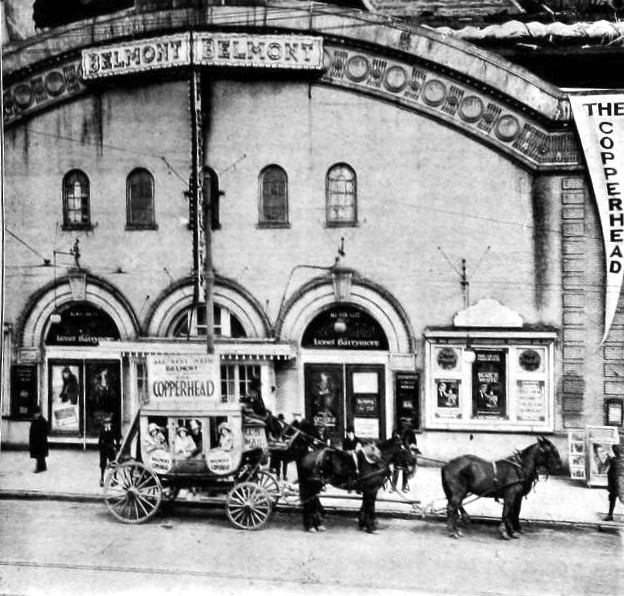
Belmont Theatre, Philadelphia PA in 1920 (Creative Commons)

The 1928 Saint Francis de Sales Parish Monthly Bulletin offers a description of a long-ago outing, supposedly written by one “Bad Boy Brady… in the Third Grade at SFDS School:”

“Our sister told us this morning in school to write…about something we did during the Easter holidays…I thought of the treat that… Joe Forte gave us on Easter Monday…Joe…lives in our parish (4839 Larchwood) and has charge of a lot of movies in West Philadelphia. He has a big green car and wears a soft hat….So one day (Father Canney) met Joe Forte in Mr. Rody’s barber shop (1213 S. 50th Street) where they get their haircut, and asked him to give the school a treat…”

“We all met at the school…and marched over to the Belmont Theatre on Fifty-second and Market Street. There were over eight hundred of us…Me and Joe Rody and Cornelius McLaughlin walked over together, and talked about marbles and baseball players. Joe said he wants to be an outfielder like Al Simmons, but Cornelius said he wants to help his father on the Ice Cream truck. I thought I would like to be a cop… A couple of cops who knew Father Canney kept the green lights on so that we could all pass across Chestnut and Walnut Streets without any break in the line. A…man named Frank Yates was in charge of the Belmont Theatre and he certainly gave us a great treat…”

Imagine friendly local police, in dark uniforms with shiny buttons, officiously stopping horse carts, delivery trucks, and Model T Fords for the neighbourhood children. The long parade filed past James Beers’ Drugstore at 47th and Baltimore, and Nace Hopple’s Radio Repair shop at 47th and Cedar; then up Cedar and along Fiftieth Street, “the head of their line of march turning into Market Street as the end approached to Pine Street” (that’s ten blocks!). The Belmont Theatre, which opened in 1914, seated 1,000 people. A trendy Philadelphia-born fast-food eatery – the Horn & Hardart Automat — was next door, and doubtless, some little faces covetously eyed its interesting prepared foods behind little clear coin-operated windows.

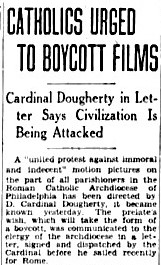
Movie treats for parish children ended in 1934 when Cardinal Dougherty issued a pastoral letter, prohibiting Catholics from attending the movies due to cinematic violence and bad language. Boycotts worked: within a few years, the industry cleaned up its offerings and the Catholic audience trickled back – but by then, Father Canney was gone.

dougherty movie boycott
Philadelphia Inquirer June 9, 1934