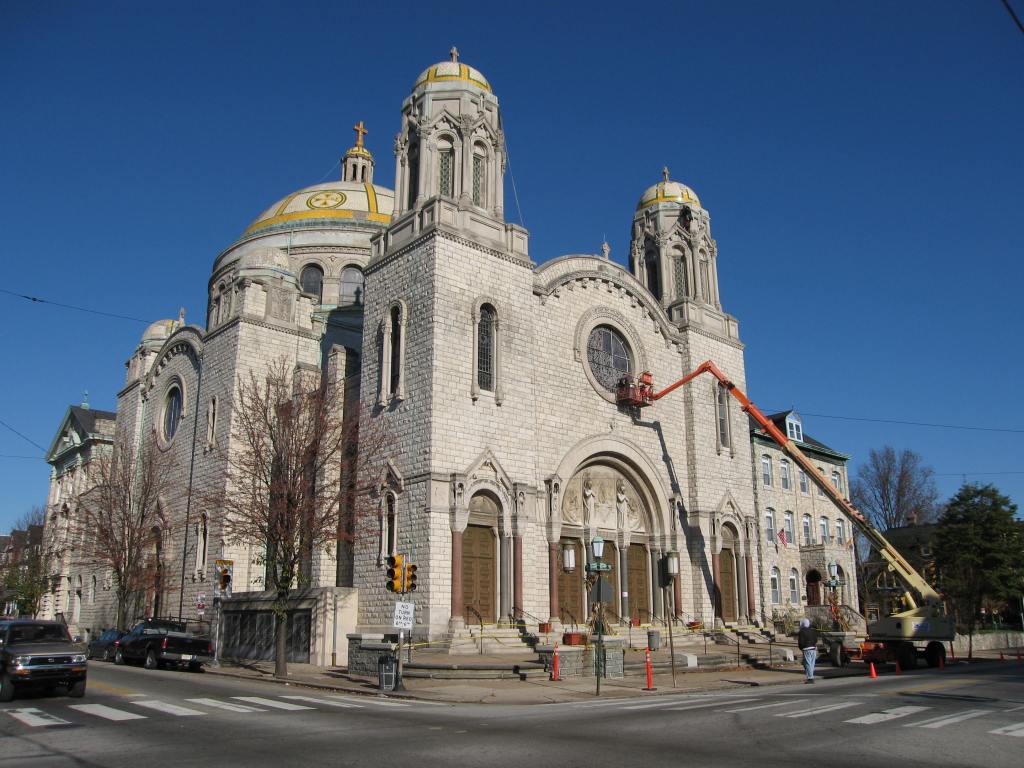
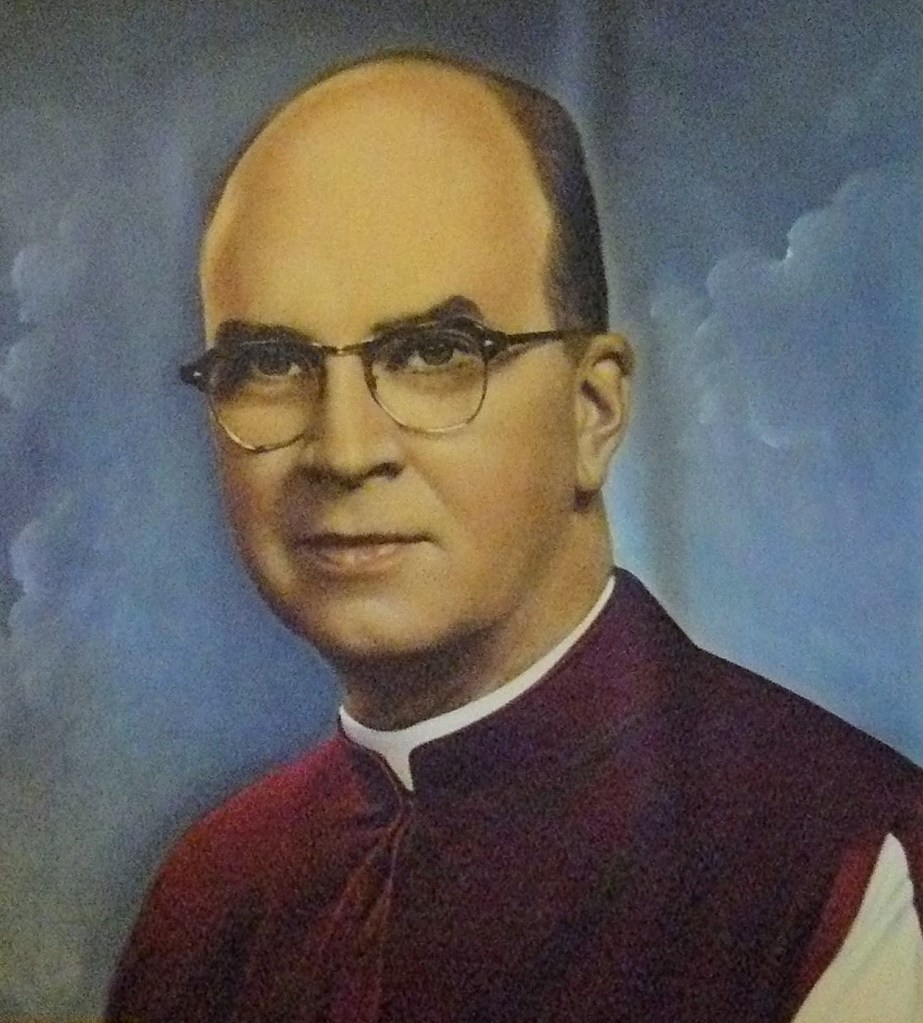
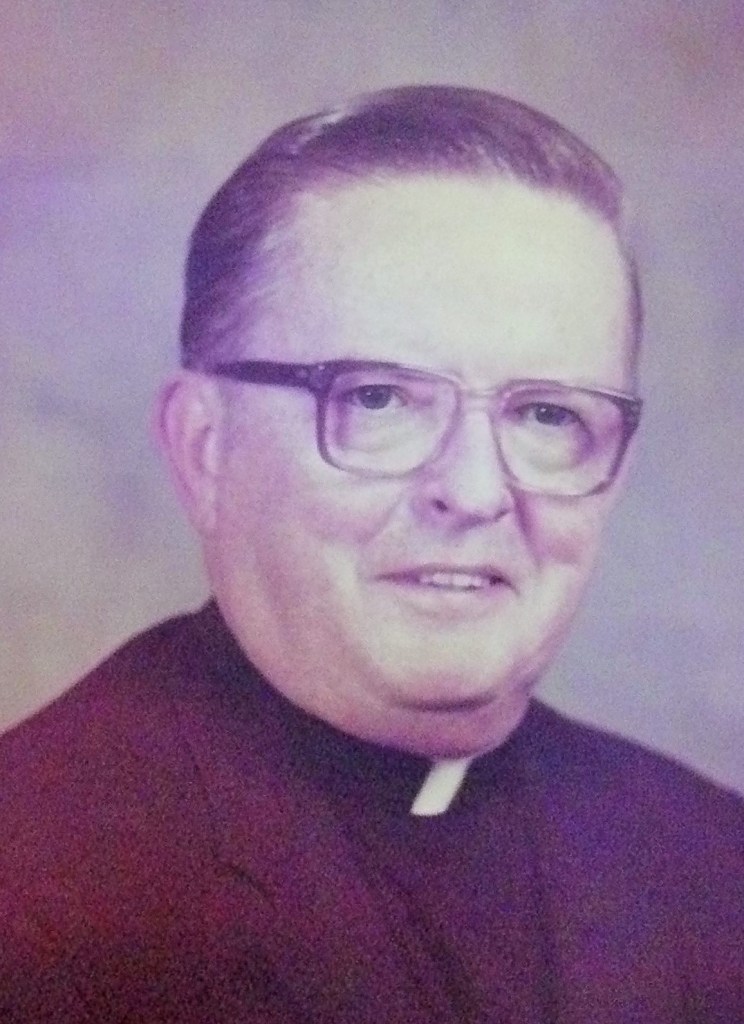
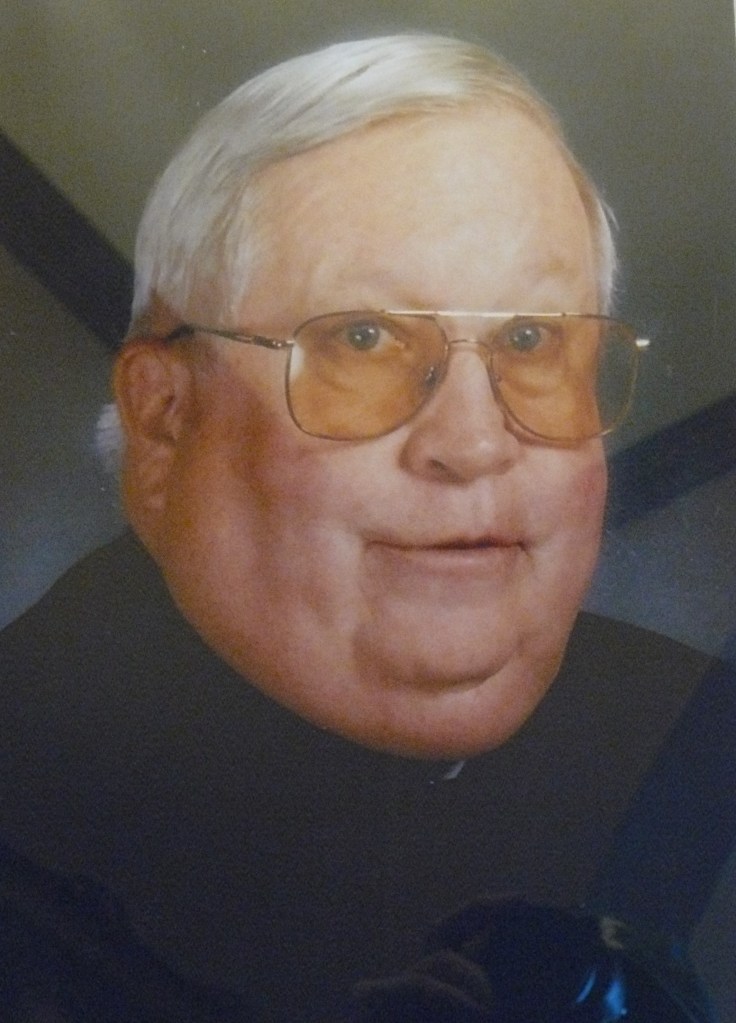
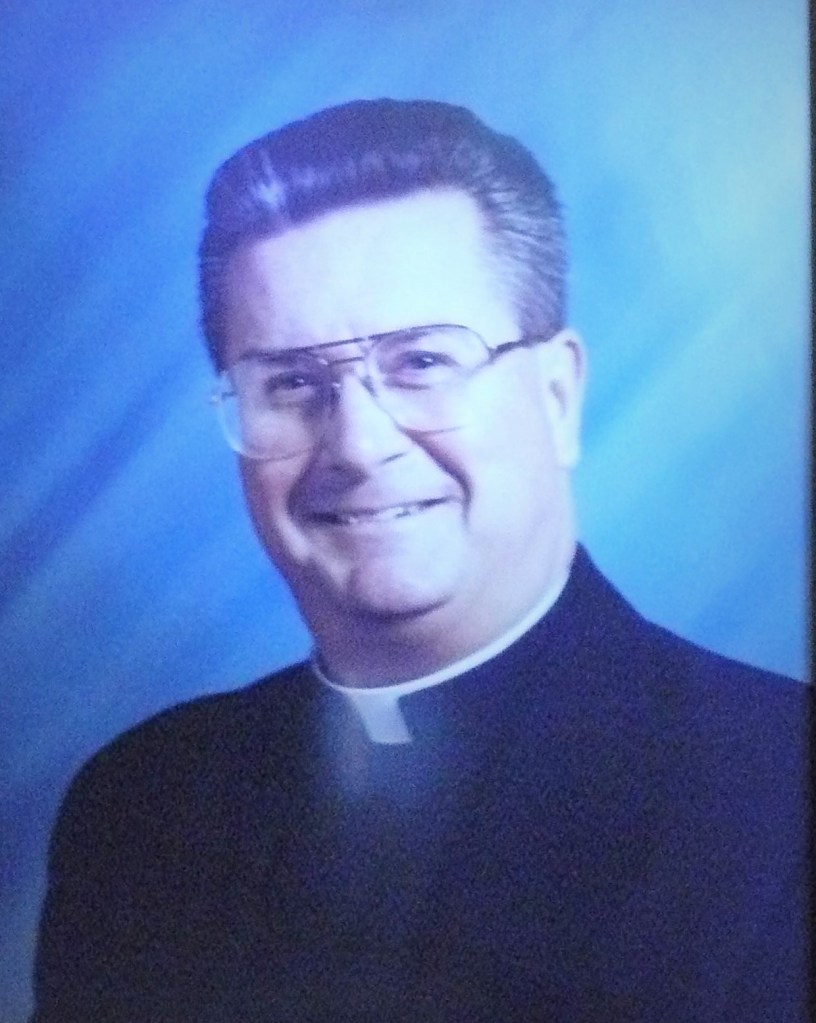
St. Francis de Sales parish is inordinately proud to have had Bishops Crane, Lamb, and McShea in its lengthy pastor lineup. Like the Three Magi in the Nativity story, the three successive bishops, 1921 to 1961, brought gifts to the parish church — of gold, in its magnificent decorations; frankincense, in its atmosphere of piety; and myrrh – an embalming fluid.
If having been home to an assistant bishop once-upon-a-time could transform a church into a cathedral, though, then Philadelphia would be a city of cathedrals! Some other Philadelphia parishes that have had Bishop-pastors include St. Malachy (Bishop Prendergast); Our Mother of Sorrows (Bishop McCort); Nativity B.V.M. Parish in Port Richmond (Bishop O’Hara); Church of the Incarnation (Bishop Benjamin); St. Helena’s in Olney (Bishop Graham); Old St. Mary’s and Holy Trinity parishes (Bishop Lohmuller); Saint Alice in Upper Darby (Bishop McDevitt); Our Lady of Fatima (Bishop Hughes); St. Colman Parish in Ardmore (Bishop Maginnis); and Saint Charles Borromeo in Bensalem (Bishop Deliman), among others.
The story of this parish is much more than the story of its long-ago episcopal royalty. Its rich musical heritage began much earlier than the bishops’ boy choirs, as early as 1902, with its first organist and choirmaster, Miss Margaret Marie Marshall. The parish was never segregated: in the 1960s, long after the bishops, it was a model for success, studied by local protestant parishes struggling with racial integration. Immigrants were always welcomed. The efforts of parishioner Betty Allen and of Sisters Constance and Jeannette at the school in the 1970s and 1980s made the parish a center for Vietnamese refugee resettlement, with immigrant ministries to refugees from around the world continuing later and in the IHM Center for Literacy and Sister Gertrude’s ministry.
It’s easy to be distracted by the glitter of elaborate pageantry and the visuals of shimmering golden mosaic and tall church windows cloaked in brilliant colours, but the reality check has always been there. Despite their magnificence, the Three Magi, or Kings, or Counsellors of the Bible story were peripheral characters — visitors — like the shepherds and sheep, coming to see Baby Jesus, who was the real attraction, lying in a manger because he “did not regard equality with God something to be grasped. Rather, he emptied himself, taking the form of a slave…” Look around the church, and you’ll see that there are no images of a kingly Christ in its impressive original decorations. Instead, you’ll see Christ as a helpless baby; as a child, working in Joseph’s workshop; and the adult Christ as a teacher, in prayer, and crucified, wearing a crown of thorns. One of the most poignant images is a humble square on the exterior of the church above the choir door, showing the Flight into Egypt, when Joseph and Mary, clutching the tightly wrapped Baby Jesus, fled the violence of King Herod and sought the kindness of strangers, far from home.
The story of the Nativity of Jesus, his ministry, death, and Resurrection, has been retold by a succession of pastors to an ever-changing congregation, each year since the parish was formed in 1890. And every year brings inspiration to see with new eyes and begin once again — much as Douglas Adams quipped in the Hitchhikers’ Guide to the Galaxy in the 1970s: “And then, one Thursday, nearly two thousand years after one man had been nailed to a tree for saying how great it would be to be nice to people for a change, a girl sitting on her own in a small café in Rickmansworth suddenly realized what it was that had been going wrong all this time, and she finally knew how the world could be made a good and happy place. This time it was right, it would work, and no one would have to get nailed to anything.” We can only keep trying.
Bird watchers like to keep a “life list” of all the different birds they’ve seen and identified. It’s a competitive activity – a long list of exotics gives bragging rights – but it also, incidentally, provides clues to the compiler’s own story and where they’ve been at different times through the years.
SFDS parish has a similar lengthy “life list” of pastors – including several bishops — that offers snapshots of the parish through its 134-year history. Perhaps it’s time to review that exhausting compilation as Father Eric moves on and Father Ryan Nguyen becomes Parochial Administrator – on the way to becoming Pastor Number Eighteen!
Here’s a quick timelapse of parish history, as told in the sequence of its pastors:
1. 1890-1903 Rev. Joseph O’Neill. Founding pastor of St. Francis de Sales. He chose thenameof the church in 1890 – probably to honour his brother Rev. Francis O’Neill, who had started to build St. James Church (38th and Chestnut. Today St. Agatha St. James) and died suddenly in 1882 . Father Joseph O’Neill picked the location and began construction of the first SFDS parish building a combination chapel/school building (today’s school hall) in 1891, and the rectory in 1893. In 1898 he was involved as a defense witness in a notorious local murder trial. He died of heart failure at SFDS in 1903.
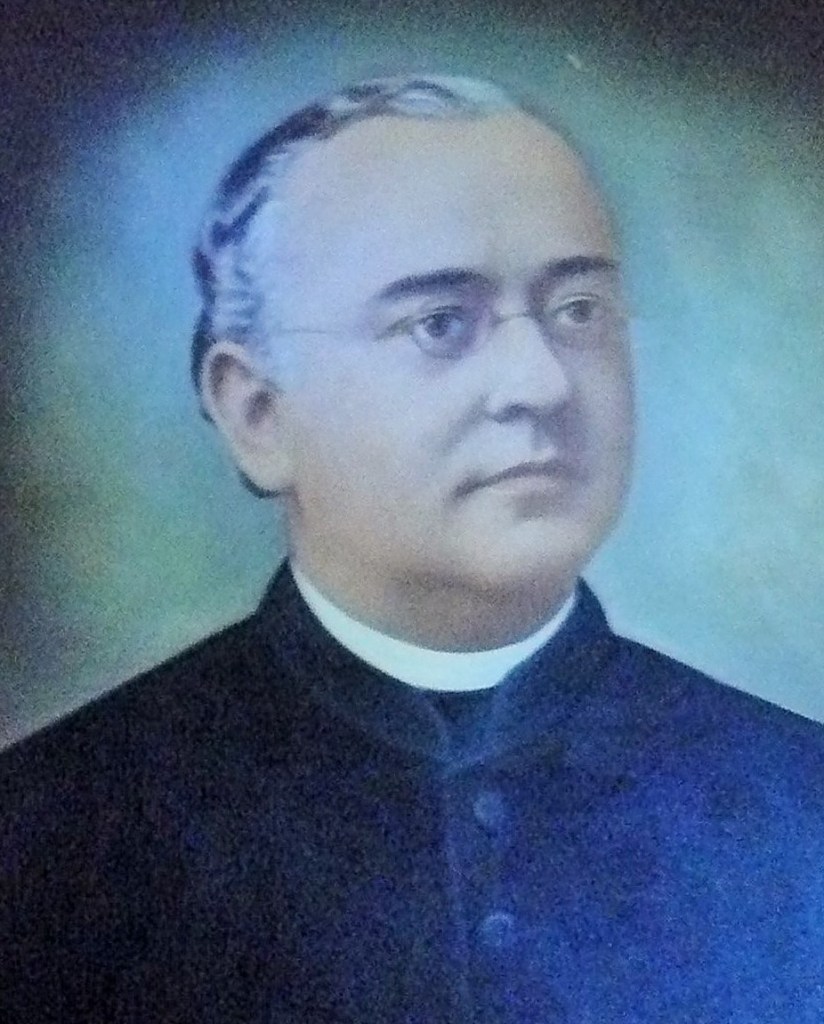
2. 1903-1928 Bishop Michael J. Crane. Reverend Crane opened the school in 1904 and built SFDS churchbetween 1907 and 1911. In 1921, he became Assistant Bishop to Cardinal Dougherty. Bishop Crane was diabetic, so Cardinal Dougherty pulled some strings to get him into Dr. Frederick Banting’s historically successful hospital trial of insulin in Toronto in 1922. Bishop Crane later built the convent and the addition to the school in 1926. He died at SFDS on December 26, 1928, and is buried on the Rectory lawn.
3. 1929-1936. Rev. Edward L. Gatens. Father Gatens is a bit of a puzzle. He came to SFDS from Pottsville, where he defiantly built a Catholic High School with a cross-shaped window atop a hill that had been used for cross burnings by the anti-Catholic Ku Klux Klan. Arriving at SFDS, he became pastor just as the Great Depression began, and struggled to minister to the many in need among his flock. He resigned, went on medical leave in 1936, and died in 1955.
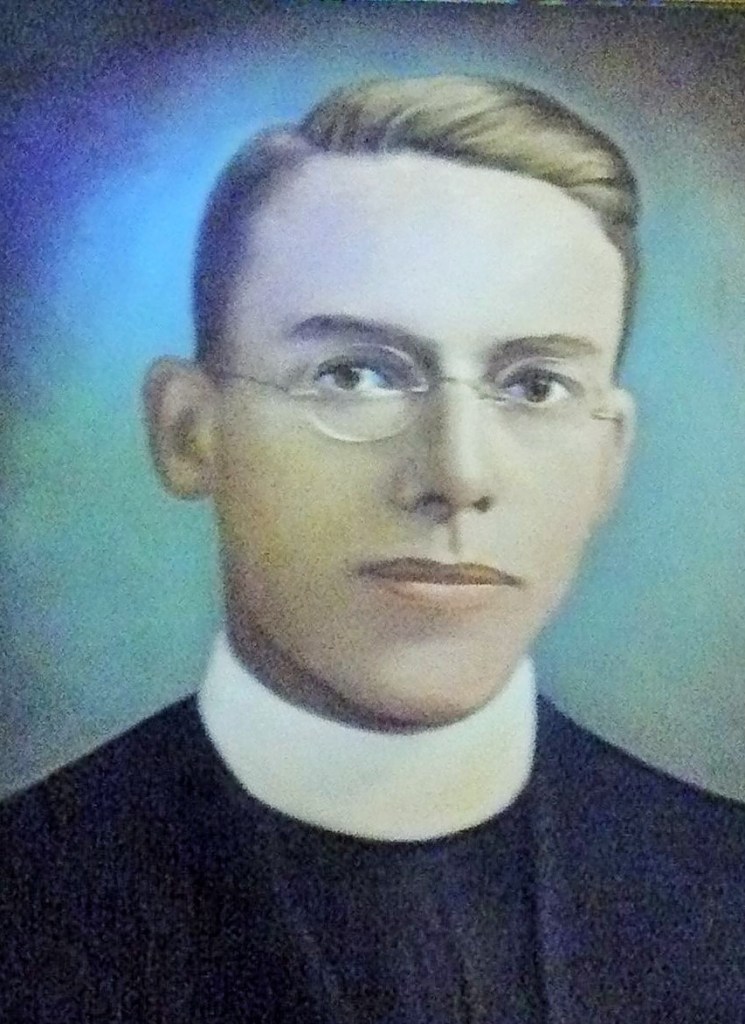
4. 1936-1951 Bishop Hugh L. Lamb. Bishop Lamb was the second of three bishops to serve as pastors at SFDS. He is remembered for radio broadcasts, expanding parish activities, paying off the parish debt, and overseeing the 1940 Parish Jubilee. In 1951, he was appointed first Bishop of Greensburg, in Western PA, where he passed away in 1959.
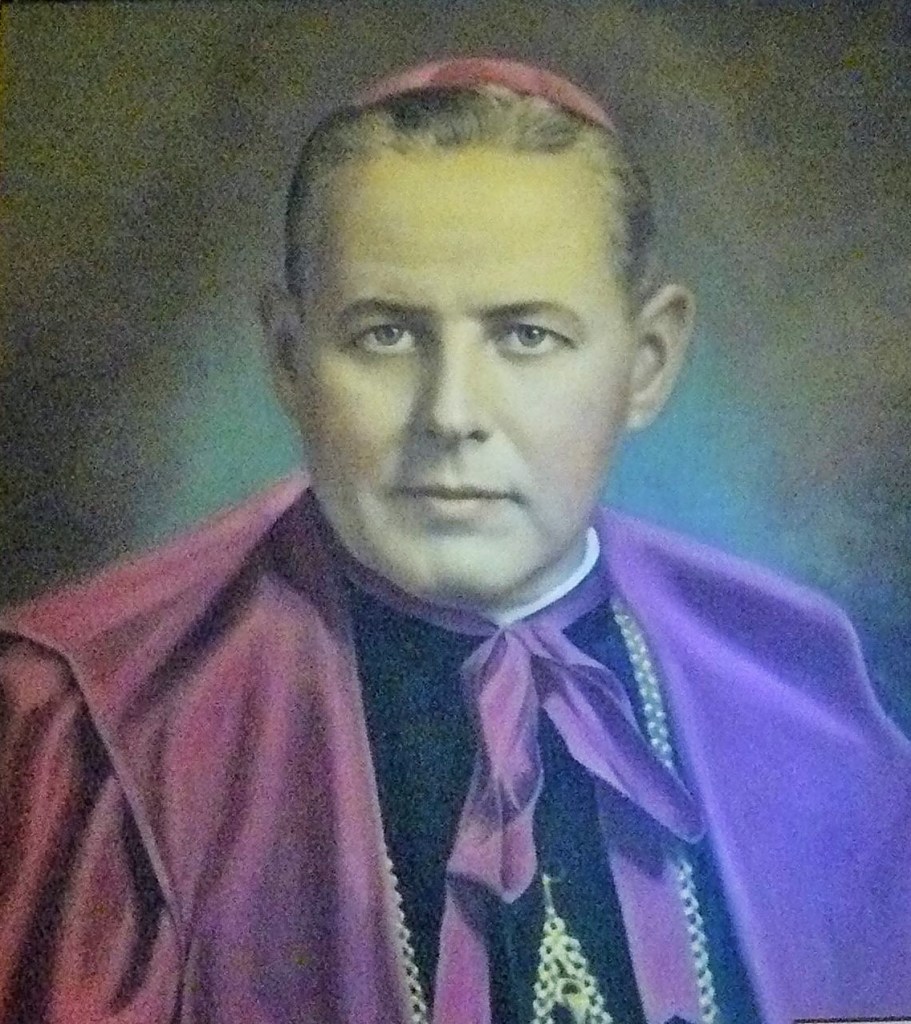
5. 1952-1961 Bishop Joseph Mark McShea. Bishop McShea was a son of the parish: in his youth, his family lived, for a time, on Farragut Terrace, right behind the school, and he served as an altar boy for Bishop Crane. His family home was one of those torn down to make room for the 1926 addition to the school. During his tenure he refurbished the Lower church and re-tiled the Guastavino domesin an unsuccessful attempt to stop leaks. In 1955, he established St. Lucy’s School for the Blind in a house on Farragut Terrace to fill an archdiocesan need (since moved to NE Philadelphia). The SFDS Boys Choir– established in 1911 – expanded and became prominent during Bishop McShea’s era. When he was appointed first bishop of the new Allentown diocese, in 1961, he took the choirmaster with him to start a new choir school there. He died in 1991.
6. 1961-1967. Monsignor John J. Sefton. Monsignor Sefton assisted at de Sales from 1945 to 1957 before returning as pastor 1961 to 1967. He left his mark on the church for its 1965 Diamond Jubilee, by replacing the original quartered oak pews with the present ones, changing the lighting, and covering the walls with blue tiles, reportedly to achieve a “Mediterranean” vibe. In 1966, Monsignor Sefton began to set up Star HarborSenior Center – “the first community of its kind in the archdiocese, a recreational center for citizens regardless of race or creed” — which opened soon after he left. Parishioners were moving to the suburbs at this time and the parish shrunk from 4,233 families in 1953 to 1,232 by 1973. Monsignor Sefton moved on to St. Charles Church in Oakview and died in 1980.
7. 1967-1976 Monsignor John T. Mitchell (Pastor Emeritus from 1973-1976). Monsignor Mitchell was known in the archdiocese for his civil rights activism and his dedication to the black community. He founded St. Ignatius Nursing Home while he was pastor of St. Ignatius Parish (43rd and Wallace). At SFDS, Monsignor Mitchell was pastor during the divisive period of the Venturi “Neon Halo” renovation, when an ultramodern Plexiglas front-facing altar was installed in the sanctuary for the New Mass of Vatican II. The SFDS Boy Choir also came to an end during this period, as musical styles changed. Monsignor Mitchell’s health deteriorated as he tried to focus on social ministry. He died in 1981 at age 67.
8. 1976-1977 Monsignor Francis J. Fitzmaurice (Parish Administrator from 1973-1976). Monsignor Fitzmaurice, who had been assisting at the parish since 1961, officially took over key administrative duties in 1973 when Monsignor Mitchell’s decline accelerated after a traumatic home invasion and robbery at the rectory. With the end of the VietnamWar, the parish began ministering to incoming refugees. Monsignor Fitzmaurice officially became Pastor for one year in 1976 – just in time for the “glorious” Eucharistic Congress in Philadelphia — before being transferred to St. Lawrence, Highland Park/Upper Darby in 1977. He died in 2004.
9. 1977-1989 Monsignor Thomas J. Hilferty. Monsignor Hilferty, who was at SFDS for twelve years, was the parish’s last long-term pastor. This was actually his first parish assignment: prior to arriving here, he had spent twenty years as a travelling Navy chaplain in the Vietnam war. During the time that he was at SFDS, the Lower Church was the archdiocesan “Mother Church” for the Vietnamese Community, with Reverend Anthony Vu Nhu Huynh as chaplain. In 1980, Philadelphia Magazine reported that “Over the last five years this parish has become one of the most successful centers for Indo-Chinese refugee resettlement in the area.” Meanwhile, a new classical choir of men and women gradually evolved in the parish under the direction of organist Bruce Schulz (who had arrived at SFDS in 1969) and choirmaster Father Hermann Behrens, a visiting German academic . Monsignor Hilferty left to become the regional Vicar of Philadelphia-South, and died in 2008.
10. 1989-1994 Rev. John J. Kilgallon. Preoccupied with the state of “this wounded and broken world,” Father Kilgallon was pastor during the lean years of the early 1990s. At that time, SFDS and MBS were both part of a “musical chairs” cluster of parishes, under study by the archdiocese as it made plans to streamline its operations. A chapter of the Knights of Peter Claver began at SFDS in 1990. The IHM Sisters also opened their Literacy Center that year, teaching English as a Second Language (ESL) classes to adult immigrant learners (moved to NE Philadelphia in 2022). He died December 26, 2024.
11. 1994-1999. Rev. Anthony W. Janton. With the parish Short of funds while archdiocesan conversations continued about its future, Father Tony tried to restore the church in simple ways – painting and stuccoing over the peeling “blue bathroom tiles” from the 1965 church renovation; finding a home in Allentown for the statue of St. Francis de Sales, which had been sitting in the parking lot, behind the dumpster, for several years since it had been removed from the church façade for safety reasons; and removing pews to create the cross-aisle linking the two side doors. The confessionals on the parking lot side of the church were turned into shrines during his tenure. Choirmaster Father Hermann Behrens died suddenly of heart failure in 1996, in a great shock to the parish, and Isabel Boston became his successor. The Assumption Religious moved from 49th Street to 1001 South 47th street across from SFDS in 1999.
12.1999-2004 Rev. Roland D. Slobogin (and 8th pastor of MBS 1996-2004). Father Roland became the Eighth Pastor of Most Blessed Sacrament Parish in 1996 and, then, also, the Twelfth Pastor of SFDS, when the two parishes were “twinned” to share a pastor in 1999. He celebrated the MBS Centennial in 2001 and closing ceremonies for MBS school in 2002. When he moved to SFDS rectory, Father Roland brought the first parish dog to live there since Reverend Crane’s Missy back in the 1920s. The annual Blessing of the Animals, near the feast of St. Francis of Assisi, began during his tenure, and originally took place inside the church. The Parish established a relationship with Partners for Sacred Places during this time and began the long, agonizingly slow, planning for church restoration.
13. 2004-2009 Rev. Zachary W. Navit. Father Navit was the 9th Pastor of MBS until its closing in 2007; the thirteenth pastor of SFDS; and the First Pastor of the combined parish of St. Francis de Sales United by the Most Blessed Sacrament. Father Navit enjoyed elaborate ceremony and was known for his lavish use of incense. The rectory garden was re-landscaped and the building restoration plan progressed slowly during his tenure as he looked for ways within the parish to fund needed repairs. Scaffolding was installed in the sanctuary and on the outside of the church during this time, due to falling masonry.
14. 2009-2011 Rev. Louis C. Bier. Father Bier was the second pastor of the combined parish of SFDS/MBS. During his brief tenure, he instituted outdoor Stations of the Cross around the neighbourhood on Good Friday and provided a birthday cake with sparklers for Baby Jesus at the Children’s Christmas Mass. His down-to-earth personal style offered a contrast to the embellishments of the traditional choir.
(2011 Monsignor Francis Beach Administrator Pro-Tem) Father Beach served for just one summer between pastors, and remembered dealing with catastrophic roof leaks in the Guastavino Dome.
15. 2011- 2016 Rev. John D. Hand. Father Hand was the pastor for the 125th Anniversary of SFDS. During his tenure, he was tasked with selling the Most Blessed Sacrament property. This enabled him to move SFDS building restoration forward, so the scaffolding in the sanctuary could be removed in 2013, after seven years. A Hispanic community moved from Divine Mercy Parish in 2013, adding a Spanish Mass to the Parish schedule in addition to the longstanding Vietnamese Mass.
16. 2016 – 2019 Monsignor Joseph Anderlonis. Monsignor Joe came to SFDS from St. George Parish, where he had served since 1982. Noticing how SFDS had suffered, due to the “revolving door” of short-term pastors in recent years, each pulling the parish in a different direction, he promised that he would never voluntarily leave – often declaring to his flock that “they’ll have to carry me out feet first.” Which, sadly, happened, when he passed away on December 6, 2019, just shy of his 50th anniversary as a priest. The Vietnamese community moved to Divine Mercy Parishin 2018.
(2020 Rev. Matt Guckin Pastor pro-tem). Father Matt arrived in February, and the church closed to the public indefinitely for Covid quarantine in March. He said prayers on Facebook; recorded Masses in the church, with a small crew of helpers, for later viewing by other parishioners online; and generally kept the parish afloat during the crisis.
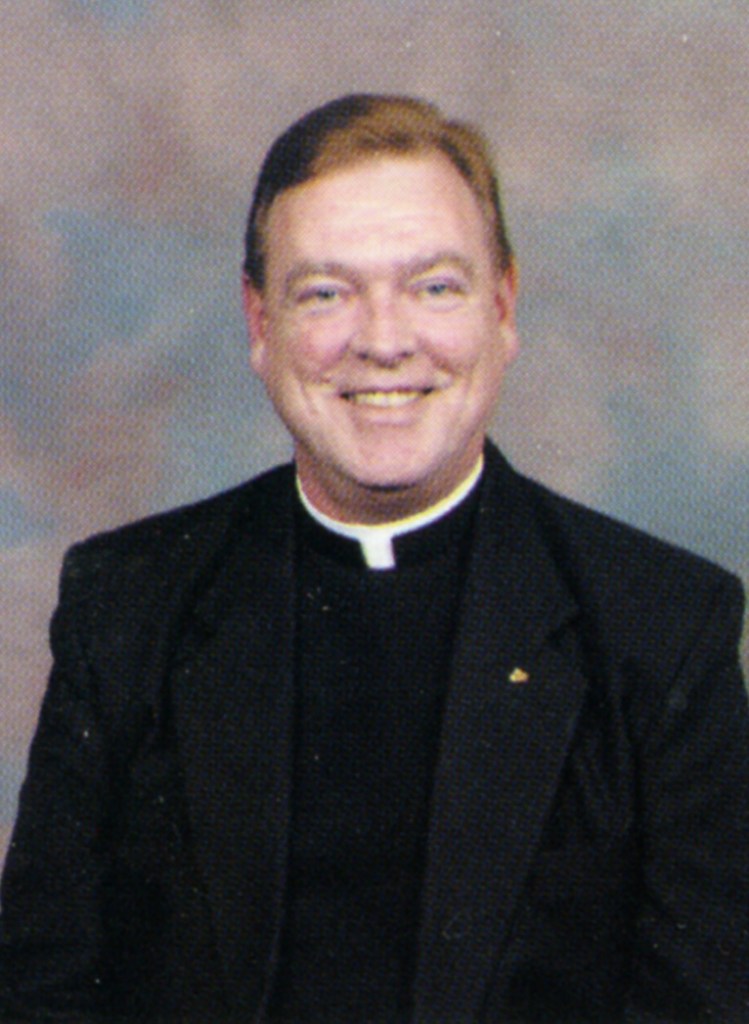
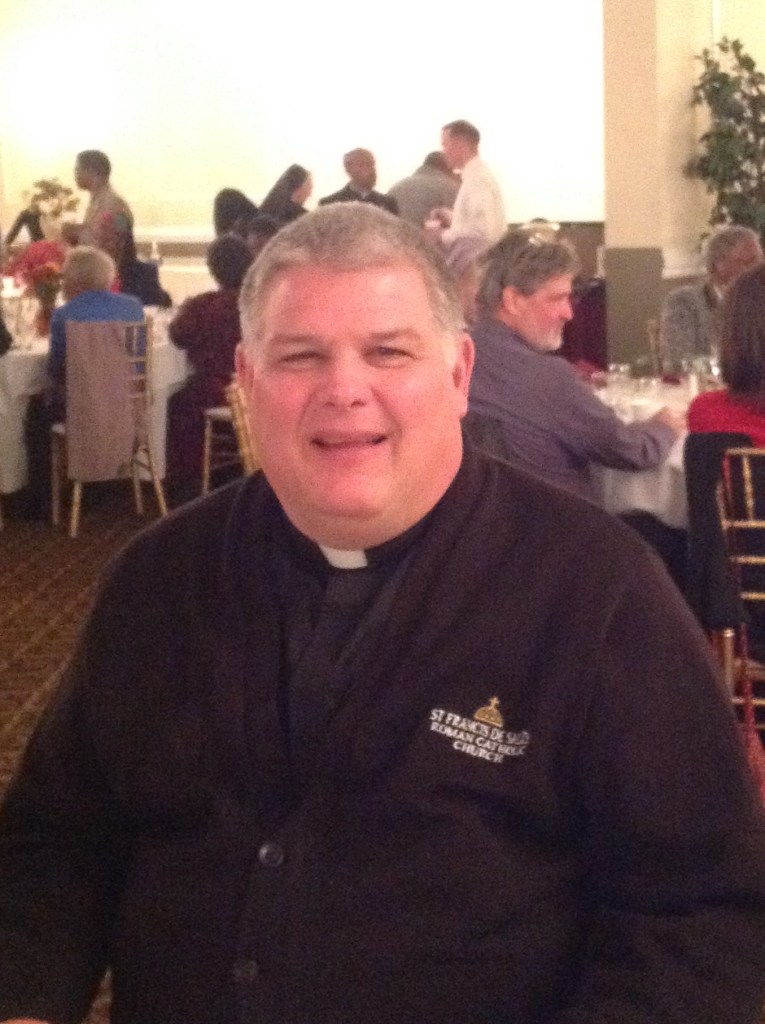
17. 2020 – 2024 Rev. Eric Banecker. SFDS was Father Eric’s first assignment as pastor. He was Administrator for a year, before being installed on the 100th anniversary of Bishop Crane’s consecration as Bishop. During his tenure, he had the scaffolding finally removed from the facade of the church after seventeen years. His Golf Classic aided funding of building repairs, which made significant progress. Working tirelessly to reshape parish organization, his goal was to transform the parish into a hub for young families and young adults of the archdiocese. We wish him well as he moves on to St. Mary Magdalene Parish in Media.
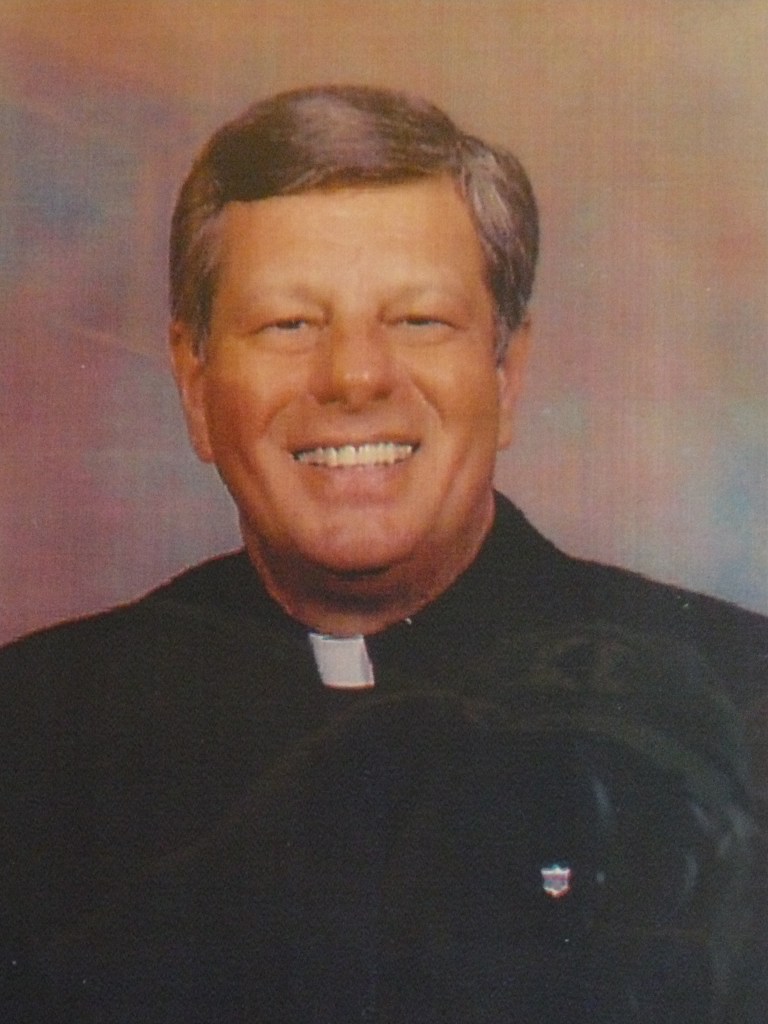
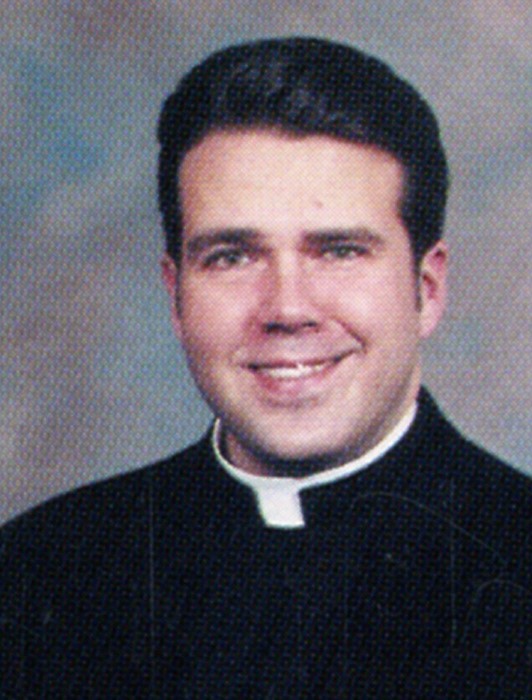
2024 Rev. Ryan Nguyen. Father Ryan, who will be joining us soon, has several odd intersections with our combined parish story. When he came to this country from Vietnam as a child in 1993, Father Ryan’s family attended St. Thomas Aquinas Parish in South Philadelphia – the parish that supplied the original chapel building for MBS when it was founded back in 1901! He later attended the University of the Sciences in our neighbourhood, where various parishioners have taught, worked, or studied. After ordination, in 2022, he was assigned to St. Bede’s Parish in Holland, PA – which had been redecorated with many of the original interior fittings of MBS, after MBS merged with SFDS in 2007. Since the Philadelphia Vietnamese community were part of SFDS for over 43 of our 134 years, it feels providential to restore that cultural connection. We welcome Father Ryan to SFDS and look forward to the notes that he will add to the symphony of our rich parish history.
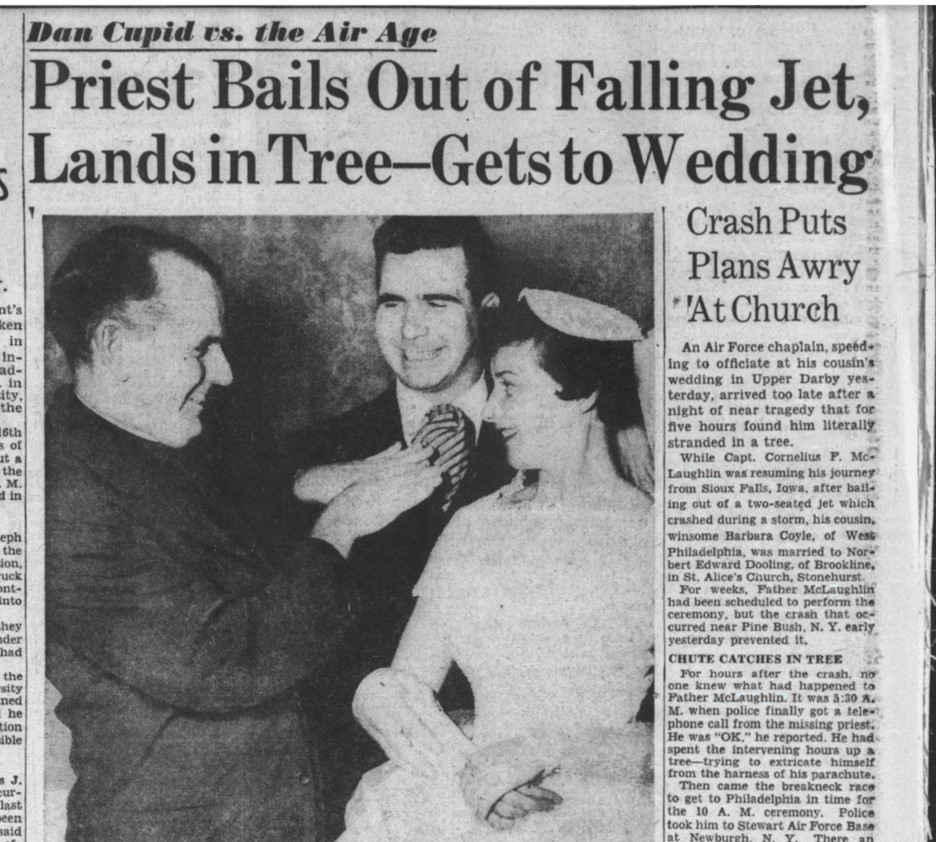
“Priest Bails Out of Falling Jet, Lands in Tree – Gets to Wedding.” Was it the sensational news headline that distracted from the original research subject on the same page, or was it the oddly familiar name of the adventurous priest, Captain Cornelius F. McLaughlin?
Rev. McLaughlin tells his tale to the newlyweds
It took a minute to place that distinctive name, then memory clicked with a smile on a small boy in a whimsical 1928 Parish Monthly Bulletin account of a children’s movie outing https://sfdshistory.wordpress.com/2018/08/06/a-trip-to-the-movies/ quoted in a history column a few years ago. “Bad Boy Brady…in the Third Grade at SFDS School,” had reported that “We all met at the school…and marched over to the Belmont Theatre on Fifty-second and Market Street…Me and Joe Rody and Cornelius McLaughlin (then about 11 years old) walked over together, and talked about marbles and baseball players. Joe said he wants to be an outfielder like Al Simmons, but Cornelius said he wants to help his father on the Ice Cream truck...” Cornelius popped up a few other times in other 1920s bulletins – in lists of altar boys, and school awards, and writing his own thank you for another movie treat
If he could have looked forward in time, young Cornelius might have been surprised by his future career and amazed by his calamitous adventure – a real-life caper as exciting as any of the movies he enjoyed!
On June 3, 1956, the Inquirer reported that Air Force chaplain Captain Cornelius McLaughlin (then age 39) was on his way from Sioux Falls IA, where he was stationed, to officiate at his cousin Barbara Coyle’s marriage to Edward Norbert Dooling in St. Alice’s Church, Upper Darby, PA, when his pilot realized that their T-33 jet trainer was running out of fuel. “Shortly thereafter, the pilot bailed out, having satisfied himself that his passenger had done likewise.” The jet crashed near Pine Bush, NY just before midnight, and “no-one knew what had happened to Father McLaughlin. It was 5:30 AM when police finally got a telephone call from the missing priest” who “had spent the intervening hours up a tree – trying to extricate himself from the harness of his parachute. Then came the breakneck race to get to Philadelphia in time for the 10 AM ceremony.” Would he make it? The Inquirer noted the first hurdle: “When New York State police picked up Father McLaughlin he was clad only in coveralls, the normal ‘uniform’ for jet flight…” so “he would have to obtain proper vestments, and quickly…After a few inquiries, the Rev. James Dalsey, of the Epiphany College in Newburgh, was willing and able to supply them…” Others helped as the race continued: “Police took him to Stewart Air Force Base at Newburgh, NY. There an obliging operations officer got Father McLaughlin a seat on a (C-47) transport plane just about to take off on a training flight. The transport landed at the International Airport here just four minutes after 10 AM. Father McLaughlin’s brother, Patrolman Martin M. McLaughlin, of the Upper Darby Police, met him there and sped him to St. Alice’s Church.”
But, as the Inquirer sadly noted, “yesterday was the first Saturday in June. At St. Alice’s, there was a wedding scheduled for 10 AM, another scheduled for 11 AM and still another scheduled for noon. Fifteen minutes was the maximum delay permissible under the circumstances. So the ceremony was already under way…when the McLaughlin brothers arrived at the church. Father McLaughlin entered the sanctuary and quietly took a seat there while Father Nolan, assistant rector of the church, performed in his stead.” All was forgiven, though, when Father McLaughlin attended the Wedding Breakfast and told his story!
Who was Cornelius McLaughlin? Baptized at SFDS in 1917, one of five children of William and Margaret McLaughlin, his family lived at 5028 Beaumont Street. He graduated from SFDS School and West Catholic High School, before entering St. Charles Seminary. McLaughlin was ordained at the Cathedral in 1945 by Bishop Hugh Lamb (who was, at the time, pastor of SFDS) and served at several parishes in the archdiocese before becoming a chaplain in the U.S. Air Force in 1952. Father McLaughlin served in the Air Force during the Korean War and remained on active duty for 20 years, earning several awards. He retired to San Diego, died in 1995, and is buried back here in PA, at Holy Cross Cemetery.
The end of the year seems to be hard on priests! Ten of our seventeen pastors have died since our founding in 1890; and of those, seven have their anniversaries within the next few weeks. This year, oddly, many of the dates happen to fall on Sundays or holy days, which feels like a sign that we should take a few moments to reflect on their special contributions to our story.
Monsignor John T. Mitchell, our seventh pastor (1967-1976), died on November 25, 1981, so his anniversary falls on Thanksgiving Day this year. He came to de Sales from St. Saint Ignatius Parish, where he founded St. Ignatius Nursing Home and was known for his civil rights activism and efforts for the black community. At de Sales, focused on social ministry, he worked to hold the neighborhood together in a time of great societal changes. The controversial Venturi neon lights renovation happened during his tenure.
Sunday, November 28 commemorates Bishop Joseph Mark McShea, our fifth pastor (1952-1961; died 1991). Bishop McShea was the last of the three bishops to serve at SFDS. He grew up in the shadow of our dome: in his youth, he was altar server to Bishop Crane and his family home on Farragut Terrace was one of those knocked down to build the addition to the school. The lower church was refurbished by the Dagit firm during his tenure, and the dome was re-tiled in an unsuccessful attempt to stop leaks. He also established St. Lucy’s School for the Blind in the building that today houses the IHM Literacy Center. Bishop McShea went on to become the first Bishop of Allentown.
Reverend Monsignor Joseph J. Anderlonis S.T.D., our sixteenth pastor (2016-2019), saw the need for stability in the parish. He promised that he would never abandon us; he’d have to be “carried out feet first.” And so he was, on December 6, 2019 – the Feast of Saint Nicholas. Monsignor Joe was our Lithuanian connection, having spent much of his career at Saint George Parish. Learned and sociable, he encouraged book clubs and educational and social gatherings to help bring our diverse community together.
Bishop Hugh Lamb, our fourth pastor (1936-1951; died 1959) has his anniversary on Wednesday, December 8, Feast of the Immaculate Conception and the official closing day for this Year of Saint Joseph. The middle of the three SFDS bishops, he is remembered for radio broadcasts, expanding parish activities, paying off the parish debt, and overseeing the 1940 Parish Jubilee. He became first Bishop of Greensburg, in Western PA.
Reverend Edward L. Gatens, our third pastor (1929-1936; died 1955), is commemorated Sunday, December 19. Rev. Gatens came to us from Pottsville, where he was known for defiantly building a Catholic high school, with a bold cross-shaped window, on the hill where the anti-Catholic Ku Klux Klan liked to burn its crosses. He arrived at SFDS just in time for the Great Depression and struggled to minister to the many in need among his flock. Due to a debilitating chronic health issue, he resigned his post in 1936.
Sunday, December 26 belongs to Bishop Michael J. Crane, our second pastor (1903-1928), who built our church and opened the school. Consecrated in 1921, he was the first of the three bishops to serve at SFDS. In addition to the church, he also built the convent and the addition to the school. Bishop Crane is buried on the Rectory lawn.
January 5 celebrates Monsignor Francis J. Fitzmaurice, our eighth pastor (1976-1977; died 2004), who was also Parish Administrator 1973-1976, when Reverend Mitchell’s health began to fail. When Father Fitzmaurice wrote his memoir for the parish 100th Anniversary, he recalled two exciting events: the glorious Eucharistic Congress in Philadelphia and a scary break-in at the rectory – both emblematic of that interesting era. He went on to become pastor of St. Laurence, Highland Park/Upper Darby.
Through good times and bad, our intricate parish tapestry is woven from the unique threads contributed by our succession of pastors. We are who we are today, in part, because of them.
Deep mysteries sometimes have surprisingly straightforward solutions.
Many years ago, Father Roland Slobogin (Pastor of St. Francis de Sales 1999-2004), was puzzled to find a meticulously compiled scrapbook of photos of Cardinal Dennis Joseph Dougherty, Archbishop of Philadelphia 1918 to 1951, tucked away at the Rectory. None of the pictures seemed to have anything to do with our parish. He wondered where did the book come from and why was it there?
Along with it was another fragile old scrapbook, in much need of conservation (and now missing in the Rectory), filled with press clippings relating to Bishop Crane, our second Pastor. Were the two books related? Bishop Crane was Assistant Bishop to Cardinal Dougherty. They had known each other all their lives: both came from the Ashland region of Pennsylvania, and they attended St. Joseph’s parish together – just a grade or two apart. When the future Cardinal was still Bishop Dougherty of Nuevo Segovia in the Philippines, he used to stay at the de Sales Rectory when he visited Philadelphia. As Archbishop of Philadelphia, in 1920, he presided at the Solemn Consecration of our Parish, and as Cardinal, in 1921, he consecrated Bishop Crane. Was Bishop Crane keeping track of his childhood acquaintance’s career?
But wait: the Dougherty scrapbook contained only photos, no articles, and half the pictures were taken in the 1930s and 1940s. Bishop Crane died in 1928 and the Cardinal presided at his funeral! Someone else must have compiled that album, but who and why?
Cardinal Dougherty was back at de Sales in 1940 to celebrate the Solemn Pontifical Mass of Thanksgiving marking our Parish fiftieth anniversary. Was the book prepared for his visit? But some of the pictures were later, and no references to de Sales appeared in its pages. The question lingered: who had a strange Cardinal fascination?
The answer arrived unexpectedly a few weeks ago, with a stack of St. Francis de Sales memorabilia, found in a collection of books purchased at an estate sale, and mailed to us for our archives.
We were thrilled to receive the surprise package of de Sales Night programs from the 1940s and 1950s, a 1913 event program, another from 1928, jubilee books, and more. Then, somewhere in the middle of the pile, a booklet slid out that didn’t seem to relate to our parish.
Titled, simply, “His Eminence Dennis Cardinal Dougherty,” it was well-illustrated with photos from the life of “The Great Builder” who established 106 Philadelphia parishes. The accompanying text was a sermon – the eulogy for the Cardinal’s funeral — by the Most Reverend Hugh L. Lamb , D.D.
Suddenly, everything fell into place: our fourth Pastor, Bishop Lamb (at SFDS from 1936 to 1951), was Archdiocesan Apostolic Administrator for a few months after the Cardinal died in 1951. As such, he would have supervised the layout of the official Archdiocesan funeral booklet – probably at de Sales rectory – and then somebody filed all the photos.
John and Wilhelmina Ruane (center) celebrate their 50th wedding anniversary in 1956, with their children and their spouses and the 20 grandchildren at that time. Joe is fourth from the right, at the edge of the door in the back row.
Longtime parishioners Joe and Nancy Ruane are “well-connected” at Saint Francis de Sales parish. Joe’s grandparents were early parishioners, and Joe’s electrician father and grandfather worked on our electrical connections – including installing the two long chandeliers at the front of the church and the first sound system.
John F. Ruane and Wilhelmina Halberstadt Ruane married in 1906 and appear to have moved to the parish sometime before 1920. Joe writes that by the 1930s, “the couple lived at 720 S. 49th Street, and had an electrical shop at 4830 Baltimore Avenue…” He notes that his father became a partner in the business after the Second World War, and “took over the business when my grandfather retired in the late 50’s. They did a lot of the electrical work for De Sales when Bishop Lamb was pastor” from 1936 to 1951.
The SFDS Parish Bookstore was located at 4726 Baltimore Avenue
Joe says “My grandmother worked one day in their store keeping the books, and worked other days at a religious goods store in 4700 block of Baltimore Ave, next to the then Byrd theater (this could have been the SFDS Parish Bookstore and Lending Library at 4726 Baltimore – today’s Vientiane Restaurant). She was the author of a book sold there, “A is for Angels” which went through the alphabet with a religious word for each letter.”
Joe further recalls “My parents lived in Delaware County after they got married and raised our family in Collingdale, but as an infant, after being baptized in the hospital, the sacrament of baptism was supplied, or completed, at St. Francis de Sales a few weeks later. As children my parents used to bring us into the city to watch the De Sales May Procession during the time of Bishop Lamb.”
Joe’s guardian angel moment came when he helped in the family electrical store in 1947/1948: “One day I dropped a screw from a toaster on the floor” and “noticed through a crack in the floor a fire in the basement. Luckily the fire was taken care of quickly by the fire station at 50th and Baltimore (today’s Dock Street Brewing Co.) since three stores on the corner of 49th and Baltimore all shared the same basement, divided by thin wooden partitions.
Joe notes that as an adult, “ I moved to the parish in late 1968, married and moved to Roxborough in 1971, and returned here in 1973, where Nancy and I raised our daughter who was married in St. Francis De Sales in 2000” — connecting our parish through multiple generations!
Joe’s grandfather, John F Ruane and grandmother, Wilhelmina Halberstadt Ruane at their 50th Wedding Anniversary in 1956. The priest on the left is Rev. Philip Bruckner, C.M., of the Miraculous Medal Association in Germantown, Joe’s cousin and nephew of his grandmother; the priest on the right is Msgr. Charles B. McGinley, pastor of Holy Child parish, north Broad Street, now Our Lady of Hope where Sr. Gertrude Borres R.A, is Director of Evangelization. Ruane Electric had done the electrical work, including lighting, for the Holy Child Shrine of the Nativity.
What’s the difference between a bishop’s chair and a throne, and which one is in our Saint Francis de Sales Church sanctuary?
Theologically, every active Catholic diocese or archdiocese has only one Diocesan Bishop, one cathedral, and one cathedra or throne. According to Denis McNamara, Associate Director at the Liturgical Institute of the University of Saint Mary of the Lake/Mundelein Seminary – and expert on ecclesiastical furniture — “the cathedra is really a theological concept (seat of authority for a diocese) that gets externalized (cathedra).” Like the throne of a monarch, it’s a physical object that represents an idea. The cathedral is the church that houses the cathedra.
Our chair is not the Philadelphia archdiocesan cathedra. So what is it?
At consecration, each new bishop is appointed to his own unique diocese. All three of our long-ago bishops (Bishop Crane, Bishop Lamb, Bishop McShea) were titular bishops, which means each received the title to an inactive ancient diocese without associated duties, territory, cathedral, or throne. He could then assist in the Philadelphia Archdiocese but was not, by technicality, a local bishop.
But all bishops — even those holding title to obsolete districts — still need to sit down from time to time! McNamara remarks that “you often see chairs with a bishop’s coats of arms on them…in his office or home… (they were very fond of doing this in the 1920s). But that did not replace the one cathedra in the diocese.” He further notes that “Cardinal Mundelein’s dining room chair here on campus has his coat of arms on it. And it’s just where he ate dinner!”
Our mystery chair bears the insignia of Bishop Crane, our second pastor, who became Titular Bishop of Curium (ancient Cyprus) in 1921. Its crosses and scrollwork match the ornamentation of our church, and a scallop-shell design on the front, just below the seat cushion, resembles decorations in the original parish Baptistry (today’s Adoration Chapel). This decoration suggests a possible purpose, recalling that ancient European baptistries were sometimes furnished with a special chair to be used by a bishop administering the sacrament of Confirmation.
Our church is just one of several bishop-associated churches in Philadelphia. Before coming to Saint Francis de Sales in 1903, our Reverend Crane was assistant priest to Bishop Prendergast at St. Malachy. Bishop McCormick became Bishop while at St. Stephen’s in 1947 – our then pastor Bishop Lamb attended the consecration. Bishop Gerald McDevitt served at St. Alice in Upper Darby from 1962, and subsequent bishops have found their homes at various suburban churches.
The Catholic Encyclopedia re-states Church law that “there shall be but one bishop of each diocese…” and “there is only one cathedral.”
Philadelphia’s cathedral is downtown on the Parkway, but our church has, in its history, been home to three bishops. How can this be?
All three of our bishops were titular bishops, which means that at consecration, each was assigned the title of an early Christian diocese that, by modern times, had “neither clergy nor people.” One reason was to preserve the memory of those “once venerable and important but now, desolate, sees.” Another, was the practical reason that, since there were no pastoral duties in an ancient inactive diocese, its bishop would be free to help out in a large modern district, such as the Philadelphia Archdiocese, that had grown too big to be managed by one bishop. A titular bishop could live locally and help with bishop’s tasks, but was not, by technicality, a local bishop with a competing cathedral.
Who were our bishops and what were their connections?
Our second Pastor, Reverend Michael J. Crane, became Auxiliary Bishop of Philadelphia under Cardinal Dougherty and Titular Bishop of Curium, Cyprus (aka Kourion – site of an important University of Pennsylvania archaeological excavation!) while serving at our church in 1921. The Titular Bishop of the ancient see of Helos (or Elos, near ancient Sparta), was fourth Pastor Auxiliary Bishop Hugh Lamb, stationed at our parish from 1935 to 1951. Reverend Joseph Mark McShea became Auxiliary Bishop of Philadelphia and Titular Bishop of Mina (aka Mauretania Caesariensis in Algeria), while serving as our fifth Pastor, in 1952.
What is the role of a titular bishop? It’s complicated. As Auxiliary Bishop, he reports to the local diocesan Bishop, who delegates a variety of pastoral tasks and “functions that require the sacramental power of a bishop.” In his own diocese-in-title, his power is entirely “potential:” the Pope is in charge, and the titular bishop waits forever in reserve “just in case.”
What happened to our SFDS bishops? Bishop Crane, who built our church, died in 1928 and is buried on the rectory lawn. Bishop Lamb became diocesan Bishop of Greensburg in Western PA in 1951. Bishop McShea was appointed first Bishop of the newly created Allentown Diocese in 1961. His departure opened a new era in the Philadelphia Archdiocese when his replacement, Bishop Gerald McDevitt, opted to follow the 1960s population shift to live in the suburbs.
“Ladies and gentlemen, I have a grave announcement to make…. Incredible as it may seem, those strange beings who landed in New Jersey to-night are the vanguard of an invading army from the planet Mars…At this moment martial law prevails throughout New Jersey and Eastern Pennsylvania…People are now holding service below us in the Cathedral…This is the end. Black smoke is drifting over the city…”
The doors of St. Francis de Sales swung open, and a phalanx of men and boys – one account says two thousand – processed slowly out into the darkness, rank upon rank, chanting solemnly and carrying candles.
Neighbours were unnerved.
The date was Sunday, October 30, 1938. Orson Welles was just closing his famous radio drama, and police stations and newspaper offices nationwide were overwhelmed by telephone calls. Panicked civilians jammed traffic, fleeing the fictional invasion.
Meanwhile, away from the radio, St. Francis de Sales Parish celebrated the feast of Christ the King. Under Bishop Lamb, the feast was celebrated in a day-long series of events culminating in a gathering of men and boys of the parish: “This Holy Hour and its attendant Eucharistic Procession of men is singular to this parish. It is a thrilling sight to see the men and the boys of the parish, carrying lighted candles walking before the Blessed Sacrament…” It “provides a splendid opportunity for father and son to walk with Christ…”
The feast was relatively new, instituted by Pope Pius XI in 1925, to be held on the last Sunday of October (moved later to the last Sunday of the church year). A response to growing nationalism and secularism, it was reported that “Pope Pius XI sought, through the establishment of this feast, to restore Christ to his rightful, pre-eminent place in both the minds and wills of men...” In 1939, The Catholic Standard noted that “If his efforts had been universally successful, the rampant hatred which stalks across the world today would have been fettered, and world powers would not now be locked in terrible conflict….”









 Deep mysteries sometimes have surprisingly straightforward solutions.
 We were thrilled to receive the surprise package of de Sales Night programs from the 1940s and 1950s, a 1913 event program, another from 1928, jubilee books, and more. Then, somewhere in the middle of the pile, a booklet slid out that didn’t seem to relate to our parish.


 John F. Ruane and Wilhelmina Halberstadt Ruane married in 1906 and appear to have moved to the parish sometime before 1920. Joe writes that by the 1930s, “the couple lived at 720 S. 49th Street, and had an electrical shop at 4830 Baltimore Avenue…” He notes that his father became a partner in the business after the Second World War, and “took over the business when my grandfather retired in the late 50’s. They did a lot of the electrical work for De Sales when Bishop Lamb was pastor” from 1936 to 1951.


 What’s the difference between a bishop’s chair and a throne, and which one is in our Saint Francis de Sales Church sanctuary?


