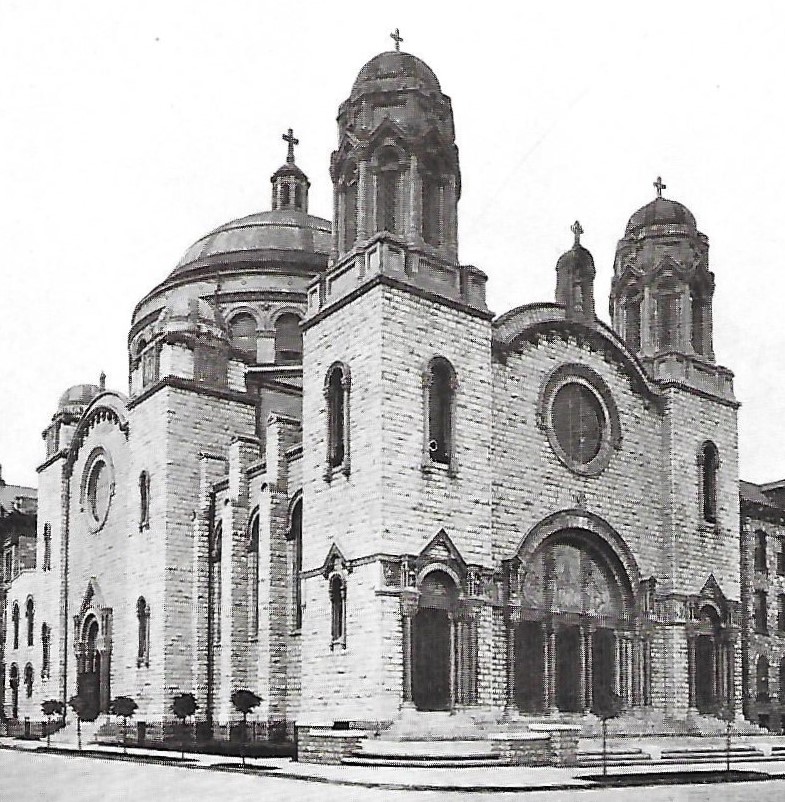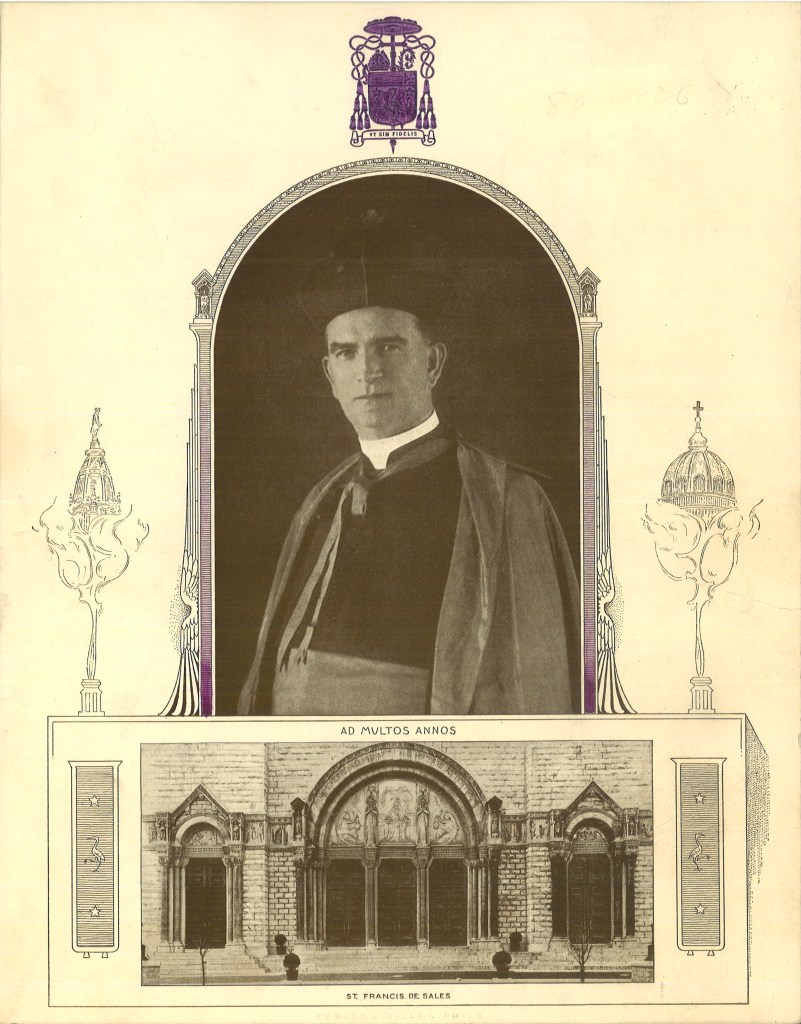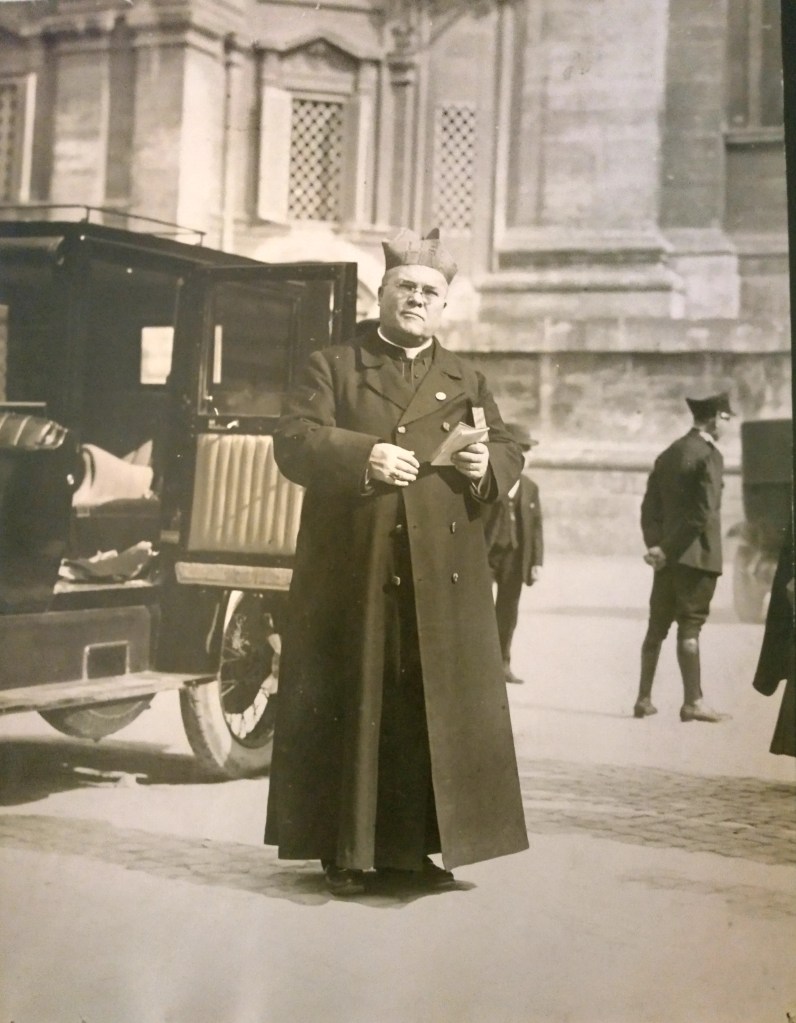


When Pope Benedict XV died on January 22, 1922, Bishop Crane, pastor of St. Francis de Sales and Assistant Bishop of Philadelphia, made the official archdiocesan announcement from St. Francis de Sales Rectory, advising that “Priests and people are earnestly requested to pray for the happy repose of his soul…” and “The Reverend Pastors are further directed to drape their churches in black for thirty days.”
Cardinal Dougherty, Bishop Crane’s boss, was out of town on a “vacation voyage to the West Indies,” and had to quickly leave his cruise and make his way home to Philadelphia to prepare for a trip to Europe, arriving in a blizzard Friday evening January 27 to leave again on Saturday morning January 28. According to the rules of the time, the conclave to elect a new Pope had to occur within ten days of the Pope’s death, so, in an era of steamship travel, the timing was very tight for the Cardinal to be at the Vatican by February 2. (Airplane travel was, as yet, impractical: Alcock and Brown of Britain had made the first historic and perilous nonstop transatlantic flight from Newfoundland to Ireland in a biplane just three years before, in 1919, and Charles Lindbergh would not make his famous New York to Paris solo flight until 1927).
Let us not imagine the Cardinal rushing about frantically on his way, however. Travel by ship was a grave and ceremonial affair, whatever the occasion, and this was the first time that a cardinal from Philadelphia was eligible to vote – one of two American cardinals — so it was a big event.
The Catholic Standard and Times reported that when His Eminence arrived in Philadelphiaon Friday evening, “He was met at Broad Street Station (Pennsylvania Railroad Station was at Broad and Market St.) at 8 o’clock by a committee of priests headed by the Right Rev. Bishop Crane.” Early the next morning, after his summer gear was hurriedly unpacked and replaced with sombre Vatican formals, a “private car was attached to the 8 o’clock express from Philadelphia to New York…and placed at the disposal of the Cardinal and his party. When His Eminence arrived at Broad Street Station a few minutes before 8 o’clock, a number of priests were assembled to wish him ‘bon voyage’ At the request of the newspaper men, the Cardinal stepped to the observation car and posed for a photograph…” He also granted an interview to the Catholic Standard and Times while aboard the train.
A large group of clergy rode with the Cardinal on the train to New York – among them, Bishop Crane and Reverend Hugh Lamb (another future assistant bishop and pastor of SFDS who would manage the Philadelphia end of things from SFDS when Cardinal Dougherty participated in the 1939 conclave). Upon arrival, they were met by representatives of “the Mayor’s Committee for the Reception of Distinguished Visitors.” Then, “Headed by a squad of motorcycle police, the Cardinal’s party entered automobiles at the station, which were provided through the courtesy of Rodman Wanamaker (heir to the Wanamaker’s Department Store fortune), of New York, and were driven to Pier 57, where the Lorraine was docked. It was precisely 10.30 o’clock when His Eminence boarded the ship. As the Cardinal strode down the gangplank of the liner he faced a battery of cameras and motion picture machines, and at the request of the photographers posed for pictures.”
The Very Rev. Joseph A. Whitaker, S. T. L., chancellor, accompanied Cardinal Dougherty to Rome as his assistant, and Cardinal Begin, the Cardinal-Archbishop of Quebec, travelled to the Conclave as a fellow passenger aboard the same ship. Bishop Crane would return to Philadelphia to keep things running until the cardinal’s return.
Cardinal Dougherty “graciously” granted more newspaper interviews in his stateroom once aboard, admitting that “It is very improbable that we shall reach Rome in time to enter the Conclave, the likelihood being that by the time we arrive a new Pope will have been elected.” The cardinal’s pessimism was justified: the record speed for a transatlantic crossing was 4.5 days and the conditions this time were not ideal. It had snowed heavily through the night, the snow was predicted to continue with gale force winds, and news reports alarmed “many ships caught in worst storm of years along coast.” (The blizzard would later be memorialized as the “Knickerbocker Storm,” after the roof of the Knickerbocker Theatre in Washington DC, collapsed under the weight of snow on the evening of January 28, killing 98 people and injuring 133)

At 11:30 AM, the newspaper men were shooed away, the decks were cleared, then, finally, “The shrill notes of the siren announced at 12 o’clock that the Lorraine, was departing and at that time she left the port of New York,” scheduled to arrive at Havre in France on February 5.
Cardinal Dougherty and Cardinal Begin received the news of the new Pope’s election by radio a week later while still at sea. By then it was predicted that after arriving at Le Havre they would reach Paris on Tuesday, February 7, and Rome on the 9th. So it was Bishop Crane of St. Francis de Sales who, on February 6, 1922, announced to the Philadelphia archdiocese that “‘Habemus Pontificem.’ With profound gratitude to God, we announce to you the glad news that a successor to the late Pope Benedict XV has been elected in the person of His Eminence, Achille Cardinal Ratti, Archbishop of Milan, who has chosen the name of Pius XI” and reminded the clergy “P. S.—Please remove mourning draperies from the church and have this letter- read at all the Masses on Sunday, February 12. “+M. J. C.”
Cardinal Dougherty was not the only one to miss the Conclave. In total, three Europeans were ill; the Brasilian cardinal knew he didn’t have time to get there and didn’t attempt the journey; and the two Americans and the Canadian tried but didn’t arrive in time. Of the fifty-three cardinals who were able to vote, thirty were Italian; five French; four Spanish; three German; two each from the United Kingdom, Austria, and Poland; and one each from Belgium, the Netherlands, Hungary, and Portugal. (By contrast, in 2025, the 135 cardinal electors eligible to vote for the successor to Pope Francis now represent seventy one countries spread across Europe, Asia, Africa, Oceania, and all of the Americas).
Some placating was, apparently, in order when Cardinal Dougherty returned to Philadelphia on April 1. Bishop Crane arranged for him to be met in New York by a large reception committee of clergy and distinguished laity – among them Bishop Crane, Reverend Hugh Lamb, various current and former SFDS assistant priests, and several SFDS parishioners including Thomas Slattery (one of the Sponsors at the blessing of the church bells in 1916), Timothy Wholey (who donated the statues of St. Anne and St. Francis de Sales to the parish), and Joseph Durkin (early pew-holder) — among many others from around the city. When the cardinal’s train pulled in to Broad Street Station in Philadelphia, he was greeted by cheering, flag-waving crowds, city dignitaries, a squad of police, a full military band, a procession of flags, and several hundred Knights of Columbus marching before him in procession.
In a fulsome speech at the Cathedral, Bishop Crane carefully framed the trip as a victory:
“After witnessing the magnificent demonstration along the Parkway and looking into the happy and contented faces of this immense congregation, need I tell Your Eminence that throughout the length and breadth of this diocese there is universal rejoicing tonight upon your safe return to your beloved people, both clergy and laity. When the death of the late and lamented Pope Benedict XV was announced to a grief-stricken world, you promptly obeyed the call of the duty which belongs to your exalted office. You at Once made speedy preparations for the journey to Rome. On that stormy Saturday morning when you left your home to board the steamship La Lorraine, you were accompanied by the. prayers of your loyal and faithful children…We had hoped against hope that the deliberations of the Conclave might be prolonged so as to enable you to take part in the election of the successor to the saintly Pope Benedict XV. Rut on account of the long distance to the Eternal City and the brief, duration of the Conclave you were doomed to disappointment. We shared in your disappointment…” However, “You had the unique honor of assisting at the Coronation of the new pontiff; you had the intimate privilege of private conversation with him. It put you in close touch with the aims, the aspirations and the ideals of the Chief Shepherd of Christ’s flock on earth. Yours was a splendid opportunity of welding even closer, if possible, the ties that bind this diocese to the centre of unity, the Holy Roman Apostolic See…”
Bishop Crane’s speech was followed by another lengthy address, highlighting every important moment thus far in the Cardinal’s illustrious career, culminating in his personal audience with the new Pope.
Curiously, there’s a postscript. A few years later, in 1927, Cardinal Dougherty felt a need to use the Catholic Standard and Times to publicly denounce an obscure news item that he said he had recently been shown. The Catholic Standard and Times offered the background, that “A copyrighted Universal Service cablegram dated at Rome, September 19, and published in a local paper (where?) on September 20,” had reportedly claimed that, “…only the Pope’s intervention dissuaded Cardinal Dougherty, of Philadelphia, from offering his resignation as a Prince of the Church in 1922” after he was unable to participate in the conclave “although he used the fastest ocean liner and although the special train placed at his disposal by the Italian Government made the trip from Naples to Rome in record time…” The Catholic Standard and Times then emphasized that “His Eminence Characterizes Recent Newspaper Articles, That There Was Opposition to Sacred College Meeting in Conclave Before Arrival of American Cardinals, as Falsehood Out of Whole Cloth and as Calculated to Do Harm.”
The news item that infuriated the cardinal was not widely circulated and does not appear to have been archived, but it seems to have hit a sensitive nerve. One detail stands out, however: Cardinal Dougherty should have recalled that his ship had docked at Havre in 1922. It was the other American, Cardinal O’Connell of Boston, who landed in Naples then raced across the country, heartbreakingly arriving at the Vatican just one hour after the doors had been sealed. At the time, it was reported that Cardinal O’Connell’s “fortitude and resignation in a most trying situation” were “commented upon favourably by all the Italian newspapers” – which is an entirely different use and meaning of the word “resignation”! Cardinal O’Connell certainly could have had reason for despair: due to the unpredictability of travel, he had likewise arrived a day late and was shut out of the previous conclave in 1914. One of the first acts of the new Pope in 1922, was to extend the travel period before future conclaves to make it more feasible for non-Europeans to participate.
The 1922 conclave was notable for another reason, when it was reported that “For the first time in history women will be permitted to be present in the quarters occupied by the conclave. They are Sisters of Mercy, who will preside over the destinies of the cardinals’ kitchens, which heretofore have been supervised by monks.”