Tag: 1900s

A Change of Tune

With a flick of a long ago editor’s pencil, she disappeared from the parish history. The 1940 parish anniversary book began its choir story with the arrival of the “distinguished” Albert J. Dooner in 1921. The 1989 parish anniversary book looked back further to claim “Tudor Strang” as first choirmaster at St. Francis de Sales in 1911 — but he was actually an organist/choirmaster for several local Episcopal churches, who played in a single organ concert at SFDS. It’s time to restore Margaret Marie Marshall to her proper place in the parish chronicles!

Margaret Marie Marshall, the original organist/choirmaster at St. Francis de Sales, left the parish quietly, without acknowledgement of her twenty years or more of service, around the time that Monsignor Crane became Bishop in 1921. “Did she fall or was she pushed?” Did she resign or was she let go? The answer to the question of how she left is probably “yes,” a bit of both, due, in part, to a new movement in church music centered in Philadelphia.

Up into the early 1900s, music offered a rare oppourtunity for Catholic women to contribute to the male-dominated liturgy. Margaret Marie Marshall was personally and professionally invested in all the possibilities, as a church organist and “concert and oratorio soprano,” who sang and also taught other soloists, first from her home at 2126 Vine Street, and later, when she moved to 3413 Baring Street. Her life seemed dedicated to her work: she lived with her father, a retired grocer, and several sisters, until they all passed away. One of her sisters was known for dramatic readings, and the other was also a church organist. It is unclear where Marshall received her training: she was listed in the Musical Blue Book of America, but, according to the U.S. Census data, her formal education ended with eighth grade.

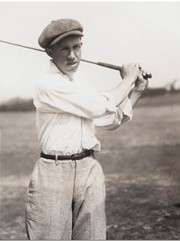
Marshall’s musical programmes at St. Francis de Sales initially included both men and women. According to family records, golf champion J.J. McDermott’s mother sang in St. Francis de Sales Choir in the early 1900s. At General Mulholland’s funeral in 1910, Marshall’s “augmented choir” included a female soloist, Anna Elizabeth Kelley, who sang Gounod’s “Ave Maria” and Koenan’s “Come Unto Me.” A quartet sang “Nearer My God to Thee.”

An article in Adoremus claims that Philadelphia-German composer Albert RoSewig, who delighted in “the florid and sentimental style of the classical music of his day,” set the tone for music in Philadelphia around the turn of the century — and Marshall’s ambitious programmes seemed to follow that lead. In December 1902, her “special Christmas program for both morning Masses” included Eduardo Marzo’s Mass at the first; and “Hayden’s Mass No. 6, Huntzer’s ‘Veni Creator,‘” and the “Angel’s Messenger” by Homer Bartlett at the second. In 1904, the Blessing of the School included “an augmented choir of selected voices under the direction of Miss Margaret Marie Marshall, organist.” A 1912 listing for Easter services noted that she would be directing a “vested choir of sixty voices” with works including the “Grand Verdi March” and pieces by Harry Rowe Shelley, Alban Lipp, Victor Hammerl, and Édouard Batiste – all romantic 1800s composers. A Solemn Pontifical Mass commemorating the fifth anniversary of the dedication of the church in 1916 featured an “augmented choir under the direction of Miss Margaret Marie Marshall, the organist,” rendering Gounod’s St. Cecilia Mass. 

But the end of the Victorian era of embellished music, sentimental hymns, and women’s voices was already in sight. In 1903, Pope Pius X had issued an Apostolic Letter on the simplification and reform of church music, which, as Anne L. Silverberg notes, “restricted both the style of appropriate liturgical music and its execution.” It expressed a strong preference for Gregorian chant — in which all the singers follow one melodic line in Latin based on medieval modes rather than modern scales — and multipart singing “unaccompanied by instruments, a decided change from the nineteenth century when orchestras and soloists were frequently heard in American and European churches.” She notes that “The Motu Proprio also forbade women from singing liturgical music and called for boy choirs to sing music with high vocal parts.”

Philadelphia would become a centre for a new American Catholic musical movement embracing the changes, when “Nicola Montani led the nation in reform” and “founded the St. Gregory Guild in Rittenhouse Square to spread the message of the Motu Proprio and to furnish suitable musical publications.” Lucy E. Carroll notes that “From 1906 to 1923 he served at St. John the Evangelist in Philadelphia, with terms as music director at Hallahan High School, West Philadelphia Catholic Girls High School, and St. Mary’s Academy.” He worked as an editor for two music company publishers, founded the Society of St. Gregory in 1914, began the Catholic Choirmaster magazine, then published his St. Gregory Hymnal and Catholic Choir Book in 1920, renewed in 1947. The young Albert J. Dooner was among his avid pupils.

Montani crusaded for his own ideas of pure Renaissance style music without any of what he perceived as “operatic,” “theatrical,” or “balletic” elements. An article in Adoremus reports that “Montani’s voice was a strong one, and his determination to rid the liturgy of anything that even smelled of the profane was his driving force.  Masses by Charles Gounod, August Durand, and Luigi Cherubini were black-listed, with many traditional hymn collections.” These would include much of the music in Marshall’s repertoire.

Montani also had strong views on women, which Albert Dooner shared. Dooner would write in 1926 that women’s voices lacked a purity and spiritual quality of boys’ voices, and their singing was far too dramatic for the liturgy. He also maintained that the proper place for a choir was in the front of the church. Since women were prohibited in the sanctuary, they were therefore disqualified from being in the choir, even though most American choirs sang from a choir loft at the back of the church.

Montani’s stern influence gradually made itself felt in the archdiocese, and Marshall may have felt the pressure. The Solemn Papal Mass commemorating the anniversary of the dedication of St. Francis de Sales Church in 1917 was tersely described as featuring a “male choir of forty voices under the direction of Margaret M. Marshall,” with no musical programme listed.

As church music changed, Marshall turned her energy to other channels. The Catholic Standard and Times reported her war work in July 1918: “Margaret Marie Marshall, Division No. 22, has started ‘liberty sings’ in the different divisions of the Auxiliary, and each Friday night she instructs the members of the chapter in patriotic songs. The meetings close, each night with the singing of the ‘Star Spangled Banner.’” In August, the paper observed that “The ‘community sing’ movement is being enthusiastically received among Catholic societies and organizations. This was evidenced by the fact that 1,500 persons attended the community sing of the Knights of Columbus Red-Cross last Monday night at the Knights of Columbus Hall, Thirty-eighth and Market streets. These ‘sings’ are being conducted under the direction of Miss Margaret Marie Marshall, organist of St. Francis de Sales’ Church, assisted by her sister, Miss Mary Agnes Marshall, organist of St. Anthony’s Church. The former is organizing the movement among the various divisions of the Ladies’ Auxiliary of the A. O. H. (Ancient Order of Hibernians).

Was there friction over music at de Sales? In November, Margaret continued her community outreach – from Most Blessed Sacrament Parish: “For the entertainment of men in the nation’s fighting forces, an elaborate fall and winter programme has been prepared by the Women’s Auxiliary of the Archbishop Ryan Catholic Association, with headquarters at Fifty-fourth street and Chester avenue, in the Most Blessed Sacrament parish. Beginning with a big community sing on Friday night of this week, under the direction of Margaret Marie Marshall, affairs will be held every two weeks and possibly more frequently, according to the committee in charge.“

Marshall may have become less enthusiastic about her musical endeavors at St. Francis de Sales. In November 1918, for the Solemn Pontifical Mass commemorating the seventh anniversary of the dedication of St. Francis de Sales Parish, The Catholic Standard and Times reported simply that “The music of the Mass will be rendered under the direction of Margaret Marie Marshall, organist and choir leader.” When the memorial tablet “to men and women of the parish who served in the late world war” was unveiled at a Solemn Military Mass in 1920, “The musical programme was in charge of Margaret M. Marshall.” And when the church was consecrated with a Solemn Pontifical Mass in November 1920, it was reported that “A splendid musical programme will be rendered on the occasion of the Thanksgiving Mass and Vespers, under the leadership of Margaret Marie Marshall, Organist and director,” but none of the musical works were listed.

Marshall’s last mention at St. Francis de Sales appears to have been at a reception for newly-installed Cardinal Dougherty, just back from Rome in May 1921, when “A chorus of welcome was sung by the children, who formed a pretty picture as they stood grouped on the steps and displaying the Cardinal’s colors, American flags and emblems of welcome. After the chorus, which was rendered under the direction of the Sisters, Servants of the Immaculate Heart of Mary, assisted by Miss Margaret Marshall and Miss Sophia E. Maley, Natalie McElroy, one of the little pupils, delivered a touching address of welcome in splendid style.”

It was a delightful image, indeed, though it suggested that Marshall had been relegated to working with the schoolchildren, under the direction of the IHM Sisters.

Bishop Crane sang his first Solemn Pontifical Mass at St. Francis de Sales in September 1921, with the proud notice that “Special musical programmes will be rendered at the Mass and at Vespers by the parish choir of thirty-five boys and thirty men, under the direction of Albert J. Dooner, organist and choirmaster.” The younger brother of prominent parishioner Edward J. Dooner, Albert had received a degree in music from the University of Pennsylvania in 1912, continued his studies under Montani, and was already acclaimed as an organist and composer for the new church music. He would find his place as founder of the parish’s renowned pre-Vatican II boy choir, and would preside as its celebrated organist and choir director from 1921 to 1957.

After leaving St. Francis de Sales, Margaret Marie Marshall appears to have focused on the pupils of her own music studio for several years, before becoming organist and choir director at the recently-built chapel/school of St. Ambrose at Roosevelt Boulevard and C Street, far away from the city centre, around 1929. She was buried from St. Agatha’s Church (38th and Spring Garden) in 1952 — three years before Pope Pius XII cracked open the door to re-allow women’s choir participation in his Musicæ Sacræ encyclical of December 25, 1955.
Lost Links

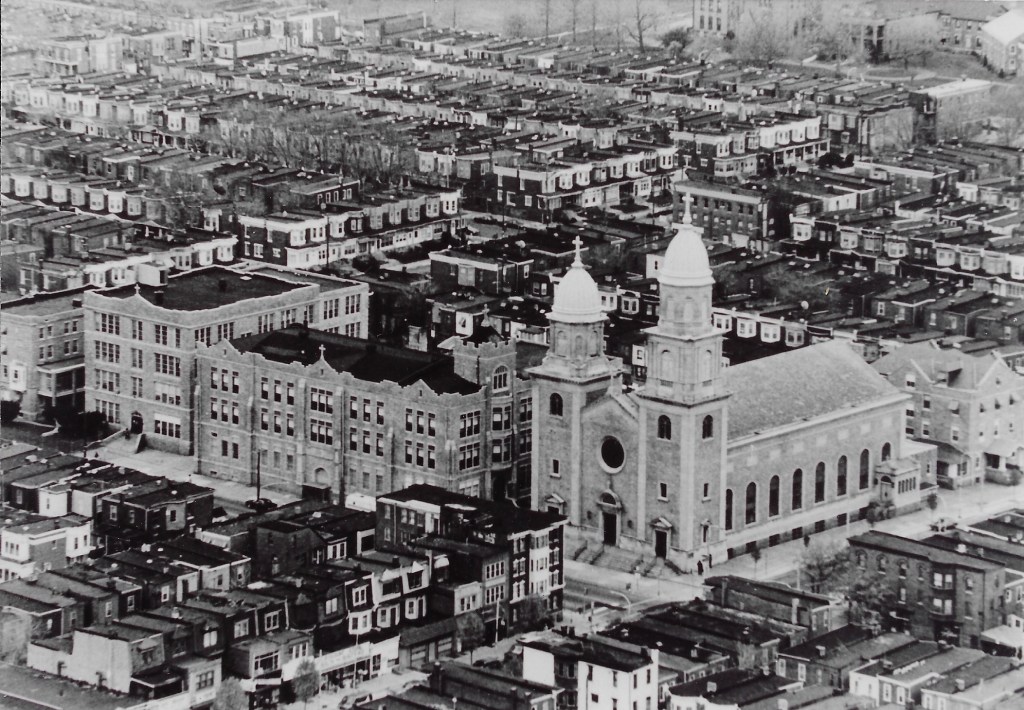
The church and school buildings of Most Blessed Sacrament Parish (56th and Chester Ave.) were sold after the parish merged with Saint Francis de Sales in 2007, but they are still a part of the landscape — now finding a new life as Independence Charter School West, a “community-based public charter school” of the School District of Philadelphia, chartered in 2016. Other significant spots, once important to MBS parish, are long gone, though – their presence faded behind the visible layers of local history:

Today a row of houses along 55th Street replaces the lone little house that used to stand at the corner

5500 Woodland Avenue

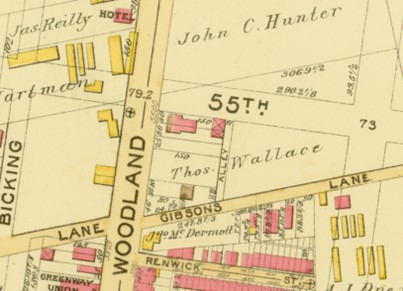
When Reverend Patrick F. Burke was named first pastor of Most Blessed Sacrament Parish in June 1901, a 1917 history reports “his first home was the house 5500 Woodland Avenue, and in its upper room, the first Mass was offered, and the first congregation of this Parish listened to his stirring appeal.” A 1907 account by Monsignor Bernard McKenna, describes the property less romantically as “an old dilapidated house which had not been occupied for seventeen years.”  Whatever its condition, it was the first home of MBS Parish, and Father Burke continued to live there after the MBS chapel was erected at 56th and Chester in December 1901. It was not an easy commute: a 1917 history reports “Father Burke’s health had been failing for some time and he had to suffer many privations in those days. For instance, Gray’s Lane was at times almost a trough of yellow mud and he had to walk from 55th and Woodland Ave to the Chapel. Some of the most public spirited among the parishioners, at their own expense, had a part of the lane filled in and a cinder path laid. Once in a while, a good soul would provide a carriage to convey the delicate priest to Mass…. The archdiocese gave him several Assistants to help him in his duties, and he lived at the Woodland address until 1906.

5406 Chester Ave. is now a parking lot.

5406 Chester Avenue

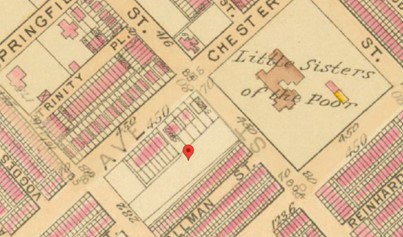
MBS First Pastor “Father Burke’s Silver Jubilee occurred in June 1906, and the parishioners presented him with a purse. The old residence on Woodland Ave was abandoned and a new home at 5406 Chester Ave rented. In the following Autumn, October 9, 1906, on Tuesday evening after a lingering illness the first pastor died. His remains were escorted from the rectory to the Chapel (wooden building at 56th and Chester) by a number of the clergy.”

5548 Chester Ave. was rebuilt at some point in the distant past as a commercial establishment.

5548 Chester Avenue

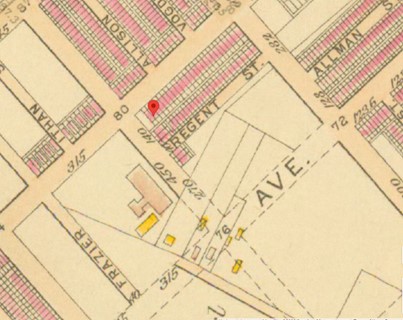
The head of the IHM order promised Third Pastor Rev. James T. Higgins that she would send four sisters to open MBS school in September 1908. “Since the parish lacked a convent. It was decided that the sisters would live nearby at Saint Francis de Sales and St Clements convents. However, before they arrived the following September, the priests of the parish gave up the comforts of the rectory at 5406 Chester Ave and took up residence in the combination church and school building (new stone building by Henry Dagit finished in 1908. The MBS Rectory would not be built until 1918). This cut down a major parish expense and enabled the pastor to use the money saved to obtain a home at 5548 Chester Ave to be used as a convent.” The school would open on September 5, 1908, and “When the sisters arrived, they found the convent prepared and furnished in a simple but comfortable way.”  (Permission to build a permanent convent at MBS was granted in 1919, and the Sisters moved into it in 1921). 

1901 MBS wooden Chapel with 1908 stone Chapel behind. MBS First Pastor Reverend Patrick Burke inset

56th and Chester Ave. Magical Moving Chapel

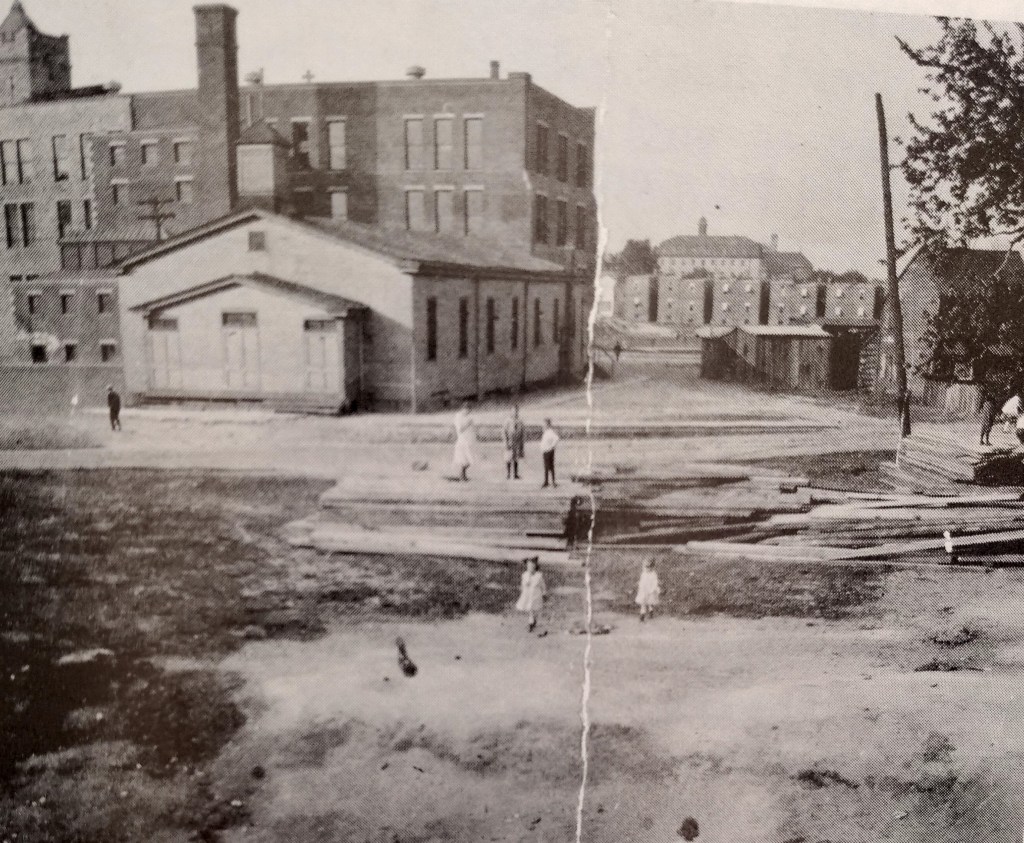
The Most Blessed Sacrament chapel – a small wooden frame building donated by St. Thomas Aquinas Church – was erected on the southern end of the lot at 56th and Chester Avenue and dedicated on December 22, 1901. A 1917 parish history provides a poetic description of those early MBS days: “Memory calls up the little wooden Chapel among the trees in all the glory of its rustic setting on a Sunday morning in Spring. Over the fields, up the lane and through the main thoroughfare, came these worshippers…” The neighborhood grew quickly, and the church expanded with it. A stone chapel/school building was dedicated in 1908, and the cornerstone was laid for the church in 1922. Meanwhile, the little wooden building – repurposed as the MBS Parish Assembly Hall and school gym — clung bravely to its spot until it was needed by the newly-established Good Shepherd Parish (67th and Chester Ave.), and moved there in 1925. Find its further adventures here: https://sfdshistory.wordpress.com/2022/05/27/a-moving-story/

Father Daniel Gatens, writing the MBS Parish 1976 Jubilee Book, observed that “the history of any parish…is the story of people and the story of buildings.” The buildings connect us to the people and the neighbourhood and give us roots. Even when they are gone, an awareness that they were once there brings  a small jolt of recognition in passing and perhaps a smile and a feeling that we are all connected.

Original MBS wooden chapel and new 1908 chapel/church shown in 1976 MBS Parish Diamond Jubilee Book

The View from the Belltower

SFDS Belltower

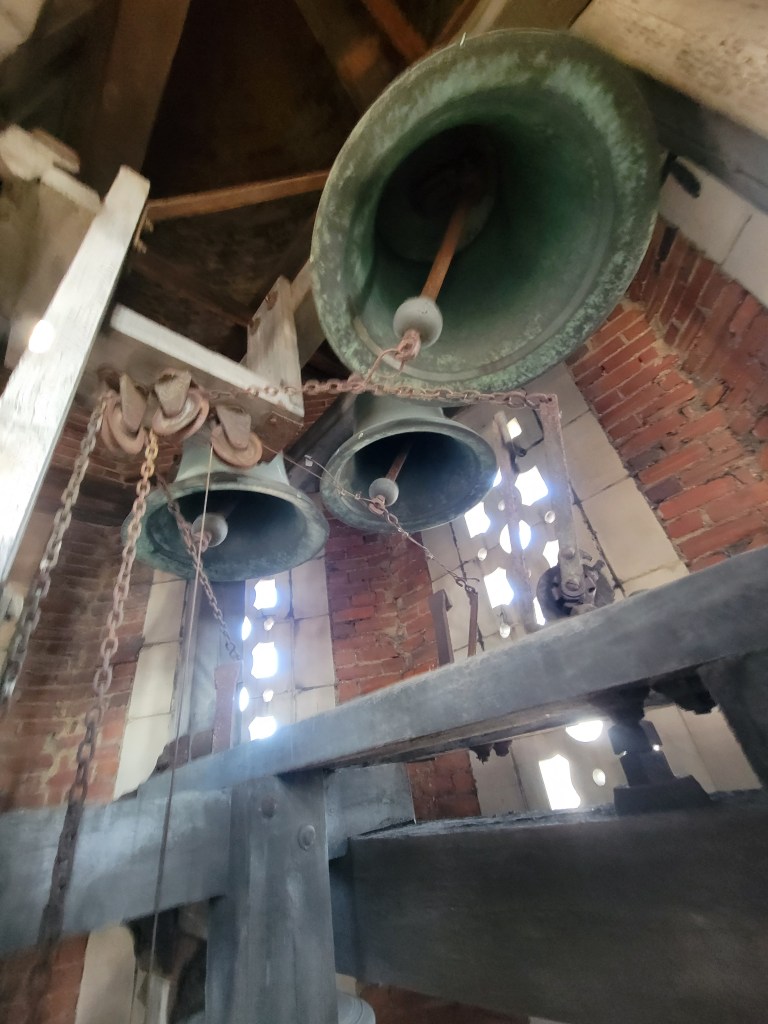
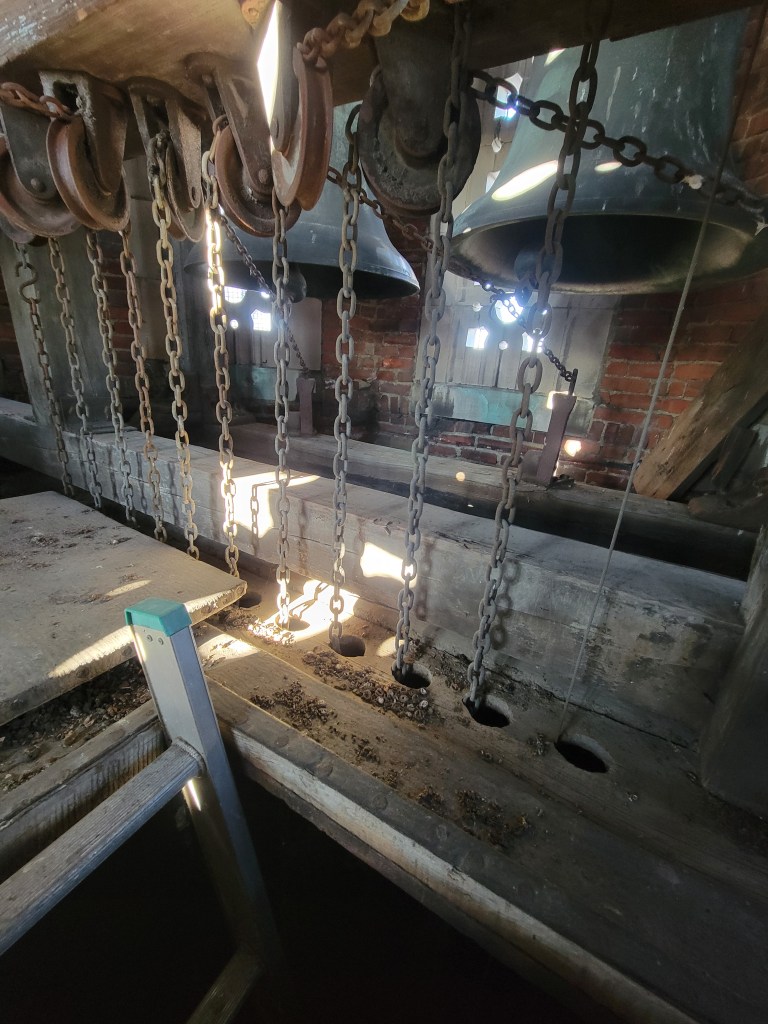
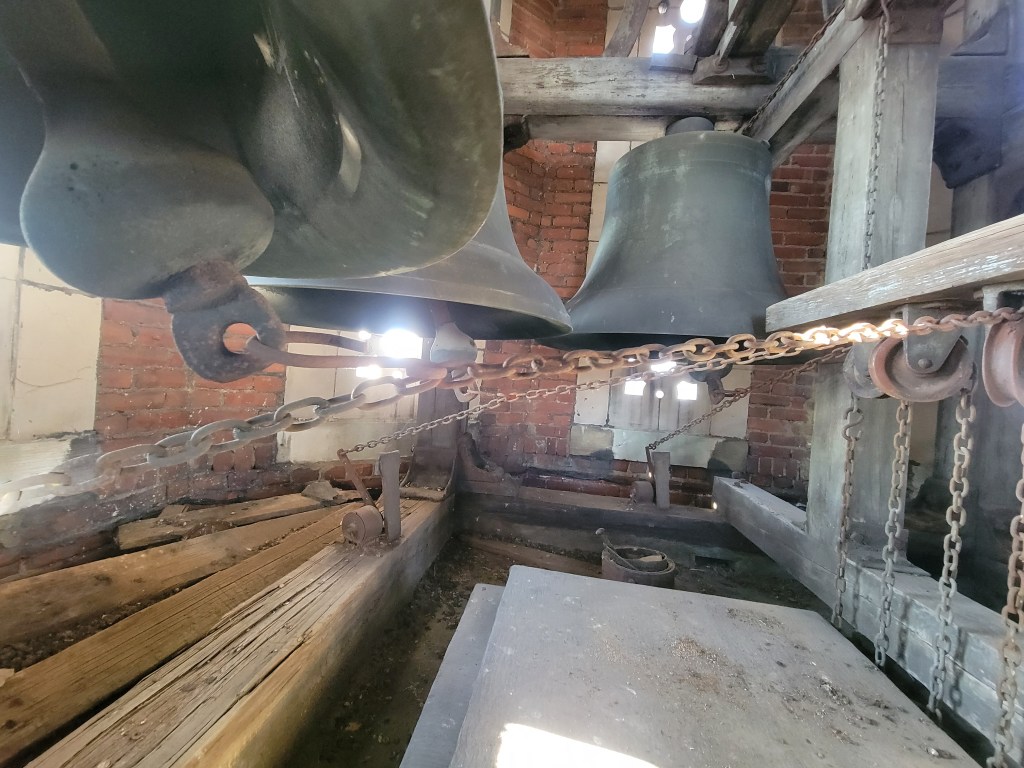
One afternoon a few weeks ago, the perilous hatch up into the belfry creaked open and the pigeons were astonished by a rare human visitor. Who was it? Not Quasimodo the Hunchback, but Tim Verdin, President of the Verdin Company of Cincinnati OH – the sixth-generation family-owned company that inherited the mantle – and the records — of the Old Meneely Bell Foundry of West Troy, NY, which made our bells back in 1916 (not to be confused with the Meneely Bell Company of Troy, NY – a different family branch and a separate competing company. Verdin notes that the Meneely vs Meneely trademark case of 1875 actually set a precedent, establishing “the legal right to use one’s surname commercially, even if a business using the same name already existed”).

In any case, Verdin, who was in town to work on the 58-bell Meneely carillon at Valley Forge (one of the world’s largest carillons), was especially interested in seeing our bells because he knew that there was something special about them: “Starting just before 1900, Meneely began experimenting with tuning their bells. What they do is cast the bells slightly thicker than they thought they should be and then they would remove metal from the outside of the bell to flatten the tone. Meneely is the only bell company to have tuned their bells on the outside; in Europe at the time all bell foundries tuned their bells by removing metal from the inside of the bell. Meneely would put the bell on a large metal lathe and then use a cutting tool to remove the appropriate bronze.” Eventually, the firm developed a new method of tuning to all “five different partials or frequencies that make up the note the bell is perceived to be” rather than just the middle three, and bell shaving became obsolete.

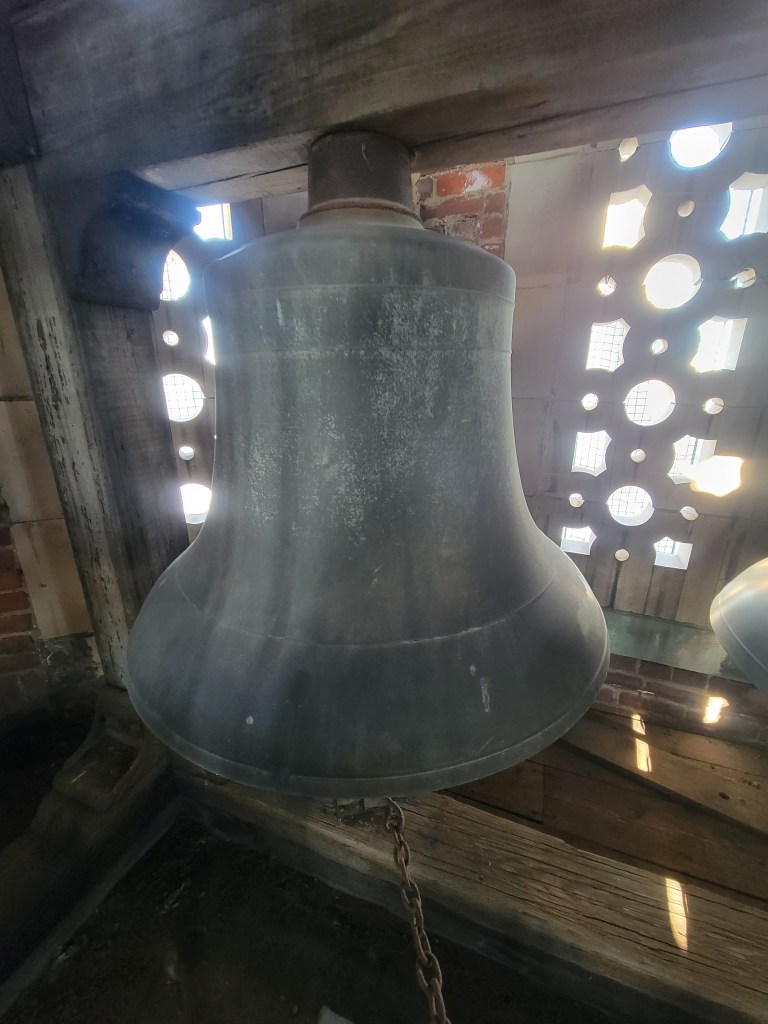
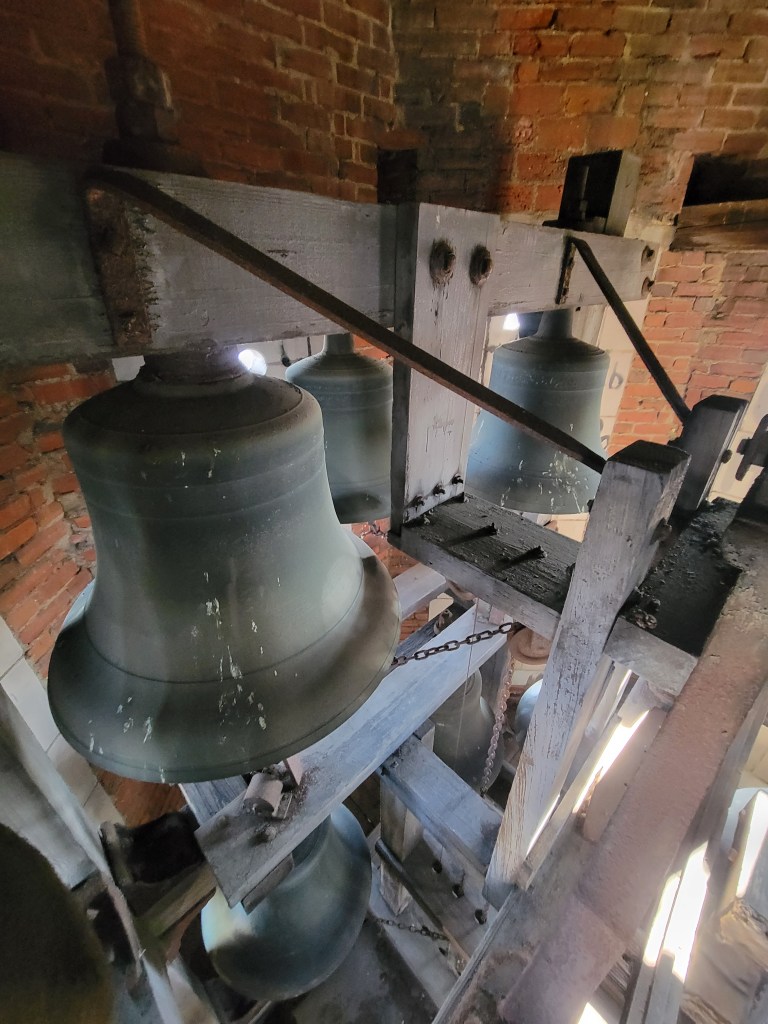
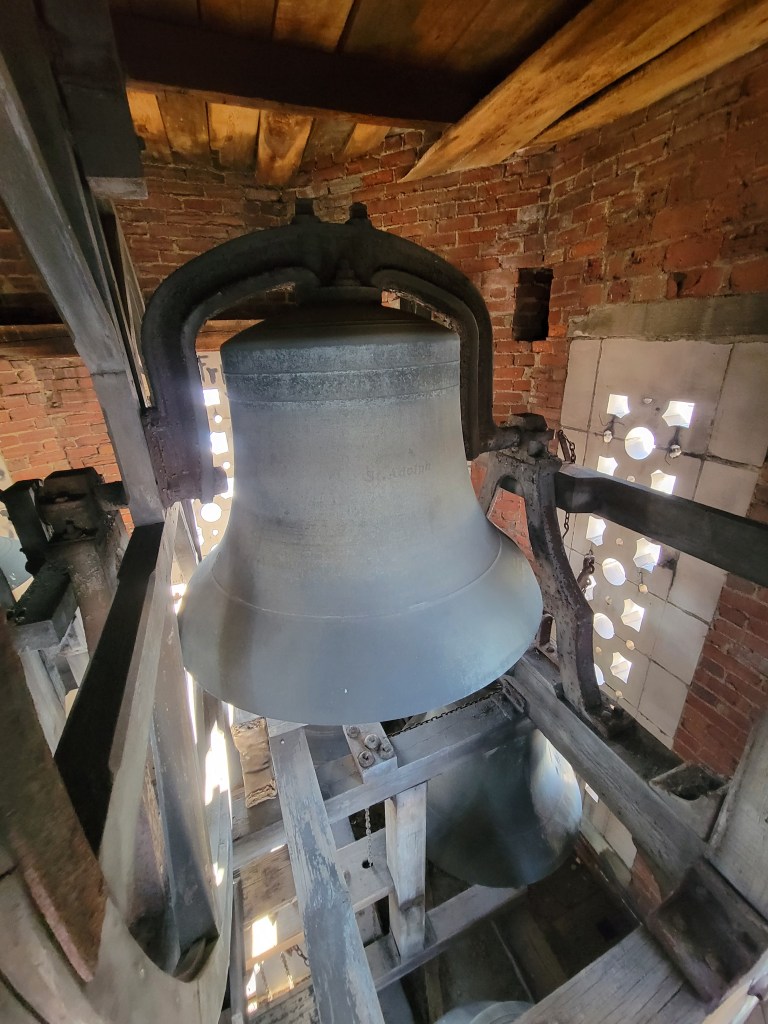
 Verdin observed that “Meneely cast some of the finest bells of any of the early American bell founders.” Our “chime consists of a total of (11) bronze bells..The largest bell weighs about 2,300 Lbs. and rings the note E1 in the middle octave. All of the bells except the largest are stationary which means they hang from the wooden frame…and don’t move.” Verdin notes that   they are “cast of bronze which is a mixture of approx. 80% copper and 20% tin. They are showing a nice greenish/blue patina which is perfectly normal for this age of bell in the environment they are in…These bells were not tuned before they were installed, but sound very nice. This is very typical of early American bell founders…The largest bell which sit on top of the wooden frame is designed to be a swinging bell, although it looks like it’s been a long time since it actually did swing.” He further notes that “The chime is a wonderful example of preserved history. It is still very much original and is basically using all of the same components as it did one the first day it was installed 104 years ago,.” which is, apparently, unusual!

Verdin located the original 1916 records for our bells in his archive. In addition to the technical specifications, labor costs, and stated fifteen-year warranty(!), there is an historic notation that “the bells to be arranged for blessing ceremonies after which they are to be placed in chiming order in the tower…Less allowance towards installation concert programs. Mr. C. to receive gratis about 250 copies.” That’s a lot of copies of our 1916 Parish Bell-Blessing ceremony program potentially floating around. What was the first music played on our bells? Can we dare hope that one of those programs may someday turn up in somebody’s attic?!

Incidentally…

Tim Verdin commented: “My Great-Great-Great Grandfather was Francis de Sales Verdin. He and several of his brothers are the ones that brought their families to America, from Marlenhiem, France, in the early 1830’s (and started the company). I am unsure…how he came to be named Francis de Sales. We actually have a Francis de Sales Catholic Church here in Cincinnati which I always thought was kind of cool because of his name. in fact, the Francis de Sales Catholic Church here in Cincinnati has the largest bell that has ever been cast in America in the tower. The bell was cast right here in Cincinnati in 1896 by the Buckeye Bell Foundry. It weighs almost 35,000 Lbs. and is called ‘Big Joe.’

Here is a picture of my Great-Great-Great Grandfather Francis de Sales Verdin; and here’s ‘Big Joe’ – Largest bell ever cast in America.

J.J. MacDermott Wins the U.S. Open

A writer calling from Ireland with a research request, alerted us to a forgotten golf celebrity in our parish history!

J.J. would have been about four years old in 1895, when a group of local enthusiasts improvised a nine-hole golf course at the Belmont Cricket Club (then located at 49th and Chester). The first four holes – made from tomato cans — were on the cricket club grounds; the other five were in a field next door, on the other side of an eight-foot fence that determined golfers had to climb! The golfers formed their own Belmont Golf Association in 1896, and, in 1897, the new club moved to 52nd and Chester, where legend said the old barn used as the clubhouse, “had once been the dwelling place for a Lenape chief named Aronimink, an odd name but one the BGA members eventually adopted and took with them to another site outside of town.” Little J.J. was fascinated, watching this strange new sport, and made his own golf course in his grandparents’ nearby orchard. At age 9, he “marched over to the club, which was, by that point, being called Aronimink, and announced that he would be the best caddie they ever had on the premises.” Walter Reynolds, the club professional, took a fancy to the plucky youngster and allowed him in.

                J.J. (John Joseph Jr.) MacDermott’s parents, John and Margaret, were married at St. James Parish (today St. Agatha St. James at 38th & Chestnut) on 15 November 1890. J.J. was born nine months later on 12 August 1891 – a year after our parish was founded – and was baptized in our parish that same month. His sisters Alice and Nora Gertrude were baptized here in 1893 and 1895. Their mother is supposed to have sung in the SFDS church choir, although we have no early records to confirm that. Their father was a mail carrier, and, reportedly, very strict. The MacDermotts lived at 1234 South 50th Street. Global Golf Post reports that J.J.’s grandparents, the Smiths, lived “a couple of streets over and a few blocks down.” According to records, they were also active parishioners. Young J.J. often stayed with them.

                When J.J.’s father wanted him to leave school in 1906, at age fifteen and begin working in a real trade, J.J. contrarily moved to Camden and took a job as assistant golf pro at the Camden Country Club, before becoming head professional at Merchantville Country Club in Cherry Hill a year later.        His career progressed quickly: in 1909, he finished 49th in the U.S. Open at Englewood Golf Club in New Jersey. In 1910, when the U.S. Open was at Philadelphia Cricket Club, he lost by 4. The following year, at Chicago Golf Club, “McDermott was 19 years old when he won the U.S. Open, making him the youngest winner in history, a record that still stands. He also was the first American to win the U.S. Open.” He won again in Buffalo, NY, in 1912 — a rare back-to-back victory.

                Sadly, J.J.’s rising star was a supernova. In 1913, in a burst of euphoria after winning the Shawnee Open, J.J., who had always been prone to odd, impulsive behavior, made a strange jarring speech scorning “British invaders” (boasting that Americans finally “owned” the U.S. Open), and then apologized, but his reputation was damaged. He still travelled to Britain for the British Open in June 1914, but he missed a boat, then his train was delayed, so he missed his qualifying tee time for the tournament. Returning across the English Channel, his ferry was struck by another ship and he had to board a lifeboat. Back home, misfortunes crowded upon him when his stock market investments failed. He had a nervous breakdown and moved back home with his parents (and back to the parish), before being committed to a mental hospital in Norristown in 1916. Formally diagnosed as schizophrenic in the 1920s, J.J. stayed in the institution until he died in 1971.

                The great theatre of world events upstaged J.J. MacDermott’s personal tragedy: World War I began in July 1914—just a month after his fateful British trip. And, as Doug Fraser has observed: “He’s like so many mentally ill people. It’s just easier to forget about them. It’s just easier to look away” — though perhaps J.J.’s hour is coming round at last as interest in his remarkable achievements seems to be suddenly renewed!

The Children’s Hour: First Communion 1911

The year 1911 was notable for the children of our parish – and not just because the newly-built church opened with great celebration and ceremony.

An old parish document states that “Nineteen hundred and eleven was a red letter year in the history of the school, for the children of St. Francis de Sales, shared with other children throughout the world the benefits of the new Decree of Pius X, making possible the reception of our dear Lord in Holy Communion at the early age of seven. Accordingly all the little ones who had reached that age received our Lord on the First Friday of May…”

This was a big moment for the church. In October 1910, the Philadelphia Inquirer had reported Pope Pius X’s new decree that children should receive their first Communion at the “age of reason,” when they made their first Penance: “regarding the points of instruction, it will not be necessary for the child to know the whole catechism, as has been customary heretofore in the United States.” First Communion, which “completed” the sacraments of initiation, came after Confirmation in those days: Confirmation was regarded as a “strengthening sacrament,” rather than a “sacrament of maturity” (the order didn’t begin to change until 1932), and the Inquirer reported that before the 1910 ruling, “children making their first Communion were usually between the ages of ten and fourteen.”

The 1911 ceremony – which may have been a combination Confirmation/First Communion — probably took place in the original chapel/school building, (the building that today contains the Parish Auditorium), since the new church would not be ready until November and we don’t know what “finishing touches” were still underway. Unfortunately, the Communion and Confirmation records for that year are unavailable, so we don’t know much about the actual ceremony, or the specific names of those receiving the sacraments — although we can guess that  the list might have included one of the Slattery boys — sons of the local coal wholesaler, who would help to “baptize” our bells in 1916; one of the Hasson girls — whose big brother Philip would be the first boy ordained from our parish; and perhaps one of the Dagits —  children of the architect, who may have modeled for our angel sculptures; among many others.

Reverend Crane chose a Friday for the 1911 First Communion, so that children could continue afterwards with “The Communion of Reparation, the receiving of Our Divine Savior, on the First Friday of every month for nine consecutive months….” A 1928 report noted that this “has ever been a devotion dear to the heart of the Pastor, and the children have responded joyously to the call of Christ, and the voice of their beloved shepherd…”

Six years later, in 1917, when most of the children in the school were receiving Communion, they mobilized further with the entrance of the United States into World War I: “A Children’s Eucharistic League was formed, the principal duty of which was to receive our Lord frequently that He might bring peace to the war-ridden world….” This was part of a much larger movement, begun by Pope Pius X, who wanted everyone to take Communion more often, and promoted the special power of children’s eucharistic participation – especially in times of trouble.

Incidentally, our Father Eric wrote a thesis on the changed order of confirmation and First Communion, so we have our own “in-house expert” to take us full circle on this interesting historical subject!

An Ornament to the City

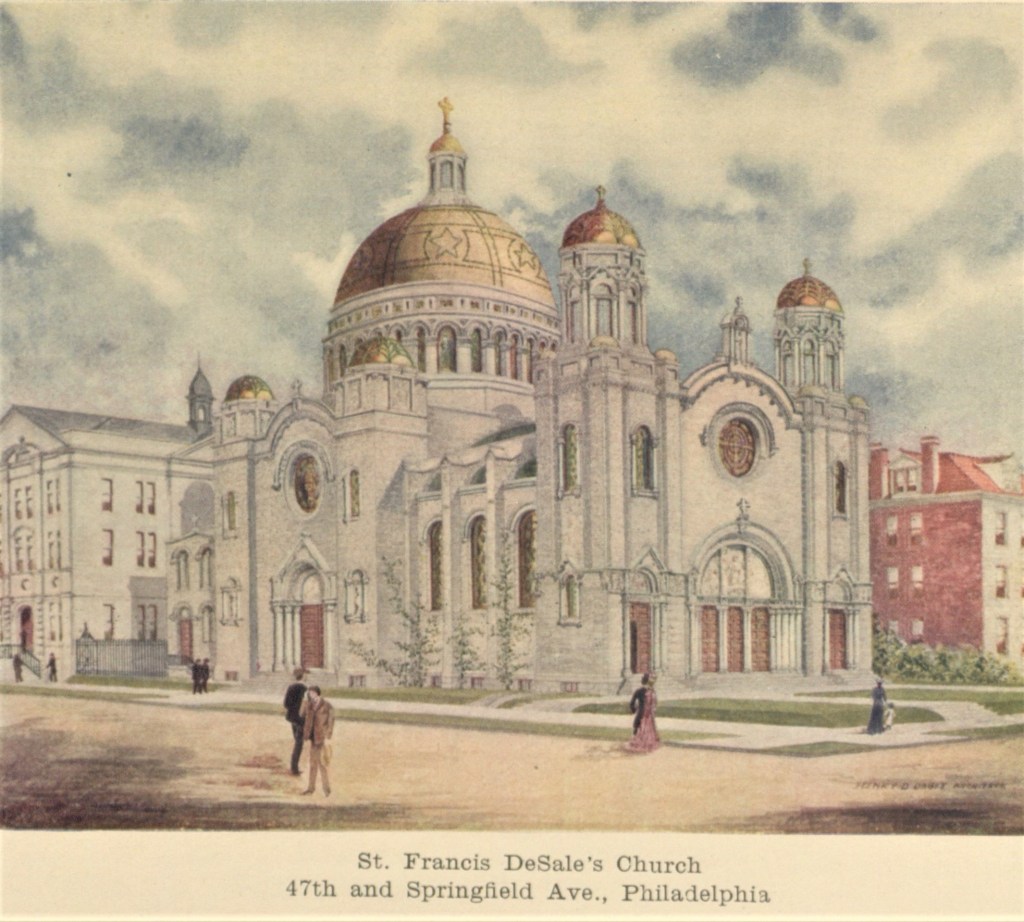
When Reverend Joseph O’Neill tried to buy land to build our first SFDS chapel in 1891, local property owners expressed concerns about the incoming Irish and German Catholic immigrants. By the time the handsome new church was finished in 1911, the building had become a local fixture.

1911 dedication

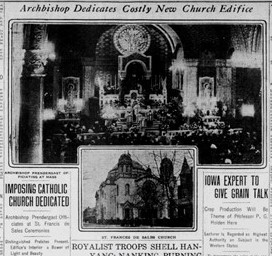
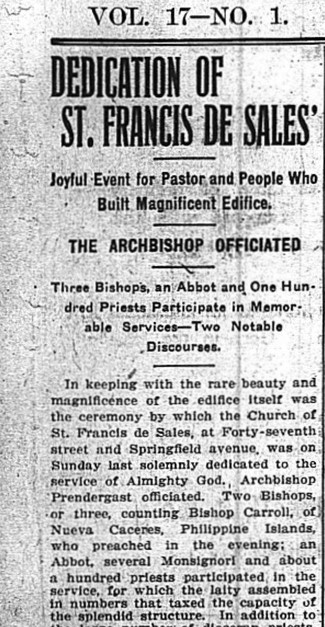
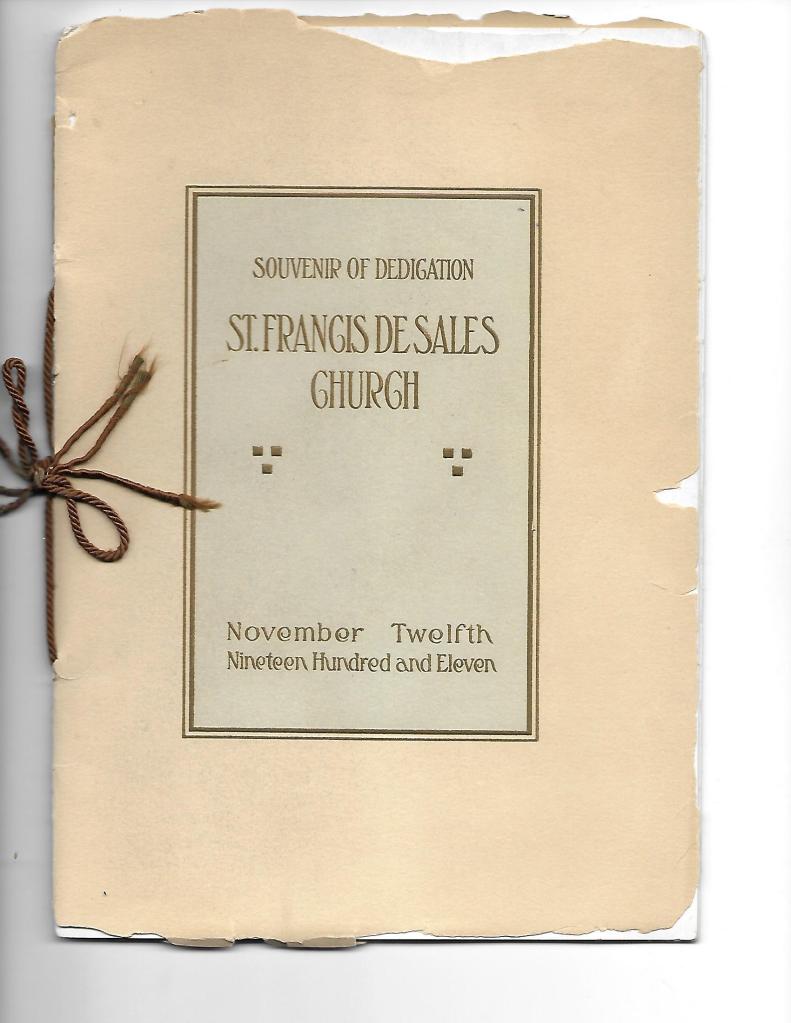
The media may have helped to bridge gaps and ease some of the tensions of the changing neighborhood, by opening windows into Catholic culture. Newspapers of the period liked to publish lengthy, detailed word-pictures of interesting events – as when, on November 13, 1911, the Philadelphia Inquirer reported how “Archbishop Prendergast, assisted by two other prelates of equal rank and a number  of priests of the archdiocese of Philadelphia, with appropriate and impressive ceremonies yesterday dedicated the new Catholic Church of St. Francis de Sales, Forty-seventh street and Springfield avenue.”

The Inquirer carefully described the scene: “The interior of the edifice had been transformed into a bower of beauty and light. Hundreds of candles and electric bulbs shed their rays through the auditorium and sanctuary, while the best skill of the florist and decorator was in evidence with the mass of multicolored autumn flowers that banked the altars with side walls. The church was crowded with a notable representation of the laity, which had gathered long before the hour set for the beginning of the ceremonies. Many unable to gain admission to the edifice stood about outside the church to see the imposing procession of prelates and priests which proceeded to the services.”

“Two church dignitaries who assisted Archbishop Prendergast at the dedicatory exercises were Bishop Fitzmaurice of Erie, and Bishop Carroll, of Nueva Segovia, Philippine Islands. Promptly at 10.30 A. M. the procession of clergy and acolytes moved from the chapel of the school building and proceeded along Forty-seventh street to the main entrance of the church on Springfield avenue. As the cross bearer entered the wide door of the edifice the choir, accompanied by a large orchestra, sang a joyous anthem. The procession moved up the centre aisle. Here it divided, part going to the right and part to the left, allowing Bishop Prendergast and the other prelates, clothed in full pontifical robes, to ascend the altar when the simple ceremony of dedication took place.”

1911 dedication cst (2)

For Catholic readers, The Catholic Standard and Times newspaper peered behind the scenes to list all the important names, then summarize the sermons and speeches. Pastor Reverend Crane spoke of construction concerns in our developing neighborhood, and how, when the plans of the building were first submitted to the men of the parish (no women, of course!), “At first all thought the church would be too expensive, but when it was pointed out that the neighborhood was one of the best residential sections of the city; that the Catholic church is the true house of God, and that God’s permanent home should be second to none, they began with confidence…” The project was complicated, with the Guastavino dome to be built atop the Dagit structure, so “Solemn High Mass was offered at the start for the intention that the work should be successful, and that no accident should occur...” Archbishop Prendergast addressed “all those who watched the progress of the work from the foundation until the cross surmounted the graceful and majestic dome, to those who that day saw for the first time the beauties of which they have so often read...” and described the resulting — “magnificent new temple” as a landmark that “charms the eye and is an ornament to the city.” It was also a permanent territorial marker for Catholicism in the area, with an interior “well fitted to serve the needs of those who for generations to come will assemble within its walls…”

Nine years later, after the construction debt was paid, the building was officially consecrated on November 13, 1920. The building that the neighbors once rejected had become a cornerstone of the neighborhood

Secret Garden Door

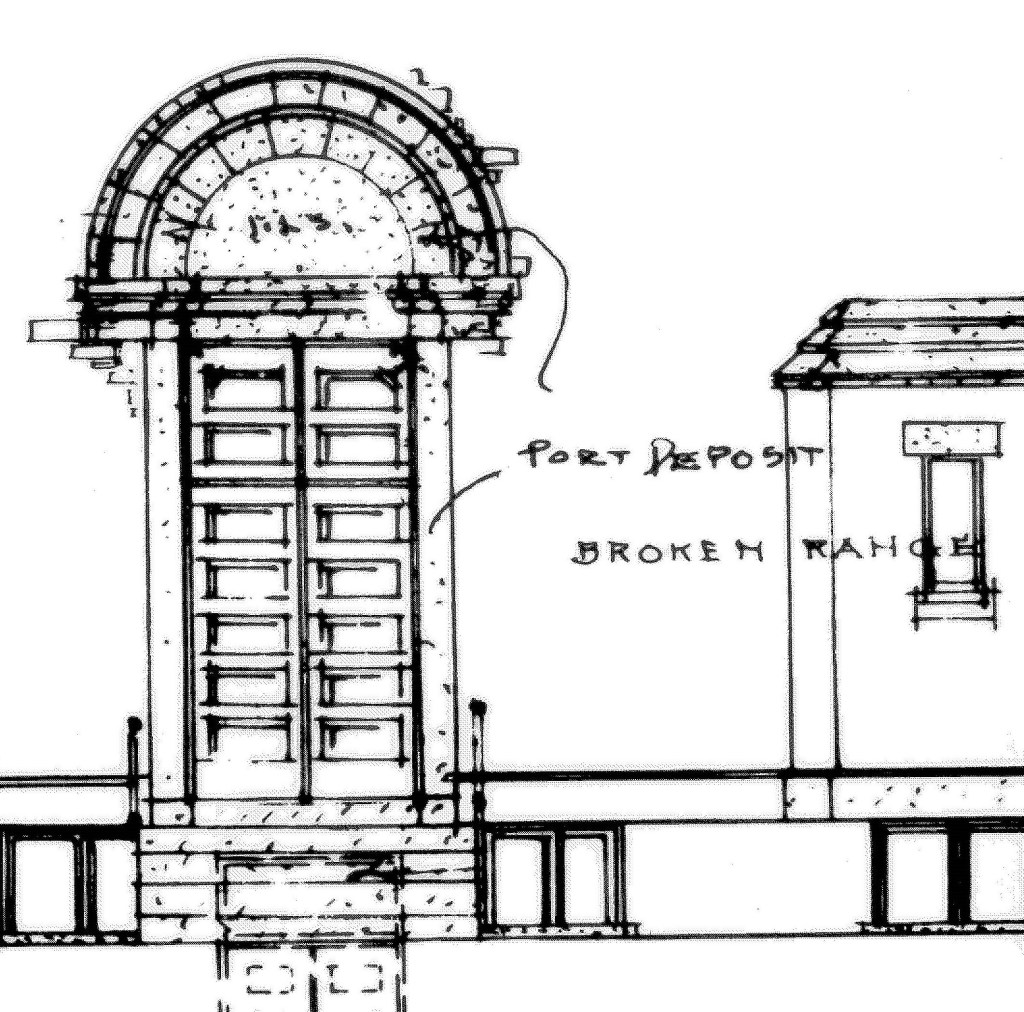
Door on East side of church as shown in architectural drawings

Have you ever noticed that there is no sculpture in the arch (tympanum) above the parking lot door outside Saint Francis de Sales Church? It looks a little bare, but that seems to have been intentional.

Henry Dagit’s original architectural plan for the church shows sculptures in the arches above the three front doors on Springfield Ave., and above the 47th Street door, but the Eastern Elevation drawing, showing the Rectory Side of the church, has an empty half-moon above the door, with no ornamentation planned for that side of the building.

                Why would that be?

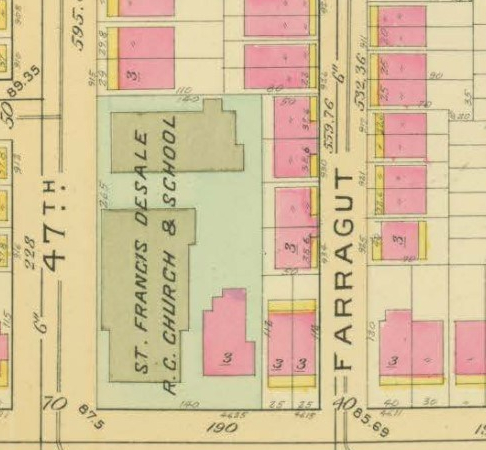
SFDS shown on 1909 map

When our church was finished in 1911, that part of the building wasn’t a priority, since it wasn’t visible from the street! The eastern entrance to the church was tucked away in a “secret garden” courtyard, formed with the back of the  rectory on one side; the wall of the new church on another; the side of the school (with the alley space between the church and school, probably used for deliveries from 47th street) filling the third side; and the back fences of a row of houses along Farragut Terrace completing the enclosure. We have no record of whether the small, closed yard space was planted or paved, or how it was used. It was probably a laundry and utility area for the rectory, and/or a school playground; there was, as yet, no need for parking, since people didn’t have cars.

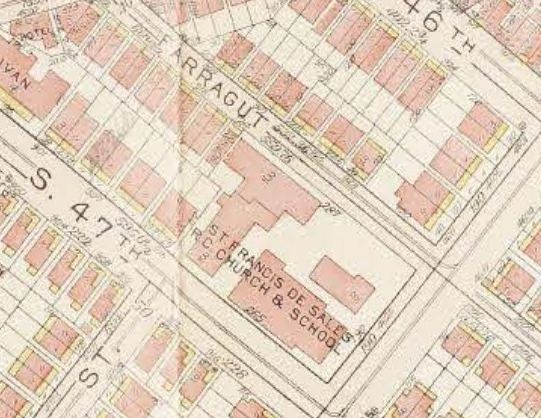
Needs and conditions changed over time and that side of the property became exposed in 1926, when the parish bought and demolished the two corner houses on Springfield Ave. (numbers 4615 and 4617) to create the corner rectory garden; and numbers 936 to 932 on Farragut Terrace to build the addition to the school. The church parking lot on Farragut Terrace was part of that development. The ramp to the church door was added in the late 1990s.

SFDS shown on 1927 map

Who owned the houses that were removed back in 1926? One familiar name is that of Roger A. McShea at 928 South Farragut Terrace – he was the father of future Bishop Joseph Mark McShea, who would grow up to become our Fifth pastor from 1952-1961. Number 932, incidentally, was owned by a gentleman named John Sanderson Trump – a terribly familiar last name, but, as far as we know, unrelated.

As to the “portal sculpture” — if a design had ever been proposed for that empty half-moon space above the eastern door, what could it have been? The scenes above the doors on the front of the church show the Annunciation, the Crowning of Mary, and the Pieta. The 47th street side of the church shows another Mary-related scene, the Nativity. The Assumption might have completed her story – and that would have been very suitable, since Bishop Crane, who built the church, had a special devotion to Mary and to the Rosary. He could even have placed a Mary garden in the courtyard — invoking the medieval idea of the hortus conclusis or enclosed garden representing Mary’s virginity and purity – looking much like today’s Rectory garden with the MBS statues.

Instead, it was left to imaginations (and perhaps to future parishioners) to complete the decorations on that side of the building. We are reminded yet again, that we, like our magnificent church, are all “unfinished business” – ever adapting to new circumstances, never complete on this earth, and never, ever perfect.

SFDS front doors as shown in architectural drawings

Building a Nation: Fourth of July 1908

oklahomaThe central event of the 1908 Philadelphia Fourth of July celebrations, reported by The Philadelphia Inquirer, was “The presentation of an American flag by Philadelphia to the Baby State of the Union, Oklahoma, and a reciprocal presentation to this city.”

Oklahoma had voted to become the 46th state in November, 1907. When its representatives came East, to be welcomed at the “seat of American Independence” for their first American Fourth of July, the festival “Chairman Frank W. Lambrith…pointed to the clicking telegraph instrument ready to keep them in touch” via the latest technology, with crowds gathered 1,367 miles away in Guthrie, Oklahoma.

Festivities began with “a delegation of citizens from the new state, occupying a conspicuous place on the platform,” along with “a number of descendants of the signers of the Declaration. Both delegations proceeded to Independence Hall with a military escort.”

 Representatives of different religious and civic groups across Philadelphia – what would, in 1908, have been considered an exemplary diversity — were invited to participate, starting with Rabbi Martin Nathans, of Beth Israel Synagogue, who delivered the opening prayer, followed by songs from the Matthew Baldwin School Chorus.

 A series of back-and-forth Oklahoma  telegrams provided live commentary: “’Guthrie wants to know what we are doing,’ called Chairman Lambrith, looking at a telegram, and we have telegraphed back: ‘We are raising over Independence Hall the flag that will be given to Oklahoma.’ Oklahoma clicked back: ‘Very good.’”

 The celebration continued, as “Rev. C. Edgar Adamson, of St. Paul’s M.E. Church, invited all to rise and repeat the Lord’s Prayer….Then came the battle-scarred Oklahoman, (Civil War)  Col. T.H. Soward, who stepped to the front on his crutch to be greeted by tremendous cheering…His expressions of the Western peoples’ love for Independence Hall, and their wonder whether the people who had it in their keeping really understood how they loved it, thrilled his auditors…” He proclaimed “that the Liberty Bell spoke…not only to our own countrymen, but…the world is hearing and heeding the Cry of Liberty…”

 A graduate of Boys’ Central High School read aloud The Declaration of Independence, then a descendant of one of its Signers delivered a speech, and State flags were exchanged. “Then there were a few minutes of holding of watches, waiting for the first stroke of 12 o’clock. At the first call of the Bell, Mayor Reyburn clicked the telegraph to Guthrie and the salutes were fired and the bands and people began to render “The Star- Spangled Banner” in Philadelphia and Guthrie at once.

 After several minutes of joyous noises during forty-six strokes of the (Liberty) Bell, the people gathered into silence again and Rev. Joseph A. Whitaker of St. Francis de Sales pronounced the benediction.” (Bet you were wondering when Saint Francis de Sales Parish would come into the story!).