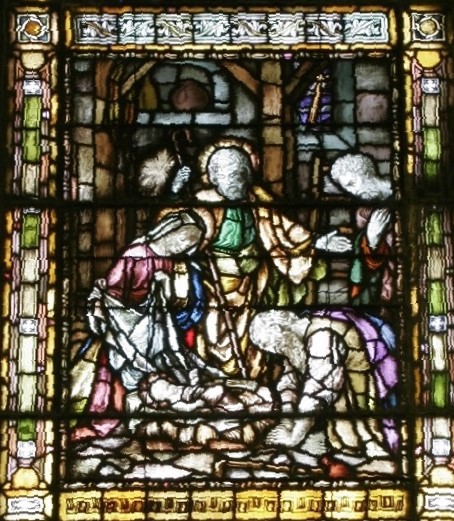
St. Francis de Sales parish is inordinately proud to have had Bishops Crane, Lamb, and McShea in its lengthy pastor lineup. Like the Three Magi in the Nativity story, the three successive bishops, 1921 to 1961, brought gifts to the parish church — of gold, in its magnificent decorations; frankincense, in its atmosphere of piety; and myrrh – an embalming fluid.
If having been home to an assistant bishop once-upon-a-time could transform a church into a cathedral, though, then Philadelphia would be a city of cathedrals! Some other Philadelphia parishes that have had Bishop-pastors include St. Malachy (Bishop Prendergast); Our Mother of Sorrows (Bishop McCort); Nativity B.V.M. Parish in Port Richmond (Bishop O’Hara); Church of the Incarnation (Bishop Benjamin); St. Helena’s in Olney (Bishop Graham); Old St. Mary’s and Holy Trinity parishes (Bishop Lohmuller); Saint Alice in Upper Darby (Bishop McDevitt); Our Lady of Fatima (Bishop Hughes); St. Colman Parish in Ardmore (Bishop Maginnis); and Saint Charles Borromeo in Bensalem (Bishop Deliman), among others.
The story of this parish is much more than the story of its long-ago episcopal royalty. Its rich musical heritage began much earlier than the bishops’ boy choirs, as early as 1902, with its first organist and choirmaster, Miss Margaret Marie Marshall. The parish was never segregated: in the 1960s, long after the bishops, it was a model for success, studied by local protestant parishes struggling with racial integration. Immigrants were always welcomed. The efforts of parishioner Betty Allen and of Sisters Constance and Jeannette at the school in the 1970s and 1980s made the parish a center for Vietnamese refugee resettlement, with immigrant ministries to refugees from around the world continuing later and in the IHM Center for Literacy and Sister Gertrude’s ministry.
It’s easy to be distracted by the glitter of elaborate pageantry and the visuals of shimmering golden mosaic and tall church windows cloaked in brilliant colours, but the reality check has always been there. Despite their magnificence, the Three Magi, or Kings, or Counsellors of the Bible story were peripheral characters — visitors — like the shepherds and sheep, coming to see Baby Jesus, who was the real attraction, lying in a manger because he “did not regard equality with God something to be grasped. Rather, he emptied himself, taking the form of a slave…” Look around the church, and you’ll see that there are no images of a kingly Christ in its impressive original decorations. Instead, you’ll see Christ as a helpless baby; as a child, working in Joseph’s workshop; and the adult Christ as a teacher, in prayer, and crucified, wearing a crown of thorns. One of the most poignant images is a humble square on the exterior of the church above the choir door, showing the Flight into Egypt, when Joseph and Mary, clutching the tightly wrapped Baby Jesus, fled the violence of King Herod and sought the kindness of strangers, far from home.
The story of the Nativity of Jesus, his ministry, death, and Resurrection, has been retold by a succession of pastors to an ever-changing congregation, each year since the parish was formed in 1890. And every year brings inspiration to see with new eyes and begin once again — much as Douglas Adams quipped in the Hitchhikers’ Guide to the Galaxy in the 1970s: “And then, one Thursday, nearly two thousand years after one man had been nailed to a tree for saying how great it would be to be nice to people for a change, a girl sitting on her own in a small café in Rickmansworth suddenly realized what it was that had been going wrong all this time, and she finally knew how the world could be made a good and happy place. This time it was right, it would work, and no one would have to get nailed to anything.” We can only keep trying.
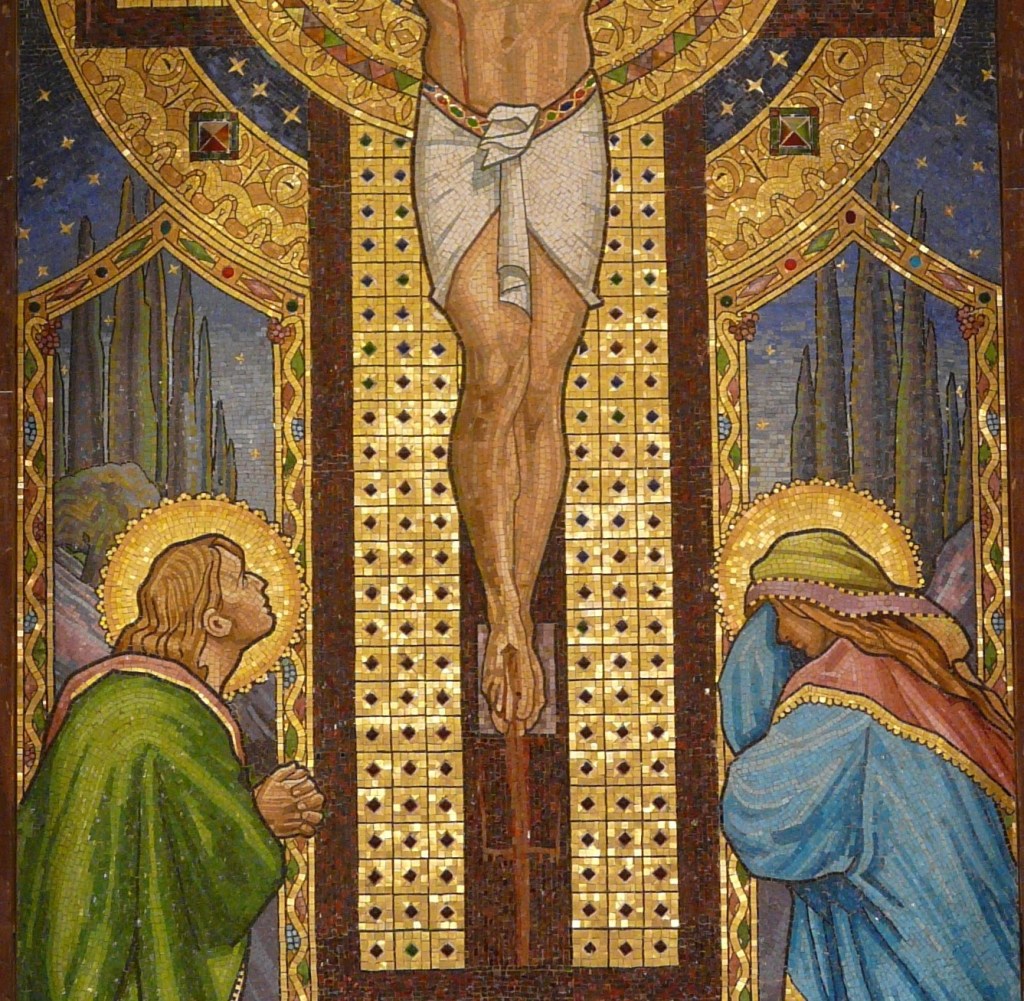
It’s easy to look at something so often, that you stop seeing it. The suffering Christ on the glass mosaic altarpiece at St. Francis de Sales (designed by Frederick Dimble Henwood and executed by mosaic artist Henry Choffin around 1910) is an obvious center of attention, especially during Lent, but look again: the mountains and stars in the background also offer something to ponder all year long.
The rocky scenery behind the kneeling figures is easy to overlook and might at first seem unimportant. The precise location for the hill of Golgotha, or Calvary (both of which mean “place of the skull”), outside the old walls of Jerusalem, where the crucifixion took place, is not known, but the general area where it is thought to have occurred was once a limestone quarry, so rocks might be expected. The mural scenery features pointy mountain pinnacles, though, not flat excavated cliffs, which might suggest other meaning.
Mountains in the Holy Land were the places closest to God, where many important Old Testament events occurred. Among them: Mount Ararat, where Noah’s Ark came to rest; Mount Moriah, where Abraham went to sacrifice Isaac; and Mount Sinai, where Moses received the ten Commandments – though, curiously, the precise location for all of these places is no longer known. Mount Zion, where The Second Temple stood in Jesus’ time (it was destroyed around 70 AD) is today known as The Temple Mount. It is the holiest site in Judaism – and also one of the holiest sites in Islam. The Dome of the Rock mosque now covers a large rock known in Judaism as the Foundation Stone – thought to be the spiritual junction between heaven and earth, and the place from which the world was created and Adam was formed. In Islamic tradition, this was the site of the miraculous Night Journey of the prophet Muhammad and his ascent into heaven — an interesting thought this year, when Ramadan, the Islamic month of fasting, reflection, and community, coincides with Lent.
The Christian connection with mountains continues in the New Testament. The gospels – particularly that of Matthew – mention a number of mountain events significant to the life of Jesus: his Sermon on the Mount; a number of healings; his resistance to the devil’s temptation; the Transfiguration, when his divinity was revealed; his farewell discourse, when he counseled his disciples to “love one another” and declared that “the hour has come for the Son of Man to be glorified;” and his commissioning of the apostles to “go therefore and make disciples of all nations...” The actual locations for most of these events are not known today, but tradition says the Transfiguration may have occurred on Mount Tabor. The garden of Gethsemane, where despairing Jesus prayed “to let this cup pass from me” on the night before his death, is at the foot of the Mount of Olives. Jesus is thought to have ascended into Heaven from the summit, and a shrine there, shared by Christians, Muslims, and Jewish people, contains a rock that supposedly has the impression of Jesus’ footprint.
Is the number of peaks shown in the mosaic significant? Two separate sets of seven summits could have been intended to link the “Seven hills of Jerusalem” with Rome, which is traditionally identified as the “City of Seven Hills.” Our church includes many references connecting the Old and New Testament while affirming our Catholic connection with Rome, and the unbroken line of authority from Saint Peter – “upon this rock” – to the present day. Seven is a mystical number, traditionally thought to represent completeness and perfection. There are seven sacraments, seven gifts of the Holy Spirit, seven joys and seven sorrows of Our Lady, and seven deadly sins. Seven mountains are mentioned in the apocalyptic vision of Revelations, which also proclaims that the first resurrection of the dead will take place at the seventh trumpet. Whatever the number intention, the stern mountain peaks in the mural all point in one direction, straight up to heaven.
Steep mountains look daunting from the ground, but the view closer to the stars is exalting. In these interesting times, the mountains beyond the crucifixion could inspire thoughts of theologian Thomas Merton’s Seven Story Mountain mystical quest for contemplative freedom inside the protective walls of a cloister in 1948, when the memory of World War II was still strong. Contrarily, in a more popular vein, it could call forth the tuneful encouragement of the Mother Superior to Maria, in the classic movie “The Sound of Music,” to “Climb every mountain…,” as Maria, also during World War II, followed her destiny to leave the security of cloister walls and journey over the mountains to a new life.
Incidentally, that movie was loosely inspired by the real-life story of an immigrant family, one among the “huddled masses yearning to breathe free,” who once found a haven on this side of the ocean. And there’s a parish connection: Peter La Manna, the parish choir director in the 1960s, performed for several years with the Von Trapp family singers, whose actual exodus from Austria during World War II inspired that film!
The Christmas season actually begins nine months ahead of December 25, with a mysterious event that can only be explained in symbols — and which attains added significance when viewed through the glass of our window.
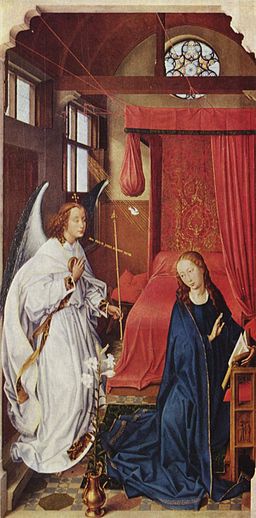
The Annunciation window on the parking lot side of SFDS church, crafted by the studio of Nicola D’Ascenzo about 1910, celebrates the startling moment when Mary found out that she was to be the human Mother of Jesus. Its design was inspired by symbol-rich 15th century Northern European Renaissance paintings such as those of Jan van Eyck (left. “The Annunciation” ca. 1434-1436), Hans Memling (center. “The Annunciation,” ca. 1465-1470) and Rogier van der Weyden (right. “The Annunciation” from the Saint Columba Altarpiece ca. 1455). Serendipitously, its thematic elements echo the decoration of the church built around it, making the scene relatable to all those sitting in the pews, while the medium of stained glass adds an extra dimension of meaning.
It begins with the familiar setting. Art historian Christopher Jones notes that in the 15th and 16th centuries, “Northern European artists…often showed the Virgin in an interior space, sometimes…an ecclesiastical context, drawing on contemporary Gothic styles to suggest the familiar setting of the Christian Church.” In our window, rather than showing medieval pointy Gothic arches, Mary’s church features the same elaborate round-topped windows and linked-chain and Byzantine lozenge decorations as the 1911 Byzantine-Romanesque church constructed around it.
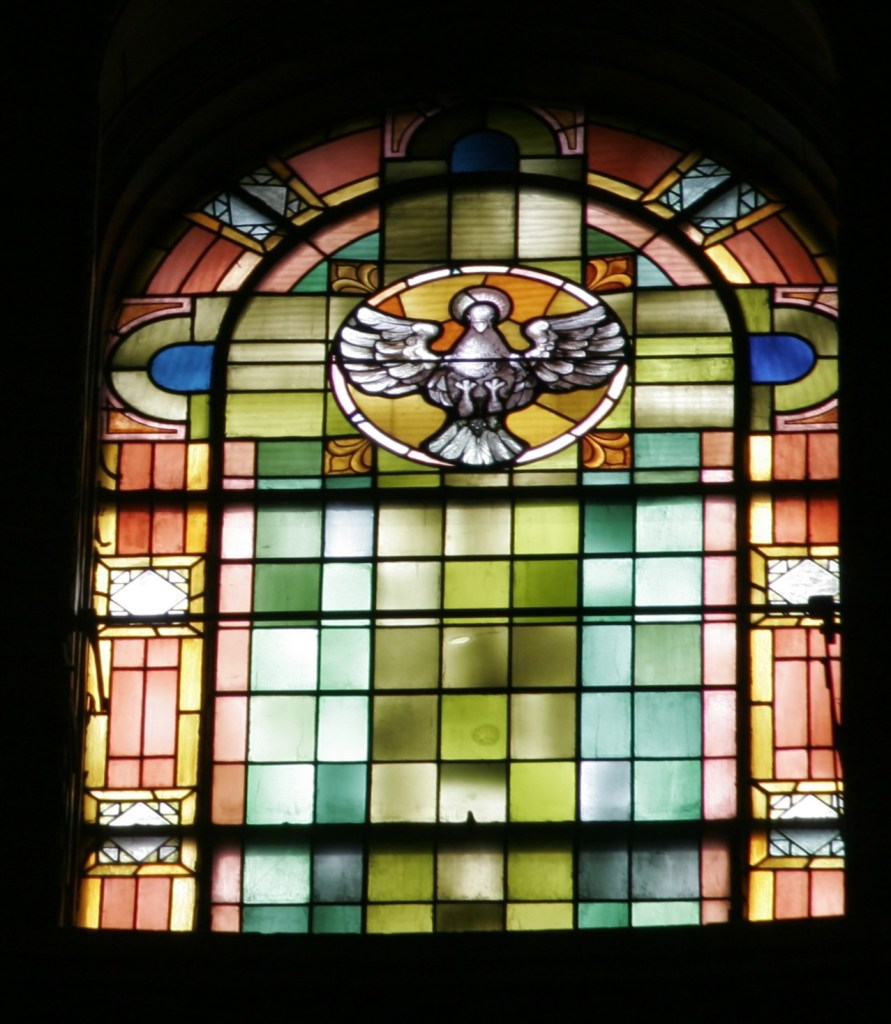
The presence of a dove, representing the Holy Spirit, is the usual convention to symbolize the moment of conception. Jones observes that “In Annunciation paintings, the dove is often shown descending on a ray of light, indicating …a sense of movement or passage, with the ray of light touching the Virgin’s head or breast in the moment of Incarnation.” This is how it’s shown in the window. The idea is presented again in the sanctuary of the church, with a dove mosaic pointing down above the statue of the Blessed Mother.
Jones observes “One fascinating tradition that developed in early Netherlandish art was to show the ray of light entering the scene through a window, as in Rogier van der Weyden’s painting. This was a way of alluding to the conceptually tricky idea of Mary’s miracle conception, by comparing the passage of the Holy Spirit through the body of the Virgin to light passing through glass.” Our Annunciation window actually becomes a double Holy Spirit reference – rays of light from the dove beam into Mary through an image of a window, painted on an actual glass window—so that the light of the dove, shining through the Blessed Mother, reaches us, too. The “Holy Spirit as a dove in a window” theme recurs in two dove windows in our dome – one showing the dove descending into the church bringing grace from heaven, and another ascending from the church, to carry prayers heavenward — the Holy Spirit passing through the glass in both directions.
Since the Feast of the Annunciation is celebrated in the Spring, nine months before Christmas, Jones observes that paintings often include garden references. He notes that in Northern Renaissance artwork, like that which inspired our window, “The motif of a flower in a vase became well-used, a tradition that developed into a lily, which became the symbol of the Virgin’s purity.” Our window shows a lily in a pot in the foreground – which would have echoed the multitude of cut flowers used to adorn the church, as well as the single lily in one of the dome windows. Since the lily also represents Christ in the Passion, it brings a poignant note into the scene — appropriate since the March feast occurs during Lent, overlapping with that more solemn season.
As in many of the Northern Renaissance paintings, the Archangel Gabriel in our window wears a lavishly patterned gown with a large jewel clasp at the neck, Art historian Isabella Meyer notes that the opulence of a similarly attired angel, in a painting by Van Eyck, evokes heavenly richness and observes that “His garments also suggest that he is taking part in or celebrating High Mass” – an interesting observation – our angel’s elaborate garments would have mirrored the pageantry of high Masses inside the church when the window was installed.
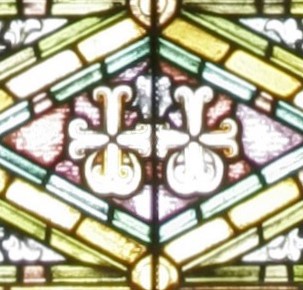
Our Archangel Gabriel is equipped with a lily staff embellished with the words “Ave gratia plena,” or “Hail favoured one.” The Dictionary of Subjects and Symbols in Art notes that Gabriel’s prop evolved in artwork over time: “In early examples the angel holds a scepter tipped with a fleur-de-lys, the attribute of Gabriel, but later it often holds the lily.” The transformation from sceptre to lily offers an interesting meditation. A sceptre would symbolize royal favour while the lily flower symbolizes purity. Gabriel’s lily staff is an invitation — or a mandate — to the Virgin from God — but a similar lily staff, shown on the St. Joseph tabernacle in our church, references Jesus’ earthly lineage: “And there shall come forth a rod out of the stem of Jesse, and a Branch shall grow out of his roots.” So the small detail of the staff can be a reminder of Christ’s dual nature: his divinity, in the recognition of God’s favour; and his humanity, based on his earthly lineage. This thought is repeated with the pair of fleur-de-lys/lily crosses under the Nativity window.
As in many Renaissance depictions, a statue of David appears near Mary in the window scene as a reminder that Jesus was both God and human (and Jewish!) — the same message as the mosaic Stars of David in the church dome, both offering a link to the Old Testament and a reference to Jesus’ family lineage as part of the House of David. Double cross symbols in the lower panels of all three windows on that side of the church to reinforce the concept of the Incarnation — the notion that Jesus had a dual nature that was both divine and human.
Finally, the Dictionary of Symbolism offers the interesting idea that Mary’s words of response to Gabriel’s invitation, sometimes included as a “speech balloon” in Renaissance Annunciation paintings, “may be upside down so that it can be more easily read by God the Father.” Curiously, the Old Testament prophecy of Isaiah, written above our Annunciation window, and which translates from the Latin as “Behold, a virgin shall conceive…and his name shall be called Emmanuel,” shows the word virgo, or virgin, upside-down. This could have been a reference to that historic practice — echoed by the symbol of the Eye of God shown peering down into the church through the oculus window of the dome.
Viewed as a group, the three windows on the parking lot side of the church celebrate the Christmas season with heavenly light, representing God’s grace shining symbolically through a window in each design. The Holy Spirit dove illuminates the first scene; and the nativity star, representing the light of Hope from above, gleams above the birth. In both instances, the light from the painted window shines into the church through the glass of the actual window. The third scene, of Christ’s youth, is a darker vision, foreshadowing his future as he builds a cross in his father’s workshop. That scene also includes a little piece of a painted window in the background, obscured by the cross and a red rose — another flower that symbolizes both Mary’s purity and Christ’s passion. The story then continues across the aisle with the three windows of the Easter season, commemorating Christ’s adult ministry, all shown outdoors, ending with the Agony in the Garden.
The story of Christ, as told in the windows of our church, invites us to find our place in the rhythm of historic continuity — from the Old Testament to the New; from Christ’s Birth to his Resurrection; from Renaissance artwork to the construction of our church in the early 1900s, to the present day; from an interior life to a worldly ministry; from darkness to light in an endless annual cycle of death and rebirth. And through it all, we are called to reflect on the miracle of God’s continuing presence, symbolized in the light shining through the bright rainbow glass, illuminating history and touching everyone who pauses to look.
This Christmas, before entering the church, take a moment to notice another depiction from Christ’s early life, now revealed with the removal of the scaffolding: a weathered bas relief outside, by the front door, of “The Flight into Egypt.” Crafted by Italian immigrant sculptor Adolfo de Nesti, it shows the Holy Family desperately fleeing a dangerous situation at home to seek refuge in a foreign land in a time of trouble — one more family, part of another endless historical cycle that is all too relatable for too many people across the globe this holiday season.
The Holy Family’s urgent movement — and the travels of Jesus who never stayed in one place — are a reminder that faith is a journey. Pope Francis, in his pre-Christmas address to the Roman Curia, cautioned that “it is important to keep faring forward, to keep searching and growing in our understanding of the truth, overcoming the temptation to stand still and never leave the ‘labyrinth’ of our fears.” Christianity “is not meant to confirm our sense of security, to let us settle into comfortable religious certitudes, and to offer us quick answers to life’s complex problems.” The Pope “concluded with a call to courage, love, and humility in our journey of faith and service” and asserted “Only those who love fare forward.”
(This post was first published on September 29, 2020)
The words and artwork above the doors of a church are intended to guide churchgoers as they move through the doorway, or portal, from the outdoor worldly world into sacred space. At Saint Francis de Sales, that direction has long been hidden – and not just because it has been covered by scaffolding!
The message above the central door to our church is visible in photographs, but long misrepresented in writing. In almost every description of the church, since the beginning, only the first half of the inscribed verse is quoted: “My eyes will be open and my ears attentive.” Winding around a scene (carved by sculptor Adolfo de Nesti) usually described as “the Madonna and Christ Child” — an active toddler — this might easily be understood as a reminder to churchgoers of proper behavior as you enter the church: be still, be quiet; observe the magnificent decorations and the pageantry; listen carefully to the readings and the sermon.
This is only a partial quote, however. The actual phrase engraved above our doors is 2 Chronicles 7:15 “My eyes shall be open and my ears attentive to the prayer of him that shall pray in this house,” which puts a different spin on things: these are the words that God the Father, spoke to Solomon at the dedication of the First Temple of Jerusalem, built to house the Ark of the Covenant. The verse in the Bible continues “For I have chosen, and have sanctified this place, that my name may be there for ever, and my eyes and my heart may remain there perpetually.” So instead of telling us how to behave in church, our church is likened to the fabled Holy Temple of King Solomon! This is reinforced in the image framed by the verse, which is not just the “Madonna and Christ Child,” but Mary seated on a throne, with angels holding a garland above her head — a traditional French doorway theme of “The Coronation, or Triumph, of the Virgin…the Virgin being symbolic of the Church as well as being the Bride of Christ.”
The association is not incidental. The Oxford Dictionary of Christian Art notes that “A door is an obvious symbol of the way to salvation through the church, and for this reason the main door is usually directly opposite the altar.” In our church, the pose of the toddler Christ above the portal is echoed in the crucifixion mosaic above the altar and the doorway inscription theme continues up in the sanctuary, with two phrases threaded around the top of the walls. The first is from the 26th Psalm in which David – patriarch of Jesus’ lineage — says “I have loved, O Lord, the beauty of thy house; and the place where thy glory dwelleth.” (note the Mary monogram above the words “beauty of thy house!”) The other quote, from Genesis 28:16, is part of what Jacob said upon awakening from his dream about angels climbing a ladder to heaven: “Indeed, the Lord is in this place” — in the Bible, the verse continues “and I knew it not….This is no other but the house of God and the gate of heaven.”
Studying inscriptions in churches, and especially the words inscribed above ancient European church portals, Calvin B. Kendall noted that historically, “Inscriptions articulated the hopes and fears of monks and worshippers, spoke for them and to them, and in some cases may have functioned as talismans against lurking demons.” In 1911, our doorway inscription boldly identified our church as a holy place and acclaimed the benefits of prayer in that uncertain age leading up to the First World War.
For many years now, the front of our church has been wreathed in scaffolding that has concealed the portal decorations and offered a different message and symbolism. Scaffolding is human-built structure that provides support while keeping people safe. It’s also an emblem of “work in progress,” a very apt description of our parish! And, perhaps, there’s a warning: over time, is it possible to become so conditioned to rigid human framework, that we are in danger of letting it overwhelm the spiritual message of God’s love?
Update: The scaffolding is now finally removed and the facade of the church will be blessed by by Archbishop Nelson J. Perez next Sunday, December 10, 2023.
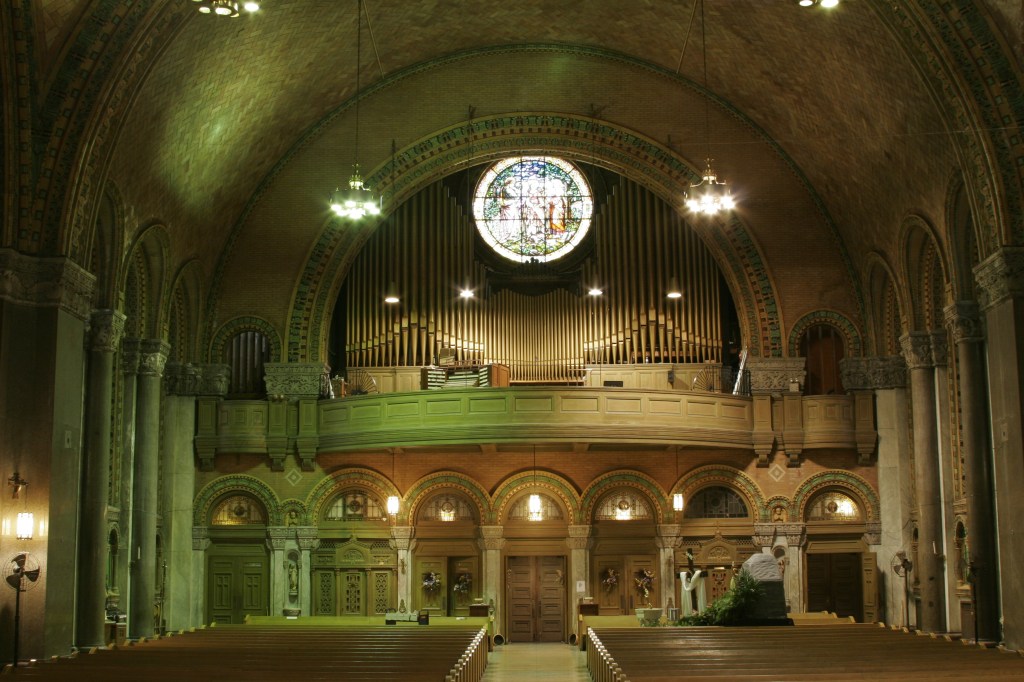
From the ground, looking up, it’s hard to identify the weathered sculptures on the columns that support the Guastavino dome inside St. Francis de Sales. Are they single creatures with two heads, or are they pairs of birds? Why are they there and what is their message?
A casual first glance suggests that they could be two-headed eagles, consistent with the Byzantine-style architecture. According to medievalist.net, in that historic convention, “the heads represent the dual sovereignty of the emperor both in secular and religious matters and/or dominance over both East and West” — which, today, seems like a disturbing nod to authoritarian “divine-right” monarchy. However, a second look shows that our sculptured birds, roosting companionably and munching vegetarian meals, are inconsistent with empire-building heraldry.
Alternatively, a single bird with two heads could represent the sometimes two-headed mythical phoenix that periodically bursts into flames and is reborn from its own ashes. This would symbolize the “triumph of eternal life over death,” and, ultimately, Christ’s Resurrection. It might also, inadvertently herald the many rebirths of our parish through a long succession of pastors. There’s a (one-headed) phoenix aflame in one of the dome windows, so the theme is used in our church, but the birds on the columns do not display any hint of transitioning.
The location of the birds offers yet a different possibility. In an old volume on the language of Christian symbolism, Canon Edward West observed that “Westerners begin with earth and move upward to divinity; Easterners begin with the divine and come down…” In the Eastern style that inspired our church architecture, symbolism begins at the top of the dome, with an image of God the Father in heaven, and then descends in order. The top of our dome features an oculus, or round window, decorated with a triangle in a shamrock-like trefoil, representing the Eye of God. Below that are the stars, and below the stars, in the pendentives — the triangular vaulting between the dome and the columns — are the symbols of the four gospel-writing evangelists: Matthew, Mark, Luke, and John, the mediators who transcribed words from God for the benefit of the people below in the pews. The mystery birds appear below the evangelists, where the pendentives join the columns that support the dome (or, in Byzantine tradition, anchor the dome to earth and keep it from floating away).
This architectural placement, and the circles in the tails of the birds, suggest that they are peacocks. The eyes in the Peacock’s tail represent stars in the sky, consistent with the celestial dome above them. Signs and Symbols in Christian Art states that the “hundred eyes” in the peacock’s tail can also symbolize the “all-seeing church,” which would pair with the “Eye of God” peering down on the congregation from the oculus. Since peacocks symbolize heavenly immortality while the vines in the birds’ beaks represent earth’s bounty, celestial peacocks holding terrestrial vines form a bridge between heaven and earth, dome and columns. The combined grouping of peacock pairs with grapevines and crosses is said to signify Christ in the Resurrection, knitting together many design themes in our church.
Peacocks had other relevance in 1911, along with the acanthus leaves so abundant in our tilework. These motifs, evoking lost paradise, were popular with the Arts and Crafts Movement in the late 1800s and early 1900s, when artisans, like those who designed and built our church, yearned for a return to a slower-paced, hand-crafted, close-to-nature artistic style. This was in reaction against the waste and impersonal uniformity of rapid industrial development — a continuing modern concern.
Intentionally or unintentionally, there’s one more peacock connection for our church. Signs and Symbols in Christian Art offers the side note that “The peacock’s habit of strutting and displaying the beauty of its feathers has caused it also to become a symbol of worldly pride and vanity.” This is perhaps a caution for a magnificent parish, once the gem of the archdiocese, run by three bishops in succession, their resplendent pageantry aided by ranks of altar boys, and robed choir boys and men marching in orderly processions. Today, looking beyond the peacocks, up into the dome, we should be better aware of our humble place in the great cosmos, while peacocks, looking down, reminisce.
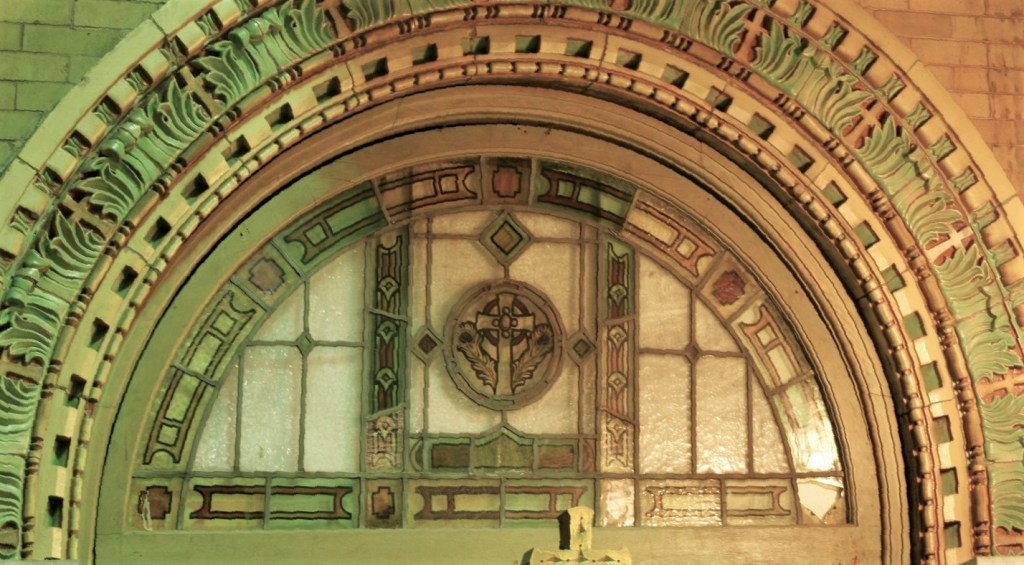
A half-moon-shaped window above the middle doors at the back of the church is a simple architectural detail packed with meaning.
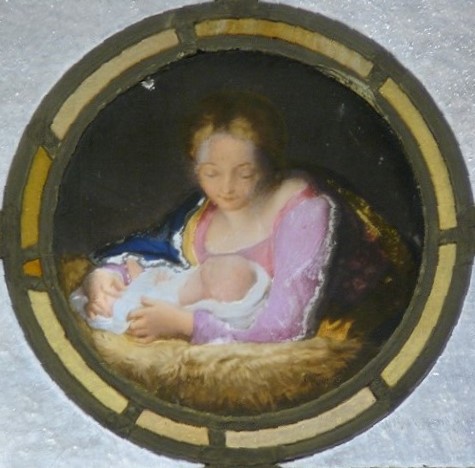
The round medallion in the center recreates Mary and Baby Jesus from an oil painting called “Holy Night” by Antonio da Correggio around 1530 (about 37 years before our patron St. Francis de Sales was born).
In the original painting, Mother and Child were shown in a pool of light, with St. Joseph and a group of shepherds in the shadows just beyond. Light plays an important symbolic role in many Nativity depictions: the Glencairn Museum notes that in Byzantine artistic tradition, “the cave of the Nativity represents the darkness into which Christ, the Light of the World, was born” and “according to the well-known mystical vision of St. Bridget of Sweden (1303–1373), when the Christ Child was born, the cave where the birth took place was filled with an ineffable divine light—a light that completely outshone the earthly light of Joseph’s candle…” Artists have tried to capture the effect ever since. The original Correggio painting was considered a masterpiece of the chiaroscuro technique, which uses strong contrasts of light and dark to tell its story. We get a slightly different variation with our window: Mother and Child are best seen illuminated from behind.
We don’t know who painted our Holy Night window or what shop put together the glass around 1910. Amy Valuck, President of the American Glass Guild, suggests that the round painted medallion was likely to have been made in one place, and the surrounding half-moon glass in another, and the two then pieced together. She observes that the glass in the lunette windows is mostly rolled glasswith black ladder-like borders that were stencilled on using a vitreous paint made with powdered ground glass and metal oxides, fired in a kiln to stabilize it, with silver nitrate then applied between the lines and fired again to get the yellow coloring – still crisp after a century of wear. “The narrow circular border around the painted medallion is rolled opalescent glass.” That could be a small origin clue: milky opalescent glass, made by mixing different metal oxides into the actual glass — was a technique pioneered in the late nineteenth century by several American studios – and most of the other handwork in our church is local.
The round medallion — which may have come from a company that supplied such ready-made work to other studios — was hand-painted with vitreous paint, mixed at the glass workshop. Our expert points out that “if the proportions of ground glass, oxide, and flux were not carefully measured, paint would be more likely to fail over time” and the white lines at the edges of Mary’s clothing and some flaking paint suggest that its glass was slightly under-fired – a very human touch, adding weight to the idea that the medallion and the surrounding window were by different artists, possibly from different studios, and reminding us that our magnificent church was built with the collective efforts of many individuals.
There’s one further curious note about the Correggio painting that inspired our medallion: commissioned for a church in northern Italy, it was treasured there until 1640, when the work was “carried off by night” by the Duke Francisco d’Este, for his private gallery – a common “disruptive phenomenon” in an age when devotional artwork in churches was especially meaningful to those whose homes were bare, but rich people felt entitled to hoard pretty things. Correggio’s picture was meant to be accessible. Today, on display in a museum in Dresden, Germany, with reproductions spread around the world, its inspirational light shines again for everyone.
Back in our church, the origin story of our own little window is still a mystery (clues welcome!), but, when daylight shines through the image as the doors swing open at the end of Mass, it offers a small reminder that faith is active, and we are called to carry the light of the Christ child with us, in our hearts, as we go back out into the world.
In 1911, the interior of our church was decorated with an intricate arrangement of Catholic symbols — but something important was missing, which would only be fittingly supplied when SFDS joined with MBS in 2007. What could it be?
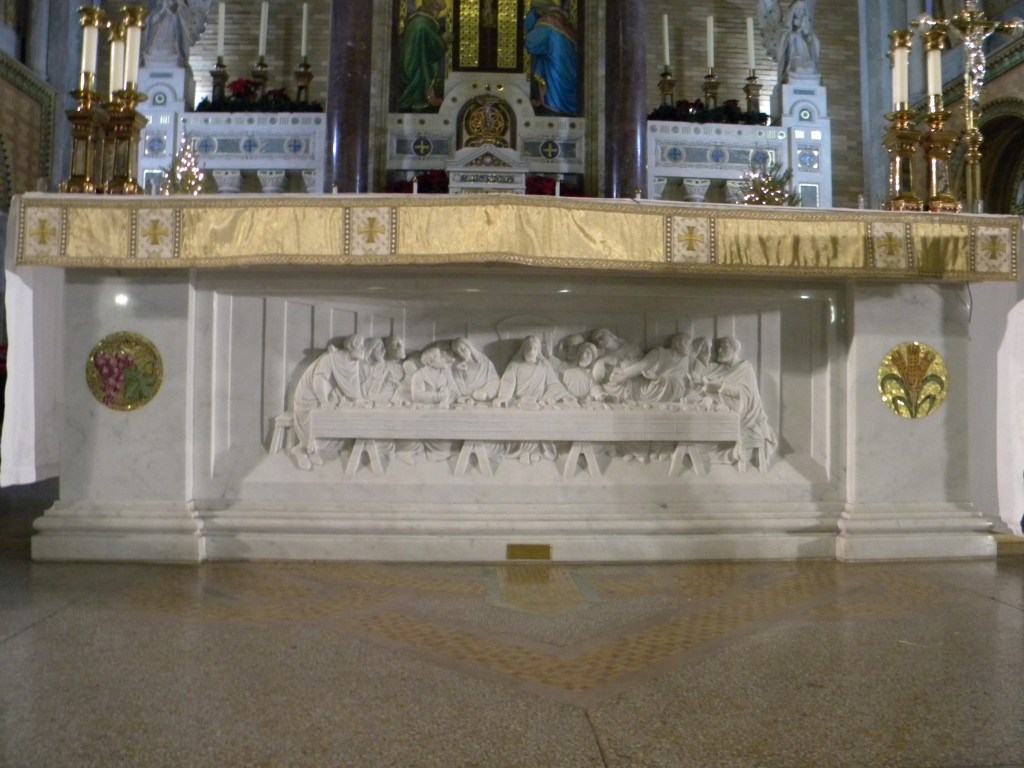
The answer, surprisingly, is the wheat in one of the mosaic medallions on the front of the MBS altar. Wheat has been an enduring symbol of abundance and rebirth, redemption and freedom, across cultures and through time. Wheat and grapes seem an obvious reference to the Eucharist, and our church is filled with grape designs and Eucharist motifs, but there was only the faintest suggestion of a wheat-like pattern in a few short decorative borders, until the altar from Most Blessed Sacrament — a church named for the Real Presence in the Eucharist — was incorporated into our building.
The “forgotten” plant symbolism is perhaps understandable since Catholicism tends to be more focused on the host’s transformation into the Real Presence of Christ. We know that bread for the Eucharist must be made of wheat – missionaries cultivated wheat around the world for the purpose, and the gluten-sensitive in modern times have been informed that wheat gluten is essential to the makeup of the host. But there is little to tell us why a wheat host is so important – there is no entry for “wheat” in the Catholic Encyclopedia!
The wheat shown on our MBS altar is a kind of “bearded wheat” (with bristles), like the wheat grown in Biblical times, which Jesus would have recognized. He would have known Exodus and the grain-related Jewish religious traditions that were part of the Passover. Wheat is one of the “Seven Species” listed in the Book of Deuteronomy as native to Israel (“a land of wheat, and barley, and vines, and fig trees and pomegranates; a land of olive oil and honey”) and thought to contain “special holiness.” Wheat is also among the “Five Grains” (wheat, barley, oats, rye and spelt) which have special status for a number of Jewish rituals. Challah and Matzah can only be made from these grains and only bread made with these grains requires the blessing before and after eating,
Myjewishlearning.com offers insight into the special importance of Jewish bread and blessing: “Jewish meals begin with the blessing over bread and then the sharing of bread together…” The words of the prayer: “Blessed are You, Adonai our God, ruler of the universe, who brings forth bread from the earth,” surprisingly, do not refer “to the actual bread that we hold in our hands at the time when the blessing is said…” One reading “is that our daily bread reminds us of time past, when bread trees grew from Eden’s soil… Official Jewish wisdom…identifies the bread of the blessing as the bread of a messianic future, constituting “a statement of faith in a time to come when all will have enough to eat, free of the backbreaking work that is now required by most of the world’s population just to put food on the table.” The traditional blessing of the bread at the Last Supper invoked centuries of heritage and yearning. Then Jesus offered himself as the “Bread of Life” for its fulfillment, changing the wheat bread and grape wine, by the miracle of transubstantiation, into his Divine Presence – the true “daily bread” for which we pray in the Our Father, and which refers both to the daily necessities of life and even more to Christ himself.
Wheat has been a critical dietary staple worldwide for many centuries, but the wheat we consume today is very different from that of ancient times. Varieties have emerged and changed to suit different conditions. Wheat is now bleached and separated; doused with poisons to control pests and weeds; and engineered and hybridized to alter specific characteristics and increase yields. A bread baker, writing in The Jerusalem Post, mused that “Wheat bread…is no longer regarded by many nutritionists to be a healthy food, perhaps because of all the shenanigans we have been getting up to with it in the last century or two…” Traveling too far from its origins, a once dependable staple has transformed into something that a growing number of people find difficult to digest. Perhaps there is a Catholic parallel here, highlighting a need to reclaim our spiritual roots, along with a recognition of our special responsibility to preserve and protect the natural resources important to survival in what Pope Francis calls “our common home” — so that those who come after us will have wholesome food to sustain life, and can continue to partake of the special gifts of the Eucharist.
When our church was built, back around 1911, every detail inside was carefully designed – right down to the lily staffs surrounding the cross on the door of the Saint Joseph altar tabernacle.
What is a lily staff and why is it important?
We don’t know much about St. Joseph from the Bible. Stories of Mary’s betrothal come from the apocrypha (ancient books not considered reliable enough to be included in the Bible). There, the Protoevangelium of James claims that when young Mary wanted to dedicate herself as a perpetual virgin at the Temple, the high priest prayed for direction. An angel then told him to gather all of the unmarried men of the area, and have each one bring his rod (generally thought to be a walking stick or staff) to the temple “and to whomsoever the Lord shall show a sign, his wife shall she be…and Joseph took his rod last; and behold, a dove came out of the rod, and flew upon Joseph’s head. And the priest said to Joseph, ‘You have been chosen by lot to take into your keeping the virgin of the Lord.’” The Gospel of Pseudo-Matthew tells a similar story, stating that “the man from the point of whose rod a dove shall come forth, and fly towards heaven, and in whose hand the rod, when given back, shall exhibit this sign, to him let Mary be delivered to be kept.”
A new detail appeared centuries later, when the stories were gathered into the Medieval Wikipedia-like Golden Legend compilation of all knowledge: “And then Joseph by the commandment of the bishop brought forth his rod, and anon it flowered, and a dove descended from heaven thereupon, so that it was clearly the advice of every man that he should have the virgin.” Use of the word “flowered” is unclear – it can mean “come out into full development,” and the earlier stories seem to suggest that the dove “flowered” from the rod, rather than that the rod burst into bloom. In any case, artists were inspired by the botanical idea, and over time, the concept of a flowering rod seems to have further developed into a specific flower. The University of Dayton Archives observes “The lily is associated with St. Joseph, spouse of Mary, through an ancient legend that he was so chosen from among other men by the blossoming of his staff like a lily. Likewise, the biblical passage, ‘The just man shall blossom like the lily’ is applied to St. Joseph in the liturgy of the Roman Catholic Church for his feastday, March 19.” The Oxford Dictionary of Christian Art notes that the lily is “The best known symbolic flower. It is the principal symbol of purity and thus associated with the Virgin Mary, especially in scenes of the Annunciation…Saint Joseph also frequently carries a lily…”
It’s actually more curious and complicated: the particular kind of lily on our tabernacle – often shown with St. Joseph in religious art — is a Calla Lily, native to Africa – an arum genus rather than a lilium – technically not a lily at all. Arums were associated with fertility in ancient cultures. At the same time, the rod of Joseph is not just a walking stick: the word was used in the Old Testament to mean genealogy — part of a family tree – such as the passage in Isaiah, thought to foretell the birth of Jesus: “And there shall come forth a rod out of the stem of Jesse, and a Branch shall grow out of his roots” (ISA 11:1). Mary has also sometimes been described as a rod, with Christ as the flower.
So, the lily staffs shown on our St. Joseph tabernacle, surrounding the symbol of a cross (which also is part of a tree) combine ancient natural symbols for integrity, belonging, and heritage, on a container for the sacred Eucharist. And one tiny artistic detail “blossoms” to connect and ground us through space, time, and history. The essence of our Catholic culture.
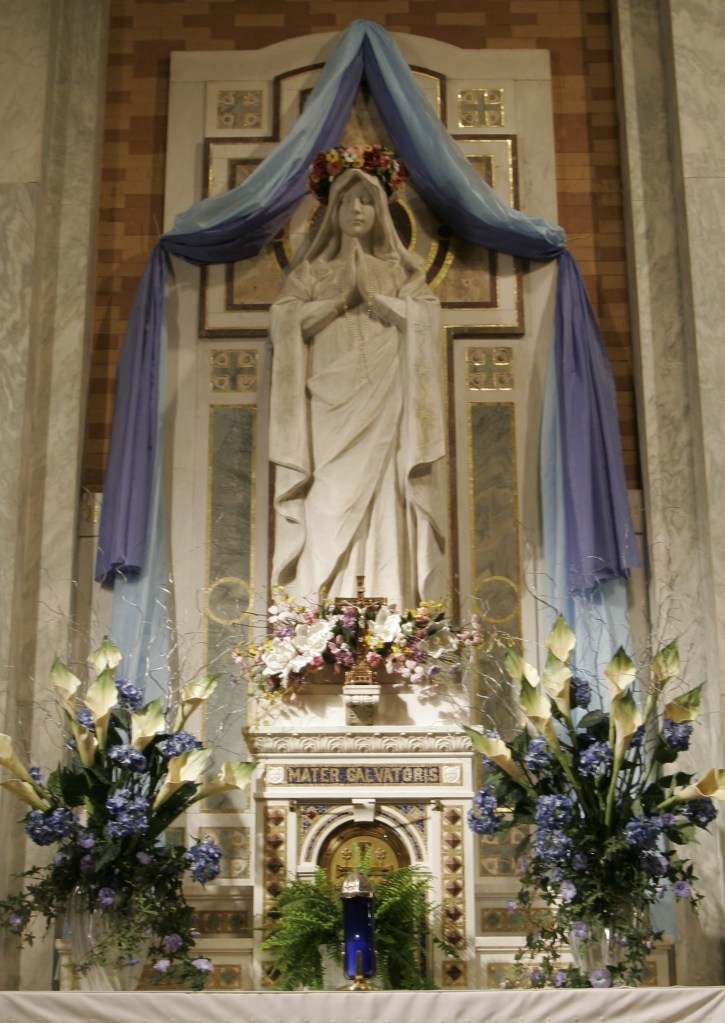
The tabernacle below the crucifix on the old high altar is the one used at Mass most of the time, but the repository on the Blessed Mother altar has a special significance.
What is a tabernacle and why is the one on the Mary altar important?
A tabernacle is a “little house” of God. The Oxford Dictionary of Christian Art reports that the first tabernacle of the Old Testament was a “portable shrine to contain the Ark of the Covenant,” with the original stone tablets inscribed with the Ten Commandments; while in churches today, “In Christian usage a tabernacle is a receptacle for the Blessed Sacrament.”
The tabernacle on our Mary altar has an added layer of symbolism, as a reminder that Mary, when she was pregnant, became a human “tabernacle” for Christ. Philip Kosloski of Aleteia notes that “This idea of Mary being the new “ark” or “tabernacle” of God is a long tradition. For example, the ancient Akathist hymn of the 6th century reads, “Hail! tabernacle of God and the Word. Hail! holy beyond all holy ones. Hail! ark gilded by the Holy Ghost. Hail! unfailing treasure-house of life.”
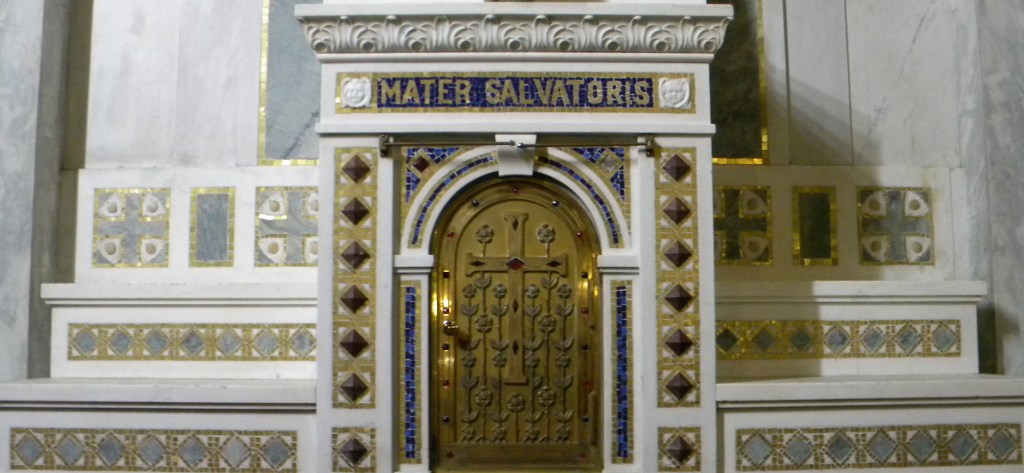
Our Mary altar tabernacle is labeled “Mater Salvatoris” (Mother of the Savior) and the door is embellished with roses. The University of Dayton’s John Stokes Jr. archives provides insight into the meaning of the decorations: “the rose, queen of flowers, is an ancient and universal symbol of the Incarnation, of Mary, of her love of God, and of her spiritual beauty and fragrance, pleasing to God.” The roses on our tabernacle are “a wild rose typical of those known to the Christians of the Middle Ages and called by them, Mary’s Rose. It is also the rose adopted as the model for the central rose windows of the medieval cathedrals.” Curiously, our patron Saint Francis de Sales had a slightly different idea of the symbolism, referring to Christ as Mary’s rose: “that Divine flower, our Lord, who came forth from the Blessed Virgin, as it had been foretold by Isaias that a flower should rise out of the root of Jesse.” The symbol of the rose on our tabernacle thus references both Mary encompassing the Christ child, and Christ contained within
Spiritually, Mary’s significance as a tabernacle in our church is not confined to her shrine: it’s part of the fabric of our building. One of the inscriptions, threaded around the sanctuary walls, reads “I have loved, O Lord, the beauty of thy house; and the place where thy glory dwelleth” (26th Psalm), with the Mary monogram placed above the words “the beauty of thy house” — perhaps as an acknowledgement that Mary is the “house” of Christ! It goes further: above the front door of our church is an image of Mary seated on a throne, with angels holding a garland above her head — a traditional entryway theme of “The Coronation, or Triumph, of the Virgin — with the Virgin being symbolic of the Church.” The verse inscribed around the image (2 Chronicles 7:15) is the Word of God at the dedication of the First Temple of Jerusalem, which contained the tabernacle for the Ark of the Covenant. So our front door welcomes us to Mother Church, which contains the precious tabernacle of Christ’s presence. Was the heavy symbolism accidental or intentional? We do know that Reverend Crane, who commissioned our church, had a special devotion to the Blessed Mother, and chose to lay the cornerstone on the feast of Our Lady of the Rosary in 1907.
Incidentally, the Mary altar and tabernacle have a surprising historical importance to our parish, in addition to the religious symbolism. The altar donor was Eleanor Donnelly, the female “poet laureate of the American Catholic Church,” a powerful feminine presence of the era. Descendants of architect Henry Dagit, also relate a family tale that one of Henry’s daughters was sculptor Adolfo de Nesti’s model for the statue of Mary, providing a link back to the long-ago designers and builders of our church.
Do you ever get the feeling that you’re being watched when you are sitting in your pew?
The colorful “eye” patterns on peacock feathers are supposed to represent the “all-seeing eyes” of the church, and there’s a pair of these peeking out — like an ever-vigilant Santa’s “elf-on-a- shelf — from a half-hidden, half-moon stained-glass window perched above the left confessional at the back of the church.
The two peacock feathers in our window actually form part of a Resurrection tableau, on either side of a cross with five “jewels” in the middle, indicating the five wounds of Christ; diamond-shaped Byzantine lozenges symbolizing the Word of God made flesh; and a calla lily border signifying rebirth.
How do the peacock feathers fit in with the Resurrection theme? That’s a complicated question. Some claim that medieval Europeans long ago believed that peacock meat would never spoil, so peacocks came to represent the “incorruptibile” and, by extension, immortal. Others maintain the fact that peacocks shed their feathers and re-grow them in the Spring, suggested a phoenix-like cycle of rebirth and renewal. According to Cirlot’s Dictionary of Symbols, the peacock is a symbol for “the blending together of all colours and for the idea of totality. This explains why, in Christian art, it appears as a symbol of immortality and of the incorruptible soul.”
Peacocks have a long mystical history in art. Tracing their story, Jelena Andelkovic writes that in ancient India and Ceylon, the peacock was considered a symbol of the sun, because of it plumy tail. In the Greek and Roman worlds, the peacock was the emblem of Dionysus, god of wine; and Juno/Hera. queen of the gods. The eyes in the peacock’s tail represented stars and invoked eternity. This may have been the roots for their association with the all-seeing church, and their use as protective talismans.
Cirlot observes that symbolic peacocks often flanked a “Cosmic Tree” — an ancient association “which came to Islam from Persia and subsequently reached Spain and the West,” and “denotes the psychic duality of man…drawing its life force from the principle of unity.” When peacocks were adopted in Byzantine Christian art (a design inspiration for our church), especially in Ravenna, Italy, Jelkovic notes that they were often shown on sarcophagi with a “Tree of Life” from the Garden of Eden, which “symbolizes the connection between heaven and earth, death and resurrection, and sometimes suggests crucifixion.” Two peacock feathers flanking the wood of a cross in our church might then be intended to signify Christ’s connection with heaven and earth — both human and divine — a theme that is already highlighted in the double-cross motifs below the long, stained glass windows on the parking lot side.
Located above the confessional, our feathers could also offer a meditation on Christ’s sacrifice and an admonition to humility for those examining their conscience before entering the box, since the peacock’s showy tail can represent vanity and pride. The peacock’s reputation for “incorruptibility” could also be a caution to the ambitious!
In the end, whatever the peacock represents, the real “eyes of the church” are not the ones in the stained-glass feathers above the confessional: they’re ours — acknowledging each other from our pews each week; watching our parish children grow, year by year; looking out for one another; and feeling that we share a bond over time as part of a faith community!