Category: people

Dooner’s Hotel

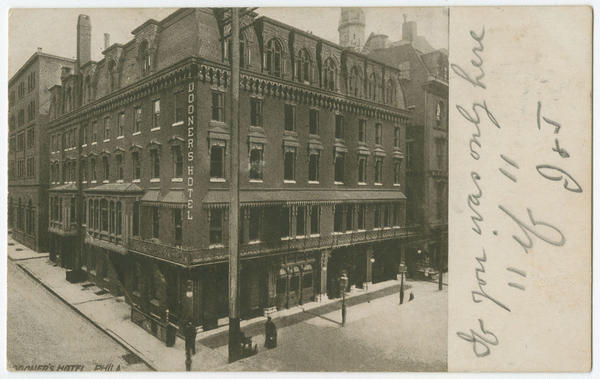
Dooner’s Hotel (photo from Library Company of Philadelphia)

In 1928, well-known author Christopher Morley (Parnassus on Wheels, Haunted Bookshop) and Thomas A. Daily collaborated on an affectionate tribute to “The House of Dooner, the Last of the Friendly Inns,” on Tenth Street above Chestnut in Philadelphia (next to St. Stephen’s Episcopal Church), which closed in 1924. The little volume wistfully captured the spirit of an age that had recently passed, while offering a curious glimpse into the manly domain once occupied by some prominent SFDS parishioners, and a caution about the changing world order at the turn of a different century.

Morley described Dooner’s men’s hotel as a comfortable home and gathering place for Philadelphia locals and occasional celebrities. He characterized it using the works of deceased authors: it was “A Mark Twain kind of place. An Edgar Allen Poe kind of place. A fireman save my child kind of place. A sleep with the window closed kind of place and hang your scapular on the back of a chair. A terrapin soup and catch the late train for Villanova kind of place…A Comédie Humaine (Balzac’s French novels about life in the 1800s) kind of place. A Joyce Kilmer (Catholic poet died in World War I. Remembered for a poem called “Trees.”) kind of place” that was “as masculine as firemen’s suspenders.”

Morley wrote that “The Dooners, father and son – sons, I should say…were publicans” — tavern owners. “The house the elder Dooner established, and which the sons inherited and carried on, was an authentic institution.” What did that mean? Morley described something ordinary, clubby, and timeless: “the gist of Dooner’s, as I think about it this moment, was that the right kind of person knew as soon as he stepped into it that it was real. The steam that floated up from those plates of cabbage was a genuine exhalation…” Its patrons included permanent residents; visitors – traveling salesmen, academics, and others — often regulars; and locals who gathered in the saloon and public spaces to relax, meet with friends, and participate in a number of men’s groups — especially relating to Ireland — which met there. These included the Hibernian Society, the Friendly Sons of Saint Patrick, the Kelly Street Choir, the Koemmenich Society (a musical group), a number of private supper clubs, and more.

Dooner’s was said to be a “mind your own business” kind of place with its own strict code of ethics, “and the house was a restful, well-mannered club for those who were likeminded.” It was probably not strong on diversity. Nonwhite staff are described in the casually racist parlance of the day. Women were approached with caution and considered potentially dangerous. Dooner’s did have a women’s parlour on the ground floor, with a separate entrance and exit from the street. But when proprietor Peter Dooner once found a “notorious woman” there, “placidly enjoying the good fare with one of her many admirers,” he reportedly ejected her, saying “we don’t want your kind here” and warned her to inform her friends. In a similar way, a college president who flipped a coin to determine who would pay for the next round in the main saloon was evicted for “gambling.”

A comfortable bachelor refuge, Morely found that “There was something essentially Catholic, I mean Papist, about that place as I remember it: one surrendered to it as the troubled soul does (eventually, I dare say) to the Church Universal… I expect there was usually some dust under the beds, and the engravings on the walls were sure to be of the Landseer type (Thomas Landseer was a British artist of the 1800s best known for engravings based on his brother Edwin’s painting of dogs, horses, and stags); the ventilation was dense (in an age when everyone smoked), and I expect some of the guests slept in their union suits (one-piece long underwear); yet there was a kind of obese holiness about it too.” Daily agreed that “Indeed, there was a ‘dim religious’ air about the place – neither pagan nor Christian, but a savouring of both; a sort of human-natural religion – particularly on Sunday mornings when foot-loose bachelors foregathered there for a late breakfast.” It was very much a men’s club: “Tradition has it that, save for the elderly housekeeper, no woman ever set foot above the ground floor of Dooner’s.”
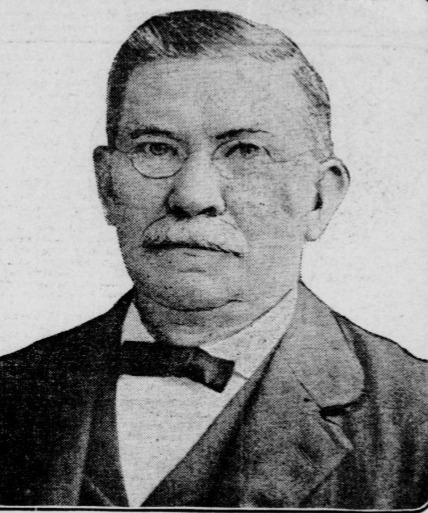
Peter S. Dooner

Daily related the hotel’s origin story:

His original hotel at Eighth and Chestnut was successful and filled a need:

The new building was designed for comfort, not to impress:

When Peter Dooner passed away in 1906, his sons took over the business and kept all of its traditions intact. “Dooner’s was a solid institution then. The one thing that was to destroy it was still slumbering in that twisted brain of fanaticism from which, in the midst of war’s alarms, it was to spring full-armed.”

Beyond the insulated walls of Dooner’s, the swirling social and political unrest that led up to World War I — supposed to be the War to End All Wars — energized those who thought the world’s problems could be solved by single-mindedly imposing their own personal values on everyone else. The particular fanaticism that Dooner’s couldn’t weather was Prohibition, which banned the manufacture, transportation and sale of intoxicating liquors from 1920 to 1933. Frank Dooner, who had bought out the interests of his siblings, kept the hotel going as long as he could, but realized that it “was a losing fight…Its venerable decencies and human frailties withered in the hot dry air of virulent virtue; and so the house whose motto was ‘Mind your own Business’ went down before the will of those who never are content to mind theirs.”

It was unfortunate that places like Dooner’s, which provided affordable, comfortable accommodations suitable for returning servicemen; and places to gather, socialize, and restore the rhythms of ordinary life in troubled times, had to close down just when they were most needed. The blight would also trickle down to the Little Sisters of the Poor, a mendicant order that depended on charity to serve the city’s neediest, and which Dooner’s had long supported with a lavish annual Christmas banquet and generous donations.

Dooner’s Hotel was demolished in 1924, to make room for a massive extension to the Federal Reserve Bank next door – ironically, just five years before the 1929 stock market crash and banking panic plunged the world into the Great Depression.

Sons of Peter Dooner associated with St. Francis de Sales, included Edward, the eldest (who lived at 4345 Baltimore Avenue; later 4230 Spruce St.); Thomas Francis (known as Frank. 4508 Chester Ave.; later 327 South 46th); and William (4705 Sansom), who had all worked at the hotel; and Albert J., of whom Morley wrote:. “The youngest son, Albert, now a distinguished organist and choirmaster and a composer of real talent and charm, is the only one of the boys who had no part in the conduct of the House of Dooner.” Instead, he founded the SFDS men’s and boy’s choir, over which he presided as choirmaster and organist from 1921 to 1957, forming his own historically-inspired male bastion against a too-rapidly changing world.

A Change of Tune

With a flick of a long ago editor’s pencil, she disappeared from the parish history. The 1940 parish anniversary book began its choir story with the arrival of the “distinguished” Albert J. Dooner in 1921. The 1989 parish anniversary book looked back further to claim “Tudor Strang” as first choirmaster at St. Francis de Sales in 1911 — but he was actually an organist/choirmaster for several local Episcopal churches, who played in a single organ concert at SFDS. It’s time to restore Margaret Marie Marshall to her proper place in the parish chronicles!

Margaret Marie Marshall, the original organist/choirmaster at St. Francis de Sales, left the parish quietly, without acknowledgement of her twenty years or more of service, around the time that Monsignor Crane became Bishop in 1921. “Did she fall or was she pushed?” Did she resign or was she let go? The answer to the question of how she left is probably “yes,” a bit of both, due, in part, to a new movement in church music centered in Philadelphia.

Up into the early 1900s, music offered a rare oppourtunity for Catholic women to contribute to the male-dominated liturgy. Margaret Marie Marshall was personally and professionally invested in all the possibilities, as a church organist and “concert and oratorio soprano,” who sang and also taught other soloists, first from her home at 2126 Vine Street, and later, when she moved to 3413 Baring Street. Her life seemed dedicated to her work: she lived with her father, a retired grocer, and several sisters, until they all passed away. One of her sisters was known for dramatic readings, and the other was also a church organist. It is unclear where Marshall received her training: she was listed in the Musical Blue Book of America, but, according to the U.S. Census data, her formal education ended with eighth grade.

Marshall’s musical programmes at St. Francis de Sales initially included both men and women. According to family records, golf champion J.J. McDermott’s mother sang in St. Francis de Sales Choir in the early 1900s. At General Mulholland’s funeral in 1910, Marshall’s “augmented choir” included a female soloist, Anna Elizabeth Kelley, who sang Gounod’s “Ave Maria” and Koenan’s “Come Unto Me.” A quartet sang “Nearer My God to Thee.”

An article in Adoremus claims that Philadelphia-German composer Albert RoSewig, who delighted in “the florid and sentimental style of the classical music of his day,” set the tone for music in Philadelphia around the turn of the century — and Marshall’s ambitious programmes seemed to follow that lead. In December 1902, her “special Christmas program for both morning Masses” included Eduardo Marzo’s Mass at the first; and “Hayden’s Mass No. 6, Huntzer’s ‘Veni Creator,‘” and the “Angel’s Messenger” by Homer Bartlett at the second. In 1904, the Blessing of the School included “an augmented choir of selected voices under the direction of Miss Margaret Marie Marshall, organist.” A 1912 listing for Easter services noted that she would be directing a “vested choir of sixty voices” with works including the “Grand Verdi March” and pieces by Harry Rowe Shelley, Alban Lipp, Victor Hammerl, and Édouard Batiste – all romantic 1800s composers. A Solemn Pontifical Mass commemorating the fifth anniversary of the dedication of the church in 1916 featured an “augmented choir under the direction of Miss Margaret Marie Marshall, the organist,” rendering Gounod’s St. Cecilia Mass. 

But the end of the Victorian era of embellished music, sentimental hymns, and women’s voices was already in sight. In 1903, Pope Pius X had issued an Apostolic Letter on the simplification and reform of church music, which, as Anne L. Silverberg notes, “restricted both the style of appropriate liturgical music and its execution.” It expressed a strong preference for Gregorian chant — in which all the singers follow one melodic line in Latin based on medieval modes rather than modern scales — and multipart singing “unaccompanied by instruments, a decided change from the nineteenth century when orchestras and soloists were frequently heard in American and European churches.” She notes that “The Motu Proprio also forbade women from singing liturgical music and called for boy choirs to sing music with high vocal parts.”

Philadelphia would become a centre for a new American Catholic musical movement embracing the changes, when “Nicola Montani led the nation in reform” and “founded the St. Gregory Guild in Rittenhouse Square to spread the message of the Motu Proprio and to furnish suitable musical publications.” Lucy E. Carroll notes that “From 1906 to 1923 he served at St. John the Evangelist in Philadelphia, with terms as music director at Hallahan High School, West Philadelphia Catholic Girls High School, and St. Mary’s Academy.” He worked as an editor for two music company publishers, founded the Society of St. Gregory in 1914, began the Catholic Choirmaster magazine, then published his St. Gregory Hymnal and Catholic Choir Book in 1920, renewed in 1947. The young Albert J. Dooner was among his avid pupils.

Montani crusaded for his own ideas of pure Renaissance style music without any of what he perceived as “operatic,” “theatrical,” or “balletic” elements. An article in Adoremus reports that “Montani’s voice was a strong one, and his determination to rid the liturgy of anything that even smelled of the profane was his driving force.  Masses by Charles Gounod, August Durand, and Luigi Cherubini were black-listed, with many traditional hymn collections.” These would include much of the music in Marshall’s repertoire.

Montani also had strong views on women, which Albert Dooner shared. Dooner would write in 1926 that women’s voices lacked a purity and spiritual quality of boys’ voices, and their singing was far too dramatic for the liturgy. He also maintained that the proper place for a choir was in the front of the church. Since women were prohibited in the sanctuary, they were therefore disqualified from being in the choir, even though most American choirs sang from a choir loft at the back of the church.

Montani’s stern influence gradually made itself felt in the archdiocese, and Marshall may have felt the pressure. The Solemn Papal Mass commemorating the anniversary of the dedication of St. Francis de Sales Church in 1917 was tersely described as featuring a “male choir of forty voices under the direction of Margaret M. Marshall,” with no musical programme listed.

As church music changed, Marshall turned her energy to other channels. The Catholic Standard and Times reported her war work in July 1918: “Margaret Marie Marshall, Division No. 22, has started ‘liberty sings’ in the different divisions of the Auxiliary, and each Friday night she instructs the members of the chapter in patriotic songs. The meetings close, each night with the singing of the ‘Star Spangled Banner.’” In August, the paper observed that “The ‘community sing’ movement is being enthusiastically received among Catholic societies and organizations. This was evidenced by the fact that 1,500 persons attended the community sing of the Knights of Columbus Red-Cross last Monday night at the Knights of Columbus Hall, Thirty-eighth and Market streets. These ‘sings’ are being conducted under the direction of Miss Margaret Marie Marshall, organist of St. Francis de Sales’ Church, assisted by her sister, Miss Mary Agnes Marshall, organist of St. Anthony’s Church. The former is organizing the movement among the various divisions of the Ladies’ Auxiliary of the A. O. H. (Ancient Order of Hibernians).

Was there friction over music at de Sales? In November, Margaret continued her community outreach – from Most Blessed Sacrament Parish: “For the entertainment of men in the nation’s fighting forces, an elaborate fall and winter programme has been prepared by the Women’s Auxiliary of the Archbishop Ryan Catholic Association, with headquarters at Fifty-fourth street and Chester avenue, in the Most Blessed Sacrament parish. Beginning with a big community sing on Friday night of this week, under the direction of Margaret Marie Marshall, affairs will be held every two weeks and possibly more frequently, according to the committee in charge.“

Marshall may have become less enthusiastic about her musical endeavors at St. Francis de Sales. In November 1918, for the Solemn Pontifical Mass commemorating the seventh anniversary of the dedication of St. Francis de Sales Parish, The Catholic Standard and Times reported simply that “The music of the Mass will be rendered under the direction of Margaret Marie Marshall, organist and choir leader.” When the memorial tablet “to men and women of the parish who served in the late world war” was unveiled at a Solemn Military Mass in 1920, “The musical programme was in charge of Margaret M. Marshall.” And when the church was consecrated with a Solemn Pontifical Mass in November 1920, it was reported that “A splendid musical programme will be rendered on the occasion of the Thanksgiving Mass and Vespers, under the leadership of Margaret Marie Marshall, Organist and director,” but none of the musical works were listed.

Marshall’s last mention at St. Francis de Sales appears to have been at a reception for newly-installed Cardinal Dougherty, just back from Rome in May 1921, when “A chorus of welcome was sung by the children, who formed a pretty picture as they stood grouped on the steps and displaying the Cardinal’s colors, American flags and emblems of welcome. After the chorus, which was rendered under the direction of the Sisters, Servants of the Immaculate Heart of Mary, assisted by Miss Margaret Marshall and Miss Sophia E. Maley, Natalie McElroy, one of the little pupils, delivered a touching address of welcome in splendid style.”

It was a delightful image, indeed, though it suggested that Marshall had been relegated to working with the schoolchildren, under the direction of the IHM Sisters.

Bishop Crane sang his first Solemn Pontifical Mass at St. Francis de Sales in September 1921, with the proud notice that “Special musical programmes will be rendered at the Mass and at Vespers by the parish choir of thirty-five boys and thirty men, under the direction of Albert J. Dooner, organist and choirmaster.” The younger brother of prominent parishioner Edward J. Dooner, Albert had received a degree in music from the University of Pennsylvania in 1912, continued his studies under Montani, and was already acclaimed as an organist and composer for the new church music. He would find his place as founder of the parish’s renowned pre-Vatican II boy choir, and would preside as its celebrated organist and choir director from 1921 to 1957.

After leaving St. Francis de Sales, Margaret Marie Marshall appears to have focused on the pupils of her own music studio for several years, before becoming organist and choir director at the recently-built chapel/school of St. Ambrose at Roosevelt Boulevard and C Street, far away from the city centre, around 1929. She was buried from St. Agatha’s Church (38th and Spring Garden) in 1952 — three years before Pope Pius XII cracked open the door to re-allow women’s choir participation in his Musicæ Sacræ encyclical of December 25, 1955.

The Attraction of Royalty

St. Francis de Sales parish is inordinately proud to have had Bishops Crane, Lamb, and McShea in its lengthy pastor lineup. Like the Three Magi in the Nativity story, the three successive bishops, 1921 to 1961, brought gifts to the parish church — of gold, in its magnificent decorations; frankincense, in its atmosphere of piety; and myrrh – an embalming fluid.

If having been home to an assistant bishop once-upon-a-time could transform a church into a cathedral, though, then Philadelphia would be a city of cathedrals! Some other Philadelphia parishes that have had Bishop-pastors include St. Malachy (Bishop Prendergast); Our Mother of Sorrows (Bishop McCort);  Nativity B.V.M. Parish in Port Richmond (Bishop O’Hara); Church of the Incarnation (Bishop Benjamin); St. Helena’s in Olney (Bishop Graham); Old St. Mary’s and Holy Trinity parishes (Bishop Lohmuller); Saint Alice in Upper Darby (Bishop McDevitt); Our Lady of Fatima (Bishop Hughes); St. Colman Parish in Ardmore (Bishop Maginnis); and Saint Charles Borromeo in Bensalem (Bishop Deliman), among others.

The story of this parish is much more than the story of its long-ago episcopal royalty. Its rich musical heritage began much earlier than the bishops’ boy choirs, as early as 1902, with its first organist and choirmaster, Miss Margaret Marie Marshall. The parish was never segregated: in the 1960s, long after the bishops, it was a model for success, studied by local protestant parishes struggling with racial integration. Immigrants were always welcomed. The efforts of parishioner Betty Allen and of Sisters Constance and Jeannette at the school in the 1970s and 1980s made the parish a center for Vietnamese refugee resettlement, with immigrant ministries to refugees from around the world continuing later and in the IHM Center for Literacy and Sister Gertrude’s ministry.

It’s easy to be distracted by the glitter of elaborate pageantry and the visuals of shimmering golden mosaic and tall church windows cloaked in brilliant colours, but the reality check has always been there. Despite their magnificence, the Three Magi, or Kings, or Counsellors of the Bible story were peripheral characters — visitors — like the shepherds and sheep, coming to see Baby Jesus, who was the real attraction, lying in a manger because he “did not regard equality with God something to be grasped. Rather, he emptied himself, taking the form of a slave…” Look around the church, and you’ll see that there are no images of a kingly Christ in its impressive original decorations. Instead, you’ll see Christ as a helpless baby; as a child, working in Joseph’s workshop; and the adult Christ as a teacher, in prayer, and crucified, wearing a crown of thorns. One of the most poignant images is a humble square on the exterior of the church above the choir door, showing the Flight into Egypt, when Joseph and Mary, clutching the tightly wrapped Baby Jesus, fled the violence of King Herod and sought the kindness of strangers, far from home.

The story of the Nativity of Jesus, his ministry, death, and Resurrection, has been retold by a succession of pastors to an ever-changing congregation, each year since the parish was formed in 1890. And every year brings inspiration  to see with new eyes and begin once again — much as Douglas Adams quipped in the Hitchhikers’ Guide to the Galaxy in the 1970s: “And then, one Thursday, nearly two thousand years after one man had been nailed to a tree for saying how great it would be to be nice to people for a change, a girl sitting on her own in a small café in Rickmansworth suddenly realized what it was that had been going wrong all this time, and she finally knew how the world could be made a good and happy place. This time it was right, it would work, and no one would have to get nailed to anything.” We can only keep trying.

Chaplain Hilferty

Was it unexpectedly shrewd Archdiocesan administration or divine providence that sent Father Hilferty to Saint Francis de Sales in 1977 for his first assignment as a pastor?

He was modest about his qualifications. He would tell parishioners that this belated first pastor assignment, at age 49, was not due to a late vocation – he was ordained back in 1952 — but because he enlisted as a Navy Chaplain in 1957 and stayed in the military for twenty years “until somebody noticed and sent me home.” But that unique experience made him peculiarly suited to the needs of the changing parish when a Ninth Pastor was required. And he was already familiar with the place, since his father and grandfather had both been buried from SFDS.

What was significant about Father Hilferty’s work as a Navy Chaplain? An initial trawl through newspaper databases finds him presiding periodically at weddings and giving speeches at local high schools, usually near the Naval Base in Newport, RI – work that seems routine. However, these moments turn out to have been the calm breaks between active postings. A deeper dive finds clues that he steered through some interesting times: between the Bay of Pigs and the Cuban Missile Crisis, the July 1962 Sunday Supplement for the U.S. Naval Base at Guantanamo noted that “After a year at Guantanamo Bay Lt. Thomas J. Hilferty is leaving for Naval Air Station, Washington, D.C. The much-traveled Father has served in the east and west – Japan to Gitmo…” And in June 1965, as the Vietnam war expanded, the Chief of Naval Operations and the Chief of Chaplains appointed Lieutenant Commander Thomas Hilferty as Navy Chaplain in Saigon.

Chaplain Hilferty’s initial posting to the Saigon military base first connected him with the Vietnamese community. According to the History of the Chaplain Corps, in addition to supervising religious services and counseling personnel on the base, an important function of the military chaplains was distributing humanitarian aid to civilians in South Vietnam. Chaplain Hilferty was also assigned to a Community Relations Committee, responsible for “formulating solutions to problems which arose out of the concentration of U.S. personnel in the Saigon-Cholon area.”

Housing issues would become his theme song. He soon saw how the large number of arriving Americans needing accommodations caused significant issues for the incumbent Vietnamese: American personnel were initially sequestered in secure but crowded compounds on the base, but as the military buildup began, “with few exceptions, every large hotel and apartment house, as well as many of the larger villas, was used for U.S. personnel. This deprived the Vietnamese nationals of many rooms and apartments and increased the housing problem caused by the influx into Saigon-Cholon of workers and refugees.” Additionally, many American servicemen preferred to rent their own properties outside the official housing compound to “live more privately, comfortably, and even luxuriously, and induced landlords to prefer Americans with their buying power to Vietnamese nationals who generally could not compete financially. The Vietnamese had to settle for substandard housing while American had two quarters: the authorized one and the one on the economy.” Chaplain Hilferty observed that “this situation is offensive to many Vietnamese who are not in the real estate business.” Understanding the issues on both sides, and learning to delicately negotiate workable solutions, foreshadowed his future efforts on this side of the ocean to resettle waves of Vietnamese refugees arriving in West Philadelphia, needing to be welcomed into scarce local accommodations.

When the humanitarian assistance program phased out on the Saigon base, as the war ramped up, Chaplain Hilferty was reassigned to become “the only navy chaplain ashore in II, III, and IV Tactical Zones in Vietnam.” A lonely job, this moved him through the jungle on swiftboats, right into the action. The History of the Chaplain Corps reports that “Captain Hilferty traveled up and down the coastline and along the rivers establishing contact with small, widely scattered units to which American personnel were attached…His efforts to provide religious coverage for personnel of sixteen widely scattered bases represented the beginning of what was to become the Saigon-based chaplains’ circuit riding ministry.” As the solitary chaplain, his efforts were ecumenical, ministering to everyone in need. Eventually, a protestant chaplain was assigned to help and they alternated routes: one going north; the other south; then reversed.

Getting places was half the fun. Chaplain Hilferty’s eventual replacement on the circuit would later report “Ordinary travel by road is almost non-existent due to the ever-present possibility of ambush by the Viet Cong…Fortunately, air travel came to my rescue…This padre became a familiar and welcome sight to the crewmen of AIR COFAT (Naval air support). As one of the pilots once said, ‘Padre, it’s always good to see you aboard. We feel like you’re a third engine. Start praying.’ Unscheduled hops on Army choppers, Air Force planes, and water transport were part of the routine. To make a one-day visit to a detachment usually involved at least a full day spent in traveling to and from the unit.” Chaplains had to cultivate patience and flexibility, and remain unflappable in any situation. This would be an asset for Father Hilferty, when he arrived at SFDS, where memories of a rectory home invasion and gunpoint robbery in 1972 had left behind a deep residue of anxiety. Father Hilferty was unimpressed by tales of neighbourhood toughs, and, like the recent popular meme, his example to the parish was ever to keep calm and carry on.

His successor in Vietnam wrote about the physical and psychological drain on chaplains who “had to experience death many times over,” administering last rites to mangled corpses and comforting the terrified, mortally injured, and bereaved. Their ministry was raw and the needs they addressed were immediate and traumatic. This was much different from the squabbling at SFDS over the modern Venturi altar and the new rituals of Vatican II, which had taken up so much parish energy. Under Father Hilferty, the parish refocused to embrace the incoming Vietnamese – and all the other refugees and immigrants from faraway places who came to the parish and school at the time, fleeing horrors and arriving destitute. Sisters Constance and Jeannette nurtured war-traumatized children and evolved an award-winning school. Father Hilferty encouraged parish cooperation with representatives of other non-Catholic religious institutions in the neighborhood as they worked together to open a credit union to solve a local banking crisis, and looked for ways to deal with other pressing local issues.

Father Hilferty was appointed Director of the Black Diaconate for the Archdiocese in 1978, while at SFDS. In 1989, Monsignor Hilferty moved on from SFDS to become the regional Vicar of Philadelphia-South, at St. Carthage. After several other assignments, he became Pastor, then Pastor Emeritus of Queen of Peace Church, Ardsley, Pa. He died in 2008.

 A Field Guide to SFDS Pastors

Bird watchers like to keep a “life list” of all the different birds they’ve seen and identified. It’s a competitive activity – a long list of exotics gives bragging rights – but it also, incidentally, provides clues to the compiler’s own story and where they’ve been at different times through the years.

SFDS parish has a similar lengthy “life list” of pastors – including several bishops — that offers snapshots of the parish through its 134-year history. Perhaps it’s time to review that exhausting compilation as Father Eric moves on and Father Ryan Nguyen becomes Parochial Administrator – on the way to becoming Pastor Number Eighteen!

Here’s a quick timelapse of parish history, as told in the sequence of its pastors:

1. 1890-1903  Rev. Joseph O’Neill. Founding pastor of St. Francis de Sales. He chose the name of the church in 1890 – probably to honour his brother Rev. Francis O’Neill, who had started to build St. James Church (38th and Chestnut. Today St. Agatha St. James) and died suddenly in 1882 . Father Joseph O’Neill picked the location and began construction of the first SFDS parish building a combination chapel/school building (today’s school hall) in 1891, and the rectory in 1893. In 1898 he was involved as a defense witness in a notorious local murder trial. He died of heart failure at SFDS in 1903.

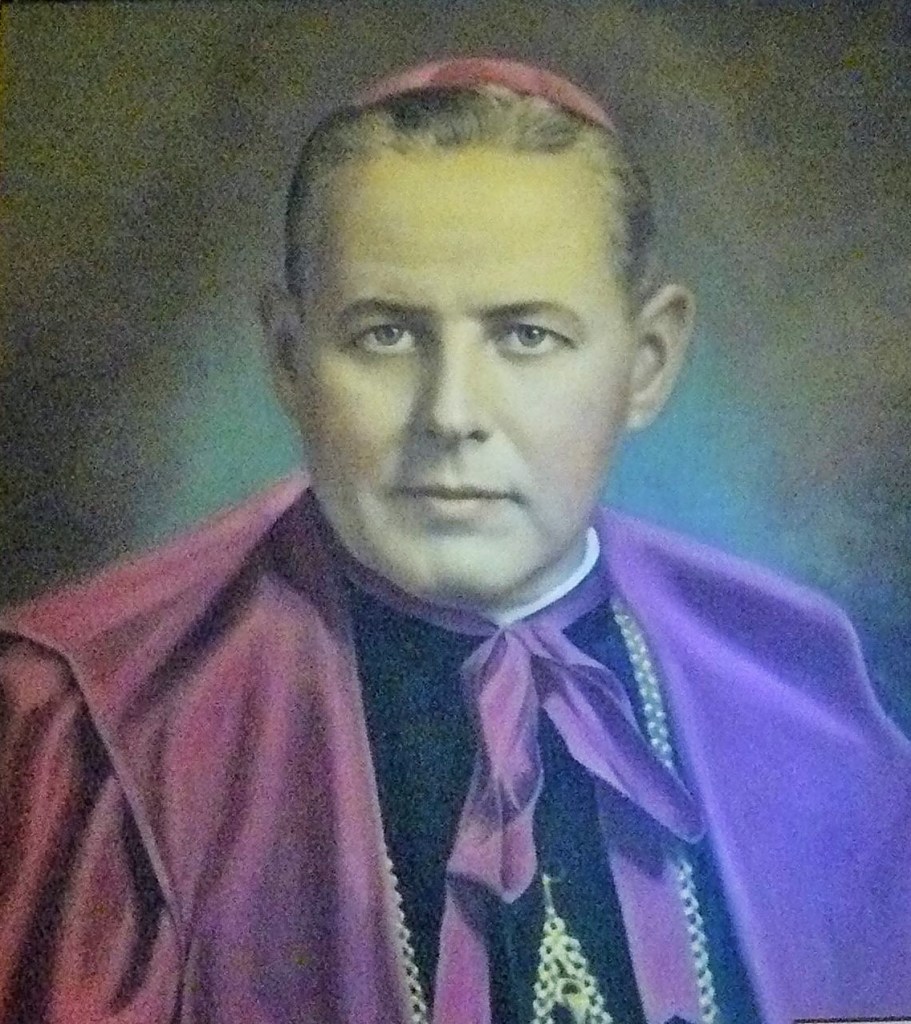
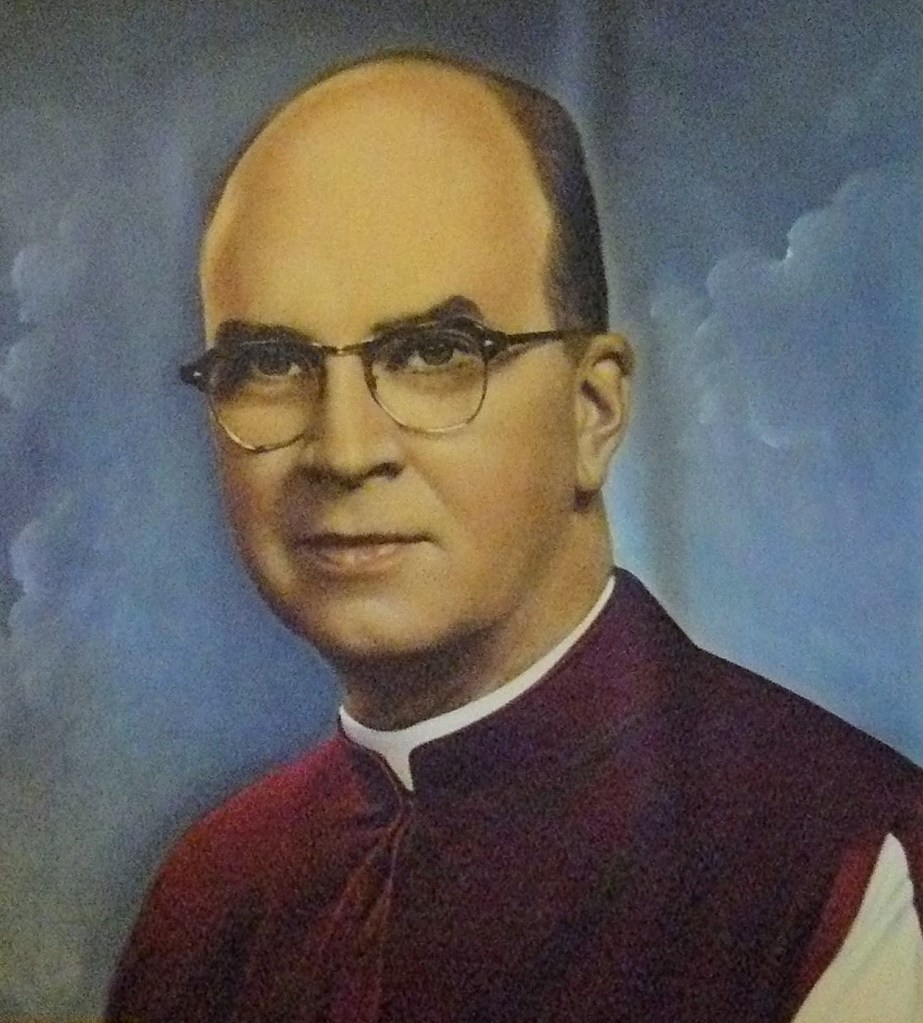
2. 1903-1928 Bishop Michael J. Crane. Reverend Crane opened the school in 1904 and built SFDS church between 1907 and 1911. In 1921, he became Assistant Bishop to Cardinal Dougherty. Bishop Crane was diabetic, so Cardinal Dougherty pulled some strings to get him into Dr. Frederick Banting’s historically successful hospital trial of insulin in Toronto in 1922. Bishop Crane later built the convent and the addition to the school in 1926. He died at SFDS on December 26, 1928, and is buried on the Rectory lawn.

3. 1929-1936.  Rev. Edward L. Gatens. Father Gatens is a bit of a puzzle. He came to SFDS from Pottsville, where he defiantly built a Catholic High School with a cross-shaped window atop a hill that had been used for cross burnings by the anti-Catholic Ku Klux Klan. Arriving at SFDS, he became pastor just as the Great Depression began, and struggled to minister to the many in need among his flock. He resigned, went on medical leave in 1936, and died in 1955.

4. 1936-1951 Bishop Hugh L. Lamb. Bishop Lamb was the second of three bishops to serve as pastors at SFDS. He is remembered for radio broadcasts, expanding parish activities, paying off the parish debt, and overseeing the 1940 Parish Jubilee. In 1951, he was appointed first Bishop of Greensburg, in Western PA, where he passed away in 1959.

5. 1952-1961 Bishop Joseph Mark McShea. Bishop McShea was a son of the parish: in his youth, his family lived, for a time, on Farragut Terrace, right behind the school, and he served as an altar boy for Bishop Crane. His family home was one of those torn down to make room for the 1926 addition to the school. During his tenure he refurbished the Lower church and re-tiled the Guastavino domes in an unsuccessful attempt to stop leaks. In 1955, he established St. Lucy’s School for the Blind in a house on Farragut Terrace to fill an archdiocesan need (since moved to NE Philadelphia). The SFDS Boys Choir – established in 1911 – expanded and became prominent during Bishop McShea’s era. When he was appointed first bishop of the new Allentown diocese, in 1961, he took the choirmaster with him to start a new choir school there. He died in 1991.

6. 1961-1967.  Monsignor John J. Sefton. Monsignor Sefton assisted at de Sales from 1945 to 1957 before returning as pastor 1961 to 1967. He left his mark on the church for its 1965 Diamond Jubilee, by replacing the original quartered oak pews with the present ones, changing the lighting, and covering the walls with blue tiles, reportedly to achieve a “Mediterranean” vibe. In 1966, Monsignor Sefton began to set up Star Harbor Senior Center – “the first community of its kind in the archdiocese, a recreational center for citizens regardless of race or creed” — which opened soon after he left. Parishioners were moving to the suburbs at this time and the parish shrunk from 4,233 families in 1953 to 1,232 by 1973. Monsignor Sefton moved on to St. Charles Church in Oakview and died in 1980.

7. 1967-1976  Monsignor John T. Mitchell (Pastor Emeritus from 1973-1976). Monsignor Mitchell was known in the archdiocese for his civil rights activism and his dedication to the black community. He founded St. Ignatius Nursing Home while he was pastor of St. Ignatius Parish (43rd and Wallace). At SFDS, Monsignor Mitchell was pastor during the divisive period of the Venturi “Neon Halo” renovation, when an ultramodern Plexiglas front-facing altar was installed in the sanctuary for the New Mass of Vatican II. The SFDS Boy Choir also came to an end during this period, as musical styles changed. Monsignor Mitchell’s health deteriorated as he tried to focus on social ministry. He died in 1981 at age 67.

8. 1976-1977  Monsignor Francis J. Fitzmaurice (Parish Administrator from 1973-1976). Monsignor Fitzmaurice, who had been assisting at the parish since 1961, officially took over key administrative duties in 1973 when Monsignor Mitchell’s decline accelerated after a traumatic home invasion and robbery at the rectory. With the end of the Vietnam War, the parish began ministering to incoming refugees. Monsignor Fitzmaurice officially became Pastor for one year in 1976 – just in time for the “glorious” Eucharistic Congress in Philadelphia — before being transferred to St. Lawrence, Highland Park/Upper Darby in 1977. He died in 2004.

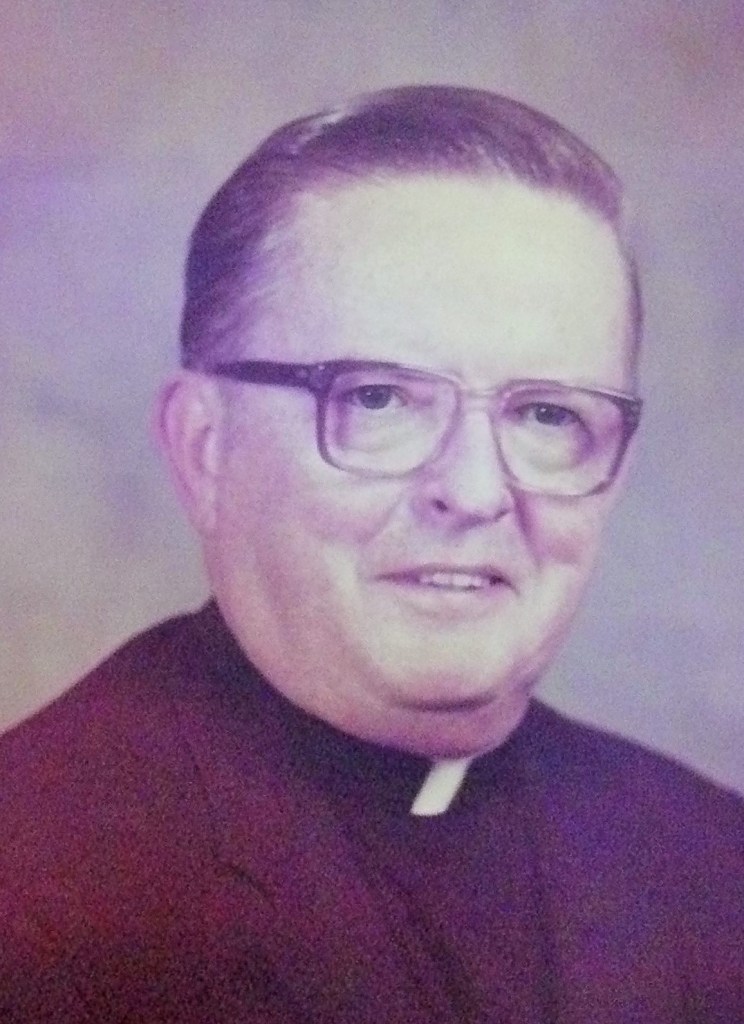
9. 1977-1989  Monsignor Thomas J. Hilferty. Monsignor Hilferty, who was at SFDS for twelve years, was the parish’s last long-term pastor. This was actually his first parish assignment: prior to arriving here, he had spent twenty years as a travelling Navy chaplain in the Vietnam war. During the time that he was at SFDS, the Lower Church was the archdiocesan “Mother Church” for the Vietnamese Community, with Reverend Anthony Vu Nhu Huynh as chaplain. In 1980, Philadelphia Magazine reported that “Over the last five years this parish has become one of the most successful centers for Indo-Chinese refugee resettlement in the area.” Meanwhile, a new classical choir of men and women gradually evolved in the parish under the direction of organist Bruce Schulz (who had arrived at SFDS in 1969) and choirmaster Father Hermann Behrens, a visiting German academic . Monsignor Hilferty left to become the regional Vicar of Philadelphia-South, and died in 2008.

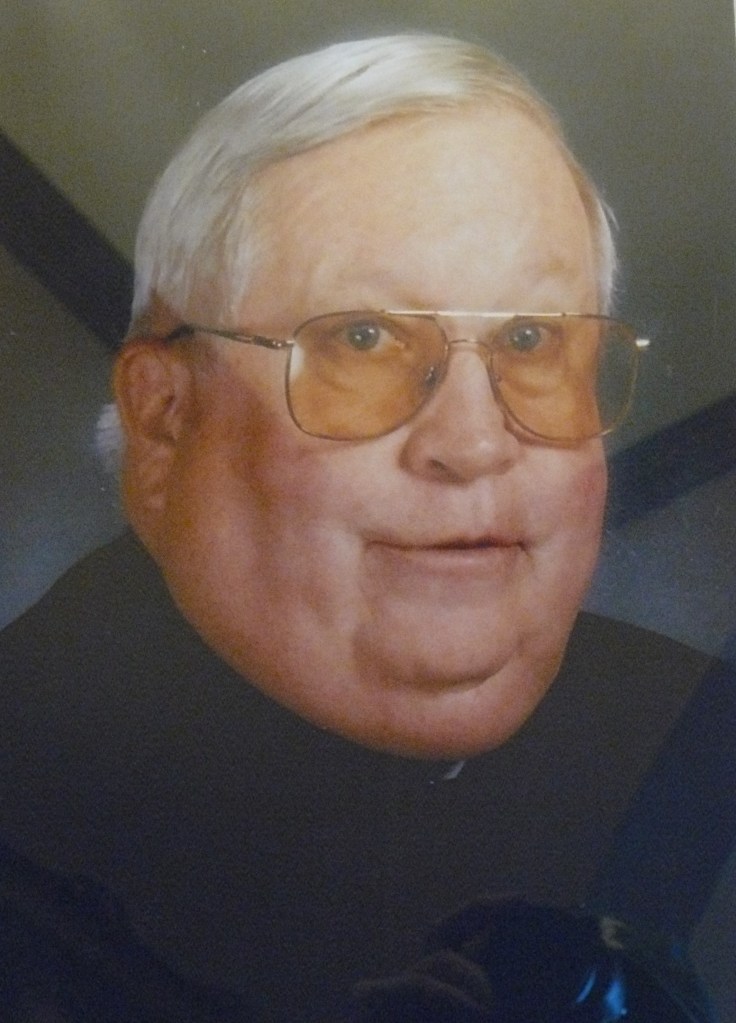
10. 1989-1994  Rev. John J. Kilgallon. Preoccupied with the state of “this wounded and broken world,” Father Kilgallon was pastor during the lean years of the early 1990s. At that time, SFDS and MBS were both part of a “musical chairs” cluster of parishes, under study by the archdiocese as it made plans to streamline its operations. A chapter of the Knights of Peter Claver began at SFDS in 1990. The IHM Sisters also opened their Literacy Center that year, teaching English as a Second Language (ESL) classes to adult immigrant learners (moved to NE Philadelphia in 2022). He died December 26, 2024.

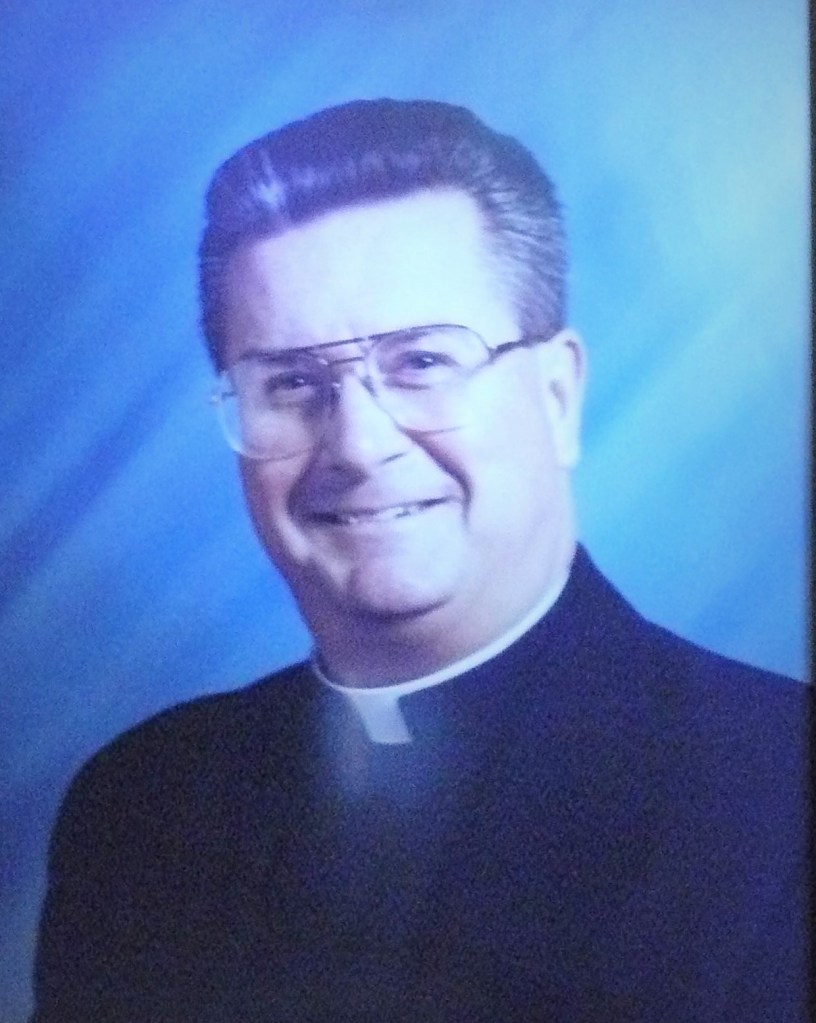
11. 1994-1999.  Rev. Anthony W. Janton. With the parish Short of funds while archdiocesan conversations continued about its future, Father Tony tried to restore the church in simple ways – painting and stuccoing over the peeling “blue bathroom tiles” from the 1965 church renovation; finding a home in Allentown for the statue of St. Francis de Sales, which had been sitting in the parking lot, behind the dumpster, for several years since it had been removed from the church façade for safety reasons; and removing pews to create the cross-aisle linking the two side doors. The confessionals on the parking lot side of the church were turned into shrines during his tenure. Choirmaster Father Hermann Behrens died suddenly of heart failure in 1996, in a great shock to the parish, and Isabel Boston became his successor. The Assumption Religious moved from 49th Street to 1001 South 47th street across from SFDS in 1999.

12. 1999-2004  Rev. Roland D. Slobogin (and 8th pastor of MBS 1996-2004). Father Roland became the Eighth Pastor of Most Blessed Sacrament Parish in 1996 and, then, also, the Twelfth Pastor of SFDS, when the two parishes were “twinned” to share a pastor in 1999. He celebrated the MBS Centennial in 2001 and closing ceremonies for MBS school in 2002. When he moved to SFDS rectory, Father Roland brought the first parish dog to live there since Reverend Crane’s Missy back in the 1920s. The annual Blessing of the Animals, near the feast of St. Francis of Assisi, began during his tenure, and originally took place inside the church. The Parish established a relationship with Partners for Sacred Places during this time and began the long, agonizingly slow, planning for church restoration.

13. 2004-2009  Rev. Zachary W. Navit. Father Navit was the 9th Pastor of MBS until its closing in 2007; the thirteenth pastor of SFDS; and the First Pastor of the combined parish of St. Francis de Sales United by the Most Blessed Sacrament. Father Navit enjoyed elaborate ceremony and was known for his lavish use of incense. The rectory garden was re-landscaped and the building restoration plan progressed slowly during his tenure as he looked for ways within the parish to fund needed repairs. Scaffolding was installed in the sanctuary and on the outside of the church during this time, due to falling masonry.

14. 2009-2011  Rev. Louis C. Bier. Father Bier was the second pastor of the combined parish of SFDS/MBS. During his brief tenure, he instituted outdoor Stations of the Cross around the neighbourhood on Good Friday and provided a birthday cake with sparklers for Baby Jesus at the Children’s Christmas Mass. His down-to-earth personal style offered a contrast to the embellishments of the traditional choir.

(2011   Monsignor Francis Beach Administrator Pro-Tem) Father Beach served for just one summer between pastors, and remembered dealing with catastrophic roof leaks in the Guastavino Dome.

15. 2011- 2016 Rev. John D. Hand. Father Hand was the pastor for the 125th Anniversary of SFDS. During his tenure, he was tasked with selling the Most Blessed Sacrament property. This enabled him to move SFDS building restoration forward, so the scaffolding in the sanctuary could be removed in 2013, after seven years. A Hispanic community moved from Divine Mercy Parish in 2013, adding a Spanish Mass to the Parish schedule in addition to the longstanding Vietnamese Mass.

16. 2016 – 2019 Monsignor Joseph Anderlonis. Monsignor Joe came to SFDS from St. George Parish, where he had served since 1982. Noticing how SFDS had suffered, due to the “revolving door” of short-term pastors in recent years, each pulling the parish in a different direction, he promised that he would never voluntarily leave – often declaring to his flock that “they’ll have to carry me out feet first.” Which, sadly, happened, when he passed away on December 6, 2019, just shy of his 50th anniversary as a priest. The Vietnamese community moved to Divine Mercy Parish in 2018.

(2020 Rev. Matt Guckin Pastor pro-tem). Father Matt arrived in February, and the church closed to the public indefinitely for Covid quarantine in March. He said prayers on Facebook; recorded Masses in the church, with a small crew of helpers, for later viewing by other parishioners online; and generally kept the parish afloat during the crisis.

17. 2020 – 2024 Rev. Eric Banecker. SFDS was Father Eric’s first assignment as pastor. He was Administrator for a year, before being installed on the 100th anniversary of Bishop Crane’s consecration as Bishop. During his tenure, he had the scaffolding finally removed from the facade of the church after seventeen years. His Golf Classic aided funding of building repairs, which made significant progress. Working tirelessly to reshape parish organization, his goal was to transform the parish into a hub for young families and young adults of the archdiocese. We wish him well as he moves on to St. Mary Magdalene Parish in Media.

2024 Rev. Ryan Nguyen. Father Ryan, who will be joining us soon, has several odd intersections with our combined parish story. When he came to this country from Vietnam as a child in 1993, Father Ryan’s family attended St. Thomas Aquinas Parish in South Philadelphia – the parish that supplied the original chapel building for MBS when it was founded back in 1901! He later attended the University of the Sciences in our neighbourhood, where various parishioners have taught, worked, or studied. After ordination, in 2022, he was assigned to St. Bede’s Parish in Holland, PA – which had been redecorated with many of the original interior fittings of MBS, after MBS merged with SFDS in 2007. Since the Philadelphia Vietnamese community were part of SFDS for over 43 of our 134 years, it feels providential to restore that cultural connection. We welcome Father Ryan to SFDS and look forward to the notes that he will add to the symphony of our rich parish history.

Let’s Talk Trash

            His work wasn’t glamourous, and his only memorial appears to be inscribed on the side of his in-laws’ tombstone at Holy Cross Cemetery, but SFDS parishioner Joseph Osborne quietly left the world just a little bit better than he found it.

            When he died of heart disease and high blood pressure in January 1960, his age mis-reported in the news as 49 or 54 (he was 51), the Philadelphia Inquirer stated simply that Osborne, who lived at 4809 Windsor, had been “an employee of the Sanitation division of the Department of Streets for 30 years” and a “captain in the army engineers in the Second World War.” The Catholic Standard and Times reported that “The deceased was a supervisor in the Philadelphia Department of Streets and a veteran of World War II. He was a member of the Men of Malvern and the Officers Reserve Association.”

The Philadelphia Tribune had more to say, especially acknowledging Osborne’s efforts to help the Black community. It reported that he was “loved by thousands” and “played a prime role in the success of the city’s Clean Block Campaign.” His work was particularly appreciated “in some lower-income areas where the ‘clean-up and paint-up’ drives were aimed.” There, “Osborne’s role was that of both a salesman and advisor to residents, and a supervisor for the City’s clean-up squads.”

            What, precisely, did Osborne do? When the Department of Streets was formed in 1952, to replace the Department of Public Works — in a time when horse carts were still used for trash collection in some of the poorer sections of Philadelphia (!) — he became the “go-to guy” for trash disposal and sanitation issues. According to a 1953 report, in the new administration, “regulations governing the operation of all city and twenty-eight privately owned and operated dumps are actually enforced by a group of five men—a field supervisor in charge (Mr. Joseph E. Osborne) and four dump inspectors, backed up by the Police Sanitation Squad. Twenty-four hour vigilance is maintained.”

            An anecdote in The Inquirer facetiously described one of Osborne’s initiatives:

“Quick, Watson, the Clam-Fork! People have no idea how relentless are the sleuths tracking down scofflaws who violate the city litter ordinances by tossing stuff in the streets and vacant lots. Take the case of the accumulated clamshells, on which inspectors of the police sanitation squad under Sgt. William Anderson, and of the Street Department’s sanitation division under Joseph Osborne, collaborated.

One of Osborn’s boys found a pile of clamshells on a South Philadelphia sidewalk. Not content with saying, “Oh, well,” he rummaged through them, turned up a receipt from a seafood store, and turned it over to the police colleagues. Together, they checked the store, found where the clams were delivered, went to the address, wrung a confession from the quivering: culprit, got him fined S9.95.

Dick Tracy could have done no more.”

            Osborne was better known for the patient, day-to-day labor of supervising trash collection, instructing residents across the city how to put household trash cans on the curb (bags weren’t available until the 1970s), monitoring illegal dumping, reminding people to use public trash cans, and providing support for the Philadelphia’s clean-up, paint-up “Clean Block Campaign.”

            The Clean Block Campaign was a grassroots program that had originated in the late 1930s, when new immigrant Mrs. Sigrid Craig, tired of hearing her adopted home referred to as “Filthadelphia,” devoted herself to improving its image. She worked to develop a network of volunteer city block captains, each responsible for organizing cleanups and monitoring security on their street. In the 1940s, brigades of children helped, incentivized by prizes for cleaning up their blocks – activities which ostensibly kept them out of trouble while improving the appearance of neighborhoods and reducing germs (a special concern in an age when antibiotics were not generally available, commercial food safety practices were primitive, and vaccinations had not yet been developed for debilitating childhood diseases). The program became popular, especially in the traditionally underserved sections of the city, where it gave residents a feeling that they mattered. Mrs. Craig, who lobbied for city government support and worked with various local city officials, was reportedly “high in her praise of Osborne and the role he played in helping make Philadelphia one of the nation’s cleanest cities.”

         The city Sanitation department continued to help with Craig’s Clean Block efforts long after Osborne’s death in 1960 (despite periodic criticism that the associated Police Sanitation Squad could be overzealous in ticketing of trash offenders). Priorities changed under Mayor Frank Rizzo (1972 to 1980), and street sweeping and other city cleanliness initiatives and services were cut back, taking decades to rebound. The Clean Block movement, which had been reconfigured in 1965 as the Philadelphia More Beautiful Committee, with City Hall offices and a paid five-person staff, somehow managed to survive. The program continues today, even as rampant construction development in many neighborhoods threatens the sense of community that block organizations have sought to promote.

Pope Francis recently published an exhortation, Laudate Deum (Praise God), imploring Catholics worldwide to “each do their part to reduce pollution and waste, and to consume with prudence,” quoting the United States Conference of Catholic Bishops (USCCB)’s assertion that “our care for one another and our care for the earth are intimately bound together.” The Pope maintains that everyone needs to participate, and changes need to occur at the large and small level — in the massive machinery of world governments and in the little details of our own daily lives.

We should be inspired by Sigrid Craig’s long-ago vision that made our city a better place for everyone; and Joseph Osborne’s faithful labor to implement it. Retiring Anglican Bishop Peter Eagles, in the UK, recently commended members of his own local government for their “deep sense we are all here to make life better for those we are called to serve” — that same exemplary sense of public service that Osborne and Craig both displayed here long ago.

It’s our turn to act. As Pope Francis wrote in Fratelli Tutti and repeated in Laudate Deum, “Each new generation must take up the struggles and attainments of past generations, while setting its sights even higher. This is the path. Goodness, together with love, justice and solidarity, are not achieved once and for all; they have to be realized each day.”

The Boys of Summer

Imagine a hot, sunny summer day in the 1930s with nothing much to do. A band of seven boys – siblings and friends ranging in age from seven to eleven – are tempted by running water in a nearby park. They know it’s forbidden, but they take off their shoes, roll up their trousers, and step into a deliciously cool stream. For half an hour or so (who’s keeping track of time on this glorious day!) they go wading – laughing, shouting, splashing, poking things with sticks, hunting for crayfish, skipping stones, and finding tin can “treasures” hidden among the rocks.

A few days later, on August 6, 1932, the Philadelphia Inquirer reports that “An 11 year old honor pupil and altar boy is dead and three other children ill after wading hip high in Cobbs Creek near 59th St and Whitby Ave. a week ago in a group of seven laughing, vacationing boys. An investigation of the cases led to statements by physicians that scores of children had been made ill throughout the city this summer as a result of bathing and streams, swimming holes and under fire plugs.”

The Inquirer noted that “The dead child, John Martin of 5130 Hatfield Ave., had been promoted with an average of .88 into the 7th grade of the Saint Francis De Sales parochial school in June and was third highest in his class. His youngest brother Hugh, 7, who was taken to Misericordia Hospital on Tuesday in a dying condition but was said to be improved yesterday, will enter the third grade in the same school in the fall.” The Parish Monthly Bulletin printed a full-page eulogy as John Martin’s classmates laid him to rest in his red altar server robes.

“The sewage saturated waters of concrete of Cobbs Creek are an unhealthy place for children to swim, Doctor Lamp declared with emphasis, and should be red flagged by park guards like the ice in winter time.”

He wasn’t wrong. Adam Levine once detailed the waterway’s industrial history for Phillyh20: in the early 1800s, it was crowded with textile mills “with clusters of factories in the Angora section of West Philadelphia (near 60th Street and Baltimore Avenue)…Water used in various industrial processes, such as paper-making and textile dyeing and bleaching, was dumped directly back into the creek, untreated, which certainly had an adverse affect on water quality and aquatic life….” In the early twentieth century, as neighborhoods grew, “rampant development” caused more problems as stream tributaries were paved over or rerouted, and “sewers from the new neighborhoods in the watershed emptied directly into the creek and its tributaries, polluting the water with raw sewage.” By the 1930s, most of the mills had moved out, but toxins remained and “in more recent times, polluted stormwater runoff and inadequate drainage systems, leaking and inadequate septic tanks, lack of open space and adequate recreation, illegal dumping, and an array of other urban ills have also taken their toll on the quality of human and natural life in the watershed”.

The boys had been told the water was unsafe, but they were children, and they were careful to look out for hazards they could see: bugs and creatures, sharp objects in the water, and a fast-moving current. Chemical poisons, trash dumps, and pollution-borne infectious diseases were outside their understanding. Problems caused by water issues were also beyond the scope of medicine at the time: antibiotics such as penicillin would not be available until the 1940s. Routine childhood vaccinations against diseases such as tetanus and diptheria would not begin until the late 1940s, and polio vaccination in the 1950s.

It has long been observed that “the more things change, the more they stay the same…” Medical knowledge has advanced considerably since the 1930s — ironically to a point where overuse of antibiotics is now limiting their effectiveness, and disease outbreaks are recurring as parents choose to reject available vaccinations for their children. At the same time, within our environment, “rampant development” and water quality issues continue to be in the news even as Pope Francis pleads with us to take better care of our “common home.” In an interview with an Argentine news agency, he observed that “Everything is connected, it is harmonious…The lives of men and women take place in an environment. I think of a Spanish saying, I hope it is not too vulgar: ‘He who spits toward the sky is spitting on his own face’. This is what abusing nature is about. Nature will pay us back. Again: nature never forgives, not because it is vengeful, but because we set in motion processes of degeneration that are not in harmony with our being.” The wording is picturesque; the warning is real.

An Artist’s Troubles

Between 1907 and 1911, renowned Philadelphia stained glass artisan Nicola D’Ascenzo was busy creating the four round and six long stained-glass windows for our church, but his life direction could have been very different!

Thirteen years earlier, at age 23, before he became a stained-glass specialist, the Philadelphia Inquirer reported that “Nicola D’Ascenzo, a Philadelphia artist, accompanied by his wife who is also an artist, sailed from New York on June 12, 1894, as passengers on the North German Lloyd steamship Neckar, bound for a two years’ residence in Mr. D’Ascenzo’s native home, Italy.” Having come to this country “when only 11 years of age,” D’Ascenzo had been granted his citizenship papers in 1893. His wife was American-born. He later told the Inquirer:

“‘When we landed at Naples…my uncle told me that I was in danger of arrest by the Italian Government. I was wanted for military duty and also for desertion. Although I was only a boy and not yet subject to military duty when I left my home in the province of Chieti, the little village of Torricella Peligna, my name had been carried upon the rolls and I was liable to conscription for 18 months military duty in the Italian army. Because I had not reported myself to the proper officials, upon reaching the age of 18 years, I was liable, in addition, to two years’ service as a deserter. Confident in the ability of the United States Government to protect me, I and my wife went on with our art studies, intending to remain in Italy until next summer…When we reached Rome, I learned that I was about to be arrested, and I sought and obtained an interview with our Minister, Mr. MacVeagh. When I stated my case, he advised me to flee the country. ‘We cannot protect you,’ said he…Accordingly…my wife and I hurriedly and secretly left Rome. Neither of us breathed free until we got beyond the Italian border…”

The paper then interviewed the acting Italian consul in Philadelphia, who clarified that the day before he left, “Nicola D’Ascenzo had appeared before him and taken out a paper which called for his appearance before the sub prefect of Lanciano, Italy, inside of 25 days to straighten out his military standing with the Italian government…There must, however, either have been some mistake or else D’Ascenzo was unwilling to serve the time which it was necessary, according to the Italian law, for him to serve…Every town or district is compelled o send a certain allotment of men to the army each year. All the physically fit young men who are just 20 years old are compelled to draw numbers,” and those drawing the low numbers “are compelled to serve nearly two years in the army…” If a man doesn’t turn up for the drawing, “the mayor of the city draws a number for him. According to the Law of Italy, if a boy is born of Italian parents, citizens of Italy, no matter whether he is naturalized in another country or not, he is an Italian and holds the same position in regard to the army as any other Italians. Consequently, D’Ascenzo would be compelled to serve whatever time had fallen to him and cannot be released from citizenship in Italy until he has fulfilled the military requirements. Then, with the consent of the government, he can give up his citizenship in Italy and become a citizen of any country he chooses.”

“Mr. Slaviz said that he had many such cases occurring all the time. All these men are classed as deserters, but during the past four years, and at present, the Italian King has granted an amnesty allowing all the privilege of returning to Italy and serving their time without receiving any punishment. The present amnesty, dating from last September, is in honour of the silver anniversary of the King’s wedding. The only way to escape doing service in the army was to leave the country.” The problem was, apparently, sorted satisfactorily for D’Ascenzo, in the end, since he and wife returned to Italy for another, happier visit two years later.              

Perhaps this incident could provide a clue to what happened to our other Italian immigrant artisan, Adolfo de Nesti, who sculpted most of our statuary and the friezes on the church façade, before disappearing mysteriously in 1916, with only a brief reference to a “family tragedy” in his American wife’s family records; she would file for a divorce in 1921 to marry an American-born dentist.

Got the winter blues? Every year around this time, libraries, archives, and other cultural institutions around the world share free coloring sheets and books online based on materials in their collections, in a NY Academy of Medicine-sponsored event. We’ve participated for five years. This year’s parish history archives coloring book features advertising art from MBS and SFDS from the 1950s and 1960s and a few other items. Check out all the offerings, from a diversity of institutions, with new collections posted each day.

Dog Tag Bakery

When Rick Curry (classmate of John Deady and cousin of Adrienne Chapman) graduated from SFDS Parish School in 1957, the IHM sisters cautioned him that his career choices would be limited. The popular student took this as a challenge, graduating from West Catholic HS, earning a BA from St. Joe’s, MA from Villanova, and a PhD in Educational Theatre from New York University. He became a professor of Catholic Studies and Theatre, as well as director of the Academy for Veterans at Georgetown University; advocated for actors with disabilities; and worked with the Veteran’s Administration on healthcare and rehabilitation for wounded veterans. As a Jesuit lay brother, he trained as a baker. With special Vatican dispensation, he was ordained a priest, and kept so busy that you might barely notice his single arm.

Dog Tag Bakery, a “thriving bakery and an immersive classroom,” named for military ID tags, was one of his most important projects. Father Curry, who lived with his condition from birth, wanted to inspire and empower those coping with life changes – especially those injured while serving their country. The bakery, which he co-founded with Constance Milstein in 2014, provided a unique way to use all of his talents, training, and experience to help others.

Tales of Father Curry from Dog Tag Bakery:

St. Joseph Story

Before the construction of the bakery building in Georgetown, DC, it was taking an awfully long time to get the building permits. Father Curry recommended the tradition of burying a statue of St. Joseph to help move things along. While other members of the team were skeptical, they figured it wouldn’t hurt. They got a small statue of St. Joseph and buried it upside down on the lot. 3 days later, the permits were approved and the team received the green light to begin building.

Stage in the Bakery Story

Because of his background, Father Curry strongly believed in the power of theater to heal and transform. In 1977, he founded the National Theatre Workshop of the Handicapped (NTWH) in New York City, and eventually expanded the program to a residential theatre school in Belfast, Maine, that grew to include a bakery program where Father Curry and his students baked and sold breads as part of an annual fundraiser.

When he started the program for veterans with service-connected disabilities, military spouses, and military caregivers at Dog Tag in 2014, he knew he wanted the performing arts to be part of the experience. His vision included a stage area within the bakery building, and as part of the program, a storytelling course called “Finding Your Voice.” To this day, at the end of the program, each Dog Tag Fellow performs their story on the stage (or the virtual stage, during COVID), as part of the culmination of their 5-month journey. Many fellows and alumni have pointed to this event as one of the most transformative parts of their experience.

Father Curry died in 2015, but his legacy lives on. Visit Dog Tag Bakery if you’re ever in Georgetown, DC, and check them out here at their website: https://www.dogtaginc.org/ His two cookbooks – on bread and soup — are also highly recommended. And if you ever watch the old TV detective show Monk, look out for the episode with the “asymmetrical” psychologist – that’s him!

Mary Alice McLaughlin

An historic marker at The Woodlands Cemetery (40th and Woodland) celebrates achievements of Alice Fisher and S. Lillian Clayton, two prominent historic figures in the field of Nursing, but tucked into a quiet corner nearby (N190-192 on the VA side of the cemetery) is another nursing figure with an SFDS connection and local roots who also deserves some recognition.

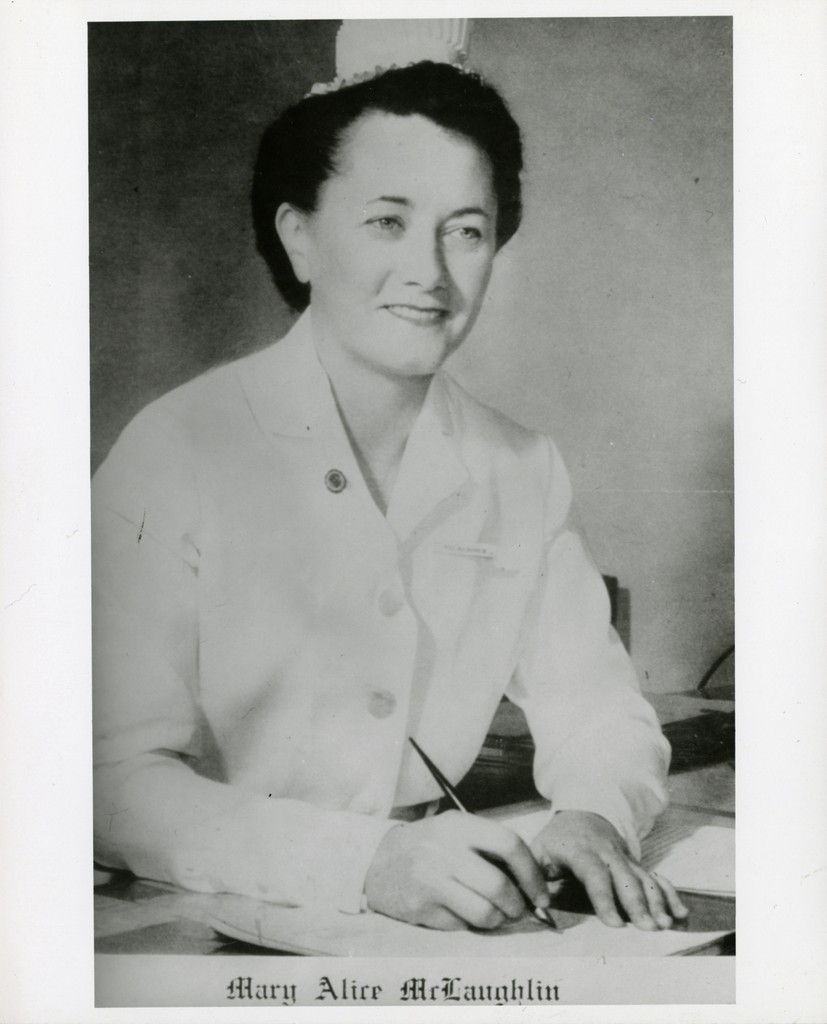
A 1978 history of the Philadelphia General Hospital (PGH) School of Nursing describes Mary Alice McLaughlin as “a tall woman, stately and immaculate in uniform…she possessed a combination of dignity, strength of purpose and total professionalism blended with patience, fairness, and compassion.” Today, she should be remembered for her efforts to improve nursing education in a time when few universities were interested, and hospitals – including PGH — operated nursing schools, mostly just to take advantage of the student labor.Dedicated to her vocation, it was said that Mary “never lost interest in her students’ welfare despite the terrible physical ordeals she suffered” in a long, ultimately fatal bout with breast cancer.

Mary received her diploma from Pennsylvania General Hospital in 1930 (the city’s public hospital, once part of Blockley Almshouse, which operated until 1977 on property now shared by HUP, CHOP, and the VA). A firm believer in continuing education for nurses, she became “the first student to register in the newly formed Department of Nursing Education at the University of Pennsylvania, receiving her Bachelor of Science degree in 1940.” For sixteen years, she worked as Assistant Director of Nursing Service at PGH, then Assistant Director in charge of Nursing Education, before becoming Director of the School of Nursing and Nursing Service from 1949 until her death at age 44.

Throughout her professional life, Mary labored to get nursing recognized as a serious career: “It was at her instigation that the first program in Pennsylvania to train Licensed Practical Nurses was begun.” In 1950, she pushed through a rigorous evaluation, so that the PGH School of Nursing achieved full academic accreditation with a curriculum centered around training nurses in effective patient care,teaching disease prevention and health education, and developing students’ “ability to adjust to all nursing situations.” In pediatric wards, student nurses learned ordinary child behavior expectations, as well as how to deal with “blindness and other specialized problems…” (the children’s department at PGH was equipped with top-of-the-line Isolettes – incubators piping pure oxygen to aid premature babies’ breathing. The archdiocesan St. Lucy School for the Blind would be founded across the street from SFDS in 1955 to fill an important need after it was realized that pure oxygen saved babies but had become a prime cause of childhood blindness!). Professional training also opened new horizons: a course on Professional Adjustments, “once intended to teach only professional courtesies,” was “redesigned to help seniors adjust to a career that could take them far away from friends and advisors.”

In addition to improving nursing education, Mary worked to make studying at PGH more attractive: for years, she advocated with the hospital board so that “finally, in 1950, students again received a stipend of $15 monthly from the city – a practice that had been discontinued during the Depression years” and more scholarships were made available.  She also “boosted student morale greatly by allowing seniors to go into white shoes and stockings. They must have felt they were almost full-fledged nurses!” and “interns and student nurses all joined in the fun of burning black shoes and stockings, or else draping them in rather surprising places around the hospital grounds, as soon as the intermediate year ended.” Seniors received special curfew privileges. As a sign of changing times, students were also “permitted a moderate amount of makeup and were allowed to wear shorts on the tennis court.”

Sadly, nursed through her last days “by those who loved and respected her.” Mary finally succumbed to her disease. She had attended All Saints Chapel at PGH, (which, incidentally, had its rectory at 3951 Baltimore Ave.), and also St. Francis de Sales with her mother, Mrs. Catherine McLaughlin, who lived at 4619 Chester Ave. She was buried at the Woodlands from St. Francis de Sales in 1954.