Category: events

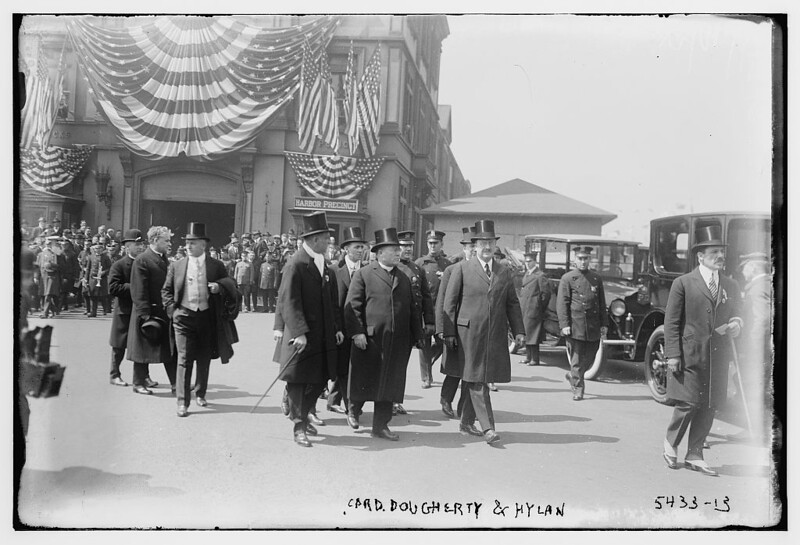
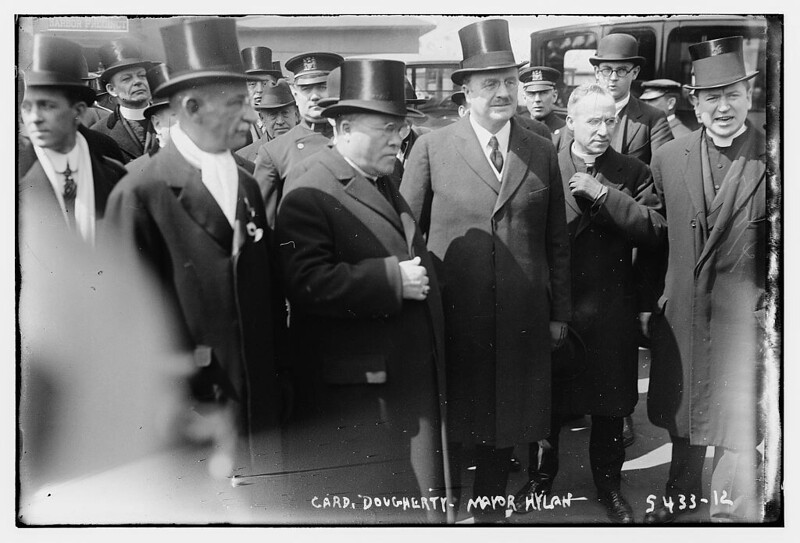
Cardinal Dougherty’s 1922 Non-clave

When Pope Benedict XV died on January 22, 1922, Bishop Crane, pastor of St. Francis de Sales and Assistant Bishop of Philadelphia, made the official archdiocesan announcement from St. Francis de Sales Rectory, advising that “Priests and people are earnestly requested to pray for the happy repose of his soul…” and “The Reverend Pastors are further directed to drape their churches in black for thirty days.”

Cardinal Dougherty, Bishop Crane’s boss, was out of town on a “vacation voyage to the West Indies,” and had to quickly leave his cruise and make his way home to Philadelphia to prepare for a trip to Europe, arriving in a blizzard Friday evening January 27 to leave again on Saturday morning January 28. According to the rules of the time, the conclave to elect a new Pope had to occur within ten days of the Pope’s death, so, in an era of steamship travel, the timing was very tight for the Cardinal to be at the Vatican by February 2. (Airplane travel was, as yet, impractical: Alcock and Brown of Britain had made the first historic and perilous nonstop transatlantic flight from Newfoundland to Ireland in a biplane just three years before, in 1919, and Charles Lindbergh would not make his famous New York to Paris solo flight until 1927).

Let us not imagine the Cardinal rushing about frantically on his way, however. Travel by ship was a grave and ceremonial affair, whatever the occasion, and this was the first time that a cardinal from Philadelphia was eligible to vote – one of two American cardinals — so it was a big event.

The Catholic Standard and Times reported that when His Eminence arrived in Philadelphiaon Friday evening, “He was met at Broad Street Station (Pennsylvania Railroad Station was at Broad and Market St.) at 8 o’clock by a committee of priests headed by the Right Rev. Bishop Crane.” Early the next morning, after his summer gear was hurriedly unpacked and replaced with sombre Vatican formals, a “private car was attached to the 8 o’clock express from Philadelphia to New York…and placed at the disposal of the Cardinal and his party. When His Eminence arrived at Broad Street Station a few minutes before 8 o’clock, a number of priests were assembled to wish him ‘bon voyage’ At the request of the newspaper men, the Cardinal stepped to the observation car and posed for a photograph…” He also granted an interview to the Catholic Standard and Times while aboard the train.

A large group of clergy rode with the Cardinal on the train to New York – among them, Bishop Crane and Reverend Hugh Lamb (another future assistant bishop and pastor of SFDS who would manage the Philadelphia end of things from SFDS when Cardinal Dougherty participated in the 1939 conclave). Upon arrival, they were met by representatives of “the Mayor’s Committee for the Reception of Distinguished Visitors.” Then, “Headed by a squad of motorcycle police, the Cardinal’s party entered automobiles at the station, which were provided through the courtesy of Rodman Wanamaker (heir to the Wanamaker’s Department Store fortune), of New York, and were driven to Pier 57, where the Lorraine was docked. It was precisely 10.30 o’clock when His Eminence boarded the ship. As the Cardinal strode down the gangplank of the liner he faced a battery of cameras and motion picture machines, and at the request of the photographers posed for pictures.”

The Very Rev. Joseph A. Whitaker, S. T. L., chancellor, accompanied Cardinal Dougherty to Rome as his assistant, and Cardinal Begin, the Cardinal-Archbishop of Quebec, travelled to the Conclave as a fellow passenger aboard the same ship. Bishop Crane would return to Philadelphia to keep things running until the cardinal’s return.

Cardinal Dougherty “graciously” granted more newspaper interviews in his stateroom once aboard, admitting that “It is very improbable that we shall reach Rome in time to enter the Conclave, the likelihood being that by the time we arrive a new Pope will have been elected.” The cardinal’s pessimism was justified: the record speed for a transatlantic crossing was 4.5 days and the conditions this time were not ideal. It had snowed heavily through the night, the snow was predicted to continue with gale force winds, and news reports alarmed “many ships caught in worst storm of years along coast.”  (The blizzard would later be memorialized as the “Knickerbocker Storm,” after the roof of the Knickerbocker Theatre in Washington DC, collapsed under the weight of snow on the evening of January 28, killing 98 people and injuring 133)

U.S. Weather Bureau Weather map for United States East Coast January 28, 1922 (wikimedia)

At 11:30 AM, the newspaper men were shooed away, the decks were cleared, then, finally, “The shrill notes of the siren announced at 12 o’clock that the Lorraine, was departing and at that time she left the port of New York,” scheduled to arrive at Havre in France on February 5.

Cardinal Dougherty and Cardinal Begin received the news of the new Pope’s election by radio a week later while still at sea. By then it was predicted that after arriving at Le Havre they would reach Paris on Tuesday, February 7, and Rome on the 9th. So it was Bishop Crane of St. Francis de Sales who, on February 6, 1922, announced to the Philadelphia archdiocese that “‘Habemus Pontificem.’ With profound gratitude to God, we announce to you the glad news that a successor to the late Pope Benedict XV has been elected in the person of His Eminence, Achille Cardinal Ratti, Archbishop of Milan, who has chosen the name of Pius XI” and reminded the clergy “P. S.—Please remove mourning draperies from the church and have this letter- read at all the Masses on Sunday, February 12. “+M. J. C.”

Cardinal Dougherty was not the only one to miss the Conclave. In total, three Europeans were ill; the Brasilian cardinal knew he didn’t have time to get there and didn’t attempt the journey; and the two Americans and the Canadian tried but didn’t arrive in time. Of the fifty-three cardinals who were able to vote, thirty were Italian; five French; four Spanish; three German; two each from the United Kingdom, Austria, and Poland; and one each from Belgium, the Netherlands, Hungary, and Portugal. (By contrast, in 2025, the 135 cardinal electors eligible to vote for the successor to Pope Francis now represent seventy one countries spread across Europe, Asia, Africa, Oceania, and all of the Americas).

Some placating was, apparently, in order when Cardinal Dougherty returned to Philadelphia on April 1. Bishop Crane arranged for him to be met in New York by a large reception committee of clergy and distinguished laity – among them Bishop Crane, Reverend Hugh Lamb, various current and former SFDS assistant priests, and several SFDS parishioners including Thomas Slattery (one of the Sponsors at the blessing of the church bells in 1916), Timothy Wholey (who donated the statues of St. Anne and St. Francis de Sales to the parish), and Joseph Durkin (early pew-holder) — among many others from around the city. When the cardinal’s train pulled in to Broad Street Station in Philadelphia, he was greeted by cheering, flag-waving crowds, city dignitaries, a squad of police, a full military band, a procession of flags, and several hundred Knights of Columbus marching before him in procession.

In a fulsome speech at the Cathedral, Bishop Crane carefully framed the trip as a victory:

“After witnessing the magnificent demonstration along the Parkway and looking into the happy and contented faces of this immense congregation, need I tell Your Eminence that throughout the length and breadth of this diocese there is universal rejoicing tonight upon your safe return to your beloved people, both clergy and laity. When the death of the late and lamented Pope Benedict XV was announced to a grief-stricken world, you promptly obeyed the call of the duty which belongs to your exalted office. You at Once made speedy preparations for the journey to Rome. On that stormy Saturday morning when you left your home to board the steamship La Lorraine, you were accompanied by the. prayers of your loyal and faithful children…We had hoped against hope that the deliberations of the Conclave might be prolonged so as to enable you to take part in the election of the successor to the saintly Pope Benedict XV. Rut on account of the long distance to the Eternal City and the brief, duration of the Conclave you were doomed to disappointment. We shared in your disappointment…” However, “You had the unique honor of assisting at the Coronation of the new pontiff; you had the intimate privilege of private conversation with him. It put you in close touch with the aims, the aspirations and the ideals of the Chief Shepherd of Christ’s flock on earth. Yours was a splendid opportunity of welding even closer, if possible, the ties that bind this diocese to the centre of unity, the Holy Roman Apostolic See…”

Bishop Crane’s speech was followed by another lengthy address, highlighting every important moment thus far in the Cardinal’s illustrious career, culminating in his personal audience with the new Pope.

Curiously, there’s a postscript. A few years later, in 1927, Cardinal Dougherty felt a need to use the Catholic Standard and Times to publicly denounce an obscure news item that he said he had recently been shown. The Catholic Standard and Times offered the background, that “A copyrighted Universal Service cablegram dated at Rome, September 19, and published in a local paper (where?) on September 20,” had reportedly claimed that, “…only the Pope’s intervention dissuaded Cardinal Dougherty, of Philadelphia, from offering his resignation as a Prince of the Church in 1922” after he was unable to participate in the conclave “although he used the fastest ocean liner and although the special train placed at his disposal by the Italian Government made the trip from Naples to Rome in record time…” The Catholic Standard and Times then emphasized that “His Eminence Characterizes Recent Newspaper Articles, That There Was Opposition to Sacred College Meeting in Conclave Before Arrival of American Cardinals, as Falsehood Out of Whole Cloth and as Calculated to Do Harm.”

The news item that infuriated the cardinal was not widely circulated and does not appear to have been archived, but it seems to have hit a sensitive nerve. One detail stands out, however: Cardinal Dougherty should have recalled that his ship had docked at Havre in 1922. It was the other American, Cardinal O’Connell of Boston, who landed in Naples then raced across the country, heartbreakingly arriving at the Vatican just one hour after the doors had been sealed. At the time, it was reported that Cardinal O’Connell’s “fortitude and resignation in a most trying situation” were “commented upon favourably by all the Italian newspapers” – which is an entirely different use and meaning of the word “resignation”! Cardinal O’Connell certainly could have had reason for despair: due to the unpredictability of travel, he had likewise arrived a day late and was shut out of the previous conclave in 1914. One of the first acts of the new Pope in 1922, was to extend the travel period before future conclaves to make it more feasible for non-Europeans to participate.

The 1922 conclave was notable for another reason, when it was reported that “For the first time in history women will be permitted to be present in the quarters occupied by the conclave. They are Sisters of Mercy, who will preside over the destinies of the cardinals’ kitchens, which heretofore have been supervised by monks.”

The Pope Comes to Philadelphia 2015

It seems like a lifetime ago, doesn’t it! The world has changed so much since then.

Ron and Maria back from Poland in time for the World Meeting of Families, with  Joan September 25, 2015

World Meeting of Families, Philadelphia Convention, September 2015 with Dominican Brother Joseph Thermadon, Fr. Shawn Casey, Venus Murphy, ofs Members of the International Catholic Deaf Association.(ICDA)

Sister Alice Daly sports a trendy t-shirt and sweater ensemble at the World Meeting of Families, Philadelphia Convention, September 2015

Pigeon coming through!

Votes for Women 1915

Philadelphia Inquirer October 23, 1915

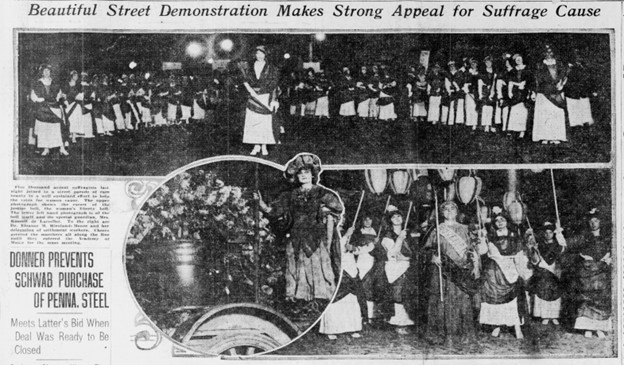
At 7:00 PM on the crisp Autumn evening of October 22, 1915, thousands of women from across Philadelphia and its suburbs gathered downtown at Broad and Mifflin Streets. Their plan was to march to City Hall, in a grand parade and “Festival of Light,” hoping to convince voting men to support a Pennsylvania state constitutional amendment permitting women to become their full partners in democracy.

Reasons for women wanting the vote ranged from idealistic notions of equality and justice for everyone, to the practical: “women who inherited family farms needed the vote to protect their interests, and mothers needed the vote to protect children’s health and education.”

They planned an impressive display.

The Philadelphia Inquirer described the scene: “The parade formed on Broad Street, south of Dickinson, promptly on time, but it reached the reviewing stand on the North Plaza of the City Hall just five minutes before nine o’clock…” with a squadron of mounted police leading “the advance guard of automobiles. There were about 150 of these cars, most of them big, costly limousines…” which, in 1915, when automobiles were still somewhat exotic, would have been a thrilling sight!  “Most of the cars were decorated with yellow plumes and banners. From one of the cars, ‘Miss Mumford,’ the official mascot, a toy fox terrier…barked lustily at the crowd.“

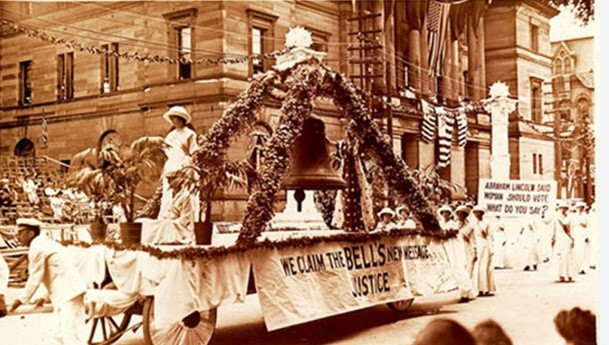
Then, “one hundred women, attired in pure white and in the strong daffodil yellow of the suffragists, each bearing a flower-shaped torch with an electric bulb in it” – electricity was another modern marvel in 1915 – “drew a similar colored triumphal car on which rested the ‘Justice Bell.’”

The Justice Bell, on its brilliantly lighted float, was a replica of the Liberty Bell, commissioned by activist Katharine Wentworth Ruschenberger and cast in bronze by the Meneely Bell Company of Troy, NY (The same name, but a confusingly different family branch and a rival company to the Old Meneely Bell Foundry of West Troy, NY that would cast the chime of bells installed in the St. Francis de Sales church tower in 1916). The words “Establish Justice” were engraved on the side of the Justice Bell and its clapper was chained to its side, to symbolize women’s silenced political voices. In the months before appearing in the parade, the bell toured the state to promote awareness of, and support for, the 1915 referendum on a state constitutional amendment allowing women to vote.

The Inquirer report continued: “Around the bell itself, as a guard of honor, were women attired to typify the virtues…” followed by several other floats depicting “historic and legendary characters.” Numerous women’s groups from across the region moved forward in orderly ranks of several hundred marchers at a time, preceded by banners, and carrying glowing lanterns and torches to light the way. Then, “Miss Dora Keene, athlete and mountain climber, on horseback, in full riding habit, led the College Equal Suffrage Society, most of the women wearing their caps and gowns. These were followed by the women physicians, and these in turn by the graduate and district nurses, in their distinctive uniforms.” The Inquirer noted that “Every profession or occupation open to women, every condition of society, every creed, had its representatives.” The parade culminated at the Academy of Music with a mass meeting and program of speakers.

What did all of this have to do with St. Francis de Sales Parish?

One of the marching groups in the 1915 parade had a direct association. The newly formed Suffrage League of Catholic Women was an offshoot of the American Catholic Historical Society (ACHS) Auxiliary, which had been involved with voting issues for many years under “pioneer Catholic suffragist” Jane Campbell of Germantown. When she retired, one of her supporters, Laura Blackburne , formed the new organization which included SFDS parishioners among its members. Blackburne herself had a special SFDS connection, as she had donated the large cross-shaped eternal lamp that hung as a beacon in the middle of the St. Francis de Sales sanctuary, from its construction until the 1950s (Bishop McShea replaced it with a pair of red sanctuary lamps, still in use, on the two side walls, and a pair of hanging lights).

SFDS also had an inspirational standard-bearer in the parade. A columnist for The Catholic Standard and Times, reminiscing some years later about the event, recalled that “our league made the finest showing in the suffrage parade, held in 1915… Banners with legends describing heroic Catholic women of the past were carried in line…Three young girls in accurate historical costumes were preceded by banner-bearers. Miss Catherine Forsythe represented St. Catherine of Siena, the famous publicist of the Middle Ages; Ethel de Barth (now Mrs. William P. O’Neill) was an ideal Joan of Arc in shining armor, and Frances Tobin appeared as Margaret Brent, niece of Lord Baltimore and the first advocate of woman suffrage in the New World.” (A laudable role model: according to the Maryland State Archive, Margaret was denied the courtesy of a vote when Maryland faced a “severe crisis” in 1647, though in the end “Margaret’s decisive actions in such troubled times ensured the survival of the settlement.”) Frances de Sales Tobin, age 24, was then the Executive Secretary of the Suffrage League of Catholic Women. A well-known daughter of the parish, her father worked for the Catholic Standard and Times, and her family, who lived at 5033 Cedar Ave., were very active in church activities.

Ultimately, the efficiently-organized 1915 parade was a powerful — perhaps intimidating — demonstration of women’s fitness to have a voice — and a choice — in government. But local politicians, who were concerned about the unpredictable effect of a large mass of new voters with different perspectives and priorities, pressed their mostly white male electorate to reject the amendment.

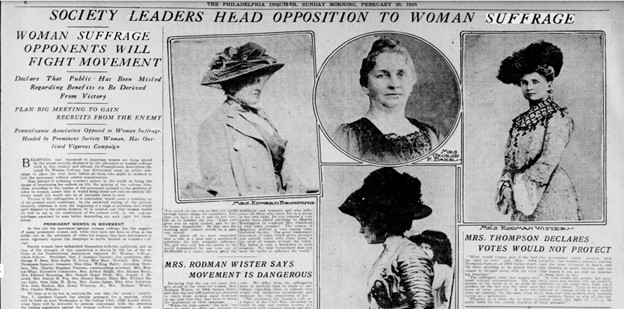
Voting men were directly responsible for the defeat, but it’s important to note that not all women had supported getting the vote. It’s hard now, to imagine that any woman would actively campaign to limit women’s opportunities, and yet some did. In 1910, the Philadelphia Inquirer published an entire page of commentary headed “Society Leaders Head Opposition to Woman Suffrage,” with photos of several prominent, wealthy, local women — wives of those comfortably in power — who opined that allowing women of every social class the right to vote would be “dangerous.” In 1913, the Washington headquarters of the National Association Opposed to Women Suffrage , an anti-voting organization, printed a letter from a woman who proudly stated “I am such an ardent anti-suffragist that I never go to bed without pinning the colors of the national organization on my night gown.” A curious mental picture indeed.

Philadelphia Inquirer February 20, 1910

World War I and the Influenza epidemic next filled the newspaper headlines and took over the nation’s attention. Then, in 1919, the controversial Eighteenth Amendment to the U.S. Constitution — instituting Prohibition and making “the production, transportation, and sale of alcohol illegal” — was ratified by the relatively small segment of the population which then qualified as voters. The Encyclopedia of Greater Philadelphia notes that although the Eighteenth Amendment took effect nationally in 1920, Pennsylvania actually enacted Prohibition earlier, on February 25, 1919. Once that happened — perhaps in reaction to it — on June 24, 1919, Pennsylvania became the seventh state to ratify the Nineteenth Amendment, allowing women to add their input to the local and national decision-making process.

In an article about the Justice Bell, Laurie Rofini writes: “After the ratification of the Nineteenth Amendment, the Justice Bell’s clapper was unchained in a ceremony on September 25, 1920, at Independence Square in Philadelphia…A wide range of women’s organizations and local clubs were represented…” supporting a broad spectrum of voices. The Encyclopedia of Greater Philadelphia then reports that “Over one million women in Pennsylvania, New Jersey, and Delaware voted in a national election for the first time on November 2, 1920. It had taken well over one hundred years for women to win that right and to push the nation forward toward living up to the ideals put forth at its founding.“

Afterwards, Frances de Sales Tobin would continue to address women’s groups on the importance of exercising their new rights. In 1921, she became the Leader of the first St. Francis de Sales Girl Scout Troop, tasked with preparing young women of the parish — now future voters — to embrace civic responsibility.

A Postscript:

Damaged in 2020, and restored in 2023, the Valley Forge Washington Memorial Chapel website now reports that “The Justice Bell is on permanent display at its home at Washington Memorial Chapel.” Check it out.

Canonization of St. Thérèse

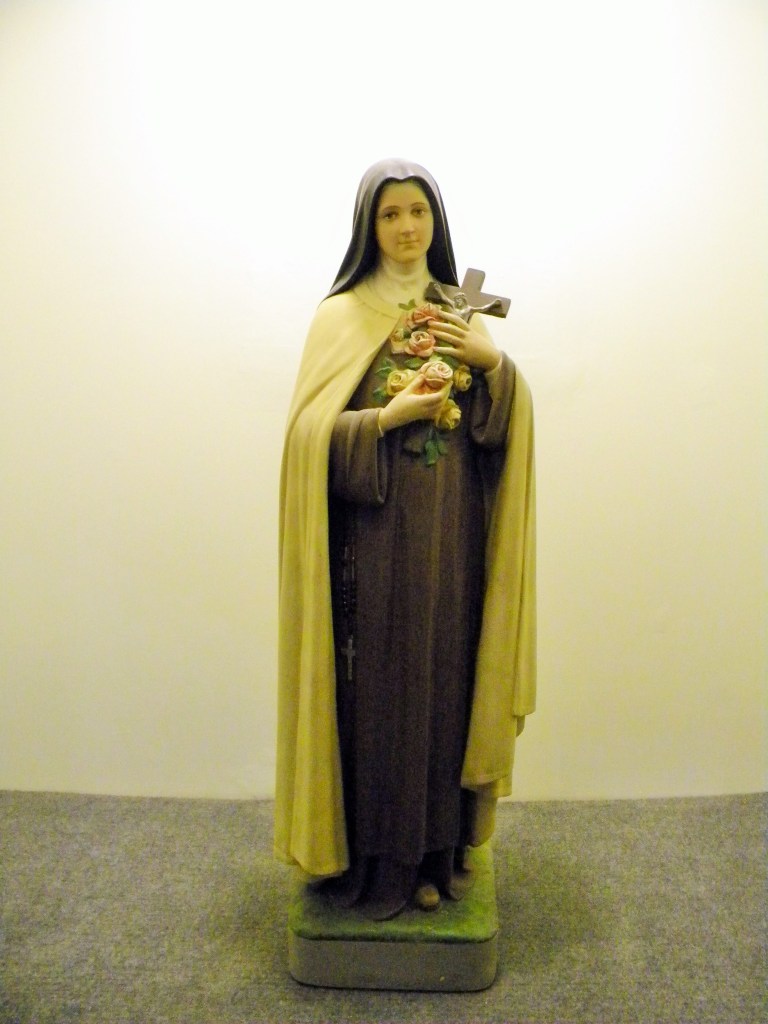
When “Sister Teresa, Carmelite Nun of Lisieux, generally known as the ‘Little Flower of Jesus,’” was canonized on May 17, 1925, our second pastor, Bishop Crane, was not personally present at the event, but still managed to have eyes at the Vatican!

Catholic News Service reported that “The canonization ceremonies—the first during the reign of the present pope (Pius XI)—were carried out with all the splendor prescribed by the ancient ritual of the Church…” Philadelphia Cardinal Dougherty – Bishop Crane’s boss — was among the cardinals and bishops in the magnificent procession. Viewers included “twenty-one members of various royal families of Europe; the sister, nephew and cousin of the sovereign pontiff, and a multitude, estimated at sixty thousand persons.” CNS reported that among those “given places of prominence were: Timothy Healy, Governor General of the Irish Free State…; John Coyle, of Philadelphia (president of the American Catholic Union and Private Chamberlain to His Holiness by Pope Pius XI), and Miss Langton, niece of Bishop Crane, Auxiliary of Philadelphia”.

The latest in technology made the ceremony accessible: when the Pope “pronounced the words whereby the new saint is formally proclaimed” it was reported that “Due to the installation of microphones and four amplifiers—the first time such installation has been made in St. Peter’s—the voice of the supreme pontiff could be heard in all parts of the vast edifice.” An ancient tradition made it memorable: “A custom, which has lain dormant since the downfall of the temporal power of the popes, in 1870,” was revived so that “the outside of the Basilica of St. Peter was brilliantly illuminated” by “Five thousand large lanterns and twenty five hundred torches…replicas of those used in former days, specially reconstructed for the purpose…At first, it was proposed to substitute electric lights for candles in the lanterns and the torches, but this suggestion was rejected because one of the most picturesque features of illumination is the blowing of the flames in the breezes, which always play about the great dome…When the hour for the illumination arrived, the first of the “sampietrini”—the personnel attached to the basilica—stationed at the top of the cross, lighted the first torch, crying out as he did so: “In nomine Patris, et Filii et Spiritus Sancti”. Almost instantaneously, 7,500 torches and lanterns, tended by his 300 assistants, burst into flame, and the outlines of the great basilica were etched in fire against the dark background of the heavens….” A report says that “Cardinal Dougherty, Bishop Schrembs, of Cleveland, Bishop Gallagher, of Detroit, and Bishop Turner, of Buffalo, viewed the spectacle from a terrace in front of the residence of Cardinal Sincero.” We don’t know where Miss Langton sat for this!

Meanwhile, back in Philadelphia, the SFDS Parish Monthly Bulletin reported Bishop Crane’s plan to dedicate a permanent shrine for St. Thérèse in a new basement “Lady Chapel” of our church on the day of her canonization. “In preparation for this a novena will be conducted on the afternoon of Sunday May 10” followed by devotions each day at 4 PM and 8 PM. “A beautiful statue of the Little Flower has been secured (located today in the former confessional on the parking lot side of the church) and this will be unveiled and blessed at 4 o’clock on the afternoon of May 17…” The Parish Monthly Bulletin published a request “to secure sufficient old gold and silver to have made up a reliquary to hold the relic of St. Therese. Those who have old articles of jewelry, watches, rings, etc., silver plate, spoons, etc., are asked to submit them with their intention that they may be incorporated into the Reliquary.” (Novenas featuring the relic were held regularly for the next few years. We do not know what became of the relic upon the death of Bishop Crane).

Miss Stella Langton returned triumphantly from Rome on 29 June, and Bishop Crane went out on the U.S. Coastguard cutter to meet her. Never in the best of health, “The bishop climbed the rope ladder from the cutter’s deck to that of the Ohio, arriving safely amid the cheers of passengers who lined the rails.” Mission accomplished!

Seasons of Darkness and Light

“The altar at St. Francis de Sales’ Church arranged for Solemn Pontifical Mass, November 12th, 1916,” 
(Catholic Historical Research Center)

A pair of evocative photos turned up recently in the Archdiocesan CHRC Archives, capturing our church in solemn and celebratory moods long ago.

The first is labeled on the reverse “The altar at St. Francis de Sales’ Church arranged for Solemn Pontifical Mass November 12th, 1916. Presented by Father Lallou to A.C.H.S.” (American Catholic Historical Soc.) The occasion was the fifth anniversary of the dedication of the Church, and Father Lallou, of St. John the Evangelist Church, gave the sermon. Bishop Thomas J. Shahan, D.D., rector of the Catholic University, presided, assisted by Rev. James T. Higgins, pastor of MBS. The Philadelphia Inquirer noted at the time that “All the officers of the mass are alumni of the Catholic University.” Our Pastor, Rev. Michael J. Crane, and Rev. Higgins – both now memorialized on our rectory lawn – had graduated together, among its first alumni. The exuberant electric lighting (imagine climbing up to replace those burnt-out bulbs!) is a reminder of how much clean, bright electricity – the new light of knowledge — was prized in 1916.

The second photo, showing the rear of the church, is unlabeled but also very early, and captures the magnificent serenity of the church at rest.

Look around you and compare these photos with our church today   — eerily the same and different. Check out the old full altar rail, the big hanging cross-shaped sanctuary lamp, the “cake stand” electric candle stands, and the early view of the organ. The old church was both darker, with the ornate dark pews and old flooring, and brighter with its multitude of light stands and bare bulbs.

Pope Francis quotes composer Gustav Mahler: “Tradition is the guarantee of the future,” adding “It is not a museum piece. It is what gives us life, as long as it makes you grow.” Our parish treasures its past, while continuing to move ahead: trying new ideas to engage families, planning updates to facilities for modern energy awareness, and looking at feasibility of adding wheelchair cuts to our 1960s pews to make the church more accessible. The shared sacrament of the Eucharist is what anchors us, connecting our past, present, and future.

 Interior of St. Francis de Sales Church, Philadelphia, Pa., with balcony and organ. (Catholic Historical Research Center)
Saint Francis de Sales Church, modern view

Bishop at Work

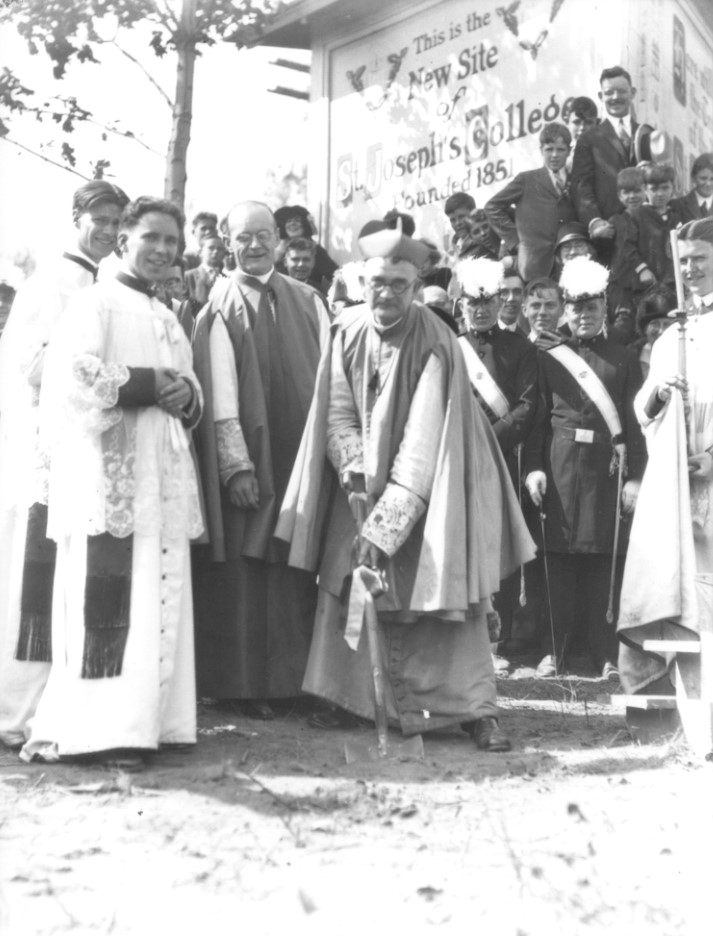
Bishop Crane breaks ground for St. Joseph’s University, 1925 (Photo used with permission from St. Joseph’s University Archives)

Saint Joseph’s University recently opened a West Philadelphia extension at the old University of the Sciences campus, 43rd and Woodland. They may be new neighbors, but an archival photo reveals our historic connection!

On October 15, 1925, at the original City Ave. campus, Catholic News Services reported that our second pastor: “The Right Rev. Michael J. Crane. Auxiliary Bishop of Philadelphia. officiated at the breaking of ground for the first building of the new St. Joseph’s College on the site where the imposing group of buildings for the Jesuit Institution will soon stand. The first building will house the College of Liberal Arts and serve as a faculty building. Bishop Crane used a shovel which was used when ground was broken for old St. Joseph’s Church here in 1733 and which has been a treasured relic among the Jesuits since that time.”

Saint Joe’s University still has the original photo, and the plaque that was affixed to the shovel, though the location of the actual shovel is not known.

News coverage of the groundbreaking was scant. A few years later, in 1927, the dedication of the building – on the 75th Anniversary of the founding of the college in 1853 — would be a much larger event, with the famously flawed aviation hero Charles Lindbergh (first to fly solo across the Atlantic) as a special guest. He would be awarded an honorary degree of Master of Aeronautics – even though the university did not have a program in the subject! It was claimed that 10,000 people attended that event, including a number of international dignitaries. Cardinal Dougherty officiated.

How did St. Joe’s come to build on City Ave back in 1925? Their history reports “The Jesuit charism, or mission, coincided perfectly with a grand plan envisioned by a group of wealthy Catholics from Overbrook and Bala Cynwyd in 1922 to develop City Line into an uber-Catholic community — a Catholic Main Line” with two wealthy parishes (Our Lady of Lourdes in Overbrook and St. Matthias in Bala Cynwyd); and plans for St. Charles Borromeo Seminary, St. Joseph’s Jesuit college, and the Cardinal’s residence, among others. Priorities change. Now, the university observes that the new “Saint Joseph’s University City campus is located in Philadelphia’s innovation district — home to health science start-ups, established biotech firms and influential higher education institutions that work together toward solving societies’ most pressing problems.” And we are here too. With a lot of young people and families bringing new energy. Shall we also be innovators?! 😊

Archbishop Dougherty’s Big Trip

Before digital media and modern tech, when the world moved at a more stately pace, an overseas trip was a major undertaking – especially if an honor would be received at the other end. Accounts of Archbishop Dougherty’s journey to Rome in 1921, to be installed as a cardinal, focused largely on getting there and back!

The Philadelphia Inquirer recorded the expedition’s start: “Entering an automobile” (still somewhat exotic transport) at 7:30 AM sharp on February 19, 1921, Archbishop Dougherty “was accompanied to Broad Street Station by Monsignors Nevin S. Fisher and Michael J. Crane (our second Pastor, also travelling). In the line of march which escorted him to the station was a bodyguard of mounted policemen, a detail of Fourth Degree Knights of Columbus, representatives from other Catholic orders, a band, and color guard. The guard carried the papal colors of gold and white and the American flag. Two cadets from the school of St. Francis de Sales Church, Edward Lipp and Edward Walsh, bore the colors.” And that was only the beginning.

A Catholic News Service reported that, including our Msgr. Crane, “Four hundred clergymen and laymen of Philadelphia accompanied Archbishop Dougherty to New York… Seven special (train) cars were required to bring the big delegation to Hoboken…” where “Thousands of men and women who awaited his arrival at the pier knelt as he passed through their midst to the vessel and when he reached the decks hundreds of others greeted him and filed up to congratulate him and kiss the episcopal ring…” It noted “When the visitors had gone ashore Archbishop Dougherty stood on the starboard side of the liner amidships… Just before the liner pulled cut, at a given signal, came the parting salute of flowers. The red carnations worn by the Philadelphia party, roses, violets and orchids were thrown in the air and showered down on the smiling prelate as the Niew Amsterdam moved out into the river.”

As to accommodations for the week-long voyage, the Inquirer noted that “An altar has been set up on board the vessel and His Grace will read mass each morning. A private dining salon has been set aside for the use of the party. According to the Catholic Standard and Times, “While the vessel was crossing the Atlantic, the Archbishop delivered an address on Washington’s birthday, eulogizing the ‘Father of Our Country.’” Upon arrival in France on February 28, “the party was greeted at Boulogne by a delegation of Knights of Columbus… and a group of prominent French Catholics, who escorted the Archbishop to Paris.” The Philadelphia group then continued to Rome on a special train, where, finally, “amid ceremonies of stirring solemnity and grandeur, Dennis Cardinal Dougherty received from Pope Benedict XV on Thursday. March 10, 1921. the full insignia of his exalted rank as a Prince of the Catholic Church.”

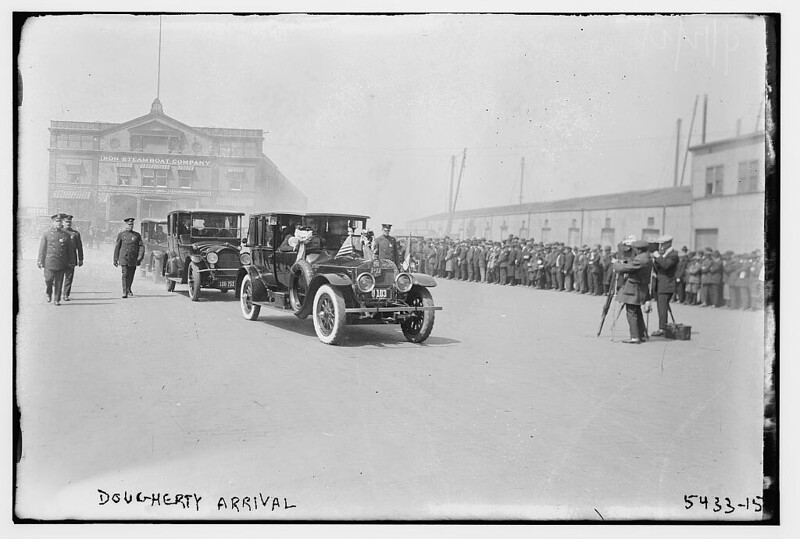
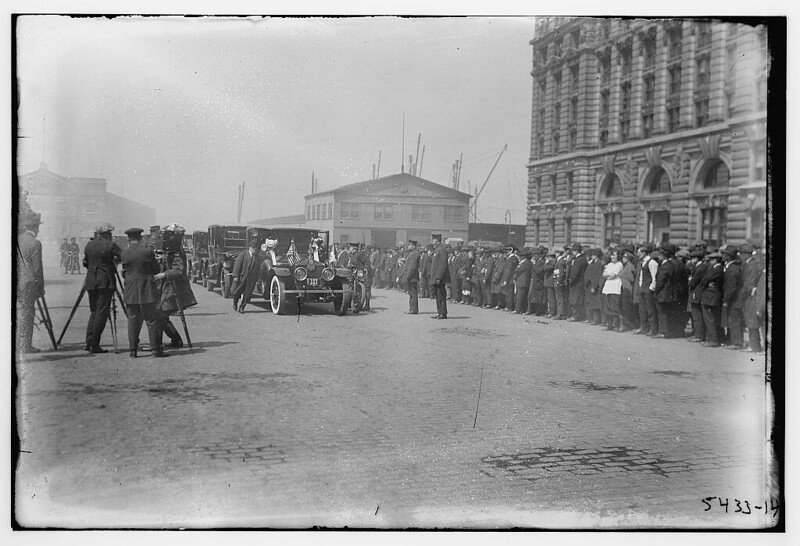
Coming home, the new Cardinal sailed from Paris on April 6, aboard the RMS Olympic (a sister ship to the Titanic, reportedly just as luxurious, but less moist), “accompanied by his party of clergy and laity who had escorted him to Rome…” Arriving in New York, April 13, he was greeted onboard by dignitaries. Then, “During his passage up New York Harbor…the Cardinal was cheered by thousands…hundreds were congregated around Pier A, where the boats docked, and the street along which the automobile procession was to pass was dense with people for several blocks…The Cardinal and his party left Pennsylvania Station in two special trains the following evening at 6 o’clock… The train bearing His Eminence arrived at North Philadelphia Station at 8.05 o’clock” where he was greeted by “Bishop Rhinelander, of the Protestant Episcopal Diocese of Pennsylvania, and Rabbi Krauskopf. of Keneseth Israel Synagogue. Clad in the robes of his high office, the Cardinal rode down Broad st. on which, for almost 10 miles, from Logan to extreme South Philadelphia, more than half a million citizens of all races and creeds greeted him with hymns of thanksgiving, deafening cheers, pealing bells and the stirring strains of music. Through this long human lane, amid sputtering red torches and spotlights, under triumphal arches, proceeded 150 automobiles carrying silk-hatted dignitaries of the city, the Church, and the professions in the special escort to the Cardinal…” And he hadn’t even won a Superbowl!

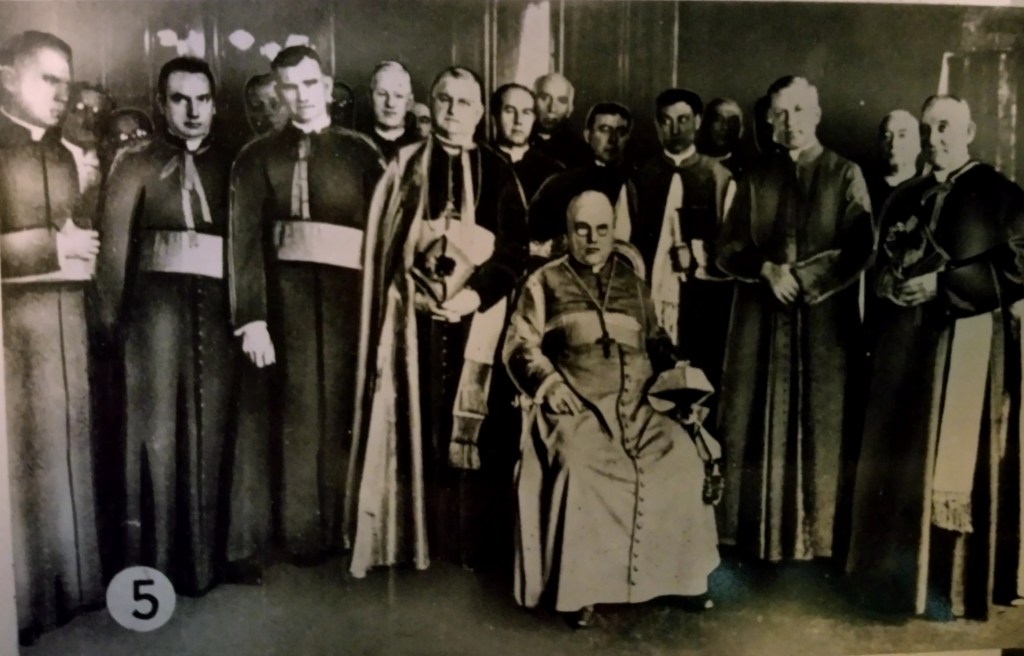
“In this picture the Cardinal-elect sits in the parlor of the American College, Rome, awaiting the visit of the Vatican Emissary to give formal notice of his elevation to the Cardinalate. Figures in the front row from right to left are : Msgr. Patrick J. Supple, a classmate from Boston; Msgrs. Grosso and Respighi, Papal Masters of Ceremonies; Msgr. McCullough, Philadelphia; Bishop Allen, Mobile, Ala.; Msgrs. Fitzpatrick and Crane, Philadelphia; Msgr. O’Hern, rector, and Msgr. Mahoney, spiritual director of North American College.” (Funeral booklet for Cardinal Dougherty June 1951)

Arrival back in New York, April 1921 (Library of Congress, Prints & Photographs Division)

2021 Border Mission: Pod 23A

Sisters Constance and Jeannette in San Antonio, TX, May 2021

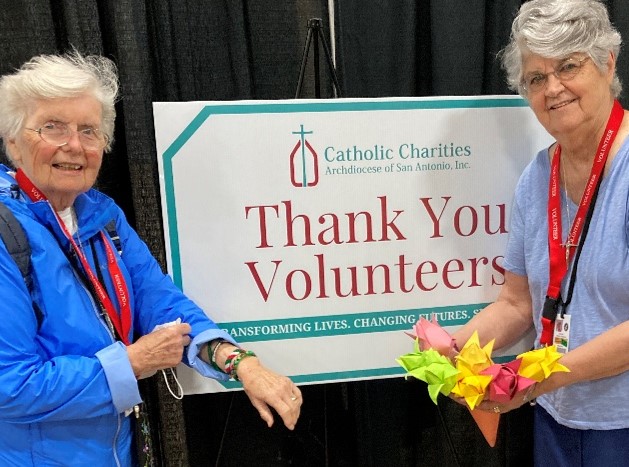
When two thousand anxious immigrant children were separated from their families at the U.S. southern border in early 2021, Catholic Charities summoned its unique superpower — nuns from orders across the country – to help in the crisis. Among those IHM sisters who answered the call, were several familiar names: Sister Kathy Benham of the IHM Ctr for Literacy, who worked with families in CA; and Sisters Constance and Jeannette, formerly of SFDS School. Snippets from Sister Jeannette’s San Antonio TX diary hint at the size of the task there:

“This morning we reported at 6:45, police, security everywhere….Covid test…Dept Homeland Security lanyard and ID, then… Catholic Charities…took pix, got ID there…gave us Catholic Charities vests and gave us instructions…We were given total charge of a pod ourselves!! 23A.   The place took our breath away. A Huge coliseum with maybe 1,000 cots in it!!!!!  And 1,000 boys to match the cots…They gave us a map and a list of names and information and told to go watch them, that the overnight person had just left…23A was Only 21 boys ages 13 to 17… We couldn’t see the end of our cots and the beginning of the cots on the pods around us…Some were sitting on their cots and a few tried to talk to us…They were scheduled for ‘indoor activity’…Our pod is scheduled to go outside to a small yard tomorrow. Around lunch time we were told to line up our pod for lunch. They are really good at getting in line and waiting to be told when to go…It’s amazing Totally organized…We picked up boxes on the way in and ate with them: sausage, beans and salsa, potatoes and a roll. It was hot and good. The minute you’re finished they move your pod out and more are coming in all the time. After lunch they are supposed to ‘rest’ and they did. Lots were reading paperback Bibles in Spanish, of course, or playing UNO. But Most of All, they were using pieces of yarn and had beads and they were making beautiful bracelets.  They were so earnest about this…The boys are so gentle and thoughtful…Three different times there was clapping, whistling, cheering and it meant that a boy from some pod was being taken out because they were reuniting him with his family…they were happy for the lucky boy and really showed it…”

Day 2 was exciting:the boys “each got to make a telephone call!!… They were arranged in a line according to bed #, then seated in chairs….The boys were called to the tables and the volunteer called the number on the paper and asked for the person to verify the info. Then they gave the cell phone to the boy and he talked. We heard one to a mother and another to a priest. They talked for 12 minutes (there was a stopwatch), then they came over to us and the next boys were called to the table. It’s like musical chairs here….”

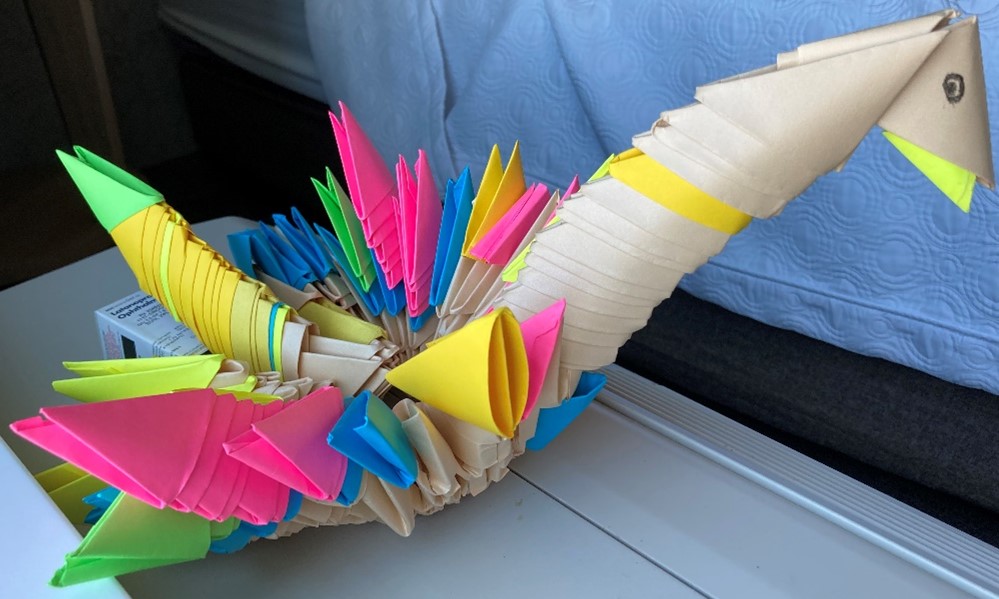
As days went by, some boys were released to relatives, and the rest waited patiently for their turn. Indoors, “along the side aisles there were soccer ball games going on all over. It reminded me of the schoolyard (small) at St. Francis de Sales…” The sisters bought craft supplies and games at Walmart. The boys studied basic English phrases and looked at a map to see the states where they would someday live. They had haircuts and figured out how to make elaborate folded paper swans. “The shrine on the table to Our Lady of Guadeloupe has been cleaned, straightened and added to. It looks very nice.  A picture of St. Martin de Porres has been placed there, also.”

The Sisters ound out that “All the boys here are from Honduras, Guatemala and Nicaragua…The US is allowing these in as a safe haven” because “their lives are in danger. If they stayed in their countries “they would be forced into gangs for drug running or sex or killed for refusing.”

At the end of their two exhausting weeks, Sister Constance called together the remaining boys in their Pod 23A “family” to tell them “this will be our last day.  We are going back to our school…” (St. Matthew’s). Explanation was important so the boys wouldn’t feel abandoned: “We learned that lesson… at De Sales. When Sisters were changed, the kids often thought that they didn’t like…them and that’s why they went away…Because we can’t touch them, we fist-bumped each one. It brought tears to us and them. They presented each of us with a RECUERDOS bracelet – remember, regards, memories.”

A Snapshot in Time

SFDS HISTORY MYSTERIES – Snapshot in Time

A browse through the parish archives turned up an unlabeled  photo from a long-ago ceremony – back when the sanctuary was lighted with electric candles on a tall stand, the altar rail had brass gates, there was no front-facing altar, and the old dark pews were still in place.

Parishioner historians John and Ted Deady, who grew up in the parish, offered some observations about the elaborate pageantry they recall from pre-Vatican II ritual, and a few of the names:

“Okay. Will start with this. The priest holding the book of the gospels is Father Sefton, later monsignor and pastor (at SFDS 1946-1947; pastor 1961-1967). The priest incensing the book is Father Flatley (at SFDS 1940-1943 and 1946-1955; WWII military chaplain in between). The two altar boys holding candles are the acolytes and the other altar boy is the thurifer (who carries the incense container, or thurible). The other priest in a surplice is the master of ceremonies. At a regular solemn high mass this would be an altar boy. Fr Sefton is the sub deacon and Fr. Flatley is the deacon. He will read the gospel in Latin. Then not sure if he or someone else will suddenly appear in the pulpit and read the gospel in English. Whoever is in the pulpit will then preach the sermon starting with ‘may it please your excellency’ or ‘eminence’ depending on who the celebrant is. That is a mystery.”

“The bishop in the seat is presiding and the two monsignors are his chaplains. The two altar boys in white cassocks are part of a gang of six called flambeaus. When Fr Navit was pastor (2004-2009) he had a similar group. They hold the lanterns during the consecration. The ones in the picture are just better dressed. “

“What the occasion is and who is celebrating the mass are mysteries. It was in the winter, fur coats. The sisters did not routinely attend the 11:00 o’clock (solemn) mass. The master of ceremonies is not a familiar face meaning he might have come with the celebrant in a package deal.”

Fran Byers, another from-the-cradle parish historian, replied to this  “Wow, John,   I am really impressed.   We girls were not privy to any of this,” which is, itself,  notable. Ted notes that “Women were not allowed in the Sanctuary except for their wedding (Vatican rule).” What did girls do Pre-Vatican-II? John recalls that all SFDS School children, except those boys who were scheduled to serve or sing at the weekly solemn Mass, were required to attend a separate Sunday children’s service, where attendance was taken – parents had to send a written excuse for absence. Girls couldn’t serve at Mass or sing in the choir. Twice a year, they were invited to follow the boys in a Eucharistic procession, strewing flower petals, and girls were selected to perform the crowning of the Mary statue in the annual May Procession (which was led by the boy “popes” and altar servers). Their mothers joined the Sodality, a ladies’ organization devoted to prayer and good works.

The Bishop’s Feast

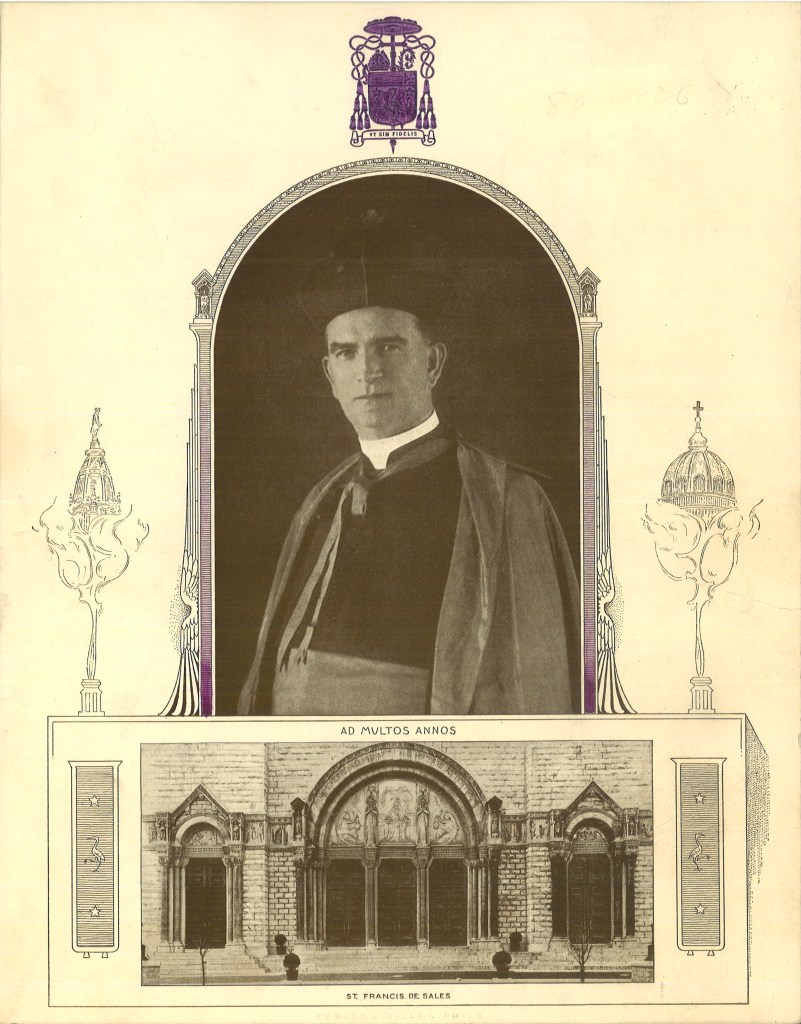
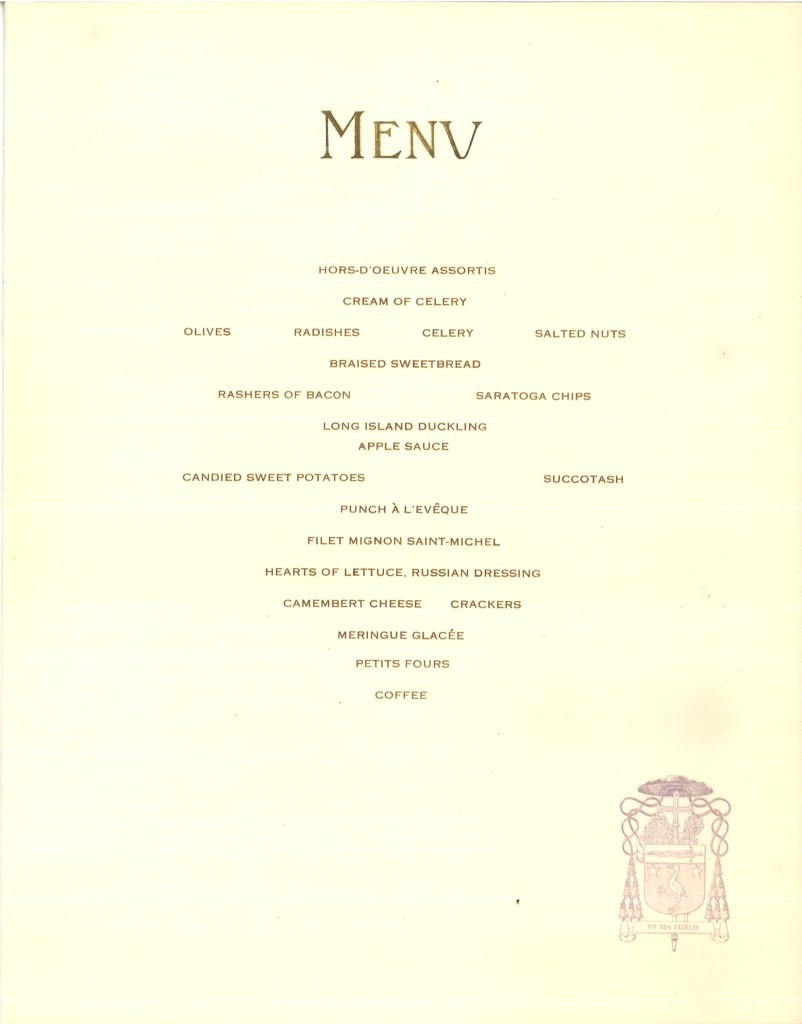
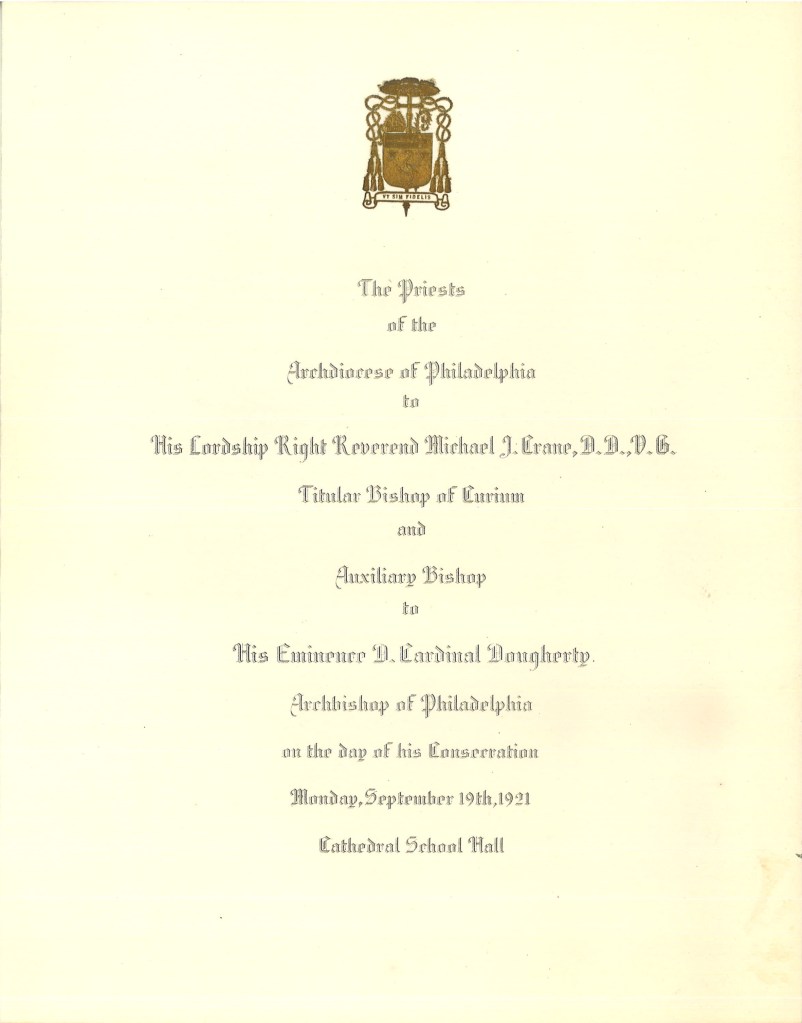
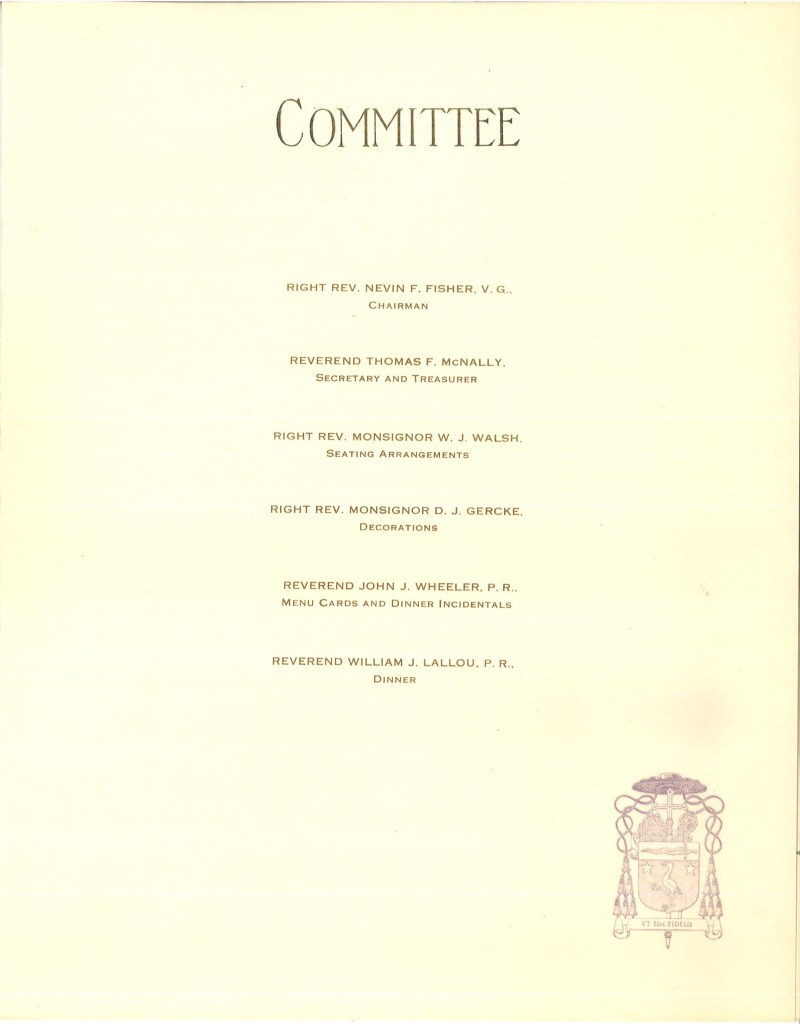
 Our second pastor, Reverend Michael J. Crane, was consecrated as a bishop one hundred years ago on September 19, 1921. Afterwards, he and his fellow priests celebrated with a grand feast. Some dishes seem ordinary now, but were exotic at the time. Some were chosen to surprise and delight. Today, the menu offers a portal into another age.

Celery was a status vegetable in the early 1900s — luxurious enough to be served in first-class cabins on the Titanic — and it appeared twice on the bishop’s menu: in Cream of Celery Soup and as an appetizer, probably served in a special-purpose dish.

Other pre-meal crunchies included olives and salted nuts – typically served with alcoholic beverages — which could hint at off-menu refreshments during Prohibition.  Radishes, also, are supposed to aid in “detoxing” the liver.

“Braised Sweetbread” is a mystifying first course. Was it a favorite dish, a reminder of mother’s home cooking, or a nod to Irish heritage?  “Sweetbread” is a polite term for thymus or pancreas of calf or lamb – much more popular in Britain and Ireland, than in the United States. (Unconsciously ironic, since Bishop Crane was afflicted with a malfunctioning pancreas that caused his diabetes. The following year, Cardinal Dougherty would pull some strings to get his new bishop enrolled in a clinical trial of insulin on humans in Toronto, which saved his life for a few more years).

“Rashers of bacon” and “Saratoga Chips” were next — both shown on the same menu line. “Saratoga Chips” was a fancy name for potato chips! Listing pig and potatoes together could have been another nod to the Bishop’s Irish heritage. It could also have referenced something closer: Saratoga, NY appears to have been a popular vacation spot for clergy (Rev. Francis O’Neill, after whom our parish may have been named, died there of a heart attack in 1882). Curiously, a town in Saratoga called “Bacon Hill,” had formerly been known as “Pope’s Corners” – which, if commonly known, could have made a good inside joke around the table of a newly-consecrated Bishop.

It’s a fair guess that “Long Island Duckling” was the closest that the menu planner could get to putting a crane on the table. Long Island was a center for raising Peking Ducks, which first arrived in this country in 1873; and duck with applesauce was a luxury dish (also served on the Titanic!).

For vegetables, Candied Sweet Potatoes, now often served at Thanksgiving, were a novelty, reportedly dating back just to 1917! Succotash – a mixture of corn and lima beans – was a traditional Thanksgiving dish in New England and upstate Pennsylvania. Bishop Crane was from Ashland, PA, and the occasion being celebrated was certainly one of thanksgiving.

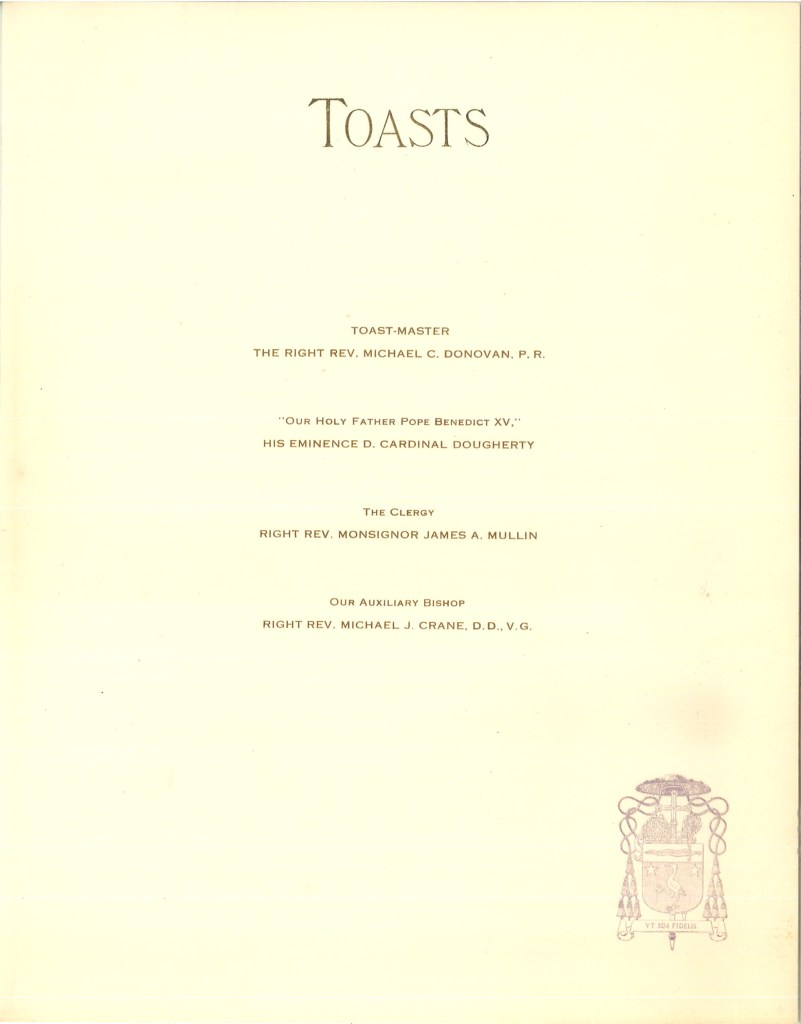
The beverage accompanying the entree was “Punch A L’Évêque,” or “Bishop’s Punch.” Was it alcoholic? Unclear! The French name made the punch sound elegant and affords a cloak of ambiguity during Prohibition. Online recipes suggest it could have been a mixture of orange juice, lemon juice, and port. Bishop Crane was not a teetotaler, but Cardinal Dougherty, who publicly advocated against alcohol, is listed as a toastmaster at the event.

 “Filet Mignon Saint Michel” (St. Michael’s steak) was the entree at Bishop Michael Crane’s feast, and the reference seems self-explanatory, though the cut could, in theory, refer to beef (American) or Pork (French)!

“Russian dressing” on the salad was trendy in 1921.The Encyclopedia of American Food and Drink describes it as “a salad dressing made from mayonnaise, pimiento, chile sauce, green pepper, and chives. It is so called possibly because the mixture was thought to resemble those found in Russian salads, but it is American in origin, first found in print in 19

“Meringue Glacée” (Meringues with ice cream) is Swiss; “Petit Fours” cakes are French. Was this a nod to our Patron Saint Francis de Sales, who came from French Savoy and became Bishop of Geneva, Switzerland?

It’s easy to read too much into the menu today, but its long-ago planners also had reason to over-think! It is clear, in any case, that the spread was carefully devised with genuine affection for the new bishop. Speculation about its details recalls that energy and coaxes dusty history back to life.