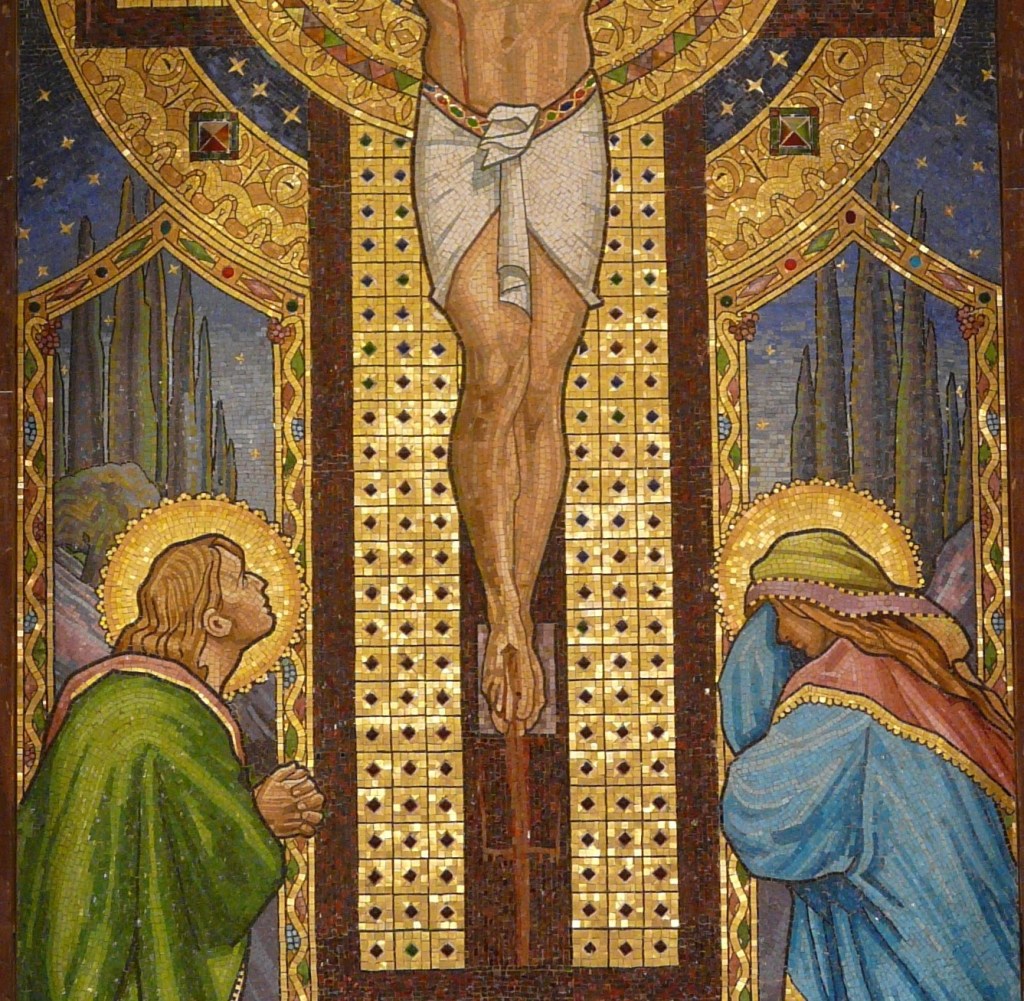
It’s easy to look at something so often, that you stop seeing it. The suffering Christ on the glass mosaic altarpiece at St. Francis de Sales (designed by Frederick Dimble Henwood and executed by mosaic artist Henry Choffin around 1910) is an obvious center of attention, especially during Lent, but look again: the mountains and stars in the background also offer something to ponder all year long.
The rocky scenery behind the kneeling figures is easy to overlook and might at first seem unimportant. The precise location for the hill of Golgotha, or Calvary (both of which mean “place of the skull”), outside the old walls of Jerusalem, where the crucifixion took place, is not known, but the general area where it is thought to have occurred was once a limestone quarry, so rocks might be expected. The mural scenery features pointy mountain pinnacles, though, not flat excavated cliffs, which might suggest other meaning.
Mountains in the Holy Land were the places closest to God, where many important Old Testament events occurred. Among them: Mount Ararat, where Noah’s Ark came to rest; Mount Moriah, where Abraham went to sacrifice Isaac; and Mount Sinai, where Moses received the ten Commandments – though, curiously, the precise location for all of these places is no longer known. Mount Zion, where The Second Temple stood in Jesus’ time (it was destroyed around 70 AD) is today known as The Temple Mount. It is the holiest site in Judaism – and also one of the holiest sites in Islam. The Dome of the Rock mosque now covers a large rock known in Judaism as the Foundation Stone – thought to be the spiritual junction between heaven and earth, and the place from which the world was created and Adam was formed. In Islamic tradition, this was the site of the miraculous Night Journey of the prophet Muhammad and his ascent into heaven — an interesting thought this year, when Ramadan, the Islamic month of fasting, reflection, and community, coincides with Lent.
The Christian connection with mountains continues in the New Testament. The gospels – particularly that of Matthew – mention a number of mountain events significant to the life of Jesus: his Sermon on the Mount; a number of healings; his resistance to the devil’s temptation; the Transfiguration, when his divinity was revealed; his farewell discourse, when he counseled his disciples to “love one another” and declared that “the hour has come for the Son of Man to be glorified;” and his commissioning of the apostles to “go therefore and make disciples of all nations...” The actual locations for most of these events are not known today, but tradition says the Transfiguration may have occurred on Mount Tabor. The garden of Gethsemane, where despairing Jesus prayed “to let this cup pass from me” on the night before his death, is at the foot of the Mount of Olives. Jesus is thought to have ascended into Heaven from the summit, and a shrine there, shared by Christians, Muslims, and Jewish people, contains a rock that supposedly has the impression of Jesus’ footprint.
Is the number of peaks shown in the mosaic significant? Two separate sets of seven summits could have been intended to link the “Seven hills of Jerusalem” with Rome, which is traditionally identified as the “City of Seven Hills.” Our church includes many references connecting the Old and New Testament while affirming our Catholic connection with Rome, and the unbroken line of authority from Saint Peter – “upon this rock” – to the present day. Seven is a mystical number, traditionally thought to represent completeness and perfection. There are seven sacraments, seven gifts of the Holy Spirit, seven joys and seven sorrows of Our Lady, and seven deadly sins. Seven mountains are mentioned in the apocalyptic vision of Revelations, which also proclaims that the first resurrection of the dead will take place at the seventh trumpet. Whatever the number intention, the stern mountain peaks in the mural all point in one direction, straight up to heaven.
Steep mountains look daunting from the ground, but the view closer to the stars is exalting. In these interesting times, the mountains beyond the crucifixion could inspire thoughts of theologian Thomas Merton’s Seven Story Mountain mystical quest for contemplative freedom inside the protective walls of a cloister in 1948, when the memory of World War II was still strong. Contrarily, in a more popular vein, it could call forth the tuneful encouragement of the Mother Superior to Maria, in the classic movie “The Sound of Music,” to “Climb every mountain…,” as Maria, also during World War II, followed her destiny to leave the security of cloister walls and journey over the mountains to a new life.
Incidentally, that movie was loosely inspired by the real-life story of an immigrant family, one among the “huddled masses yearning to breathe free,” who once found a haven on this side of the ocean. And there’s a parish connection: Peter La Manna, the parish choir director in the 1960s, performed for several years with the Von Trapp family singers, whose actual exodus from Austria during World War II inspired that film!

