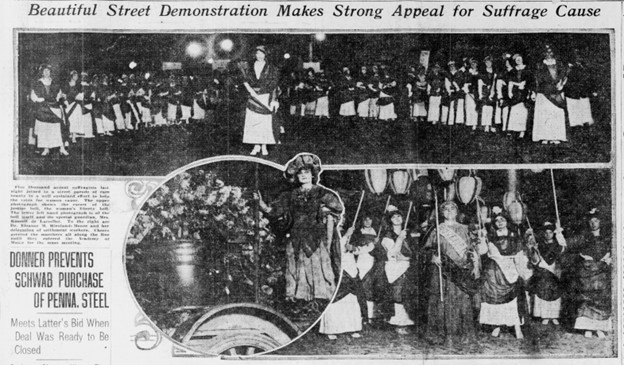
At 7:00 PM on the crisp Autumn evening of October 22, 1915, thousands of women from across Philadelphia and its suburbs gathered downtown at Broad and Mifflin Streets. Their plan was to march to City Hall, in a grand parade and “Festival of Light,” hoping to convince voting men to support a Pennsylvania state constitutional amendment permitting women to become their full partners in democracy.
Reasons for women wanting the vote ranged from idealistic notions of equality and justice for everyone, to the practical: “women who inherited family farms needed the vote to protect their interests, and mothers needed the vote to protect children’s health and education.”
They planned an impressive display.
The Philadelphia Inquirer described the scene: “The parade formed on Broad Street, south of Dickinson, promptly on time, but it reached the reviewing stand on the North Plaza of the City Hall just five minutes before nine o’clock…” with a squadron of mounted police leading “the advance guard of automobiles. There were about 150 of these cars, most of them big, costly limousines…” which, in 1915, when automobiles were still somewhat exotic, would have been a thrilling sight! “Most of the cars were decorated with yellow plumes and banners. From one of the cars, ‘Miss Mumford,’ the official mascot, a toy fox terrier…barked lustily at the crowd.“
Then, “one hundred women, attired in pure white and in the strong daffodil yellow of the suffragists, each bearing a flower-shaped torch with an electric bulb in it” – electricity was another modern marvel in 1915 – “drew a similar colored triumphal car on which rested the ‘Justice Bell.’”
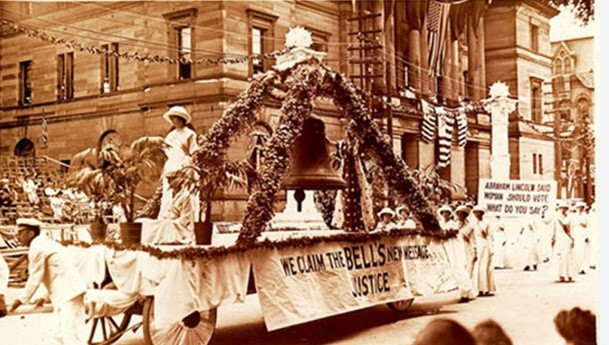
The Justice Bell, on its brilliantly lighted float, was a replica of the Liberty Bell, commissioned by activist Katharine Wentworth Ruschenberger and cast in bronze by the Meneely Bell Company of Troy, NY (The same name, but a confusingly different family branch and a rival company to the Old Meneely Bell Foundry of West Troy, NY that would cast the chime of bells installed in the St. Francis de Sales church tower in 1916). The words “Establish Justice” were engraved on the side of the Justice Bell and its clapper was chained to its side, to symbolize women’s silenced political voices. In the months before appearing in the parade, the bell toured the state to promote awareness of, and support for, the 1915 referendum on a state constitutional amendment allowing women to vote.
The Inquirer report continued: “Around the bell itself, as a guard of honor, were women attired to typify the virtues…” followed by several other floats depicting “historic and legendary characters.” Numerous women’s groups from across the region moved forward in orderly ranks of several hundred marchers at a time, preceded by banners, and carrying glowing lanterns and torches to light the way. Then, “Miss Dora Keene, athlete and mountain climber, on horseback, in full riding habit, led the College Equal Suffrage Society, most of the women wearing their caps and gowns. These were followed by the women physicians, and these in turn by the graduate and district nurses, in their distinctive uniforms.” The Inquirer noted that “Every profession or occupation open to women, every condition of society, every creed, had its representatives.” The parade culminated at the Academy of Music with a mass meeting and program of speakers.
What did all of this have to do with St. Francis de Sales Parish?

One of the marching groups in the 1915 parade had a direct association. The newly formed Suffrage League of Catholic Women was an offshoot of the American Catholic Historical Society (ACHS) Auxiliary, which had been involved with voting issues for many years under “pioneer Catholic suffragist” Jane Campbell of Germantown. When she retired, one of her supporters, Laura Blackburne , formed the new organization which included SFDS parishioners among its members. Blackburne herself had a special SFDS connection, as she had donated the large cross-shaped eternal lamp that hung as a beacon in the middle of the St. Francis de Sales sanctuary, from its construction until the 1950s (Bishop McShea replaced it with a pair of red sanctuary lamps, still in use, on the two side walls, and a pair of hanging lights).
SFDS also had an inspirational standard-bearer in the parade. A columnist for The Catholic Standard and Times, reminiscing some years later about the event, recalled that “our league made the finest showing in the suffrage parade, held in 1915… Banners with legends describing heroic Catholic women of the past were carried in line…Three young girls in accurate historical costumes were preceded by banner-bearers. Miss Catherine Forsythe represented St. Catherine of Siena, the famous publicist of the Middle Ages; Ethel de Barth (now Mrs. William P. O’Neill) was an ideal Joan of Arc in shining armor, and Frances Tobin appeared as Margaret Brent, niece of Lord Baltimore and the first advocate of woman suffrage in the New World.” (A laudable role model: according to the Maryland State Archive, Margaret was denied the courtesy of a vote when Maryland faced a “severe crisis” in 1647, though in the end “Margaret’s decisive actions in such troubled times ensured the survival of the settlement.”) Frances de Sales Tobin, age 24, was then the Executive Secretary of the Suffrage League of Catholic Women. A well-known daughter of the parish, her father worked for the Catholic Standard and Times, and her family, who lived at 5033 Cedar Ave., were very active in church activities.


Ultimately, the efficiently-organized 1915 parade was a powerful — perhaps intimidating — demonstration of women’s fitness to have a voice — and a choice — in government. But local politicians, who were concerned about the unpredictable effect of a large mass of new voters with different perspectives and priorities, pressed their mostly white male electorate to reject the amendment.
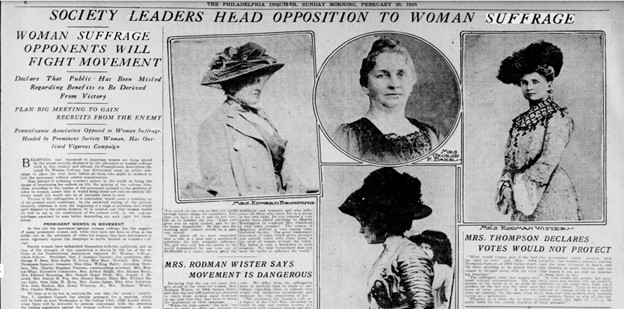
Voting men were directly responsible for the defeat, but it’s important to note that not all women had supported getting the vote. It’s hard now, to imagine that any woman would actively campaign to limit women’s opportunities, and yet some did. In 1910, the Philadelphia Inquirer published an entire page of commentary headed “Society Leaders Head Opposition to Woman Suffrage,” with photos of several prominent, wealthy, local women — wives of those comfortably in power — who opined that allowing women of every social class the right to vote would be “dangerous.” In 1913, the Washington headquarters of the National Association Opposed to Women Suffrage , an anti-voting organization, printed a letter from a woman who proudly stated “I am such an ardent anti-suffragist that I never go to bed without pinning the colors of the national organization on my night gown.” A curious mental picture indeed.
World War I and the Influenza epidemic next filled the newspaper headlines and took over the nation’s attention. Then, in 1919, the controversial Eighteenth Amendment to the U.S. Constitution — instituting Prohibition and making “the production, transportation, and sale of alcohol illegal” — was ratified by the relatively small segment of the population which then qualified as voters. The Encyclopedia of Greater Philadelphia notes that although the Eighteenth Amendment took effect nationally in 1920, Pennsylvania actually enacted Prohibition earlier, on February 25, 1919. Once that happened — perhaps in reaction to it — on June 24, 1919, Pennsylvania became the seventh state to ratify the Nineteenth Amendment, allowing women to add their input to the local and national decision-making process.
In an article about the Justice Bell, Laurie Rofini writes: “After the ratification of the Nineteenth Amendment, the Justice Bell’s clapper was unchained in a ceremony on September 25, 1920, at Independence Square in Philadelphia…A wide range of women’s organizations and local clubs were represented…” supporting a broad spectrum of voices. The Encyclopedia of Greater Philadelphia then reports that “Over one million women in Pennsylvania, New Jersey, and Delaware voted in a national election for the first time on November 2, 1920. It had taken well over one hundred years for women to win that right and to push the nation forward toward living up to the ideals put forth at its founding.“
Afterwards, Frances de Sales Tobin would continue to address women’s groups on the importance of exercising their new rights. In 1921, she became the Leader of the first St. Francis de Sales Girl Scout Troop, tasked with preparing young women of the parish — now future voters — to embrace civic responsibility.

A Postscript:
Damaged in 2020, and restored in 2023, the Valley Forge Washington Memorial Chapel website now reports that “The Justice Bell is on permanent display at its home at Washington Memorial Chapel.” Check it out.

