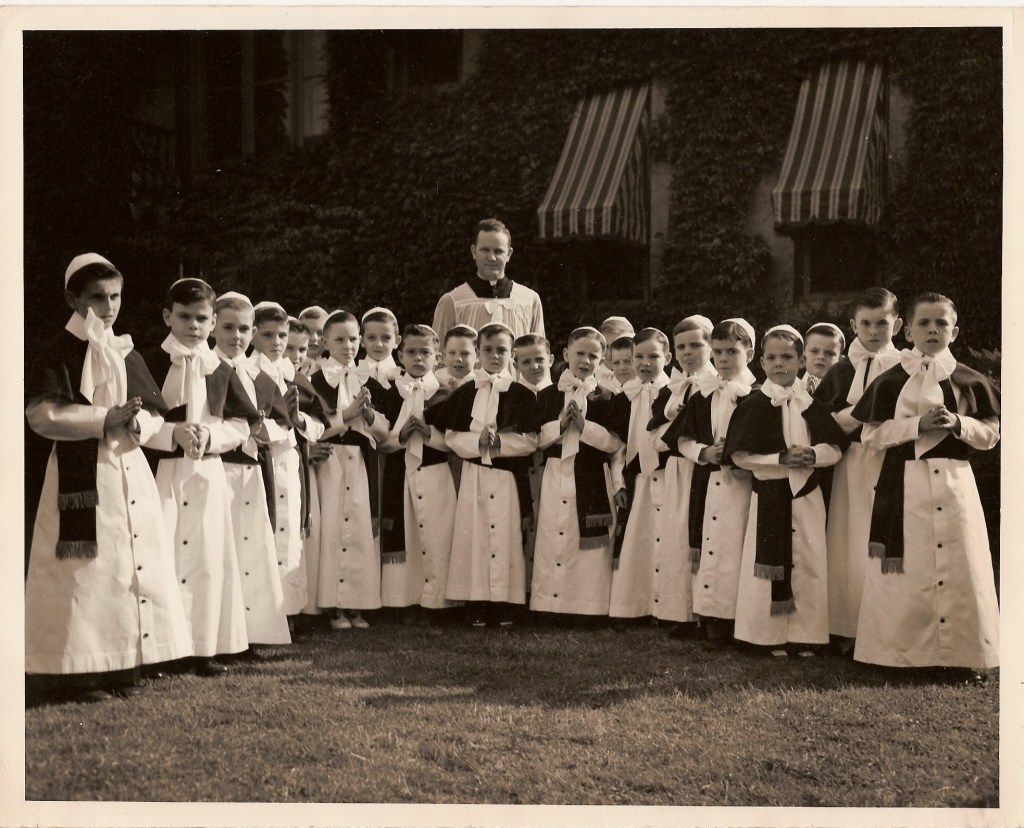
Philadelphia Catholic school and parish alumni from the 1940s to the early 1960s recall picturesque Little Popes – tiny first and second grade sanctuary boys who wore white robes, red capes and sashes, and little white zucchetto skull caps, and marched ahead of the bigger altar servers in long formal processions — but nobody seems to know why.
Father Dennis Gill, Director of the Office for Divine Worship for the Archdiocese, recalls being a Little Pope in his youth, and says they were used widely throughout the archdiocese and were “for younger boys who were not yet old enough to be altar servers. They were used during 40 Hours and Holy Thursday and would sit in the sanctuary, or in some parishes would be along the altar rail.“
The Little Popes may have been a local phenomenon. All the instances found so far have been in Pennsylvania, and all within the old boundaries of the Philadelphia archdiocese (including what is now the Allentown diocese). Almost all of the references to Little Popes seem to date from the late 1940s to the early 1960s – with the exception of a single boy puzzlingly identified in a parish history as a “Little Pope” in an 1894 photo of clergy and assistants at a Jubilee Mass at St. Anthony of Padua Church in Lancaster.
Memories of former Little Popes offer a curious window into a different era.
Paul Peterson (SFDS class of 1954), recalled:

“I, like many other boys, had liturgical experience in first grade being a ‘Little Pope.’ We wore: a white cassock made of heavy cotton muslin, a red velveteen sash and cape with gold fringe, a stiff high collar with a wide silk bow, tied by Sister, and a white zucchetto. My mother complained how difficult it was to wash, starch and iron the cassock. The collars could be bought in the men’s department of Strawbridge and Clothier at eighth and Market Streets. I remember having my collar cleaned and starched at the Chinese laundry under the Ivan Apartments at 47th and Baltimore Avenue. The Little Popes processed at the solemn Pontifical Masses for Christmas and Easter, as well as the closing ceremony of Forty Hours, and the May Procession. My tenure as Pope did not last far into the 2nd grade, as I outgrew my cassock.”
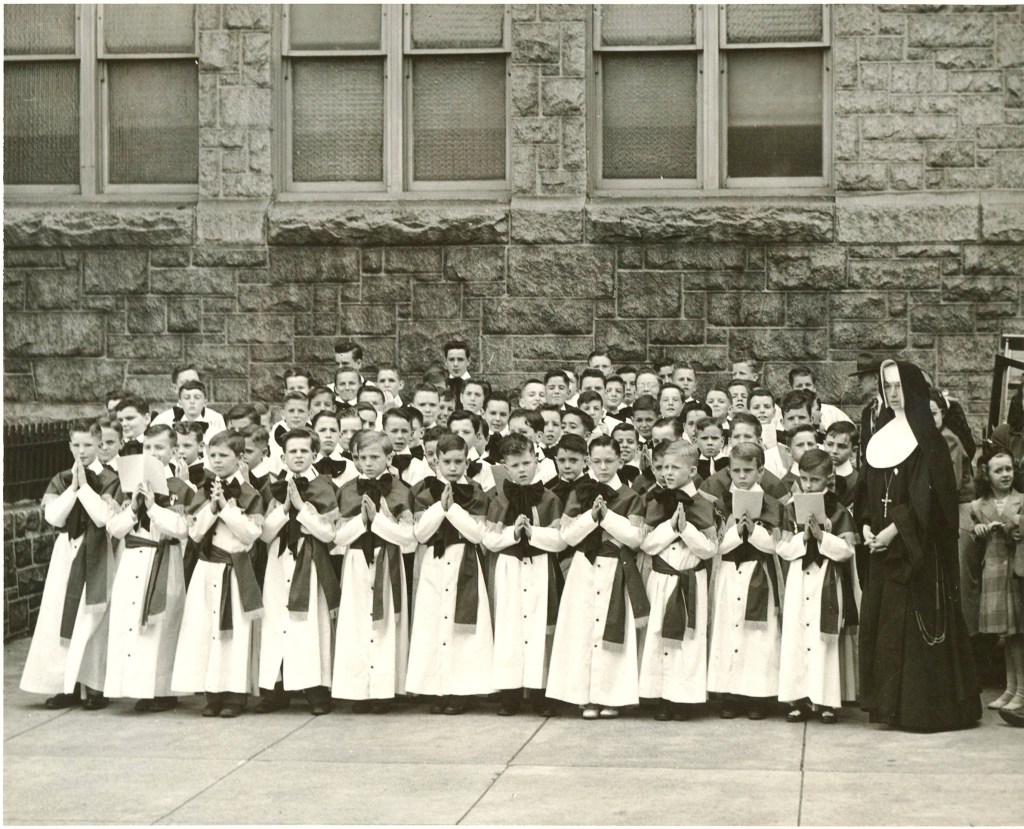
Frank Adolf (Transfiguration Parish Class of 1954), recalls that at Transfiguration of Our Lord Parish (formerly at 5533 Cedar Ave., Philadelphia, not far from SFDS):
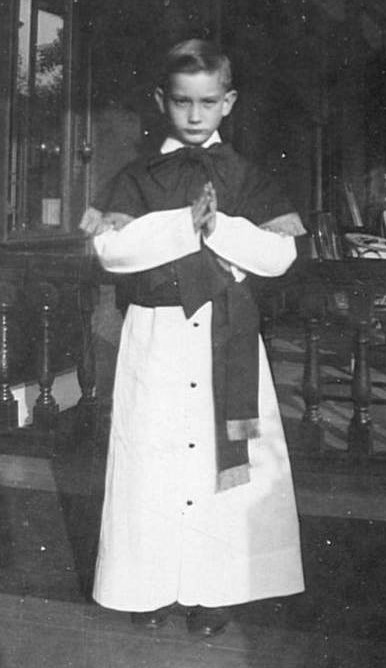
“I was a ‘Little Pope’ for one school year in 1947-48. We were chosen for the position by the I.H.M. Nuns who taught us. The popes were in attendance at the High Mass each Sunday. We all sat on benches inside the altar railing facing the altar. We had no official role to play, we were just there to enhance the solemnity of the Mass. Many of the popes were selected to learn the Latin responses at Mass and those who did well were promoted to full-fledged altar boys. I didn’t get selected because my Nun said I couldn’t sit still.”
“I know that every parish had ‘Little Popes’ during the time that I was in grade school (1946-1954). My uncle was a pastor in Kutztown and he had boys dress in the same white cassock, red cape and red cincture, so it was not unique to Philadelphia parishes. However, during that time period Kutztown was part of the Archdiocese of Philadelphia, so it may have been unique to the archdiocese.”
SFDS Alum and historian John Deady notes that his brother “Teddy was a pope and he started 1st grade in 1947. Don’t know if popes existed prior to that.” He also wryly observes “Guess one from a family was the limit,” since neither John nor his other, younger, brother would be among the chosen (though they would both later be Altar Boys).
Little Popes seem to have become popular in the late 1940s, just after World War II. The Theology and Religious Studies Librarian at Catholic University suggested how the custom could have been inspired by a wartime Pope with a complicated legacy:
“I think the answer to your question is in the book Letters to an Altar Boy by Rev. David E. Rosage. Milwaukee: Bruce Pub. Co., 1952. According to Fr. Rosage, Pope Pius XII has been called the ‘Pope of the Altar Boys’ for his letter Mediator Dei that he wrote to the bishops in 1947. If you look at the original letter, article 200 states the following:”
“200. To attain this purpose, it will greatly help to select carefully good and upright young boys from all classes of citizens who will come generously and spontaneously to serve at the altar with careful zeal and exactness. Parents of higher social standing and culture should greatly esteem this office for their children. If these youths, under the watchful guidance of the priests, are properly trained and encouraged to fulfill the task committed to them punctually, reverently and constantly, then from their number will readily come fresh candidates for the priesthood. The clergy will not then complain – as, alas, sometimes happens even in Catholic places – that in the celebration of the august sacrifice they find no one to answer or serve them.”
“It is likely that the sisters just did what the letter required while the capes and skullcaps were in honor of Pope Pius XII.”
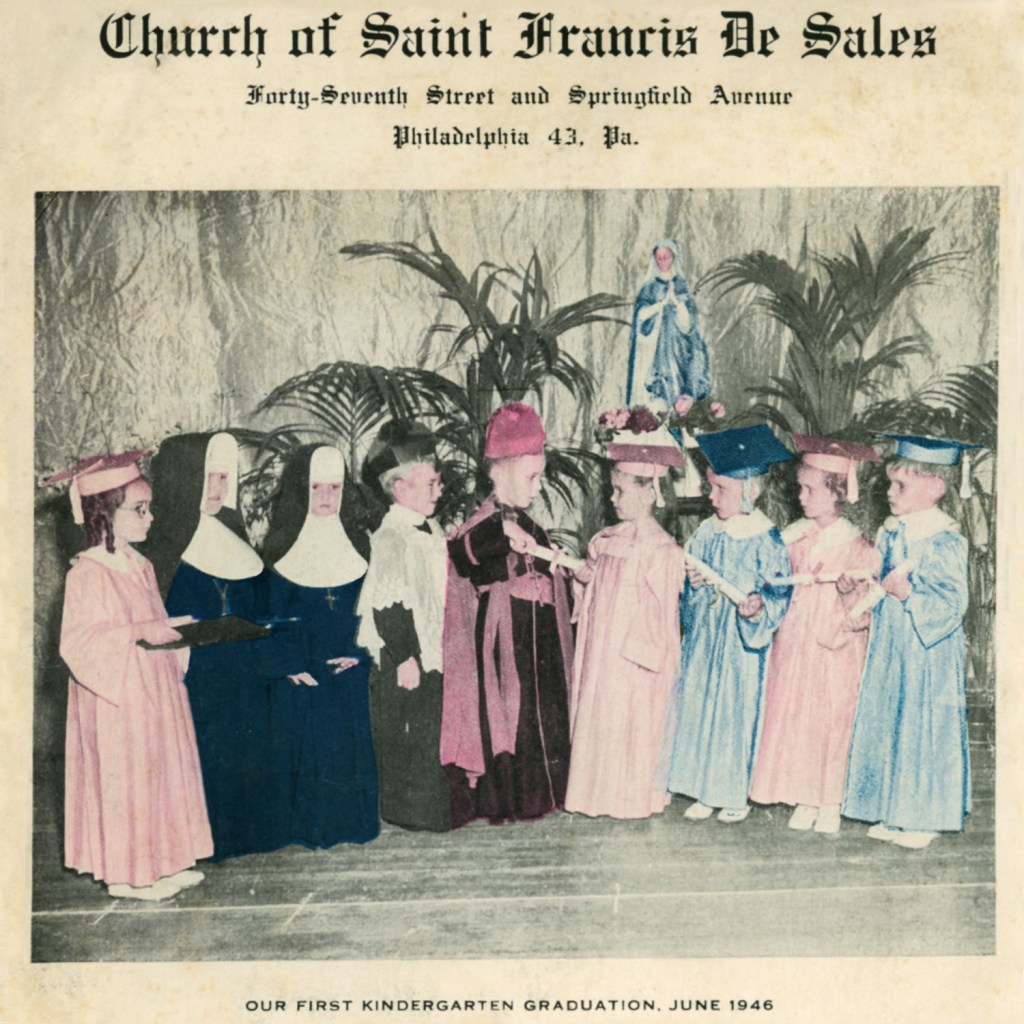
The first known photo of Little Popes at SFDS, shown at the top of the page, is actually dated a year earlier, in 1946. A calendar photo of SFDS Parish school’s first kindergarten graduation ceremony, that same year, shows its tiny pupils costumed, aspirationally, in religious garb. Coincidence? An inspiration of the IHM sisters? Or merely reflective of a pious trend at the time?
Whatever the initial impetus, Dennis Cardinal Dougherty, Archbishop of Philadelphia from 1918 until 1921, and Philadelphia’s first cardinal from 1921 until his death in 1951, is likely to have strongly supported the concept of “Little Popes.” An article by Charles R. Morris about “God’s Bricklayer” describes the effects of the cardinal’s strong personality in shaping an archdiocese in which “the schools were Dougherty’s top priority, and he drove Catholics and Philadelphia religious to extraordinary accomplishments.” Dougherty realized that a complete, separate, catholic educational system would tie children to parishes, attach them to the liturgy, and protect them from any outside noncatholic experience. By taking charge of family education, he also influenced parents throughout the vast network of churches that became a powerful “city-state within a city” under his command. A charismatic leader with a mystical tendency, the article highlights “Dougherty’s attention to ceremonial stagecraft, which in Philadelphia achieved a level of polish and consistency exceeded nowhere else. The elaborate liturgy was an expression, a validation, of who he was as a Catholic, a priest, and a cardinal, the emissary of a two-thousand-year-old tradition, stemming directly from Christ.” The article further notes that “among all of the American prelates, in an age when the American church’s loyalty to Rome was at a high pitch, Dougherty was ‘Romanissimus,’ the most devoted of all, to the point of servility.” The “Little Popes” seem to fit well within this vision.
The custom of Little Popes seems to have disappeared in the mid 1960s, probably due to a combination of factors. When Cardinal Dougherty met his final reward in 1951, he was replaced by Cardinal O’Hara — a non-Pennsylvanian with a very different style, who reportedly “often answered his own doorbell, which he explained by saying ‘How else can I meet the poor?’” No-nonsense Cardinal Krol, whose name meant “king” in Polish, was next, in the early 1960s, when middle-class families migrated from cities to suburbs in a national trend, and a sharp decline in Philadelphia’s urban parish populations left much smaller, poorer, city parish schools with fewer Catholic children. At the same time, the less ornate rituals after Vatican II allowed fewer servers per Mass, while a more general cultural shift favored simple “streamlined” design over baroque “fussiness” in every aspect of life. The church was challenged to respect its own diversity, and to accept a richer array of multicultural Catholic traditions.
At Saint Francis de Sales, Bishop McShea, the last of three Bishop pastors, moved to Allentown in 1961, and was replaced by Monsignor Sefton, so the parish no longer engaged in the elaborate pageantry of pontifical Masses. Then came Monsignor Mitchell, focused on the civil rights movement, and with little interest in ceremonies. The renowned boy choir ended as musical tastes changed. When Vatican II reforms mandated a forward-facing altar, toward the end of the decade, architect Robert Venturi’s sleek modern installation became a magnet for controversy. The custom of dressing as Little Popes was long gone by the time girls were able to join the boys as altar servers — which could have made things interesting.
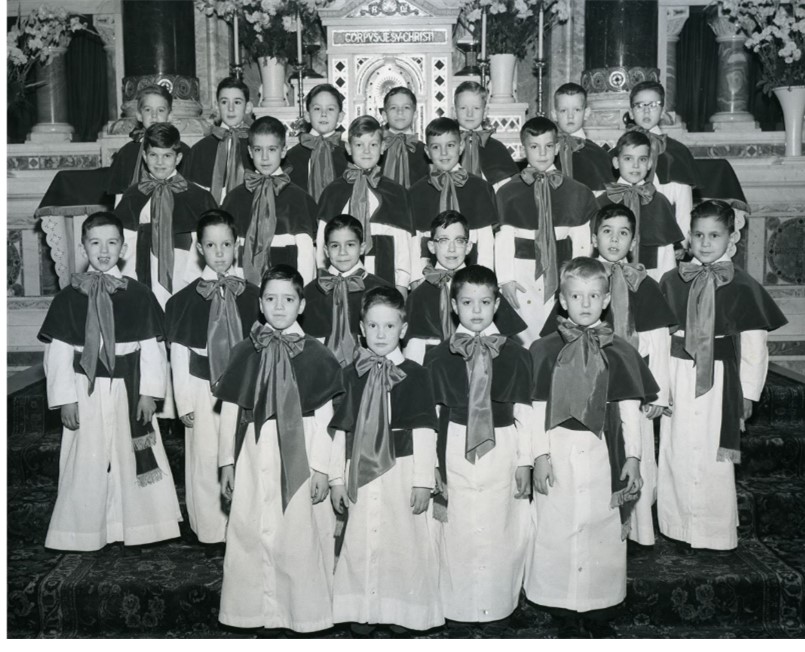
St. Francis de Sales “Popes” (Boys Choir) 1960.
Little Popes faded quietly. The caption on the 1960 group photo above, from the Bishop McShea Archives at DeSales University in Allentown, oddly conflates two activities, suggesting that information was lacking. John Deady believes the photo depicts Little Popes junior altar servers, rather than musical choir boys, because “They are all young. The choir boys would have ranged in age from probably third grade to eighth grade so they wouldn’t all have been relatively the same height. Choir boys wore cassocks and surplices. Popes were the only ones who wore white cassocks…In the picture they don’t seem to have zucchettos but they do have the sashes. Only the popes wore sashes. ”
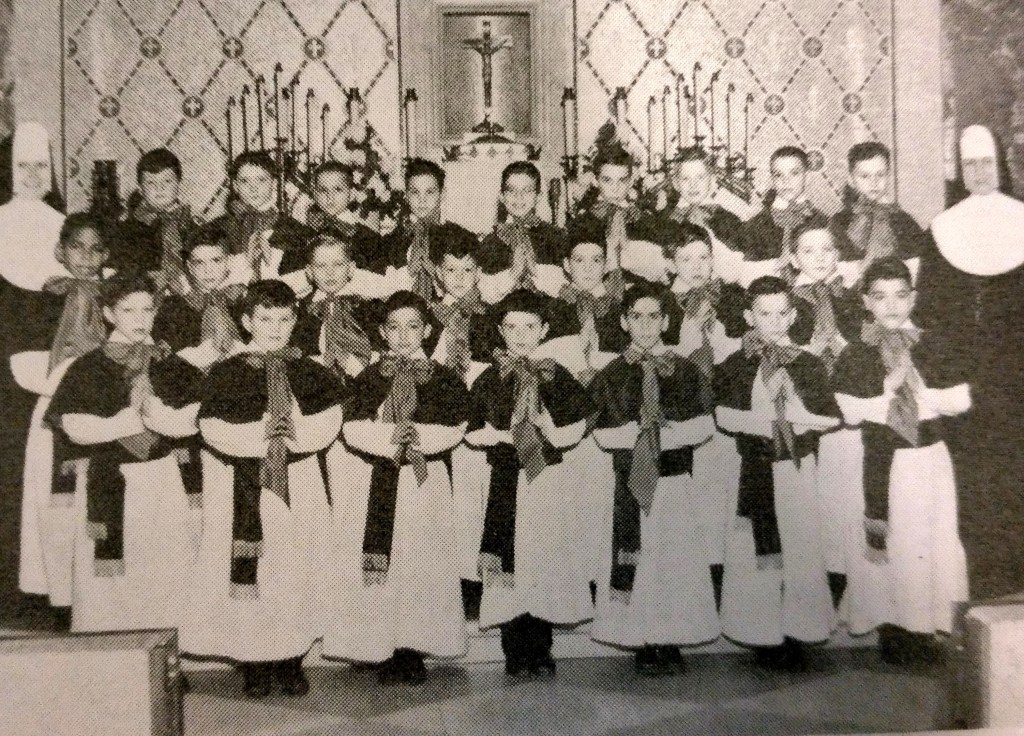
This is supported in the last-known group photo labeled Little Popes, taken in the new Lower Church for the parish 1965 Jubilee book.
The custom of Little Popes was born and disappeared in a different age. Why is it important?
Stories from the past remind us how we came to be where we are now, and offer context to help light the way forward. Today’s churchgoers navigate a changing world of baffling complexity. Pope Francis has warned against the “backwardism” of trying to re-create the conditions of times gone by, but last year, in an audience with French altar servers, Pope Francis advised young people to “search for your roots, learn to know and love your culture, your history, to enter into a dialogue in truth with those who are different from you, strong in who you are and respectful of what others are.” He added “If you carry out your service at the altar with joy, dignity, and with an attitude of prayer, you will certainly inspire in other young people the desire to commit themselves to the Church as well.”

Incidentally, the term “Little Pope” has been used in several unrelated contexts.
Kevin di Camillo, writing for the National Catholic Register, described the habit of the Norbertine religious order (Daylesford Abbey), “which according to tradition was given to St. Norbert directly in a vision from the Blessed Virgin Mary, ” and includes a Pope-like “sash, the short cape with buttons and the white tunic. Not for nothing are Norbertines (or Premonstratensians) also called ‘The Little Popes’!“
The perennial rival to Philadelphia, the city of Boston, MA, had a decidedly different kind of “little pope” custom in the 18th century, which comes up when researching the subject. The Boston version, popular before the American Revolution, was a riotous “anticatholic holiday celebrated annually on November 5.” Wikipedia notes that “At the height of its popularity, Pope Night in Boston was a three-part ritual consisting of a procession in which effigies of the Pope and other figures were paraded through the streets; a battle between the processions from the North and South Ends; and the burning of the effigies by the victors…The procession was led by young boys who carried small effigies of the pope…” (The New England festival was a re-concepting of Guy Fawkes Night, back in England — an annual commemoration of the capture and execution of several resolute English Catholics, who, in 1605 plotted to blow up the British Houses of Parliament, kill the Protestant King James, and restore the Catholic monarchy to the throne — an historic reminder that religion and politics are a provocative mix).

