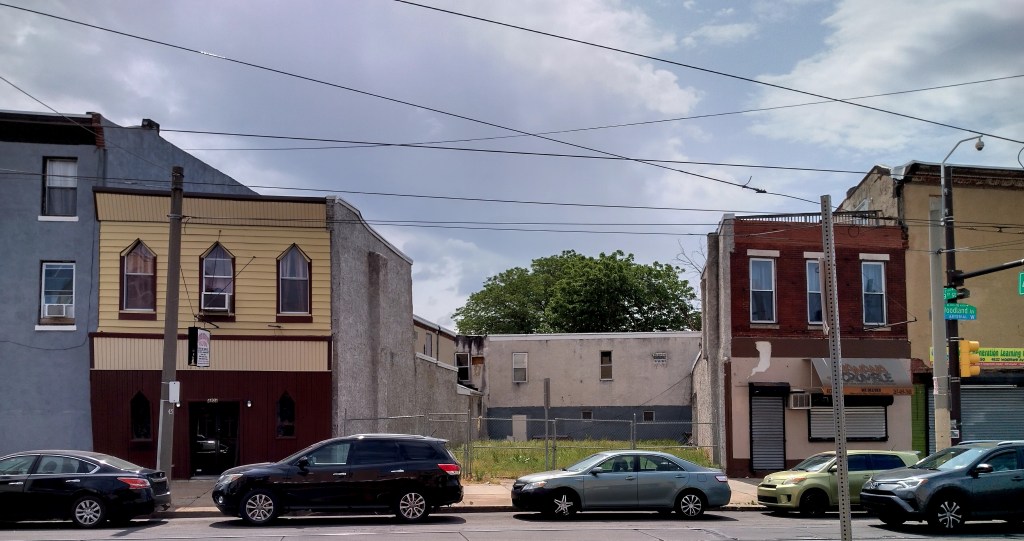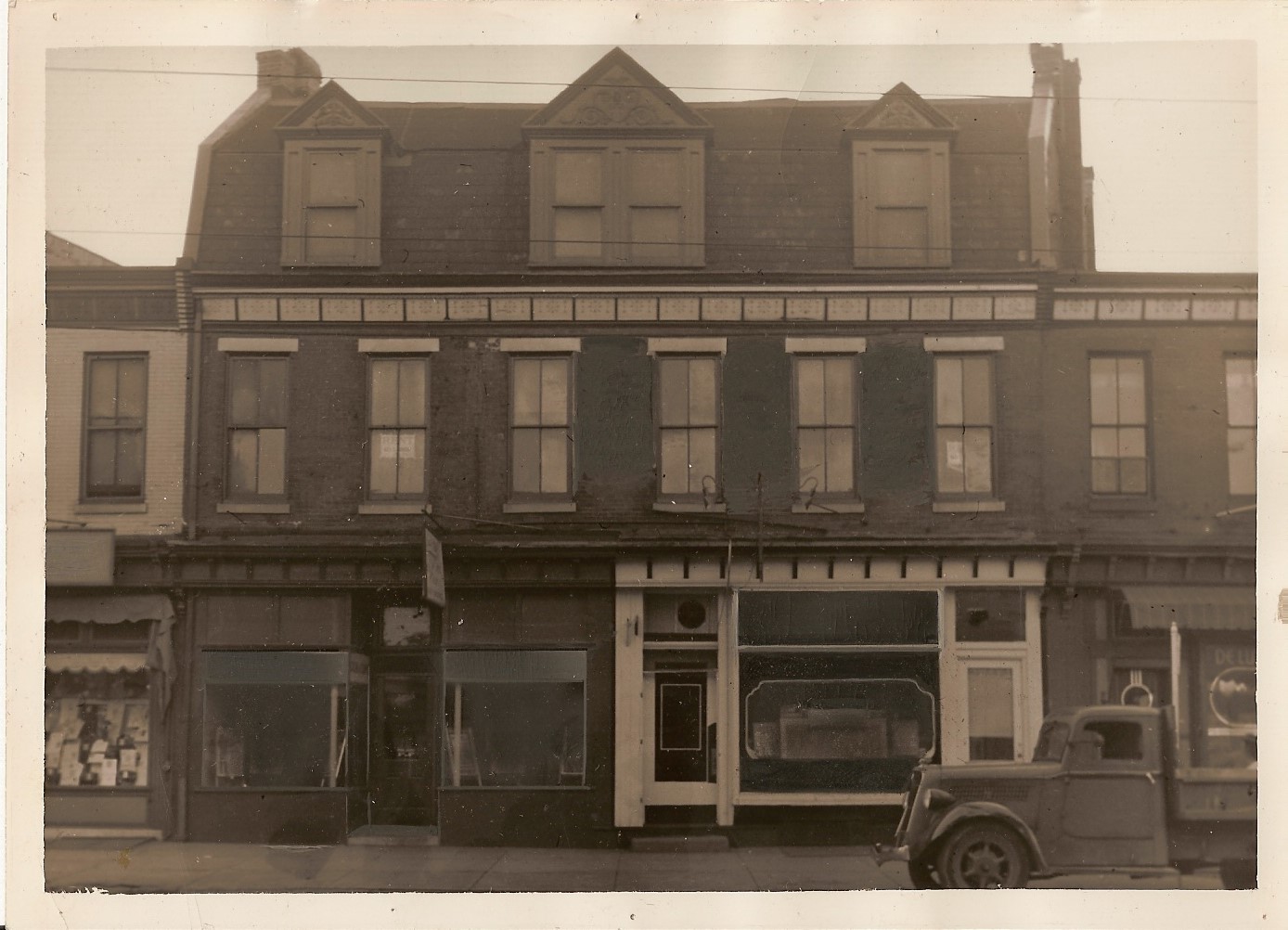
An archival photo of a building adorned with a prominent ad for “The Smile Smith” highlights a parish puzzle, fills in a gap between properties in the modern landscape, and provides a window into neighbourhood life in days gone by.
Various SFDS parish accounts through the years have affirmed that the first SFDS Masses were said in a hall, rented in January 1890, on the second floor of a building “on the corner of 49th Street and Woodland Avenue,” but the precise street address was never recorded. A photo in the 1940 Parish Jubilee book shows the purported spot, but the picture, probably taken in the late 1930s when many parishioners would still have remembered the location, was significantly retouched to remove distracting “modern” advertising on the front of the building – and some incidental details that may have seemed less important at the time!
Fortunately, the unretouched version of the photo, also in the parish archives, reveals the street number as 4826-4828 Woodland Avenue. If this was, indeed, the correct place, then it would actually have been a few doors down from the end of the block – though it is possible that the second-floor hall, where our parish met, could have run through several adjoining properties.
Our 1989 Parish Anniversary Book offers an additional detail: Ruth Wood Buley, of Drexel Hill, PA, recalled that “My maternal grandmother, Mary Ann Broders, and her husband James A. Denney, were the first couple married in the parish on April 15, 1891. The ceremony was held in the building at 49th Street and Woodland Avenue in a hall over Bell’s Drug Store.” This is a little perplexing because the 49th Street corner drug store was run by Dr. Dahl, and Bell’s Grocery was at 4826-4828. It also appears that both of those businesses may have arrived after our parish left the premises!
We have no information about life on that block in 1890 or 1891 when our parish met there..
The 49th Street corner drug store made the news a few times in the early 1900s. In December 1900, after a Washington express train collided with a freight train at Gray’s Ferry Station, “about a score” of slightly-injured victims were brought to Dr. Dahl’s drug store for treatment. Skipping ahead to 1906, “Frederick Becht, a drug clerk employed at Forty-ninth street and Woodland avenue, was committed to prison…pending trial” after “Mrs. Emma Smith, 18 years old, a bride of four months” took tablets purchased from Becht and “died at her home, 1247 South Forty-ninth street.” Then, in 1908, a five-year old girl named Ethel Thomas used a stove poker to try to dislodge a doll from a high shelf in her family kitchen, and knocked over a box of matches, which landed on the stove and ignited. The mother rushed her badly-burned child to the 49th Street drug store, where she was picked up by an ambulance and taken to the University Hospital in critical condition.
Exactly how the other properties on the block were configured is still a little unclear. A permit was granted in 1895 to build a one-story addition to the rear of 4826-4828, to be used as a photograph gallery, but we don’t know if it was actually built at the time. A photographer did have a studio somewhere on the premises from 1895 to 901, when he first advertised for an investor, and then sold his equipment.
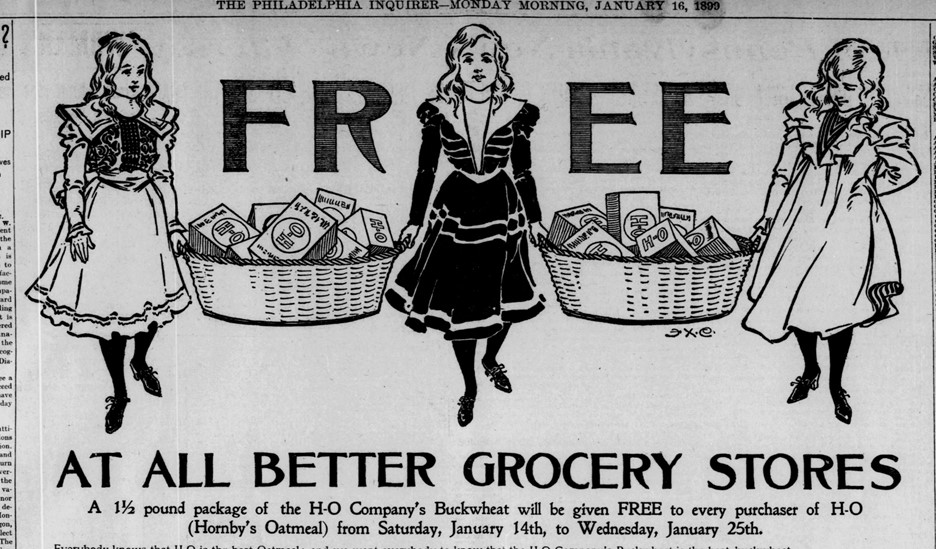
Meanwhile, grocery store proprietor Frederick Bell at 4828 was a busy man. From about 1899 through 1921, The Inquirer published regular help-wanted ads for meat cutters, and later, bakers at his establishment. In 1906, he looked for a “young man…to drive wagon for grocery store;” a few years later, he wanted a young man to drive a Ford truck. At some point, he appears to have annexed 4826. By 1913, Bell had expanded to run additional grocery stores at 5012 Baltimore Ave.; 43rd and Baltimore Ave.; 50th and Locust; and 52nd and Spruce. He was also a proud member of the Retail Grocery Association’s Triangle Stores – according to their ads “each of the 700 stores which make up this wonderful merchandising organization is owned and managed independently by the individual grocer in each particular store, yet these stores combine as one unit in purchasing their supplies.” This ensured that they could sell “pure wholesome groceries of known quality at prices which are as low as it is possible to get.”
Bell may have enjoyed the protection of an umbrella retail organization, after a bad experience back in 1900, when the Inquirer headlined “Eighteen Dealers Accused of Adulterating Food. State Officials and District Attorney Combine to Enforce the Provisions of the Pure Food Law.” At that time, the Dairy and Food Commissioner of the Commonwealth was especially eager to stop sales of “oleomargarine” butter substitute — a “product or compound made wholly or partly out of fat, oil, or oleaginous substance…not produced from unadulterated milk or cream” — and enacted a series of strict bureaucratic regulations to protect the state’s dairy industry.
Two agents of the State Food and Dairy Commission ran a sting operation in April of that year, looking for oleomargarine and other adulterated or illegal grocery products sold across the city. Bell’s Grocery at 4826 Woodland became one of their targets: they “testified that they had purchased from Mr. Bell a half pound of cheese that had not been marked in accordance with the act of Assembly on the subject. It was cut from a small English dairy cheese, which Mr. Bell said had been specially ordered for some of his customers. All the other cheeses in the place, the agents admitted, were marked properly.” The agents took the cheese to a lab for analysis. The chemist then testified that the cheese was “fully ten percent better than the average cream cheese.” Bell’s lawyer pointed out that Bell had “secured a superior article” to sell and his failure to label it was a simple oversight. The magistrate agreed, but felt that if “some example was not made in the matter other dealers might be afflicted with the same carelessness” — imposing a fine of $50, which seems a large sum for a “technical violation of the act” when there was no food adulteration. (Bell appealed the judgement, but we don’t know the outcome).
Bell’s Grocery disappeared from the newspapers in 1921. From 1920 to 1925, Liberty Restaurant, at 4826 Woodland, placed ads for waitresses, cooks, and dishwashers, then nothing more was printed related to 4826 or 4828 until 1944, when ads appeared for an “experienced sea food cook, man or woman. Good wages. Good hours. No Sundays” at 4828. That was probably “Berts Sea Food,” the restaurant shown in the 1940 Jubilee parish photograph. The business did not long endure: 4828 was available to rent in 1946. Meanwhile, next door at 4826, Inquirer ads in 1952 announced the closing of Banner Cleaners and Dyers — the other business shown in the un-retouched parish photo — after fifteen years (so it must have arrived around 1937, close to when the parish photo was taken).
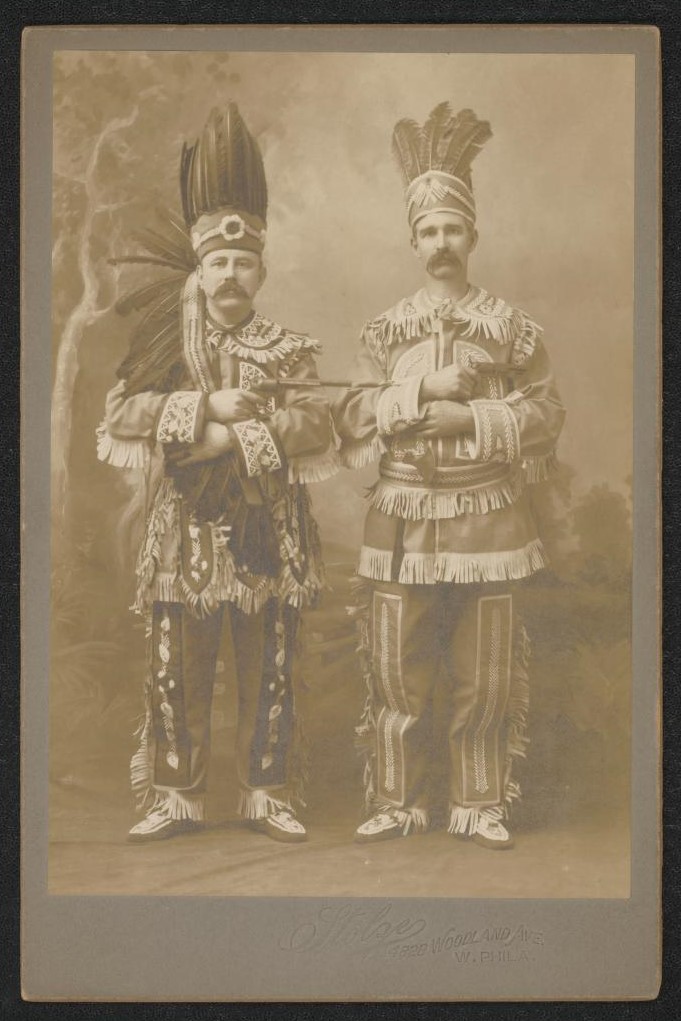
And what became of our once-upon-a-time parish hall? Newspaper information shows a variety of secret societies meeting on the second floor of 4828 in the early 1890s after our parish left: the Sons of American Hall of the Twenty-Seventh Ward; the Knights of the Golden Eagle; the Junior Order of American Mechanics; and United Americans Valley Forge Temple 37. Then, in 1901, photographer Hans Stolze, “The Smile Smith,” appears to have taken the space for his studio (children’s photographs a specialty) – remaining until at least 1930. Sometime before 1930 he moved his home address from 1321 Divinity Place to the suburbs and may eventually have moved his business – but his ad, though weathered, still appeared on the building for the parish photo.


Little subsequent information is available about the properties from the Inquirer, which covered the area less as the neighbourhood changed. From 1963 to 1973, number 4828 was listed only as a polling place and 4826 was not mentioned at all. A check cashing business is currently recorded at the location. At some point, the two front buildings quietly disappeared from the street, and our circa 1939 parish photograph – once buried in the archives — may be their only memory!