Month: September 2020

Secret Garden Door

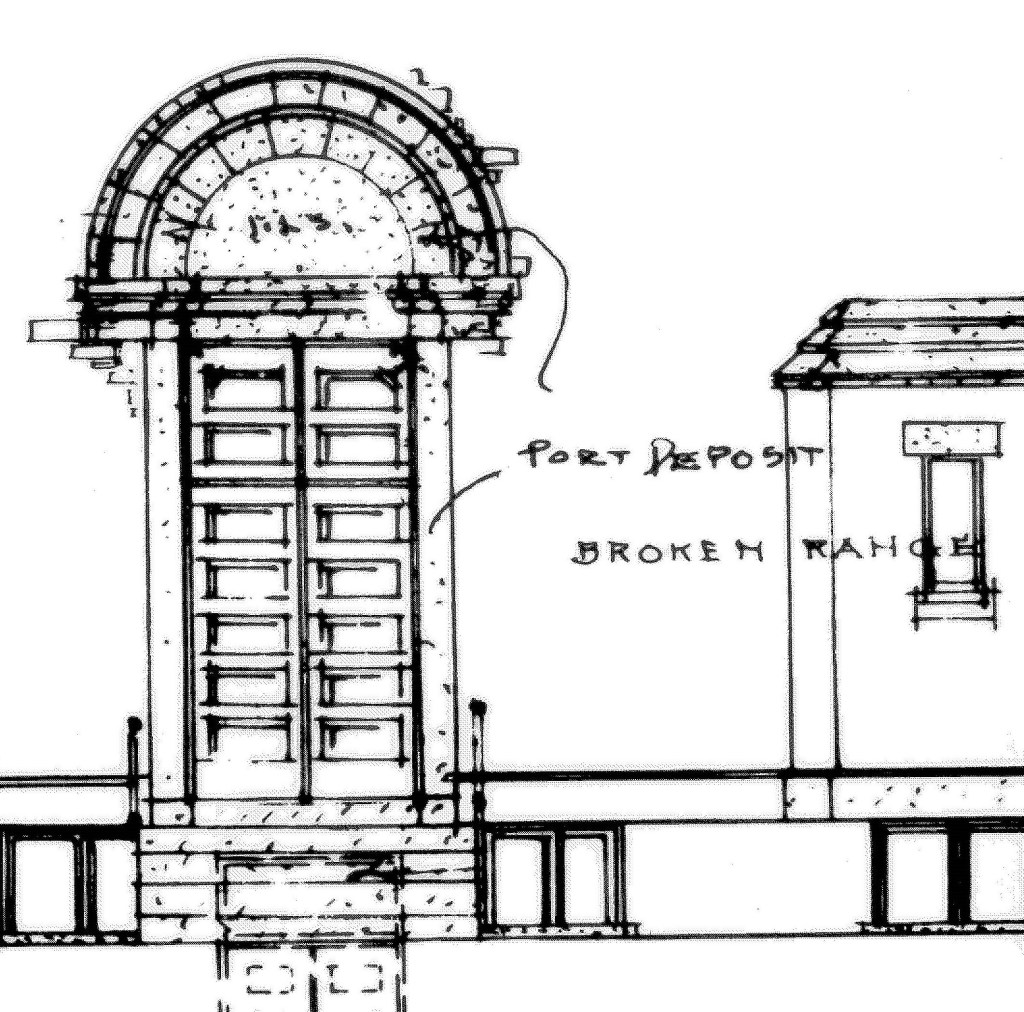
Door on East side of church as shown in architectural drawings

Have you ever noticed that there is no sculpture in the arch (tympanum) above the parking lot door outside Saint Francis de Sales Church? It looks a little bare, but that seems to have been intentional.

Henry Dagit’s original architectural plan for the church shows sculptures in the arches above the three front doors on Springfield Ave., and above the 47th Street door, but the Eastern Elevation drawing, showing the Rectory Side of the church, has an empty half-moon above the door, with no ornamentation planned for that side of the building.

                Why would that be?
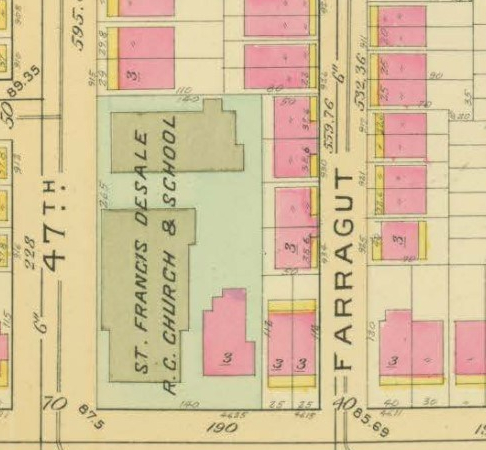
SFDS shown on 1909 map

When our church was finished in 1911, that part of the building wasn’t a priority, since it wasn’t visible from the street! The eastern entrance to the church was tucked away in a “secret garden” courtyard, formed with the back of the  rectory on one side; the wall of the new church on another; the side of the school (with the alley space between the church and school, probably used for deliveries from 47th street) filling the third side; and the back fences of a row of houses along Farragut Terrace completing the enclosure. We have no record of whether the small, closed yard space was planted or paved, or how it was used. It was probably a laundry and utility area for the rectory, and/or a school playground; there was, as yet, no need for parking, since people didn’t have cars.

Needs and conditions changed over time and that side of the property became exposed in 1926, when the parish bought and demolished the two corner houses on Springfield Ave. (numbers 4615 and 4617) to create the corner rectory garden; and numbers 936 to 932 on Farragut Terrace to build the addition to the school. The church parking lot on Farragut Terrace was part of that development. The ramp to the church door was added in the late 1990s.
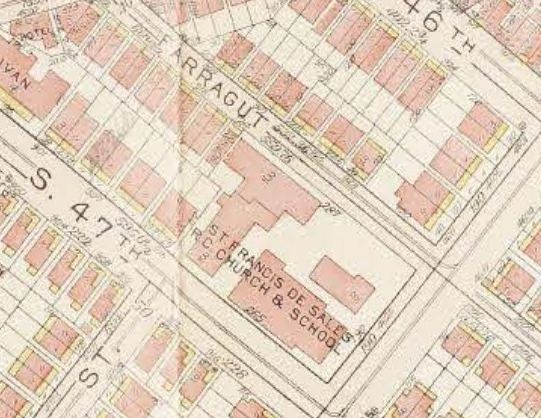
SFDS shown on 1927 map

Who owned the houses that were removed back in 1926? One familiar name is that of Roger A. McShea at 928 South Farragut Terrace – he was the father of future Bishop Joseph Mark McShea, who would grow up to become our Fifth pastor from 1952-1961. Number 932, incidentally, was owned by a gentleman named John Sanderson Trump – a terribly familiar last name, but, as far as we know, unrelated.

As to the “portal sculpture” — if a design had ever been proposed for that empty half-moon space above the eastern door, what could it have been? The scenes above the doors on the front of the church show the Annunciation, the Crowning of Mary, and the Pieta. The 47th street side of the church shows another Mary-related scene, the Nativity. The Assumption might have completed her story – and that would have been very suitable, since Bishop Crane, who built the church, had a special devotion to Mary and to the Rosary. He could even have placed a Mary garden in the courtyard — invoking the medieval idea of the hortus conclusis or enclosed garden representing Mary’s virginity and purity – looking much like today’s Rectory garden with the MBS statues.

Instead, it was left to imaginations (and perhaps to future parishioners) to complete the decorations on that side of the building. We are reminded yet again, that we, like our magnificent church, are all “unfinished business” – ever adapting to new circumstances, never complete on this earth, and never, ever perfect.

SFDS front doors as shown in architectural drawings

Father Flatley Enlists

1943 photo fr. flatley in uniformRev. William Flatley assisted at SFDS from May 1940 until he enlisted in June 1943. The Parish Monthly Bulletin reported: “While here, Father did grand work among the High School students, Ushers and the men of the Holy Name Society, also in various other projects which were assigned to him. We are certain that Father will make a good Chaplain and will be an asset to the Chaplains Corps of the United States Army” in World War II.
The Bulletin reported his progress: “At present Father Flatley is in the training school for Chaplains at Harvard University. He will remain there for a period of four weeks after which he will be assigned to some Army Camp…” A 1945 De Sales Night Program later added “On October 19, 1943, Captain Flatley embarked for England. In July, 1944, he reached France, Belgium, and probably elsewhere. His assignments included an Evacuation Hospital, an Anti-Aircraft Group, and a Tank Destroyer Outfit. We hear from Father Flatley regularly. In his travels abroad he has met many of our boys, among them PFS John C. Mundy, who is with the First Army. Christmas afforded him a most pleasant experience. After saying Mass, he came upon another boy of the Parish, Sgt. Francis C. Boyle.”

In March 1945, the St. Louis Register reported on one of his assignments: “The Stars and Stripes fly over the celebrated Abbey of Maria-Laach…” (German Rhineland) where “The 800-year-old abbey, a masterpiece of Romanesque, is intact. Abbot Ildefons Herwegen and the entire community were found well. The magnificent liturgical services continue, although the community is considerably reduced. Seven priests, three clerics, four postulants, and fourteen brothers drafted by the Nazis, are still in the army….The abbey buildings were used as a Nazi hospital. The U.S. Catholic Army Chaplain now stationed in Maria-Laach is the Rev. William H. Flatley, Philadelphia, who has Mass every afternoon in the famous abbey church. “

It could have been an awkward posting and Flatley did well to focus on the abbey’s ancient heritage. In the early 1930s, the Maria-Laach Abbey reportedly became a center for “right-wing Catholics…The monks, politicians, businessmen, theologians and students who gathered there were strongly influenced by the idea of a coming ‘Reich’, hoping to build a third Holy Roman Empire…” and in 1933, Herwegen had proclaimed “Let us say a wholehearted yes to the new structure of the total state, which is thought to be entirely analogous to the structure of the church.” Nazism later proved hostile to Catholicism and the monks became “a regular target of state attacks. It was only the Nazi persecution of the churches… that forced Herwegen to see the regime in a new light…” Getting things back in order, Flatley may at times have had to channel our patron St. Francis de Sales, who advised “When you encounter difficulties and contradictions, do not try to break them, but bend them with gentleness and time.”

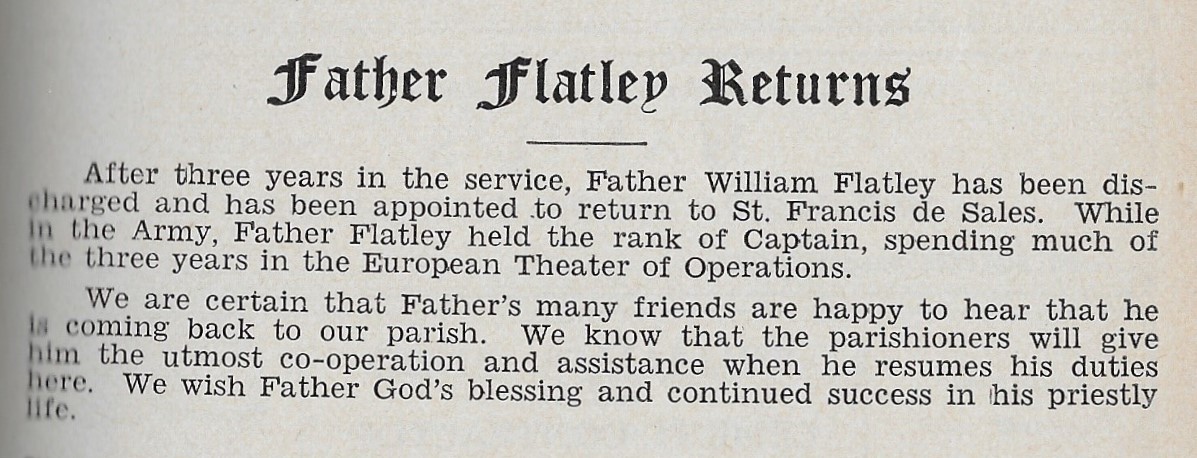
Father Flatley came home in 1946: the Parish Monthly Bulletin reports that “After three years in the service, Father William Flatley has been discharged and has been appointed to return to St. Francis de Sales…” He stayed here until 1955.  Fran Byers says: “I remember Father Flatley well and liked him (and all the other priests) very much.  To me, he was kind of a nice tough guy.  He could enforce discipline effectively.   For example, if two boys acted up at one of our Friday night dances, Father Flatley would come over to the auditorium, usher the offenders out the side door to the school yard and do whatever was needed to convince them to behave properly. I didn’t witness what his methods were.” Author Constance O’Hara wrote that he had “the gentleness of all strong people” with his “patience, kindness, and…the compassion of his Christ.” She credited him with a crucial role in her return to Catholicism, gently, persistently, urging her to focus outward and offer up her personal sufferings for faraway soldiers in Korea.

Monsignor William Flatley eventually became Pastor and then Pastor Emeritus of Immaculate Conception Parish, Jenkintown. He died May 23, 1992, one day after the 55th Anniversary of his ordination.


flatley returns bulletin

flatley and chaplains

flately and chaplains captions