
For almost 20 years we have worked with the public and experts to create guides and resources on topics that are misrepresented or misunderstood in public discussions.

How MEPs Use Evidence
Despite what you might hear about the public losing interest in facts and truth, people across Europe care deeply that their elected representatives examine evidence when making decisions that shape their lives. From the Covid-19 pandemic to the energy crisis, citizens want their MEPs to engage seriously with the best available research — and to... More

Research integrity: A toolkit for early career researchers
Research integrity refers to all the factors that underpin good research practice and promote trust and confidence in the research process. It is foundational for building public trust in science. A lack of integrity undermines scientific credibility, risks spreading misinformation and potentially harming those who depend on reliable research findings. Research integrity applies to: All disciplines and all sectors... More

Making sense of health claims
How to weigh up claims made for experimental medical treatments and alternative therapies. While there is no easy way to know what to believe, there are questions you can ask to make sense of some of the claims these treatments make. We have worked on this guide with patients, carers, doctors, nurses and medical charities... More

Making sense of uncertainty
Scientific uncertainty is prominent in research and has big implications for our society. Could the Arctic be ice-free in summer by 2080? Will a new cancer drug be worth its side effects? Is this strain of ‘flu’ going to be a dangerous epidemic?

Questions you should ask when presented with the use of simulation models in policymaking
Background Evidence matters to people, and it’s important that the reasoning behind policy decisions is questioned. There is growing use of simulation models in policymaking, for example, policies to mitigate climate change, tackle the Covid-19 pandemic and develop energy planning following the Russian Invasion of Ukraine all draw extensive on predictive models. This makes it... More

Using Artificial Intelligence to Support Healthcare Decisions: A Guide for Society
AI technology is increasingly being used in the healthcare sector and has demonstrated its accuracy and efficiency in diagnosing and predicting diseases. Despite its huge impact on our daily lives in every sector of society, AI technology has some drawbacks and comes with risks, especially due to potentially biased algorithms. “The guide is written to... More

Data Science: A guide for society
According to the headlines, we’re in the middle of a ‘data revolution’ — allowing us to make predictions on anything from football results to who is likely to commit a crime. Data science is clearly a powerful tool. If used properly, people will be able to make better decisions far more efficiently.
Peer Review: the nuts and bolts
This is a guide to peer review for early career researchers written by members of the VoYS network. Using a collection of concerns raised by their peers, the VoYS writing team set off to interview scientists, journal editors, grant bodies’ representatives, patient group workers and journalists in the UK and around the world... More

Making Sense of Covid-19 Testing
In recent months there has been much discussion and confusion around what Covid-19 testing is, how it works, and what testing can and can't tell us. This short guide sets out what the tests are used for, how the tests work, the limitations and the differences between RT-PCR test and rapid tests. Please... More

How-to: Getting your research into the European Parliament
Research plays an important role in the European Parliament. Whether it's by helping Members of the European Parliament (MEPs) scrutinize proposals from the European Commission, or by helping these policy makers understand complex societal issues, research has a role to play. At the same time, getting research into parliament is important for individual researchers particularly when... More
Evidence Matters Ireland
On 14th November 2018 we launched Evidence Matters Ireland, supported by Science Foundation Ireland. Citizens from across the country went to the Oireachtas to tell policymakers why evidence matters to them. People and community groups went to Leinster House to tell TDs, Irish Members of Parliament, why evidence matters to the public and why they... More

Public engagement: a practical guide
This is a practical guide for researchers on involving the public in working out how to communicate findings - from the earliest stages of projects, and on the most challenging of subjects.
Making Sense of Nuclear
The International Energy Agency projects that between 2014 and 2040 world energy demand will have increased by 37%. In recent years some prominent advocates for the environment have become advocates for nuclear power. Film directors, parliamentarians, journalists and environmental campaigners: people who once were opposed to nuclear power... More

Making Sense of Testing
A test result is not taken as a number in isolation. It gets compared to a range of values considered ‘normal’ for a healthy individual. This is called the reference range, and it’s what a doctor can use to interpret a set of results for individual patients. We... More
I don’t know what to believe
There are around 28,000 scholarly and scientific journals that use the peer review system. A high proportion of these are scientific, technical or medical journals, publishing over 1 million research papers each year. Every day we are bombarded with information about science from newspapers, radio and television programmes... More

Making Sense of Crime
The use of violent video games isn’t linked with a rise in violent crime (in the USA). If anything there is a strong correlation the other way. There’s always heated debate about crime in the media and a lot of political argument about how we should respond to... More

I’ve got nothing to lose by trying it
This guide was made in 2013 and has since been updated. See our new guide. It may feel reassuring to spend a lot on a treatment – ‘if it’s expensive, it must be good’. However, some of the most effective and commonly used drugs have been used... More
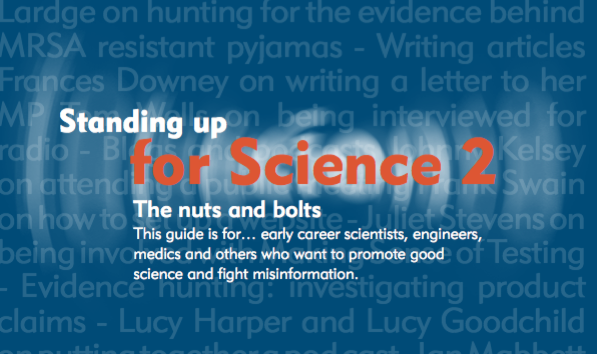
Standing up for Science 2
A follow up to our popular Standing up for Science guide to the media, this guide offers more tips for early career researchers on standing up for science in public life including: writing to your MP and attending public meetings; engaging with local media; writing blogs and podcasts; and investigating product claims. This guide was... More

Standing up for Science
This guide was written by VoYS members for VoYS members. It's a lively and informal guide to how the media works, and practical tips about what you can do if your research area hits the news. Whether you’re worried about what your peers think of you speaking to the media or would not... More

Making Sense of Allergies
There isn’t one test to diagnose all allergies. Accurate diagnosis requires both a test and a medical consultation. This guide was produced in collaboration with the British Society for Immunology, Cochrane UK, Allergy Academy, Allergy UK, Asthma UK, Anaphylaxis Campaign and the British Society for Allergy & Clinical Immunology. [gallery... More
